
Calibration Management Software in France
Calibration Management Software in France
David Bentley
Quality Assurance Engineer
6 min read
Calibration Management Software in France
France's sophisticated manufacturing economy demands precision measurement and quality control across diverse industrial sectors. From Airbus facilities in Toulouse to pharmaceutical plants in Lyon, French companies require robust calibration management software France solutions that meet stringent European regulations while supporting advanced manufacturing processes. Modern calibration management systems must navigate complex requirements including ISO standards, FDA regulations for medical devices, and aerospace certifications that define France's industrial excellence.
The French industrial landscape encompasses everything from luxury automotive manufacturing to cutting-edge aerospace engineering, each requiring meticulous calibration protocols. With over 270,000 manufacturing companies employing more than 3 million workers, France's industrial sector relies heavily on precision measurement equipment that must be properly calibrated and documented to maintain competitive advantage in global markets.
France's Precision Manufacturing Landscape
France ranks as Europe's second-largest manufacturing economy, with industrial production contributing approximately 19% of the nation's GDP. The country's manufacturing prowess spans from traditional sectors like automotive and chemicals to emerging technologies including renewable energy and biotechnology. This diversity creates unique challenges for calibration management, as companies must handle everything from basic mechanical gauges to sophisticated analytical instruments.
The French manufacturing sector is characterized by a strong emphasis on quality and precision, inherited from centuries of craftsmanship tradition. Modern French manufacturers combine this heritage with advanced technology, creating environments where calibration management software France solutions must support both traditional measurement practices and cutting-edge digital manufacturing processes.
Regional manufacturing clusters across France each present distinct calibration requirements. The aerospace corridor around Toulouse demands compliance with AS9100 and NADCAP standards, while pharmaceutical facilities in the Paris region must meet stringent FDA and EMA requirements. Chemical plants along the Rhine require specialized calibration protocols for hazardous environments, and automotive facilities throughout the country need systems supporting IATF 16949 compliance.
Key Industries Requiring Advanced Calibration Management in France
Aerospace and Defense
France's aerospace industry, anchored by Airbus, Safran, and Thales, represents one of the world's most demanding calibration environments. Aerospace manufacturers require calibration of precision measurement equipment including coordinate measuring machines (CMMs) with tolerances to ±0.0001 inches, torque wrenches calibrated to ±2% accuracy, and environmental chambers maintaining temperature stability within ±0.1°C.
Defense contractors must maintain calibration records for decades to support long-term military contracts. A typical aerospace facility might manage calibration schedules for over 2,000 instruments, from basic micrometers to sophisticated non-destructive testing equipment, all requiring traceability to international standards and compliance with AS9100 requirements.
Automotive Manufacturing
France's automotive sector, including manufacturers like Renault, PSA Group (now Stellantis), and numerous suppliers, relies heavily on statistical process control and precision measurement. Automotive calibration management must handle high-volume production environments where pneumatic gauges check critical dimensions on engine components with tolerances of ±0.05mm, and coordinate measuring machines verify complex geometries on transmission housings.
The transition to electric vehicles has introduced new calibration challenges, including high-voltage testing equipment, battery testing systems, and electromagnetic compatibility (EMC) chambers. Modern automotive calibration management software must track calibration intervals for equipment ranging from simple go/no-go gauges to million-euro CMM systems.
Pharmaceutical and Biotechnology
France's pharmaceutical industry, including global players like Sanofi and numerous biotechnology companies, operates under some of the most stringent calibration requirements globally. Pharmaceutical calibration management must ensure that analytical balances maintain accuracy to ±0.1mg, HPLC systems deliver repeatable results within ±2% RSD, and environmental monitoring systems maintain temperature stability within ±0.5°C.
The complexity increases with specialized equipment like particle counters, dissolution testing apparatus, and bioanalytical instruments. Each piece of equipment requires documented calibration procedures, certified reference standards, and comprehensive audit trails supporting FDA inspections and European Medicines Agency (EMA) compliance.
Energy and Utilities
France's energy sector, dominated by nuclear power generation and growing renewable energy infrastructure, presents unique calibration challenges. Nuclear facilities require calibration of radiation monitoring equipment, temperature sensors operating in extreme environments, and pressure transmitters in safety-critical applications. Calibration intervals are strictly regulated, with some instruments requiring monthly verification.
The renewable energy sector introduces different requirements, including calibration of wind measurement equipment for turbine farms and solar irradiance meters for photovoltaic installations. These instruments often operate in remote locations, making calibration scheduling and documentation particularly challenging.
Quality Standards and Regulatory Requirements in France
French manufacturers must navigate a complex landscape of quality standards and regulatory requirements that directly impact calibration management practices. The European Union's regulatory framework, combined with France's national standards through AFNOR (Association française de normalisation), creates comprehensive requirements for calibration and measurement traceability.
ISO 9001 quality management system requirements form the foundation for most French manufacturers, mandating that measuring and monitoring equipment be calibrated at specified intervals. ISO 17025 standards govern calibration laboratories, whether internal or external, requiring detailed uncertainty calculations and measurement traceability. Companies serving regulated industries must also comply with sector-specific standards like ISO 13485 for medical devices or AS9100 for aerospace applications.
The French regulatory environment emphasizes documentation and traceability, particularly for companies serving global markets. Calibration management systems must support multi-language documentation, maintain records in compliance with European data protection regulations (GDPR), and provide audit trails suitable for international quality audits.
Regional Calibration Challenges and Solutions
France's diverse climate zones and industrial regions present unique challenges for calibration management software France implementation. Mediterranean coastal facilities deal with high humidity and salt air that can affect sensitive measurement equipment, requiring more frequent calibration cycles for certain instruments. Alpine regions experience significant temperature variations that impact dimensional measuring equipment, necessitating environmental compensation in calibration procedures.
The country's industrial heritage means many facilities operate both legacy equipment and modern digital instruments. Calibration management systems must accommodate this diversity, supporting everything from analog dial indicators with manual documentation to fully automated calibration systems with digital data capture.
Language requirements present another consideration, as calibration procedures and documentation must often be available in French for local technicians while maintaining English versions for international audits. Modern calibration management software must support multi-language interfaces and documentation to meet these needs effectively.
Ready to modernize your calibration management processes? Start your free trial of Gaugify today and experience how cloud-based calibration management can transform your quality operations.
How Gaugify Supports French Manufacturing Excellence
Modern French manufacturers need calibration management software France solutions that match their sophisticated operational requirements while providing the flexibility to adapt to changing market demands. Gaugify's cloud-based calibration management platform addresses these needs by eliminating the complexity and limitations of traditional calibration tracking systems.
The cloud-based architecture means French companies can access their calibration data from any location, whether managing instruments at a main facility in Paris or coordinating calibration activities across multiple sites throughout the country. This flexibility proves particularly valuable for companies with distributed operations or those supporting field service operations across France and international markets.
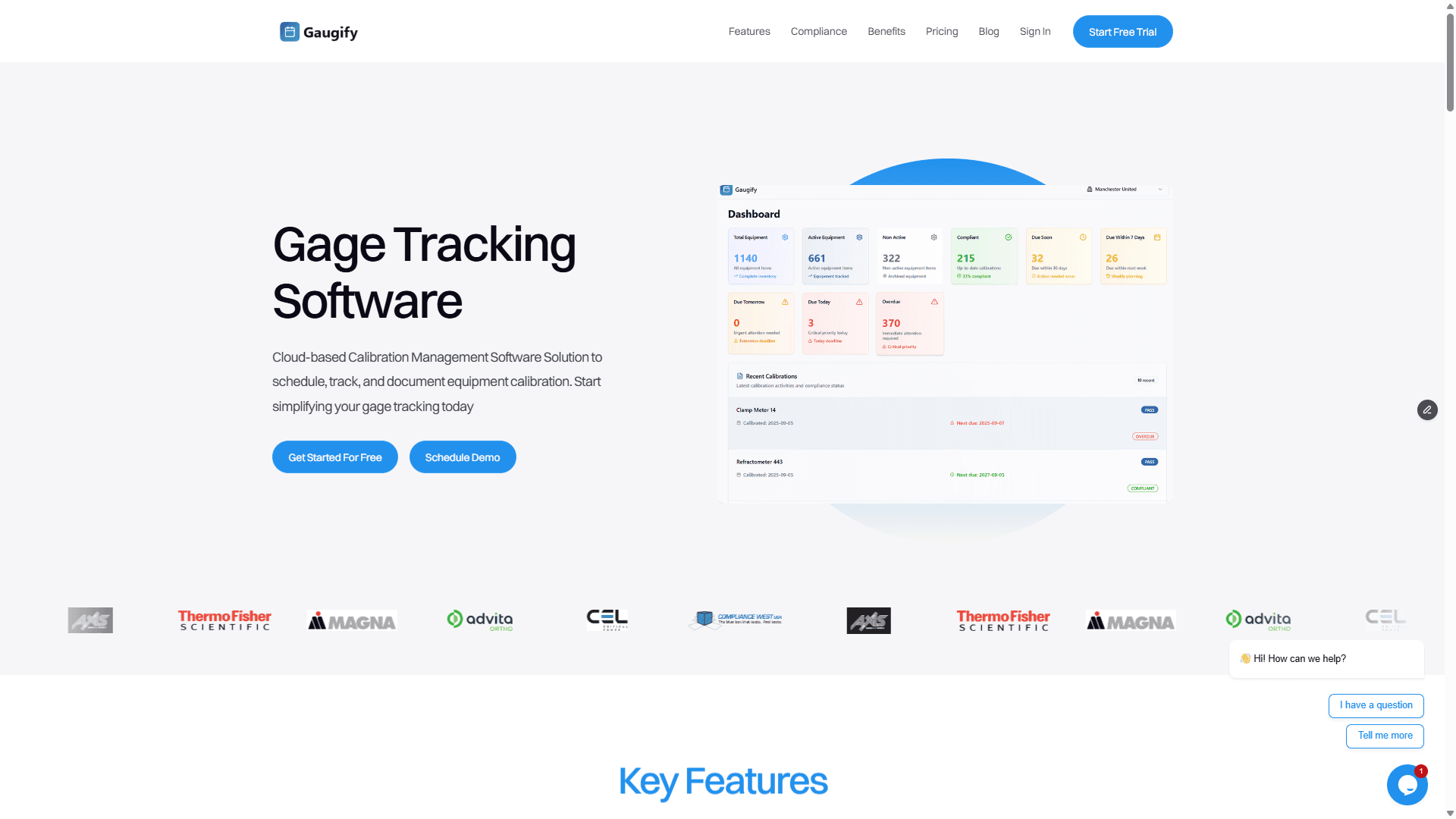
Gaugify's comprehensive feature set supports the diverse calibration requirements found in French manufacturing. The system handles complex calibration scheduling for facilities managing thousands of instruments, provides automated notifications to prevent calibration lapses, and maintains detailed audit trails supporting ISO compliance and customer audits.
For companies serving regulated industries, Gaugify's compliance capabilities ensure that calibration records meet the stringent documentation requirements of pharmaceutical, aerospace, and medical device manufacturers. The system supports electronic signatures, provides comprehensive change control, and maintains the data integrity required for FDA, EMA, and other regulatory inspections.
The platform's ISO 17025 compliance features support both internal calibration laboratories and companies working with external calibration service providers. This flexibility allows French manufacturers to optimize their calibration strategies while maintaining full traceability and compliance with international standards.
Transform Your Calibration Management Today
French manufacturers cannot afford calibration failures that result in quality issues, regulatory non-compliance, or production delays. Traditional paper-based systems and outdated software solutions create unnecessary risks and inefficiencies that modern companies must eliminate to remain competitive.
Gaugify provides the modern calibration management solution French manufacturers need to excel in today's demanding market environment. The platform's intuitive interface reduces training time, automated workflows prevent calibration oversights, and comprehensive reporting capabilities support both internal quality management and external audits.
Companies across France trust Gaugify to manage their most critical measurement equipment, from precision manufacturing tools to analytical laboratory instruments. The system's scalability means it grows with your business, supporting everything from startup biotechnology companies to established aerospace manufacturers.
Experience the difference modern calibration management can make for your French manufacturing operation. Schedule a personalized demo to see how Gaugify can streamline your calibration processes, improve compliance, and reduce operational costs. Join the growing number of French manufacturers who have modernized their quality operations with cloud-based calibration management software that delivers results.
Calibration Management Software in France
France's sophisticated manufacturing economy demands precision measurement and quality control across diverse industrial sectors. From Airbus facilities in Toulouse to pharmaceutical plants in Lyon, French companies require robust calibration management software France solutions that meet stringent European regulations while supporting advanced manufacturing processes. Modern calibration management systems must navigate complex requirements including ISO standards, FDA regulations for medical devices, and aerospace certifications that define France's industrial excellence.
The French industrial landscape encompasses everything from luxury automotive manufacturing to cutting-edge aerospace engineering, each requiring meticulous calibration protocols. With over 270,000 manufacturing companies employing more than 3 million workers, France's industrial sector relies heavily on precision measurement equipment that must be properly calibrated and documented to maintain competitive advantage in global markets.
France's Precision Manufacturing Landscape
France ranks as Europe's second-largest manufacturing economy, with industrial production contributing approximately 19% of the nation's GDP. The country's manufacturing prowess spans from traditional sectors like automotive and chemicals to emerging technologies including renewable energy and biotechnology. This diversity creates unique challenges for calibration management, as companies must handle everything from basic mechanical gauges to sophisticated analytical instruments.
The French manufacturing sector is characterized by a strong emphasis on quality and precision, inherited from centuries of craftsmanship tradition. Modern French manufacturers combine this heritage with advanced technology, creating environments where calibration management software France solutions must support both traditional measurement practices and cutting-edge digital manufacturing processes.
Regional manufacturing clusters across France each present distinct calibration requirements. The aerospace corridor around Toulouse demands compliance with AS9100 and NADCAP standards, while pharmaceutical facilities in the Paris region must meet stringent FDA and EMA requirements. Chemical plants along the Rhine require specialized calibration protocols for hazardous environments, and automotive facilities throughout the country need systems supporting IATF 16949 compliance.
Key Industries Requiring Advanced Calibration Management in France
Aerospace and Defense
France's aerospace industry, anchored by Airbus, Safran, and Thales, represents one of the world's most demanding calibration environments. Aerospace manufacturers require calibration of precision measurement equipment including coordinate measuring machines (CMMs) with tolerances to ±0.0001 inches, torque wrenches calibrated to ±2% accuracy, and environmental chambers maintaining temperature stability within ±0.1°C.
Defense contractors must maintain calibration records for decades to support long-term military contracts. A typical aerospace facility might manage calibration schedules for over 2,000 instruments, from basic micrometers to sophisticated non-destructive testing equipment, all requiring traceability to international standards and compliance with AS9100 requirements.
Automotive Manufacturing
France's automotive sector, including manufacturers like Renault, PSA Group (now Stellantis), and numerous suppliers, relies heavily on statistical process control and precision measurement. Automotive calibration management must handle high-volume production environments where pneumatic gauges check critical dimensions on engine components with tolerances of ±0.05mm, and coordinate measuring machines verify complex geometries on transmission housings.
The transition to electric vehicles has introduced new calibration challenges, including high-voltage testing equipment, battery testing systems, and electromagnetic compatibility (EMC) chambers. Modern automotive calibration management software must track calibration intervals for equipment ranging from simple go/no-go gauges to million-euro CMM systems.
Pharmaceutical and Biotechnology
France's pharmaceutical industry, including global players like Sanofi and numerous biotechnology companies, operates under some of the most stringent calibration requirements globally. Pharmaceutical calibration management must ensure that analytical balances maintain accuracy to ±0.1mg, HPLC systems deliver repeatable results within ±2% RSD, and environmental monitoring systems maintain temperature stability within ±0.5°C.
The complexity increases with specialized equipment like particle counters, dissolution testing apparatus, and bioanalytical instruments. Each piece of equipment requires documented calibration procedures, certified reference standards, and comprehensive audit trails supporting FDA inspections and European Medicines Agency (EMA) compliance.
Energy and Utilities
France's energy sector, dominated by nuclear power generation and growing renewable energy infrastructure, presents unique calibration challenges. Nuclear facilities require calibration of radiation monitoring equipment, temperature sensors operating in extreme environments, and pressure transmitters in safety-critical applications. Calibration intervals are strictly regulated, with some instruments requiring monthly verification.
The renewable energy sector introduces different requirements, including calibration of wind measurement equipment for turbine farms and solar irradiance meters for photovoltaic installations. These instruments often operate in remote locations, making calibration scheduling and documentation particularly challenging.
Quality Standards and Regulatory Requirements in France
French manufacturers must navigate a complex landscape of quality standards and regulatory requirements that directly impact calibration management practices. The European Union's regulatory framework, combined with France's national standards through AFNOR (Association française de normalisation), creates comprehensive requirements for calibration and measurement traceability.
ISO 9001 quality management system requirements form the foundation for most French manufacturers, mandating that measuring and monitoring equipment be calibrated at specified intervals. ISO 17025 standards govern calibration laboratories, whether internal or external, requiring detailed uncertainty calculations and measurement traceability. Companies serving regulated industries must also comply with sector-specific standards like ISO 13485 for medical devices or AS9100 for aerospace applications.
The French regulatory environment emphasizes documentation and traceability, particularly for companies serving global markets. Calibration management systems must support multi-language documentation, maintain records in compliance with European data protection regulations (GDPR), and provide audit trails suitable for international quality audits.
Regional Calibration Challenges and Solutions
France's diverse climate zones and industrial regions present unique challenges for calibration management software France implementation. Mediterranean coastal facilities deal with high humidity and salt air that can affect sensitive measurement equipment, requiring more frequent calibration cycles for certain instruments. Alpine regions experience significant temperature variations that impact dimensional measuring equipment, necessitating environmental compensation in calibration procedures.
The country's industrial heritage means many facilities operate both legacy equipment and modern digital instruments. Calibration management systems must accommodate this diversity, supporting everything from analog dial indicators with manual documentation to fully automated calibration systems with digital data capture.
Language requirements present another consideration, as calibration procedures and documentation must often be available in French for local technicians while maintaining English versions for international audits. Modern calibration management software must support multi-language interfaces and documentation to meet these needs effectively.
Ready to modernize your calibration management processes? Start your free trial of Gaugify today and experience how cloud-based calibration management can transform your quality operations.
How Gaugify Supports French Manufacturing Excellence
Modern French manufacturers need calibration management software France solutions that match their sophisticated operational requirements while providing the flexibility to adapt to changing market demands. Gaugify's cloud-based calibration management platform addresses these needs by eliminating the complexity and limitations of traditional calibration tracking systems.
The cloud-based architecture means French companies can access their calibration data from any location, whether managing instruments at a main facility in Paris or coordinating calibration activities across multiple sites throughout the country. This flexibility proves particularly valuable for companies with distributed operations or those supporting field service operations across France and international markets.
Gaugify's comprehensive feature set supports the diverse calibration requirements found in French manufacturing. The system handles complex calibration scheduling for facilities managing thousands of instruments, provides automated notifications to prevent calibration lapses, and maintains detailed audit trails supporting ISO compliance and customer audits.
For companies serving regulated industries, Gaugify's compliance capabilities ensure that calibration records meet the stringent documentation requirements of pharmaceutical, aerospace, and medical device manufacturers. The system supports electronic signatures, provides comprehensive change control, and maintains the data integrity required for FDA, EMA, and other regulatory inspections.
The platform's ISO 17025 compliance features support both internal calibration laboratories and companies working with external calibration service providers. This flexibility allows French manufacturers to optimize their calibration strategies while maintaining full traceability and compliance with international standards.
Transform Your Calibration Management Today
French manufacturers cannot afford calibration failures that result in quality issues, regulatory non-compliance, or production delays. Traditional paper-based systems and outdated software solutions create unnecessary risks and inefficiencies that modern companies must eliminate to remain competitive.
Gaugify provides the modern calibration management solution French manufacturers need to excel in today's demanding market environment. The platform's intuitive interface reduces training time, automated workflows prevent calibration oversights, and comprehensive reporting capabilities support both internal quality management and external audits.
Companies across France trust Gaugify to manage their most critical measurement equipment, from precision manufacturing tools to analytical laboratory instruments. The system's scalability means it grows with your business, supporting everything from startup biotechnology companies to established aerospace manufacturers.
Experience the difference modern calibration management can make for your French manufacturing operation. Schedule a personalized demo to see how Gaugify can streamline your calibration processes, improve compliance, and reduce operational costs. Join the growing number of French manufacturers who have modernized their quality operations with cloud-based calibration management software that delivers results.