
cGMP Calibration Requirements for Pharmaceutical Manufacturing
cGMP Calibration Requirements for Pharmaceutical Manufacturing
David Bentley
Quality Assurance Engineer
8 min read
cGMP Calibration Requirements for Pharmaceutical Manufacturing
Current Good Manufacturing Practice (cGMP) calibration requirements form the backbone of quality assurance in pharmaceutical manufacturing. The FDA's cGMP regulations, codified in 21 CFR Parts 210 and 211, mandate strict calibration protocols to ensure drug safety, efficacy, and quality. For pharmaceutical manufacturers, understanding and implementing comprehensive cGMP calibration requirements isn't just about regulatory compliance—it's about protecting patient safety and maintaining manufacturing excellence.
These regulations apply to all facilities manufacturing drug products for human use in the United States, including finished pharmaceuticals, active pharmaceutical ingredients (APIs), and medical devices. Whether you're operating a small-scale compounding facility or a large-scale manufacturing plant, your measuring and testing equipment must meet rigorous calibration standards that demonstrate accuracy, reliability, and traceability.
Overview of cGMP Calibration Standards and Application
The cGMP framework encompasses multiple pharmaceutical manufacturing sectors, each with specific calibration obligations. Finished drug product manufacturers must calibrate everything from analytical balances used for raw material weighing to dissolution testers that verify tablet release profiles. API manufacturers face additional scrutiny on process instrumentation like temperature sensors in reactors and pH meters in crystallization processes.
The regulation distinguishes between different types of equipment based on their impact on product quality. Critical equipment—such as HPLC systems used for potency testing or moisture analyzers for stability studies—requires more frequent calibration than non-critical monitoring equipment. For example, a Mettler Toledo analytical balance used for weighing active ingredients typically requires daily calibration checks, while a temperature monitoring system in a warehouse might only need quarterly calibration.
Calibration frequency depends on several factors: equipment type, manufacturer recommendations, historical performance data, and criticality to product quality. A Waters HPLC system performing batch release testing might need weekly calibration verification, while the same system used for method development could operate on a monthly schedule.
Equipment Categories Under cGMP
The FDA categorizes equipment into three primary groups for calibration purposes:
Laboratory instruments: Analytical balances, spectrophotometers, chromatography systems, dissolution apparatus, and particle size analyzers
Process equipment: Temperature sensors, pressure gauges, flow meters, pH electrodes, and weighing systems
Environmental monitoring: Temperature/humidity loggers, particle counters, viable air samplers, and pressure differential monitors
Specific cGMP Calibration Requirements Breakdown
Section 211.68 of the cGMP regulations specifically addresses automatic, mechanical, and electronic equipment used in drug manufacturing. The regulation states that such equipment must be "routinely calibrated, inspected, or checked according to a written program designed to assure proper performance."
This seemingly straightforward requirement encompasses several critical elements. Written procedures must define calibration methods, acceptance criteria, and corrective actions. For instance, your procedure for calibrating a Sartorius analytical balance must specify the test weights to be used (typically OIML Class E1 or E2), the acceptable tolerance limits (often ±0.1% of the applied load), and the steps to take if the balance fails calibration.
The regulation also requires routine calibration schedules based on equipment type and usage. High-use instruments like balances in active production areas typically need daily checks, while backup equipment might only require monthly verification. A pharmaceutical company manufacturing tablets might calibrate their Erweka dissolution tester weekly during production campaigns but extend this to monthly during maintenance periods.
Traceability Requirements
All calibrations must demonstrate metrological traceability to national or international measurement standards. This means your reference standards—whether they're certified weights, temperature standards, or volumetric glassware—must have unbroken calibration chains traceable to NIST or equivalent national metrology institutes.
For example, when calibrating a Mettler Toledo XPE analytical balance, your reference weights must carry ISO 17025-accredited calibration certificates showing traceability to NIST mass standards. The uncertainty budget for your calibration must account for uncertainties from the reference standard, environmental conditions, and measurement repeatability.
Start your free Gaugify trial today to implement a comprehensive calibration management system that ensures full cGMP compliance and traceability for all your pharmaceutical equipment.
FDA Audit Focus Areas for Calibration Compliance
During cGMP inspections, FDA investigators concentrate on specific aspects of your calibration program that directly impact product quality and patient safety. Understanding these focus areas helps you prepare for inspections and maintain continuous compliance.
Calibration procedures and documentation receive intense scrutiny. Auditors verify that written procedures exist for each instrument type, that they're technically sound, and that personnel follow them consistently. They'll examine calibration records for completeness, accuracy, and proper approval signatures. For instance, investigators might review HPLC calibration records to ensure daily system suitability tests meet acceptance criteria and that any failures triggered appropriate investigations.
Auditors also examine calibration intervals and their justification. You must demonstrate that calibration frequencies are appropriate based on equipment stability, usage patterns, and historical performance data. A temperature sensor in a stability chamber showing consistent performance over two years might justify extending calibration intervals from quarterly to semi-annually, but this decision requires documented technical justification.
Critical Documentation Review Points
FDA inspectors typically request the following calibration-related documents during audits:
Master calibration procedures for each equipment type
Individual calibration certificates with raw data and calculations
Calibration schedules and completion tracking records
Out-of-specification investigation reports and corrective actions
Vendor qualification records for calibration service providers
Training records demonstrating personnel competency in calibration procedures
Investigators pay particular attention to corrective action effectiveness. When equipment fails calibration, you must investigate the root cause, assess potential impact on product quality, and implement appropriate corrective and preventive actions. For example, if a dissolution tester fails calibration during a production campaign, you must evaluate all batches tested since the last successful calibration and potentially retest affected products.
cGMP Calibration Documentation Requirements
Comprehensive documentation forms the foundation of cGMP compliance. The FDA expects calibration records that demonstrate not just compliance with procedures, but also the technical competency of your quality systems. Each calibration event must generate records that provide complete traceability and enable independent verification of results.
Individual calibration certificates must contain specific technical elements. These include the instrument identification, calibration date and due date, environmental conditions during calibration, reference standards used with their traceability information, actual measurement data, acceptance criteria, and pass/fail determination. For a pH meter calibration, records must show the buffer solutions used, their certified pH values, the meter readings at each point, and verification that accuracy meets specifications (typically ±0.1 pH units).
The regulation requires retention periods that align with product lifecycle requirements. Calibration records for equipment used in manufacturing and testing must be retained for at least one year after drug product expiration dating. For critical equipment with longer product shelf lives, this might extend to five years or more.
Electronic Record Requirements
Many pharmaceutical companies now use electronic calibration management systems to improve efficiency and data integrity. These systems must comply with 21 CFR Part 11 requirements for electronic records and signatures. Gaugify's compliance features ensure your electronic calibration records meet all FDA requirements for data integrity, audit trails, and electronic signatures.
Electronic systems must provide complete audit trails showing when records are created, modified, or deleted, along with user identification and timestamps. The system must prevent unauthorized changes to calibration data and provide secure backup and recovery capabilities.
Common cGMP Calibration Non-Conformances
Based on FDA inspection databases and Warning Letters, certain calibration-related deficiencies appear repeatedly across pharmaceutical facilities. Understanding these common pitfalls helps you proactively address potential compliance gaps before they become inspection findings.
Inadequate calibration procedures represent the most frequent non-conformance category. Procedures that lack sufficient technical detail, don't specify acceptance criteria, or fail to address corrective actions create compliance vulnerabilities. For example, a generic procedure stating "calibrate the balance daily" without specifying test weights, tolerance limits, or failure response protocols would trigger a citation.
Another common issue involves improper calibration intervals. Companies sometimes adopt manufacturer-recommended intervals without considering their specific operating conditions. A particle counter used in a high-traffic manufacturing area might need more frequent calibration than the same instrument in a controlled laboratory environment.
Data Integrity Issues
Data integrity violations in calibration records have become increasingly common inspection findings. These include:
Missing or incomplete calibration data
Alteration of calibration results without proper documentation
Failure to investigate out-of-specification calibration results
Inadequate backup and archival of electronic calibration records
Lack of proper access controls in calibration management systems
The FDA has issued numerous Warning Letters citing companies for calibration data integrity failures. One recent example involved a manufacturer that failed to investigate negative temperature excursions recorded by calibrated data loggers in vaccine storage areas, potentially compromising product potency.
How Gaugify Ensures Complete cGMP Calibration Compliance
Gaugify's cloud-based calibration management platform specifically addresses every aspect of cGMP calibration requirements, providing pharmaceutical manufacturers with comprehensive tools for compliance and operational efficiency.
The platform's automated scheduling system ensures no equipment misses its calibration due date. You can configure calibration intervals based on regulatory requirements, manufacturer recommendations, or your facility's risk assessment. The system automatically generates work orders, sends email notifications, and escalates overdue items to management. For a pharmaceutical facility managing 500+ instruments, this automation eliminates the manual tracking burden while ensuring 100% compliance.
Gaugify's advanced features include comprehensive procedure management, allowing you to create detailed calibration procedures for each instrument type. The system guides technicians through step-by-step calibration processes, ensuring consistency and reducing human error. Built-in calculation tools automatically compute results and compare them against predetermined acceptance criteria.
FDA-Ready Documentation and Reporting
Gaugify generates professional calibration certificates that meet all FDA documentation requirements. Each certificate includes complete traceability information, environmental conditions, raw measurement data, and clear pass/fail determinations. The system maintains complete audit trails showing who performed calibrations, when they occurred, and any subsequent modifications.
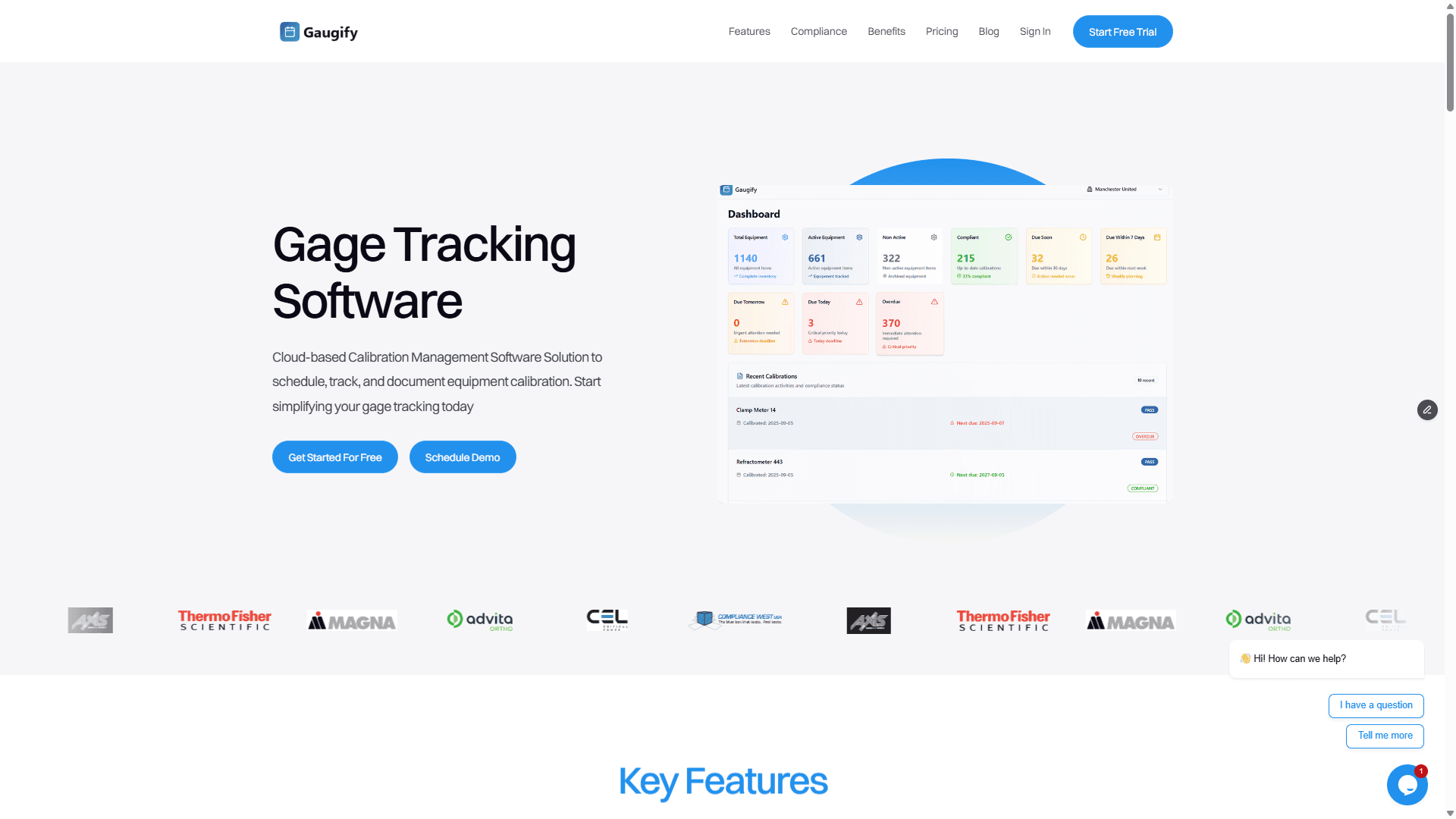
The platform's reporting capabilities provide instant access to calibration status across your entire facility. Quality managers can generate compliance dashboards showing overdue calibrations, trending analysis of equipment performance, and summaries of corrective actions. During FDA inspections, these reports demonstrate proactive calibration management and commitment to quality.
For companies requiring ISO 17025 compliance in addition to cGMP requirements, Gaugify supports both standards simultaneously, eliminating the need for separate systems.
cGMP Calibration Compliance Checklist
Use this comprehensive checklist to evaluate your current calibration program against cGMP requirements and identify areas for improvement:
Documentation and Procedures
Written calibration procedures exist for all equipment types
Procedures specify calibration methods, acceptance criteria, and corrective actions
Calibration intervals are documented and technically justified
Procedures are approved, controlled, and regularly reviewed
Personnel training records demonstrate competency in calibration procedures
Calibration Execution
All measuring and testing equipment is included in the calibration program
Calibrations are performed according to written procedures
Reference standards have valid, traceable calibration certificates
Environmental conditions are monitored and documented during calibrations
Calibration results are properly calculated and verified against acceptance criteria
Record Management
Complete calibration certificates are maintained for each instrument
Records include all required technical elements and approvals
Electronic records comply with 21 CFR Part 11 requirements
Records are retained for appropriate periods based on product lifecycle
Backup and recovery procedures protect calibration data
Quality Assurance
Out-of-specification calibration results trigger formal investigations
Corrective and preventive actions address root causes of calibration failures
Calibration program effectiveness is regularly reviewed and improved
External calibration service providers are qualified and monitored
Calibration status is clearly identified on all equipment
Achieve cGMP Calibration Excellence with Gaugify
Meeting cGMP calibration requirements demands more than just periodic equipment checks—it requires a systematic approach that ensures accuracy, traceability, and complete documentation. The complexity of modern pharmaceutical operations, combined with evolving FDA expectations, makes manual calibration management both risky and inefficient.
Gaugify transforms calibration management from a compliance burden into a competitive advantage. The platform's pharmaceutical-specific features address every aspect of cGMP requirements while improving operational efficiency and reducing compliance costs. With automated scheduling, comprehensive documentation, and real-time compliance monitoring, Gaugify helps pharmaceutical manufacturers maintain the highest quality standards while focusing on their core mission of developing life-saving medications.
Don't leave your calibration compliance to chance. Start your free Gaugify trial today and experience how modern calibration management technology can strengthen your quality systems, streamline FDA inspections, and ensure patient safety through accurate, traceable measurements. For personalized guidance on implementing Gaugify in your pharmaceutical facility, schedule a demo with our calibration experts who understand the unique challenges of pharmaceutical manufacturing.
cGMP Calibration Requirements for Pharmaceutical Manufacturing
Current Good Manufacturing Practice (cGMP) calibration requirements form the backbone of quality assurance in pharmaceutical manufacturing. The FDA's cGMP regulations, codified in 21 CFR Parts 210 and 211, mandate strict calibration protocols to ensure drug safety, efficacy, and quality. For pharmaceutical manufacturers, understanding and implementing comprehensive cGMP calibration requirements isn't just about regulatory compliance—it's about protecting patient safety and maintaining manufacturing excellence.
These regulations apply to all facilities manufacturing drug products for human use in the United States, including finished pharmaceuticals, active pharmaceutical ingredients (APIs), and medical devices. Whether you're operating a small-scale compounding facility or a large-scale manufacturing plant, your measuring and testing equipment must meet rigorous calibration standards that demonstrate accuracy, reliability, and traceability.
Overview of cGMP Calibration Standards and Application
The cGMP framework encompasses multiple pharmaceutical manufacturing sectors, each with specific calibration obligations. Finished drug product manufacturers must calibrate everything from analytical balances used for raw material weighing to dissolution testers that verify tablet release profiles. API manufacturers face additional scrutiny on process instrumentation like temperature sensors in reactors and pH meters in crystallization processes.
The regulation distinguishes between different types of equipment based on their impact on product quality. Critical equipment—such as HPLC systems used for potency testing or moisture analyzers for stability studies—requires more frequent calibration than non-critical monitoring equipment. For example, a Mettler Toledo analytical balance used for weighing active ingredients typically requires daily calibration checks, while a temperature monitoring system in a warehouse might only need quarterly calibration.
Calibration frequency depends on several factors: equipment type, manufacturer recommendations, historical performance data, and criticality to product quality. A Waters HPLC system performing batch release testing might need weekly calibration verification, while the same system used for method development could operate on a monthly schedule.
Equipment Categories Under cGMP
The FDA categorizes equipment into three primary groups for calibration purposes:
Laboratory instruments: Analytical balances, spectrophotometers, chromatography systems, dissolution apparatus, and particle size analyzers
Process equipment: Temperature sensors, pressure gauges, flow meters, pH electrodes, and weighing systems
Environmental monitoring: Temperature/humidity loggers, particle counters, viable air samplers, and pressure differential monitors
Specific cGMP Calibration Requirements Breakdown
Section 211.68 of the cGMP regulations specifically addresses automatic, mechanical, and electronic equipment used in drug manufacturing. The regulation states that such equipment must be "routinely calibrated, inspected, or checked according to a written program designed to assure proper performance."
This seemingly straightforward requirement encompasses several critical elements. Written procedures must define calibration methods, acceptance criteria, and corrective actions. For instance, your procedure for calibrating a Sartorius analytical balance must specify the test weights to be used (typically OIML Class E1 or E2), the acceptable tolerance limits (often ±0.1% of the applied load), and the steps to take if the balance fails calibration.
The regulation also requires routine calibration schedules based on equipment type and usage. High-use instruments like balances in active production areas typically need daily checks, while backup equipment might only require monthly verification. A pharmaceutical company manufacturing tablets might calibrate their Erweka dissolution tester weekly during production campaigns but extend this to monthly during maintenance periods.
Traceability Requirements
All calibrations must demonstrate metrological traceability to national or international measurement standards. This means your reference standards—whether they're certified weights, temperature standards, or volumetric glassware—must have unbroken calibration chains traceable to NIST or equivalent national metrology institutes.
For example, when calibrating a Mettler Toledo XPE analytical balance, your reference weights must carry ISO 17025-accredited calibration certificates showing traceability to NIST mass standards. The uncertainty budget for your calibration must account for uncertainties from the reference standard, environmental conditions, and measurement repeatability.
Start your free Gaugify trial today to implement a comprehensive calibration management system that ensures full cGMP compliance and traceability for all your pharmaceutical equipment.
FDA Audit Focus Areas for Calibration Compliance
During cGMP inspections, FDA investigators concentrate on specific aspects of your calibration program that directly impact product quality and patient safety. Understanding these focus areas helps you prepare for inspections and maintain continuous compliance.
Calibration procedures and documentation receive intense scrutiny. Auditors verify that written procedures exist for each instrument type, that they're technically sound, and that personnel follow them consistently. They'll examine calibration records for completeness, accuracy, and proper approval signatures. For instance, investigators might review HPLC calibration records to ensure daily system suitability tests meet acceptance criteria and that any failures triggered appropriate investigations.
Auditors also examine calibration intervals and their justification. You must demonstrate that calibration frequencies are appropriate based on equipment stability, usage patterns, and historical performance data. A temperature sensor in a stability chamber showing consistent performance over two years might justify extending calibration intervals from quarterly to semi-annually, but this decision requires documented technical justification.
Critical Documentation Review Points
FDA inspectors typically request the following calibration-related documents during audits:
Master calibration procedures for each equipment type
Individual calibration certificates with raw data and calculations
Calibration schedules and completion tracking records
Out-of-specification investigation reports and corrective actions
Vendor qualification records for calibration service providers
Training records demonstrating personnel competency in calibration procedures
Investigators pay particular attention to corrective action effectiveness. When equipment fails calibration, you must investigate the root cause, assess potential impact on product quality, and implement appropriate corrective and preventive actions. For example, if a dissolution tester fails calibration during a production campaign, you must evaluate all batches tested since the last successful calibration and potentially retest affected products.
cGMP Calibration Documentation Requirements
Comprehensive documentation forms the foundation of cGMP compliance. The FDA expects calibration records that demonstrate not just compliance with procedures, but also the technical competency of your quality systems. Each calibration event must generate records that provide complete traceability and enable independent verification of results.
Individual calibration certificates must contain specific technical elements. These include the instrument identification, calibration date and due date, environmental conditions during calibration, reference standards used with their traceability information, actual measurement data, acceptance criteria, and pass/fail determination. For a pH meter calibration, records must show the buffer solutions used, their certified pH values, the meter readings at each point, and verification that accuracy meets specifications (typically ±0.1 pH units).
The regulation requires retention periods that align with product lifecycle requirements. Calibration records for equipment used in manufacturing and testing must be retained for at least one year after drug product expiration dating. For critical equipment with longer product shelf lives, this might extend to five years or more.
Electronic Record Requirements
Many pharmaceutical companies now use electronic calibration management systems to improve efficiency and data integrity. These systems must comply with 21 CFR Part 11 requirements for electronic records and signatures. Gaugify's compliance features ensure your electronic calibration records meet all FDA requirements for data integrity, audit trails, and electronic signatures.
Electronic systems must provide complete audit trails showing when records are created, modified, or deleted, along with user identification and timestamps. The system must prevent unauthorized changes to calibration data and provide secure backup and recovery capabilities.
Common cGMP Calibration Non-Conformances
Based on FDA inspection databases and Warning Letters, certain calibration-related deficiencies appear repeatedly across pharmaceutical facilities. Understanding these common pitfalls helps you proactively address potential compliance gaps before they become inspection findings.
Inadequate calibration procedures represent the most frequent non-conformance category. Procedures that lack sufficient technical detail, don't specify acceptance criteria, or fail to address corrective actions create compliance vulnerabilities. For example, a generic procedure stating "calibrate the balance daily" without specifying test weights, tolerance limits, or failure response protocols would trigger a citation.
Another common issue involves improper calibration intervals. Companies sometimes adopt manufacturer-recommended intervals without considering their specific operating conditions. A particle counter used in a high-traffic manufacturing area might need more frequent calibration than the same instrument in a controlled laboratory environment.
Data Integrity Issues
Data integrity violations in calibration records have become increasingly common inspection findings. These include:
Missing or incomplete calibration data
Alteration of calibration results without proper documentation
Failure to investigate out-of-specification calibration results
Inadequate backup and archival of electronic calibration records
Lack of proper access controls in calibration management systems
The FDA has issued numerous Warning Letters citing companies for calibration data integrity failures. One recent example involved a manufacturer that failed to investigate negative temperature excursions recorded by calibrated data loggers in vaccine storage areas, potentially compromising product potency.
How Gaugify Ensures Complete cGMP Calibration Compliance
Gaugify's cloud-based calibration management platform specifically addresses every aspect of cGMP calibration requirements, providing pharmaceutical manufacturers with comprehensive tools for compliance and operational efficiency.
The platform's automated scheduling system ensures no equipment misses its calibration due date. You can configure calibration intervals based on regulatory requirements, manufacturer recommendations, or your facility's risk assessment. The system automatically generates work orders, sends email notifications, and escalates overdue items to management. For a pharmaceutical facility managing 500+ instruments, this automation eliminates the manual tracking burden while ensuring 100% compliance.
Gaugify's advanced features include comprehensive procedure management, allowing you to create detailed calibration procedures for each instrument type. The system guides technicians through step-by-step calibration processes, ensuring consistency and reducing human error. Built-in calculation tools automatically compute results and compare them against predetermined acceptance criteria.
FDA-Ready Documentation and Reporting
Gaugify generates professional calibration certificates that meet all FDA documentation requirements. Each certificate includes complete traceability information, environmental conditions, raw measurement data, and clear pass/fail determinations. The system maintains complete audit trails showing who performed calibrations, when they occurred, and any subsequent modifications.
The platform's reporting capabilities provide instant access to calibration status across your entire facility. Quality managers can generate compliance dashboards showing overdue calibrations, trending analysis of equipment performance, and summaries of corrective actions. During FDA inspections, these reports demonstrate proactive calibration management and commitment to quality.
For companies requiring ISO 17025 compliance in addition to cGMP requirements, Gaugify supports both standards simultaneously, eliminating the need for separate systems.
cGMP Calibration Compliance Checklist
Use this comprehensive checklist to evaluate your current calibration program against cGMP requirements and identify areas for improvement:
Documentation and Procedures
Written calibration procedures exist for all equipment types
Procedures specify calibration methods, acceptance criteria, and corrective actions
Calibration intervals are documented and technically justified
Procedures are approved, controlled, and regularly reviewed
Personnel training records demonstrate competency in calibration procedures
Calibration Execution
All measuring and testing equipment is included in the calibration program
Calibrations are performed according to written procedures
Reference standards have valid, traceable calibration certificates
Environmental conditions are monitored and documented during calibrations
Calibration results are properly calculated and verified against acceptance criteria
Record Management
Complete calibration certificates are maintained for each instrument
Records include all required technical elements and approvals
Electronic records comply with 21 CFR Part 11 requirements
Records are retained for appropriate periods based on product lifecycle
Backup and recovery procedures protect calibration data
Quality Assurance
Out-of-specification calibration results trigger formal investigations
Corrective and preventive actions address root causes of calibration failures
Calibration program effectiveness is regularly reviewed and improved
External calibration service providers are qualified and monitored
Calibration status is clearly identified on all equipment
Achieve cGMP Calibration Excellence with Gaugify
Meeting cGMP calibration requirements demands more than just periodic equipment checks—it requires a systematic approach that ensures accuracy, traceability, and complete documentation. The complexity of modern pharmaceutical operations, combined with evolving FDA expectations, makes manual calibration management both risky and inefficient.
Gaugify transforms calibration management from a compliance burden into a competitive advantage. The platform's pharmaceutical-specific features address every aspect of cGMP requirements while improving operational efficiency and reducing compliance costs. With automated scheduling, comprehensive documentation, and real-time compliance monitoring, Gaugify helps pharmaceutical manufacturers maintain the highest quality standards while focusing on their core mission of developing life-saving medications.
Don't leave your calibration compliance to chance. Start your free Gaugify trial today and experience how modern calibration management technology can strengthen your quality systems, streamline FDA inspections, and ensure patient safety through accurate, traceable measurements. For personalized guidance on implementing Gaugify in your pharmaceutical facility, schedule a demo with our calibration experts who understand the unique challenges of pharmaceutical manufacturing.