
HACCP Calibration: Critical Control Points and Monitoring Equipment
HACCP Calibration: Critical Control Points and Monitoring Equipment
David Bentley
Quality Assurance Engineer
12 min read
HACCP Calibration: Critical Control Points and Monitoring Equipment
Food safety failures can destroy brands overnight. When monitoring equipment fails at Critical Control Points (CCPs), contaminated products reach consumers, triggering recalls that cost millions and damage reputations permanently. Understanding HACCP calibration requirements isn't just about compliance—it's about protecting your customers and your business from catastrophic food safety incidents.
The Hazard Analysis Critical Control Points (HACCP) system relies entirely on accurate monitoring data to verify that food safety hazards remain controlled. Without properly calibrated instruments measuring temperature, pH, water activity, and other critical parameters, your CCPs become blind spots where dangerous pathogens can multiply undetected.
HACCP Overview: Who Must Follow Calibration Requirements
HACCP applies to virtually every segment of the food industry, from primary production through retail. The FDA's Food Safety Modernization Act (FSMA) mandates HACCP-based food safety plans for most food facilities, while the USDA-FSIS requires HACCP systems for all meat, poultry, and processed egg products.
Industries requiring HACCP compliance include:
Food manufacturing and processing facilities
Seafood processors and importers
Juice manufacturers
Meat and poultry plants
Dairy processing operations
Commercial food service operations
Food packaging and storage facilities
Each facility must identify Critical Control Points where hazards can be prevented, eliminated, or reduced to acceptable levels. These CCPs require continuous monitoring with calibrated instruments to ensure critical limits are maintained.
Critical Monitoring Equipment in HACCP Systems
Your HACCP plan's effectiveness depends on the accuracy of monitoring equipment at each CCP. Common instruments requiring regular calibration include:
Temperature monitoring devices: Thermocouples, RTDs, and infrared thermometers measuring cooking, cooling, and storage temperatures
pH meters: Critical for acidified foods where pH must remain below 4.6 to prevent botulism
Water activity meters: Essential for shelf-stable products where aw must stay below 0.85
Metal detectors: Physical hazard CCPs requiring sensitivity verification
Flow meters: Monitoring sanitizer concentration and flow rates
Pressure gauges: Ensuring proper retort and pasteurization conditions
HACCP Calibration Requirements: The Seven Principles
While HACCP doesn't specify detailed calibration procedures like ISO 17025, the seven HACCP principles create clear HACCP calibration requirements that facilities must follow:
Principle 4: Establish Monitoring Procedures
This principle directly addresses calibration by requiring that monitoring procedures "describe how the measurement will be taken, when it is taken, who is responsible for the measurement and how frequently it is taken during production."
Key requirements include:
Monitoring instruments must provide accurate, real-time measurements
Calibration frequency must ensure continued accuracy throughout production
Backup monitoring methods must be available when primary instruments fail
Personnel must be trained on proper calibration and use of monitoring equipment
For example, a ready-to-eat meat processor monitoring cooking temperature at 165°F (±2°F) needs thermocouples calibrated weekly to ±0.5°F accuracy. The tighter calibration tolerance provides a safety buffer ensuring the critical limit is never unknowingly violated.
Principle 5: Establish Corrective Actions
When monitoring equipment fails calibration, HACCP requires predetermined corrective actions including:
Immediate recalibration or replacement of failed instruments
Evaluation of product safety during the period of inaccurate monitoring
Documentation of corrective actions taken and their effectiveness
Root cause analysis to prevent recurrence
Principle 6: Establish Verification Procedures
Verification activities confirm that calibration procedures work as intended. This includes:
Independent verification of calibration accuracy using reference standards
Review of calibration records and corrective action documentation
Validation that calibration frequencies maintain required accuracy
Periodic audits of calibration procedures and personnel competency
Ready to ensure your monitoring equipment meets every HACCP requirement? Start your free Gaugify trial and get automated calibration scheduling, instant non-conformance alerts, and audit-ready documentation in minutes.
What HACCP Auditors Check During Assessments
HACCP auditors—whether internal, customer, or regulatory—focus intensely on calibration practices because inaccurate monitoring undermines the entire food safety system. Understanding their priorities helps you prepare for successful audits.
Calibration Documentation Review
Auditors examine calibration records for completeness and compliance:
Calibration certificates: Traceable to national standards with uncertainty statements
Frequency compliance: No overdue calibrations, especially for CCP monitoring equipment
Accuracy verification: Calibration tolerances tighter than critical limit tolerances
Corrective actions: Proper response to out-of-tolerance conditions
For instance, an auditor reviewing a pasteurization CCP at 161°F (±2°F) expects to see temperature sensors calibrated to ±0.5°F or better, with certificates showing traceability to NIST standards.
On-Floor Equipment Inspection
Auditors don't just review paperwork—they verify that monitoring equipment matches calibration records:
Instrument identification matching calibration certificates
Current calibration labels with due dates clearly visible
Proper installation and maintenance preventing accuracy drift
Backup instruments available and properly calibrated
Personnel Competency Assessment
Auditors interview operators and quality staff to verify:
Understanding of calibration requirements and procedures
Ability to recognize and respond to equipment malfunctions
Proper techniques for using and maintaining monitoring instruments
Knowledge of corrective actions when calibration problems occur
HACCP Calibration Documentation Requirements
Principle 7 of HACCP mandates comprehensive record-keeping that demonstrates continuous compliance with HACCP calibration requirements. Your documentation system must provide complete traceability of all calibration activities.
Essential Calibration Records
Calibration certificates must include:
Instrument identification and location (CCP designation)
Calibration date, technician, and next due date
Reference standards used with their traceability chain
As-found and as-left readings at multiple test points
Environmental conditions during calibration
Measurement uncertainty and pass/fail determination
Supporting documentation includes:
Calibration procedures specifying methods and acceptance criteria
Instrument master lists linking equipment to specific CCPs
Calibration schedules showing planned and completed activities
Non-conformance reports and corrective action records
Training records for personnel performing calibrations
Record Retention Requirements
HACCP regulations specify minimum retention periods:
FDA facilities: Two years minimum, longer for low-acid canned foods
USDA-regulated facilities: One year minimum
Seafood processors: Two years minimum
Customer requirements: Often specify longer retention periods
Electronic record systems like Gaugify's calibration management platform provide unlimited retention with instant retrieval during audits, eliminating the burden of paper filing systems.
Common HACCP Calibration Non-Conformances
Learning from typical audit findings helps prevent compliance failures in your facility. These non-conformances appear repeatedly across HACCP audits:
Inadequate Calibration Frequency
Finding: "Temperature sensors at pasteurization CCP last calibrated 8 months ago despite 6-month procedure requirement."
Root cause: Manual scheduling systems fail to track due dates reliably, especially when instruments are moved between production lines.
Prevention: Automated calibration scheduling with overdue alerts prevents missed calibrations.
Insufficient Calibration Accuracy
Finding: "pH meter calibrated to ±0.1 pH units while critical limit tolerance is ±0.1 pH units, providing no measurement safety margin."
Root cause: Calibration tolerances set equal to critical limits rather than providing safety buffers.
Prevention: Establish calibration tolerances at 25-50% of critical limit tolerances.
Missing Traceability Documentation
Finding: "Reference thermometer used for CCP calibrations has no certificate showing NIST traceability."
Root cause: Using uncertified reference standards or letting certificates expire.
Prevention: Maintain complete traceability chains for all reference standards with automatic renewal alerts.
Inadequate Corrective Actions
Finding: "Metal detector failed sensitivity test on March 15. No documentation of product evaluation or corrective actions taken."
Root cause: Failure to follow established corrective action procedures when equipment fails calibration.
Prevention: Standardized corrective action workflows triggered automatically when instruments fail calibration.
How Gaugify Ensures Complete HACCP Compliance
Modern cloud-based calibration management eliminates the manual processes that cause HACCP compliance failures. Gaugify's platform maps directly to every HACCP calibration requirement:
Automated Monitoring Compliance (Principle 4)
Gaugify's intelligent scheduling ensures CCP monitoring equipment never goes overdue:
Smart notifications: Email and SMS alerts before calibrations come due
Equipment tracking: QR code scanning links physical instruments to digital records
Mobile accessibility: Technicians access procedures and record results from any device
Backup planning: Automatic identification of spare instruments when primaries fail
Streamlined Corrective Actions (Principle 5)
When instruments fail calibration, Gaugify triggers standardized corrective action workflows:
Immediate notifications to quality managers and production supervisors
Guided corrective action templates ensuring consistent responses
Product hold capabilities linking timeframes to potentially affected lots
Root cause analysis tools preventing recurring failures
Comprehensive Verification Support (Principle 6)
Gaugify's analytics and reporting capabilities support all HACCP verification activities:
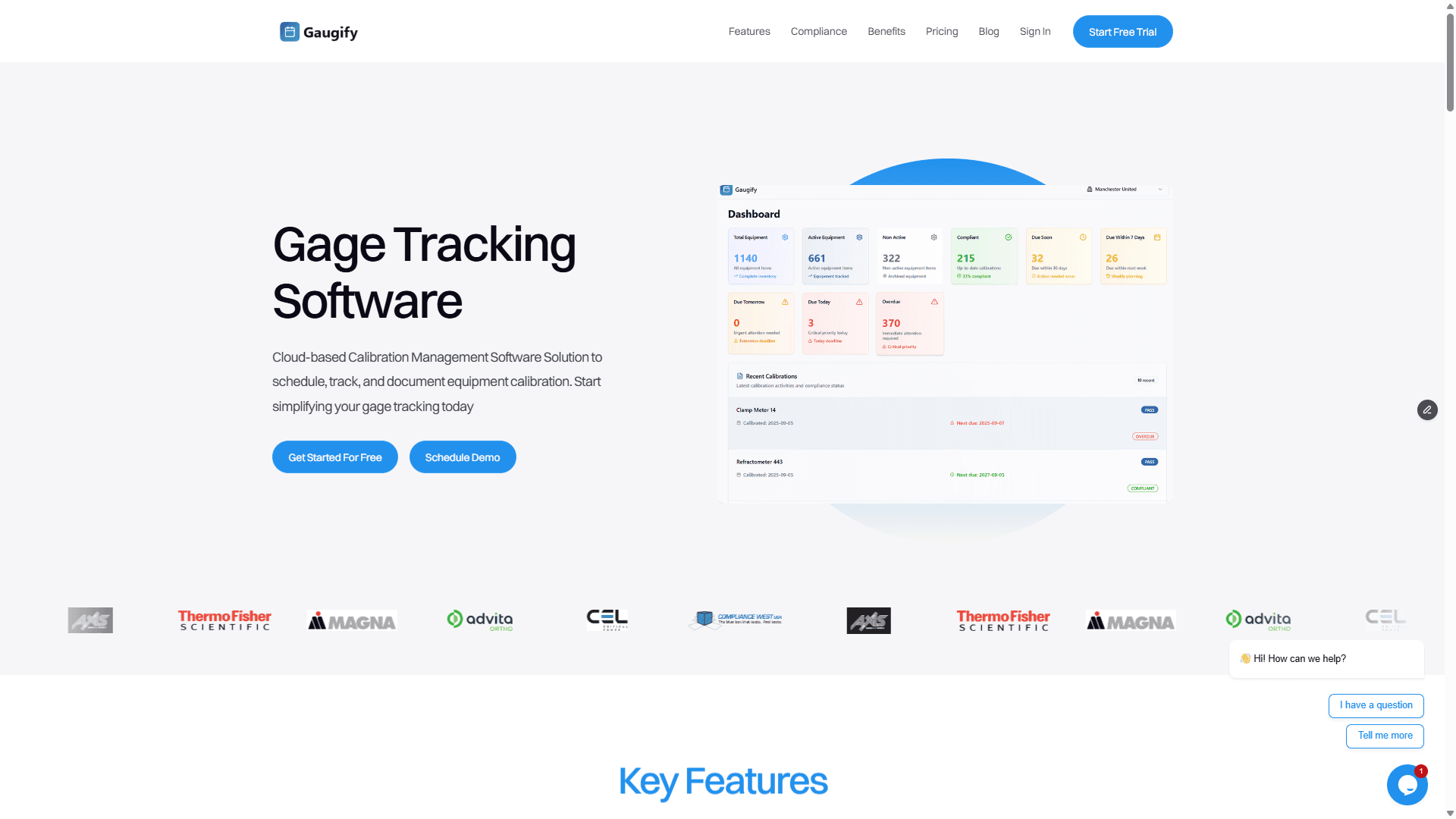
Compliance dashboards: Real-time visibility into calibration status across all CCPs
Trend analysis: Identify instruments requiring more frequent calibration
Audit trails: Complete history of all calibration activities and changes
Performance metrics: Track calibration program effectiveness over time
Bulletproof Documentation (Principle 7)
Every calibration activity in Gaugify generates audit-ready documentation automatically:
Digital certificates with tamper-proof timestamps and electronic signatures
Unlimited cloud storage with instant search and retrieval
Custom reporting templates matching your facility's specific requirements
Integration capabilities linking calibration data to your existing HACCP software
Food facilities using Gaugify report 95% reduction in calibration-related audit findings and 80% less time spent preparing calibration documentation for audits.
HACCP Calibration Compliance Checklist
Use this comprehensive checklist to verify your facility meets all HACCP calibration requirements:
Equipment Management
☐ All CCP monitoring instruments identified and tagged with unique IDs
☐ Calibration schedules established based on manufacturer recommendations and usage conditions
☐ Calibration tolerances set tighter than critical limit tolerances (typically 25-50%)
☐ Backup monitoring instruments available and properly calibrated
☐ Environmental conditions controlled during calibration activities
Procedures and Training
☐ Written calibration procedures for each type of monitoring instrument
☐ Personnel trained and competent in calibration procedures
☐ Corrective action procedures established for calibration failures
☐ Verification activities scheduled and documented
☐ Management review of calibration program effectiveness
Documentation and Records
☐ Calibration certificates complete with traceability information
☐ Reference standard certificates current and traceable to national standards
☐ Non-conformance and corrective action records maintained
☐ Records retained per regulatory requirements
☐ Documentation easily retrievable during audits
Compliance Verification
☐ No overdue calibrations, especially for CCP monitoring equipment
☐ Recent calibration results within specified tolerances
☐ Corrective actions completed and effective
☐ Personnel demonstrate competency during interviews
☐ Equipment properly maintained and functioning accurately
Start Your HACCP Calibration Journey Today
Food safety depends on accurate monitoring at every Critical Control Point. Manual calibration management creates gaps that auditors find and that put your customers at risk. The stakes are too high for spreadsheets and paper-based systems that fail when you need them most.
Gaugify's HACCP compliance features eliminate calibration-related audit findings by automating every aspect of your monitoring equipment management. From intelligent scheduling that prevents overdue calibrations to instant corrective action workflows that protect your products, Gaugify transforms calibration from a compliance burden into a competitive advantage.
Join hundreds of food facilities that have achieved zero calibration non-conformances with Gaugify. Start your free 30-day trial today and experience the confidence that comes with bulletproof HACCP compliance. Your next audit is coming—make sure your calibration program is ready.
Questions about implementing HACCP calibration requirements in your facility? Schedule a personalized demo and see exactly how Gaugify maps to your specific CCPs and monitoring equipment. Our food safety experts understand the unique challenges you face and can show you the fastest path to complete compliance.
HACCP Calibration: Critical Control Points and Monitoring Equipment
Food safety failures can destroy brands overnight. When monitoring equipment fails at Critical Control Points (CCPs), contaminated products reach consumers, triggering recalls that cost millions and damage reputations permanently. Understanding HACCP calibration requirements isn't just about compliance—it's about protecting your customers and your business from catastrophic food safety incidents.
The Hazard Analysis Critical Control Points (HACCP) system relies entirely on accurate monitoring data to verify that food safety hazards remain controlled. Without properly calibrated instruments measuring temperature, pH, water activity, and other critical parameters, your CCPs become blind spots where dangerous pathogens can multiply undetected.
HACCP Overview: Who Must Follow Calibration Requirements
HACCP applies to virtually every segment of the food industry, from primary production through retail. The FDA's Food Safety Modernization Act (FSMA) mandates HACCP-based food safety plans for most food facilities, while the USDA-FSIS requires HACCP systems for all meat, poultry, and processed egg products.
Industries requiring HACCP compliance include:
Food manufacturing and processing facilities
Seafood processors and importers
Juice manufacturers
Meat and poultry plants
Dairy processing operations
Commercial food service operations
Food packaging and storage facilities
Each facility must identify Critical Control Points where hazards can be prevented, eliminated, or reduced to acceptable levels. These CCPs require continuous monitoring with calibrated instruments to ensure critical limits are maintained.
Critical Monitoring Equipment in HACCP Systems
Your HACCP plan's effectiveness depends on the accuracy of monitoring equipment at each CCP. Common instruments requiring regular calibration include:
Temperature monitoring devices: Thermocouples, RTDs, and infrared thermometers measuring cooking, cooling, and storage temperatures
pH meters: Critical for acidified foods where pH must remain below 4.6 to prevent botulism
Water activity meters: Essential for shelf-stable products where aw must stay below 0.85
Metal detectors: Physical hazard CCPs requiring sensitivity verification
Flow meters: Monitoring sanitizer concentration and flow rates
Pressure gauges: Ensuring proper retort and pasteurization conditions
HACCP Calibration Requirements: The Seven Principles
While HACCP doesn't specify detailed calibration procedures like ISO 17025, the seven HACCP principles create clear HACCP calibration requirements that facilities must follow:
Principle 4: Establish Monitoring Procedures
This principle directly addresses calibration by requiring that monitoring procedures "describe how the measurement will be taken, when it is taken, who is responsible for the measurement and how frequently it is taken during production."
Key requirements include:
Monitoring instruments must provide accurate, real-time measurements
Calibration frequency must ensure continued accuracy throughout production
Backup monitoring methods must be available when primary instruments fail
Personnel must be trained on proper calibration and use of monitoring equipment
For example, a ready-to-eat meat processor monitoring cooking temperature at 165°F (±2°F) needs thermocouples calibrated weekly to ±0.5°F accuracy. The tighter calibration tolerance provides a safety buffer ensuring the critical limit is never unknowingly violated.
Principle 5: Establish Corrective Actions
When monitoring equipment fails calibration, HACCP requires predetermined corrective actions including:
Immediate recalibration or replacement of failed instruments
Evaluation of product safety during the period of inaccurate monitoring
Documentation of corrective actions taken and their effectiveness
Root cause analysis to prevent recurrence
Principle 6: Establish Verification Procedures
Verification activities confirm that calibration procedures work as intended. This includes:
Independent verification of calibration accuracy using reference standards
Review of calibration records and corrective action documentation
Validation that calibration frequencies maintain required accuracy
Periodic audits of calibration procedures and personnel competency
Ready to ensure your monitoring equipment meets every HACCP requirement? Start your free Gaugify trial and get automated calibration scheduling, instant non-conformance alerts, and audit-ready documentation in minutes.
What HACCP Auditors Check During Assessments
HACCP auditors—whether internal, customer, or regulatory—focus intensely on calibration practices because inaccurate monitoring undermines the entire food safety system. Understanding their priorities helps you prepare for successful audits.
Calibration Documentation Review
Auditors examine calibration records for completeness and compliance:
Calibration certificates: Traceable to national standards with uncertainty statements
Frequency compliance: No overdue calibrations, especially for CCP monitoring equipment
Accuracy verification: Calibration tolerances tighter than critical limit tolerances
Corrective actions: Proper response to out-of-tolerance conditions
For instance, an auditor reviewing a pasteurization CCP at 161°F (±2°F) expects to see temperature sensors calibrated to ±0.5°F or better, with certificates showing traceability to NIST standards.
On-Floor Equipment Inspection
Auditors don't just review paperwork—they verify that monitoring equipment matches calibration records:
Instrument identification matching calibration certificates
Current calibration labels with due dates clearly visible
Proper installation and maintenance preventing accuracy drift
Backup instruments available and properly calibrated
Personnel Competency Assessment
Auditors interview operators and quality staff to verify:
Understanding of calibration requirements and procedures
Ability to recognize and respond to equipment malfunctions
Proper techniques for using and maintaining monitoring instruments
Knowledge of corrective actions when calibration problems occur
HACCP Calibration Documentation Requirements
Principle 7 of HACCP mandates comprehensive record-keeping that demonstrates continuous compliance with HACCP calibration requirements. Your documentation system must provide complete traceability of all calibration activities.
Essential Calibration Records
Calibration certificates must include:
Instrument identification and location (CCP designation)
Calibration date, technician, and next due date
Reference standards used with their traceability chain
As-found and as-left readings at multiple test points
Environmental conditions during calibration
Measurement uncertainty and pass/fail determination
Supporting documentation includes:
Calibration procedures specifying methods and acceptance criteria
Instrument master lists linking equipment to specific CCPs
Calibration schedules showing planned and completed activities
Non-conformance reports and corrective action records
Training records for personnel performing calibrations
Record Retention Requirements
HACCP regulations specify minimum retention periods:
FDA facilities: Two years minimum, longer for low-acid canned foods
USDA-regulated facilities: One year minimum
Seafood processors: Two years minimum
Customer requirements: Often specify longer retention periods
Electronic record systems like Gaugify's calibration management platform provide unlimited retention with instant retrieval during audits, eliminating the burden of paper filing systems.
Common HACCP Calibration Non-Conformances
Learning from typical audit findings helps prevent compliance failures in your facility. These non-conformances appear repeatedly across HACCP audits:
Inadequate Calibration Frequency
Finding: "Temperature sensors at pasteurization CCP last calibrated 8 months ago despite 6-month procedure requirement."
Root cause: Manual scheduling systems fail to track due dates reliably, especially when instruments are moved between production lines.
Prevention: Automated calibration scheduling with overdue alerts prevents missed calibrations.
Insufficient Calibration Accuracy
Finding: "pH meter calibrated to ±0.1 pH units while critical limit tolerance is ±0.1 pH units, providing no measurement safety margin."
Root cause: Calibration tolerances set equal to critical limits rather than providing safety buffers.
Prevention: Establish calibration tolerances at 25-50% of critical limit tolerances.
Missing Traceability Documentation
Finding: "Reference thermometer used for CCP calibrations has no certificate showing NIST traceability."
Root cause: Using uncertified reference standards or letting certificates expire.
Prevention: Maintain complete traceability chains for all reference standards with automatic renewal alerts.
Inadequate Corrective Actions
Finding: "Metal detector failed sensitivity test on March 15. No documentation of product evaluation or corrective actions taken."
Root cause: Failure to follow established corrective action procedures when equipment fails calibration.
Prevention: Standardized corrective action workflows triggered automatically when instruments fail calibration.
How Gaugify Ensures Complete HACCP Compliance
Modern cloud-based calibration management eliminates the manual processes that cause HACCP compliance failures. Gaugify's platform maps directly to every HACCP calibration requirement:
Automated Monitoring Compliance (Principle 4)
Gaugify's intelligent scheduling ensures CCP monitoring equipment never goes overdue:
Smart notifications: Email and SMS alerts before calibrations come due
Equipment tracking: QR code scanning links physical instruments to digital records
Mobile accessibility: Technicians access procedures and record results from any device
Backup planning: Automatic identification of spare instruments when primaries fail
Streamlined Corrective Actions (Principle 5)
When instruments fail calibration, Gaugify triggers standardized corrective action workflows:
Immediate notifications to quality managers and production supervisors
Guided corrective action templates ensuring consistent responses
Product hold capabilities linking timeframes to potentially affected lots
Root cause analysis tools preventing recurring failures
Comprehensive Verification Support (Principle 6)
Gaugify's analytics and reporting capabilities support all HACCP verification activities:
Compliance dashboards: Real-time visibility into calibration status across all CCPs
Trend analysis: Identify instruments requiring more frequent calibration
Audit trails: Complete history of all calibration activities and changes
Performance metrics: Track calibration program effectiveness over time
Bulletproof Documentation (Principle 7)
Every calibration activity in Gaugify generates audit-ready documentation automatically:
Digital certificates with tamper-proof timestamps and electronic signatures
Unlimited cloud storage with instant search and retrieval
Custom reporting templates matching your facility's specific requirements
Integration capabilities linking calibration data to your existing HACCP software
Food facilities using Gaugify report 95% reduction in calibration-related audit findings and 80% less time spent preparing calibration documentation for audits.
HACCP Calibration Compliance Checklist
Use this comprehensive checklist to verify your facility meets all HACCP calibration requirements:
Equipment Management
☐ All CCP monitoring instruments identified and tagged with unique IDs
☐ Calibration schedules established based on manufacturer recommendations and usage conditions
☐ Calibration tolerances set tighter than critical limit tolerances (typically 25-50%)
☐ Backup monitoring instruments available and properly calibrated
☐ Environmental conditions controlled during calibration activities
Procedures and Training
☐ Written calibration procedures for each type of monitoring instrument
☐ Personnel trained and competent in calibration procedures
☐ Corrective action procedures established for calibration failures
☐ Verification activities scheduled and documented
☐ Management review of calibration program effectiveness
Documentation and Records
☐ Calibration certificates complete with traceability information
☐ Reference standard certificates current and traceable to national standards
☐ Non-conformance and corrective action records maintained
☐ Records retained per regulatory requirements
☐ Documentation easily retrievable during audits
Compliance Verification
☐ No overdue calibrations, especially for CCP monitoring equipment
☐ Recent calibration results within specified tolerances
☐ Corrective actions completed and effective
☐ Personnel demonstrate competency during interviews
☐ Equipment properly maintained and functioning accurately
Start Your HACCP Calibration Journey Today
Food safety depends on accurate monitoring at every Critical Control Point. Manual calibration management creates gaps that auditors find and that put your customers at risk. The stakes are too high for spreadsheets and paper-based systems that fail when you need them most.
Gaugify's HACCP compliance features eliminate calibration-related audit findings by automating every aspect of your monitoring equipment management. From intelligent scheduling that prevents overdue calibrations to instant corrective action workflows that protect your products, Gaugify transforms calibration from a compliance burden into a competitive advantage.
Join hundreds of food facilities that have achieved zero calibration non-conformances with Gaugify. Start your free 30-day trial today and experience the confidence that comes with bulletproof HACCP compliance. Your next audit is coming—make sure your calibration program is ready.
Questions about implementing HACCP calibration requirements in your facility? Schedule a personalized demo and see exactly how Gaugify maps to your specific CCPs and monitoring equipment. Our food safety experts understand the unique challenges you face and can show you the fastest path to complete compliance.