
ISO 22000 Calibration Requirements for Food Safety
ISO 22000 Calibration Requirements for Food Safety
David Bentley
Quality Assurance Engineer
12 min read
ISO 22000 Calibration Requirements for Food Safety
ISO 22000 calibration requirements are critical for maintaining food safety management systems across the entire food chain. From meat processing plants measuring internal temperatures with digital thermometers to dairy facilities monitoring pasteurization with RTDs, proper calibration ensures your measurements are accurate and your food products remain safe for consumption. This comprehensive guide breaks down exactly what ISO 22000 demands for calibration and how to achieve full compliance.
Understanding ISO 22000 and Its Calibration Scope
ISO 22000:2018 Food Safety Management Systems applies to organizations throughout the food chain, including primary producers, feed manufacturers, food processors, transport and storage operators, retailers, and food service providers. The standard integrates HACCP principles with prerequisite programs and management system requirements.
Unlike some other ISO standards, ISO 22000 doesn't dedicate an entire clause specifically to calibration. Instead, calibration requirements are woven throughout the standard, particularly in sections dealing with monitoring and measurement equipment used for food safety.
The calibration requirements primarily focus on equipment used to monitor Critical Control Points (CCPs) and Operational Prerequisite Programs (OPRPs). This includes:
Temperature monitoring equipment - Digital thermometers, thermocouples, RTDs, and infrared thermometers used in cooking, cooling, and storage
pH meters - Critical for acidified foods and fermentation processes
Water activity meters - Essential for shelf-stable product validation
Metal detectors - Requiring regular calibration with test pieces of known sizes
Scales and balances - Used for ingredient measurement and portion control
Pressure gauges - Monitoring retort operations and packaging systems
Flow meters - Measuring sanitizer concentrations and CIP systems
Key ISO 22000 Calibration Requirements Explained
Clause 8.5.1 - Monitoring and Measurement
This clause requires organizations to determine what monitoring and measurement activities are necessary to provide evidence of conformity. For calibration specifically, it mandates that:
Equipment must be suitable for the specific type of monitoring and measurement activities being undertaken. A basic dial thermometer with ±2°C accuracy won't suffice for monitoring a CCP where the critical limit is 165°F ±1°F for pathogen destruction.
Equipment must be maintained to ensure continuing fitness for purpose. This means establishing calibration frequencies based on manufacturer recommendations, usage intensity, and criticality to food safety. A thermometer used 50 times daily in a high-volume kitchen requires more frequent calibration than one used weekly in a small bakery.
Clause 8.5.2 - Internal Audit
Internal audits must verify that calibration activities conform to planned arrangements. Auditors should check calibration certificates, due dates, and that out-of-specification equipment is immediately removed from service. They'll also verify that calibration records demonstrate traceability to national or international standards.
Clause 8.6 - Management Review
Management reviews must consider the performance of monitoring and measurement processes, including calibration effectiveness. This means analyzing trends in calibration results, identifying equipment that frequently drifts out of specification, and making decisions about replacement or more frequent calibration intervals.
What Auditors Look for During ISO 22000 Calibration Assessments
Third-party auditors conducting ISO 22000 assessments focus heavily on calibration evidence because measurement accuracy directly impacts food safety. Here's exactly what they examine:
Equipment Inventory and Identification
Auditors expect a complete inventory of all monitoring and measuring equipment affecting food safety. Each piece should have unique identification - asset tags, serial numbers, or internal codes that link to calibration records. They'll walk your facility and randomly select equipment to trace back to calibration documentation.
Calibration Status Verification
Every piece of equipment must display current calibration status through labels, stickers, or electronic indicators. Auditors will check multiple instruments to ensure none are overdue. They'll also verify that any equipment found out of calibration has been quarantined and that product safety assessments were conducted.
Traceability Documentation
Calibration certificates must demonstrate unbroken traceability to national standards through accredited laboratories. Auditors will examine certificates for completeness, checking that measurement points cover the actual use range, uncertainties are appropriate, and calibration intervals are justified.
Competency Records
For organizations performing internal calibrations, auditors verify that personnel have appropriate training and competency records. This includes understanding measurement uncertainty, proper calibration procedures, and when to escalate out-of-specification results.
Ready to streamline your ISO 22000 calibration management? Start your free Gaugify trial and see how leading food manufacturers maintain audit-ready calibration records effortlessly.
Essential Documentation for ISO 22000 Calibration Compliance
Proper documentation forms the backbone of ISO 22000 calibration compliance. Your calibration management system must maintain comprehensive records that demonstrate ongoing conformity.
Calibration Procedures
Document step-by-step calibration procedures for each type of equipment, including:
Environmental conditions required (temperature, humidity ranges)
Reference standards to be used with their accuracy specifications
Measurement points and acceptance criteria
Actions to take when equipment fails calibration
Personnel qualifications required to perform the calibration
Calibration Records
Every calibration event must be documented with:
Equipment identification and location
Calibration date and next due date
Personnel who performed the calibration
Environmental conditions during calibration
Reference standards used with their calibration status
As-found and as-left readings at each measurement point
Measurement uncertainty calculations
Pass/fail determination and any corrective actions
Equipment History Files
Maintain individual files for each piece of equipment containing purchase records, user manuals, calibration history, repair records, and any modifications. This historical data helps establish optimal calibration intervals and identify trends that might indicate impending failure.
Measurement Uncertainty Budgets
For critical measurements, document uncertainty budgets that account for all sources of measurement error including the instrument, reference standard, environmental conditions, and operator technique. This demonstrates that your measurement capability is adequate for the intended application.
Common ISO 22000 Calibration Non-Conformances
Based on actual audit findings across the food industry, these calibration-related non-conformances appear most frequently during ISO 22000 assessments:
Inadequate Calibration Intervals
Many organizations default to annual calibration intervals without justification. A bakery using digital scales to measure critical allergen ingredients at 0.1% of finished product weight needs more frequent calibration than scales used for bulk flour measurement. Auditors expect interval decisions based on equipment stability, usage frequency, and measurement criticality.
Missing Calibration for CCP Monitoring Equipment
The most serious non-conformance occurs when equipment monitoring Critical Control Points lacks current calibration. For example, a meat processor failed calibration on thermometers monitoring cooking temperature CCPs. Since accurate temperature measurement directly relates to pathogen destruction, this created both a calibration non-conformance and a food safety violation.
Inadequate Response to Out-of-Specification Results
When equipment fails calibration, organizations must evaluate the impact on product safety. A dairy plant's pasteurization temperature recorder was found reading 2°C low during calibration. The plant failed to assess whether products processed since the last successful calibration met safety requirements, creating a major non-conformance.
Poor Traceability Documentation
Calibration certificates from non-accredited sources or missing uncertainty statements frequently trigger non-conformances. ISO 22000 requires measurement traceability to national standards, which means using ISO/IEC 17025 accredited calibration laboratories or demonstrating equivalent traceability for internal calibrations.
Inadequate Environmental Controls
Performing calibrations in unsuitable environments compromises results. A food processor calibrating precision balances in an area with temperature fluctuations of ±10°C and significant vibration received a non-conformance because environmental conditions affected calibration validity.
How Gaugify Ensures ISO 22000 Calibration Compliance
Gaugify's calibration management platform addresses every ISO 22000 calibration requirement through purpose-built features designed for food safety compliance:
Automated Compliance Tracking
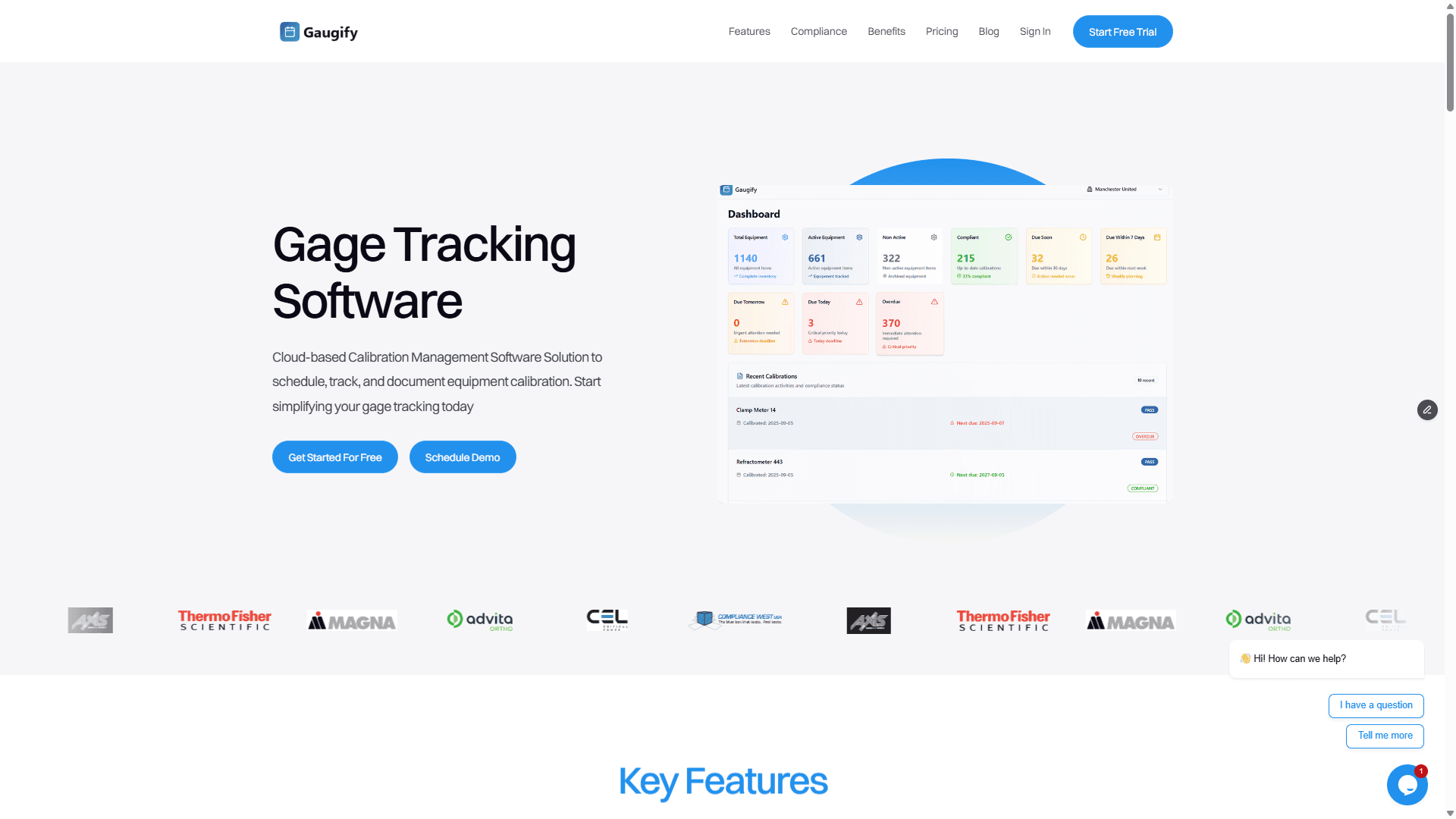
Gaugify automatically tracks calibration due dates and sends notifications before equipment expires. The system prevents overdue equipment from being used through status locks, ensuring CCP monitoring equipment never operates without valid calibration. Dashboard views show calibration status across your entire facility, making audit preparation effortless.
Comprehensive Documentation Management
Store all calibration certificates, procedures, and records in a centralized digital repository with unlimited file attachments. Advanced features include automatic certificate parsing, which extracts key calibration data from PDF certificates and populates your equipment records automatically.
Measurement Uncertainty Calculations
Built-in uncertainty calculators help you determine if your measurement capability meets food safety requirements. The system combines uncertainties from multiple sources and compares total uncertainty against your specification limits, ensuring adequate measurement capability for CCPs.
Audit-Ready Reporting
Generate comprehensive calibration reports filtered by location, equipment type, or criticality level. Compliance reports show calibration status, traceability documentation, and historical trends that demonstrate your calibration program's effectiveness to auditors.
Integration with Quality Systems
Gaugify integrates with leading quality management software to ensure calibration data flows seamlessly into your broader food safety management system. This eliminates duplicate data entry and ensures consistency across all your quality records.
Mobile Accessibility
Plant floor personnel can access calibration records, update equipment status, and initiate work orders directly from mobile devices. This real-time connectivity ensures calibration information remains current and accessible throughout your facility.
ISO 22000 Calibration Compliance Checklist
Use this comprehensive checklist to verify your calibration program meets all ISO 22000 requirements:
Equipment Management
Complete inventory of all monitoring and measuring equipment affecting food safety
Unique identification for each piece of equipment
Clear calibration status indicators (labels, stickers, or electronic displays)
Procedures for quarantining out-of-specification equipment
Regular review of equipment suitability for intended applications
Calibration Planning
Documented calibration intervals with technical justification
Calibration procedures covering all equipment types
Identification of required reference standards and their accuracy
Environmental condition requirements for each calibration type
Personnel competency requirements and training records
Calibration Execution
Current calibration certificates for all CCP monitoring equipment
Traceability to national standards through accredited laboratories
Appropriate measurement points covering actual use ranges
Documented as-found and as-left readings
Measurement uncertainty calculations where required
Record Management
Complete calibration history for each piece of equipment
Documentation of all out-of-specification events and corrective actions
Product impact assessments when equipment fails calibration
Calibration certificates and supporting documentation readily accessible
Regular backup and protection of calibration records
Program Management
Regular management review of calibration program effectiveness
Analysis of calibration trends and equipment performance
Internal audit coverage of calibration activities
Continuous improvement initiatives based on calibration data
Supplier evaluation for external calibration services
Achieving Long-Term ISO 22000 Calibration Success
Maintaining ISO 22000 calibration compliance requires ongoing attention to detail, robust systems, and a commitment to continuous improvement. The food safety implications of measurement accuracy make calibration one of the most scrutinized aspects of any ISO 22000 audit.
Successful organizations recognize that calibration management extends beyond simple compliance checking. It involves understanding measurement uncertainty, optimizing calibration intervals based on equipment performance data, and ensuring that measurement capability always exceeds food safety requirements.
Modern calibration management software has transformed how food companies approach ISO 22000 compliance. By automating routine tasks, providing real-time visibility into calibration status, and generating comprehensive documentation, these systems allow quality professionals to focus on strategic improvement rather than administrative burden.
Gaugify's specialized calibration platform has helped hundreds of food manufacturers achieve and maintain ISO 22000 compliance while reducing calibration costs and improving operational efficiency. The system's food industry focus ensures that every feature addresses real-world challenges faced by quality managers in food processing environments.
Don't let calibration management complexity compromise your food safety program or audit readiness. Schedule a personalized demo to see how Gaugify can transform your ISO 22000 calibration compliance from a time-consuming burden into a competitive advantage. Start your journey toward effortless calibration management today and ensure your food safety measurements remain accurate, traceable, and audit-ready at all times.
ISO 22000 Calibration Requirements for Food Safety
ISO 22000 calibration requirements are critical for maintaining food safety management systems across the entire food chain. From meat processing plants measuring internal temperatures with digital thermometers to dairy facilities monitoring pasteurization with RTDs, proper calibration ensures your measurements are accurate and your food products remain safe for consumption. This comprehensive guide breaks down exactly what ISO 22000 demands for calibration and how to achieve full compliance.
Understanding ISO 22000 and Its Calibration Scope
ISO 22000:2018 Food Safety Management Systems applies to organizations throughout the food chain, including primary producers, feed manufacturers, food processors, transport and storage operators, retailers, and food service providers. The standard integrates HACCP principles with prerequisite programs and management system requirements.
Unlike some other ISO standards, ISO 22000 doesn't dedicate an entire clause specifically to calibration. Instead, calibration requirements are woven throughout the standard, particularly in sections dealing with monitoring and measurement equipment used for food safety.
The calibration requirements primarily focus on equipment used to monitor Critical Control Points (CCPs) and Operational Prerequisite Programs (OPRPs). This includes:
Temperature monitoring equipment - Digital thermometers, thermocouples, RTDs, and infrared thermometers used in cooking, cooling, and storage
pH meters - Critical for acidified foods and fermentation processes
Water activity meters - Essential for shelf-stable product validation
Metal detectors - Requiring regular calibration with test pieces of known sizes
Scales and balances - Used for ingredient measurement and portion control
Pressure gauges - Monitoring retort operations and packaging systems
Flow meters - Measuring sanitizer concentrations and CIP systems
Key ISO 22000 Calibration Requirements Explained
Clause 8.5.1 - Monitoring and Measurement
This clause requires organizations to determine what monitoring and measurement activities are necessary to provide evidence of conformity. For calibration specifically, it mandates that:
Equipment must be suitable for the specific type of monitoring and measurement activities being undertaken. A basic dial thermometer with ±2°C accuracy won't suffice for monitoring a CCP where the critical limit is 165°F ±1°F for pathogen destruction.
Equipment must be maintained to ensure continuing fitness for purpose. This means establishing calibration frequencies based on manufacturer recommendations, usage intensity, and criticality to food safety. A thermometer used 50 times daily in a high-volume kitchen requires more frequent calibration than one used weekly in a small bakery.
Clause 8.5.2 - Internal Audit
Internal audits must verify that calibration activities conform to planned arrangements. Auditors should check calibration certificates, due dates, and that out-of-specification equipment is immediately removed from service. They'll also verify that calibration records demonstrate traceability to national or international standards.
Clause 8.6 - Management Review
Management reviews must consider the performance of monitoring and measurement processes, including calibration effectiveness. This means analyzing trends in calibration results, identifying equipment that frequently drifts out of specification, and making decisions about replacement or more frequent calibration intervals.
What Auditors Look for During ISO 22000 Calibration Assessments
Third-party auditors conducting ISO 22000 assessments focus heavily on calibration evidence because measurement accuracy directly impacts food safety. Here's exactly what they examine:
Equipment Inventory and Identification
Auditors expect a complete inventory of all monitoring and measuring equipment affecting food safety. Each piece should have unique identification - asset tags, serial numbers, or internal codes that link to calibration records. They'll walk your facility and randomly select equipment to trace back to calibration documentation.
Calibration Status Verification
Every piece of equipment must display current calibration status through labels, stickers, or electronic indicators. Auditors will check multiple instruments to ensure none are overdue. They'll also verify that any equipment found out of calibration has been quarantined and that product safety assessments were conducted.
Traceability Documentation
Calibration certificates must demonstrate unbroken traceability to national standards through accredited laboratories. Auditors will examine certificates for completeness, checking that measurement points cover the actual use range, uncertainties are appropriate, and calibration intervals are justified.
Competency Records
For organizations performing internal calibrations, auditors verify that personnel have appropriate training and competency records. This includes understanding measurement uncertainty, proper calibration procedures, and when to escalate out-of-specification results.
Ready to streamline your ISO 22000 calibration management? Start your free Gaugify trial and see how leading food manufacturers maintain audit-ready calibration records effortlessly.
Essential Documentation for ISO 22000 Calibration Compliance
Proper documentation forms the backbone of ISO 22000 calibration compliance. Your calibration management system must maintain comprehensive records that demonstrate ongoing conformity.
Calibration Procedures
Document step-by-step calibration procedures for each type of equipment, including:
Environmental conditions required (temperature, humidity ranges)
Reference standards to be used with their accuracy specifications
Measurement points and acceptance criteria
Actions to take when equipment fails calibration
Personnel qualifications required to perform the calibration
Calibration Records
Every calibration event must be documented with:
Equipment identification and location
Calibration date and next due date
Personnel who performed the calibration
Environmental conditions during calibration
Reference standards used with their calibration status
As-found and as-left readings at each measurement point
Measurement uncertainty calculations
Pass/fail determination and any corrective actions
Equipment History Files
Maintain individual files for each piece of equipment containing purchase records, user manuals, calibration history, repair records, and any modifications. This historical data helps establish optimal calibration intervals and identify trends that might indicate impending failure.
Measurement Uncertainty Budgets
For critical measurements, document uncertainty budgets that account for all sources of measurement error including the instrument, reference standard, environmental conditions, and operator technique. This demonstrates that your measurement capability is adequate for the intended application.
Common ISO 22000 Calibration Non-Conformances
Based on actual audit findings across the food industry, these calibration-related non-conformances appear most frequently during ISO 22000 assessments:
Inadequate Calibration Intervals
Many organizations default to annual calibration intervals without justification. A bakery using digital scales to measure critical allergen ingredients at 0.1% of finished product weight needs more frequent calibration than scales used for bulk flour measurement. Auditors expect interval decisions based on equipment stability, usage frequency, and measurement criticality.
Missing Calibration for CCP Monitoring Equipment
The most serious non-conformance occurs when equipment monitoring Critical Control Points lacks current calibration. For example, a meat processor failed calibration on thermometers monitoring cooking temperature CCPs. Since accurate temperature measurement directly relates to pathogen destruction, this created both a calibration non-conformance and a food safety violation.
Inadequate Response to Out-of-Specification Results
When equipment fails calibration, organizations must evaluate the impact on product safety. A dairy plant's pasteurization temperature recorder was found reading 2°C low during calibration. The plant failed to assess whether products processed since the last successful calibration met safety requirements, creating a major non-conformance.
Poor Traceability Documentation
Calibration certificates from non-accredited sources or missing uncertainty statements frequently trigger non-conformances. ISO 22000 requires measurement traceability to national standards, which means using ISO/IEC 17025 accredited calibration laboratories or demonstrating equivalent traceability for internal calibrations.
Inadequate Environmental Controls
Performing calibrations in unsuitable environments compromises results. A food processor calibrating precision balances in an area with temperature fluctuations of ±10°C and significant vibration received a non-conformance because environmental conditions affected calibration validity.
How Gaugify Ensures ISO 22000 Calibration Compliance
Gaugify's calibration management platform addresses every ISO 22000 calibration requirement through purpose-built features designed for food safety compliance:
Automated Compliance Tracking
Gaugify automatically tracks calibration due dates and sends notifications before equipment expires. The system prevents overdue equipment from being used through status locks, ensuring CCP monitoring equipment never operates without valid calibration. Dashboard views show calibration status across your entire facility, making audit preparation effortless.
Comprehensive Documentation Management
Store all calibration certificates, procedures, and records in a centralized digital repository with unlimited file attachments. Advanced features include automatic certificate parsing, which extracts key calibration data from PDF certificates and populates your equipment records automatically.
Measurement Uncertainty Calculations
Built-in uncertainty calculators help you determine if your measurement capability meets food safety requirements. The system combines uncertainties from multiple sources and compares total uncertainty against your specification limits, ensuring adequate measurement capability for CCPs.
Audit-Ready Reporting
Generate comprehensive calibration reports filtered by location, equipment type, or criticality level. Compliance reports show calibration status, traceability documentation, and historical trends that demonstrate your calibration program's effectiveness to auditors.
Integration with Quality Systems
Gaugify integrates with leading quality management software to ensure calibration data flows seamlessly into your broader food safety management system. This eliminates duplicate data entry and ensures consistency across all your quality records.
Mobile Accessibility
Plant floor personnel can access calibration records, update equipment status, and initiate work orders directly from mobile devices. This real-time connectivity ensures calibration information remains current and accessible throughout your facility.
ISO 22000 Calibration Compliance Checklist
Use this comprehensive checklist to verify your calibration program meets all ISO 22000 requirements:
Equipment Management
Complete inventory of all monitoring and measuring equipment affecting food safety
Unique identification for each piece of equipment
Clear calibration status indicators (labels, stickers, or electronic displays)
Procedures for quarantining out-of-specification equipment
Regular review of equipment suitability for intended applications
Calibration Planning
Documented calibration intervals with technical justification
Calibration procedures covering all equipment types
Identification of required reference standards and their accuracy
Environmental condition requirements for each calibration type
Personnel competency requirements and training records
Calibration Execution
Current calibration certificates for all CCP monitoring equipment
Traceability to national standards through accredited laboratories
Appropriate measurement points covering actual use ranges
Documented as-found and as-left readings
Measurement uncertainty calculations where required
Record Management
Complete calibration history for each piece of equipment
Documentation of all out-of-specification events and corrective actions
Product impact assessments when equipment fails calibration
Calibration certificates and supporting documentation readily accessible
Regular backup and protection of calibration records
Program Management
Regular management review of calibration program effectiveness
Analysis of calibration trends and equipment performance
Internal audit coverage of calibration activities
Continuous improvement initiatives based on calibration data
Supplier evaluation for external calibration services
Achieving Long-Term ISO 22000 Calibration Success
Maintaining ISO 22000 calibration compliance requires ongoing attention to detail, robust systems, and a commitment to continuous improvement. The food safety implications of measurement accuracy make calibration one of the most scrutinized aspects of any ISO 22000 audit.
Successful organizations recognize that calibration management extends beyond simple compliance checking. It involves understanding measurement uncertainty, optimizing calibration intervals based on equipment performance data, and ensuring that measurement capability always exceeds food safety requirements.
Modern calibration management software has transformed how food companies approach ISO 22000 compliance. By automating routine tasks, providing real-time visibility into calibration status, and generating comprehensive documentation, these systems allow quality professionals to focus on strategic improvement rather than administrative burden.
Gaugify's specialized calibration platform has helped hundreds of food manufacturers achieve and maintain ISO 22000 compliance while reducing calibration costs and improving operational efficiency. The system's food industry focus ensures that every feature addresses real-world challenges faced by quality managers in food processing environments.
Don't let calibration management complexity compromise your food safety program or audit readiness. Schedule a personalized demo to see how Gaugify can transform your ISO 22000 calibration compliance from a time-consuming burden into a competitive advantage. Start your journey toward effortless calibration management today and ensure your food safety measurements remain accurate, traceable, and audit-ready at all times.