
Calibration Management Software for Aerospace Tier 1 Suppliers
Calibration Management Software for Aerospace Tier 1 Suppliers
David Bentley
Quality Assurance Engineer
12 min read
Calibration Management Software for Aerospace Tier 1 Suppliers
Aerospace Tier 1 suppliers face unprecedented pressure to maintain measurement traceability while meeting the demanding delivery schedules of prime contractors like Boeing, Airbus, and Lockheed Martin. The complexity of managing thousands of precision measuring instruments across multiple production lines, combined with stringent quality standards, makes calibration software aerospace tier 1 suppliers a critical investment for operational excellence and compliance integrity.
When a single out-of-tolerance torque wrench can ground an entire aircraft fleet or delay a multi-million dollar delivery, the stakes couldn't be higher. Traditional paper-based calibration systems and basic spreadsheets simply cannot handle the volume, complexity, and audit requirements that aerospace tier 1 suppliers face daily.
The Calibration Challenge: Aerospace Tier 1 Complexity
Aerospace tier 1 suppliers operate in a uniquely demanding environment where measurement precision directly impacts flight safety. Consider a typical scenario: Collins Aerospace managing 15,000+ measuring instruments across their avionics manufacturing facilities, or Spirit AeroSystems coordinating calibration schedules for composite manufacturing equipment with tolerances measured in thousandths of an inch.
The primary challenges these suppliers face include:
Scale and Complexity: Managing 5,000-50,000+ instruments across multiple facilities and production lines
Critical Timing: Avoiding production delays when key measurement equipment requires calibration during peak delivery periods
Traceability Requirements: Maintaining unbroken chains of traceability to national standards for every measurement
Multi-Standard Compliance: Simultaneously meeting AS9100, ISO 9001, NADCAP, and customer-specific requirements
Audit Intensity: Preparing for frequent audits from primes, NADCAP, and regulatory bodies
Cost Pressure: Minimizing calibration costs while maintaining the highest quality standards
A single compliance failure can result in production shutdowns, costly rework, delayed deliveries, and potentially losing contracts worth hundreds of millions of dollars.
Mission-Critical Equipment: What Aerospace Tier 1 Suppliers Calibrate
The breadth of precision measuring equipment in aerospace tier 1 facilities is staggering. Each instrument type requires specific calibration procedures, frequencies, and uncertainty calculations:
Dimensional Measurement Equipment
Coordinate Measuring Machines (CMMs): Hexagon, Zeiss, and Mitutoyo CMMs measuring wing components with tolerances of ±0.0005"
Optical Comparators: Starrett and Nikon systems for complex airfoil inspections
Height Gages: Mitutoyo and Starrett digital height gages for turbine blade measurements
Micrometers and Calipers: Thousands of handheld instruments with calibration cycles every 6-12 months
Pin Gages and Ring Gages: Go/no-go gages for fastener hole inspections
Torque and Force Equipment
Torque Wrenches: Snap-on, CDI, and Norbar wrenches from 5 in-lbs to 2000 ft-lbs for critical fastening operations
Torque Multipliers: High-capacity tools for main landing gear assembly
Force Gages: Chatillon and Mark-10 systems for control cable tension verification
Load Cells: Interface and Honeywell load cells for structural testing
Environmental and Process Equipment
Temperature Sensors: RTDs, thermocouples, and infrared pyrometers for heat treatment processes
Pressure Gages: Ashcroft, WIKA, and Omega instruments for hydraulic and pneumatic systems
Flow Meters: Fuel system testing equipment requiring NIST traceability
Vibration Analyzers: PCB Piezotronics equipment for engine component testing
Non-Destructive Testing (NDT) Equipment
Ultrasonic Thickness Gages: Olympus and GE equipment for composite inspections
Eddy Current Systems: Zetec and Olympus systems for crack detection
Radiographic Equipment: X-ray systems requiring specialized calibration procedures
Aerospace Quality Standards: The Calibration Software Aerospace Tier 1 Must Address
Aerospace tier 1 suppliers must simultaneously comply with multiple overlapping quality standards, each with specific calibration requirements:
AS9100 Rev D Requirements
AS9100, the aerospace quality management standard, builds upon ISO 9001 with additional requirements specific to aviation, space, and defense. Section 7.1.5 specifically addresses monitoring and measuring resources, requiring:
Calibration against measurement standards traceable to international or national standards
Protection from adjustments that would invalidate calibration status
Clear identification of calibration status
Documentation of calibration procedures and results
For example, when Safran calibrates their turbine blade measurement CMMs, they must demonstrate traceability through an unbroken chain to NIST standards, with uncertainty budgets calculated at each step.
NADCAP Accreditation
The National Aerospace and Defense Contractors Accreditation Program (NADCAP) requires even more stringent calibration controls. NADCAP audits focus heavily on:
Gage R&R Studies: Statistical validation that measurement systems are capable of detecting part-to-part variation
Uncertainty Analysis: Detailed calculations showing that measurement uncertainty is appropriate for the tolerance being measured
Environmental Controls: Temperature, humidity, and vibration controls in calibration laboratories
Personnel Qualification: Training records for all calibration technicians
Customer-Specific Requirements
Prime contractors often impose additional requirements beyond standard certifications:
Boeing: D1-9000 requires specific calibration intervals and uncertainty ratios
Airbus: AIMS requirements for measurement system analysis
Lockheed Martin: Additional documentation requirements for critical measurements
Pratt & Whitney: Specific requirements for turbine engine component measurements
Audit Scenarios: What Aerospace Calibration Auditors Examine
Understanding what auditors look for helps aerospace tier 1 suppliers prepare more effectively. Here are common audit scenarios and the specific evidence auditors examine:
Scenario 1: NADCAP Measurement and Inspection Audit
The auditor selects a critical turbine blade measurement and traces the entire measurement chain:
Measurement Procedure: Is the measurement method clearly defined with acceptance criteria?
Equipment Selection: Is the CMM capable of measuring the required tolerance (typically 10:1 accuracy ratio)?
Calibration Status: Current calibration certificate with valid dates and uncertainty calculations
Traceability Chain: Unbroken chain from the part measurement back to NIST standards
Environmental Conditions: Temperature records showing 68°F ± 2°F during measurement
Operator Qualification: Training records for the CMM operator
Scenario 2: AS9100 Management System Audit
The auditor examines the overall calibration management system:
Calibration Schedule: How does the organization ensure instruments are calibrated before they expire?
Recall System: What happens when a calibration laboratory notifies the supplier of an out-of-tolerance condition?
Risk Assessment: How are calibration intervals determined and adjusted based on usage and drift patterns?
Nonconforming Product: What products were measured with out-of-tolerance equipment?
Scenario 3: Prime Contractor Quality Survey
Boeing's supplier quality team visits to assess measurement capabilities for a new wing component contract:
Measurement Capability: Can the supplier's equipment measure the tightest tolerances (±0.0005") with adequate uncertainty?
Calibration Intervals: Are intervals appropriate for the criticality of measurements?
Statistical Control: Evidence of Gage R&R studies and statistical process control
Continuous Improvement: How does the supplier optimize calibration costs while maintaining quality?
In each scenario, auditors expect to see real-time access to calibration records, clear audit trails, and evidence of proactive management rather than reactive fire-fighting.
How Calibration Software Aerospace Tier 1 Suppliers Choose Solves Critical Pain Points
Modern calibration management software like Gaugify addresses each of the specific challenges aerospace tier 1 suppliers face:
Automated Scheduling and Notifications
Instead of managing calibration schedules in spreadsheets, Gaugify automatically tracks calibration due dates for thousands of instruments. For example, when Collins Aerospace has 847 torque wrenches due for calibration next month across 12 facilities, the system automatically:
Generates work orders grouped by calibration laboratory and instrument type
Sends email notifications to technicians and supervisors 30, 14, and 7 days before due dates
Optimizes calibration batches to minimize production disruption
Tracks instruments from the moment they leave production until they return calibrated
This eliminates the common problem of discovering that critical production equipment is overdue during a rush delivery period.
Digital Calibration Certificates and Records
Paper calibration certificates are easily lost, damaged, or difficult to access during audits. Gaugify stores digital certificates with complete traceability information:
Searchable Database: Find any calibration record instantly by serial number, location, or calibration date
Complete Traceability: Every certificate includes the complete chain of traceability back to national standards
Uncertainty Calculations: Automated uncertainty budgets ensure measurement capability is adequate
Revision Control: Track changes to calibration procedures and ensure technicians use current versions
When a NADCAP auditor asks to see the calibration record for CMM serial number CMM-2157 that measured turbine blade TB-4429 on March 15th, the answer is available in seconds rather than hours.
Automated Compliance Reporting
Gaugify's compliance features generate the reports aerospace tier 1 suppliers need for various audit scenarios:
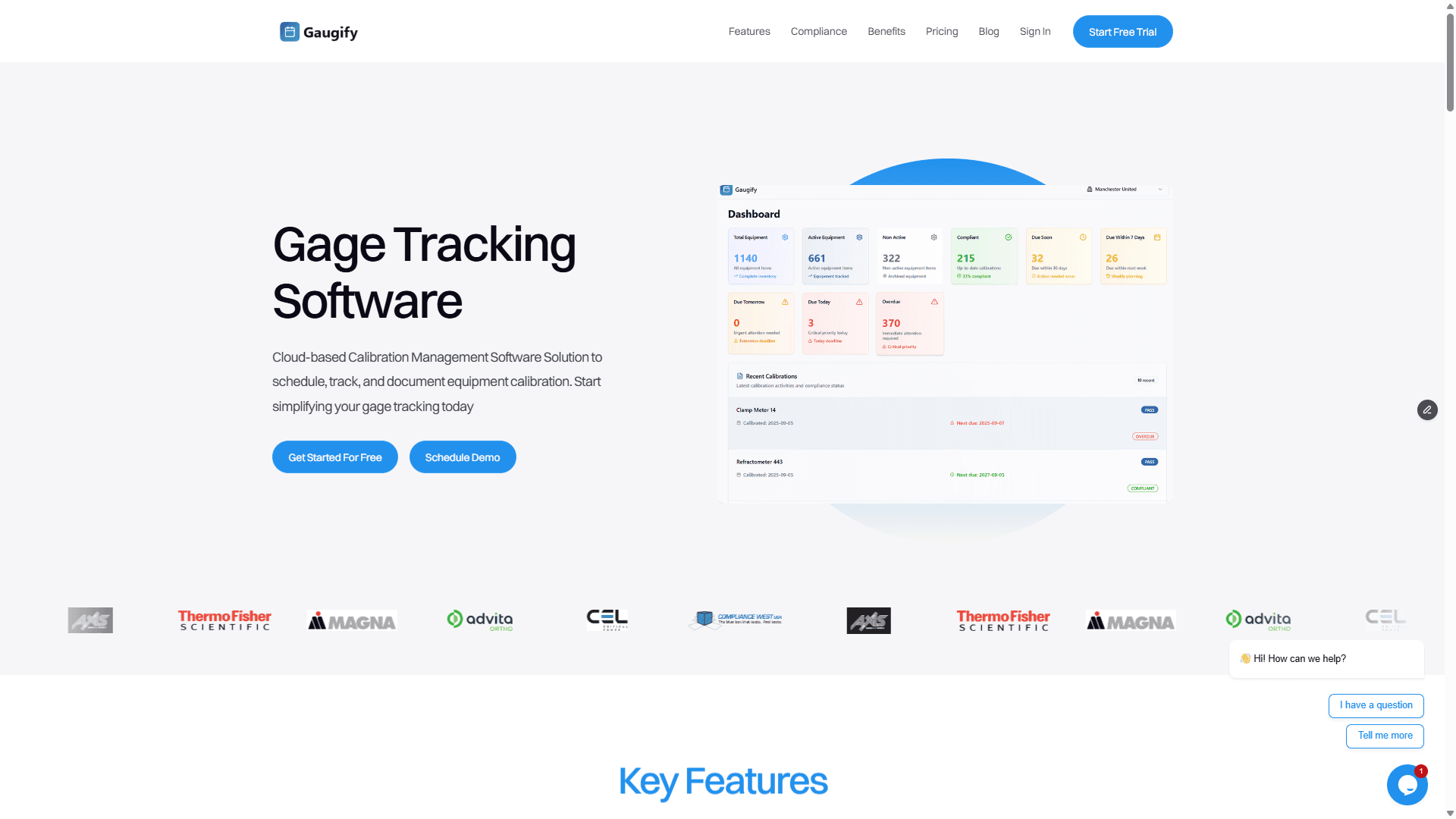
Calibration Status Reports: Real-time dashboard showing instruments due, overdue, or requiring attention
Traceability Reports: Complete measurement uncertainty budgets for any instrument or measurement
Recall Investigation Reports: When a calibration lab reports an out-of-tolerance condition, instantly identify all affected products
Statistical Analysis: Drift analysis and calibration interval optimization based on historical data
Ready to see how modern calibration management software can transform your aerospace quality operations? Start your free trial today and discover why leading aerospace suppliers choose Gaugify to manage their critical calibration programs.
Integration with Quality Management Systems
Aerospace tier 1 suppliers typically use enterprise quality management systems like ETQ, MasterControl, or SAP Quality Management. Gaugify integrates seamlessly with these systems to:
Automatically create nonconformance records when calibrations reveal out-of-tolerance conditions
Link calibration records to specific production lots or serial numbers
Generate corrective action requests when calibration intervals need adjustment
Provide measurement data for statistical process control charts
Multi-Site and Multi-Customer Management
Large aerospace tier 1 suppliers often operate multiple facilities serving different customers with varying requirements. Gaugify handles this complexity by:
Site-Specific Configurations: Different calibration intervals and procedures for each facility
Customer-Specific Requirements: Separate compliance rules for Boeing vs. Airbus contracts
Centralized Visibility: Corporate quality managers can see calibration status across all sites
Local Control: Plant quality managers retain control over day-to-day operations
The ROI of Modern Calibration Software Aerospace Tier 1 Operations
The investment in professional calibration management software pays dividends through multiple channels:
Reduced Audit Preparation Time
Spirit AeroSystems reduced NADCAP audit preparation from 200+ hours to less than 20 hours by implementing automated calibration record management. Instead of manually collecting calibration certificates from filing cabinets, auditors can access any record instantly through Gaugify's search interface.
Optimized Calibration Intervals
Statistical analysis of calibration data allows suppliers to optimize intervals without compromising quality. For example, if torque wrench drift analysis shows consistent performance over 18 months instead of 12, extending the interval saves significant calibration costs while maintaining measurement integrity.
Eliminated Production Delays
Automated scheduling prevents the costly scenario where critical production equipment is discovered overdue during peak production periods. The cost of delaying a single aircraft delivery can exceed $100,000 per day.
Reduced Calibration Administrative Costs
Automation eliminates many manual tasks:
No more manual tracking of calibration due dates
Automated generation of calibration work orders
Electronic approval workflows for calibration procedures
Instant access to calibration records eliminates search time
Selecting the Right Calibration Software for Aerospace Tier 1 Requirements
Not all calibration management software is suitable for aerospace tier 1 suppliers. Key selection criteria include:
Aerospace-Specific Features
AS9100 and NADCAP Compliance: Built-in templates and workflows for aerospace requirements
Uncertainty Analysis: Automated calculation of measurement uncertainty budgets
Statistical Analysis: Gage R&R integration and calibration interval optimization
Multi-Standard Support: Simultaneous compliance with multiple quality standards
Enterprise Scalability
High Volume Capacity: Support for 10,000+ instruments across multiple sites
Performance: Fast search and reporting even with years of historical data
Integration Capability: APIs for connecting with ERP and quality management systems
Security: Role-based access control and audit trails meeting aerospace security requirements
Implementation and Support
Rapid Deployment: Cloud-based systems that can be operational within weeks
Data Migration: Tools to import existing calibration records and equipment lists
Training and Support: Comprehensive training programs for quality technicians and managers
Ongoing Updates: Regular software updates to address changing regulatory requirements
Gaugify's feature set addresses each of these requirements, with specific capabilities designed for the aerospace industry's unique demands.
Implementation Strategy: Getting Started with Calibration Software
Successful implementation of calibration management software in aerospace tier 1 operations requires careful planning:
Phase 1: Data Preparation and Migration
Most aerospace suppliers have equipment lists scattered across multiple spreadsheets and databases. The first phase involves:
Consolidating equipment master lists with serial numbers, models, and locations
Gathering historical calibration data and certificates
Standardizing calibration procedures and acceptance criteria
Defining user roles and access permissions
Phase 2: Pilot Implementation
Start with a subset of critical equipment or a single production line:
Configure the system for high-value instruments like CMMs and specialized gages
Train key personnel on system operation
Validate that automated workflows match existing procedures
Generate sample reports for audit readiness
Phase 3: Full Rollout
Expand to all equipment and locations:
Import complete equipment databases
Train all quality technicians and supervisors
Integrate with existing quality management systems
Establish Key Performance Indicators (KPIs) for calibration program effectiveness
The entire implementation typically takes 60-90 days for mid-size suppliers and up to 6 months for large multi-site operations.
Measuring Success
Aerospace tier 1 suppliers should track specific metrics to validate their calibration software investment:
Audit Preparation Time: Hours required to prepare for quality audits
Calibration Compliance Rate: Percentage of instruments calibrated before due date
Administrative Time Savings: Hours saved on calibration scheduling and record keeping
Production Disruption Events: Number of times production stopped due to overdue calibration equipment
Calibration Cost per Instrument: Total cost including labor, external services, and administrative overhead
Future Trends in Aerospace Calibration Management
The aerospace industry continues evolving, and calibration management software must adapt to emerging trends:
Industry 4.0 and Smart Manufacturing
Integration with IoT sensors and smart manufacturing systems will enable:
Condition-Based Calibration: Adjusting calibration intervals based on actual usage and environmental conditions
Real-Time Monitoring: Continuous monitoring of critical measurement equipment performance
Predictive Analytics: Using machine learning to predict calibration failures before they occur
Additive Manufacturing
As aerospace companies adopt 3D printing for production parts, new measurement challenges emerge:
Specialized measurement equipment for complex geometries
New material properties requiring different measurement approaches
Increased importance of dimensional measurements in powder bed fusion processes
Digital Transformation
The move toward paperless quality systems accelerates the need for:
Mobile access to calibration records on the shop floor
Electronic signatures and approval workflows
AI-powered analysis of calibration trends and patterns
Integration with digital quality management ecosystems
Modern calibration management software like Gaugify positions aerospace tier 1 suppliers to take advantage of these emerging technologies while maintaining compliance with existing quality standards.
Conclusion: Elevating Aerospace Quality Through Modern Calibration Management
Aerospace tier 1 suppliers operate in an environment where measurement precision directly impacts flight safety and operational success. The complexity of managing thousands of precision instruments while meeting the demanding requirements of AS9100, NADCAP, and prime contractor specifications requires sophisticated calibration management capabilities that go far beyond spreadsheets and paper certificates.
Modern calibration software aerospace tier 1 suppliers like Gaugify provides the automation, traceability, and audit readiness that today's aerospace quality programs demand. From automated scheduling that prevents production delays to comprehensive uncertainty analysis that satisfies the most demanding auditors, the right software investment transforms calibration from a compliance burden into a competitive advantage.
The aerospace industry's future depends on suppliers who can deliver unprecedented levels of quality while controlling costs and meeting aggressive delivery schedules. Calibration management software isn't just a quality tool—it's a strategic capability that enables aerospace tier 1 suppliers to excel in an increasingly demanding marketplace.
Ready to Transform Your Aerospace Calibration Program?
Join leading aerospace tier 1 suppliers who rely on Gaugify to manage their critical calibration programs. See why companies trust us with their most demanding quality requirements.
Calibration Management Software for Aerospace Tier 1 Suppliers
Aerospace Tier 1 suppliers face unprecedented pressure to maintain measurement traceability while meeting the demanding delivery schedules of prime contractors like Boeing, Airbus, and Lockheed Martin. The complexity of managing thousands of precision measuring instruments across multiple production lines, combined with stringent quality standards, makes calibration software aerospace tier 1 suppliers a critical investment for operational excellence and compliance integrity.
When a single out-of-tolerance torque wrench can ground an entire aircraft fleet or delay a multi-million dollar delivery, the stakes couldn't be higher. Traditional paper-based calibration systems and basic spreadsheets simply cannot handle the volume, complexity, and audit requirements that aerospace tier 1 suppliers face daily.
The Calibration Challenge: Aerospace Tier 1 Complexity
Aerospace tier 1 suppliers operate in a uniquely demanding environment where measurement precision directly impacts flight safety. Consider a typical scenario: Collins Aerospace managing 15,000+ measuring instruments across their avionics manufacturing facilities, or Spirit AeroSystems coordinating calibration schedules for composite manufacturing equipment with tolerances measured in thousandths of an inch.
The primary challenges these suppliers face include:
Scale and Complexity: Managing 5,000-50,000+ instruments across multiple facilities and production lines
Critical Timing: Avoiding production delays when key measurement equipment requires calibration during peak delivery periods
Traceability Requirements: Maintaining unbroken chains of traceability to national standards for every measurement
Multi-Standard Compliance: Simultaneously meeting AS9100, ISO 9001, NADCAP, and customer-specific requirements
Audit Intensity: Preparing for frequent audits from primes, NADCAP, and regulatory bodies
Cost Pressure: Minimizing calibration costs while maintaining the highest quality standards
A single compliance failure can result in production shutdowns, costly rework, delayed deliveries, and potentially losing contracts worth hundreds of millions of dollars.
Mission-Critical Equipment: What Aerospace Tier 1 Suppliers Calibrate
The breadth of precision measuring equipment in aerospace tier 1 facilities is staggering. Each instrument type requires specific calibration procedures, frequencies, and uncertainty calculations:
Dimensional Measurement Equipment
Coordinate Measuring Machines (CMMs): Hexagon, Zeiss, and Mitutoyo CMMs measuring wing components with tolerances of ±0.0005"
Optical Comparators: Starrett and Nikon systems for complex airfoil inspections
Height Gages: Mitutoyo and Starrett digital height gages for turbine blade measurements
Micrometers and Calipers: Thousands of handheld instruments with calibration cycles every 6-12 months
Pin Gages and Ring Gages: Go/no-go gages for fastener hole inspections
Torque and Force Equipment
Torque Wrenches: Snap-on, CDI, and Norbar wrenches from 5 in-lbs to 2000 ft-lbs for critical fastening operations
Torque Multipliers: High-capacity tools for main landing gear assembly
Force Gages: Chatillon and Mark-10 systems for control cable tension verification
Load Cells: Interface and Honeywell load cells for structural testing
Environmental and Process Equipment
Temperature Sensors: RTDs, thermocouples, and infrared pyrometers for heat treatment processes
Pressure Gages: Ashcroft, WIKA, and Omega instruments for hydraulic and pneumatic systems
Flow Meters: Fuel system testing equipment requiring NIST traceability
Vibration Analyzers: PCB Piezotronics equipment for engine component testing
Non-Destructive Testing (NDT) Equipment
Ultrasonic Thickness Gages: Olympus and GE equipment for composite inspections
Eddy Current Systems: Zetec and Olympus systems for crack detection
Radiographic Equipment: X-ray systems requiring specialized calibration procedures
Aerospace Quality Standards: The Calibration Software Aerospace Tier 1 Must Address
Aerospace tier 1 suppliers must simultaneously comply with multiple overlapping quality standards, each with specific calibration requirements:
AS9100 Rev D Requirements
AS9100, the aerospace quality management standard, builds upon ISO 9001 with additional requirements specific to aviation, space, and defense. Section 7.1.5 specifically addresses monitoring and measuring resources, requiring:
Calibration against measurement standards traceable to international or national standards
Protection from adjustments that would invalidate calibration status
Clear identification of calibration status
Documentation of calibration procedures and results
For example, when Safran calibrates their turbine blade measurement CMMs, they must demonstrate traceability through an unbroken chain to NIST standards, with uncertainty budgets calculated at each step.
NADCAP Accreditation
The National Aerospace and Defense Contractors Accreditation Program (NADCAP) requires even more stringent calibration controls. NADCAP audits focus heavily on:
Gage R&R Studies: Statistical validation that measurement systems are capable of detecting part-to-part variation
Uncertainty Analysis: Detailed calculations showing that measurement uncertainty is appropriate for the tolerance being measured
Environmental Controls: Temperature, humidity, and vibration controls in calibration laboratories
Personnel Qualification: Training records for all calibration technicians
Customer-Specific Requirements
Prime contractors often impose additional requirements beyond standard certifications:
Boeing: D1-9000 requires specific calibration intervals and uncertainty ratios
Airbus: AIMS requirements for measurement system analysis
Lockheed Martin: Additional documentation requirements for critical measurements
Pratt & Whitney: Specific requirements for turbine engine component measurements
Audit Scenarios: What Aerospace Calibration Auditors Examine
Understanding what auditors look for helps aerospace tier 1 suppliers prepare more effectively. Here are common audit scenarios and the specific evidence auditors examine:
Scenario 1: NADCAP Measurement and Inspection Audit
The auditor selects a critical turbine blade measurement and traces the entire measurement chain:
Measurement Procedure: Is the measurement method clearly defined with acceptance criteria?
Equipment Selection: Is the CMM capable of measuring the required tolerance (typically 10:1 accuracy ratio)?
Calibration Status: Current calibration certificate with valid dates and uncertainty calculations
Traceability Chain: Unbroken chain from the part measurement back to NIST standards
Environmental Conditions: Temperature records showing 68°F ± 2°F during measurement
Operator Qualification: Training records for the CMM operator
Scenario 2: AS9100 Management System Audit
The auditor examines the overall calibration management system:
Calibration Schedule: How does the organization ensure instruments are calibrated before they expire?
Recall System: What happens when a calibration laboratory notifies the supplier of an out-of-tolerance condition?
Risk Assessment: How are calibration intervals determined and adjusted based on usage and drift patterns?
Nonconforming Product: What products were measured with out-of-tolerance equipment?
Scenario 3: Prime Contractor Quality Survey
Boeing's supplier quality team visits to assess measurement capabilities for a new wing component contract:
Measurement Capability: Can the supplier's equipment measure the tightest tolerances (±0.0005") with adequate uncertainty?
Calibration Intervals: Are intervals appropriate for the criticality of measurements?
Statistical Control: Evidence of Gage R&R studies and statistical process control
Continuous Improvement: How does the supplier optimize calibration costs while maintaining quality?
In each scenario, auditors expect to see real-time access to calibration records, clear audit trails, and evidence of proactive management rather than reactive fire-fighting.
How Calibration Software Aerospace Tier 1 Suppliers Choose Solves Critical Pain Points
Modern calibration management software like Gaugify addresses each of the specific challenges aerospace tier 1 suppliers face:
Automated Scheduling and Notifications
Instead of managing calibration schedules in spreadsheets, Gaugify automatically tracks calibration due dates for thousands of instruments. For example, when Collins Aerospace has 847 torque wrenches due for calibration next month across 12 facilities, the system automatically:
Generates work orders grouped by calibration laboratory and instrument type
Sends email notifications to technicians and supervisors 30, 14, and 7 days before due dates
Optimizes calibration batches to minimize production disruption
Tracks instruments from the moment they leave production until they return calibrated
This eliminates the common problem of discovering that critical production equipment is overdue during a rush delivery period.
Digital Calibration Certificates and Records
Paper calibration certificates are easily lost, damaged, or difficult to access during audits. Gaugify stores digital certificates with complete traceability information:
Searchable Database: Find any calibration record instantly by serial number, location, or calibration date
Complete Traceability: Every certificate includes the complete chain of traceability back to national standards
Uncertainty Calculations: Automated uncertainty budgets ensure measurement capability is adequate
Revision Control: Track changes to calibration procedures and ensure technicians use current versions
When a NADCAP auditor asks to see the calibration record for CMM serial number CMM-2157 that measured turbine blade TB-4429 on March 15th, the answer is available in seconds rather than hours.
Automated Compliance Reporting
Gaugify's compliance features generate the reports aerospace tier 1 suppliers need for various audit scenarios:
Calibration Status Reports: Real-time dashboard showing instruments due, overdue, or requiring attention
Traceability Reports: Complete measurement uncertainty budgets for any instrument or measurement
Recall Investigation Reports: When a calibration lab reports an out-of-tolerance condition, instantly identify all affected products
Statistical Analysis: Drift analysis and calibration interval optimization based on historical data
Ready to see how modern calibration management software can transform your aerospace quality operations? Start your free trial today and discover why leading aerospace suppliers choose Gaugify to manage their critical calibration programs.
Integration with Quality Management Systems
Aerospace tier 1 suppliers typically use enterprise quality management systems like ETQ, MasterControl, or SAP Quality Management. Gaugify integrates seamlessly with these systems to:
Automatically create nonconformance records when calibrations reveal out-of-tolerance conditions
Link calibration records to specific production lots or serial numbers
Generate corrective action requests when calibration intervals need adjustment
Provide measurement data for statistical process control charts
Multi-Site and Multi-Customer Management
Large aerospace tier 1 suppliers often operate multiple facilities serving different customers with varying requirements. Gaugify handles this complexity by:
Site-Specific Configurations: Different calibration intervals and procedures for each facility
Customer-Specific Requirements: Separate compliance rules for Boeing vs. Airbus contracts
Centralized Visibility: Corporate quality managers can see calibration status across all sites
Local Control: Plant quality managers retain control over day-to-day operations
The ROI of Modern Calibration Software Aerospace Tier 1 Operations
The investment in professional calibration management software pays dividends through multiple channels:
Reduced Audit Preparation Time
Spirit AeroSystems reduced NADCAP audit preparation from 200+ hours to less than 20 hours by implementing automated calibration record management. Instead of manually collecting calibration certificates from filing cabinets, auditors can access any record instantly through Gaugify's search interface.
Optimized Calibration Intervals
Statistical analysis of calibration data allows suppliers to optimize intervals without compromising quality. For example, if torque wrench drift analysis shows consistent performance over 18 months instead of 12, extending the interval saves significant calibration costs while maintaining measurement integrity.
Eliminated Production Delays
Automated scheduling prevents the costly scenario where critical production equipment is discovered overdue during peak production periods. The cost of delaying a single aircraft delivery can exceed $100,000 per day.
Reduced Calibration Administrative Costs
Automation eliminates many manual tasks:
No more manual tracking of calibration due dates
Automated generation of calibration work orders
Electronic approval workflows for calibration procedures
Instant access to calibration records eliminates search time
Selecting the Right Calibration Software for Aerospace Tier 1 Requirements
Not all calibration management software is suitable for aerospace tier 1 suppliers. Key selection criteria include:
Aerospace-Specific Features
AS9100 and NADCAP Compliance: Built-in templates and workflows for aerospace requirements
Uncertainty Analysis: Automated calculation of measurement uncertainty budgets
Statistical Analysis: Gage R&R integration and calibration interval optimization
Multi-Standard Support: Simultaneous compliance with multiple quality standards
Enterprise Scalability
High Volume Capacity: Support for 10,000+ instruments across multiple sites
Performance: Fast search and reporting even with years of historical data
Integration Capability: APIs for connecting with ERP and quality management systems
Security: Role-based access control and audit trails meeting aerospace security requirements
Implementation and Support
Rapid Deployment: Cloud-based systems that can be operational within weeks
Data Migration: Tools to import existing calibration records and equipment lists
Training and Support: Comprehensive training programs for quality technicians and managers
Ongoing Updates: Regular software updates to address changing regulatory requirements
Gaugify's feature set addresses each of these requirements, with specific capabilities designed for the aerospace industry's unique demands.
Implementation Strategy: Getting Started with Calibration Software
Successful implementation of calibration management software in aerospace tier 1 operations requires careful planning:
Phase 1: Data Preparation and Migration
Most aerospace suppliers have equipment lists scattered across multiple spreadsheets and databases. The first phase involves:
Consolidating equipment master lists with serial numbers, models, and locations
Gathering historical calibration data and certificates
Standardizing calibration procedures and acceptance criteria
Defining user roles and access permissions
Phase 2: Pilot Implementation
Start with a subset of critical equipment or a single production line:
Configure the system for high-value instruments like CMMs and specialized gages
Train key personnel on system operation
Validate that automated workflows match existing procedures
Generate sample reports for audit readiness
Phase 3: Full Rollout
Expand to all equipment and locations:
Import complete equipment databases
Train all quality technicians and supervisors
Integrate with existing quality management systems
Establish Key Performance Indicators (KPIs) for calibration program effectiveness
The entire implementation typically takes 60-90 days for mid-size suppliers and up to 6 months for large multi-site operations.
Measuring Success
Aerospace tier 1 suppliers should track specific metrics to validate their calibration software investment:
Audit Preparation Time: Hours required to prepare for quality audits
Calibration Compliance Rate: Percentage of instruments calibrated before due date
Administrative Time Savings: Hours saved on calibration scheduling and record keeping
Production Disruption Events: Number of times production stopped due to overdue calibration equipment
Calibration Cost per Instrument: Total cost including labor, external services, and administrative overhead
Future Trends in Aerospace Calibration Management
The aerospace industry continues evolving, and calibration management software must adapt to emerging trends:
Industry 4.0 and Smart Manufacturing
Integration with IoT sensors and smart manufacturing systems will enable:
Condition-Based Calibration: Adjusting calibration intervals based on actual usage and environmental conditions
Real-Time Monitoring: Continuous monitoring of critical measurement equipment performance
Predictive Analytics: Using machine learning to predict calibration failures before they occur
Additive Manufacturing
As aerospace companies adopt 3D printing for production parts, new measurement challenges emerge:
Specialized measurement equipment for complex geometries
New material properties requiring different measurement approaches
Increased importance of dimensional measurements in powder bed fusion processes
Digital Transformation
The move toward paperless quality systems accelerates the need for:
Mobile access to calibration records on the shop floor
Electronic signatures and approval workflows
AI-powered analysis of calibration trends and patterns
Integration with digital quality management ecosystems
Modern calibration management software like Gaugify positions aerospace tier 1 suppliers to take advantage of these emerging technologies while maintaining compliance with existing quality standards.
Conclusion: Elevating Aerospace Quality Through Modern Calibration Management
Aerospace tier 1 suppliers operate in an environment where measurement precision directly impacts flight safety and operational success. The complexity of managing thousands of precision instruments while meeting the demanding requirements of AS9100, NADCAP, and prime contractor specifications requires sophisticated calibration management capabilities that go far beyond spreadsheets and paper certificates.
Modern calibration software aerospace tier 1 suppliers like Gaugify provides the automation, traceability, and audit readiness that today's aerospace quality programs demand. From automated scheduling that prevents production delays to comprehensive uncertainty analysis that satisfies the most demanding auditors, the right software investment transforms calibration from a compliance burden into a competitive advantage.
The aerospace industry's future depends on suppliers who can deliver unprecedented levels of quality while controlling costs and meeting aggressive delivery schedules. Calibration management software isn't just a quality tool—it's a strategic capability that enables aerospace tier 1 suppliers to excel in an increasingly demanding marketplace.
Ready to Transform Your Aerospace Calibration Program?
Join leading aerospace tier 1 suppliers who rely on Gaugify to manage their critical calibration programs. See why companies trust us with their most demanding quality requirements.