
Calibration Management Software for Battery Manufacturing
Calibration Management Software for Battery Manufacturing
David Bentley
Quality Assurance Engineer
12 min read
Calibration Management Software for Battery Manufacturing
Battery manufacturing demands extraordinary precision across every production stage, from cell formation to pack assembly. With tolerances measured in micrometers and voltage specifications down to millivolts, your calibration management software battery operations must deliver flawless accuracy to prevent costly recalls, safety incidents, and regulatory violations. Traditional paper-based calibration systems simply cannot keep pace with the complexity and scale of modern battery production facilities.
Whether you're producing lithium-ion cells for electric vehicles, industrial energy storage systems, or consumer electronics, maintaining calibrated measurement equipment isn't just about quality—it's about safety, compliance, and your company's reputation. A single out-of-tolerance thickness gauge could result in batteries that overheat or fail catastrophically in the field.
Critical Calibration Challenges in Battery Manufacturing
Battery manufacturers face unique calibration management challenges that set them apart from other industries. The combination of high-volume production, stringent safety requirements, and rapidly evolving technology creates a perfect storm of complexity.
Multi-shift operations run 24/7, making it difficult to coordinate calibration schedules without disrupting production. When your line produces 50,000 cells per day, even a two-hour calibration window can cost tens of thousands of dollars in lost output.
Environmental sensitivity adds another layer of complexity. Temperature and humidity fluctuations in different areas of your facility—from the dry room at 1% relative humidity to ambient warehouse conditions—can affect instrument accuracy and calibration intervals. Your thickness micrometers might need monthly recalibration in the coating area but quarterly recalibration in final assembly.
Traceability requirements extend beyond traditional manufacturing. Battery cells often remain in service for 10-15 years, and you may need to demonstrate measurement traceability for the entire production history if field failures occur. This means maintaining calibration records and certificates for instruments that may have been retired years ago.
Rapid technology evolution continuously introduces new measurement requirements. As battery chemistries advance and energy densities increase, measurement tolerances become tighter. What was acceptable measurement uncertainty five years ago may no longer meet today's specifications for next-generation battery designs.
Essential Measurement Equipment in Battery Production Lines
Battery manufacturing requires an extensive array of precision measurement instruments, each with specific calibration requirements and tolerances that directly impact product quality and safety.
Dimensional Measurement Equipment
Thickness gauges and micrometers measure electrode coating thickness, typically with tolerances of ±2 micrometers. These instruments require monthly calibration due to the abrasive nature of battery materials and constant use in production environments. A typical facility might have 15-20 thickness measurement stations across multiple coating lines.
Calipers and height gauges verify cell dimensions, tab positions, and assembly tolerances. With battery pack designs requiring precise fit within vehicle assemblies, dimensional accuracy of ±0.1mm is common. These tools need quarterly calibration and proper storage to maintain accuracy.
Surface profilometers measure electrode surface roughness, which affects electrolyte wetting and cell performance. These sophisticated instruments require semi-annual calibration by specialized service providers and can cost $100,000+ to replace if damaged.
Electrical Test Equipment
Digital multimeters and precision voltage sources verify cell voltages during formation and testing. With measurement requirements down to ±1 millivolt accuracy, these instruments need monthly calibration and careful handling. Formation systems alone might contain 50+ measurement channels requiring individual calibration.
Battery analyzers and cyclers perform capacity testing and life cycle validation. These complex systems combine voltage, current, and temperature measurements with calibration intervals ranging from monthly for high-use production units to quarterly for R&D equipment.
Insulation resistance testers verify electrical isolation in battery packs, with measurement ranges from megohms to teraohms. Calibration at these extreme ranges requires specialized equipment and procedures, often performed annually by external laboratories.
Environmental Monitoring Equipment
Temperature and humidity sensors throughout the facility require regular calibration to ensure optimal production conditions. Dry room humidity sensors measuring below 2% RH need quarterly calibration with certified reference standards.
Gas analyzers monitor electrolyte vapor concentrations and detect gas evolution during cell formation. These safety-critical instruments require monthly calibration and immediate attention if readings drift outside acceptable ranges.
Quality Standards and Regulatory Compliance Requirements
Battery manufacturers must navigate a complex web of quality standards and regulatory requirements, each with specific calibration documentation and traceability mandates.
Automotive Industry Standards
IATF 16949 automotive quality management standard requires comprehensive measurement system analysis (MSA) and calibration control. Battery suppliers to automotive OEMs must demonstrate measurement capability studies showing gage R&R values typically below 10% for critical characteristics like cell capacity and internal resistance.
ISO 26262 functional safety standard applies to automotive battery systems and requires calibration of safety-related measurement equipment with enhanced documentation and verification procedures. Instruments used to verify safety functions need calibration status clearly visible and accessible to production operators.
General Manufacturing Standards
ISO 9001 quality management forms the foundation for most battery manufacturers' quality systems. The standard requires documented calibration procedures, traceability to international standards, and corrective actions when instruments are found out of tolerance during calibration.
ISO/IEC 17025 applies when battery manufacturers operate internal calibration laboratories. This standard demands rigorous uncertainty calculations, proficiency testing, and environmental controls that many companies struggle to implement and maintain without proper ISO 17025 calibration software.
Transportation and Safety Regulations
UN38.3 transportation testing requires calibrated equipment for altitude simulation, thermal cycling, vibration, and impact testing. Calibration certificates for these test systems must demonstrate traceability and appropriate measurement uncertainty to validate test results.
UL 2580 safety standard for electric vehicle batteries mandates calibrated measurement equipment for electrical, mechanical, and environmental testing. Calibration intervals and procedures must align with the criticality of safety-related measurements.
Common Audit Scenarios and Auditor Expectations
Battery manufacturing audits reveal predictable patterns of calibration-related findings that can derail production schedules and customer relationships. Understanding what auditors look for helps you prepare proactive solutions.
Customer Audits
Automotive OEM audits typically focus intensively on measurement systems for critical safety characteristics. Auditors will randomly select battery cells from production and trace measurement data back through calibration records for every instrument used in testing. They expect to see calibration certificates, uncertainty calculations, and evidence that measurement capability meets specification requirements.
A common audit scenario involves an auditor selecting a battery pack with internal resistance measured at 2.8 milliohms and asking to see calibration records for the impedance analyzer used. They'll verify the calibration was current at the time of measurement, check that measurement uncertainty doesn't exceed 10% of the specification tolerance, and confirm the instrument was environmentally compensated for temperature variations.
Regulatory Inspections
DOT inspections for transportation compliance focus on test equipment used for UN38.3 certification testing. Inspectors examine calibration records for altitude chambers, vibration tables, and temperature cycling equipment. They look for gaps in calibration coverage, expired certificates, and inadequate measurement uncertainty analysis.
UL factory inspections verify that production test equipment maintains the same calibration standards used during initial product certification. Inspectors compare current calibration certificates against those submitted with the original certification application, looking for changes in measurement uncertainty or calibration intervals that might affect product compliance.
Internal Audit Findings
Calibration status visibility consistently appears as an audit finding. Production operators must be able to immediately identify instrument calibration status without searching through filing cabinets or computer databases. Color-coded calibration labels with clear due dates are expected on every measurement instrument.
Out-of-tolerance procedures often receive audit attention when instruments are found outside specification limits during calibration. Auditors expect documented investigations into all measurements performed since the last successful calibration, with evidence of product disposition and corrective actions to prevent recurrence.
How Calibration Management Software Battery Operations Transform Efficiency
Modern calibration management software battery manufacturing facilities require sophisticated digital solutions that address the unique challenges of high-volume, safety-critical production environments. Gaugify's cloud-based calibration management platform delivers the automation, traceability, and compliance capabilities battery manufacturers need to maintain operational excellence.
Automated Scheduling Prevents Production Disruptions
Traditional calibration scheduling relies on spreadsheets and manual tracking that inevitably leads to surprise calibration due dates and emergency shutdowns. Gaugify's intelligent scheduling engine considers your production calendar, instrument criticality, and historical calibration data to optimize timing and minimize disruptions.
The system automatically generates calibration schedules months in advance, allowing you to coordinate with external calibration services and plan production around required downtime. For a battery manufacturer with 500+ instruments across three shifts, this visibility prevents the chaos of last-minute calibration emergencies that can shut down entire production lines.
Smart notifications alert the right people at the right time. Quality managers receive 30-day advance warnings for critical production equipment, while technicians get daily task lists prioritized by due date and production impact. Maintenance supervisors can coordinate calibration schedules with planned equipment maintenance to maximize efficiency.
Digital Certificates Eliminate Documentation Chaos
Paper calibration certificates create audit nightmares and compliance risks in battery manufacturing environments. Gaugify stores all calibration certificates digitally with instant search and retrieval capabilities that transform audit preparation from weeks of document hunting to minutes of organized reporting.
Each instrument record contains complete calibration history with as-found and as-left data, environmental conditions, and technician certifications. When auditors ask about the impedance analyzer used to test batch #BT-2024-0847, you can instantly display calibration certificates, measurement uncertainty calculations, and traceability documentation.
Automated certificate generation ensures consistent formatting and complete information for internal calibrations. The system pulls instrument specifications, applies your standard uncertainty calculations, and generates professional certificates that meet ISO 17025 requirements without manual data entry errors.
Ready to eliminate calibration chaos and streamline your battery manufacturing compliance? Start your free Gaugify trial today and experience the difference automated calibration management makes in your facility.
Advanced Uncertainty Calculations Support Tight Tolerances
Battery manufacturing tolerances demand sophisticated measurement uncertainty analysis that paper-based systems simply cannot handle effectively. Gaugify automatically calculates measurement uncertainty using Monte Carlo methods and GUM (Guide to Uncertainty in Measurement) principles, ensuring your measurements meet the stringent requirements of automotive and safety standards.
The system maintains uncertainty budgets for complex measurement chains common in battery testing. When calibrating a battery formation system that combines voltage, current, temperature, and time measurements, Gaugify automatically propagates uncertainties through the entire measurement equation to determine overall system capability.
Gage R&R integration combines calibration uncertainty with measurement system variation studies required by IATF 16949. The system tracks both calibration-related uncertainty and operator/environmental variation to provide complete measurement system analysis that satisfies automotive audit requirements.
Comprehensive Audit Trails Ensure Regulatory Compliance
Battery safety regulations and automotive standards require extensive documentation of measurement system control and calibration activities. Gaugify maintains complete audit trails with tamper-proof records of all calibration activities, status changes, and user interactions.
Every action is logged with user identification, timestamps, and change justification. When regulators ask about calibration activities during a specific production period, you can generate comprehensive reports showing exactly which instruments were calibrated, by whom, and what actions were taken for any out-of-tolerance conditions.
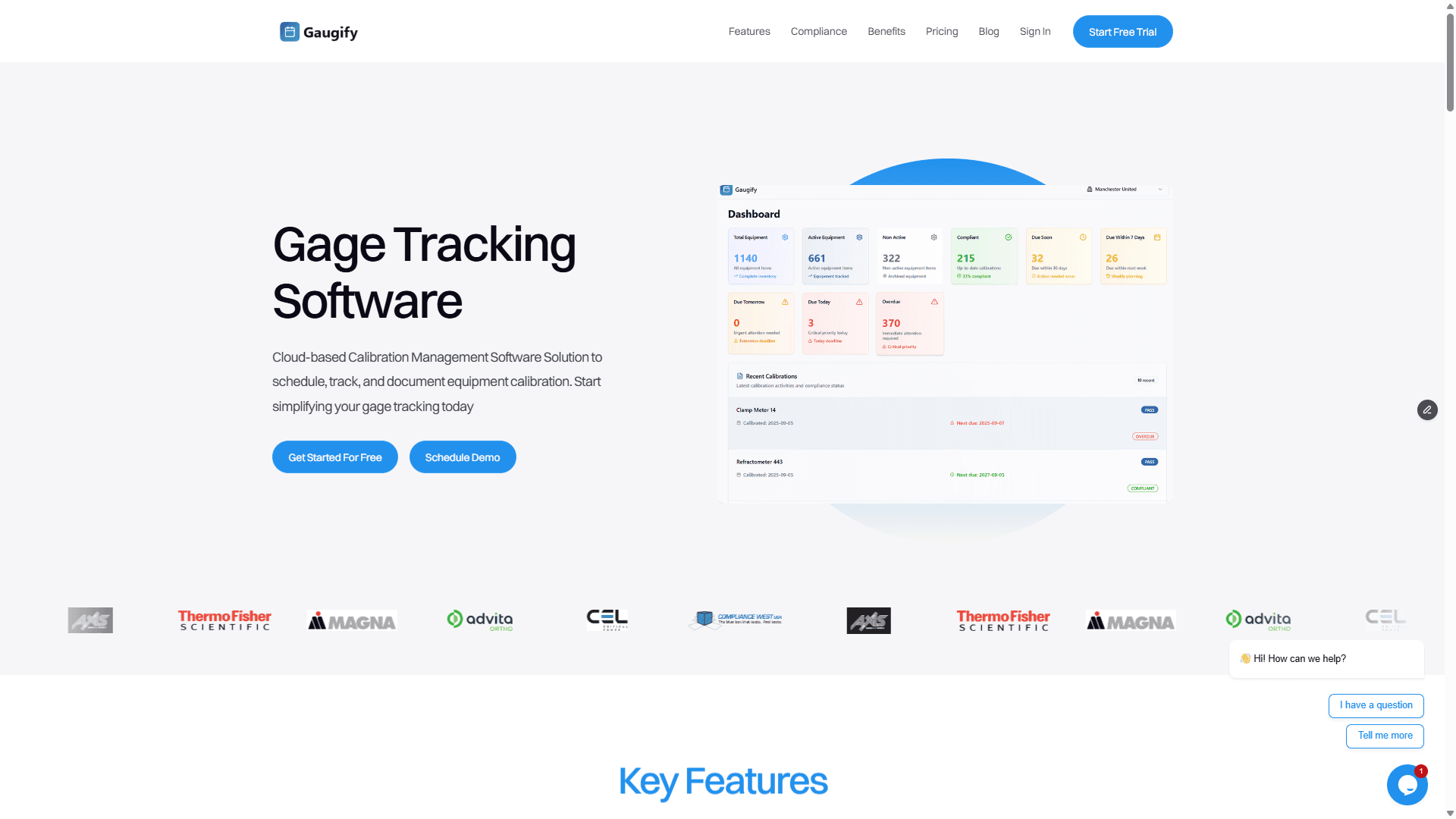
Automated compliance reporting generates standardized reports for ISO 9001, IATF 16949, and ISO 17025 requirements. The system tracks calibration coverage, overdue items, and compliance metrics with dashboard visibility that keeps management informed of calibration program health.
Integration Capabilities for Battery Manufacturing Systems
Modern battery manufacturing relies on integrated information systems that share data across quality, production, and maintenance functions. Gaugify's flexible integration capabilities connect calibration management with your existing systems to create seamless information flow and eliminate duplicate data entry.
ERP and Manufacturing Execution System Integration
Calibration scheduling integrates with your production planning systems to automatically consider equipment calibration status when scheduling production runs. The system can prevent scheduling of production batches on equipment approaching calibration due dates or automatically flag products manufactured with out-of-tolerance instruments.
Asset management synchronization maintains consistent equipment identification and specifications across calibration, maintenance, and production systems. When equipment specifications change or instruments are retired, updates propagate automatically to prevent calibration of obsolete equipment or missed calibration of newly installed instruments.
Laboratory Information Management System (LIMS) Connectivity
Battery testing laboratories benefit from direct integration between calibration management and LIMS systems. Test results automatically include calibration status verification, and out-of-tolerance calibration findings trigger automatic review of affected test data.
Measurement uncertainty propagation flows from calibration records into test result uncertainty calculations, providing complete uncertainty analysis for battery performance parameters like capacity, internal resistance, and cycle life projections.
Cost-Benefit Analysis for Battery Manufacturers
Implementing comprehensive calibration management software requires initial investment, but the return on investment in battery manufacturing environments typically pays back within 6-12 months through reduced compliance costs, elimination of calibration-related production delays, and improved audit outcomes.
Direct Cost Savings
Reduced calibration labor costs result from automated scheduling, digital certificate management, and elimination of manual data entry. A typical battery manufacturing facility with 500 instruments can save 20-30 hours per month in calibration administrative tasks.
Eliminated emergency calibration costs prevent expensive rush charges and production shutdowns. External calibration services often charge 50-100% premiums for emergency service, and production line shutdowns can cost $10,000+ per hour in lost output.
Streamlined audit preparation reduces external consultant costs and internal labor for compliance activities. Digital records and automated reporting can cut audit preparation time from weeks to days, saving thousands of dollars in labor costs per audit cycle.
Risk Mitigation Benefits
Reduced product liability exposure results from comprehensive calibration documentation and traceability. In the event of field failures or safety incidents, complete calibration records demonstrate due diligence and can significantly reduce liability exposure.
Avoided regulatory penalties prevent costly fines and production shutdowns from compliance violations. Regulatory penalties in the automotive industry can reach millions of dollars, making robust calibration management a critical risk mitigation investment.
Implementation Best Practices for Battery Manufacturing
Successful calibration management software implementation in battery manufacturing requires careful planning and phased deployment that minimizes disruption to ongoing production operations.
Phased Implementation Approach
Pilot program implementation should focus on a single production line or department to validate system functionality and refine procedures before facility-wide deployment. Battery manufacturers often start with final assembly and testing areas where calibration requirements are well-defined and instrument populations are manageable.
Critical equipment prioritization ensures safety-related and production-critical instruments receive immediate attention. Formation systems, capacity analyzers, and dimensional measurement equipment typically take priority over general-purpose tools and environmental monitoring equipment.
Data migration planning addresses the challenge of transferring historical calibration records from existing systems. While complete historical data transfer isn't always necessary, maintaining calibration history for critical production equipment and instruments under warranty is essential.
Training and Change Management
Multi-level training programs address different user groups with targeted content. Production technicians need basic training on calibration status verification and overdue equipment procedures, while quality engineers require comprehensive training on uncertainty calculations and audit reporting capabilities.
Gradual transition from paper-based systems allows parallel operation during the initial implementation period. Running both systems temporarily provides confidence and backup while users adapt to new digital workflows.
Future-Proofing Battery Manufacturing Calibration
The rapid evolution of battery technology and manufacturing processes demands calibration management systems that can adapt to changing requirements and integrate with emerging technologies.
Industry 4.0 Integration
IoT sensor integration enables real-time monitoring of instrument performance and environmental conditions that affect calibration intervals. Smart instruments can automatically report calibration status and performance trends, enabling predictive calibration scheduling based on actual usage and drift patterns rather than fixed time intervals.
Artificial intelligence applications analyze historical calibration data to optimize calibration intervals, predict instrument failures, and recommend preventive actions. Machine learning algorithms can identify patterns in calibration drift that indicate environmental issues or improper handling procedures.
Emerging Battery Technologies
Solid-state battery manufacturing will introduce new measurement requirements and calibration challenges as this technology reaches commercial production. Calibration management systems must be flexible enough to accommodate new instrument types and measurement parameters without major system overhauls.
Advanced battery chemistries continue to push measurement accuracy requirements tighter, demanding more sophisticated calibration procedures and uncertainty analysis. Compliance-focused calibration management systems must evolve to support these increasingly stringent requirements.
Measuring Success: Key Performance Indicators
Successful calibration management programs in battery manufacturing can be measured through specific metrics that demonstrate both operational efficiency and compliance effectiveness.
Operational Metrics
Calibration scheduling efficiency measures the percentage of calibrations completed on schedule without production disruptions. Best-in-class battery manufacturers achieve 98%+ on-time calibration rates with minimal impact on production schedules.
Instrument availability tracks the percentage of measurement equipment available for production use. Effective calibration management should maintain 99%+ instrument availability by eliminating surprise calibration due dates and optimizing calibration timing.
Documentation completeness measures the percentage of calibration activities with complete, audit-ready documentation. Digital calibration management systems should achieve 100% documentation completeness by eliminating manual data entry errors and ensuring complete record capture.
Compliance Metrics
Audit findings reduction demonstrates improved compliance posture through fewer calibration-related audit findings year-over-year. Comprehensive calibration management typically reduces calibration-related findings by 80% or more within the first year of implementation.
Regulatory compliance rate measures adherence to calibration requirements across all applicable standards and regulations. Battery manufacturers should target 100% compliance with zero tolerance for safety-critical measurement equipment.
Conclusion: Transform Your Battery Manufacturing Calibration
Battery manufacturing's demanding precision requirements, complex regulatory landscape, and high-volume production environment make comprehensive calibration management software battery operations an essential investment rather than an optional upgrade. The combination of automated scheduling, digital documentation, advanced uncertainty calculations, and comprehensive audit trails provides the foundation for sustainable competitive advantage in this rapidly evolving industry.
Companies that continue relying on manual calibration management face increasing risks of production disruptions, compliance violations, and audit failures as battery technology advances and regulatory requirements tighten. The question isn't whether to modernize your calibration management—it's how quickly you can implement digital solutions that support your growth objectives.
Gaugify's cloud-based calibration management platform delivers the specific capabilities battery manufacturers need to maintain operational excellence while meeting the stringent compliance requirements of automotive, transportation, and safety regulations. With proven success across multiple battery manufacturing facilities, Gaugify provides the reliability, flexibility, and scalability your operation demands.
Don't let calibration management become a bottleneck in your battery manufacturing success. Schedule a personalized Gaugify demonstration to see how automated calibration management can transform your facility's efficiency, compliance posture, and competitive position in the rapidly growing battery market. Your future depends on precision—make sure your calibration management delivers it consistently.
Calibration Management Software for Battery Manufacturing
Battery manufacturing demands extraordinary precision across every production stage, from cell formation to pack assembly. With tolerances measured in micrometers and voltage specifications down to millivolts, your calibration management software battery operations must deliver flawless accuracy to prevent costly recalls, safety incidents, and regulatory violations. Traditional paper-based calibration systems simply cannot keep pace with the complexity and scale of modern battery production facilities.
Whether you're producing lithium-ion cells for electric vehicles, industrial energy storage systems, or consumer electronics, maintaining calibrated measurement equipment isn't just about quality—it's about safety, compliance, and your company's reputation. A single out-of-tolerance thickness gauge could result in batteries that overheat or fail catastrophically in the field.
Critical Calibration Challenges in Battery Manufacturing
Battery manufacturers face unique calibration management challenges that set them apart from other industries. The combination of high-volume production, stringent safety requirements, and rapidly evolving technology creates a perfect storm of complexity.
Multi-shift operations run 24/7, making it difficult to coordinate calibration schedules without disrupting production. When your line produces 50,000 cells per day, even a two-hour calibration window can cost tens of thousands of dollars in lost output.
Environmental sensitivity adds another layer of complexity. Temperature and humidity fluctuations in different areas of your facility—from the dry room at 1% relative humidity to ambient warehouse conditions—can affect instrument accuracy and calibration intervals. Your thickness micrometers might need monthly recalibration in the coating area but quarterly recalibration in final assembly.
Traceability requirements extend beyond traditional manufacturing. Battery cells often remain in service for 10-15 years, and you may need to demonstrate measurement traceability for the entire production history if field failures occur. This means maintaining calibration records and certificates for instruments that may have been retired years ago.
Rapid technology evolution continuously introduces new measurement requirements. As battery chemistries advance and energy densities increase, measurement tolerances become tighter. What was acceptable measurement uncertainty five years ago may no longer meet today's specifications for next-generation battery designs.
Essential Measurement Equipment in Battery Production Lines
Battery manufacturing requires an extensive array of precision measurement instruments, each with specific calibration requirements and tolerances that directly impact product quality and safety.
Dimensional Measurement Equipment
Thickness gauges and micrometers measure electrode coating thickness, typically with tolerances of ±2 micrometers. These instruments require monthly calibration due to the abrasive nature of battery materials and constant use in production environments. A typical facility might have 15-20 thickness measurement stations across multiple coating lines.
Calipers and height gauges verify cell dimensions, tab positions, and assembly tolerances. With battery pack designs requiring precise fit within vehicle assemblies, dimensional accuracy of ±0.1mm is common. These tools need quarterly calibration and proper storage to maintain accuracy.
Surface profilometers measure electrode surface roughness, which affects electrolyte wetting and cell performance. These sophisticated instruments require semi-annual calibration by specialized service providers and can cost $100,000+ to replace if damaged.
Electrical Test Equipment
Digital multimeters and precision voltage sources verify cell voltages during formation and testing. With measurement requirements down to ±1 millivolt accuracy, these instruments need monthly calibration and careful handling. Formation systems alone might contain 50+ measurement channels requiring individual calibration.
Battery analyzers and cyclers perform capacity testing and life cycle validation. These complex systems combine voltage, current, and temperature measurements with calibration intervals ranging from monthly for high-use production units to quarterly for R&D equipment.
Insulation resistance testers verify electrical isolation in battery packs, with measurement ranges from megohms to teraohms. Calibration at these extreme ranges requires specialized equipment and procedures, often performed annually by external laboratories.
Environmental Monitoring Equipment
Temperature and humidity sensors throughout the facility require regular calibration to ensure optimal production conditions. Dry room humidity sensors measuring below 2% RH need quarterly calibration with certified reference standards.
Gas analyzers monitor electrolyte vapor concentrations and detect gas evolution during cell formation. These safety-critical instruments require monthly calibration and immediate attention if readings drift outside acceptable ranges.
Quality Standards and Regulatory Compliance Requirements
Battery manufacturers must navigate a complex web of quality standards and regulatory requirements, each with specific calibration documentation and traceability mandates.
Automotive Industry Standards
IATF 16949 automotive quality management standard requires comprehensive measurement system analysis (MSA) and calibration control. Battery suppliers to automotive OEMs must demonstrate measurement capability studies showing gage R&R values typically below 10% for critical characteristics like cell capacity and internal resistance.
ISO 26262 functional safety standard applies to automotive battery systems and requires calibration of safety-related measurement equipment with enhanced documentation and verification procedures. Instruments used to verify safety functions need calibration status clearly visible and accessible to production operators.
General Manufacturing Standards
ISO 9001 quality management forms the foundation for most battery manufacturers' quality systems. The standard requires documented calibration procedures, traceability to international standards, and corrective actions when instruments are found out of tolerance during calibration.
ISO/IEC 17025 applies when battery manufacturers operate internal calibration laboratories. This standard demands rigorous uncertainty calculations, proficiency testing, and environmental controls that many companies struggle to implement and maintain without proper ISO 17025 calibration software.
Transportation and Safety Regulations
UN38.3 transportation testing requires calibrated equipment for altitude simulation, thermal cycling, vibration, and impact testing. Calibration certificates for these test systems must demonstrate traceability and appropriate measurement uncertainty to validate test results.
UL 2580 safety standard for electric vehicle batteries mandates calibrated measurement equipment for electrical, mechanical, and environmental testing. Calibration intervals and procedures must align with the criticality of safety-related measurements.
Common Audit Scenarios and Auditor Expectations
Battery manufacturing audits reveal predictable patterns of calibration-related findings that can derail production schedules and customer relationships. Understanding what auditors look for helps you prepare proactive solutions.
Customer Audits
Automotive OEM audits typically focus intensively on measurement systems for critical safety characteristics. Auditors will randomly select battery cells from production and trace measurement data back through calibration records for every instrument used in testing. They expect to see calibration certificates, uncertainty calculations, and evidence that measurement capability meets specification requirements.
A common audit scenario involves an auditor selecting a battery pack with internal resistance measured at 2.8 milliohms and asking to see calibration records for the impedance analyzer used. They'll verify the calibration was current at the time of measurement, check that measurement uncertainty doesn't exceed 10% of the specification tolerance, and confirm the instrument was environmentally compensated for temperature variations.
Regulatory Inspections
DOT inspections for transportation compliance focus on test equipment used for UN38.3 certification testing. Inspectors examine calibration records for altitude chambers, vibration tables, and temperature cycling equipment. They look for gaps in calibration coverage, expired certificates, and inadequate measurement uncertainty analysis.
UL factory inspections verify that production test equipment maintains the same calibration standards used during initial product certification. Inspectors compare current calibration certificates against those submitted with the original certification application, looking for changes in measurement uncertainty or calibration intervals that might affect product compliance.
Internal Audit Findings
Calibration status visibility consistently appears as an audit finding. Production operators must be able to immediately identify instrument calibration status without searching through filing cabinets or computer databases. Color-coded calibration labels with clear due dates are expected on every measurement instrument.
Out-of-tolerance procedures often receive audit attention when instruments are found outside specification limits during calibration. Auditors expect documented investigations into all measurements performed since the last successful calibration, with evidence of product disposition and corrective actions to prevent recurrence.
How Calibration Management Software Battery Operations Transform Efficiency
Modern calibration management software battery manufacturing facilities require sophisticated digital solutions that address the unique challenges of high-volume, safety-critical production environments. Gaugify's cloud-based calibration management platform delivers the automation, traceability, and compliance capabilities battery manufacturers need to maintain operational excellence.
Automated Scheduling Prevents Production Disruptions
Traditional calibration scheduling relies on spreadsheets and manual tracking that inevitably leads to surprise calibration due dates and emergency shutdowns. Gaugify's intelligent scheduling engine considers your production calendar, instrument criticality, and historical calibration data to optimize timing and minimize disruptions.
The system automatically generates calibration schedules months in advance, allowing you to coordinate with external calibration services and plan production around required downtime. For a battery manufacturer with 500+ instruments across three shifts, this visibility prevents the chaos of last-minute calibration emergencies that can shut down entire production lines.
Smart notifications alert the right people at the right time. Quality managers receive 30-day advance warnings for critical production equipment, while technicians get daily task lists prioritized by due date and production impact. Maintenance supervisors can coordinate calibration schedules with planned equipment maintenance to maximize efficiency.
Digital Certificates Eliminate Documentation Chaos
Paper calibration certificates create audit nightmares and compliance risks in battery manufacturing environments. Gaugify stores all calibration certificates digitally with instant search and retrieval capabilities that transform audit preparation from weeks of document hunting to minutes of organized reporting.
Each instrument record contains complete calibration history with as-found and as-left data, environmental conditions, and technician certifications. When auditors ask about the impedance analyzer used to test batch #BT-2024-0847, you can instantly display calibration certificates, measurement uncertainty calculations, and traceability documentation.
Automated certificate generation ensures consistent formatting and complete information for internal calibrations. The system pulls instrument specifications, applies your standard uncertainty calculations, and generates professional certificates that meet ISO 17025 requirements without manual data entry errors.
Ready to eliminate calibration chaos and streamline your battery manufacturing compliance? Start your free Gaugify trial today and experience the difference automated calibration management makes in your facility.
Advanced Uncertainty Calculations Support Tight Tolerances
Battery manufacturing tolerances demand sophisticated measurement uncertainty analysis that paper-based systems simply cannot handle effectively. Gaugify automatically calculates measurement uncertainty using Monte Carlo methods and GUM (Guide to Uncertainty in Measurement) principles, ensuring your measurements meet the stringent requirements of automotive and safety standards.
The system maintains uncertainty budgets for complex measurement chains common in battery testing. When calibrating a battery formation system that combines voltage, current, temperature, and time measurements, Gaugify automatically propagates uncertainties through the entire measurement equation to determine overall system capability.
Gage R&R integration combines calibration uncertainty with measurement system variation studies required by IATF 16949. The system tracks both calibration-related uncertainty and operator/environmental variation to provide complete measurement system analysis that satisfies automotive audit requirements.
Comprehensive Audit Trails Ensure Regulatory Compliance
Battery safety regulations and automotive standards require extensive documentation of measurement system control and calibration activities. Gaugify maintains complete audit trails with tamper-proof records of all calibration activities, status changes, and user interactions.
Every action is logged with user identification, timestamps, and change justification. When regulators ask about calibration activities during a specific production period, you can generate comprehensive reports showing exactly which instruments were calibrated, by whom, and what actions were taken for any out-of-tolerance conditions.
Automated compliance reporting generates standardized reports for ISO 9001, IATF 16949, and ISO 17025 requirements. The system tracks calibration coverage, overdue items, and compliance metrics with dashboard visibility that keeps management informed of calibration program health.
Integration Capabilities for Battery Manufacturing Systems
Modern battery manufacturing relies on integrated information systems that share data across quality, production, and maintenance functions. Gaugify's flexible integration capabilities connect calibration management with your existing systems to create seamless information flow and eliminate duplicate data entry.
ERP and Manufacturing Execution System Integration
Calibration scheduling integrates with your production planning systems to automatically consider equipment calibration status when scheduling production runs. The system can prevent scheduling of production batches on equipment approaching calibration due dates or automatically flag products manufactured with out-of-tolerance instruments.
Asset management synchronization maintains consistent equipment identification and specifications across calibration, maintenance, and production systems. When equipment specifications change or instruments are retired, updates propagate automatically to prevent calibration of obsolete equipment or missed calibration of newly installed instruments.
Laboratory Information Management System (LIMS) Connectivity
Battery testing laboratories benefit from direct integration between calibration management and LIMS systems. Test results automatically include calibration status verification, and out-of-tolerance calibration findings trigger automatic review of affected test data.
Measurement uncertainty propagation flows from calibration records into test result uncertainty calculations, providing complete uncertainty analysis for battery performance parameters like capacity, internal resistance, and cycle life projections.
Cost-Benefit Analysis for Battery Manufacturers
Implementing comprehensive calibration management software requires initial investment, but the return on investment in battery manufacturing environments typically pays back within 6-12 months through reduced compliance costs, elimination of calibration-related production delays, and improved audit outcomes.
Direct Cost Savings
Reduced calibration labor costs result from automated scheduling, digital certificate management, and elimination of manual data entry. A typical battery manufacturing facility with 500 instruments can save 20-30 hours per month in calibration administrative tasks.
Eliminated emergency calibration costs prevent expensive rush charges and production shutdowns. External calibration services often charge 50-100% premiums for emergency service, and production line shutdowns can cost $10,000+ per hour in lost output.
Streamlined audit preparation reduces external consultant costs and internal labor for compliance activities. Digital records and automated reporting can cut audit preparation time from weeks to days, saving thousands of dollars in labor costs per audit cycle.
Risk Mitigation Benefits
Reduced product liability exposure results from comprehensive calibration documentation and traceability. In the event of field failures or safety incidents, complete calibration records demonstrate due diligence and can significantly reduce liability exposure.
Avoided regulatory penalties prevent costly fines and production shutdowns from compliance violations. Regulatory penalties in the automotive industry can reach millions of dollars, making robust calibration management a critical risk mitigation investment.
Implementation Best Practices for Battery Manufacturing
Successful calibration management software implementation in battery manufacturing requires careful planning and phased deployment that minimizes disruption to ongoing production operations.
Phased Implementation Approach
Pilot program implementation should focus on a single production line or department to validate system functionality and refine procedures before facility-wide deployment. Battery manufacturers often start with final assembly and testing areas where calibration requirements are well-defined and instrument populations are manageable.
Critical equipment prioritization ensures safety-related and production-critical instruments receive immediate attention. Formation systems, capacity analyzers, and dimensional measurement equipment typically take priority over general-purpose tools and environmental monitoring equipment.
Data migration planning addresses the challenge of transferring historical calibration records from existing systems. While complete historical data transfer isn't always necessary, maintaining calibration history for critical production equipment and instruments under warranty is essential.
Training and Change Management
Multi-level training programs address different user groups with targeted content. Production technicians need basic training on calibration status verification and overdue equipment procedures, while quality engineers require comprehensive training on uncertainty calculations and audit reporting capabilities.
Gradual transition from paper-based systems allows parallel operation during the initial implementation period. Running both systems temporarily provides confidence and backup while users adapt to new digital workflows.
Future-Proofing Battery Manufacturing Calibration
The rapid evolution of battery technology and manufacturing processes demands calibration management systems that can adapt to changing requirements and integrate with emerging technologies.
Industry 4.0 Integration
IoT sensor integration enables real-time monitoring of instrument performance and environmental conditions that affect calibration intervals. Smart instruments can automatically report calibration status and performance trends, enabling predictive calibration scheduling based on actual usage and drift patterns rather than fixed time intervals.
Artificial intelligence applications analyze historical calibration data to optimize calibration intervals, predict instrument failures, and recommend preventive actions. Machine learning algorithms can identify patterns in calibration drift that indicate environmental issues or improper handling procedures.
Emerging Battery Technologies
Solid-state battery manufacturing will introduce new measurement requirements and calibration challenges as this technology reaches commercial production. Calibration management systems must be flexible enough to accommodate new instrument types and measurement parameters without major system overhauls.
Advanced battery chemistries continue to push measurement accuracy requirements tighter, demanding more sophisticated calibration procedures and uncertainty analysis. Compliance-focused calibration management systems must evolve to support these increasingly stringent requirements.
Measuring Success: Key Performance Indicators
Successful calibration management programs in battery manufacturing can be measured through specific metrics that demonstrate both operational efficiency and compliance effectiveness.
Operational Metrics
Calibration scheduling efficiency measures the percentage of calibrations completed on schedule without production disruptions. Best-in-class battery manufacturers achieve 98%+ on-time calibration rates with minimal impact on production schedules.
Instrument availability tracks the percentage of measurement equipment available for production use. Effective calibration management should maintain 99%+ instrument availability by eliminating surprise calibration due dates and optimizing calibration timing.
Documentation completeness measures the percentage of calibration activities with complete, audit-ready documentation. Digital calibration management systems should achieve 100% documentation completeness by eliminating manual data entry errors and ensuring complete record capture.
Compliance Metrics
Audit findings reduction demonstrates improved compliance posture through fewer calibration-related audit findings year-over-year. Comprehensive calibration management typically reduces calibration-related findings by 80% or more within the first year of implementation.
Regulatory compliance rate measures adherence to calibration requirements across all applicable standards and regulations. Battery manufacturers should target 100% compliance with zero tolerance for safety-critical measurement equipment.
Conclusion: Transform Your Battery Manufacturing Calibration
Battery manufacturing's demanding precision requirements, complex regulatory landscape, and high-volume production environment make comprehensive calibration management software battery operations an essential investment rather than an optional upgrade. The combination of automated scheduling, digital documentation, advanced uncertainty calculations, and comprehensive audit trails provides the foundation for sustainable competitive advantage in this rapidly evolving industry.
Companies that continue relying on manual calibration management face increasing risks of production disruptions, compliance violations, and audit failures as battery technology advances and regulatory requirements tighten. The question isn't whether to modernize your calibration management—it's how quickly you can implement digital solutions that support your growth objectives.
Gaugify's cloud-based calibration management platform delivers the specific capabilities battery manufacturers need to maintain operational excellence while meeting the stringent compliance requirements of automotive, transportation, and safety regulations. With proven success across multiple battery manufacturing facilities, Gaugify provides the reliability, flexibility, and scalability your operation demands.
Don't let calibration management become a bottleneck in your battery manufacturing success. Schedule a personalized Gaugify demonstration to see how automated calibration management can transform your facility's efficiency, compliance posture, and competitive position in the rapidly growing battery market. Your future depends on precision—make sure your calibration management delivers it consistently.