
Calibration Management Software for EDM and Wire EDM Shops
Calibration Management Software for EDM and Wire EDM Shops
David Bentley
Quality Assurance Engineer
12 min read
Calibration Management Software for EDM and Wire EDM Shops
EDM and wire EDM operations demand exceptional precision, often working with tolerances as tight as ±0.0001" (±0.0025mm). When your equipment produces parts for aerospace turbine blades, medical implants, or precision tooling, your calibration management software EDM program becomes mission-critical. A single out-of-tolerance measurement device can lead to scrapped parts worth thousands of dollars, failed customer audits, or worse – quality escapes that damage your reputation.
Traditional paper-based calibration systems or basic spreadsheets simply cannot handle the complexity and rigor required in modern EDM shops. Between managing dozens of precision measuring instruments, tracking calibration certificates from multiple vendors, and maintaining audit trails for AS9100 or ISO 13485 compliance, manual systems create unnecessary risk and inefficiency.
Critical Equipment Requiring Calibration in EDM Operations
EDM and wire EDM shops rely on a diverse array of precision measuring equipment, each with specific calibration requirements and intervals. Understanding this equipment landscape is essential for implementing effective calibration management software EDM solutions.
Primary Measuring Equipment
Coordinate Measuring Machines (CMMs): Bridge CMMs, horizontal arm CMMs, and portable CMMs used for complex geometry verification, typically requiring annual calibration with uncertainty ratios of 4:1 or better
Surface Roughness Testers: Critical for verifying Ra values between 8-125 μin (0.2-3.2 μm) on EDM surfaces, requiring calibration every 6-12 months using certified roughness standards
Digital Height Gages: Used for electrode setup and part verification, typically calibrated annually with uncertainty better than ±0.00015" at 6" height
Digital Micrometers: 0-1", 1-2", 2-3" sets used for electrode and workpiece measurement, requiring calibration every 12 months with Class XX gage blocks
Digital Calipers: 6", 8", and 12" models for general dimensional verification, typically calibrated annually with uncertainties around ±0.0005"
Pin Gages: Go/no-go sets for hole diameter verification, requiring calibration every 2-3 years depending on usage
Specialized EDM Equipment
Wire Tension Meters: Critical for wire EDM setup, ensuring proper wire tension between 2-15N depending on wire diameter, calibrated every 6-12 months
Electrode Wear Measurement Systems: Optical or contact systems for measuring electrode wear during sinker EDM operations
Dielectric Fluid Conductivity Meters: Monitoring fluid condition for optimal cutting performance, requiring monthly calibration checks
Digital Torque Wrenches: For workholding and electrode mounting, typically 5-50 ft-lbs capacity, calibrated annually
Environmental Monitoring Equipment
Temperature Sensors: Monitoring machine and workpiece temperature for thermal compensation, requiring calibration every 12 months with NIST-traceable standards
Humidity Sensors: Important for shops working with hygroscopic materials, calibrated using saturated salt solutions
Vibration Meters: Ensuring optimal machine performance and surface finish quality
Quality Standards and Compliance Requirements for EDM Shops
EDM shops serving regulated industries must navigate complex quality standards that directly impact their calibration management software EDM requirements. Each standard brings specific documentation, traceability, and uncertainty calculation requirements.
Aerospace Industry Standards
AS9100 (Aerospace Quality Management) requires comprehensive calibration programs with specific focus on measurement system analysis (MSA). EDM shops must demonstrate that their measuring equipment capability studies show acceptable bias, linearity, and repeatability. For example, when measuring a 2.000" ±0.005" aerospace component feature, your digital micrometer must demonstrate measurement uncertainty no greater than ±0.0012" to maintain a 4:1 test uncertainty ratio.
The standard mandates retention of calibration certificates for a minimum of three years, with complete traceability to national standards. When an aerospace auditor reviews your calibration system, they expect to see automated alerts for approaching due dates, complete historical records, and documented actions taken when equipment is found out-of-tolerance.
Medical Device Manufacturing Standards
ISO 13485 (Medical Devices Quality Management) emphasizes risk-based calibration programs. For EDM shops producing surgical instruments or implant components, calibration intervals must be justified based on stability studies, usage patterns, and the criticality of measurements. A CMM used for measuring spinal rod geometry (tolerance ±0.002") requires more frequent calibration than general-purpose height gages.
The standard requires documented calibration procedures, environmental condition recording, and immediate quarantine procedures when equipment fails calibration. Your calibration management system must automatically flag affected products manufactured since the last successful calibration.
ISO 17025 Laboratory Standards
EDM shops with internal measurement laboratories must comply with ISO 17025 (Testing and Calibration Laboratories). This standard requires detailed uncertainty budgets for each measurement, considering factors like temperature coefficients, resolution, repeatability, and calibration uncertainty.
For example, when calibrating a digital micrometer used to measure electrode dimensions, your uncertainty budget must include:
Calibration standard uncertainty (±0.00005")
Temperature variation effects (±0.00003" for aluminum electrodes)
Operator repeatability (±0.00002")
Instrument resolution (±0.000025")
Common Audit Scenarios in EDM Calibration Management
Understanding what auditors look for during calibration system reviews helps EDM shops prepare effectively and demonstrates why robust calibration management software EDM solutions are essential for maintaining compliance.
Scenario 1: Aerospace Customer Audit
An AS9100-certified EDM shop receives a 48-hour notice for a customer audit. The auditor arrives and immediately requests calibration records for the CMM used to verify titanium turbine blade features. They want to see:
Current calibration certificate with measurement uncertainty statements
Evidence that the CMM's measurement uncertainty supports the required 4:1 test accuracy ratio
Historical calibration data showing trending and stability
Documentation of corrective actions when the CMM failed pitch accuracy during the previous calibration
Evidence that affected parts were identified and dispositioned
Shops using paper systems or basic spreadsheets struggle to provide this information quickly and completely. The auditor typically spends 2-3 hours reviewing calibration documentation, looking for gaps that could indicate systemic problems.
Scenario 2: FDA Inspection for Medical Devices
An FDA inspector visits a wire EDM shop producing orthopedic cutting tools. They focus on the calibration program supporting measurement of cutting edge geometry (tolerances ±0.0005"). The inspector requests:
Risk assessment documentation justifying calibration intervals
Calibration procedures including environmental requirements
Evidence that measuring equipment is suitable for intended use
Documentation of measurement system capability studies
Records showing immediate response when equipment goes out-of-tolerance
The inspector pays particular attention to how the shop handles equipment that fails calibration, expecting to see automatic quarantine procedures and comprehensive impact assessments.
Scenario 3: ISO 13485 Surveillance Audit
During a routine surveillance audit, the auditor examines calibration records for surface roughness testers used to verify Ra 32 μin specifications on implant surfaces. They verify:
Calibration intervals are based on documented risk analysis
Environmental conditions during calibration meet equipment requirements
Uncertainty calculations include all relevant factors
Calibration status is clearly identified on equipment
Personnel performing measurements are trained and qualified
How Gaugify Solves EDM Calibration Management Challenges
Modern EDM shops need calibration management software EDM solutions that address the industry's unique challenges while streamlining daily operations. Gaugify's cloud-based platform delivers comprehensive functionality designed specifically for precision manufacturing environments.
Automated Scheduling and Notifications
Gaugify eliminates the risk of missed calibrations through intelligent scheduling that considers your shop's specific needs. For example, you can set your Mitutoyo CMM for annual calibration, surface roughness testers for 9-month intervals, and digital micrometers for 12-month cycles. The system sends automated notifications at 90, 30, and 7 days before due dates.
When your wire tension meter approaches its calibration due date, Gaugify automatically generates work orders and can even schedule appointments with your preferred calibration vendor. This proactive approach prevents the costly downtime that occurs when critical equipment goes overdue.
Comprehensive Certificate Management
Managing calibration certificates from multiple vendors becomes effortless with Gaugify's centralized document repository. Upload PDF certificates directly to equipment records, where they're automatically parsed to extract key data like calibration dates, uncertainty values, and environmental conditions.
When an auditor requests calibration documentation for your coordinate measuring machine, you can instantly access the current certificate plus complete historical records. The system maintains permanent archives, ensuring you never lose critical compliance documentation.
Advanced Uncertainty Calculations
Gaugify's built-in uncertainty calculator helps EDM shops meet ISO 17025 requirements and customer specifications for measurement uncertainty. Input your measurement parameters – such as measuring a 1.500" ±0.002" electrode dimension – and the system calculates combined uncertainty considering calibration, environmental, and operational factors.
The software automatically verifies that your test uncertainty ratios meet customer requirements, flagging situations where equipment uncertainty exceeds acceptable limits. This prevents the embarrassing situation of failing an audit due to inadequate measurement capability.
Complete Audit Trail Documentation
Every action in Gaugify creates permanent audit trail records, essential for regulated EDM environments. When equipment fails calibration, the system automatically documents the failure, timestamps all actions, and maintains records of corrective actions taken.
For example, if your digital height gage fails its annual calibration for measurement accuracy, Gaugify captures the failure details, documents which parts were measured since the last successful calibration, and tracks the disposition decisions made for each affected product.
Ready to eliminate calibration management headaches in your EDM shop? Start your free 30-day trial and see how Gaugify streamlines your calibration program while ensuring complete compliance with industry standards.
Integration with EDM Shop Floor Operations
Effective calibration management software EDM solutions must integrate seamlessly with daily shop floor operations, minimizing disruption while maximizing compliance and efficiency.
Real-Time Equipment Status
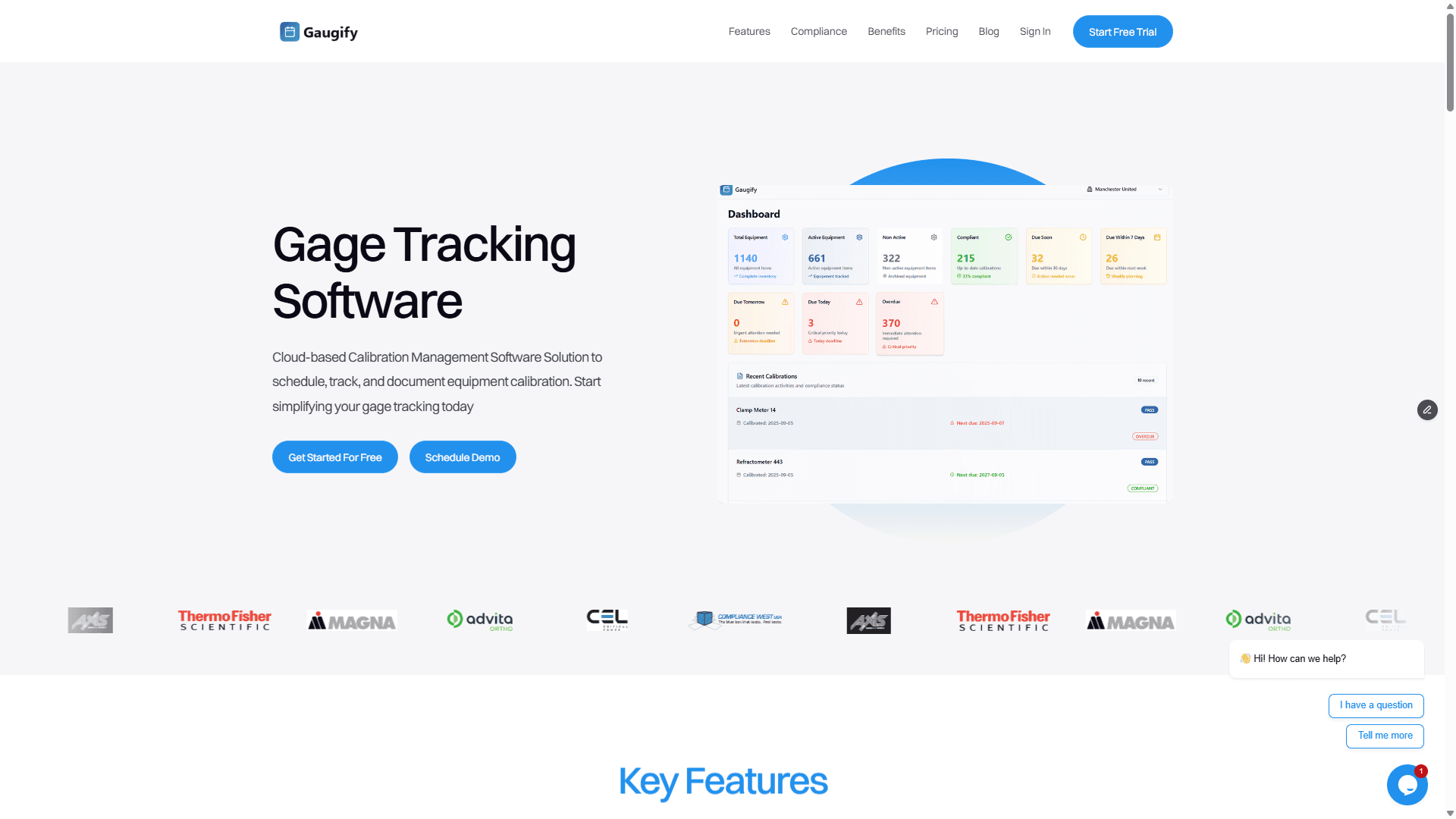
Gaugify provides real-time visibility into calibration status across your entire EDM operation. Digital dashboards show which measuring instruments are current, approaching due dates, or overdue. Shop floor supervisors can instantly verify that operators are using properly calibrated equipment before starting critical measurements.
QR code labels on each piece of equipment link directly to current calibration status, certificates, and usage instructions. When an operator scans the code on a digital micrometer before measuring electrode dimensions, they immediately see calibration validity, measurement uncertainty, and any special handling requirements.
Work Order Integration
The platform integrates calibration requirements directly into production workflows. When a work order calls for CMM verification of aerospace component features, Gaugify automatically checks that the designated CMM has current calibration and adequate measurement capability for the specified tolerances.
If scheduled calibration would conflict with critical production requirements, the system provides advance warning and suggests alternative scheduling or equipment substitution options.
Vendor Management and Outsourcing
Most EDM shops outsource calibration services, requiring coordination with multiple vendors for different equipment types. Gaugify streamlines vendor management through automated scheduling, purchase order generation, and performance tracking.
The system maintains preferred vendor lists with lead times, pricing, and capability information. When your surface roughness tester needs calibration, Gaugify can automatically select the appropriate vendor, generate a purchase order, and schedule pickup/delivery based on your production requirements.
Vendor performance tracking helps identify issues with calibration quality, delivery times, or customer service, enabling data-driven decisions about calibration service providers.
Cost-Benefit Analysis for EDM Shops
Implementing professional calibration management software EDM solutions requires investment, but the benefits typically far exceed the costs for precision manufacturing operations.
Direct Cost Savings
Manual calibration management consumes significant administrative time. A typical EDM shop with 50 pieces of measuring equipment spends 10-15 hours monthly on calibration scheduling, certificate filing, and record keeping. Gaugify reduces this to 2-3 hours monthly, saving $400-800 per month in administrative costs.
Automated scheduling prevents emergency calibrations that cost 25-50% more than planned services. Avoiding just two emergency calibrations annually can save $500-1500 in premium charges.
Risk Mitigation Benefits
The cost of using out-of-calibration equipment can be devastating. Consider an EDM shop that discovers their CMM was out-of-calibration for two months while measuring aerospace components with ±0.005" tolerances. Potential costs include:
Scrapping or reworking affected parts: $10,000-50,000
Customer notification and investigation: $5,000-15,000
Lost production time for re-inspection: $2,000-8,000
Potential customer audit costs: $3,000-10,000
Damage to customer relationships: Incalculable
Gaugify's automated monitoring and alerts virtually eliminate the risk of using out-of-calibration equipment, providing insurance against these catastrophic costs.
Audit Efficiency Improvements
Customer and regulatory audits typically require 4-6 hours of preparation time to gather calibration documentation. Gaugify reduces this to 15-30 minutes through instant access to organized records and automated compliance reports.
During audits, the time spent reviewing calibration records drops from 2-3 hours to 30-45 minutes, allowing auditors to focus on value-added activities rather than documentation review.
Implementation Best Practices for EDM Environments
Successful calibration management software EDM implementation requires careful planning and attention to industry-specific requirements.
Equipment Inventory and Data Migration
Begin implementation by conducting a comprehensive inventory of all measuring equipment. Document current calibration status, vendor relationships, and historical performance data. Gaugify's import tools simplify data migration from existing systems, whether they're spreadsheet-based or legacy software platforms.
Pay particular attention to equipment criticality classification. CMMs and surface roughness testers used for customer-specified requirements should be flagged as critical assets with enhanced monitoring and notification requirements.
Procedure Documentation and Training
Develop written procedures covering calibration scheduling, certificate review, and corrective actions when equipment fails calibration. These procedures should align with your quality management system requirements (AS9100, ISO 13485, etc.) while leveraging Gaugify's automated capabilities.
Train personnel on both system operation and underlying calibration principles. Shop floor supervisors should understand how to interpret calibration certificates and uncertainty statements, not just verify that equipment shows "current" status.
Continuous Improvement Integration
Use Gaugify's reporting capabilities to identify improvement opportunities in your calibration program. Analyze trends in equipment stability, vendor performance, and calibration costs to optimize intervals and service providers.
Regular review of measurement system capability studies helps identify when equipment uncertainties approach customer requirements, enabling proactive equipment upgrades or recalibration interval adjustments.
Future-Proofing Your EDM Calibration Program
The EDM industry continues evolving with advancing technology and increasingly stringent quality requirements. Modern calibration management software EDM solutions must adapt to these changing needs.
Industry 4.0 Integration
Smart manufacturing initiatives increasingly demand real-time integration between calibration systems and production equipment. Gaugify's API capabilities enable integration with EDM machine controls, automatically verifying calibration status before critical measurements begin.
Future developments will include direct integration with measuring equipment, automatically capturing measurement results and linking them to calibration certificates for complete traceability.
Advanced Analytics and Predictive Maintenance
Machine learning algorithms analyze historical calibration data to predict equipment drift and optimize calibration intervals. For stable equipment that consistently passes calibration with minimal drift, intervals can be extended. Equipment showing increasing instability receives more frequent attention.
Predictive analytics help identify environmental factors affecting equipment stability, enabling targeted improvements in shop climate control or equipment placement.
Regulatory Compliance Evolution
Quality standards continue evolving toward more rigorous calibration requirements. Recent revisions to AS9100 emphasize risk-based approaches and enhanced documentation requirements. ISO 17025 updates stress the importance of measurement uncertainty and decision rules.
Gaugify's cloud-based architecture ensures automatic updates as compliance requirements change, protecting your investment while maintaining cutting-edge functionality.
Transform Your EDM Calibration Program Today
EDM and wire EDM operations cannot afford calibration management failures. The precision demands of aerospace turbine components, medical implants, and high-precision tooling require calibration systems that match the sophistication of your manufacturing processes.
Gaugify delivers the comprehensive calibration management software EDM shops need to maintain compliance, reduce costs, and eliminate calibration-related risks. From automated scheduling that prevents missed calibrations to instant audit trail access that satisfies the most demanding customer requirements, Gaugify transforms calibration from a compliance burden into a competitive advantage.
Stop risking your reputation and profitability with inadequate calibration management. Schedule a personalized demo to see how Gaugify can revolutionize your EDM shop's calibration program. Our EDM industry specialists will show you exactly how the platform addresses your unique challenges while streamlining daily operations.
Join hundreds of precision manufacturers who trust Gaugify to protect their quality systems and customer relationships. Your calibration program is too critical to leave to chance – upgrade to professional calibration management software designed for the demands of modern EDM operations.
Calibration Management Software for EDM and Wire EDM Shops
EDM and wire EDM operations demand exceptional precision, often working with tolerances as tight as ±0.0001" (±0.0025mm). When your equipment produces parts for aerospace turbine blades, medical implants, or precision tooling, your calibration management software EDM program becomes mission-critical. A single out-of-tolerance measurement device can lead to scrapped parts worth thousands of dollars, failed customer audits, or worse – quality escapes that damage your reputation.
Traditional paper-based calibration systems or basic spreadsheets simply cannot handle the complexity and rigor required in modern EDM shops. Between managing dozens of precision measuring instruments, tracking calibration certificates from multiple vendors, and maintaining audit trails for AS9100 or ISO 13485 compliance, manual systems create unnecessary risk and inefficiency.
Critical Equipment Requiring Calibration in EDM Operations
EDM and wire EDM shops rely on a diverse array of precision measuring equipment, each with specific calibration requirements and intervals. Understanding this equipment landscape is essential for implementing effective calibration management software EDM solutions.
Primary Measuring Equipment
Coordinate Measuring Machines (CMMs): Bridge CMMs, horizontal arm CMMs, and portable CMMs used for complex geometry verification, typically requiring annual calibration with uncertainty ratios of 4:1 or better
Surface Roughness Testers: Critical for verifying Ra values between 8-125 μin (0.2-3.2 μm) on EDM surfaces, requiring calibration every 6-12 months using certified roughness standards
Digital Height Gages: Used for electrode setup and part verification, typically calibrated annually with uncertainty better than ±0.00015" at 6" height
Digital Micrometers: 0-1", 1-2", 2-3" sets used for electrode and workpiece measurement, requiring calibration every 12 months with Class XX gage blocks
Digital Calipers: 6", 8", and 12" models for general dimensional verification, typically calibrated annually with uncertainties around ±0.0005"
Pin Gages: Go/no-go sets for hole diameter verification, requiring calibration every 2-3 years depending on usage
Specialized EDM Equipment
Wire Tension Meters: Critical for wire EDM setup, ensuring proper wire tension between 2-15N depending on wire diameter, calibrated every 6-12 months
Electrode Wear Measurement Systems: Optical or contact systems for measuring electrode wear during sinker EDM operations
Dielectric Fluid Conductivity Meters: Monitoring fluid condition for optimal cutting performance, requiring monthly calibration checks
Digital Torque Wrenches: For workholding and electrode mounting, typically 5-50 ft-lbs capacity, calibrated annually
Environmental Monitoring Equipment
Temperature Sensors: Monitoring machine and workpiece temperature for thermal compensation, requiring calibration every 12 months with NIST-traceable standards
Humidity Sensors: Important for shops working with hygroscopic materials, calibrated using saturated salt solutions
Vibration Meters: Ensuring optimal machine performance and surface finish quality
Quality Standards and Compliance Requirements for EDM Shops
EDM shops serving regulated industries must navigate complex quality standards that directly impact their calibration management software EDM requirements. Each standard brings specific documentation, traceability, and uncertainty calculation requirements.
Aerospace Industry Standards
AS9100 (Aerospace Quality Management) requires comprehensive calibration programs with specific focus on measurement system analysis (MSA). EDM shops must demonstrate that their measuring equipment capability studies show acceptable bias, linearity, and repeatability. For example, when measuring a 2.000" ±0.005" aerospace component feature, your digital micrometer must demonstrate measurement uncertainty no greater than ±0.0012" to maintain a 4:1 test uncertainty ratio.
The standard mandates retention of calibration certificates for a minimum of three years, with complete traceability to national standards. When an aerospace auditor reviews your calibration system, they expect to see automated alerts for approaching due dates, complete historical records, and documented actions taken when equipment is found out-of-tolerance.
Medical Device Manufacturing Standards
ISO 13485 (Medical Devices Quality Management) emphasizes risk-based calibration programs. For EDM shops producing surgical instruments or implant components, calibration intervals must be justified based on stability studies, usage patterns, and the criticality of measurements. A CMM used for measuring spinal rod geometry (tolerance ±0.002") requires more frequent calibration than general-purpose height gages.
The standard requires documented calibration procedures, environmental condition recording, and immediate quarantine procedures when equipment fails calibration. Your calibration management system must automatically flag affected products manufactured since the last successful calibration.
ISO 17025 Laboratory Standards
EDM shops with internal measurement laboratories must comply with ISO 17025 (Testing and Calibration Laboratories). This standard requires detailed uncertainty budgets for each measurement, considering factors like temperature coefficients, resolution, repeatability, and calibration uncertainty.
For example, when calibrating a digital micrometer used to measure electrode dimensions, your uncertainty budget must include:
Calibration standard uncertainty (±0.00005")
Temperature variation effects (±0.00003" for aluminum electrodes)
Operator repeatability (±0.00002")
Instrument resolution (±0.000025")
Common Audit Scenarios in EDM Calibration Management
Understanding what auditors look for during calibration system reviews helps EDM shops prepare effectively and demonstrates why robust calibration management software EDM solutions are essential for maintaining compliance.
Scenario 1: Aerospace Customer Audit
An AS9100-certified EDM shop receives a 48-hour notice for a customer audit. The auditor arrives and immediately requests calibration records for the CMM used to verify titanium turbine blade features. They want to see:
Current calibration certificate with measurement uncertainty statements
Evidence that the CMM's measurement uncertainty supports the required 4:1 test accuracy ratio
Historical calibration data showing trending and stability
Documentation of corrective actions when the CMM failed pitch accuracy during the previous calibration
Evidence that affected parts were identified and dispositioned
Shops using paper systems or basic spreadsheets struggle to provide this information quickly and completely. The auditor typically spends 2-3 hours reviewing calibration documentation, looking for gaps that could indicate systemic problems.
Scenario 2: FDA Inspection for Medical Devices
An FDA inspector visits a wire EDM shop producing orthopedic cutting tools. They focus on the calibration program supporting measurement of cutting edge geometry (tolerances ±0.0005"). The inspector requests:
Risk assessment documentation justifying calibration intervals
Calibration procedures including environmental requirements
Evidence that measuring equipment is suitable for intended use
Documentation of measurement system capability studies
Records showing immediate response when equipment goes out-of-tolerance
The inspector pays particular attention to how the shop handles equipment that fails calibration, expecting to see automatic quarantine procedures and comprehensive impact assessments.
Scenario 3: ISO 13485 Surveillance Audit
During a routine surveillance audit, the auditor examines calibration records for surface roughness testers used to verify Ra 32 μin specifications on implant surfaces. They verify:
Calibration intervals are based on documented risk analysis
Environmental conditions during calibration meet equipment requirements
Uncertainty calculations include all relevant factors
Calibration status is clearly identified on equipment
Personnel performing measurements are trained and qualified
How Gaugify Solves EDM Calibration Management Challenges
Modern EDM shops need calibration management software EDM solutions that address the industry's unique challenges while streamlining daily operations. Gaugify's cloud-based platform delivers comprehensive functionality designed specifically for precision manufacturing environments.
Automated Scheduling and Notifications
Gaugify eliminates the risk of missed calibrations through intelligent scheduling that considers your shop's specific needs. For example, you can set your Mitutoyo CMM for annual calibration, surface roughness testers for 9-month intervals, and digital micrometers for 12-month cycles. The system sends automated notifications at 90, 30, and 7 days before due dates.
When your wire tension meter approaches its calibration due date, Gaugify automatically generates work orders and can even schedule appointments with your preferred calibration vendor. This proactive approach prevents the costly downtime that occurs when critical equipment goes overdue.
Comprehensive Certificate Management
Managing calibration certificates from multiple vendors becomes effortless with Gaugify's centralized document repository. Upload PDF certificates directly to equipment records, where they're automatically parsed to extract key data like calibration dates, uncertainty values, and environmental conditions.
When an auditor requests calibration documentation for your coordinate measuring machine, you can instantly access the current certificate plus complete historical records. The system maintains permanent archives, ensuring you never lose critical compliance documentation.
Advanced Uncertainty Calculations
Gaugify's built-in uncertainty calculator helps EDM shops meet ISO 17025 requirements and customer specifications for measurement uncertainty. Input your measurement parameters – such as measuring a 1.500" ±0.002" electrode dimension – and the system calculates combined uncertainty considering calibration, environmental, and operational factors.
The software automatically verifies that your test uncertainty ratios meet customer requirements, flagging situations where equipment uncertainty exceeds acceptable limits. This prevents the embarrassing situation of failing an audit due to inadequate measurement capability.
Complete Audit Trail Documentation
Every action in Gaugify creates permanent audit trail records, essential for regulated EDM environments. When equipment fails calibration, the system automatically documents the failure, timestamps all actions, and maintains records of corrective actions taken.
For example, if your digital height gage fails its annual calibration for measurement accuracy, Gaugify captures the failure details, documents which parts were measured since the last successful calibration, and tracks the disposition decisions made for each affected product.
Ready to eliminate calibration management headaches in your EDM shop? Start your free 30-day trial and see how Gaugify streamlines your calibration program while ensuring complete compliance with industry standards.
Integration with EDM Shop Floor Operations
Effective calibration management software EDM solutions must integrate seamlessly with daily shop floor operations, minimizing disruption while maximizing compliance and efficiency.
Real-Time Equipment Status
Gaugify provides real-time visibility into calibration status across your entire EDM operation. Digital dashboards show which measuring instruments are current, approaching due dates, or overdue. Shop floor supervisors can instantly verify that operators are using properly calibrated equipment before starting critical measurements.
QR code labels on each piece of equipment link directly to current calibration status, certificates, and usage instructions. When an operator scans the code on a digital micrometer before measuring electrode dimensions, they immediately see calibration validity, measurement uncertainty, and any special handling requirements.
Work Order Integration
The platform integrates calibration requirements directly into production workflows. When a work order calls for CMM verification of aerospace component features, Gaugify automatically checks that the designated CMM has current calibration and adequate measurement capability for the specified tolerances.
If scheduled calibration would conflict with critical production requirements, the system provides advance warning and suggests alternative scheduling or equipment substitution options.
Vendor Management and Outsourcing
Most EDM shops outsource calibration services, requiring coordination with multiple vendors for different equipment types. Gaugify streamlines vendor management through automated scheduling, purchase order generation, and performance tracking.
The system maintains preferred vendor lists with lead times, pricing, and capability information. When your surface roughness tester needs calibration, Gaugify can automatically select the appropriate vendor, generate a purchase order, and schedule pickup/delivery based on your production requirements.
Vendor performance tracking helps identify issues with calibration quality, delivery times, or customer service, enabling data-driven decisions about calibration service providers.
Cost-Benefit Analysis for EDM Shops
Implementing professional calibration management software EDM solutions requires investment, but the benefits typically far exceed the costs for precision manufacturing operations.
Direct Cost Savings
Manual calibration management consumes significant administrative time. A typical EDM shop with 50 pieces of measuring equipment spends 10-15 hours monthly on calibration scheduling, certificate filing, and record keeping. Gaugify reduces this to 2-3 hours monthly, saving $400-800 per month in administrative costs.
Automated scheduling prevents emergency calibrations that cost 25-50% more than planned services. Avoiding just two emergency calibrations annually can save $500-1500 in premium charges.
Risk Mitigation Benefits
The cost of using out-of-calibration equipment can be devastating. Consider an EDM shop that discovers their CMM was out-of-calibration for two months while measuring aerospace components with ±0.005" tolerances. Potential costs include:
Scrapping or reworking affected parts: $10,000-50,000
Customer notification and investigation: $5,000-15,000
Lost production time for re-inspection: $2,000-8,000
Potential customer audit costs: $3,000-10,000
Damage to customer relationships: Incalculable
Gaugify's automated monitoring and alerts virtually eliminate the risk of using out-of-calibration equipment, providing insurance against these catastrophic costs.
Audit Efficiency Improvements
Customer and regulatory audits typically require 4-6 hours of preparation time to gather calibration documentation. Gaugify reduces this to 15-30 minutes through instant access to organized records and automated compliance reports.
During audits, the time spent reviewing calibration records drops from 2-3 hours to 30-45 minutes, allowing auditors to focus on value-added activities rather than documentation review.
Implementation Best Practices for EDM Environments
Successful calibration management software EDM implementation requires careful planning and attention to industry-specific requirements.
Equipment Inventory and Data Migration
Begin implementation by conducting a comprehensive inventory of all measuring equipment. Document current calibration status, vendor relationships, and historical performance data. Gaugify's import tools simplify data migration from existing systems, whether they're spreadsheet-based or legacy software platforms.
Pay particular attention to equipment criticality classification. CMMs and surface roughness testers used for customer-specified requirements should be flagged as critical assets with enhanced monitoring and notification requirements.
Procedure Documentation and Training
Develop written procedures covering calibration scheduling, certificate review, and corrective actions when equipment fails calibration. These procedures should align with your quality management system requirements (AS9100, ISO 13485, etc.) while leveraging Gaugify's automated capabilities.
Train personnel on both system operation and underlying calibration principles. Shop floor supervisors should understand how to interpret calibration certificates and uncertainty statements, not just verify that equipment shows "current" status.
Continuous Improvement Integration
Use Gaugify's reporting capabilities to identify improvement opportunities in your calibration program. Analyze trends in equipment stability, vendor performance, and calibration costs to optimize intervals and service providers.
Regular review of measurement system capability studies helps identify when equipment uncertainties approach customer requirements, enabling proactive equipment upgrades or recalibration interval adjustments.
Future-Proofing Your EDM Calibration Program
The EDM industry continues evolving with advancing technology and increasingly stringent quality requirements. Modern calibration management software EDM solutions must adapt to these changing needs.
Industry 4.0 Integration
Smart manufacturing initiatives increasingly demand real-time integration between calibration systems and production equipment. Gaugify's API capabilities enable integration with EDM machine controls, automatically verifying calibration status before critical measurements begin.
Future developments will include direct integration with measuring equipment, automatically capturing measurement results and linking them to calibration certificates for complete traceability.
Advanced Analytics and Predictive Maintenance
Machine learning algorithms analyze historical calibration data to predict equipment drift and optimize calibration intervals. For stable equipment that consistently passes calibration with minimal drift, intervals can be extended. Equipment showing increasing instability receives more frequent attention.
Predictive analytics help identify environmental factors affecting equipment stability, enabling targeted improvements in shop climate control or equipment placement.
Regulatory Compliance Evolution
Quality standards continue evolving toward more rigorous calibration requirements. Recent revisions to AS9100 emphasize risk-based approaches and enhanced documentation requirements. ISO 17025 updates stress the importance of measurement uncertainty and decision rules.
Gaugify's cloud-based architecture ensures automatic updates as compliance requirements change, protecting your investment while maintaining cutting-edge functionality.
Transform Your EDM Calibration Program Today
EDM and wire EDM operations cannot afford calibration management failures. The precision demands of aerospace turbine components, medical implants, and high-precision tooling require calibration systems that match the sophistication of your manufacturing processes.
Gaugify delivers the comprehensive calibration management software EDM shops need to maintain compliance, reduce costs, and eliminate calibration-related risks. From automated scheduling that prevents missed calibrations to instant audit trail access that satisfies the most demanding customer requirements, Gaugify transforms calibration from a compliance burden into a competitive advantage.
Stop risking your reputation and profitability with inadequate calibration management. Schedule a personalized demo to see how Gaugify can revolutionize your EDM shop's calibration program. Our EDM industry specialists will show you exactly how the platform addresses your unique challenges while streamlining daily operations.
Join hundreds of precision manufacturers who trust Gaugify to protect their quality systems and customer relationships. Your calibration program is too critical to leave to chance – upgrade to professional calibration management software designed for the demands of modern EDM operations.