
Calibration Management Software for Environmental Testing Labs
Calibration Management Software for Environmental Testing Labs
David Bentley
Quality Assurance Engineer
12 min read
Calibration Management Software for Environmental Testing Labs
Environmental testing laboratories face unique calibration challenges that can make or break their accreditation status. With instruments ranging from pH meters to gas chromatographs, managing calibration schedules, certificates, and compliance documentation becomes a complex puzzle. Calibration management software for environmental testing laboratories must handle the intricate requirements of EPA methods, ISO 17025 standards, and state regulatory demands while maintaining the precision needed for accurate environmental analysis.
Traditional paper-based systems and basic spreadsheets simply can't keep pace with the demanding calibration requirements of modern environmental labs. When a client needs soil contamination results within 48 hours, or when EPA auditors arrive for an unannounced inspection, your calibration records need to be bulletproof and instantly accessible.
Critical Equipment Requiring Precision Calibration Management
Environmental testing laboratories operate sophisticated instruments that demand rigorous calibration protocols. Each piece of equipment has specific tolerance requirements and calibration intervals that must be meticulously tracked.
Analytical Instruments
Gas chromatography-mass spectrometry (GC-MS) systems require multi-point calibrations with reference standards traceable to NIST. These instruments typically need calibration verification every 12 hours during continuous operation, with full recalibration monthly. The calibration curves must demonstrate linearity within ±15% for most EPA methods, and all calibration data must be retained for audit purposes.
High-performance liquid chromatography (HPLC) systems used for pesticide analysis require similar attention. Calibration standards must span the expected concentration range, with relative standard deviations typically below 20% for the lowest calibration point. Missing a single calibration check can invalidate an entire analytical run, potentially costing thousands in re-analysis fees.
Physical Testing Equipment
Balances and scales used for sample preparation require daily calibration checks with certified reference masses. Analytical balances with 0.1 mg readability must maintain accuracy within ±0.5 mg across their range. Environmental labs often manage 15-20 balances across different sampling and preparation areas, each requiring individual calibration tracking.
Temperature and humidity monitoring equipment throughout the laboratory must maintain calibration within ±0.5°C and ±3% RH respectively. These instruments require quarterly calibration with traceable standards, and any deviation outside tolerance requires immediate corrective action and potential sample integrity investigations.
Field Sampling Equipment
Portable pH meters used for field measurements must be calibrated before each sampling event using buffer solutions with known pH values of 4.0, 7.0, and 10.0. The calibration must achieve slopes between 90-105% of theoretical to meet EPA method requirements.
Dissolved oxygen meters require two-point calibrations using water-saturated air and zero-oxygen solutions. Calibration drift beyond ±0.2 mg/L requires immediate attention, as field measurements directly impact laboratory analysis priorities and client reporting timelines.
Navigating Complex Environmental Testing Compliance Requirements
Environmental testing laboratories operate under multiple overlapping regulatory frameworks that create intricate calibration documentation requirements. Understanding and maintaining compliance with these standards requires systematic tracking that goes far beyond basic spreadsheet capabilities.
EPA Method Specifications
EPA Method 8260 for volatile organic compounds requires initial calibration with a minimum of five concentration levels. The calibration curve must demonstrate acceptable linearity, with correlation coefficients exceeding 0.99 for most compounds. Continuing calibration verification must occur every 12 hours, with acceptance criteria of ±15% for most analytes and ±25% for specific challenging compounds like vinyl chloride.
Method 6010 for inductively coupled plasma analysis demands initial calibration blank and calibration verification standards that bracket sample concentrations. The calibration must be verified every 10 samples, and any verification failure requires immediate recalibration before continuing analysis. Documentation must include all raw calibration data, acceptance criteria, and corrective actions taken.
ISO 17025 Calibration Requirements
ISO 17025 accreditation requires environmental labs to establish calibration procedures that ensure measurement traceability and uncertainty estimation. Calibration management software that supports ISO 17025 compliance must track uncertainty budgets for each instrument, including contributions from calibration standards, environmental conditions, and measurement repeatability.
The standard requires calibration intervals based on equipment stability, usage frequency, and measurement criticality. Environmental testing labs typically calibrate critical analytical instruments monthly, with verification checks performed more frequently based on method requirements and historical performance data.
State Environmental Regulatory Requirements
Many state environmental agencies impose additional calibration requirements beyond federal EPA methods. California's Department of Toxic Substances Control requires quarterly calibration of all analytical balances with documented uncertainty calculations. Florida DEP mandates specific calibration procedures for groundwater monitoring equipment, with calibration records retained for minimum seven years.
These varying state requirements create calibration tracking complexity that requires sophisticated software systems to maintain compliance across multiple jurisdictions while supporting client projects nationwide.
Common Audit Scenarios and Auditor Focus Areas
Environmental testing laboratory audits follow predictable patterns, with calibration management consistently ranking among the top findings. Understanding what auditors examine helps laboratories prepare comprehensive calibration documentation that withstands scrutiny.
Unannounced EPA Inspections
EPA inspectors typically request calibration records for the past 90 days within minutes of arrival. They examine calibration frequency compliance, traceability of reference standards, and corrective action documentation. A recent inspection at a Midwest environmental lab resulted in a finding when calibration verification for their GC-MS system showed a gap of 16 hours instead of the required 12-hour maximum interval.
Inspectors also verify that calibration acceptance criteria match method requirements exactly. They've been known to calculate correlation coefficients independently and compare results to laboratory documentation. Any discrepancies or missing calculations can result in method suspension until corrective actions are completed.
ISO 17025 Assessment Challenges
ISO 17025 assessors focus heavily on calibration interval justification and uncertainty budget documentation. They examine whether laboratories have established appropriate calibration frequencies based on historical performance data and manufacturer recommendations. Labs must demonstrate systematic approaches to interval adjustment based on calibration history and drift patterns.
Assessors frequently request demonstration of calibration uncertainty calculations, expecting laboratories to show how individual uncertainty components combine to produce expanded uncertainty values. Environmental labs struggling with manual uncertainty calculations often face extended assessment timelines and additional technical reviews.
Client Audit Expectations
Pharmaceutical and aerospace clients conducting environmental lab audits often exceed regulatory requirements in their calibration expectations. They may request real-time access to calibration status for instruments analyzing their samples, or demand notification systems when calibration due dates approach.
Fortune 500 environmental consulting firms increasingly require their analytical laboratories to provide electronic calibration certificates and real-time instrument status dashboards. Labs unable to meet these digital documentation expectations risk losing significant contract opportunities.
How Modern Calibration Management Software Solves Environmental Testing Challenges
Environmental testing laboratories require calibration management software that addresses their unique operational challenges while maintaining the flexibility to adapt to evolving regulatory requirements. Gaugify's cloud-based platform specifically addresses the complex needs of environmental testing facilities with features designed around real-world laboratory workflows.
Automated Scheduling and Compliance Tracking
Environmental labs managing hundreds of instruments across multiple locations need automated scheduling that accounts for method-specific requirements and regulatory deadlines. The software automatically generates calibration schedules based on EPA method frequencies, manufacturer recommendations, and historical performance data. When Method 8260 requires 12-hour verification intervals, the system tracks these requirements independently from monthly full calibrations, sending alerts to appropriate technical staff.
The platform manages complex calibration hierarchies where field instruments require daily checks, analytical instruments need method-specific verifications, and reference standards demand annual recertification. Each calibration type maintains independent tracking with customized acceptance criteria and documentation requirements.
Automated email and SMS notifications ensure calibration deadlines never surprise laboratory staff. The system sends escalating alerts at 30, 14, 7, and 1 day intervals, with customized messaging for different stakeholder groups. Laboratory managers receive summary reports while technicians get specific instrument assignments with detailed calibration procedures.
Digital Certificate Management and Traceability
Environmental testing requires complete traceability chains from NIST standards through calibration service providers to individual laboratory instruments. Gaugify's certificate management features automatically link calibration certificates to instrument records, maintaining digital copies with automated expiration tracking.
The system generates comprehensive traceability reports that follow measurement uncertainty through each calibration level. When EPA inspectors request documentation for a specific GC-MS analysis, the software instantly produces complete calibration histories including reference standard certificates, uncertainty calculations, and environmental condition records during calibration.
Certificate templates accommodate various calibration service providers and internal calibration formats, ensuring consistent documentation regardless of calibration source. The platform validates certificate completeness, flagging missing uncertainty values or expired reference standards before calibrations are approved.
Real-Time Compliance Monitoring
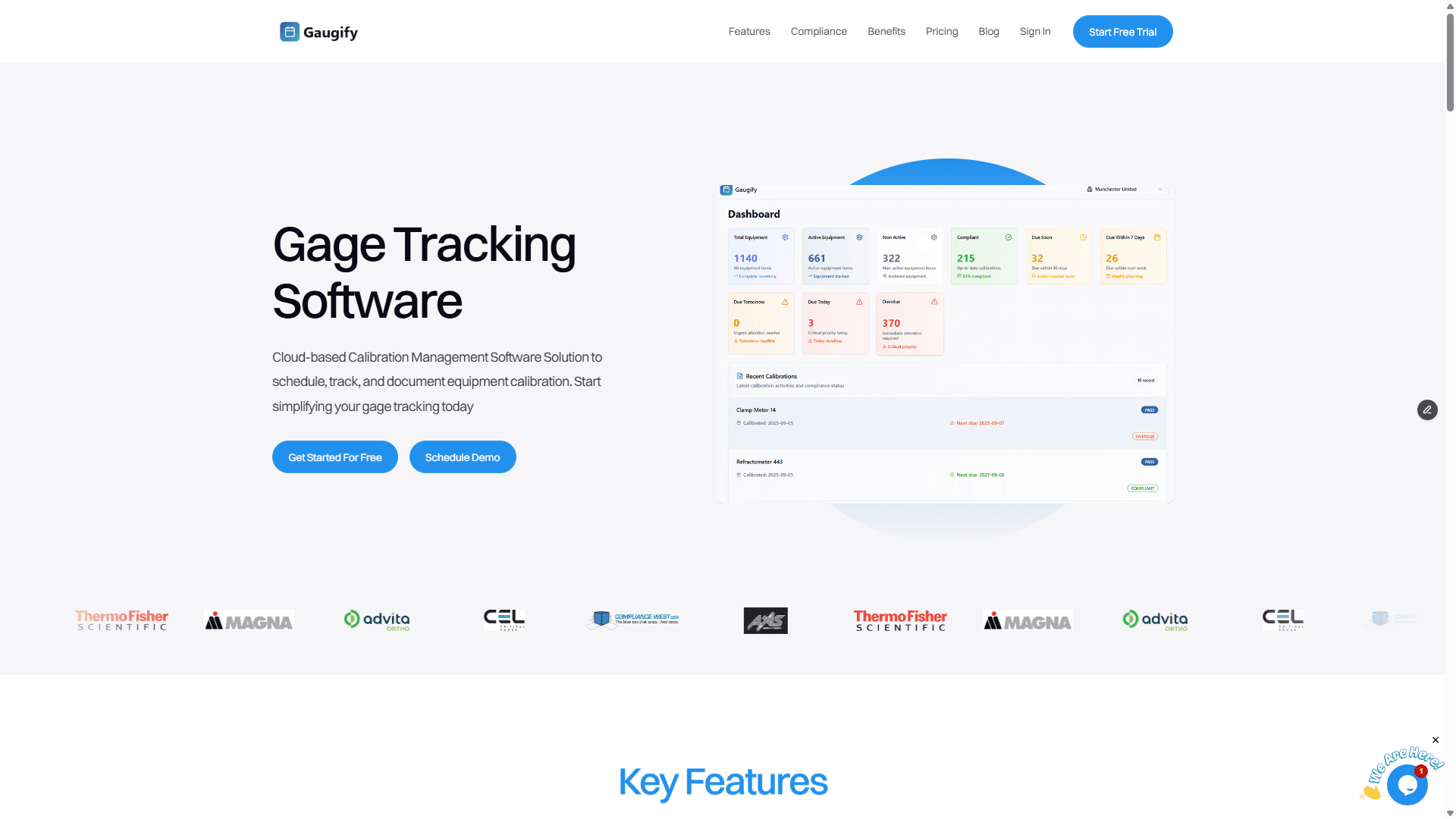
Environmental labs cannot afford compliance surprises during critical analytical runs. The software provides real-time compliance dashboards showing current instrument status, upcoming calibration requirements, and potential compliance risks. Color-coded indicators immediately identify instruments approaching due dates or showing calibration drift trends.
Integration with laboratory information management systems (LIMS) enables automatic sample hold notifications when instrument calibration status becomes questionable. If a calibration verification fails during an analytical sequence, the system can automatically flag affected samples and trigger corrective action workflows.
Compliance reporting features generate audit-ready documentation formatted for specific regulatory requirements. EPA inspection reports include all required calibration data with proper formatting and calculations, while ISO 17025 reports emphasize uncertainty budgets and interval justifications.
Ready to eliminate calibration management headaches and ensure bulletproof compliance documentation? Start your free 30-day trial and see how Gaugify transforms environmental testing laboratory calibration management.
Measurement Uncertainty Calculations Made Simple
Environmental testing laboratories struggle with measurement uncertainty calculations required by ISO 17025 and increasingly demanded by sophisticated clients. Manual uncertainty budget development consumes significant technical resources while introducing calculation errors that compromise accreditation status.
Automated Uncertainty Budget Development
The software automatically combines uncertainty components from calibration standards, instrument repeatability, environmental conditions, and analyst variability. For GC-MS analysis, the system considers uncertainty contributions from calibration standard preparation, instrument response variation, integration parameter effects, and matrix interference factors.
Built-in uncertainty calculation templates for common environmental methods eliminate repetitive mathematical operations while ensuring compliance with ISO/IEC Guide 98 requirements. The system validates uncertainty budget completeness and flags unrealistic uncertainty estimates that may indicate calculation errors or missing components.
Uncertainty trending analysis helps laboratories optimize calibration intervals and identify instruments requiring attention. When uncertainty values increase beyond acceptable limits, the system recommends calibration frequency adjustments or maintenance interventions to restore performance.
Method-Specific Calibration Templates
Environmental methods contain detailed calibration requirements that vary significantly between analytical techniques. Calibration management software for environmental testing must accommodate these differences while maintaining consistency across laboratory operations.
Pre-configured templates for EPA Methods 8260, 8270, 6010, 7470, and dozens of other common environmental methods include correct calibration frequencies, acceptance criteria, and documentation requirements. These templates eliminate setup time while ensuring regulatory compliance from initial implementation.
Custom template development supports proprietary methods and client-specific requirements. When pharmaceutical clients demand tighter calibration tolerances than EPA methods require, the software maintains separate calibration criteria for different project types while using the same underlying instrument management system.
Integration with Laboratory Operations
Modern environmental testing laboratories require calibration management that integrates seamlessly with existing laboratory workflows and information systems. Standalone calibration tracking creates information silos that compromise operational efficiency and audit readiness.
LIMS Integration Capabilities
Direct integration with popular LIMS platforms ensures calibration status information flows automatically into sample processing workflows. Before analysts begin sample preparation, the system verifies that all required instruments maintain current calibration status, preventing costly analytical reruns due to calibration lapses.
Bidirectional data exchange enables calibration scheduling based on projected analytical workloads and method requirements. When large soil contamination projects require extended GC-MS operations, the system automatically adjusts calibration verification schedules to ensure continuous compliance throughout analytical sequences.
Integration extends to quality control sample results, using ongoing QC performance to validate calibration effectiveness and identify instruments requiring attention between scheduled calibrations.
Multi-Location Laboratory Management
Environmental consulting firms operating laboratories in multiple states face complex calibration coordination challenges. Cloud-based calibration management enables centralized oversight while supporting local operational requirements and varying state regulatory frameworks.
Corporate quality managers can monitor calibration compliance across all laboratory locations through unified dashboards while local laboratory managers maintain operational control over daily calibration activities. The system accommodates different calibration service providers, regulatory requirements, and operational procedures while maintaining consistent documentation standards.
Resource sharing capabilities enable laboratories to coordinate calibration services and share specialized reference standards, reducing overall calibration costs while improving traceability documentation.
Cost Management and Resource Optimization
Environmental testing laboratories face increasing pressure to control calibration costs while maintaining rigorous compliance standards. Effective calibration management software provides financial oversight tools that support strategic decision-making and resource optimization.
Calibration Cost Tracking and Analysis
Comprehensive cost tracking includes internal labor, external service provider fees, reference standard purchases, and compliance-related expenses. The system allocates calibration costs to specific instruments, analytical methods, and client projects, enabling accurate project pricing and profitability analysis.
Trend analysis identifies calibration cost drivers and opportunities for optimization. When external calibration services consistently exceed budgeted amounts, the system provides data supporting internal calibration capability development or alternative service provider evaluation.
Budget planning features project annual calibration expenses based on instrument inventories, calibration intervals, and historical cost data. Laboratory managers can model the financial impact of equipment additions, interval changes, or service provider modifications before making operational commitments.
Vendor Performance Management
Environmental labs typically work with multiple calibration service providers, each offering different capabilities, turnaround times, and pricing structures. The software tracks vendor performance metrics including on-time delivery, certificate quality, and cost competitiveness.
Automated vendor scorecards support annual supplier evaluations required by ISO 17025, documenting performance trends and supporting vendor qualification maintenance. When calibration service quality issues arise, the system provides objective performance data supporting corrective action requests or vendor changes.
Competitive bidding management streamlines the process of obtaining calibration service quotes while maintaining detailed comparison records for audit purposes.
Future-Proofing Environmental Testing Calibration Management
Environmental testing laboratories must anticipate evolving regulatory requirements, technological advances, and client expectations while maintaining current compliance standards. Modern calibration management solutions provide the flexibility needed to adapt to changing operational demands.
Regulatory Change Management
EPA methods undergo periodic revisions that can significantly impact calibration requirements and documentation standards. The software accommodates method updates through configurable calibration templates and automated notification systems when regulatory changes affect laboratory operations.
Version control capabilities maintain historical calibration records while implementing updated requirements for new analytical work. When Method 8260 revisions change calibration verification frequencies, laboratories can implement new requirements while preserving historical compliance documentation.
Regulatory change tracking provides audit trails showing when and how laboratories adapted to updated requirements, supporting compliance demonstrations during assessments and inspections.
Technology Integration Readiness
Emerging technologies like IoT sensors, automated calibration systems, and artificial intelligence will transform environmental testing calibration management. Cloud-based platforms provide the foundation needed to integrate these technologies without disrupting current operations.
API connectivity supports integration with new analytical instruments and automated calibration systems as they become available. Laboratories can gradually implement technological improvements while maintaining comprehensive calibration documentation and compliance oversight.
Data export capabilities ensure calibration records remain accessible regardless of future software changes or technology migrations, protecting valuable historical documentation and compliance evidence.
Transform Your Environmental Testing Laboratory's Calibration Management
Environmental testing laboratories cannot afford calibration management failures that compromise analytical results, regulatory compliance, or client confidence. Manual tracking systems and basic spreadsheets create unnecessary risks while consuming valuable technical resources that should focus on analytical excellence.
Modern cloud-based calibration management software transforms these operational challenges into competitive advantages. Automated scheduling eliminates calibration surprises, digital certificate management ensures audit readiness, and integrated uncertainty calculations support ISO 17025 compliance while reducing administrative overhead.
Gaugify's specialized features for environmental testing laboratories address the unique complexities of EPA method compliance, multi-location operations, and sophisticated client requirements. From automated Method 8260 calibration tracking to integrated uncertainty budget management, the platform supports operational excellence while reducing compliance risks.
Don't let calibration management complexity compromise your laboratory's success. Schedule a personalized demo to see how Gaugify transforms environmental testing laboratory calibration management, or explore our flexible pricing options designed for laboratories of all sizes. Take control of your calibration management today and focus on what matters most – delivering accurate, reliable environmental testing results that protect public health and environmental quality.
Calibration Management Software for Environmental Testing Labs
Environmental testing laboratories face unique calibration challenges that can make or break their accreditation status. With instruments ranging from pH meters to gas chromatographs, managing calibration schedules, certificates, and compliance documentation becomes a complex puzzle. Calibration management software for environmental testing laboratories must handle the intricate requirements of EPA methods, ISO 17025 standards, and state regulatory demands while maintaining the precision needed for accurate environmental analysis.
Traditional paper-based systems and basic spreadsheets simply can't keep pace with the demanding calibration requirements of modern environmental labs. When a client needs soil contamination results within 48 hours, or when EPA auditors arrive for an unannounced inspection, your calibration records need to be bulletproof and instantly accessible.
Critical Equipment Requiring Precision Calibration Management
Environmental testing laboratories operate sophisticated instruments that demand rigorous calibration protocols. Each piece of equipment has specific tolerance requirements and calibration intervals that must be meticulously tracked.
Analytical Instruments
Gas chromatography-mass spectrometry (GC-MS) systems require multi-point calibrations with reference standards traceable to NIST. These instruments typically need calibration verification every 12 hours during continuous operation, with full recalibration monthly. The calibration curves must demonstrate linearity within ±15% for most EPA methods, and all calibration data must be retained for audit purposes.
High-performance liquid chromatography (HPLC) systems used for pesticide analysis require similar attention. Calibration standards must span the expected concentration range, with relative standard deviations typically below 20% for the lowest calibration point. Missing a single calibration check can invalidate an entire analytical run, potentially costing thousands in re-analysis fees.
Physical Testing Equipment
Balances and scales used for sample preparation require daily calibration checks with certified reference masses. Analytical balances with 0.1 mg readability must maintain accuracy within ±0.5 mg across their range. Environmental labs often manage 15-20 balances across different sampling and preparation areas, each requiring individual calibration tracking.
Temperature and humidity monitoring equipment throughout the laboratory must maintain calibration within ±0.5°C and ±3% RH respectively. These instruments require quarterly calibration with traceable standards, and any deviation outside tolerance requires immediate corrective action and potential sample integrity investigations.
Field Sampling Equipment
Portable pH meters used for field measurements must be calibrated before each sampling event using buffer solutions with known pH values of 4.0, 7.0, and 10.0. The calibration must achieve slopes between 90-105% of theoretical to meet EPA method requirements.
Dissolved oxygen meters require two-point calibrations using water-saturated air and zero-oxygen solutions. Calibration drift beyond ±0.2 mg/L requires immediate attention, as field measurements directly impact laboratory analysis priorities and client reporting timelines.
Navigating Complex Environmental Testing Compliance Requirements
Environmental testing laboratories operate under multiple overlapping regulatory frameworks that create intricate calibration documentation requirements. Understanding and maintaining compliance with these standards requires systematic tracking that goes far beyond basic spreadsheet capabilities.
EPA Method Specifications
EPA Method 8260 for volatile organic compounds requires initial calibration with a minimum of five concentration levels. The calibration curve must demonstrate acceptable linearity, with correlation coefficients exceeding 0.99 for most compounds. Continuing calibration verification must occur every 12 hours, with acceptance criteria of ±15% for most analytes and ±25% for specific challenging compounds like vinyl chloride.
Method 6010 for inductively coupled plasma analysis demands initial calibration blank and calibration verification standards that bracket sample concentrations. The calibration must be verified every 10 samples, and any verification failure requires immediate recalibration before continuing analysis. Documentation must include all raw calibration data, acceptance criteria, and corrective actions taken.
ISO 17025 Calibration Requirements
ISO 17025 accreditation requires environmental labs to establish calibration procedures that ensure measurement traceability and uncertainty estimation. Calibration management software that supports ISO 17025 compliance must track uncertainty budgets for each instrument, including contributions from calibration standards, environmental conditions, and measurement repeatability.
The standard requires calibration intervals based on equipment stability, usage frequency, and measurement criticality. Environmental testing labs typically calibrate critical analytical instruments monthly, with verification checks performed more frequently based on method requirements and historical performance data.
State Environmental Regulatory Requirements
Many state environmental agencies impose additional calibration requirements beyond federal EPA methods. California's Department of Toxic Substances Control requires quarterly calibration of all analytical balances with documented uncertainty calculations. Florida DEP mandates specific calibration procedures for groundwater monitoring equipment, with calibration records retained for minimum seven years.
These varying state requirements create calibration tracking complexity that requires sophisticated software systems to maintain compliance across multiple jurisdictions while supporting client projects nationwide.
Common Audit Scenarios and Auditor Focus Areas
Environmental testing laboratory audits follow predictable patterns, with calibration management consistently ranking among the top findings. Understanding what auditors examine helps laboratories prepare comprehensive calibration documentation that withstands scrutiny.
Unannounced EPA Inspections
EPA inspectors typically request calibration records for the past 90 days within minutes of arrival. They examine calibration frequency compliance, traceability of reference standards, and corrective action documentation. A recent inspection at a Midwest environmental lab resulted in a finding when calibration verification for their GC-MS system showed a gap of 16 hours instead of the required 12-hour maximum interval.
Inspectors also verify that calibration acceptance criteria match method requirements exactly. They've been known to calculate correlation coefficients independently and compare results to laboratory documentation. Any discrepancies or missing calculations can result in method suspension until corrective actions are completed.
ISO 17025 Assessment Challenges
ISO 17025 assessors focus heavily on calibration interval justification and uncertainty budget documentation. They examine whether laboratories have established appropriate calibration frequencies based on historical performance data and manufacturer recommendations. Labs must demonstrate systematic approaches to interval adjustment based on calibration history and drift patterns.
Assessors frequently request demonstration of calibration uncertainty calculations, expecting laboratories to show how individual uncertainty components combine to produce expanded uncertainty values. Environmental labs struggling with manual uncertainty calculations often face extended assessment timelines and additional technical reviews.
Client Audit Expectations
Pharmaceutical and aerospace clients conducting environmental lab audits often exceed regulatory requirements in their calibration expectations. They may request real-time access to calibration status for instruments analyzing their samples, or demand notification systems when calibration due dates approach.
Fortune 500 environmental consulting firms increasingly require their analytical laboratories to provide electronic calibration certificates and real-time instrument status dashboards. Labs unable to meet these digital documentation expectations risk losing significant contract opportunities.
How Modern Calibration Management Software Solves Environmental Testing Challenges
Environmental testing laboratories require calibration management software that addresses their unique operational challenges while maintaining the flexibility to adapt to evolving regulatory requirements. Gaugify's cloud-based platform specifically addresses the complex needs of environmental testing facilities with features designed around real-world laboratory workflows.
Automated Scheduling and Compliance Tracking
Environmental labs managing hundreds of instruments across multiple locations need automated scheduling that accounts for method-specific requirements and regulatory deadlines. The software automatically generates calibration schedules based on EPA method frequencies, manufacturer recommendations, and historical performance data. When Method 8260 requires 12-hour verification intervals, the system tracks these requirements independently from monthly full calibrations, sending alerts to appropriate technical staff.
The platform manages complex calibration hierarchies where field instruments require daily checks, analytical instruments need method-specific verifications, and reference standards demand annual recertification. Each calibration type maintains independent tracking with customized acceptance criteria and documentation requirements.
Automated email and SMS notifications ensure calibration deadlines never surprise laboratory staff. The system sends escalating alerts at 30, 14, 7, and 1 day intervals, with customized messaging for different stakeholder groups. Laboratory managers receive summary reports while technicians get specific instrument assignments with detailed calibration procedures.
Digital Certificate Management and Traceability
Environmental testing requires complete traceability chains from NIST standards through calibration service providers to individual laboratory instruments. Gaugify's certificate management features automatically link calibration certificates to instrument records, maintaining digital copies with automated expiration tracking.
The system generates comprehensive traceability reports that follow measurement uncertainty through each calibration level. When EPA inspectors request documentation for a specific GC-MS analysis, the software instantly produces complete calibration histories including reference standard certificates, uncertainty calculations, and environmental condition records during calibration.
Certificate templates accommodate various calibration service providers and internal calibration formats, ensuring consistent documentation regardless of calibration source. The platform validates certificate completeness, flagging missing uncertainty values or expired reference standards before calibrations are approved.
Real-Time Compliance Monitoring
Environmental labs cannot afford compliance surprises during critical analytical runs. The software provides real-time compliance dashboards showing current instrument status, upcoming calibration requirements, and potential compliance risks. Color-coded indicators immediately identify instruments approaching due dates or showing calibration drift trends.
Integration with laboratory information management systems (LIMS) enables automatic sample hold notifications when instrument calibration status becomes questionable. If a calibration verification fails during an analytical sequence, the system can automatically flag affected samples and trigger corrective action workflows.
Compliance reporting features generate audit-ready documentation formatted for specific regulatory requirements. EPA inspection reports include all required calibration data with proper formatting and calculations, while ISO 17025 reports emphasize uncertainty budgets and interval justifications.
Ready to eliminate calibration management headaches and ensure bulletproof compliance documentation? Start your free 30-day trial and see how Gaugify transforms environmental testing laboratory calibration management.
Measurement Uncertainty Calculations Made Simple
Environmental testing laboratories struggle with measurement uncertainty calculations required by ISO 17025 and increasingly demanded by sophisticated clients. Manual uncertainty budget development consumes significant technical resources while introducing calculation errors that compromise accreditation status.
Automated Uncertainty Budget Development
The software automatically combines uncertainty components from calibration standards, instrument repeatability, environmental conditions, and analyst variability. For GC-MS analysis, the system considers uncertainty contributions from calibration standard preparation, instrument response variation, integration parameter effects, and matrix interference factors.
Built-in uncertainty calculation templates for common environmental methods eliminate repetitive mathematical operations while ensuring compliance with ISO/IEC Guide 98 requirements. The system validates uncertainty budget completeness and flags unrealistic uncertainty estimates that may indicate calculation errors or missing components.
Uncertainty trending analysis helps laboratories optimize calibration intervals and identify instruments requiring attention. When uncertainty values increase beyond acceptable limits, the system recommends calibration frequency adjustments or maintenance interventions to restore performance.
Method-Specific Calibration Templates
Environmental methods contain detailed calibration requirements that vary significantly between analytical techniques. Calibration management software for environmental testing must accommodate these differences while maintaining consistency across laboratory operations.
Pre-configured templates for EPA Methods 8260, 8270, 6010, 7470, and dozens of other common environmental methods include correct calibration frequencies, acceptance criteria, and documentation requirements. These templates eliminate setup time while ensuring regulatory compliance from initial implementation.
Custom template development supports proprietary methods and client-specific requirements. When pharmaceutical clients demand tighter calibration tolerances than EPA methods require, the software maintains separate calibration criteria for different project types while using the same underlying instrument management system.
Integration with Laboratory Operations
Modern environmental testing laboratories require calibration management that integrates seamlessly with existing laboratory workflows and information systems. Standalone calibration tracking creates information silos that compromise operational efficiency and audit readiness.
LIMS Integration Capabilities
Direct integration with popular LIMS platforms ensures calibration status information flows automatically into sample processing workflows. Before analysts begin sample preparation, the system verifies that all required instruments maintain current calibration status, preventing costly analytical reruns due to calibration lapses.
Bidirectional data exchange enables calibration scheduling based on projected analytical workloads and method requirements. When large soil contamination projects require extended GC-MS operations, the system automatically adjusts calibration verification schedules to ensure continuous compliance throughout analytical sequences.
Integration extends to quality control sample results, using ongoing QC performance to validate calibration effectiveness and identify instruments requiring attention between scheduled calibrations.
Multi-Location Laboratory Management
Environmental consulting firms operating laboratories in multiple states face complex calibration coordination challenges. Cloud-based calibration management enables centralized oversight while supporting local operational requirements and varying state regulatory frameworks.
Corporate quality managers can monitor calibration compliance across all laboratory locations through unified dashboards while local laboratory managers maintain operational control over daily calibration activities. The system accommodates different calibration service providers, regulatory requirements, and operational procedures while maintaining consistent documentation standards.
Resource sharing capabilities enable laboratories to coordinate calibration services and share specialized reference standards, reducing overall calibration costs while improving traceability documentation.
Cost Management and Resource Optimization
Environmental testing laboratories face increasing pressure to control calibration costs while maintaining rigorous compliance standards. Effective calibration management software provides financial oversight tools that support strategic decision-making and resource optimization.
Calibration Cost Tracking and Analysis
Comprehensive cost tracking includes internal labor, external service provider fees, reference standard purchases, and compliance-related expenses. The system allocates calibration costs to specific instruments, analytical methods, and client projects, enabling accurate project pricing and profitability analysis.
Trend analysis identifies calibration cost drivers and opportunities for optimization. When external calibration services consistently exceed budgeted amounts, the system provides data supporting internal calibration capability development or alternative service provider evaluation.
Budget planning features project annual calibration expenses based on instrument inventories, calibration intervals, and historical cost data. Laboratory managers can model the financial impact of equipment additions, interval changes, or service provider modifications before making operational commitments.
Vendor Performance Management
Environmental labs typically work with multiple calibration service providers, each offering different capabilities, turnaround times, and pricing structures. The software tracks vendor performance metrics including on-time delivery, certificate quality, and cost competitiveness.
Automated vendor scorecards support annual supplier evaluations required by ISO 17025, documenting performance trends and supporting vendor qualification maintenance. When calibration service quality issues arise, the system provides objective performance data supporting corrective action requests or vendor changes.
Competitive bidding management streamlines the process of obtaining calibration service quotes while maintaining detailed comparison records for audit purposes.
Future-Proofing Environmental Testing Calibration Management
Environmental testing laboratories must anticipate evolving regulatory requirements, technological advances, and client expectations while maintaining current compliance standards. Modern calibration management solutions provide the flexibility needed to adapt to changing operational demands.
Regulatory Change Management
EPA methods undergo periodic revisions that can significantly impact calibration requirements and documentation standards. The software accommodates method updates through configurable calibration templates and automated notification systems when regulatory changes affect laboratory operations.
Version control capabilities maintain historical calibration records while implementing updated requirements for new analytical work. When Method 8260 revisions change calibration verification frequencies, laboratories can implement new requirements while preserving historical compliance documentation.
Regulatory change tracking provides audit trails showing when and how laboratories adapted to updated requirements, supporting compliance demonstrations during assessments and inspections.
Technology Integration Readiness
Emerging technologies like IoT sensors, automated calibration systems, and artificial intelligence will transform environmental testing calibration management. Cloud-based platforms provide the foundation needed to integrate these technologies without disrupting current operations.
API connectivity supports integration with new analytical instruments and automated calibration systems as they become available. Laboratories can gradually implement technological improvements while maintaining comprehensive calibration documentation and compliance oversight.
Data export capabilities ensure calibration records remain accessible regardless of future software changes or technology migrations, protecting valuable historical documentation and compliance evidence.
Transform Your Environmental Testing Laboratory's Calibration Management
Environmental testing laboratories cannot afford calibration management failures that compromise analytical results, regulatory compliance, or client confidence. Manual tracking systems and basic spreadsheets create unnecessary risks while consuming valuable technical resources that should focus on analytical excellence.
Modern cloud-based calibration management software transforms these operational challenges into competitive advantages. Automated scheduling eliminates calibration surprises, digital certificate management ensures audit readiness, and integrated uncertainty calculations support ISO 17025 compliance while reducing administrative overhead.
Gaugify's specialized features for environmental testing laboratories address the unique complexities of EPA method compliance, multi-location operations, and sophisticated client requirements. From automated Method 8260 calibration tracking to integrated uncertainty budget management, the platform supports operational excellence while reducing compliance risks.
Don't let calibration management complexity compromise your laboratory's success. Schedule a personalized demo to see how Gaugify transforms environmental testing laboratory calibration management, or explore our flexible pricing options designed for laboratories of all sizes. Take control of your calibration management today and focus on what matters most – delivering accurate, reliable environmental testing results that protect public health and environmental quality.