
Calibration Management Software for Government and Military Labs
Calibration Management Software for Government and Military Labs
David Bentley
Quality Assurance Engineer
12 min read
Calibration Management Software for Government and Military Labs
Government and military laboratories face unique calibration management challenges that commercial facilities rarely encounter. From stringent security requirements and multi-level approval processes to complex traceability chains and mandatory compliance with federal standards, these specialized environments demand calibration management software government military organizations can rely on. Traditional paper-based systems and basic spreadsheets simply cannot handle the rigorous documentation, audit trail requirements, and security protocols that defense contractors and federal agencies must maintain to ensure mission-critical equipment performs flawlessly in the field.
The stakes in government and military calibration programs are exceptionally high. A poorly calibrated torque wrench used on aircraft components could lead to catastrophic failure. An uncalibrated pressure transducer in weapons testing could compromise national security programs. These facilities cannot afford the compliance gaps, missed calibrations, or documentation errors that plague less sophisticated calibration management approaches.
Critical Equipment in Government and Military Calibration Programs
Government and military laboratories maintain extensive inventories of precision measurement equipment that require regular calibration to exacting standards. Understanding the scope and complexity of these instruments helps illustrate why specialized calibration management software government military labs need goes far beyond basic commercial solutions.
Dimensional Measurement Equipment
Coordinate Measuring Machines (CMMs) used in defense manufacturing require calibration of linear measurement accuracy typically within ±0.0001 inches, with documentation tracing back to NIST standards. Laser interferometers measuring distances up to 40 meters need verification against certified length standards with uncertainties often less than ±0.5 ppm. Surface plates used as reference datums require flatness verification across their entire surface, with Grade AA plates maintaining tolerances of 0.000025 inches per inch of diagonal.
Height gages, micrometers, and dial indicators used in ammunition and ordnance manufacturing demand rigorous calibration schedules, often quarterly rather than annually due to their critical role in ensuring dimensional compliance of explosive components. Thread plug and ring gages used for military standard fasteners require certification against master gages traceable to national standards.
Electronic Test Equipment
Military electronics calibration encompasses sophisticated instruments including network analyzers operating at frequencies up to 67 GHz for radar and communication systems testing. Signal generators require amplitude accuracy verification typically within ±0.1 dB and frequency accuracy to parts per million. Spectrum analyzers need calibration across their full frequency range with documented uncertainty calculations for each measurement parameter.
Digital multimeters used in avionics testing require DC voltage accuracy verification often to 0.01% of reading, with resistance measurements certified across multiple ranges. Oscilloscopes measuring high-speed digital signals need bandwidth and timing accuracy verification with traceability to time and frequency standards.
Environmental and Safety Equipment
Temperature chambers used for equipment qualification testing require calibration across their full operating range, often from -65°F to +350°F, with spatial uniformity verification at multiple load conditions. Vibration systems for shock and vibration testing need acceleration calibration typically within ±2% across frequencies from 5 Hz to 2000 Hz.
Radiation detection equipment including Geiger counters and dose rate meters require calibration against certified radioactive sources with documented response verification across multiple energy ranges. Chemical detection systems used for biological and chemical agent testing need calibration against certified reference materials with full chain of custody documentation.
Regulatory Standards Governing Military Calibration Management Software
Government and military calibration programs operate under multiple overlapping regulatory frameworks that create complex compliance requirements no commercial laboratory faces. These standards drive the specific functionality requirements for calibration management software government military organizations must implement.
Federal Acquisition Regulation (FAR) Requirements
FAR Part 46 establishes quality assurance requirements for government contractors, mandating calibration programs with documented procedures, trained personnel, and traceable standards. Contractors must maintain calibration records demonstrating continuous compliance throughout contract performance periods, often spanning multiple years. The regulation requires calibration intervals based on manufacturer recommendations, industry standards, or statistical analysis of measurement history.
FAR compliance audits scrutinize calibration certificate authenticity, traceability documentation, and environmental condition records during calibration events. Auditors verify that out-of-tolerance conditions trigger proper notification procedures and that affected measurements are evaluated for impact on delivered products or services.
MIL-STD-45662A Calibration System Requirements
This military standard establishes comprehensive requirements for calibration systems supporting Department of Defense programs. MIL-STD-45662A mandates specific calibration intervals, environmental controls during calibration, and detailed record-keeping requirements that exceed commercial industry practices.
The standard requires calibration procedures address measurement uncertainty, environmental effects, and equipment handling protocols. Calibration records must include complete traceability chains, environmental conditions, as-found and as-left data, and uncertainty calculations for each measurement parameter. Equipment requiring calibration must be uniquely identified and tracked throughout its service life.
ISO/IEC 17025 Laboratory Accreditation
Many government laboratories maintain ISO/IEC 17025 accreditation for their calibration services, requiring documented management systems, technical competence demonstration, and continuous improvement processes. This standard mandates specific record retention periods, typically five years, with electronic records requiring backup and recovery procedures.
ISO 17025 audits examine calibration certificate formats, measurement uncertainty calculations, and proficiency testing participation. Laboratories must demonstrate technical competence through personnel qualification records, equipment validation documentation, and method verification studies.
Common Audit Scenarios in Government Calibration Programs
Government and military calibration programs face frequent audits from multiple oversight bodies, each focusing on different aspects of calibration management compliance. Understanding these audit scenarios helps illustrate the documentation and traceability requirements that drive calibration management software government military labs need.
Defense Contract Audit Agency (DCAA) Reviews
DCAA auditors conduct detailed reviews of contractor calibration programs, typically focusing on cost accounting and compliance with contract requirements. These audits examine calibration costs charged to government contracts, verification of calibration vendor qualifications, and documentation supporting calibration interval decisions.
A typical DCAA audit scenario involves requesting calibration records for a random sample of equipment used on government contracts during a specific period, often covering 12-18 months of activity. Auditors verify that calibration certificates contain required information, including uncertainty statements, environmental conditions, and traceability documentation. They examine calibration schedules to ensure equipment was in calibration when used for contract work.
Auditors frequently challenge calibration intervals that exceed manufacturer recommendations, requiring statistical justification or engineering analysis supporting extended intervals. They verify that out-of-tolerance conditions triggered proper evaluation procedures and that affected deliverables were appropriately dispositioned.
Quality Assurance Representative (QAR) Inspections
Government QARs conduct routine surveillance of contractor calibration programs, focusing on real-time compliance verification rather than historical record reviews. These inspections typically involve observing calibration procedures, reviewing current calibration status of equipment in use, and verifying that calibration records are readily accessible.
During a typical QAR inspection, the representative selects equipment currently in use on government work and requests immediate access to calibration documentation. They verify calibration due dates, examine certificate authenticity, and confirm that equipment identification matches calibration records. QARs often request demonstration of calibration recall procedures and verification of calibration vendor accreditation status.
Military Standard Compliance Audits
Military programs often require compliance audits specifically focused on MIL-STD adherence, examining technical aspects of calibration procedures rather than cost accounting. These audits involve detailed technical review of calibration methods, uncertainty calculations, and environmental control documentation.
Auditors examine calibration procedures for technical adequacy, comparing documented methods against published standards and manufacturer recommendations. They verify that calibration personnel possess appropriate qualifications and that calibration environments meet specified requirements. Measurement uncertainty calculations receive particular scrutiny, with auditors verifying that all significant sources of uncertainty are identified and properly combined.
How Specialized Calibration Management Software Addresses Government Requirements
Government and military calibration programs require sophisticated software capabilities that go far beyond basic commercial calibration tracking systems. Gaugify provides the advanced functionality these demanding environments need while maintaining the security and compliance standards federal regulations require.
Advanced Scheduling and Recall Management
Government calibration programs often involve complex scheduling requirements driven by mission priorities, security classifications, and personnel availability. Equipment supporting critical programs may require expedited calibration, while classified items need scheduling coordination with cleared personnel and approved facilities.
Gaugify's advanced scheduling engine handles multiple calibration interval types, including manufacturer-recommended intervals, statistically-derived intervals based on stability analysis, and mission-critical intervals established by program requirements. The system automatically generates recall notices with configurable lead times, accounting for typical government procurement cycles and approval processes.
The software tracks equipment location across multiple buildings, security zones, and even deployed locations, ensuring calibration schedules account for transportation time and security requirements. Automated notifications alert calibration managers when equipment requires declassification or security review before calibration services can proceed.
Comprehensive Certificate Management and Verification
Government audits frequently focus on calibration certificate authenticity and completeness, requiring immediate access to original certificates with full traceability documentation. Gaugify provides secure certificate storage with advanced search capabilities, allowing auditors to quickly locate and verify calibration documentation.
The system automatically validates certificate completeness, flagging missing uncertainty statements, incomplete traceability information, or expired accreditation credentials. Digital certificate storage includes tamper-evident features and audit trails tracking all access and modifications, meeting federal requirements for electronic record integrity.
Certificate analysis tools identify trends in measurement performance, automatically flagging equipment showing drift patterns that might indicate reliability issues or inappropriate calibration intervals. This proactive approach helps prevent out-of-tolerance conditions that could impact mission-critical measurements.
Start Your Free Trial Today - See how Gaugify streamlines government calibration compliance
Detailed Audit Trail and Compliance Reporting
Federal regulations require comprehensive audit trails documenting all calibration-related activities, from initial equipment receipt through disposal. Gaugify maintains detailed logs of every system interaction, including user identification, timestamps, and specific actions performed.
The software generates audit reports tailored to specific regulatory requirements, including FAR compliance reports, MIL-STD documentation packages, and ISO 17025 quality records. These reports include all required elements such as traceability chains, environmental conditions, and uncertainty calculations, formatted for direct inclusion in audit responses.
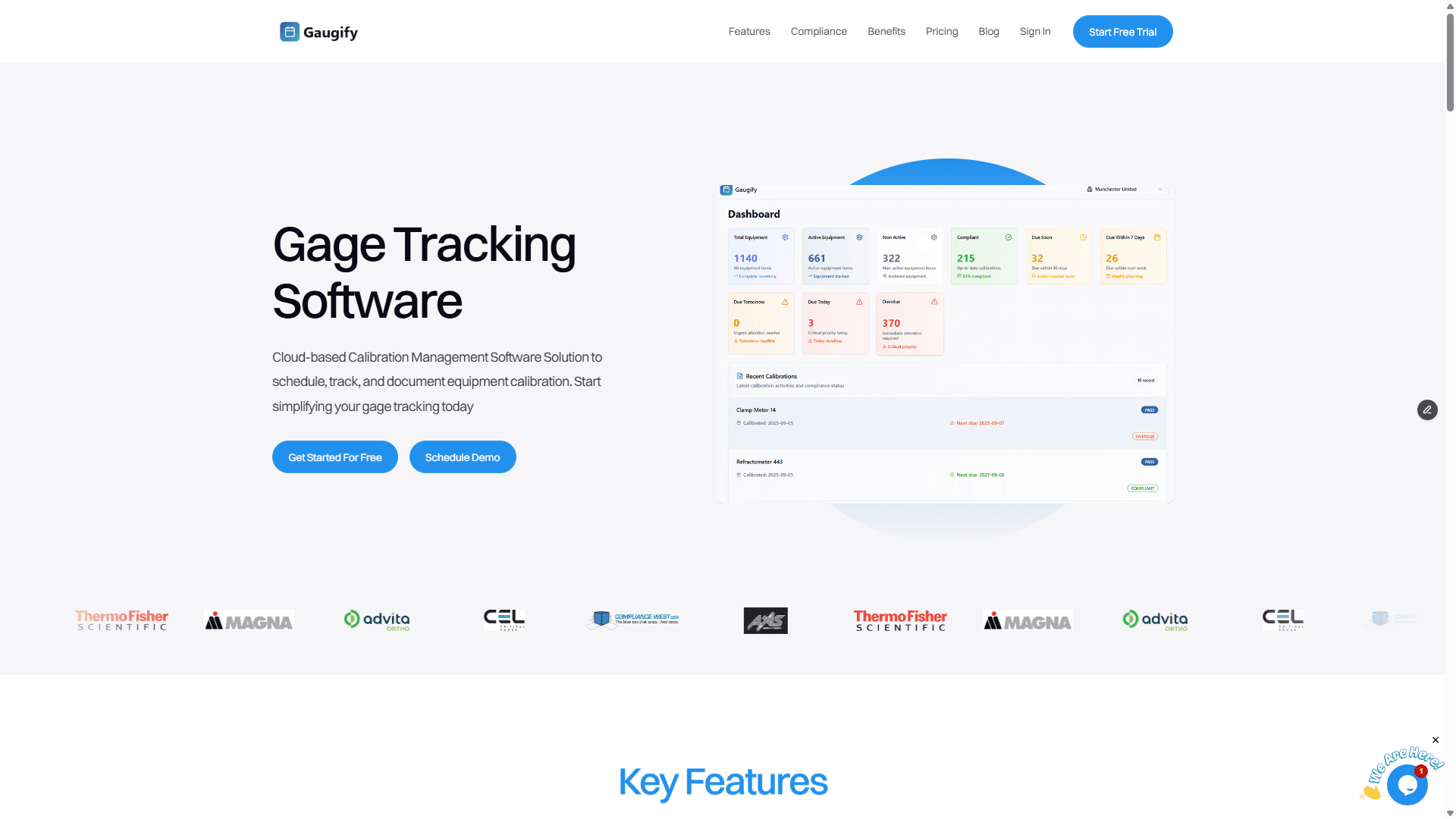
Compliance dashboards provide real-time visibility into calibration status across the entire equipment inventory, highlighting potential compliance issues before they become audit findings. Automated compliance checking verifies that all regulatory requirements are met and documented according to applicable standards.
Integration with Government Systems and Workflows
Government and military organizations often require integration with existing enterprise systems, including property management databases, project accounting systems, and security classification tracking. Gaugify's integration capabilities support these complex requirements while maintaining security and data integrity.
The software interfaces with government contractor accounting systems, enabling accurate allocation of calibration costs to specific contracts and programs. Integration with property management systems ensures calibration records remain synchronized with equipment transfers, disposals, and location changes.
API connectivity enables data exchange with laboratory information management systems (LIMS), quality management systems, and other specialized software used in government facilities. These integrations eliminate duplicate data entry while maintaining comprehensive audit trails across all connected systems.
Security and Access Control for Sensitive Environments
Government and military calibration programs handle classified equipment and sensitive program information requiring sophisticated security controls beyond commercial calibration software capabilities. Gaugify provides enterprise-grade security features meeting federal requirements for sensitive information protection.
Role-Based Access Control and User Management
Government facilities require granular access control reflecting organizational structure, security clearances, and program assignments. Gaugify's role-based access control system enables administrators to define access permissions based on job function, security level, and program participation.
The system supports multi-level security architectures common in defense environments, where users may have different access levels for various equipment categories or programs. Access controls extend to individual equipment records, calibration certificates, and reporting functions, ensuring personnel only access information appropriate to their roles and clearances.
User authentication integrates with government directory services and common access card (CAC) systems where required, providing seamless access while maintaining security standards. Failed access attempts and unusual activity patterns trigger security alerts for investigation by system administrators.
Data Protection and Backup Requirements
Federal regulations often specify data retention periods, backup frequencies, and recovery capabilities that exceed commercial requirements. Gaugify provides automated backup systems with configurable retention periods and geographically distributed storage options meeting government continuity requirements.
Encryption protects calibration data both in transit and at rest, using algorithms approved for government use. Data export capabilities support migration requirements while maintaining audit trail integrity and compliance with record retention regulations.
Cost Management and Contract Compliance
Government contractors must demonstrate cost reasonableness and proper allocation of calibration expenses across multiple contracts and programs. This requirement drives specific functionality needs in calibration management software government military organizations use for contract compliance.
Contract-Based Cost Allocation
Gaugify enables precise tracking of calibration costs by contract, program, or cost center, supporting government contractor accounting requirements. The system allocates calibration expenses based on equipment usage, supporting both direct charging and overhead allocation methods required by federal acquisition regulations.
Cost tracking includes all calibration-related expenses, from service provider fees and transportation costs to internal labor charges and facility overhead. Detailed cost reports support billing submissions and audit responses, with full documentation of allocation methodologies and supporting calculations.
Vendor Management and Procurement Compliance
Government contractors must often use approved vendor lists, comply with small business utilization goals, and maintain detailed vendor qualification records. Gaugify's vendor management capabilities track accreditation status, capability assessments, and performance metrics for all calibration service providers.
The system monitors vendor accreditation expiration dates and automatically flags potential issues before they affect calibration validity. Vendor performance tracking includes on-time delivery, technical quality metrics, and cost competitiveness, supporting procurement decisions and vendor selection justification.
Measurement Uncertainty and Technical Requirements
Government and military calibration programs often involve sophisticated measurement uncertainty requirements exceeding typical commercial applications. Gaugify's technical capabilities support these demanding requirements while maintaining usability for calibration technicians and quality managers.
Uncertainty Calculation and Management
Federal standards require documented measurement uncertainty for all calibrated equipment, with calculations following recognized methodologies such as the Guide to the Expression of Uncertainty in Measurement (GUM). Gaugify provides built-in uncertainty calculation tools supporting these requirements while maintaining traceability to source documents and assumptions.
The software maintains uncertainty budgets for each calibration method, automatically calculating combined uncertainties based on current calibration data and environmental conditions. Uncertainty analysis tools identify dominant uncertainty sources and suggest improvements to calibration procedures or equipment selection.
Trend analysis of measurement uncertainty over time helps optimize calibration intervals and identify equipment requiring enhanced maintenance or replacement. This proactive approach prevents measurement quality degradation that could affect mission-critical applications.
Environmental Monitoring and Documentation
Military standards often specify environmental conditions during calibration, with documented verification that conditions remained within acceptable limits throughout calibration procedures. Gaugify integrates with environmental monitoring systems to automatically record temperature, humidity, and other relevant parameters.
Environmental data becomes part of the permanent calibration record, supporting measurement uncertainty calculations and providing evidence of procedure compliance. Automated alerts notify calibration personnel when environmental conditions exceed acceptable limits, preventing invalid calibrations and ensuring measurement integrity.
Implementation and Training Considerations
Government and military organizations face unique implementation challenges when deploying new calibration management software, including security approval processes, personnel training requirements, and integration with existing systems. Successful implementation requires careful planning and specialized support.
Security Authorization and Compliance Verification
Government deployment of calibration management software typically requires security authorization processes, including Authority to Operate (ATO) documentation and cybersecurity compliance verification. Gaugify provides comprehensive security documentation supporting these authorization processes, including system security plans, risk assessments, and control implementation evidence.
The software supports various deployment options, including on-premises installation, government cloud environments, and hybrid architectures meeting specific security requirements. Security controls align with NIST frameworks and other federal cybersecurity standards, simplifying authorization processes and ongoing compliance monitoring.
Personnel Training and Qualification
Government calibration programs often require documented training for personnel using calibration management systems, with qualification records maintained as part of quality system documentation. Gaugify provides comprehensive training materials and supports qualification testing to meet these requirements.
Training programs address both software operation and regulatory compliance aspects, ensuring users understand how system features support specific federal requirements. Ongoing training support helps organizations maintain qualification records and adapt to changing regulatory requirements.
Ready to transform your government or military calibration program with purpose-built software that meets federal compliance requirements? Schedule a personalized demo to see how Gaugify addresses your specific regulatory challenges, from MIL-STD compliance and FAR requirements to ISO 17025 accreditation support. Our calibration management experts understand the unique demands of government and defense environments and can show you exactly how our software streamlines compliance while reducing administrative burden. Start your free trial today and discover why leading government contractors and military facilities trust Gaugify for their most critical calibration management needs.
Calibration Management Software for Government and Military Labs
Government and military laboratories face unique calibration management challenges that commercial facilities rarely encounter. From stringent security requirements and multi-level approval processes to complex traceability chains and mandatory compliance with federal standards, these specialized environments demand calibration management software government military organizations can rely on. Traditional paper-based systems and basic spreadsheets simply cannot handle the rigorous documentation, audit trail requirements, and security protocols that defense contractors and federal agencies must maintain to ensure mission-critical equipment performs flawlessly in the field.
The stakes in government and military calibration programs are exceptionally high. A poorly calibrated torque wrench used on aircraft components could lead to catastrophic failure. An uncalibrated pressure transducer in weapons testing could compromise national security programs. These facilities cannot afford the compliance gaps, missed calibrations, or documentation errors that plague less sophisticated calibration management approaches.
Critical Equipment in Government and Military Calibration Programs
Government and military laboratories maintain extensive inventories of precision measurement equipment that require regular calibration to exacting standards. Understanding the scope and complexity of these instruments helps illustrate why specialized calibration management software government military labs need goes far beyond basic commercial solutions.
Dimensional Measurement Equipment
Coordinate Measuring Machines (CMMs) used in defense manufacturing require calibration of linear measurement accuracy typically within ±0.0001 inches, with documentation tracing back to NIST standards. Laser interferometers measuring distances up to 40 meters need verification against certified length standards with uncertainties often less than ±0.5 ppm. Surface plates used as reference datums require flatness verification across their entire surface, with Grade AA plates maintaining tolerances of 0.000025 inches per inch of diagonal.
Height gages, micrometers, and dial indicators used in ammunition and ordnance manufacturing demand rigorous calibration schedules, often quarterly rather than annually due to their critical role in ensuring dimensional compliance of explosive components. Thread plug and ring gages used for military standard fasteners require certification against master gages traceable to national standards.
Electronic Test Equipment
Military electronics calibration encompasses sophisticated instruments including network analyzers operating at frequencies up to 67 GHz for radar and communication systems testing. Signal generators require amplitude accuracy verification typically within ±0.1 dB and frequency accuracy to parts per million. Spectrum analyzers need calibration across their full frequency range with documented uncertainty calculations for each measurement parameter.
Digital multimeters used in avionics testing require DC voltage accuracy verification often to 0.01% of reading, with resistance measurements certified across multiple ranges. Oscilloscopes measuring high-speed digital signals need bandwidth and timing accuracy verification with traceability to time and frequency standards.
Environmental and Safety Equipment
Temperature chambers used for equipment qualification testing require calibration across their full operating range, often from -65°F to +350°F, with spatial uniformity verification at multiple load conditions. Vibration systems for shock and vibration testing need acceleration calibration typically within ±2% across frequencies from 5 Hz to 2000 Hz.
Radiation detection equipment including Geiger counters and dose rate meters require calibration against certified radioactive sources with documented response verification across multiple energy ranges. Chemical detection systems used for biological and chemical agent testing need calibration against certified reference materials with full chain of custody documentation.
Regulatory Standards Governing Military Calibration Management Software
Government and military calibration programs operate under multiple overlapping regulatory frameworks that create complex compliance requirements no commercial laboratory faces. These standards drive the specific functionality requirements for calibration management software government military organizations must implement.
Federal Acquisition Regulation (FAR) Requirements
FAR Part 46 establishes quality assurance requirements for government contractors, mandating calibration programs with documented procedures, trained personnel, and traceable standards. Contractors must maintain calibration records demonstrating continuous compliance throughout contract performance periods, often spanning multiple years. The regulation requires calibration intervals based on manufacturer recommendations, industry standards, or statistical analysis of measurement history.
FAR compliance audits scrutinize calibration certificate authenticity, traceability documentation, and environmental condition records during calibration events. Auditors verify that out-of-tolerance conditions trigger proper notification procedures and that affected measurements are evaluated for impact on delivered products or services.
MIL-STD-45662A Calibration System Requirements
This military standard establishes comprehensive requirements for calibration systems supporting Department of Defense programs. MIL-STD-45662A mandates specific calibration intervals, environmental controls during calibration, and detailed record-keeping requirements that exceed commercial industry practices.
The standard requires calibration procedures address measurement uncertainty, environmental effects, and equipment handling protocols. Calibration records must include complete traceability chains, environmental conditions, as-found and as-left data, and uncertainty calculations for each measurement parameter. Equipment requiring calibration must be uniquely identified and tracked throughout its service life.
ISO/IEC 17025 Laboratory Accreditation
Many government laboratories maintain ISO/IEC 17025 accreditation for their calibration services, requiring documented management systems, technical competence demonstration, and continuous improvement processes. This standard mandates specific record retention periods, typically five years, with electronic records requiring backup and recovery procedures.
ISO 17025 audits examine calibration certificate formats, measurement uncertainty calculations, and proficiency testing participation. Laboratories must demonstrate technical competence through personnel qualification records, equipment validation documentation, and method verification studies.
Common Audit Scenarios in Government Calibration Programs
Government and military calibration programs face frequent audits from multiple oversight bodies, each focusing on different aspects of calibration management compliance. Understanding these audit scenarios helps illustrate the documentation and traceability requirements that drive calibration management software government military labs need.
Defense Contract Audit Agency (DCAA) Reviews
DCAA auditors conduct detailed reviews of contractor calibration programs, typically focusing on cost accounting and compliance with contract requirements. These audits examine calibration costs charged to government contracts, verification of calibration vendor qualifications, and documentation supporting calibration interval decisions.
A typical DCAA audit scenario involves requesting calibration records for a random sample of equipment used on government contracts during a specific period, often covering 12-18 months of activity. Auditors verify that calibration certificates contain required information, including uncertainty statements, environmental conditions, and traceability documentation. They examine calibration schedules to ensure equipment was in calibration when used for contract work.
Auditors frequently challenge calibration intervals that exceed manufacturer recommendations, requiring statistical justification or engineering analysis supporting extended intervals. They verify that out-of-tolerance conditions triggered proper evaluation procedures and that affected deliverables were appropriately dispositioned.
Quality Assurance Representative (QAR) Inspections
Government QARs conduct routine surveillance of contractor calibration programs, focusing on real-time compliance verification rather than historical record reviews. These inspections typically involve observing calibration procedures, reviewing current calibration status of equipment in use, and verifying that calibration records are readily accessible.
During a typical QAR inspection, the representative selects equipment currently in use on government work and requests immediate access to calibration documentation. They verify calibration due dates, examine certificate authenticity, and confirm that equipment identification matches calibration records. QARs often request demonstration of calibration recall procedures and verification of calibration vendor accreditation status.
Military Standard Compliance Audits
Military programs often require compliance audits specifically focused on MIL-STD adherence, examining technical aspects of calibration procedures rather than cost accounting. These audits involve detailed technical review of calibration methods, uncertainty calculations, and environmental control documentation.
Auditors examine calibration procedures for technical adequacy, comparing documented methods against published standards and manufacturer recommendations. They verify that calibration personnel possess appropriate qualifications and that calibration environments meet specified requirements. Measurement uncertainty calculations receive particular scrutiny, with auditors verifying that all significant sources of uncertainty are identified and properly combined.
How Specialized Calibration Management Software Addresses Government Requirements
Government and military calibration programs require sophisticated software capabilities that go far beyond basic commercial calibration tracking systems. Gaugify provides the advanced functionality these demanding environments need while maintaining the security and compliance standards federal regulations require.
Advanced Scheduling and Recall Management
Government calibration programs often involve complex scheduling requirements driven by mission priorities, security classifications, and personnel availability. Equipment supporting critical programs may require expedited calibration, while classified items need scheduling coordination with cleared personnel and approved facilities.
Gaugify's advanced scheduling engine handles multiple calibration interval types, including manufacturer-recommended intervals, statistically-derived intervals based on stability analysis, and mission-critical intervals established by program requirements. The system automatically generates recall notices with configurable lead times, accounting for typical government procurement cycles and approval processes.
The software tracks equipment location across multiple buildings, security zones, and even deployed locations, ensuring calibration schedules account for transportation time and security requirements. Automated notifications alert calibration managers when equipment requires declassification or security review before calibration services can proceed.
Comprehensive Certificate Management and Verification
Government audits frequently focus on calibration certificate authenticity and completeness, requiring immediate access to original certificates with full traceability documentation. Gaugify provides secure certificate storage with advanced search capabilities, allowing auditors to quickly locate and verify calibration documentation.
The system automatically validates certificate completeness, flagging missing uncertainty statements, incomplete traceability information, or expired accreditation credentials. Digital certificate storage includes tamper-evident features and audit trails tracking all access and modifications, meeting federal requirements for electronic record integrity.
Certificate analysis tools identify trends in measurement performance, automatically flagging equipment showing drift patterns that might indicate reliability issues or inappropriate calibration intervals. This proactive approach helps prevent out-of-tolerance conditions that could impact mission-critical measurements.
Start Your Free Trial Today - See how Gaugify streamlines government calibration compliance
Detailed Audit Trail and Compliance Reporting
Federal regulations require comprehensive audit trails documenting all calibration-related activities, from initial equipment receipt through disposal. Gaugify maintains detailed logs of every system interaction, including user identification, timestamps, and specific actions performed.
The software generates audit reports tailored to specific regulatory requirements, including FAR compliance reports, MIL-STD documentation packages, and ISO 17025 quality records. These reports include all required elements such as traceability chains, environmental conditions, and uncertainty calculations, formatted for direct inclusion in audit responses.
Compliance dashboards provide real-time visibility into calibration status across the entire equipment inventory, highlighting potential compliance issues before they become audit findings. Automated compliance checking verifies that all regulatory requirements are met and documented according to applicable standards.
Integration with Government Systems and Workflows
Government and military organizations often require integration with existing enterprise systems, including property management databases, project accounting systems, and security classification tracking. Gaugify's integration capabilities support these complex requirements while maintaining security and data integrity.
The software interfaces with government contractor accounting systems, enabling accurate allocation of calibration costs to specific contracts and programs. Integration with property management systems ensures calibration records remain synchronized with equipment transfers, disposals, and location changes.
API connectivity enables data exchange with laboratory information management systems (LIMS), quality management systems, and other specialized software used in government facilities. These integrations eliminate duplicate data entry while maintaining comprehensive audit trails across all connected systems.
Security and Access Control for Sensitive Environments
Government and military calibration programs handle classified equipment and sensitive program information requiring sophisticated security controls beyond commercial calibration software capabilities. Gaugify provides enterprise-grade security features meeting federal requirements for sensitive information protection.
Role-Based Access Control and User Management
Government facilities require granular access control reflecting organizational structure, security clearances, and program assignments. Gaugify's role-based access control system enables administrators to define access permissions based on job function, security level, and program participation.
The system supports multi-level security architectures common in defense environments, where users may have different access levels for various equipment categories or programs. Access controls extend to individual equipment records, calibration certificates, and reporting functions, ensuring personnel only access information appropriate to their roles and clearances.
User authentication integrates with government directory services and common access card (CAC) systems where required, providing seamless access while maintaining security standards. Failed access attempts and unusual activity patterns trigger security alerts for investigation by system administrators.
Data Protection and Backup Requirements
Federal regulations often specify data retention periods, backup frequencies, and recovery capabilities that exceed commercial requirements. Gaugify provides automated backup systems with configurable retention periods and geographically distributed storage options meeting government continuity requirements.
Encryption protects calibration data both in transit and at rest, using algorithms approved for government use. Data export capabilities support migration requirements while maintaining audit trail integrity and compliance with record retention regulations.
Cost Management and Contract Compliance
Government contractors must demonstrate cost reasonableness and proper allocation of calibration expenses across multiple contracts and programs. This requirement drives specific functionality needs in calibration management software government military organizations use for contract compliance.
Contract-Based Cost Allocation
Gaugify enables precise tracking of calibration costs by contract, program, or cost center, supporting government contractor accounting requirements. The system allocates calibration expenses based on equipment usage, supporting both direct charging and overhead allocation methods required by federal acquisition regulations.
Cost tracking includes all calibration-related expenses, from service provider fees and transportation costs to internal labor charges and facility overhead. Detailed cost reports support billing submissions and audit responses, with full documentation of allocation methodologies and supporting calculations.
Vendor Management and Procurement Compliance
Government contractors must often use approved vendor lists, comply with small business utilization goals, and maintain detailed vendor qualification records. Gaugify's vendor management capabilities track accreditation status, capability assessments, and performance metrics for all calibration service providers.
The system monitors vendor accreditation expiration dates and automatically flags potential issues before they affect calibration validity. Vendor performance tracking includes on-time delivery, technical quality metrics, and cost competitiveness, supporting procurement decisions and vendor selection justification.
Measurement Uncertainty and Technical Requirements
Government and military calibration programs often involve sophisticated measurement uncertainty requirements exceeding typical commercial applications. Gaugify's technical capabilities support these demanding requirements while maintaining usability for calibration technicians and quality managers.
Uncertainty Calculation and Management
Federal standards require documented measurement uncertainty for all calibrated equipment, with calculations following recognized methodologies such as the Guide to the Expression of Uncertainty in Measurement (GUM). Gaugify provides built-in uncertainty calculation tools supporting these requirements while maintaining traceability to source documents and assumptions.
The software maintains uncertainty budgets for each calibration method, automatically calculating combined uncertainties based on current calibration data and environmental conditions. Uncertainty analysis tools identify dominant uncertainty sources and suggest improvements to calibration procedures or equipment selection.
Trend analysis of measurement uncertainty over time helps optimize calibration intervals and identify equipment requiring enhanced maintenance or replacement. This proactive approach prevents measurement quality degradation that could affect mission-critical applications.
Environmental Monitoring and Documentation
Military standards often specify environmental conditions during calibration, with documented verification that conditions remained within acceptable limits throughout calibration procedures. Gaugify integrates with environmental monitoring systems to automatically record temperature, humidity, and other relevant parameters.
Environmental data becomes part of the permanent calibration record, supporting measurement uncertainty calculations and providing evidence of procedure compliance. Automated alerts notify calibration personnel when environmental conditions exceed acceptable limits, preventing invalid calibrations and ensuring measurement integrity.
Implementation and Training Considerations
Government and military organizations face unique implementation challenges when deploying new calibration management software, including security approval processes, personnel training requirements, and integration with existing systems. Successful implementation requires careful planning and specialized support.
Security Authorization and Compliance Verification
Government deployment of calibration management software typically requires security authorization processes, including Authority to Operate (ATO) documentation and cybersecurity compliance verification. Gaugify provides comprehensive security documentation supporting these authorization processes, including system security plans, risk assessments, and control implementation evidence.
The software supports various deployment options, including on-premises installation, government cloud environments, and hybrid architectures meeting specific security requirements. Security controls align with NIST frameworks and other federal cybersecurity standards, simplifying authorization processes and ongoing compliance monitoring.
Personnel Training and Qualification
Government calibration programs often require documented training for personnel using calibration management systems, with qualification records maintained as part of quality system documentation. Gaugify provides comprehensive training materials and supports qualification testing to meet these requirements.
Training programs address both software operation and regulatory compliance aspects, ensuring users understand how system features support specific federal requirements. Ongoing training support helps organizations maintain qualification records and adapt to changing regulatory requirements.
Ready to transform your government or military calibration program with purpose-built software that meets federal compliance requirements? Schedule a personalized demo to see how Gaugify addresses your specific regulatory challenges, from MIL-STD compliance and FAR requirements to ISO 17025 accreditation support. Our calibration management experts understand the unique demands of government and defense environments and can show you exactly how our software streamlines compliance while reducing administrative burden. Start your free trial today and discover why leading government contractors and military facilities trust Gaugify for their most critical calibration management needs.