
Calibration Management Software for ISO 9001: Everything You Need to Know
Calibration Management Software for ISO 9001: Everything You Need to Know
David Bentley
Quality Assurance Engineer
12 min read
Calibration Management Software for ISO 9001: Everything You Need to Know
If you're managing calibration programs for ISO 9001 compliance, you know the challenges: tracking hundreds of instruments, staying on top of due dates, maintaining detailed records, and proving traceability during audits. The right calibration management software ISO 9001 solution can transform this complex process from a compliance headache into a streamlined operation that actually supports your quality goals.
ISO 9001 clause 7.1.5 requires organizations to ensure that monitoring and measuring resources are suitable for their purpose and maintained to ensure continuing fitness for use. This means your Mitutoyo micrometers, Fluke multimeters, and torque wrenches need documented calibration schedules, certificates, and traceability records—all readily available when auditors come calling.
In this comprehensive guide, we'll cover everything you need to know about selecting and implementing calibration management software that meets ISO 9001 requirements while improving your operational efficiency.
What Is Calibration Management Software and Why Does ISO 9001 Compliance Matter?
Calibration management software is a digital platform that automates and centralizes the entire calibration lifecycle—from scheduling and notifications to certificate management and audit reporting. For ISO 9001 organizations, this software serves as the backbone of documented quality management, ensuring measurement traceability and equipment reliability.
Consider a typical manufacturing facility with 500+ instruments: dial indicators with ±0.001" tolerances, pressure gauges rated for 0-100 PSI, and temperature probes requiring annual recalibration. Managing this manually through spreadsheets creates risks of missed calibrations, lost certificates, and failed audits. Modern calibration management software eliminates these risks while reducing administrative overhead by up to 75%.
ISO 9001:2015 specifically requires organizations to demonstrate that measuring equipment is:
Calibrated or verified at specified intervals against measurement standards traceable to international or national standards
Identified to enable calibration status determination
Safeguarded from adjustments that would invalidate measurement results
Protected from damage and deterioration during handling, maintenance, and storage
Professional calibration management platforms address each of these requirements through automated workflows, detailed record-keeping, and comprehensive reporting capabilities.
Essential Features for Calibration Management Software ISO 9001 Compliance
When evaluating calibration management solutions for ISO 9001 compliance, focus on these critical capabilities:
Automated Scheduling and Reminders
The software should automatically calculate next calibration due dates based on your specified intervals—whether that's 12 months for your Starrett height gages or 6 months for critical process thermometers. Advanced systems account for calibration history, adjusting intervals based on drift patterns and usage frequency.
Look for multi-channel notification systems that send email alerts 30, 14, and 7 days before calibrations expire, with escalation to supervisors for overdue items. The best platforms also generate mobile notifications for technicians responsible for specific instrument categories.
Digital Certificate Management
ISO 9001 auditors expect immediate access to calibration certificates showing traceability chains, measurement uncertainties, and "as found/as left" data. Your software should store certificates as searchable PDFs while automatically extracting key data points like calibration dates, technician signatures, and environmental conditions during calibration.
Integration with commercial calibration labs through electronic data interchange (EDI) streamlines certificate imports, reducing manual data entry errors that could compromise audit trails.
Comprehensive Asset Management
Beyond basic instrument tracking, robust calibration management software maintains detailed asset profiles including:
Manufacturer specifications and tolerance ranges
Location tracking (Building A, Line 3, Station 12)
Calibration procedures and required standards
Usage history and environmental exposure
Maintenance logs and repair history
Cost tracking for calibration services
Measurement Uncertainty Calculations
For ISO 9001 compliance, you need documented evidence that your measurement uncertainty doesn't compromise product conformity. Advanced calibration management software performs automatic uncertainty calculations using RSS (root sum square) methods, considering factors like calibration standard accuracy, environmental conditions, and instrument resolution.
For example, when calibrating a 0-6" micrometer with ±0.0001" accuracy using a gage block set with ±0.000050" uncertainty, the software calculates combined uncertainty and determines measurement capability ratios automatically.
Audit Trail and Compliance Reporting
Every action within the system should generate timestamped audit logs showing who made changes, when, and why. This includes calibration schedule modifications, certificate uploads, and status changes from "calibrated" to "out of service."
Pre-built compliance reports should include:
Calibration status summaries by department or instrument type
Traceability chain documentation
Overdue instrument reports with responsible parties
Calibration cost analysis and trending
Statistical process control charts showing instrument drift
Role-Based Access Controls
Different team members need different levels of access. Technicians might view calibration schedules and upload certificates, while quality managers need full reporting access and the ability to modify calibration intervals. Shop floor supervisors might only need read-only access to verify instrument status before production runs.
ISO 9001-compliant systems enforce these permissions strictly, preventing unauthorized changes that could compromise measurement integrity.
Leading Calibration Management Software Options for ISO 9001
The calibration management software market offers several robust solutions designed specifically for ISO 9001 compliance. Here's how the leading options compare:
Gaugify: Modern Cloud-Based Solution
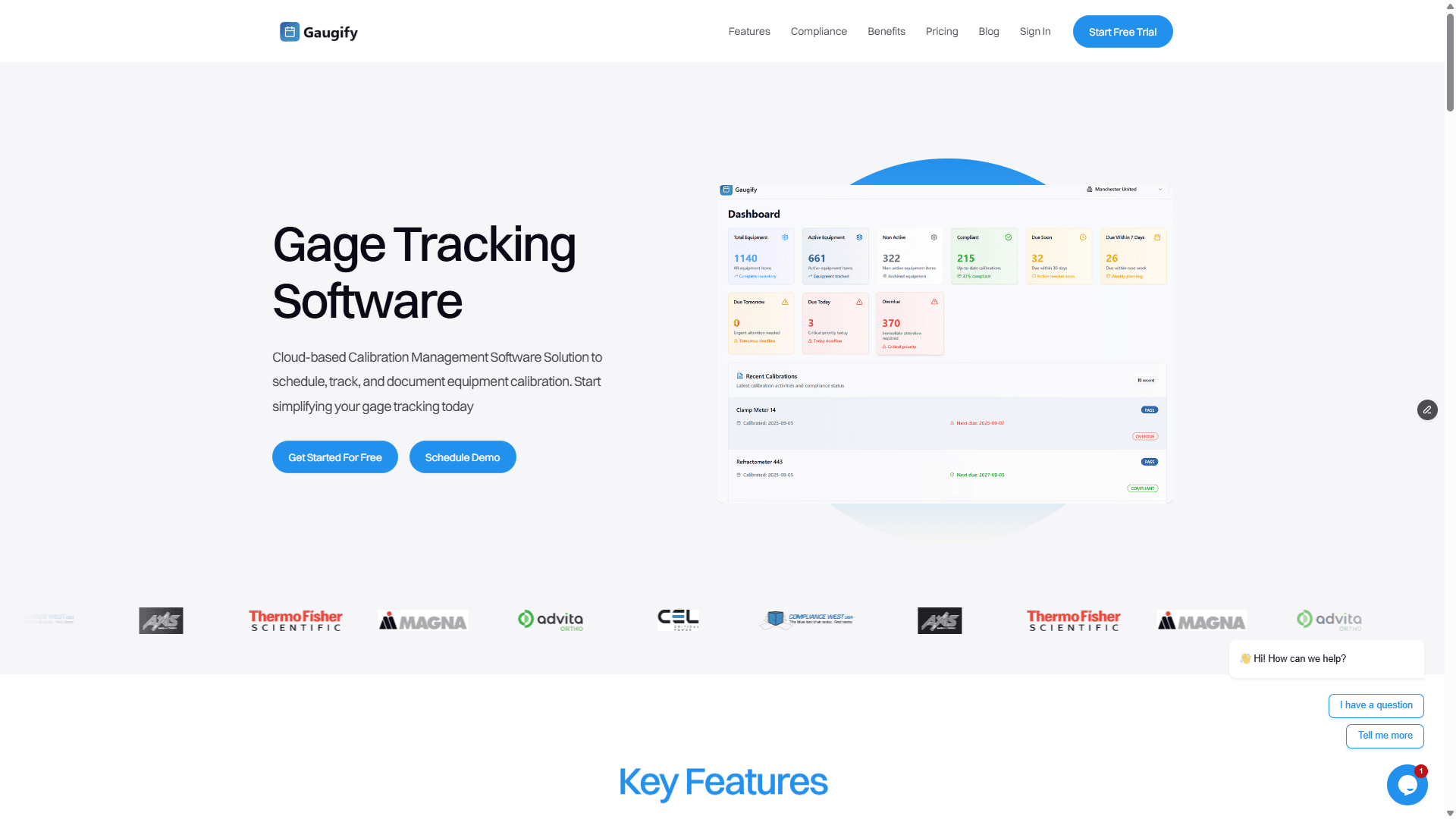
Gaugify stands out as a next-generation calibration management platform built specifically for modern quality organizations. Its cloud-based architecture eliminates IT maintenance overhead while providing enterprise-grade security and 99.9% uptime reliability.
Key differentiators include:
Intuitive interface that reduces training time from weeks to hours
Mobile-first design enabling field technicians to update calibration status in real-time
Advanced analytics with predictive calibration scheduling based on historical drift patterns
Seamless integration with popular ERP systems like SAP, Oracle, and Microsoft Dynamics
Built-in ISO 17025 compliance features for organizations managing internal calibration labs
Gaugify's reporting engine automatically generates ISO 9001 audit packages, compiling all necessary documentation with a single click. During a recent audit at a tier-1 automotive supplier, auditors completed their calibration review 60% faster thanks to Gaugify's organized documentation and instant report generation.
Traditional Enterprise Solutions
Established players like PQ Systems GAGEtrak and CyberMetrics GAGEpack offer comprehensive functionality but often require significant customization and IT resources. These solutions work well for large organizations with dedicated calibration departments but may be overly complex for smaller manufacturers.
Legacy systems typically involve substantial upfront licensing fees ($15,000-$50,000+) plus annual maintenance costs, making them cost-prohibitive for many mid-market manufacturers.
Specialized Industry Solutions
Some vendors focus on specific industries like aerospace or pharmaceuticals, offering deep functionality for specialized requirements like AS9100 or FDA 21 CFR Part 11 compliance. While these solutions excel in their niches, they often lack the flexibility needed for diverse manufacturing environments.
Start your free trial to experience how modern calibration management software can streamline your ISO 9001 compliance while reducing administrative overhead.
Calibration Management Software ISO 9001 Pricing: What to Expect
Calibration management software pricing varies significantly based on deployment model, feature complexity, and user count. Understanding the total cost of ownership helps ensure budget alignment and ROI realization.
Cloud-Based SaaS Solutions
Modern cloud platforms like Gaugify typically charge monthly subscriptions ranging from $50-150 per user, with volume discounts for larger organizations. This model includes automatic updates, security patches, and technical support, eliminating the hidden costs associated with on-premise deployments.
For a 50-person quality team managing 1,000 instruments, expect monthly costs between $500-2,000 depending on feature requirements and integration complexity.
On-Premise Enterprise Licenses
Traditional software licenses require substantial upfront investments ($10,000-100,000+) plus annual maintenance fees (typically 18-22% of license cost). Additional costs include server hardware, database licenses, IT administration, and security updates.
While per-user costs may appear lower for very large deployments, the total cost of ownership often exceeds cloud solutions when factoring in infrastructure and maintenance expenses.
Hybrid and Custom Solutions
Some organizations require hybrid deployments combining cloud convenience with on-premise data control. These solutions typically cost 25-40% more than pure cloud platforms but offer greater customization flexibility.
Custom development for highly specialized requirements can range from $50,000-500,000+ depending on complexity and integration requirements.
Review detailed pricing options to find the calibration management solution that fits your budget and feature requirements.
Implementation Considerations for ISO 9001 Compliance
Successful calibration management software implementation requires careful planning and stakeholder alignment. Organizations that approach implementation systematically achieve full productivity 3-4 months faster than those without structured deployment plans.
Data Migration Strategy
Most organizations have existing calibration data scattered across spreadsheets, paper files, and legacy systems. Developing a comprehensive data migration strategy ensures historical information remains accessible for ISO 9001 audit requirements.
Key migration considerations include:
Instrument master data with serial numbers, models, and specifications
Historical calibration records and certificates (minimum 3 years for most ISO 9001 audits)
Current calibration schedules and responsible parties
Location hierarchies and organizational structures
Vendor information and external lab relationships
Process Standardization
Implementation provides an opportunity to standardize calibration processes across multiple facilities or departments. Document standard operating procedures for common scenarios like receiving new instruments, handling calibration failures, and managing emergency calibrations.
Establish clear escalation procedures when instruments exceed tolerance limits during calibration. For example, when a torque wrench used for critical fastener applications shows 5% deviation, define whether production stops immediately or continues pending engineering review.
User Training and Change Management
Even intuitive software requires focused training to ensure user adoption and compliance consistency. Develop role-based training programs addressing specific responsibilities:
Technicians: Daily task management, certificate uploads, status updates
Supervisors: Schedule review, approval workflows, exception handling
Quality managers: Reporting, audit preparation, trend analysis
Administrators: System configuration, user management, integration maintenance
Plan for 2-3 training sessions per role plus ongoing support during the first 90 days of production use.
Evaluating Calibration Management Software During Your Free Trial
Most calibration management software vendors offer free trials lasting 14-30 days. Maximize this evaluation period by testing scenarios that reflect your actual ISO 9001 compliance needs.
Core Functionality Testing
Import a sample of your instrument data (50-100 items representing different categories) and test the complete calibration lifecycle:
Create calibration schedules with varying intervals (annual, bi-annual, quarterly)
Set up automated reminders and test notification delivery
Upload sample calibration certificates and verify data extraction accuracy
Generate compliance reports and evaluate formatting for audit presentation
Test mobile access if your technicians work in field locations
Integration Capabilities
If you use ERP systems, LIMS, or other quality management tools, test integration capabilities during the trial. Verify that instrument master data synchronizes correctly and that calibration status updates propagate to connected systems.
Test both automated data exchanges and manual import/export processes to ensure operational flexibility.
User Experience Evaluation
Include actual end users in the trial evaluation, not just decision-makers. Technicians who will use the system daily provide valuable feedback about interface usability, mobile functionality, and workflow efficiency.
Conduct realistic scenarios like "find all pressure gages due for calibration in the next 30 days" or "generate a traceability report for instruments in the final inspection area."
Support and Documentation Review
Evaluate vendor support quality during the trial period. Test response times for technical questions and assess documentation completeness. ISO 9001 compliance often requires rapid issue resolution to maintain calibration schedules.
Review available training materials, video tutorials, and implementation support to gauge the total cost of ownership beyond software licensing.
Why Choose Gaugify for Your ISO 9001 Calibration Management Software Needs
Selecting the right calibration management software significantly impacts your organization's ISO 9001 compliance efficiency and audit readiness. Gaugify combines modern cloud technology with deep understanding of quality management requirements, delivering a solution that grows with your organization.
Key advantages that set Gaugify apart:
Rapid Implementation: Cloud-based deployment means you're productive within days, not months. Our implementation team helps migrate existing data and configure workflows to match your current processes while identifying improvement opportunities.
Intuitive User Experience: Technicians and quality managers can navigate Gaugify without extensive training, reducing change management challenges and ensuring consistent adoption across your organization.
Comprehensive Compliance Support: Built-in ISO 9001 templates and automated audit trail generation eliminate compliance guesswork. Generate professional audit packages with complete traceability documentation in minutes, not hours.
Scalable Architecture: Whether you're managing 100 instruments or 10,000, Gaugify's cloud platform scales seamlessly without performance degradation or additional IT infrastructure investment.
Transparent Pricing: No hidden fees, unexpected upgrade costs, or complex licensing models. Our straightforward subscription pricing includes all features, updates, and support.
Organizations using Gaugify report 40-60% reduction in calibration administrative time, 95% faster audit preparation, and zero calibration-related nonconformances during ISO 9001 surveillance audits.
Ready to transform your calibration management program? Schedule a personalized demo to see how Gaugify addresses your specific ISO 9001 compliance requirements and operational challenges.
Calibration Management Software for ISO 9001: Everything You Need to Know
If you're managing calibration programs for ISO 9001 compliance, you know the challenges: tracking hundreds of instruments, staying on top of due dates, maintaining detailed records, and proving traceability during audits. The right calibration management software ISO 9001 solution can transform this complex process from a compliance headache into a streamlined operation that actually supports your quality goals.
ISO 9001 clause 7.1.5 requires organizations to ensure that monitoring and measuring resources are suitable for their purpose and maintained to ensure continuing fitness for use. This means your Mitutoyo micrometers, Fluke multimeters, and torque wrenches need documented calibration schedules, certificates, and traceability records—all readily available when auditors come calling.
In this comprehensive guide, we'll cover everything you need to know about selecting and implementing calibration management software that meets ISO 9001 requirements while improving your operational efficiency.
What Is Calibration Management Software and Why Does ISO 9001 Compliance Matter?
Calibration management software is a digital platform that automates and centralizes the entire calibration lifecycle—from scheduling and notifications to certificate management and audit reporting. For ISO 9001 organizations, this software serves as the backbone of documented quality management, ensuring measurement traceability and equipment reliability.
Consider a typical manufacturing facility with 500+ instruments: dial indicators with ±0.001" tolerances, pressure gauges rated for 0-100 PSI, and temperature probes requiring annual recalibration. Managing this manually through spreadsheets creates risks of missed calibrations, lost certificates, and failed audits. Modern calibration management software eliminates these risks while reducing administrative overhead by up to 75%.
ISO 9001:2015 specifically requires organizations to demonstrate that measuring equipment is:
Calibrated or verified at specified intervals against measurement standards traceable to international or national standards
Identified to enable calibration status determination
Safeguarded from adjustments that would invalidate measurement results
Protected from damage and deterioration during handling, maintenance, and storage
Professional calibration management platforms address each of these requirements through automated workflows, detailed record-keeping, and comprehensive reporting capabilities.
Essential Features for Calibration Management Software ISO 9001 Compliance
When evaluating calibration management solutions for ISO 9001 compliance, focus on these critical capabilities:
Automated Scheduling and Reminders
The software should automatically calculate next calibration due dates based on your specified intervals—whether that's 12 months for your Starrett height gages or 6 months for critical process thermometers. Advanced systems account for calibration history, adjusting intervals based on drift patterns and usage frequency.
Look for multi-channel notification systems that send email alerts 30, 14, and 7 days before calibrations expire, with escalation to supervisors for overdue items. The best platforms also generate mobile notifications for technicians responsible for specific instrument categories.
Digital Certificate Management
ISO 9001 auditors expect immediate access to calibration certificates showing traceability chains, measurement uncertainties, and "as found/as left" data. Your software should store certificates as searchable PDFs while automatically extracting key data points like calibration dates, technician signatures, and environmental conditions during calibration.
Integration with commercial calibration labs through electronic data interchange (EDI) streamlines certificate imports, reducing manual data entry errors that could compromise audit trails.
Comprehensive Asset Management
Beyond basic instrument tracking, robust calibration management software maintains detailed asset profiles including:
Manufacturer specifications and tolerance ranges
Location tracking (Building A, Line 3, Station 12)
Calibration procedures and required standards
Usage history and environmental exposure
Maintenance logs and repair history
Cost tracking for calibration services
Measurement Uncertainty Calculations
For ISO 9001 compliance, you need documented evidence that your measurement uncertainty doesn't compromise product conformity. Advanced calibration management software performs automatic uncertainty calculations using RSS (root sum square) methods, considering factors like calibration standard accuracy, environmental conditions, and instrument resolution.
For example, when calibrating a 0-6" micrometer with ±0.0001" accuracy using a gage block set with ±0.000050" uncertainty, the software calculates combined uncertainty and determines measurement capability ratios automatically.
Audit Trail and Compliance Reporting
Every action within the system should generate timestamped audit logs showing who made changes, when, and why. This includes calibration schedule modifications, certificate uploads, and status changes from "calibrated" to "out of service."
Pre-built compliance reports should include:
Calibration status summaries by department or instrument type
Traceability chain documentation
Overdue instrument reports with responsible parties
Calibration cost analysis and trending
Statistical process control charts showing instrument drift
Role-Based Access Controls
Different team members need different levels of access. Technicians might view calibration schedules and upload certificates, while quality managers need full reporting access and the ability to modify calibration intervals. Shop floor supervisors might only need read-only access to verify instrument status before production runs.
ISO 9001-compliant systems enforce these permissions strictly, preventing unauthorized changes that could compromise measurement integrity.
Leading Calibration Management Software Options for ISO 9001
The calibration management software market offers several robust solutions designed specifically for ISO 9001 compliance. Here's how the leading options compare:
Gaugify: Modern Cloud-Based Solution
Gaugify stands out as a next-generation calibration management platform built specifically for modern quality organizations. Its cloud-based architecture eliminates IT maintenance overhead while providing enterprise-grade security and 99.9% uptime reliability.
Key differentiators include:
Intuitive interface that reduces training time from weeks to hours
Mobile-first design enabling field technicians to update calibration status in real-time
Advanced analytics with predictive calibration scheduling based on historical drift patterns
Seamless integration with popular ERP systems like SAP, Oracle, and Microsoft Dynamics
Built-in ISO 17025 compliance features for organizations managing internal calibration labs
Gaugify's reporting engine automatically generates ISO 9001 audit packages, compiling all necessary documentation with a single click. During a recent audit at a tier-1 automotive supplier, auditors completed their calibration review 60% faster thanks to Gaugify's organized documentation and instant report generation.
Traditional Enterprise Solutions
Established players like PQ Systems GAGEtrak and CyberMetrics GAGEpack offer comprehensive functionality but often require significant customization and IT resources. These solutions work well for large organizations with dedicated calibration departments but may be overly complex for smaller manufacturers.
Legacy systems typically involve substantial upfront licensing fees ($15,000-$50,000+) plus annual maintenance costs, making them cost-prohibitive for many mid-market manufacturers.
Specialized Industry Solutions
Some vendors focus on specific industries like aerospace or pharmaceuticals, offering deep functionality for specialized requirements like AS9100 or FDA 21 CFR Part 11 compliance. While these solutions excel in their niches, they often lack the flexibility needed for diverse manufacturing environments.
Start your free trial to experience how modern calibration management software can streamline your ISO 9001 compliance while reducing administrative overhead.
Calibration Management Software ISO 9001 Pricing: What to Expect
Calibration management software pricing varies significantly based on deployment model, feature complexity, and user count. Understanding the total cost of ownership helps ensure budget alignment and ROI realization.
Cloud-Based SaaS Solutions
Modern cloud platforms like Gaugify typically charge monthly subscriptions ranging from $50-150 per user, with volume discounts for larger organizations. This model includes automatic updates, security patches, and technical support, eliminating the hidden costs associated with on-premise deployments.
For a 50-person quality team managing 1,000 instruments, expect monthly costs between $500-2,000 depending on feature requirements and integration complexity.
On-Premise Enterprise Licenses
Traditional software licenses require substantial upfront investments ($10,000-100,000+) plus annual maintenance fees (typically 18-22% of license cost). Additional costs include server hardware, database licenses, IT administration, and security updates.
While per-user costs may appear lower for very large deployments, the total cost of ownership often exceeds cloud solutions when factoring in infrastructure and maintenance expenses.
Hybrid and Custom Solutions
Some organizations require hybrid deployments combining cloud convenience with on-premise data control. These solutions typically cost 25-40% more than pure cloud platforms but offer greater customization flexibility.
Custom development for highly specialized requirements can range from $50,000-500,000+ depending on complexity and integration requirements.
Review detailed pricing options to find the calibration management solution that fits your budget and feature requirements.
Implementation Considerations for ISO 9001 Compliance
Successful calibration management software implementation requires careful planning and stakeholder alignment. Organizations that approach implementation systematically achieve full productivity 3-4 months faster than those without structured deployment plans.
Data Migration Strategy
Most organizations have existing calibration data scattered across spreadsheets, paper files, and legacy systems. Developing a comprehensive data migration strategy ensures historical information remains accessible for ISO 9001 audit requirements.
Key migration considerations include:
Instrument master data with serial numbers, models, and specifications
Historical calibration records and certificates (minimum 3 years for most ISO 9001 audits)
Current calibration schedules and responsible parties
Location hierarchies and organizational structures
Vendor information and external lab relationships
Process Standardization
Implementation provides an opportunity to standardize calibration processes across multiple facilities or departments. Document standard operating procedures for common scenarios like receiving new instruments, handling calibration failures, and managing emergency calibrations.
Establish clear escalation procedures when instruments exceed tolerance limits during calibration. For example, when a torque wrench used for critical fastener applications shows 5% deviation, define whether production stops immediately or continues pending engineering review.
User Training and Change Management
Even intuitive software requires focused training to ensure user adoption and compliance consistency. Develop role-based training programs addressing specific responsibilities:
Technicians: Daily task management, certificate uploads, status updates
Supervisors: Schedule review, approval workflows, exception handling
Quality managers: Reporting, audit preparation, trend analysis
Administrators: System configuration, user management, integration maintenance
Plan for 2-3 training sessions per role plus ongoing support during the first 90 days of production use.
Evaluating Calibration Management Software During Your Free Trial
Most calibration management software vendors offer free trials lasting 14-30 days. Maximize this evaluation period by testing scenarios that reflect your actual ISO 9001 compliance needs.
Core Functionality Testing
Import a sample of your instrument data (50-100 items representing different categories) and test the complete calibration lifecycle:
Create calibration schedules with varying intervals (annual, bi-annual, quarterly)
Set up automated reminders and test notification delivery
Upload sample calibration certificates and verify data extraction accuracy
Generate compliance reports and evaluate formatting for audit presentation
Test mobile access if your technicians work in field locations
Integration Capabilities
If you use ERP systems, LIMS, or other quality management tools, test integration capabilities during the trial. Verify that instrument master data synchronizes correctly and that calibration status updates propagate to connected systems.
Test both automated data exchanges and manual import/export processes to ensure operational flexibility.
User Experience Evaluation
Include actual end users in the trial evaluation, not just decision-makers. Technicians who will use the system daily provide valuable feedback about interface usability, mobile functionality, and workflow efficiency.
Conduct realistic scenarios like "find all pressure gages due for calibration in the next 30 days" or "generate a traceability report for instruments in the final inspection area."
Support and Documentation Review
Evaluate vendor support quality during the trial period. Test response times for technical questions and assess documentation completeness. ISO 9001 compliance often requires rapid issue resolution to maintain calibration schedules.
Review available training materials, video tutorials, and implementation support to gauge the total cost of ownership beyond software licensing.
Why Choose Gaugify for Your ISO 9001 Calibration Management Software Needs
Selecting the right calibration management software significantly impacts your organization's ISO 9001 compliance efficiency and audit readiness. Gaugify combines modern cloud technology with deep understanding of quality management requirements, delivering a solution that grows with your organization.
Key advantages that set Gaugify apart:
Rapid Implementation: Cloud-based deployment means you're productive within days, not months. Our implementation team helps migrate existing data and configure workflows to match your current processes while identifying improvement opportunities.
Intuitive User Experience: Technicians and quality managers can navigate Gaugify without extensive training, reducing change management challenges and ensuring consistent adoption across your organization.
Comprehensive Compliance Support: Built-in ISO 9001 templates and automated audit trail generation eliminate compliance guesswork. Generate professional audit packages with complete traceability documentation in minutes, not hours.
Scalable Architecture: Whether you're managing 100 instruments or 10,000, Gaugify's cloud platform scales seamlessly without performance degradation or additional IT infrastructure investment.
Transparent Pricing: No hidden fees, unexpected upgrade costs, or complex licensing models. Our straightforward subscription pricing includes all features, updates, and support.
Organizations using Gaugify report 40-60% reduction in calibration administrative time, 95% faster audit preparation, and zero calibration-related nonconformances during ISO 9001 surveillance audits.
Ready to transform your calibration management program? Schedule a personalized demo to see how Gaugify addresses your specific ISO 9001 compliance requirements and operational challenges.