
Calibration Management Software for Metal Fabrication
Calibration Management Software for Metal Fabrication
David Bentley
Quality Assurance Engineer
8 min read
Calibration Management Software for Metal Fabrication
Metal fabrication operations face unique calibration challenges that can make or break their quality management systems. From precision micrometers measuring critical weld joint tolerances to coordinate measuring machines (CMMs) verifying complex aerospace components, the accuracy of your measuring equipment directly impacts product quality, customer satisfaction, and regulatory compliance. Calibration management software for metal fabrication has become essential for shops handling everything from structural steel work to precision machining contracts that demand tolerances of ±0.0005 inches or tighter.
The consequences of calibration failures in metal fabrication are severe. A single out-of-tolerance caliper could result in hundreds of rejected parts, expensive rework, and potential safety hazards. When you're working on critical applications like medical device components or aerospace brackets, the stakes are even higher. Traditional paper-based calibration tracking systems simply can't handle the complexity and volume of equipment that modern metal fabrication shops rely on.
Critical Equipment Requiring Calibration Management in Metal Fabrication
Metal fabrication facilities typically maintain dozens to hundreds of precision instruments that require regular calibration. Understanding which equipment needs tracking is the first step toward implementing effective calibration management software for metal fabrication operations.
Dimensional Measurement Equipment
Your dimensional measurement tools form the backbone of quality control in metal fabrication. Micrometers and calipers are used daily to verify part dimensions, with many shops requiring calibration every 90 days for tools measuring tolerances tighter than ±0.001 inches. Digital calipers measuring sheet metal thickness, tube wall dimensions, or machined part features need documented traceability to NIST standards.
Coordinate Measuring Machines (CMMs) represent significant capital investments that require comprehensive calibration management. A typical CMM calibration involves checking probe accuracy, measuring certified reference standards, and validating software algorithms. For a shop running multiple shifts, CMM downtime for calibration can cost thousands of dollars in lost production time.
Height gages and surface plates provide critical reference surfaces and elevation measurements. Surface plates supporting precision layout work or inspection activities require annual calibration with documented flatness measurements across the entire surface area. Height gages used for scribing layout lines or measuring vertical dimensions need regular verification against certified gage blocks.
Welding and Heat Treatment Monitoring
Temperature measurement accuracy directly affects weld quality and heat treatment effectiveness. Pyrometers and thermocouples monitoring welding processes need calibration to ensure proper heat input control. For example, a structural steel shop welding ASTM A992 beams might require pyrometer accuracy within ±5°F to maintain proper interpass temperatures.
Welding parameter monitors tracking voltage, current, and wire feed speed require calibration to meet AWS D1.1 structural welding code requirements. These instruments ensure consistent weld penetration and mechanical properties across production runs.
Material Testing Equipment
Hardness testers, tensile testing machines, and impact testing equipment all require regular calibration to validate material properties. A Rockwell hardness tester used for incoming material verification might need monthly calibration using certified test blocks to ensure readings within ±2 HRC units.
Quality Standards and Compliance Requirements for Metal Fabrication Calibration
Metal fabrication operations must navigate multiple quality standards that mandate specific calibration practices. Implementing robust calibration management software for metal fabrication helps ensure compliance across all applicable standards.
ISO 9001 Quality Management Requirements
ISO 9001:2015 clause 7.1.5 requires organizations to ensure measuring equipment is calibrated and verified at specified intervals. For metal fabrication shops, this means maintaining calibration records for all equipment affecting product conformity. The standard demands that you maintain evidence of calibration traceability, typically to national or international standards.
When your customer requires ISO 9001 certification, auditors will examine your calibration system thoroughly. They expect to see documented calibration procedures, evidence of regular calibration intervals, and corrective actions when equipment is found out of tolerance. Manual tracking systems often fail during these audits due to incomplete records or missing documentation.
AS9100 Aerospace Quality Standards
Aerospace metal fabrication requires compliance with AS9100, which builds upon ISO 9001 with additional calibration requirements. AS9100 demands more rigorous measurement system analysis and often requires shorter calibration intervals for critical equipment. A shop manufacturing aerospace brackets might need monthly calibration for micrometers measuring bolt hole locations with positional tolerances of ±0.005 inches.
NADCAP and Customer-Specific Requirements
Many aerospace and defense customers require NADCAP (National Aerospace and Defense Contractors Accreditation Program) certification. NADCAP audits focus heavily on calibration system effectiveness, requiring detailed measurement uncertainty analyses and documented calibration procedures for each instrument type.
Customer-specific requirements often exceed industry standards. Boeing, Lockheed Martin, and other major OEMs may require quarterly calibrations for equipment measuring critical characteristics, even when annual calibration would normally suffice.
Common Audit Scenarios and What Auditors Examine
Understanding typical audit scenarios helps metal fabrication shops prepare their calibration management systems. Auditors consistently examine specific aspects of calibration programs, and calibration management software for metal fabrication can address these focus areas proactively.
Calibration Certificate Authentication
Auditors will randomly select measuring equipment and request current calibration certificates. They verify certificate authenticity, check calibration dates against your scheduled intervals, and ensure certificates demonstrate traceability to national standards. A common finding involves expired calibrations or certificates that don't clearly show measurement uncertainty values.
During a recent AS9100 audit at a precision sheet metal fabrication shop, the auditor discovered three digital calipers with calibrations that had expired by more than 30 days. The shop had been using these tools to verify critical dimensions on aerospace components, resulting in a major nonconformity and expensive product quarantine.
Measurement System Analysis (MSA)
Auditors expect to see evidence of measurement system capability through gage R&R studies or other MSA techniques. They'll examine how you determine calibration intervals and whether your measurement uncertainty is adequate for the tolerances you're measuring. The general rule requires measurement uncertainty to be no more than 10% of the tolerance being measured.
For example, if you're measuring a machined dimension with a ±0.010-inch tolerance, your measuring equipment uncertainty should be ±0.001 inches or better. Auditors will check calibration certificates to verify these relationships.
Calibration Due Date Management
Auditors scrutinize your system for managing calibration due dates and preventing the use of overdue equipment. They expect to see evidence of proactive scheduling, notifications before due dates, and immediate removal from service when calibrations expire.
A typical audit scenario involves the auditor asking to see your calibration schedule for the next 90 days. They want confirmation that you know which equipment needs calibration and have arrangements in place with qualified calibration providers. Manual tracking systems often struggle to provide this forward-looking visibility.
Start your free Gaugify trial today to see how automated calibration scheduling eliminates audit findings and keeps your measuring equipment compliant.
How Gaugify Solves Metal Fabrication Calibration Challenges
Modern metal fabrication operations need sophisticated tools to manage their calibration programs effectively. Gaugify's cloud-based calibration management platform addresses the specific challenges faced by metal fabrication shops while providing the audit trail and compliance documentation that quality standards demand.
Automated Scheduling and Notifications
Gaugify eliminates the risk of expired calibrations through intelligent scheduling and automated notifications. The system tracks calibration due dates for every piece of equipment and sends alerts well before calibrations expire. Shop supervisors receive email notifications 30, 14, and 7 days before due dates, ensuring adequate time to schedule calibration services without disrupting production.
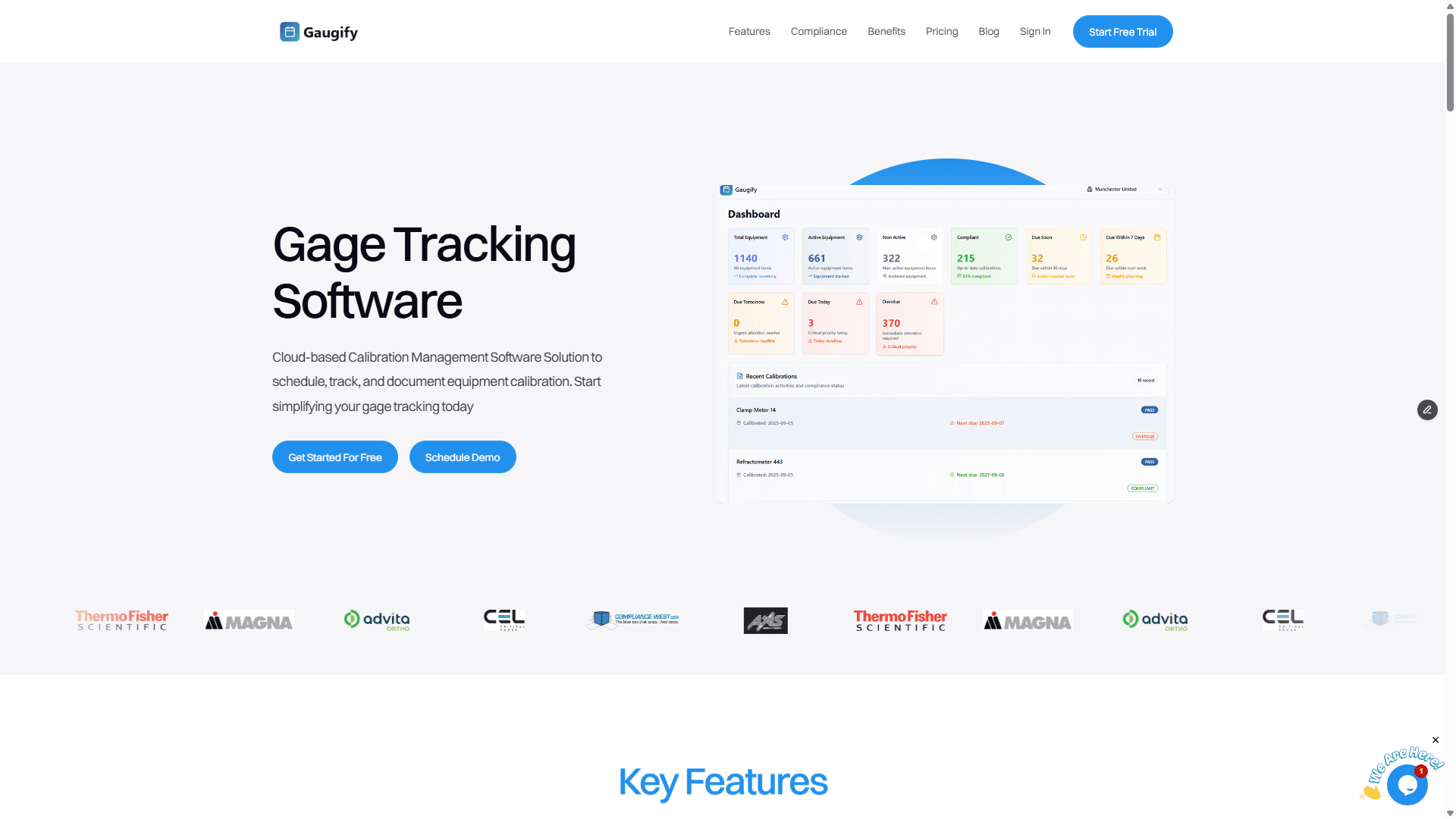
For a fabrication shop managing 200+ measuring instruments across multiple shifts, manual tracking becomes impossible. Gaugify's dashboard provides real-time visibility into calibration status, upcoming due dates, and overdue equipment. Production managers can quickly identify which tools are available for use and which need immediate attention.
Digital Certificate Management
Paper calibration certificates create multiple problems for metal fabrication shops. They're easily lost, difficult to share between shifts, and time-consuming to locate during audits. Gaugify's digital certificate storage solves these issues by maintaining secure, searchable records of all calibration documentation.
When an auditor requests calibration certificates for specific equipment, users can instantly access and print the required documentation. The system maintains complete historical records, showing calibration trends and any out-of-tolerance conditions discovered during previous calibrations.
Measurement Uncertainty Calculations
Meeting customer requirements for measurement uncertainty often requires complex calculations that consider multiple error sources. Gaugify automates uncertainty calculations based on calibration data, environmental conditions, and equipment specifications. This ensures your measurement capabilities are adequate for the tolerances you're inspecting.
For aerospace applications requiring detailed uncertainty budgets, Gaugify generates the documentation automatically. This eliminates time-consuming manual calculations and reduces the risk of errors in uncertainty analysis.
Integration with Shop Floor Operations
Effective calibration management software for metal fabrication must integrate seamlessly with daily operations rather than creating additional administrative burden. Gaugify's mobile-friendly interface allows shop floor personnel to check calibration status instantly using smartphones or tablets.
Real-Time Status Verification
Before starting critical measurements, operators can scan QR codes or search by equipment ID to verify current calibration status. The system immediately shows whether equipment is suitable for use, when the next calibration is due, and any special handling requirements.
This real-time verification prevents the use of expired or out-of-tolerance equipment, reducing the risk of producing nonconforming parts. For high-volume production environments, this capability alone can prevent costly quality escapes.
Calibration History and Trending
Gaugify maintains complete calibration histories for each piece of equipment, enabling trend analysis that identifies potential problems before they affect product quality. If a particular micrometer consistently drifts toward the upper tolerance limit, the system can flag this trend and recommend shortened calibration intervals or equipment replacement.
This predictive capability helps metal fabrication shops optimize their calibration intervals based on actual equipment performance rather than generic manufacturer recommendations. Stable equipment might safely extend calibration intervals, while problematic instruments require more frequent verification.
Compliance Reporting and Audit Preparation
Audit preparation becomes straightforward with Gaugify's compliance reporting capabilities. The system generates comprehensive reports showing calibration status, upcoming schedules, and compliance metrics that auditors expect to see.
Custom Reports for Different Standards
Different quality standards require different reporting formats. ISO 17025 compliance demands detailed uncertainty budgets, while AS9100 requires evidence of measurement system analysis. Gaugify provides customizable report templates that align with specific standard requirements.
These reports can be generated instantly during audits, demonstrating your calibration program's effectiveness and completeness. Auditors appreciate the professional presentation and comprehensive data that digital systems provide.
Cost Management and Budget Planning
Calibration costs represent a significant expense for metal fabrication operations. Gaugify tracks calibration costs by equipment type, service provider, and time period, enabling better budget planning and cost optimization. The system identifies opportunities to consolidate calibration services or negotiate better pricing with suppliers.
Historical cost data helps justify capital equipment purchases by showing the total cost of ownership, including calibration expenses over the equipment's useful life.
Implementation and Training Considerations
Successful implementation of calibration management software requires careful planning and staff training. Gaugify's intuitive interface minimizes the learning curve, but shops should plan for a structured rollout that addresses different user needs.
Phased Implementation Approach
Many metal fabrication shops benefit from implementing Gaugify in phases, starting with critical equipment or specific departments. This approach allows users to become familiar with the system while maintaining existing processes for lower-priority equipment.
A typical implementation might begin with CMMs and precision measuring equipment, then expand to include hand tools and test equipment. This phased approach reduces disruption while building confidence in the new system.
User Training and Adoption
Different user groups require different levels of training. Shop floor operators need to understand how to check calibration status and report equipment problems. Quality managers require comprehensive training on reporting capabilities and compliance features. Gaugify provides role-based training materials that address these different needs.
The system's mobile-friendly design makes it accessible to users who may not be comfortable with complex software interfaces. This accessibility improves adoption rates and ensures consistent use across the organization.
ROI and Business Benefits
Implementing effective calibration management software delivers measurable returns through reduced audit costs, improved efficiency, and prevention of quality escapes. Metal fabrication shops typically see payback within the first year of implementation.
Audit Cost Reduction
External audits become more efficient when calibration records are immediately accessible and professionally presented. Shorter audit duration reduces internal costs while demonstrating system maturity to auditors and customers.
Prevention of Quality Escapes
The cost of shipping nonconforming products far exceeds calibration program expenses. By ensuring measurement equipment accuracy, Gaugify helps prevent quality escapes that could result in expensive recalls, rework, or customer complaints.
Ready to transform your metal fabrication calibration program? Schedule a personalized demo to see how Gaugify addresses your specific challenges and compliance requirements. Our calibration management experts will show you exactly how the software integrates with your existing processes while providing the documentation and traceability that auditors and customers demand. Don't let manual calibration tracking put your quality system at risk – discover why leading metal fabrication shops trust Gaugify to keep their measuring equipment compliant and their operations running smoothly.
Calibration Management Software for Metal Fabrication
Metal fabrication operations face unique calibration challenges that can make or break their quality management systems. From precision micrometers measuring critical weld joint tolerances to coordinate measuring machines (CMMs) verifying complex aerospace components, the accuracy of your measuring equipment directly impacts product quality, customer satisfaction, and regulatory compliance. Calibration management software for metal fabrication has become essential for shops handling everything from structural steel work to precision machining contracts that demand tolerances of ±0.0005 inches or tighter.
The consequences of calibration failures in metal fabrication are severe. A single out-of-tolerance caliper could result in hundreds of rejected parts, expensive rework, and potential safety hazards. When you're working on critical applications like medical device components or aerospace brackets, the stakes are even higher. Traditional paper-based calibration tracking systems simply can't handle the complexity and volume of equipment that modern metal fabrication shops rely on.
Critical Equipment Requiring Calibration Management in Metal Fabrication
Metal fabrication facilities typically maintain dozens to hundreds of precision instruments that require regular calibration. Understanding which equipment needs tracking is the first step toward implementing effective calibration management software for metal fabrication operations.
Dimensional Measurement Equipment
Your dimensional measurement tools form the backbone of quality control in metal fabrication. Micrometers and calipers are used daily to verify part dimensions, with many shops requiring calibration every 90 days for tools measuring tolerances tighter than ±0.001 inches. Digital calipers measuring sheet metal thickness, tube wall dimensions, or machined part features need documented traceability to NIST standards.
Coordinate Measuring Machines (CMMs) represent significant capital investments that require comprehensive calibration management. A typical CMM calibration involves checking probe accuracy, measuring certified reference standards, and validating software algorithms. For a shop running multiple shifts, CMM downtime for calibration can cost thousands of dollars in lost production time.
Height gages and surface plates provide critical reference surfaces and elevation measurements. Surface plates supporting precision layout work or inspection activities require annual calibration with documented flatness measurements across the entire surface area. Height gages used for scribing layout lines or measuring vertical dimensions need regular verification against certified gage blocks.
Welding and Heat Treatment Monitoring
Temperature measurement accuracy directly affects weld quality and heat treatment effectiveness. Pyrometers and thermocouples monitoring welding processes need calibration to ensure proper heat input control. For example, a structural steel shop welding ASTM A992 beams might require pyrometer accuracy within ±5°F to maintain proper interpass temperatures.
Welding parameter monitors tracking voltage, current, and wire feed speed require calibration to meet AWS D1.1 structural welding code requirements. These instruments ensure consistent weld penetration and mechanical properties across production runs.
Material Testing Equipment
Hardness testers, tensile testing machines, and impact testing equipment all require regular calibration to validate material properties. A Rockwell hardness tester used for incoming material verification might need monthly calibration using certified test blocks to ensure readings within ±2 HRC units.
Quality Standards and Compliance Requirements for Metal Fabrication Calibration
Metal fabrication operations must navigate multiple quality standards that mandate specific calibration practices. Implementing robust calibration management software for metal fabrication helps ensure compliance across all applicable standards.
ISO 9001 Quality Management Requirements
ISO 9001:2015 clause 7.1.5 requires organizations to ensure measuring equipment is calibrated and verified at specified intervals. For metal fabrication shops, this means maintaining calibration records for all equipment affecting product conformity. The standard demands that you maintain evidence of calibration traceability, typically to national or international standards.
When your customer requires ISO 9001 certification, auditors will examine your calibration system thoroughly. They expect to see documented calibration procedures, evidence of regular calibration intervals, and corrective actions when equipment is found out of tolerance. Manual tracking systems often fail during these audits due to incomplete records or missing documentation.
AS9100 Aerospace Quality Standards
Aerospace metal fabrication requires compliance with AS9100, which builds upon ISO 9001 with additional calibration requirements. AS9100 demands more rigorous measurement system analysis and often requires shorter calibration intervals for critical equipment. A shop manufacturing aerospace brackets might need monthly calibration for micrometers measuring bolt hole locations with positional tolerances of ±0.005 inches.
NADCAP and Customer-Specific Requirements
Many aerospace and defense customers require NADCAP (National Aerospace and Defense Contractors Accreditation Program) certification. NADCAP audits focus heavily on calibration system effectiveness, requiring detailed measurement uncertainty analyses and documented calibration procedures for each instrument type.
Customer-specific requirements often exceed industry standards. Boeing, Lockheed Martin, and other major OEMs may require quarterly calibrations for equipment measuring critical characteristics, even when annual calibration would normally suffice.
Common Audit Scenarios and What Auditors Examine
Understanding typical audit scenarios helps metal fabrication shops prepare their calibration management systems. Auditors consistently examine specific aspects of calibration programs, and calibration management software for metal fabrication can address these focus areas proactively.
Calibration Certificate Authentication
Auditors will randomly select measuring equipment and request current calibration certificates. They verify certificate authenticity, check calibration dates against your scheduled intervals, and ensure certificates demonstrate traceability to national standards. A common finding involves expired calibrations or certificates that don't clearly show measurement uncertainty values.
During a recent AS9100 audit at a precision sheet metal fabrication shop, the auditor discovered three digital calipers with calibrations that had expired by more than 30 days. The shop had been using these tools to verify critical dimensions on aerospace components, resulting in a major nonconformity and expensive product quarantine.
Measurement System Analysis (MSA)
Auditors expect to see evidence of measurement system capability through gage R&R studies or other MSA techniques. They'll examine how you determine calibration intervals and whether your measurement uncertainty is adequate for the tolerances you're measuring. The general rule requires measurement uncertainty to be no more than 10% of the tolerance being measured.
For example, if you're measuring a machined dimension with a ±0.010-inch tolerance, your measuring equipment uncertainty should be ±0.001 inches or better. Auditors will check calibration certificates to verify these relationships.
Calibration Due Date Management
Auditors scrutinize your system for managing calibration due dates and preventing the use of overdue equipment. They expect to see evidence of proactive scheduling, notifications before due dates, and immediate removal from service when calibrations expire.
A typical audit scenario involves the auditor asking to see your calibration schedule for the next 90 days. They want confirmation that you know which equipment needs calibration and have arrangements in place with qualified calibration providers. Manual tracking systems often struggle to provide this forward-looking visibility.
Start your free Gaugify trial today to see how automated calibration scheduling eliminates audit findings and keeps your measuring equipment compliant.
How Gaugify Solves Metal Fabrication Calibration Challenges
Modern metal fabrication operations need sophisticated tools to manage their calibration programs effectively. Gaugify's cloud-based calibration management platform addresses the specific challenges faced by metal fabrication shops while providing the audit trail and compliance documentation that quality standards demand.
Automated Scheduling and Notifications
Gaugify eliminates the risk of expired calibrations through intelligent scheduling and automated notifications. The system tracks calibration due dates for every piece of equipment and sends alerts well before calibrations expire. Shop supervisors receive email notifications 30, 14, and 7 days before due dates, ensuring adequate time to schedule calibration services without disrupting production.
For a fabrication shop managing 200+ measuring instruments across multiple shifts, manual tracking becomes impossible. Gaugify's dashboard provides real-time visibility into calibration status, upcoming due dates, and overdue equipment. Production managers can quickly identify which tools are available for use and which need immediate attention.
Digital Certificate Management
Paper calibration certificates create multiple problems for metal fabrication shops. They're easily lost, difficult to share between shifts, and time-consuming to locate during audits. Gaugify's digital certificate storage solves these issues by maintaining secure, searchable records of all calibration documentation.
When an auditor requests calibration certificates for specific equipment, users can instantly access and print the required documentation. The system maintains complete historical records, showing calibration trends and any out-of-tolerance conditions discovered during previous calibrations.
Measurement Uncertainty Calculations
Meeting customer requirements for measurement uncertainty often requires complex calculations that consider multiple error sources. Gaugify automates uncertainty calculations based on calibration data, environmental conditions, and equipment specifications. This ensures your measurement capabilities are adequate for the tolerances you're inspecting.
For aerospace applications requiring detailed uncertainty budgets, Gaugify generates the documentation automatically. This eliminates time-consuming manual calculations and reduces the risk of errors in uncertainty analysis.
Integration with Shop Floor Operations
Effective calibration management software for metal fabrication must integrate seamlessly with daily operations rather than creating additional administrative burden. Gaugify's mobile-friendly interface allows shop floor personnel to check calibration status instantly using smartphones or tablets.
Real-Time Status Verification
Before starting critical measurements, operators can scan QR codes or search by equipment ID to verify current calibration status. The system immediately shows whether equipment is suitable for use, when the next calibration is due, and any special handling requirements.
This real-time verification prevents the use of expired or out-of-tolerance equipment, reducing the risk of producing nonconforming parts. For high-volume production environments, this capability alone can prevent costly quality escapes.
Calibration History and Trending
Gaugify maintains complete calibration histories for each piece of equipment, enabling trend analysis that identifies potential problems before they affect product quality. If a particular micrometer consistently drifts toward the upper tolerance limit, the system can flag this trend and recommend shortened calibration intervals or equipment replacement.
This predictive capability helps metal fabrication shops optimize their calibration intervals based on actual equipment performance rather than generic manufacturer recommendations. Stable equipment might safely extend calibration intervals, while problematic instruments require more frequent verification.
Compliance Reporting and Audit Preparation
Audit preparation becomes straightforward with Gaugify's compliance reporting capabilities. The system generates comprehensive reports showing calibration status, upcoming schedules, and compliance metrics that auditors expect to see.
Custom Reports for Different Standards
Different quality standards require different reporting formats. ISO 17025 compliance demands detailed uncertainty budgets, while AS9100 requires evidence of measurement system analysis. Gaugify provides customizable report templates that align with specific standard requirements.
These reports can be generated instantly during audits, demonstrating your calibration program's effectiveness and completeness. Auditors appreciate the professional presentation and comprehensive data that digital systems provide.
Cost Management and Budget Planning
Calibration costs represent a significant expense for metal fabrication operations. Gaugify tracks calibration costs by equipment type, service provider, and time period, enabling better budget planning and cost optimization. The system identifies opportunities to consolidate calibration services or negotiate better pricing with suppliers.
Historical cost data helps justify capital equipment purchases by showing the total cost of ownership, including calibration expenses over the equipment's useful life.
Implementation and Training Considerations
Successful implementation of calibration management software requires careful planning and staff training. Gaugify's intuitive interface minimizes the learning curve, but shops should plan for a structured rollout that addresses different user needs.
Phased Implementation Approach
Many metal fabrication shops benefit from implementing Gaugify in phases, starting with critical equipment or specific departments. This approach allows users to become familiar with the system while maintaining existing processes for lower-priority equipment.
A typical implementation might begin with CMMs and precision measuring equipment, then expand to include hand tools and test equipment. This phased approach reduces disruption while building confidence in the new system.
User Training and Adoption
Different user groups require different levels of training. Shop floor operators need to understand how to check calibration status and report equipment problems. Quality managers require comprehensive training on reporting capabilities and compliance features. Gaugify provides role-based training materials that address these different needs.
The system's mobile-friendly design makes it accessible to users who may not be comfortable with complex software interfaces. This accessibility improves adoption rates and ensures consistent use across the organization.
ROI and Business Benefits
Implementing effective calibration management software delivers measurable returns through reduced audit costs, improved efficiency, and prevention of quality escapes. Metal fabrication shops typically see payback within the first year of implementation.
Audit Cost Reduction
External audits become more efficient when calibration records are immediately accessible and professionally presented. Shorter audit duration reduces internal costs while demonstrating system maturity to auditors and customers.
Prevention of Quality Escapes
The cost of shipping nonconforming products far exceeds calibration program expenses. By ensuring measurement equipment accuracy, Gaugify helps prevent quality escapes that could result in expensive recalls, rework, or customer complaints.
Ready to transform your metal fabrication calibration program? Schedule a personalized demo to see how Gaugify addresses your specific challenges and compliance requirements. Our calibration management experts will show you exactly how the software integrates with your existing processes while providing the documentation and traceability that auditors and customers demand. Don't let manual calibration tracking put your quality system at risk – discover why leading metal fabrication shops trust Gaugify to keep their measuring equipment compliant and their operations running smoothly.