
Calibration Management Software for Nuclear Facilities
Calibration Management Software for Nuclear Facilities
David Bentley
Quality Assurance Engineer
12 min read
Calibration Management Software for Nuclear Facilities
Nuclear facilities face some of the most stringent calibration requirements in any industry. When a radiation monitor at a nuclear power plant drifts out of tolerance or a neutron flux detector fails its quarterly calibration, the consequences extend far beyond simple measurement uncertainty. Plant safety, regulatory compliance, and public trust all hang in the balance. This is why nuclear facilities need robust calibration management software nuclear operations can depend on to maintain the highest standards of measurement accuracy and traceability.
Traditional paper-based calibration systems and basic spreadsheet tracking simply cannot meet the complex demands of nuclear facility operations. Between NRC inspections, 10 CFR Part 50 Appendix B requirements, and the need for real-time visibility into instrument status across multiple safety systems, nuclear facilities require a comprehensive digital solution that can handle the unique challenges of this critical industry.
Critical Calibration Challenges in Nuclear Facilities
Nuclear facilities operate under a regulatory microscope that makes calibration management exponentially more complex than in typical industrial settings. Every radiation protection instrument, process monitoring device, and safety system component must maintain perfect calibration records with full traceability to national standards.
Consider the complexity of managing calibrations for a typical nuclear power plant's radiation monitoring systems alone. Area radiation monitors (ARMs) require monthly functional checks and annual calibrations with specific geometry corrections. Continuous air monitors (CAMs) need weekly response checks and quarterly calibrations using NIST-traceable sources. Personnel contamination monitors (PCMs) must undergo daily response checks and semi-annual calibrations with alpha, beta, and gamma sources.
The scheduling nightmare becomes apparent when you factor in that these instruments cannot simply be taken offline for calibration without careful coordination with plant operations. A reactor coolant system pressure transmitter operating at 2235 PSIG ±1% cannot wait for a convenient maintenance window – its calibration must be precisely scheduled during planned outages or require online calibration techniques that maintain safety system operability.
Documentation requirements add another layer of complexity. Every calibration must include not just the standard "as found" and "as left" readings, but also detailed uncertainty calculations, environmental conditions during calibration, traceability statements for reference standards, and often photographic evidence of instrument configurations. When the NRC arrives for an inspection, they expect to see complete calibration histories going back years, with every adjustment, repair, and calibration interval change fully documented and justified.
Essential Nuclear Facility Instrumentation Requiring Calibration Management Software Nuclear Operations
The breadth of instrumentation requiring calibration in nuclear facilities is staggering. Each category has its own specific requirements, tolerances, and calibration frequencies that must be meticulously tracked.
Radiation Detection and Monitoring Equipment forms the backbone of nuclear safety systems. This includes fixed area radiation monitors typically calibrated to ±20% accuracy using cesium-137 or cobalt-60 sources, portable survey meters requiring annual calibrations with multiple energy responses, and neutron detection systems that need specialized calibration sources and techniques. Whole body monitors and portal monitors require quarterly calibrations with anthropomorphic phantoms and multiple isotope sources.
Process Instrumentation encompasses the thousands of temperature, pressure, flow, and level instruments that monitor reactor systems. RTDs measuring reactor coolant temperature must maintain ±0.5°F accuracy, while pressure transmitters monitoring reactor coolant system pressure require calibrations traceable to NIST standards with documented uncertainty calculations. Flow transmitters measuring feedwater flow need calibrations that account for density corrections and Reynolds number effects.
Safety System Instrumentation includes reactor protection system components, engineered safety features actuation system instruments, and emergency core cooling system monitoring equipment. These instruments often have tolerance requirements of ±1% or better and require periodic channel calibrations that verify not just individual instrument accuracy but entire loop performance.
Environmental Monitoring Systems require calibration of meteorological towers, stack monitors, liquid effluent monitors, and environmental TLD programs. Stack monitors measuring radioactive effluents need calibrations with gaseous sources that simulate actual plant conditions, while meteorological instruments require calibrations that account for site-specific environmental factors.
Specialized Nuclear Calibration Requirements
Unlike conventional industrial calibrations, nuclear facility instruments often require specialized techniques and considerations. Neutron flux detectors need calibration adjustments for burnup effects and flux spectrum changes. Gamma spectroscopy systems require energy and efficiency calibrations using multiple certified reference sources. Criticality monitors need calibrations that verify response to neutron and gamma radiation while maintaining sensitivity to criticality accident conditions.
Regulatory Standards and Compliance Requirements
Nuclear facilities must comply with an intricate web of regulatory requirements that make calibration management far more complex than in other industries. The Nuclear Regulatory Commission's 10 CFR Part 50, Appendix B establishes the quality assurance requirements that govern calibration programs. Criterion XII specifically addresses "Control of Measuring and Test Equipment," requiring that instruments used for activities affecting quality be controlled, calibrated, and adjusted at specified periods to maintain accuracy within necessary limits.
Regulatory Guide 1.105 provides detailed guidance on instrument setpoints, requiring that calibration procedures account for instrument uncertainties, process measurement uncertainties, and setpoint calculation methodologies. This means that a simple "calibrate to manufacturer specifications" approach is insufficient – nuclear facilities must perform detailed uncertainty calculations that consider factors like temperature effects, humidity, electromagnetic interference, and long-term drift.
For facilities with radiological programs, 10 CFR Part 20 mandates specific calibration requirements for radiation detection equipment. Survey instruments must be calibrated annually with sources traceable to national standards, and calibration must cover the range of use and energy responses expected in the facility. Fixed radiation monitoring systems require calibrations that verify alarm setpoints, response time, and proper indication of radiation levels.
ANSI/ANS-15.11 provides additional requirements for research reactor instrumentation, while IEEE 338 establishes criteria for safety system instrumentation in commercial nuclear power plants. These standards require documented calibration procedures, trained personnel, and quality assurance oversight of all calibration activities.
International facilities must also consider IAEA Safety Standards, which provide guidance on instrumentation and control systems for nuclear facilities. IAEA-TECDOC-1016 specifically addresses calibration of nuclear instrumentation and emphasizes the importance of maintaining calibration records and ensuring traceability to international standards.
Documentation and Record Keeping Requirements
Regulatory compliance extends far beyond simply performing calibrations on schedule. Nuclear facilities must maintain comprehensive calibration records that demonstrate not just what was done, but why it was done and how the results ensure continued safe operation.
Each calibration record must include the instrument identification, calibration procedure used, reference standards employed (with their own calibration data), environmental conditions during calibration, personnel qualifications, and any deviations from normal procedures. When an instrument is found out of tolerance, facilities must evaluate the potential impact on safety analyses and determine if any compensatory actions are required.
Nuclear Facility Audit Scenarios and Expectations
Nuclear facility audits represent some of the most rigorous examinations of calibration programs in any industry. NRC inspectors, INPO evaluators, and third-party auditors all bring specific expectations and inspection techniques that can quickly expose weaknesses in calibration management systems.
During a typical NRC inspection, inspectors will select a sample of safety-related instruments and trace their calibration history from the current certificate back through multiple calibration cycles. They look for evidence that calibrations were performed on schedule, by qualified personnel, using properly calibrated reference standards. Any gaps in documentation, late calibrations, or improperly documented out-of-tolerance conditions will trigger additional scrutiny.
A common audit scenario involves an inspector selecting a reactor protection system pressure transmitter and asking to see its complete calibration history. They expect to see not just the calibration certificates, but also the calibration procedure used, evidence that the procedure was followed, documentation of any deviations, and records showing that reference standards were within their calibration intervals when used.
Inspectors pay particular attention to calibration interval justifications. If a facility extends a calibration interval from 18 months to 24 months, they must demonstrate through historical data analysis that instruments remain within tolerance for the extended period. This requires detailed statistical analysis of calibration data that shows drift patterns, failure modes, and reliability trends.
Cross-calibration verification is another area of focus. When multiple instruments measure the same parameter, inspectors expect to see evidence that readings are consistent and that any discrepancies have been investigated and resolved. This is particularly important for redundant safety systems where instrument agreement is critical for proper system operation.
Common Audit Findings and How to Avoid Them
Nuclear facility audits frequently identify similar calibration-related findings that can be easily prevented with proper calibration management systems. Late calibrations top the list, particularly when facilities cannot demonstrate that instrument accuracy was maintained during the overdue period.
Missing traceability documentation is another common finding. Inspectors expect to see an unbroken chain of traceability from the instrument being calibrated back to national or international standards. If a reference standard's calibration certificate is missing or expired, the entire calibration becomes questionable.
Inadequate uncertainty calculations often trigger violations. Nuclear facilities must demonstrate that measurement uncertainties are properly calculated and that instrument setpoints provide adequate margin for safe operation. This requires detailed analysis of all uncertainty contributors, not just simple accuracy specifications.
How Calibration Management Software Nuclear Facilities Can Trust Solves Critical Pain Points
Modern calibration management software nuclear facilities can depend on transforms the complex challenges of nuclear calibration management into manageable, automated processes. Gaugify's calibration management platform specifically addresses the unique requirements of nuclear facilities while providing the robust documentation and traceability that regulators demand.
Automated Scheduling and Work Planning eliminates the nightmare of coordinating calibrations with plant operations. The system automatically generates work orders based on calibration due dates, plant operating schedules, and resource availability. When a reactor coolant system pressure transmitter approaches its calibration due date, Gaugify automatically schedules the work for the next planned maintenance window and ensures that all necessary resources, procedures, and personnel are available.
The system tracks not just calibration due dates but also grace periods, allowing facilities to optimize maintenance schedules while maintaining regulatory compliance. If plant conditions require extending a calibration interval, Gaugify maintains complete documentation of the justification and approval process, creating the audit trail that inspectors expect to see.
Comprehensive Documentation Management ensures that every calibration record meets nuclear industry standards. Digital calibration certificates automatically include all required elements: instrument identification, calibration procedure, reference standards, environmental conditions, and uncertainty calculations. When technicians complete a calibration, they can attach photos, annotate procedures, and document any unusual conditions or observations.
The system maintains complete calibration histories that auditors can access instantly. When an NRC inspector asks to see five years of calibration data for a specific radiation monitor, the complete history appears in seconds, including trend analysis and statistical summaries that demonstrate instrument reliability.
Uncertainty Calculation Integration handles the complex mathematical requirements of nuclear calibration programs. Rather than relying on technicians to perform manual uncertainty calculations, Gaugify automatically calculates measurement uncertainties based on instrument specifications, reference standard uncertainties, environmental factors, and calibration method contributions.
For a typical area radiation monitor calibration, the system combines uncertainties from the calibration source (±3%), geometry factors (±5%), temperature effects (±1%), and calibrator uncertainties (±2%) to provide a combined uncertainty calculation that meets regulatory requirements. This ensures consistency across all calibrations and eliminates the errors that commonly occur with manual calculations.
Advanced Reporting and Analytics provide the insights that nuclear facilities need for continuous improvement. The system tracks calibration trends, identifies instruments with excessive drift, and provides statistical analysis that supports calibration interval optimization. When facilities need to justify extending calibration intervals or changing maintenance strategies, Gaugify provides the data analysis tools necessary to make defensible decisions.
Real-Time Compliance Monitoring
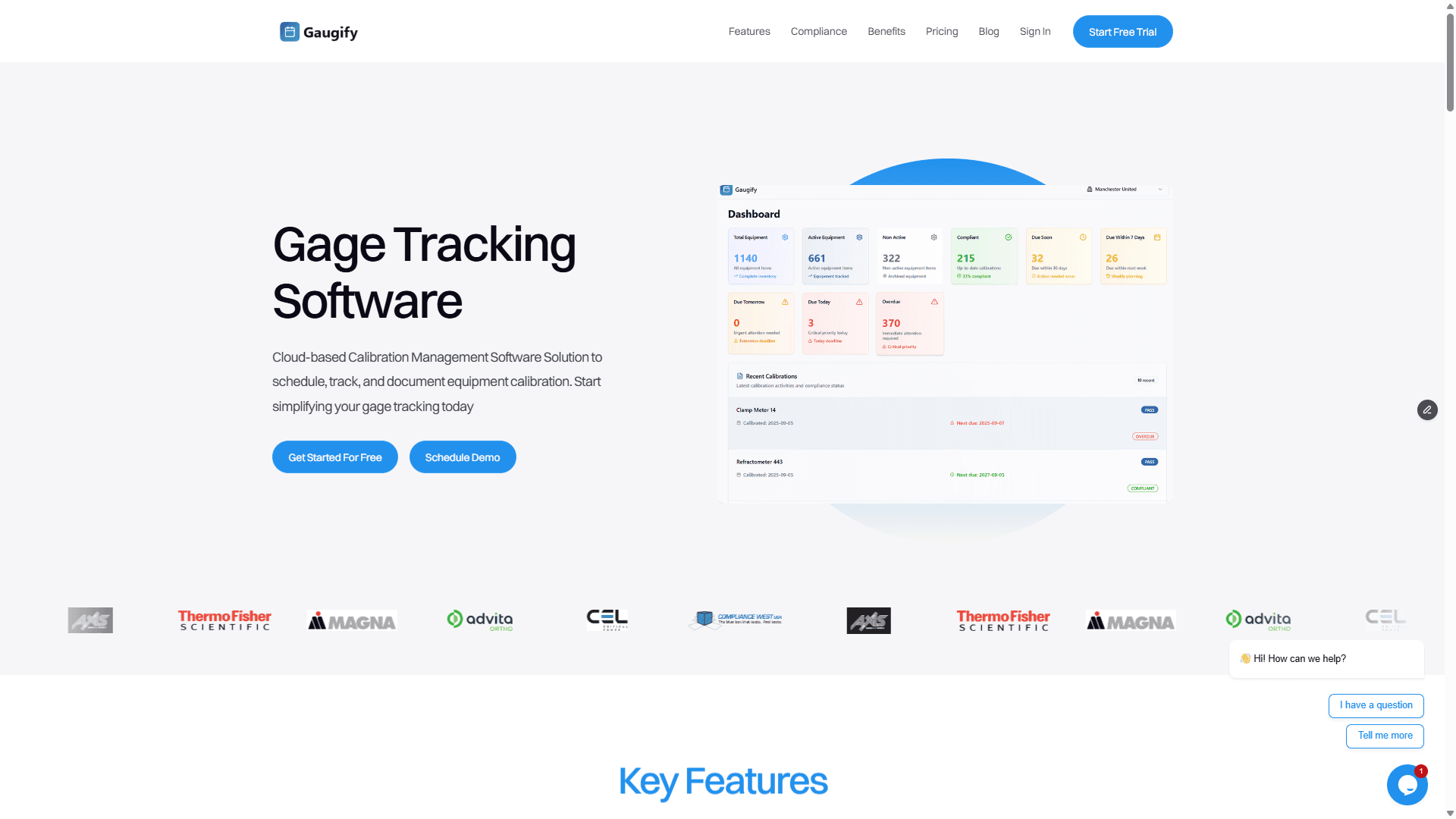
Nuclear facilities cannot afford to discover compliance issues during audits. Gaugify provides real-time monitoring of calibration status, automatically flagging potential problems before they become violations. Dashboard displays show calibration status across all plant systems, highlighting overdue calibrations, expiring reference standards, and instruments approaching their due dates.
The system integrates with plant work management systems to ensure that calibration work orders are properly prioritized and scheduled. When a safety-related instrument approaches its calibration due date, automatic notifications ensure that maintenance planners, operations staff, and quality assurance personnel are all aware of the impending requirement.
Ready to see how modern calibration management software can transform your nuclear facility's calibration program? Start your free trial of Gaugify and experience firsthand how automated scheduling, comprehensive documentation, and real-time compliance monitoring can eliminate calibration management headaches while exceeding regulatory expectations.
Integration with Nuclear Quality Assurance Programs
Nuclear facilities operate under comprehensive quality assurance programs that extend far beyond basic calibration requirements. Gaugify's compliance features integrate seamlessly with existing QA programs, providing the documentation controls, audit trails, and change management capabilities that nuclear facilities require.
The system maintains complete electronic signatures and approval workflows that satisfy 10 CFR Part 50, Appendix B requirements. When calibration procedures are revised, Gaugify routes them through proper review and approval channels, maintains revision histories, and ensures that only current, approved procedures are available to technicians.
Configuration management integration ensures that instrument calibrations align with plant design requirements and safety analyses. When setpoints are changed or calibration intervals are modified, the system maintains documentation linking these changes to engineering evaluations and safety assessments.
Personnel Qualification Tracking verifies that only qualified technicians perform calibrations. The system maintains training records, certification expiration dates, and skill assessments, automatically preventing unqualified personnel from accessing calibration procedures. This addresses a common audit finding while ensuring that calibration quality remains consistently high.
Corrective Action Integration links calibration issues to the facility's corrective action program. When instruments are found out of tolerance or calibration problems are identified, Gaugify automatically generates condition reports and tracks the resolution process through closure. This ensures that systemic calibration issues are properly evaluated and corrected.
Advanced Analytics for Nuclear Applications
Nuclear facilities generate massive amounts of calibration data that can provide valuable insights into equipment performance and reliability trends. Gaugify's analytics engine processes this data to identify patterns, predict failures, and optimize maintenance strategies.
Statistical process control charts track instrument drift patterns over time, identifying instruments that may require more frequent calibration or replacement. When radiation monitors consistently drift in one direction, the system alerts maintenance personnel to investigate potential environmental factors or equipment degradation.
Reliability analysis helps facilities optimize calibration intervals while maintaining safety margins. By analyzing historical calibration data, Gaugify can recommend interval adjustments based on actual instrument performance rather than conservative manufacturer recommendations.
Meeting International Nuclear Standards
International nuclear facilities must navigate additional complexity when managing calibration programs across multiple regulatory jurisdictions. Gaugify's ISO 17025 compliance features address the requirements of international standards while maintaining flexibility for local regulatory requirements.
The system supports multiple calibration standards simultaneously, allowing facilities to maintain compliance with both national requirements and international best practices. A facility operating under Canadian Nuclear Safety Commission oversight can maintain compliance with CSA standards while also meeting IAEA recommendations for instrumentation calibration.
Multi-language support and configurable reporting formats ensure that calibration documentation meets local requirements regardless of operating jurisdiction. When international auditors require specific documentation formats or languages, Gaugify adapts to provide exactly what's needed.
Currency and Units Management handles the complexity of international operations where reference standards may be calibrated in different units or currencies. The system automatically converts between measurement units and maintains exchange rate information for cost tracking and budget planning.
Vendor and Supply Chain Management
Nuclear facilities rely on qualified vendors for specialized calibration services and reference standards. Gaugify maintains comprehensive vendor qualification records, tracking certifications, audit results, and performance history for all calibration service providers.
The system monitors vendor certifications and automatically alerts procurement personnel when vendor qualifications are approaching expiration. This prevents the common problem of receiving calibration services from vendors whose certifications have lapsed, which can invalidate calibration results and create regulatory compliance issues.
Purchase order integration streamlines the procurement of calibration services while maintaining proper authorization and budget controls. When specialized calibration services are required, Gaugify generates purchase requisitions with detailed technical specifications and delivery requirements.
Future-Proofing Nuclear Calibration Management
The nuclear industry continues to evolve, with new technologies, updated regulations, and changing operational requirements driving the need for adaptable calibration management systems. Gaugify's cloud-based architecture ensures that nuclear facilities can adapt to future requirements without major system overhauls or data migrations.
Artificial intelligence and machine learning capabilities are being integrated to provide predictive analytics that can identify potential calibration issues before they occur. By analyzing patterns in calibration data, environmental conditions, and operational parameters, the system can predict when instruments are likely to drift out of tolerance and recommend proactive maintenance actions.
Digital Twin Integration represents the next evolution in nuclear facility management. Gaugify's calibration data can integrate with digital plant models to provide real-time validation of instrument readings and automatic detection of measurement inconsistencies. This technology promises to revolutionize how nuclear facilities monitor and maintain their instrumentation systems.
Blockchain Technology offers the potential for immutable calibration records that provide unprecedented assurance of data integrity. As regulators become more comfortable with distributed ledger technologies, nuclear facilities will be able to leverage blockchain to create calibration records that cannot be altered or disputed.
Implementation Success Stories
Nuclear facilities that have implemented modern calibration management software consistently report dramatic improvements in efficiency, compliance, and operational reliability. A typical implementation reduces calibration-related paperwork by 80% while improving on-time performance to over 98%.
One nuclear power plant reported that digital calibration management eliminated over 1,200 hours of annual administrative work previously required to maintain paper calibration records. The time savings allowed the facility to redeploy quality assurance staff to more value-added activities while improving overall calibration program effectiveness.
During their most recent NRC inspection, the facility received zero calibration-related findings, compared to multiple minor violations in previous inspections under their paper-based system. Inspectors specifically commented on the completeness and accessibility of calibration records, noting that the digital system made their inspection more efficient and thorough.
Another facility using Gaugify's calibration management system successfully extended calibration intervals for over 200 instruments, resulting in annual savings of $150,000 in calibration costs while maintaining safety margins and regulatory compliance. The statistical analysis capabilities provided the data necessary to justify interval extensions to regulators.
Transform Your Nuclear Facility's Calibration Management Today
Nuclear facilities cannot afford calibration management failures. The safety implications, regulatory consequences, and operational impacts are simply too significant to risk with outdated paper systems or inadequate digital tools. Modern calibration management software nuclear facilities can trust provides the robust capabilities, comprehensive documentation, and regulatory compliance features that this critical industry demands.
Gaugify's comprehensive feature set addresses every aspect of nuclear calibration management, from automated scheduling and work planning to advanced analytics and regulatory reporting. The system's cloud-based architecture ensures reliable access while maintaining the security and data integrity that nuclear facilities require.
The transition to digital calibration management isn't just about improving efficiency – it's about transforming how nuclear facilities manage one of their most critical operational requirements. With automated processes, real-time monitoring, and comprehensive analytics, facilities can move from reactive calibration management to proactive optimization that enhances both safety and operational performance.
Don't let outdated calibration management systems put your nuclear facility at risk. The combination of regulatory pressure, operational complexity, and safety requirements demands a modern solution that can meet today's challenges while adapting to tomorrow's requirements. Schedule a demo with Gaugify today and discover how the right calibration management software can transform your nuclear facility's operations, ensure regulatory compliance, and provide the peace of mind that comes with knowing your critical instruments are properly maintained and documented.
Calibration Management Software for Nuclear Facilities
Nuclear facilities face some of the most stringent calibration requirements in any industry. When a radiation monitor at a nuclear power plant drifts out of tolerance or a neutron flux detector fails its quarterly calibration, the consequences extend far beyond simple measurement uncertainty. Plant safety, regulatory compliance, and public trust all hang in the balance. This is why nuclear facilities need robust calibration management software nuclear operations can depend on to maintain the highest standards of measurement accuracy and traceability.
Traditional paper-based calibration systems and basic spreadsheet tracking simply cannot meet the complex demands of nuclear facility operations. Between NRC inspections, 10 CFR Part 50 Appendix B requirements, and the need for real-time visibility into instrument status across multiple safety systems, nuclear facilities require a comprehensive digital solution that can handle the unique challenges of this critical industry.
Critical Calibration Challenges in Nuclear Facilities
Nuclear facilities operate under a regulatory microscope that makes calibration management exponentially more complex than in typical industrial settings. Every radiation protection instrument, process monitoring device, and safety system component must maintain perfect calibration records with full traceability to national standards.
Consider the complexity of managing calibrations for a typical nuclear power plant's radiation monitoring systems alone. Area radiation monitors (ARMs) require monthly functional checks and annual calibrations with specific geometry corrections. Continuous air monitors (CAMs) need weekly response checks and quarterly calibrations using NIST-traceable sources. Personnel contamination monitors (PCMs) must undergo daily response checks and semi-annual calibrations with alpha, beta, and gamma sources.
The scheduling nightmare becomes apparent when you factor in that these instruments cannot simply be taken offline for calibration without careful coordination with plant operations. A reactor coolant system pressure transmitter operating at 2235 PSIG ±1% cannot wait for a convenient maintenance window – its calibration must be precisely scheduled during planned outages or require online calibration techniques that maintain safety system operability.
Documentation requirements add another layer of complexity. Every calibration must include not just the standard "as found" and "as left" readings, but also detailed uncertainty calculations, environmental conditions during calibration, traceability statements for reference standards, and often photographic evidence of instrument configurations. When the NRC arrives for an inspection, they expect to see complete calibration histories going back years, with every adjustment, repair, and calibration interval change fully documented and justified.
Essential Nuclear Facility Instrumentation Requiring Calibration Management Software Nuclear Operations
The breadth of instrumentation requiring calibration in nuclear facilities is staggering. Each category has its own specific requirements, tolerances, and calibration frequencies that must be meticulously tracked.
Radiation Detection and Monitoring Equipment forms the backbone of nuclear safety systems. This includes fixed area radiation monitors typically calibrated to ±20% accuracy using cesium-137 or cobalt-60 sources, portable survey meters requiring annual calibrations with multiple energy responses, and neutron detection systems that need specialized calibration sources and techniques. Whole body monitors and portal monitors require quarterly calibrations with anthropomorphic phantoms and multiple isotope sources.
Process Instrumentation encompasses the thousands of temperature, pressure, flow, and level instruments that monitor reactor systems. RTDs measuring reactor coolant temperature must maintain ±0.5°F accuracy, while pressure transmitters monitoring reactor coolant system pressure require calibrations traceable to NIST standards with documented uncertainty calculations. Flow transmitters measuring feedwater flow need calibrations that account for density corrections and Reynolds number effects.
Safety System Instrumentation includes reactor protection system components, engineered safety features actuation system instruments, and emergency core cooling system monitoring equipment. These instruments often have tolerance requirements of ±1% or better and require periodic channel calibrations that verify not just individual instrument accuracy but entire loop performance.
Environmental Monitoring Systems require calibration of meteorological towers, stack monitors, liquid effluent monitors, and environmental TLD programs. Stack monitors measuring radioactive effluents need calibrations with gaseous sources that simulate actual plant conditions, while meteorological instruments require calibrations that account for site-specific environmental factors.
Specialized Nuclear Calibration Requirements
Unlike conventional industrial calibrations, nuclear facility instruments often require specialized techniques and considerations. Neutron flux detectors need calibration adjustments for burnup effects and flux spectrum changes. Gamma spectroscopy systems require energy and efficiency calibrations using multiple certified reference sources. Criticality monitors need calibrations that verify response to neutron and gamma radiation while maintaining sensitivity to criticality accident conditions.
Regulatory Standards and Compliance Requirements
Nuclear facilities must comply with an intricate web of regulatory requirements that make calibration management far more complex than in other industries. The Nuclear Regulatory Commission's 10 CFR Part 50, Appendix B establishes the quality assurance requirements that govern calibration programs. Criterion XII specifically addresses "Control of Measuring and Test Equipment," requiring that instruments used for activities affecting quality be controlled, calibrated, and adjusted at specified periods to maintain accuracy within necessary limits.
Regulatory Guide 1.105 provides detailed guidance on instrument setpoints, requiring that calibration procedures account for instrument uncertainties, process measurement uncertainties, and setpoint calculation methodologies. This means that a simple "calibrate to manufacturer specifications" approach is insufficient – nuclear facilities must perform detailed uncertainty calculations that consider factors like temperature effects, humidity, electromagnetic interference, and long-term drift.
For facilities with radiological programs, 10 CFR Part 20 mandates specific calibration requirements for radiation detection equipment. Survey instruments must be calibrated annually with sources traceable to national standards, and calibration must cover the range of use and energy responses expected in the facility. Fixed radiation monitoring systems require calibrations that verify alarm setpoints, response time, and proper indication of radiation levels.
ANSI/ANS-15.11 provides additional requirements for research reactor instrumentation, while IEEE 338 establishes criteria for safety system instrumentation in commercial nuclear power plants. These standards require documented calibration procedures, trained personnel, and quality assurance oversight of all calibration activities.
International facilities must also consider IAEA Safety Standards, which provide guidance on instrumentation and control systems for nuclear facilities. IAEA-TECDOC-1016 specifically addresses calibration of nuclear instrumentation and emphasizes the importance of maintaining calibration records and ensuring traceability to international standards.
Documentation and Record Keeping Requirements
Regulatory compliance extends far beyond simply performing calibrations on schedule. Nuclear facilities must maintain comprehensive calibration records that demonstrate not just what was done, but why it was done and how the results ensure continued safe operation.
Each calibration record must include the instrument identification, calibration procedure used, reference standards employed (with their own calibration data), environmental conditions during calibration, personnel qualifications, and any deviations from normal procedures. When an instrument is found out of tolerance, facilities must evaluate the potential impact on safety analyses and determine if any compensatory actions are required.
Nuclear Facility Audit Scenarios and Expectations
Nuclear facility audits represent some of the most rigorous examinations of calibration programs in any industry. NRC inspectors, INPO evaluators, and third-party auditors all bring specific expectations and inspection techniques that can quickly expose weaknesses in calibration management systems.
During a typical NRC inspection, inspectors will select a sample of safety-related instruments and trace their calibration history from the current certificate back through multiple calibration cycles. They look for evidence that calibrations were performed on schedule, by qualified personnel, using properly calibrated reference standards. Any gaps in documentation, late calibrations, or improperly documented out-of-tolerance conditions will trigger additional scrutiny.
A common audit scenario involves an inspector selecting a reactor protection system pressure transmitter and asking to see its complete calibration history. They expect to see not just the calibration certificates, but also the calibration procedure used, evidence that the procedure was followed, documentation of any deviations, and records showing that reference standards were within their calibration intervals when used.
Inspectors pay particular attention to calibration interval justifications. If a facility extends a calibration interval from 18 months to 24 months, they must demonstrate through historical data analysis that instruments remain within tolerance for the extended period. This requires detailed statistical analysis of calibration data that shows drift patterns, failure modes, and reliability trends.
Cross-calibration verification is another area of focus. When multiple instruments measure the same parameter, inspectors expect to see evidence that readings are consistent and that any discrepancies have been investigated and resolved. This is particularly important for redundant safety systems where instrument agreement is critical for proper system operation.
Common Audit Findings and How to Avoid Them
Nuclear facility audits frequently identify similar calibration-related findings that can be easily prevented with proper calibration management systems. Late calibrations top the list, particularly when facilities cannot demonstrate that instrument accuracy was maintained during the overdue period.
Missing traceability documentation is another common finding. Inspectors expect to see an unbroken chain of traceability from the instrument being calibrated back to national or international standards. If a reference standard's calibration certificate is missing or expired, the entire calibration becomes questionable.
Inadequate uncertainty calculations often trigger violations. Nuclear facilities must demonstrate that measurement uncertainties are properly calculated and that instrument setpoints provide adequate margin for safe operation. This requires detailed analysis of all uncertainty contributors, not just simple accuracy specifications.
How Calibration Management Software Nuclear Facilities Can Trust Solves Critical Pain Points
Modern calibration management software nuclear facilities can depend on transforms the complex challenges of nuclear calibration management into manageable, automated processes. Gaugify's calibration management platform specifically addresses the unique requirements of nuclear facilities while providing the robust documentation and traceability that regulators demand.
Automated Scheduling and Work Planning eliminates the nightmare of coordinating calibrations with plant operations. The system automatically generates work orders based on calibration due dates, plant operating schedules, and resource availability. When a reactor coolant system pressure transmitter approaches its calibration due date, Gaugify automatically schedules the work for the next planned maintenance window and ensures that all necessary resources, procedures, and personnel are available.
The system tracks not just calibration due dates but also grace periods, allowing facilities to optimize maintenance schedules while maintaining regulatory compliance. If plant conditions require extending a calibration interval, Gaugify maintains complete documentation of the justification and approval process, creating the audit trail that inspectors expect to see.
Comprehensive Documentation Management ensures that every calibration record meets nuclear industry standards. Digital calibration certificates automatically include all required elements: instrument identification, calibration procedure, reference standards, environmental conditions, and uncertainty calculations. When technicians complete a calibration, they can attach photos, annotate procedures, and document any unusual conditions or observations.
The system maintains complete calibration histories that auditors can access instantly. When an NRC inspector asks to see five years of calibration data for a specific radiation monitor, the complete history appears in seconds, including trend analysis and statistical summaries that demonstrate instrument reliability.
Uncertainty Calculation Integration handles the complex mathematical requirements of nuclear calibration programs. Rather than relying on technicians to perform manual uncertainty calculations, Gaugify automatically calculates measurement uncertainties based on instrument specifications, reference standard uncertainties, environmental factors, and calibration method contributions.
For a typical area radiation monitor calibration, the system combines uncertainties from the calibration source (±3%), geometry factors (±5%), temperature effects (±1%), and calibrator uncertainties (±2%) to provide a combined uncertainty calculation that meets regulatory requirements. This ensures consistency across all calibrations and eliminates the errors that commonly occur with manual calculations.
Advanced Reporting and Analytics provide the insights that nuclear facilities need for continuous improvement. The system tracks calibration trends, identifies instruments with excessive drift, and provides statistical analysis that supports calibration interval optimization. When facilities need to justify extending calibration intervals or changing maintenance strategies, Gaugify provides the data analysis tools necessary to make defensible decisions.
Real-Time Compliance Monitoring
Nuclear facilities cannot afford to discover compliance issues during audits. Gaugify provides real-time monitoring of calibration status, automatically flagging potential problems before they become violations. Dashboard displays show calibration status across all plant systems, highlighting overdue calibrations, expiring reference standards, and instruments approaching their due dates.
The system integrates with plant work management systems to ensure that calibration work orders are properly prioritized and scheduled. When a safety-related instrument approaches its calibration due date, automatic notifications ensure that maintenance planners, operations staff, and quality assurance personnel are all aware of the impending requirement.
Ready to see how modern calibration management software can transform your nuclear facility's calibration program? Start your free trial of Gaugify and experience firsthand how automated scheduling, comprehensive documentation, and real-time compliance monitoring can eliminate calibration management headaches while exceeding regulatory expectations.
Integration with Nuclear Quality Assurance Programs
Nuclear facilities operate under comprehensive quality assurance programs that extend far beyond basic calibration requirements. Gaugify's compliance features integrate seamlessly with existing QA programs, providing the documentation controls, audit trails, and change management capabilities that nuclear facilities require.
The system maintains complete electronic signatures and approval workflows that satisfy 10 CFR Part 50, Appendix B requirements. When calibration procedures are revised, Gaugify routes them through proper review and approval channels, maintains revision histories, and ensures that only current, approved procedures are available to technicians.
Configuration management integration ensures that instrument calibrations align with plant design requirements and safety analyses. When setpoints are changed or calibration intervals are modified, the system maintains documentation linking these changes to engineering evaluations and safety assessments.
Personnel Qualification Tracking verifies that only qualified technicians perform calibrations. The system maintains training records, certification expiration dates, and skill assessments, automatically preventing unqualified personnel from accessing calibration procedures. This addresses a common audit finding while ensuring that calibration quality remains consistently high.
Corrective Action Integration links calibration issues to the facility's corrective action program. When instruments are found out of tolerance or calibration problems are identified, Gaugify automatically generates condition reports and tracks the resolution process through closure. This ensures that systemic calibration issues are properly evaluated and corrected.
Advanced Analytics for Nuclear Applications
Nuclear facilities generate massive amounts of calibration data that can provide valuable insights into equipment performance and reliability trends. Gaugify's analytics engine processes this data to identify patterns, predict failures, and optimize maintenance strategies.
Statistical process control charts track instrument drift patterns over time, identifying instruments that may require more frequent calibration or replacement. When radiation monitors consistently drift in one direction, the system alerts maintenance personnel to investigate potential environmental factors or equipment degradation.
Reliability analysis helps facilities optimize calibration intervals while maintaining safety margins. By analyzing historical calibration data, Gaugify can recommend interval adjustments based on actual instrument performance rather than conservative manufacturer recommendations.
Meeting International Nuclear Standards
International nuclear facilities must navigate additional complexity when managing calibration programs across multiple regulatory jurisdictions. Gaugify's ISO 17025 compliance features address the requirements of international standards while maintaining flexibility for local regulatory requirements.
The system supports multiple calibration standards simultaneously, allowing facilities to maintain compliance with both national requirements and international best practices. A facility operating under Canadian Nuclear Safety Commission oversight can maintain compliance with CSA standards while also meeting IAEA recommendations for instrumentation calibration.
Multi-language support and configurable reporting formats ensure that calibration documentation meets local requirements regardless of operating jurisdiction. When international auditors require specific documentation formats or languages, Gaugify adapts to provide exactly what's needed.
Currency and Units Management handles the complexity of international operations where reference standards may be calibrated in different units or currencies. The system automatically converts between measurement units and maintains exchange rate information for cost tracking and budget planning.
Vendor and Supply Chain Management
Nuclear facilities rely on qualified vendors for specialized calibration services and reference standards. Gaugify maintains comprehensive vendor qualification records, tracking certifications, audit results, and performance history for all calibration service providers.
The system monitors vendor certifications and automatically alerts procurement personnel when vendor qualifications are approaching expiration. This prevents the common problem of receiving calibration services from vendors whose certifications have lapsed, which can invalidate calibration results and create regulatory compliance issues.
Purchase order integration streamlines the procurement of calibration services while maintaining proper authorization and budget controls. When specialized calibration services are required, Gaugify generates purchase requisitions with detailed technical specifications and delivery requirements.
Future-Proofing Nuclear Calibration Management
The nuclear industry continues to evolve, with new technologies, updated regulations, and changing operational requirements driving the need for adaptable calibration management systems. Gaugify's cloud-based architecture ensures that nuclear facilities can adapt to future requirements without major system overhauls or data migrations.
Artificial intelligence and machine learning capabilities are being integrated to provide predictive analytics that can identify potential calibration issues before they occur. By analyzing patterns in calibration data, environmental conditions, and operational parameters, the system can predict when instruments are likely to drift out of tolerance and recommend proactive maintenance actions.
Digital Twin Integration represents the next evolution in nuclear facility management. Gaugify's calibration data can integrate with digital plant models to provide real-time validation of instrument readings and automatic detection of measurement inconsistencies. This technology promises to revolutionize how nuclear facilities monitor and maintain their instrumentation systems.
Blockchain Technology offers the potential for immutable calibration records that provide unprecedented assurance of data integrity. As regulators become more comfortable with distributed ledger technologies, nuclear facilities will be able to leverage blockchain to create calibration records that cannot be altered or disputed.
Implementation Success Stories
Nuclear facilities that have implemented modern calibration management software consistently report dramatic improvements in efficiency, compliance, and operational reliability. A typical implementation reduces calibration-related paperwork by 80% while improving on-time performance to over 98%.
One nuclear power plant reported that digital calibration management eliminated over 1,200 hours of annual administrative work previously required to maintain paper calibration records. The time savings allowed the facility to redeploy quality assurance staff to more value-added activities while improving overall calibration program effectiveness.
During their most recent NRC inspection, the facility received zero calibration-related findings, compared to multiple minor violations in previous inspections under their paper-based system. Inspectors specifically commented on the completeness and accessibility of calibration records, noting that the digital system made their inspection more efficient and thorough.
Another facility using Gaugify's calibration management system successfully extended calibration intervals for over 200 instruments, resulting in annual savings of $150,000 in calibration costs while maintaining safety margins and regulatory compliance. The statistical analysis capabilities provided the data necessary to justify interval extensions to regulators.
Transform Your Nuclear Facility's Calibration Management Today
Nuclear facilities cannot afford calibration management failures. The safety implications, regulatory consequences, and operational impacts are simply too significant to risk with outdated paper systems or inadequate digital tools. Modern calibration management software nuclear facilities can trust provides the robust capabilities, comprehensive documentation, and regulatory compliance features that this critical industry demands.
Gaugify's comprehensive feature set addresses every aspect of nuclear calibration management, from automated scheduling and work planning to advanced analytics and regulatory reporting. The system's cloud-based architecture ensures reliable access while maintaining the security and data integrity that nuclear facilities require.
The transition to digital calibration management isn't just about improving efficiency – it's about transforming how nuclear facilities manage one of their most critical operational requirements. With automated processes, real-time monitoring, and comprehensive analytics, facilities can move from reactive calibration management to proactive optimization that enhances both safety and operational performance.
Don't let outdated calibration management systems put your nuclear facility at risk. The combination of regulatory pressure, operational complexity, and safety requirements demands a modern solution that can meet today's challenges while adapting to tomorrow's requirements. Schedule a demo with Gaugify today and discover how the right calibration management software can transform your nuclear facility's operations, ensure regulatory compliance, and provide the peace of mind that comes with knowing your critical instruments are properly maintained and documented.