
Calibration Management Software for Packaging Companies
Calibration Management Software for Packaging Companies
David Bentley
Quality Assurance Engineer
8 min read
Calibration Management Software for Packaging Companies
Packaging companies face unique challenges when managing calibration programs across their manufacturing operations. From precision weighing systems that ensure accurate fill weights to thickness gauges that maintain package integrity, calibration management software packaging solutions must handle diverse instrumentation while meeting strict regulatory requirements. Quality managers at packaging facilities often struggle with paper-based systems, missed calibration schedules, and the complexity of maintaining audit-ready documentation across multiple production lines.
The packaging industry operates under intense pressure to maintain product consistency while meeting regulatory compliance standards from the FDA, USDA, and other governing bodies. A single out-of-tolerance scale can result in costly product recalls, regulatory fines, or customer complaints about under-filled packages. This makes robust calibration management not just a quality requirement, but a business-critical function that directly impacts profitability and brand reputation.
Critical Equipment Requiring Calibration in Packaging Operations
Packaging facilities rely on an extensive array of precision instruments that require regular calibration to maintain accuracy and compliance. Understanding the scope of equipment involved helps illustrate why calibration management software packaging companies need must be comprehensive and industry-specific.
Weighing and Measuring Equipment
Checkweighers represent the backbone of packaging quality control, typically requiring calibration every 30 days with tolerances as tight as ±0.1g for pharmaceutical packaging or ±1g for food products. These systems often integrate with production lines running at speeds of 300-600 packages per minute, making any downtime for calibration extremely costly.
Bench scales used for raw material weighing typically operate within tolerances of ±0.01% to ±0.1% depending on capacity, with calibration intervals ranging from monthly to quarterly based on usage frequency and environmental conditions. Platform scales handling bulk materials may have looser tolerances of ±0.02% but require more frequent calibration due to heavy usage.
Digital calipers and micrometers used for package dimension verification typically maintain tolerances of ±0.02mm and require calibration every 90 days. These measurements are critical for ensuring proper case packing, palletization efficiency, and shipping container optimization.
Environmental Monitoring Systems
Temperature sensors in cold storage areas require calibration within ±0.5°C to ensure product integrity, particularly for pharmaceuticals and perishable foods. These sensors often connect to automated monitoring systems that trigger alerts when temperatures drift outside acceptable ranges.
Humidity sensors used in controlled atmosphere packaging operations typically require calibration within ±2% RH to maintain product shelf life. For sensitive products like electronics or moisture-sensitive foods, these tolerances may tighten to ±1% RH or better.
Pressure gauges on pneumatic packaging equipment require calibration within ±1% of full scale to ensure consistent sealing pressure and prevent package failures. These gauges often operate in harsh industrial environments with temperature fluctuations and vibration that can affect accuracy over time.
Material Testing Equipment
Thickness gauges used for film, foil, and corrugated materials typically require calibration within ±0.001mm to ensure package integrity and material cost optimization. These instruments are critical for maintaining barrier properties in food packaging and pharmaceutical applications.
Tensile strength testers used for package seal integrity must be calibrated within ±1% of reading to ensure reliable seal strength measurements. These tests are often required by customer specifications or regulatory standards for medical device packaging.
Leak detection equipment requires calibration to detect leaks as small as 1×10⁻⁶ atm·cc/sec for pharmaceutical packaging or 1×10⁻³ atm·cc/sec for food packaging, depending on the application requirements.
Quality Standards and Compliance Requirements for Packaging Calibration Management
The packaging industry operates under multiple overlapping regulatory frameworks that demand rigorous calibration documentation and traceability. Effective calibration management software packaging operations use must accommodate these diverse requirements while streamlining compliance processes.
FDA and USDA Regulations
Food packaging facilities must comply with FDA 21 CFR Part 110 requirements for current Good Manufacturing Practices (cGMPs), which mandate that "instruments or controls used for measuring, regulating, or recording temperatures, pH, acidity, water activity, or other conditions" be accurate and properly maintained. This includes documented calibration procedures with certificates traceable to NIST standards.
Pharmaceutical packaging operations fall under FDA 21 CFR Part 211, which requires more stringent calibration documentation including uncertainty calculations, environmental condition monitoring during calibration, and risk-based calibration intervals. These facilities often require calibration certificates to include measurement uncertainty statements and conform to ISO 17025 requirements.
ISO Standards Implementation
ISO 9001:2015 requires packaging companies to demonstrate that monitoring and measuring equipment is "calibrated or verified, or both, at specified intervals, or prior to use, against measurement standards traceable to international or national measurement standards." This creates documentation requirements for calibration schedules, procedures, and nonconformance handling.
Many packaging companies also implement ISO 22000 for food safety management, which requires calibration of critical control point monitoring equipment with defined accuracy requirements and calibration frequencies based on HACCP analysis.
Customer-Specific Requirements
Major retailers and brand owners often impose additional calibration requirements through supplier audits. Walmart's supplier requirements, for example, mandate that all scales used for net weight determination be calibrated monthly with certificates available for audit review. Amazon requires similar documentation for packaging dimension verification equipment used by fulfillment partners.
Automotive packaging suppliers must often comply with IATF 16949 requirements, which mandate statistical process control of calibration data and risk-based approaches to calibration interval determination.
Common Audit Scenarios and Inspector Expectations
Understanding what auditors look for during calibration system reviews helps packaging companies prepare more effectively and highlights why robust calibration management software packaging solutions are essential for audit success.
FDA Inspection Scenarios
During a typical FDA inspection of a food packaging facility, investigators will request calibration records for all scales used in the production process. They expect to see current calibration certificates for each piece of equipment, documented calibration procedures, and evidence that out-of-tolerance conditions are properly investigated and resolved.
A common finding occurs when facilities cannot quickly produce calibration records or when certificates are expired. For example, if a checkweigher used for portion control shows its last calibration was performed 45 days ago but the facility's procedure requires 30-day intervals, this creates a compliance gap that may result in a Form 483 observation.
Investigators also examine how facilities handle equipment found out-of-tolerance during calibration. They expect to see documented investigations into the potential impact on product quality, including evaluation of products manufactured since the last successful calibration.
Customer Audit Expectations
Third-party auditors conducting SQF, BRC, or customer-specific audits typically focus on the systematic approach to calibration management. They look for evidence that calibration schedules are based on risk assessment, that procedures are followed consistently, and that the calibration program is regularly reviewed for effectiveness.
A major beverage company's audit protocol requires packaging suppliers to demonstrate real-time visibility into calibration status across all production lines. Auditors expect to see dashboard-style reporting that shows upcoming calibrations, overdue items, and trending of measurement accuracy over time.
Auditors frequently test the facility's calibration database by selecting random equipment and requesting immediate access to current certificates, calibration history, and any nonconformance records. Facilities using paper-based systems or disconnected spreadsheets often struggle to provide this information quickly and completely.
Ready to streamline your packaging facility's calibration management? Start your free trial of Gaugify today and see how our industry-specific features can simplify compliance and improve audit readiness.
How Gaugify Solves Packaging Industry Calibration Challenges
Modern calibration management software packaging companies rely on must address the specific operational challenges and regulatory requirements of the packaging industry. Gaugify's cloud-based platform provides comprehensive solutions tailored to packaging operations of all sizes.
Automated Scheduling and Notifications
Gaugify's intelligent scheduling system automatically tracks calibration due dates for all equipment types common in packaging operations. The system sends email and SMS notifications starting 30 days before calibration due dates, with escalating reminders to ensure no equipment falls overdue.
For packaging facilities operating multiple shifts, Gaugify's mobile app allows technicians to receive notifications and update calibration status from anywhere on the production floor. This real-time connectivity ensures that calibration activities don't disrupt critical production schedules while maintaining compliance.
The platform's workflow automation can assign calibration tasks to specific technicians based on equipment type, location, or certification requirements. For example, precision analytical balances might automatically route to certified metrologists, while routine checkweigher calibrations can be assigned to trained production technicians.
Comprehensive Certificate Management
Gaugify automatically generates professional calibration certificates that meet FDA, ISO, and customer-specific requirements. Each certificate includes measurement uncertainty calculations, environmental conditions during calibration, and complete traceability to NIST standards through our calibration service provider network.
The system stores unlimited calibration history for each instrument, making it easy to track performance trends and identify equipment that may require more frequent calibration or replacement. This historical data proves invaluable during customer audits and regulatory inspections.
For packaging companies serving multiple markets, Gaugify can generate certificates in different formats to meet varying customer requirements. The platform maintains templates for common audit standards including SQF, BRC, FSSC 22000, and customer-specific formats.
Advanced Uncertainty Calculations
Gaugify automatically calculates measurement uncertainty for all calibration results using industry-standard methods. This is particularly important for pharmaceutical packaging operations that must demonstrate measurement capability relative to product specifications.
The platform's uncertainty calculator considers multiple sources of uncertainty including calibration standard accuracy, environmental conditions, repeatability, and long-term stability. This comprehensive approach ensures that uncertainty statements meet the requirements of ISO/IEC 17025 and FDA validation guidelines.
For packaging applications with tight tolerance requirements, Gaugify's uncertainty analysis helps determine appropriate calibration intervals and identify when equipment may need upgraded specifications to meet measurement requirements.
Audit-Ready Documentation and Reporting
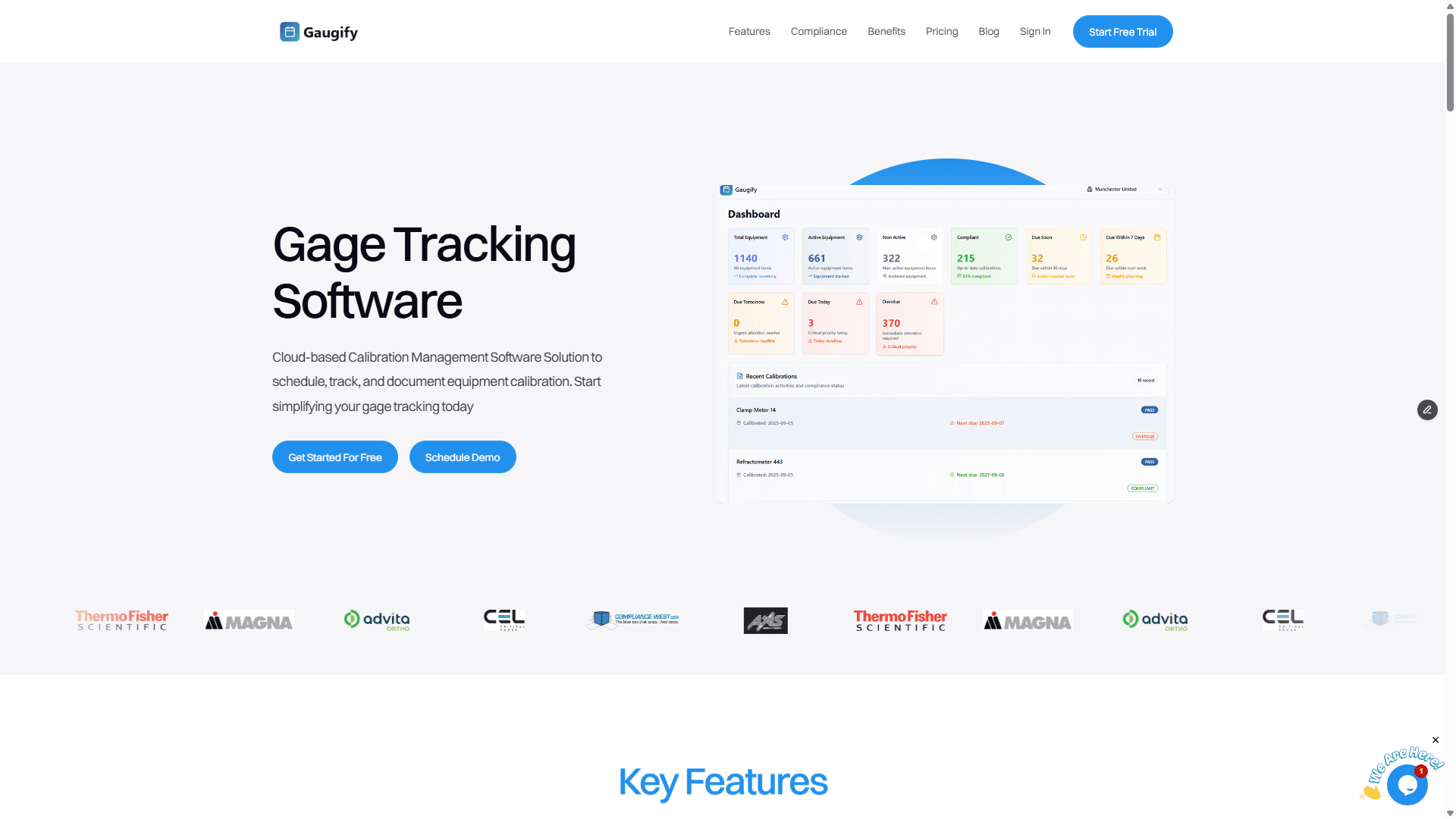
Gaugify's compliance dashboard provides real-time visibility into calibration status across entire facilities or multi-site operations. Quality managers can instantly identify overdue calibrations, equipment approaching due dates, and any instruments found out-of-tolerance during recent calibrations.
The platform generates comprehensive audit reports that summarize calibration compliance by department, equipment type, or time period. These reports include statistical analysis of calibration results, identification of trending issues, and documentation of corrective actions taken for out-of-tolerance conditions.
During audits, Gaugify's mobile-responsive interface allows immediate access to calibration records from any device. Auditors can review current certificates, calibration history, and supporting documentation without waiting for printed reports or file searches.
Integration with Existing Systems
Gaugify integrates seamlessly with existing ERP, LIMS, and quality management systems common in packaging operations. API connections allow automatic synchronization of equipment lists, work order generation, and calibration status updates without duplicate data entry.
For packaging facilities using statistical process control systems, Gaugify can export calibration data and uncertainty information to support measurement system analysis and gage R&R studies. This integration helps quality engineers optimize calibration intervals based on actual process requirements.
The platform's flexible data export capabilities support compliance with customer-specific reporting requirements. Whether customers require monthly calibration status reports or real-time access to calibration certificates, Gaugify can accommodate various data sharing needs.
ROI and Operational Benefits for Packaging Companies
Implementing modern calibration management software packaging operations benefit from extends beyond compliance to deliver measurable operational improvements and cost savings.
Reduced Calibration Costs
Packaging companies using Gaugify typically reduce calibration-related costs by 20-35% through optimized scheduling, reduced expedite fees, and elimination of duplicate calibrations. The platform's predictive analytics help extend calibration intervals where appropriate while maintaining measurement accuracy.
Automated work order generation and technician scheduling reduce administrative overhead, allowing quality departments to focus on value-added activities rather than calendar management and paperwork processing.
Improved Production Efficiency
By preventing unplanned downtime from overdue calibrations, Gaugify helps packaging facilities maintain consistent production schedules. The platform's integration with maintenance management systems allows coordination of calibration activities with planned downtime, minimizing production impact.
Real-time calibration status visibility helps production planners make informed decisions about line assignments and production sequencing when calibration activities are required during operating hours.
Enhanced Customer Relationships
Packaging companies using Gaugify report improved customer audit performance and stronger supplier relationships. The platform's professional reporting capabilities and comprehensive documentation demonstrate commitment to quality and regulatory compliance.
Many customers now require suppliers to provide real-time access to calibration status through supplier portals. Gaugify's API capabilities enable this transparency while reducing the administrative burden of manual reporting.
The packaging industry's demanding calibration requirements need modern solutions that deliver both compliance and operational efficiency. Gaugify provides the comprehensive platform packaging companies need to streamline calibration management, improve audit readiness, and reduce operational costs. Our industry-specific features and flexible pricing options make it easy for packaging operations of any size to implement professional calibration management.
Don't let outdated calibration processes put your packaging operations at risk. Schedule a personalized demo to see how Gaugify can transform your calibration program and deliver the compliance confidence your packaging operation demands. Join hundreds of packaging companies already benefiting from streamlined calibration management and superior audit readiness.
Calibration Management Software for Packaging Companies
Packaging companies face unique challenges when managing calibration programs across their manufacturing operations. From precision weighing systems that ensure accurate fill weights to thickness gauges that maintain package integrity, calibration management software packaging solutions must handle diverse instrumentation while meeting strict regulatory requirements. Quality managers at packaging facilities often struggle with paper-based systems, missed calibration schedules, and the complexity of maintaining audit-ready documentation across multiple production lines.
The packaging industry operates under intense pressure to maintain product consistency while meeting regulatory compliance standards from the FDA, USDA, and other governing bodies. A single out-of-tolerance scale can result in costly product recalls, regulatory fines, or customer complaints about under-filled packages. This makes robust calibration management not just a quality requirement, but a business-critical function that directly impacts profitability and brand reputation.
Critical Equipment Requiring Calibration in Packaging Operations
Packaging facilities rely on an extensive array of precision instruments that require regular calibration to maintain accuracy and compliance. Understanding the scope of equipment involved helps illustrate why calibration management software packaging companies need must be comprehensive and industry-specific.
Weighing and Measuring Equipment
Checkweighers represent the backbone of packaging quality control, typically requiring calibration every 30 days with tolerances as tight as ±0.1g for pharmaceutical packaging or ±1g for food products. These systems often integrate with production lines running at speeds of 300-600 packages per minute, making any downtime for calibration extremely costly.
Bench scales used for raw material weighing typically operate within tolerances of ±0.01% to ±0.1% depending on capacity, with calibration intervals ranging from monthly to quarterly based on usage frequency and environmental conditions. Platform scales handling bulk materials may have looser tolerances of ±0.02% but require more frequent calibration due to heavy usage.
Digital calipers and micrometers used for package dimension verification typically maintain tolerances of ±0.02mm and require calibration every 90 days. These measurements are critical for ensuring proper case packing, palletization efficiency, and shipping container optimization.
Environmental Monitoring Systems
Temperature sensors in cold storage areas require calibration within ±0.5°C to ensure product integrity, particularly for pharmaceuticals and perishable foods. These sensors often connect to automated monitoring systems that trigger alerts when temperatures drift outside acceptable ranges.
Humidity sensors used in controlled atmosphere packaging operations typically require calibration within ±2% RH to maintain product shelf life. For sensitive products like electronics or moisture-sensitive foods, these tolerances may tighten to ±1% RH or better.
Pressure gauges on pneumatic packaging equipment require calibration within ±1% of full scale to ensure consistent sealing pressure and prevent package failures. These gauges often operate in harsh industrial environments with temperature fluctuations and vibration that can affect accuracy over time.
Material Testing Equipment
Thickness gauges used for film, foil, and corrugated materials typically require calibration within ±0.001mm to ensure package integrity and material cost optimization. These instruments are critical for maintaining barrier properties in food packaging and pharmaceutical applications.
Tensile strength testers used for package seal integrity must be calibrated within ±1% of reading to ensure reliable seal strength measurements. These tests are often required by customer specifications or regulatory standards for medical device packaging.
Leak detection equipment requires calibration to detect leaks as small as 1×10⁻⁶ atm·cc/sec for pharmaceutical packaging or 1×10⁻³ atm·cc/sec for food packaging, depending on the application requirements.
Quality Standards and Compliance Requirements for Packaging Calibration Management
The packaging industry operates under multiple overlapping regulatory frameworks that demand rigorous calibration documentation and traceability. Effective calibration management software packaging operations use must accommodate these diverse requirements while streamlining compliance processes.
FDA and USDA Regulations
Food packaging facilities must comply with FDA 21 CFR Part 110 requirements for current Good Manufacturing Practices (cGMPs), which mandate that "instruments or controls used for measuring, regulating, or recording temperatures, pH, acidity, water activity, or other conditions" be accurate and properly maintained. This includes documented calibration procedures with certificates traceable to NIST standards.
Pharmaceutical packaging operations fall under FDA 21 CFR Part 211, which requires more stringent calibration documentation including uncertainty calculations, environmental condition monitoring during calibration, and risk-based calibration intervals. These facilities often require calibration certificates to include measurement uncertainty statements and conform to ISO 17025 requirements.
ISO Standards Implementation
ISO 9001:2015 requires packaging companies to demonstrate that monitoring and measuring equipment is "calibrated or verified, or both, at specified intervals, or prior to use, against measurement standards traceable to international or national measurement standards." This creates documentation requirements for calibration schedules, procedures, and nonconformance handling.
Many packaging companies also implement ISO 22000 for food safety management, which requires calibration of critical control point monitoring equipment with defined accuracy requirements and calibration frequencies based on HACCP analysis.
Customer-Specific Requirements
Major retailers and brand owners often impose additional calibration requirements through supplier audits. Walmart's supplier requirements, for example, mandate that all scales used for net weight determination be calibrated monthly with certificates available for audit review. Amazon requires similar documentation for packaging dimension verification equipment used by fulfillment partners.
Automotive packaging suppliers must often comply with IATF 16949 requirements, which mandate statistical process control of calibration data and risk-based approaches to calibration interval determination.
Common Audit Scenarios and Inspector Expectations
Understanding what auditors look for during calibration system reviews helps packaging companies prepare more effectively and highlights why robust calibration management software packaging solutions are essential for audit success.
FDA Inspection Scenarios
During a typical FDA inspection of a food packaging facility, investigators will request calibration records for all scales used in the production process. They expect to see current calibration certificates for each piece of equipment, documented calibration procedures, and evidence that out-of-tolerance conditions are properly investigated and resolved.
A common finding occurs when facilities cannot quickly produce calibration records or when certificates are expired. For example, if a checkweigher used for portion control shows its last calibration was performed 45 days ago but the facility's procedure requires 30-day intervals, this creates a compliance gap that may result in a Form 483 observation.
Investigators also examine how facilities handle equipment found out-of-tolerance during calibration. They expect to see documented investigations into the potential impact on product quality, including evaluation of products manufactured since the last successful calibration.
Customer Audit Expectations
Third-party auditors conducting SQF, BRC, or customer-specific audits typically focus on the systematic approach to calibration management. They look for evidence that calibration schedules are based on risk assessment, that procedures are followed consistently, and that the calibration program is regularly reviewed for effectiveness.
A major beverage company's audit protocol requires packaging suppliers to demonstrate real-time visibility into calibration status across all production lines. Auditors expect to see dashboard-style reporting that shows upcoming calibrations, overdue items, and trending of measurement accuracy over time.
Auditors frequently test the facility's calibration database by selecting random equipment and requesting immediate access to current certificates, calibration history, and any nonconformance records. Facilities using paper-based systems or disconnected spreadsheets often struggle to provide this information quickly and completely.
Ready to streamline your packaging facility's calibration management? Start your free trial of Gaugify today and see how our industry-specific features can simplify compliance and improve audit readiness.
How Gaugify Solves Packaging Industry Calibration Challenges
Modern calibration management software packaging companies rely on must address the specific operational challenges and regulatory requirements of the packaging industry. Gaugify's cloud-based platform provides comprehensive solutions tailored to packaging operations of all sizes.
Automated Scheduling and Notifications
Gaugify's intelligent scheduling system automatically tracks calibration due dates for all equipment types common in packaging operations. The system sends email and SMS notifications starting 30 days before calibration due dates, with escalating reminders to ensure no equipment falls overdue.
For packaging facilities operating multiple shifts, Gaugify's mobile app allows technicians to receive notifications and update calibration status from anywhere on the production floor. This real-time connectivity ensures that calibration activities don't disrupt critical production schedules while maintaining compliance.
The platform's workflow automation can assign calibration tasks to specific technicians based on equipment type, location, or certification requirements. For example, precision analytical balances might automatically route to certified metrologists, while routine checkweigher calibrations can be assigned to trained production technicians.
Comprehensive Certificate Management
Gaugify automatically generates professional calibration certificates that meet FDA, ISO, and customer-specific requirements. Each certificate includes measurement uncertainty calculations, environmental conditions during calibration, and complete traceability to NIST standards through our calibration service provider network.
The system stores unlimited calibration history for each instrument, making it easy to track performance trends and identify equipment that may require more frequent calibration or replacement. This historical data proves invaluable during customer audits and regulatory inspections.
For packaging companies serving multiple markets, Gaugify can generate certificates in different formats to meet varying customer requirements. The platform maintains templates for common audit standards including SQF, BRC, FSSC 22000, and customer-specific formats.
Advanced Uncertainty Calculations
Gaugify automatically calculates measurement uncertainty for all calibration results using industry-standard methods. This is particularly important for pharmaceutical packaging operations that must demonstrate measurement capability relative to product specifications.
The platform's uncertainty calculator considers multiple sources of uncertainty including calibration standard accuracy, environmental conditions, repeatability, and long-term stability. This comprehensive approach ensures that uncertainty statements meet the requirements of ISO/IEC 17025 and FDA validation guidelines.
For packaging applications with tight tolerance requirements, Gaugify's uncertainty analysis helps determine appropriate calibration intervals and identify when equipment may need upgraded specifications to meet measurement requirements.
Audit-Ready Documentation and Reporting
Gaugify's compliance dashboard provides real-time visibility into calibration status across entire facilities or multi-site operations. Quality managers can instantly identify overdue calibrations, equipment approaching due dates, and any instruments found out-of-tolerance during recent calibrations.
The platform generates comprehensive audit reports that summarize calibration compliance by department, equipment type, or time period. These reports include statistical analysis of calibration results, identification of trending issues, and documentation of corrective actions taken for out-of-tolerance conditions.
During audits, Gaugify's mobile-responsive interface allows immediate access to calibration records from any device. Auditors can review current certificates, calibration history, and supporting documentation without waiting for printed reports or file searches.
Integration with Existing Systems
Gaugify integrates seamlessly with existing ERP, LIMS, and quality management systems common in packaging operations. API connections allow automatic synchronization of equipment lists, work order generation, and calibration status updates without duplicate data entry.
For packaging facilities using statistical process control systems, Gaugify can export calibration data and uncertainty information to support measurement system analysis and gage R&R studies. This integration helps quality engineers optimize calibration intervals based on actual process requirements.
The platform's flexible data export capabilities support compliance with customer-specific reporting requirements. Whether customers require monthly calibration status reports or real-time access to calibration certificates, Gaugify can accommodate various data sharing needs.
ROI and Operational Benefits for Packaging Companies
Implementing modern calibration management software packaging operations benefit from extends beyond compliance to deliver measurable operational improvements and cost savings.
Reduced Calibration Costs
Packaging companies using Gaugify typically reduce calibration-related costs by 20-35% through optimized scheduling, reduced expedite fees, and elimination of duplicate calibrations. The platform's predictive analytics help extend calibration intervals where appropriate while maintaining measurement accuracy.
Automated work order generation and technician scheduling reduce administrative overhead, allowing quality departments to focus on value-added activities rather than calendar management and paperwork processing.
Improved Production Efficiency
By preventing unplanned downtime from overdue calibrations, Gaugify helps packaging facilities maintain consistent production schedules. The platform's integration with maintenance management systems allows coordination of calibration activities with planned downtime, minimizing production impact.
Real-time calibration status visibility helps production planners make informed decisions about line assignments and production sequencing when calibration activities are required during operating hours.
Enhanced Customer Relationships
Packaging companies using Gaugify report improved customer audit performance and stronger supplier relationships. The platform's professional reporting capabilities and comprehensive documentation demonstrate commitment to quality and regulatory compliance.
Many customers now require suppliers to provide real-time access to calibration status through supplier portals. Gaugify's API capabilities enable this transparency while reducing the administrative burden of manual reporting.
The packaging industry's demanding calibration requirements need modern solutions that deliver both compliance and operational efficiency. Gaugify provides the comprehensive platform packaging companies need to streamline calibration management, improve audit readiness, and reduce operational costs. Our industry-specific features and flexible pricing options make it easy for packaging operations of any size to implement professional calibration management.
Don't let outdated calibration processes put your packaging operations at risk. Schedule a personalized demo to see how Gaugify can transform your calibration program and deliver the compliance confidence your packaging operation demands. Join hundreds of packaging companies already benefiting from streamlined calibration management and superior audit readiness.