
Calibration Management Software for Pharmaceutical Companies
Calibration Management Software for Pharmaceutical Companies
David Bentley
Quality Assurance Engineer
12 min read
Calibration Management Software for Pharmaceutical Companies
Pharmaceutical manufacturing operates under some of the most stringent regulatory requirements in any industry. When your products directly impact human health and safety, maintaining precise calibration management software pharmaceutical companies can rely on isn't just about compliance—it's about ensuring every measurement that goes into drug development and production meets the highest standards of accuracy and traceability.
The challenges facing pharmaceutical quality managers today go far beyond simple equipment tracking. You're dealing with FDA 21 CFR Part 11 requirements, ISO 17025 compliance, complex uncertainty calculations for critical process parameters, and audit trails that must withstand the scrutiny of regulatory inspections. Traditional paper-based systems or basic spreadsheet tracking simply can't handle the complexity and documentation requirements that pharmaceutical operations demand.
Critical Equipment Requiring Calibration Management Software Pharmaceutical Operations Depend On
Pharmaceutical facilities house an extensive array of precision instruments that require regular calibration to maintain product quality and regulatory compliance. Understanding the breadth of equipment involved helps illustrate why specialized calibration management software pharmaceutical companies choose makes such a significant difference in operational efficiency.
Laboratory Analytical Equipment
Your analytical laboratory contains some of the most critical instruments requiring precise calibration schedules. High-Performance Liquid Chromatography (HPLC) systems used for potency testing typically require quarterly calibration with uncertainty calculations that must account for detector linearity, injection precision, and column performance. Many facilities struggle with tracking the multiple components within each HPLC system—pumps, detectors, autosamplers—each with different calibration intervals and certificate requirements.
UV-Vis spectrophotometers performing dissolution testing need wavelength accuracy verification within ±0.5 nm and photometric accuracy within ±0.003 A. Gas chromatography systems analyzing residual solvents require calibration of temperature controllers (±0.1°C), flow controllers (±1% of setpoint), and detector response linearity across the working range.
Karl Fischer titrators measuring water content need daily standardization with certified reference materials, while the instrument itself requires quarterly calibration with uncertainty budgets that account for volumetric delivery, electrode response, and environmental factors.
Manufacturing Process Equipment
On the production floor, pharmaceutical balances and scales represent perhaps the most critical calibration challenge. An analytical balance with 0.1 mg readability used for active pharmaceutical ingredient (API) weighing requires daily performance verification and quarterly full calibration with certified weights traceable to national standards. The uncertainty budget must account for repeatability, linearity, eccentricity, and environmental conditions—calculations that become complex when you're managing dozens of balances across multiple production lines.
Temperature monitoring systems in freeze-drying operations require calibration of RTD sensors within ±0.1°C accuracy. Autoclave temperature sensors need calibration that accounts for the harsh steam environment, while stability chamber sensors require calibration across the full operating range with humidity considerations.
Pressure transducers in tablet compression equipment typically require calibration to ±0.25% of full scale, with traceability that extends through multiple levels of transfer standards back to national pressure standards.
Environmental Monitoring Systems
Clean room differential pressure monitors, particle counters, and air velocity meters all require regular calibration with specific environmental considerations. Particle counters need calibration with certified latex spheres of known size distributions, while air velocity meters require calibration in controlled conditions that account for temperature and pressure effects on air density.
Regulatory Standards Demanding Robust Calibration Management Software Pharmaceutical Companies Must Meet
The pharmaceutical industry operates under a complex web of overlapping regulations that make calibration management particularly challenging. Understanding these requirements helps explain why generic calibration software often falls short of pharmaceutical needs.
FDA 21 CFR Part 11 Electronic Records Requirements
When implementing calibration management software pharmaceutical facilities must ensure full compliance with 21 CFR Part 11, which governs electronic records and signatures. This means your calibration certificates, schedules, and historical data must include audit trails that capture who made changes, when changes occurred, and why changes were necessary.
The regulation requires electronic signatures that are legally equivalent to handwritten signatures. Your calibration technicians must have unique user credentials, and the system must prevent unauthorized access to calibration records. Time-stamped audit trails must be exportable and readable throughout the record retention period, typically extending 3-5 years beyond product expiration.
ISO 17025 Laboratory Accreditation Standards
If your facility operates an accredited testing laboratory, ISO 17025 compliance adds another layer of calibration management requirements. The standard demands detailed uncertainty calculations for every measurement, traceability chains that extend to national metrology institutes, and calibration intervals based on statistical analysis of historical performance data.
ISO 17025 requires that calibration certificates include detailed uncertainty budgets that account for all significant sources of measurement uncertainty. For a pharmaceutical balance, this might include contributions from repeatability (Type A evaluation), calibration weight uncertainty, temperature effects, air buoyancy corrections, and long-term stability (Type B evaluations).
Specialized ISO 17025 calibration software helps automate these complex uncertainty calculations while maintaining the detailed documentation required for accreditation audits.
ICH Q7 Good Manufacturing Practice Guidelines
ICH Q7 specifically addresses calibration requirements for API manufacturing, stating that "instruments used for measuring, monitoring or recording should be calibrated or checked at defined intervals by appropriate methods." The guideline emphasizes that calibration standards must have valid certificates of analysis and be traceable to national or international standards.
The guideline also requires that "deviations from approved calibration standards should be investigated to determine if these could have had an impact on the quality of the intermediate(s) or API(s) manufactured using this equipment since the last successful calibration."
What Pharmaceutical Auditors Look for During Calibration Reviews
Understanding audit scenarios helps highlight where calibration management software pharmaceutical companies implement provides the most value. Regulatory auditors arrive with specific expectations and systematic approaches to evaluating your calibration program.
FDA Inspection Scenarios
During a typical FDA inspection, auditors will select critical equipment and trace calibration records backward through time. They might choose your primary analytical balance used for API weighing and request calibration certificates for the past two years. They'll examine not just the certificates themselves, but the complete audit trail showing who performed calibrations, when equipment was removed from and returned to service, and how any out-of-specification results were investigated and resolved.
Auditors frequently test your calibration recall system by asking: "If you discovered today that a calibration standard was found to be out of specification, how would you identify all equipment calibrated with that standard and assess the impact on product quality?" This scenario reveals whether your calibration management system provides the cross-referencing capabilities necessary for effective impact assessments.
They'll also examine calibration intervals to ensure they're based on appropriate criteria. An auditor might ask why your HPLC detector is calibrated quarterly rather than monthly or semi-annually. Your calibration management software pharmaceutical operations use should provide historical performance data and statistical tools to justify these intervals scientifically rather than relying on manufacturer recommendations alone.
ISO Accreditation Assessment Focus Areas
ISO 17025 assessors take a more technical approach, diving deep into measurement uncertainty calculations and traceability chains. They'll select calibration certificates and verify that uncertainty budgets are complete and technically sound. For pharmaceutical applications, they're particularly focused on whether your uncertainty calculations properly account for sample matrix effects, environmental conditions, and human factors.
Assessors examine whether your calibration intervals are appropriate for the intended use and measurement requirements. They expect to see documented rationale for interval selection, preferably supported by statistical analysis of historical calibration data showing equipment stability over time.
Customer Audit Expectations
Pharmaceutical customer audits often focus on supply chain qualification, examining whether your calibration program supports the quality of materials or services you provide. Customer auditors typically want to see that your calibration program covers all equipment that could affect product quality, not just instruments directly involved in testing their specific products.
They frequently request calibration trend data to assess equipment stability and your facility's commitment to continuous improvement. Customer auditors also examine whether your calibration program includes appropriate environmental monitoring to ensure stable measurement conditions.
How Advanced Calibration Management Software Pharmaceutical Companies Need Solves Industry Challenges
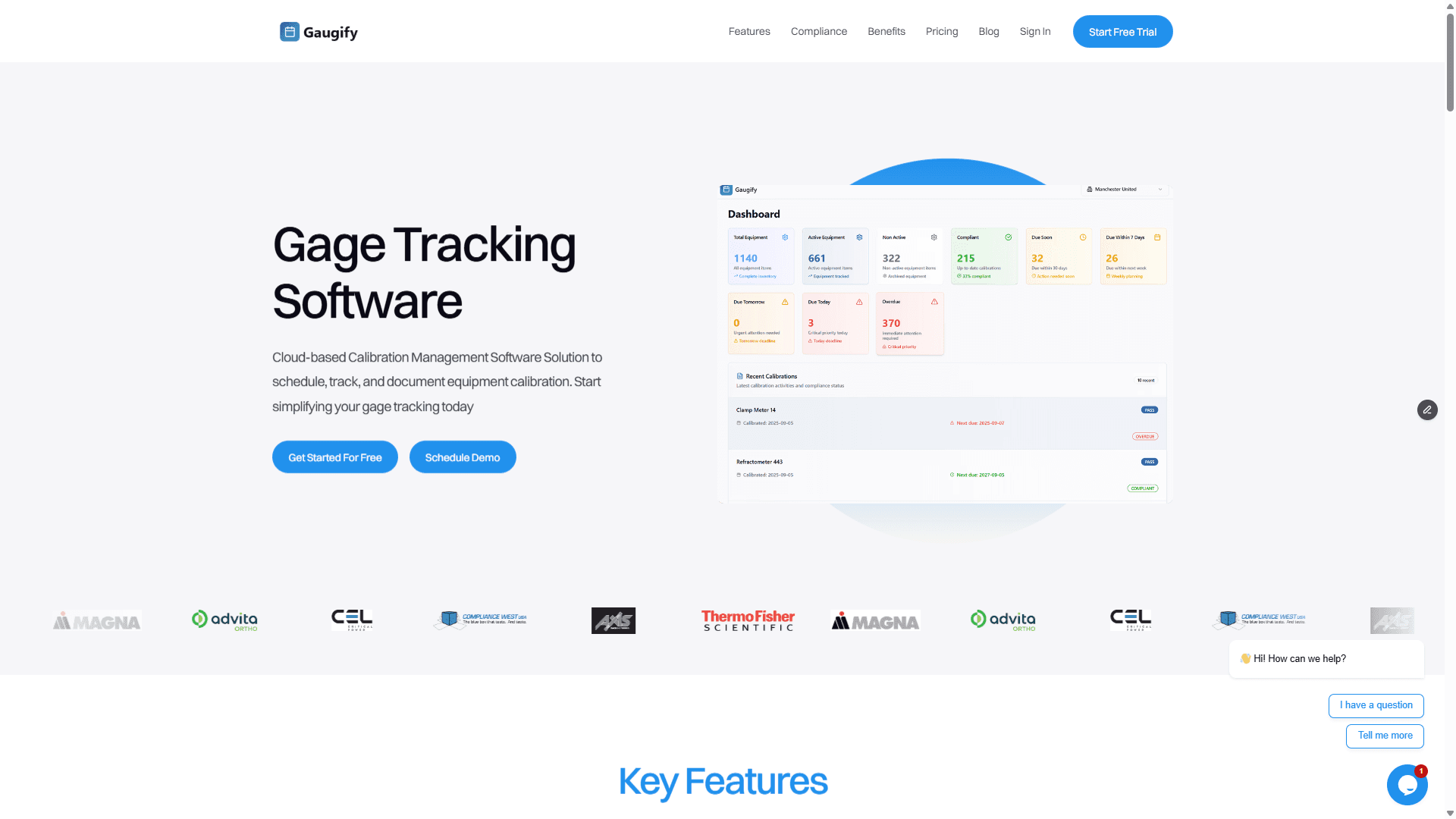
The complexity of pharmaceutical calibration requirements demands software solutions specifically designed for regulated industries. Gaugify's calibration management platform addresses each of these challenges with features built specifically for pharmaceutical operations.
Automated Scheduling with Regulatory Intelligence
Traditional calibration scheduling often relies on simple calendar-based reminders that don't account for equipment usage patterns, regulatory requirements, or risk-based intervals. Gaugify's intelligent scheduling system recognizes that your tablet hardness tester used for critical quality attributes needs more frequent attention than a backup instrument used only for investigations.
The system automatically adjusts calibration schedules based on historical performance data, usage patterns, and regulatory requirements specific to pharmaceutical applications. When your analytical balance shows increasing drift over recent calibrations, the software can automatically shorten the calibration interval and alert quality management to investigate potential causes.
For pharmaceutical facilities managing hundreds of instruments across multiple production lines, automated scheduling prevents the oversight that can lead to expired calibrations and production delays. The system sends escalating notifications to technicians, supervisors, and quality managers, ensuring that calibration due dates never slip through the cracks.
Comprehensive Certificate Management and Audit Trails
Pharmaceutical calibration certificates require much more detail than certificates for general industrial applications. Each certificate must include complete uncertainty budgets, environmental conditions during calibration, traceability statements, and detailed procedural information that satisfies both FDA and ISO requirements.
Gaugify automatically generates certificates that include all required pharmaceutical-specific information while maintaining the 21 CFR Part 11 compliant audit trails that track every access, modification, and approval. The system maintains complete versioning history, so auditors can see not just the current certificate, but the complete evolution of equipment performance over time.
When regulatory inspectors request calibration documentation during an audit, quality managers can instantly provide complete calibration histories with full audit trails, dramatically reducing the time and stress associated with regulatory inspections.
Advanced Uncertainty Calculations for Critical Measurements
Pharmaceutical applications often require complex uncertainty calculations that account for multiple sources of measurement uncertainty. Calculating combined uncertainty for an HPLC assay method involves contributions from calibration standards, volumetric glassware, environmental conditions, sample preparation effects, and instrument repeatability.
Gaugify's uncertainty calculation engine automates these complex calculations while maintaining full transparency in the mathematical approach. The system can handle both Type A uncertainty evaluations based on statistical analysis of repeated measurements and Type B evaluations based on manufacturer specifications, calibration certificates, and scientific judgment.
For ISO 17025 accredited laboratories, the software generates detailed uncertainty budgets that satisfy technical assessor requirements while providing the measurement capability statements necessary for scope of accreditation documents.
Start your free trial today to see how Gaugify can streamline your pharmaceutical calibration management while ensuring complete regulatory compliance.
Risk-Based Calibration Interval Optimization
Pharmaceutical regulations increasingly emphasize risk-based approaches to quality management, and calibration programs should reflect this philosophy. Gaugify analyzes historical calibration data to identify instruments that consistently perform well and could potentially have extended calibration intervals, while flagging equipment that shows increasing drift and might need more frequent attention.
The system's statistical analysis tools help justify calibration intervals based on equipment stability data rather than arbitrary time periods. This approach not only satisfies regulatory expectations but can significantly reduce calibration costs by optimizing resource allocation based on actual risk assessment.
Integration with Laboratory Information Management Systems
Modern pharmaceutical operations rely on integrated systems that share data seamlessly across quality management functions. Gaugify integrates with popular LIMS platforms to ensure that calibration status information is available when analytical results are generated and reviewed.
This integration prevents the release of analytical results from equipment that's overdue for calibration while maintaining the complete audit trail that connects calibration status to specific test results. When product quality investigations arise, quality managers can quickly identify all testing performed on specific equipment and assess whether calibration status could have impacted results.
Environmental Monitoring Integration
Pharmaceutical calibrations must account for environmental conditions that could affect measurement accuracy. Gaugify can integrate with environmental monitoring systems to capture temperature, humidity, and pressure conditions during calibration activities, automatically incorporating this data into calibration certificates.
The system can also flag when environmental conditions are outside acceptable ranges for calibration activities, preventing invalid calibrations that could compromise measurement traceability.
Streamlining Regulatory Inspections and Audits
When FDA investigators or customer auditors request calibration documentation, the speed and completeness of your response significantly impacts their perception of your quality system's effectiveness. Gaugify's compliance-focused design ensures that all required documentation is immediately available in the format auditors expect.
The system's powerful search and reporting capabilities allow quality managers to quickly respond to auditor requests for specific information. Whether an auditor wants to see all calibrations performed by a specific technician, all equipment calibrated with a particular standard, or all calibrations performed during a specific time period, the information is available within seconds.
Audit report generation includes complete calibration histories with statistical summaries, trend analyses, and compliance metrics that demonstrate your facility's commitment to measurement quality and continuous improvement.
Cost Management and Resource Optimization
Pharmaceutical calibration programs represent significant operational expenses, including external calibration services, internal labor costs, equipment downtime, and calibration standard maintenance. Gaugify provides detailed cost tracking and analysis tools that help quality managers optimize calibration spending while maintaining compliance.
The system tracks calibration costs by equipment type, vendor, and facility location, identifying opportunities for consolidation or renegotiation with calibration service providers. Budget forecasting tools help predict future calibration expenses based on equipment additions, interval changes, and historical cost trends.
Resource planning features ensure optimal utilization of internal calibration technicians by balancing workloads across team members and identifying peak demand periods that might require additional resources or schedule adjustments.
Validation and Change Control for Software Implementation
Implementing calibration management software pharmaceutical facilities require involves formal validation protocols that demonstrate the system meets its intended purpose and maintains data integrity throughout its lifecycle. Gaugify provides comprehensive validation support including Installation Qualification (IQ), Operational Qualification (OQ), and Performance Qualification (PQ) protocols specifically designed for pharmaceutical applications.
The platform's built-in change control system ensures that any modifications to calibration procedures, equipment configurations, or system settings follow appropriate approval workflows with complete audit trail documentation. This capability is essential for maintaining 21 CFR Part 11 compliance and supporting regulatory inspections.
Future-Proofing Your Calibration Program
Pharmaceutical regulations continue evolving toward more sophisticated quality management approaches, including advanced data analytics, predictive maintenance strategies, and integrated quality systems. Gaugify's cloud-based architecture ensures that your calibration management system can adapt to these changing requirements without major software overhauls or data migrations.
The platform's API capabilities support integration with emerging technologies like IoT sensors, automated calibration systems, and artificial intelligence tools that will define the future of pharmaceutical quality management.
Machine learning algorithms analyze calibration patterns to predict equipment failures before they occur, supporting proactive maintenance strategies that minimize production disruptions and ensure consistent product quality.
Transform Your Pharmaceutical Calibration Management Today
The complexity of pharmaceutical calibration requirements demands specialized software solutions that understand the unique challenges facing your industry. Generic calibration tracking systems simply cannot provide the depth of functionality, regulatory compliance features, and technical sophistication that pharmaceutical operations require.
Gaugify combines deep pharmaceutical industry expertise with cutting-edge software technology to deliver a calibration management platform specifically designed for regulated industries. Our customers report significant improvements in audit readiness, regulatory compliance, and operational efficiency within months of implementation.
Don't let calibration management complexity continue hampering your quality operations. Schedule a personalized demo to see exactly how Gaugify addresses the specific calibration challenges facing your pharmaceutical facility. Our team will walk you through real-world scenarios using your actual equipment types and regulatory requirements, demonstrating the immediate value our platform can provide to your quality management operations.
Calibration Management Software for Pharmaceutical Companies
Pharmaceutical manufacturing operates under some of the most stringent regulatory requirements in any industry. When your products directly impact human health and safety, maintaining precise calibration management software pharmaceutical companies can rely on isn't just about compliance—it's about ensuring every measurement that goes into drug development and production meets the highest standards of accuracy and traceability.
The challenges facing pharmaceutical quality managers today go far beyond simple equipment tracking. You're dealing with FDA 21 CFR Part 11 requirements, ISO 17025 compliance, complex uncertainty calculations for critical process parameters, and audit trails that must withstand the scrutiny of regulatory inspections. Traditional paper-based systems or basic spreadsheet tracking simply can't handle the complexity and documentation requirements that pharmaceutical operations demand.
Critical Equipment Requiring Calibration Management Software Pharmaceutical Operations Depend On
Pharmaceutical facilities house an extensive array of precision instruments that require regular calibration to maintain product quality and regulatory compliance. Understanding the breadth of equipment involved helps illustrate why specialized calibration management software pharmaceutical companies choose makes such a significant difference in operational efficiency.
Laboratory Analytical Equipment
Your analytical laboratory contains some of the most critical instruments requiring precise calibration schedules. High-Performance Liquid Chromatography (HPLC) systems used for potency testing typically require quarterly calibration with uncertainty calculations that must account for detector linearity, injection precision, and column performance. Many facilities struggle with tracking the multiple components within each HPLC system—pumps, detectors, autosamplers—each with different calibration intervals and certificate requirements.
UV-Vis spectrophotometers performing dissolution testing need wavelength accuracy verification within ±0.5 nm and photometric accuracy within ±0.003 A. Gas chromatography systems analyzing residual solvents require calibration of temperature controllers (±0.1°C), flow controllers (±1% of setpoint), and detector response linearity across the working range.
Karl Fischer titrators measuring water content need daily standardization with certified reference materials, while the instrument itself requires quarterly calibration with uncertainty budgets that account for volumetric delivery, electrode response, and environmental factors.
Manufacturing Process Equipment
On the production floor, pharmaceutical balances and scales represent perhaps the most critical calibration challenge. An analytical balance with 0.1 mg readability used for active pharmaceutical ingredient (API) weighing requires daily performance verification and quarterly full calibration with certified weights traceable to national standards. The uncertainty budget must account for repeatability, linearity, eccentricity, and environmental conditions—calculations that become complex when you're managing dozens of balances across multiple production lines.
Temperature monitoring systems in freeze-drying operations require calibration of RTD sensors within ±0.1°C accuracy. Autoclave temperature sensors need calibration that accounts for the harsh steam environment, while stability chamber sensors require calibration across the full operating range with humidity considerations.
Pressure transducers in tablet compression equipment typically require calibration to ±0.25% of full scale, with traceability that extends through multiple levels of transfer standards back to national pressure standards.
Environmental Monitoring Systems
Clean room differential pressure monitors, particle counters, and air velocity meters all require regular calibration with specific environmental considerations. Particle counters need calibration with certified latex spheres of known size distributions, while air velocity meters require calibration in controlled conditions that account for temperature and pressure effects on air density.
Regulatory Standards Demanding Robust Calibration Management Software Pharmaceutical Companies Must Meet
The pharmaceutical industry operates under a complex web of overlapping regulations that make calibration management particularly challenging. Understanding these requirements helps explain why generic calibration software often falls short of pharmaceutical needs.
FDA 21 CFR Part 11 Electronic Records Requirements
When implementing calibration management software pharmaceutical facilities must ensure full compliance with 21 CFR Part 11, which governs electronic records and signatures. This means your calibration certificates, schedules, and historical data must include audit trails that capture who made changes, when changes occurred, and why changes were necessary.
The regulation requires electronic signatures that are legally equivalent to handwritten signatures. Your calibration technicians must have unique user credentials, and the system must prevent unauthorized access to calibration records. Time-stamped audit trails must be exportable and readable throughout the record retention period, typically extending 3-5 years beyond product expiration.
ISO 17025 Laboratory Accreditation Standards
If your facility operates an accredited testing laboratory, ISO 17025 compliance adds another layer of calibration management requirements. The standard demands detailed uncertainty calculations for every measurement, traceability chains that extend to national metrology institutes, and calibration intervals based on statistical analysis of historical performance data.
ISO 17025 requires that calibration certificates include detailed uncertainty budgets that account for all significant sources of measurement uncertainty. For a pharmaceutical balance, this might include contributions from repeatability (Type A evaluation), calibration weight uncertainty, temperature effects, air buoyancy corrections, and long-term stability (Type B evaluations).
Specialized ISO 17025 calibration software helps automate these complex uncertainty calculations while maintaining the detailed documentation required for accreditation audits.
ICH Q7 Good Manufacturing Practice Guidelines
ICH Q7 specifically addresses calibration requirements for API manufacturing, stating that "instruments used for measuring, monitoring or recording should be calibrated or checked at defined intervals by appropriate methods." The guideline emphasizes that calibration standards must have valid certificates of analysis and be traceable to national or international standards.
The guideline also requires that "deviations from approved calibration standards should be investigated to determine if these could have had an impact on the quality of the intermediate(s) or API(s) manufactured using this equipment since the last successful calibration."
What Pharmaceutical Auditors Look for During Calibration Reviews
Understanding audit scenarios helps highlight where calibration management software pharmaceutical companies implement provides the most value. Regulatory auditors arrive with specific expectations and systematic approaches to evaluating your calibration program.
FDA Inspection Scenarios
During a typical FDA inspection, auditors will select critical equipment and trace calibration records backward through time. They might choose your primary analytical balance used for API weighing and request calibration certificates for the past two years. They'll examine not just the certificates themselves, but the complete audit trail showing who performed calibrations, when equipment was removed from and returned to service, and how any out-of-specification results were investigated and resolved.
Auditors frequently test your calibration recall system by asking: "If you discovered today that a calibration standard was found to be out of specification, how would you identify all equipment calibrated with that standard and assess the impact on product quality?" This scenario reveals whether your calibration management system provides the cross-referencing capabilities necessary for effective impact assessments.
They'll also examine calibration intervals to ensure they're based on appropriate criteria. An auditor might ask why your HPLC detector is calibrated quarterly rather than monthly or semi-annually. Your calibration management software pharmaceutical operations use should provide historical performance data and statistical tools to justify these intervals scientifically rather than relying on manufacturer recommendations alone.
ISO Accreditation Assessment Focus Areas
ISO 17025 assessors take a more technical approach, diving deep into measurement uncertainty calculations and traceability chains. They'll select calibration certificates and verify that uncertainty budgets are complete and technically sound. For pharmaceutical applications, they're particularly focused on whether your uncertainty calculations properly account for sample matrix effects, environmental conditions, and human factors.
Assessors examine whether your calibration intervals are appropriate for the intended use and measurement requirements. They expect to see documented rationale for interval selection, preferably supported by statistical analysis of historical calibration data showing equipment stability over time.
Customer Audit Expectations
Pharmaceutical customer audits often focus on supply chain qualification, examining whether your calibration program supports the quality of materials or services you provide. Customer auditors typically want to see that your calibration program covers all equipment that could affect product quality, not just instruments directly involved in testing their specific products.
They frequently request calibration trend data to assess equipment stability and your facility's commitment to continuous improvement. Customer auditors also examine whether your calibration program includes appropriate environmental monitoring to ensure stable measurement conditions.
How Advanced Calibration Management Software Pharmaceutical Companies Need Solves Industry Challenges
The complexity of pharmaceutical calibration requirements demands software solutions specifically designed for regulated industries. Gaugify's calibration management platform addresses each of these challenges with features built specifically for pharmaceutical operations.
Automated Scheduling with Regulatory Intelligence
Traditional calibration scheduling often relies on simple calendar-based reminders that don't account for equipment usage patterns, regulatory requirements, or risk-based intervals. Gaugify's intelligent scheduling system recognizes that your tablet hardness tester used for critical quality attributes needs more frequent attention than a backup instrument used only for investigations.
The system automatically adjusts calibration schedules based on historical performance data, usage patterns, and regulatory requirements specific to pharmaceutical applications. When your analytical balance shows increasing drift over recent calibrations, the software can automatically shorten the calibration interval and alert quality management to investigate potential causes.
For pharmaceutical facilities managing hundreds of instruments across multiple production lines, automated scheduling prevents the oversight that can lead to expired calibrations and production delays. The system sends escalating notifications to technicians, supervisors, and quality managers, ensuring that calibration due dates never slip through the cracks.
Comprehensive Certificate Management and Audit Trails
Pharmaceutical calibration certificates require much more detail than certificates for general industrial applications. Each certificate must include complete uncertainty budgets, environmental conditions during calibration, traceability statements, and detailed procedural information that satisfies both FDA and ISO requirements.
Gaugify automatically generates certificates that include all required pharmaceutical-specific information while maintaining the 21 CFR Part 11 compliant audit trails that track every access, modification, and approval. The system maintains complete versioning history, so auditors can see not just the current certificate, but the complete evolution of equipment performance over time.
When regulatory inspectors request calibration documentation during an audit, quality managers can instantly provide complete calibration histories with full audit trails, dramatically reducing the time and stress associated with regulatory inspections.
Advanced Uncertainty Calculations for Critical Measurements
Pharmaceutical applications often require complex uncertainty calculations that account for multiple sources of measurement uncertainty. Calculating combined uncertainty for an HPLC assay method involves contributions from calibration standards, volumetric glassware, environmental conditions, sample preparation effects, and instrument repeatability.
Gaugify's uncertainty calculation engine automates these complex calculations while maintaining full transparency in the mathematical approach. The system can handle both Type A uncertainty evaluations based on statistical analysis of repeated measurements and Type B evaluations based on manufacturer specifications, calibration certificates, and scientific judgment.
For ISO 17025 accredited laboratories, the software generates detailed uncertainty budgets that satisfy technical assessor requirements while providing the measurement capability statements necessary for scope of accreditation documents.
Start your free trial today to see how Gaugify can streamline your pharmaceutical calibration management while ensuring complete regulatory compliance.
Risk-Based Calibration Interval Optimization
Pharmaceutical regulations increasingly emphasize risk-based approaches to quality management, and calibration programs should reflect this philosophy. Gaugify analyzes historical calibration data to identify instruments that consistently perform well and could potentially have extended calibration intervals, while flagging equipment that shows increasing drift and might need more frequent attention.
The system's statistical analysis tools help justify calibration intervals based on equipment stability data rather than arbitrary time periods. This approach not only satisfies regulatory expectations but can significantly reduce calibration costs by optimizing resource allocation based on actual risk assessment.
Integration with Laboratory Information Management Systems
Modern pharmaceutical operations rely on integrated systems that share data seamlessly across quality management functions. Gaugify integrates with popular LIMS platforms to ensure that calibration status information is available when analytical results are generated and reviewed.
This integration prevents the release of analytical results from equipment that's overdue for calibration while maintaining the complete audit trail that connects calibration status to specific test results. When product quality investigations arise, quality managers can quickly identify all testing performed on specific equipment and assess whether calibration status could have impacted results.
Environmental Monitoring Integration
Pharmaceutical calibrations must account for environmental conditions that could affect measurement accuracy. Gaugify can integrate with environmental monitoring systems to capture temperature, humidity, and pressure conditions during calibration activities, automatically incorporating this data into calibration certificates.
The system can also flag when environmental conditions are outside acceptable ranges for calibration activities, preventing invalid calibrations that could compromise measurement traceability.
Streamlining Regulatory Inspections and Audits
When FDA investigators or customer auditors request calibration documentation, the speed and completeness of your response significantly impacts their perception of your quality system's effectiveness. Gaugify's compliance-focused design ensures that all required documentation is immediately available in the format auditors expect.
The system's powerful search and reporting capabilities allow quality managers to quickly respond to auditor requests for specific information. Whether an auditor wants to see all calibrations performed by a specific technician, all equipment calibrated with a particular standard, or all calibrations performed during a specific time period, the information is available within seconds.
Audit report generation includes complete calibration histories with statistical summaries, trend analyses, and compliance metrics that demonstrate your facility's commitment to measurement quality and continuous improvement.
Cost Management and Resource Optimization
Pharmaceutical calibration programs represent significant operational expenses, including external calibration services, internal labor costs, equipment downtime, and calibration standard maintenance. Gaugify provides detailed cost tracking and analysis tools that help quality managers optimize calibration spending while maintaining compliance.
The system tracks calibration costs by equipment type, vendor, and facility location, identifying opportunities for consolidation or renegotiation with calibration service providers. Budget forecasting tools help predict future calibration expenses based on equipment additions, interval changes, and historical cost trends.
Resource planning features ensure optimal utilization of internal calibration technicians by balancing workloads across team members and identifying peak demand periods that might require additional resources or schedule adjustments.
Validation and Change Control for Software Implementation
Implementing calibration management software pharmaceutical facilities require involves formal validation protocols that demonstrate the system meets its intended purpose and maintains data integrity throughout its lifecycle. Gaugify provides comprehensive validation support including Installation Qualification (IQ), Operational Qualification (OQ), and Performance Qualification (PQ) protocols specifically designed for pharmaceutical applications.
The platform's built-in change control system ensures that any modifications to calibration procedures, equipment configurations, or system settings follow appropriate approval workflows with complete audit trail documentation. This capability is essential for maintaining 21 CFR Part 11 compliance and supporting regulatory inspections.
Future-Proofing Your Calibration Program
Pharmaceutical regulations continue evolving toward more sophisticated quality management approaches, including advanced data analytics, predictive maintenance strategies, and integrated quality systems. Gaugify's cloud-based architecture ensures that your calibration management system can adapt to these changing requirements without major software overhauls or data migrations.
The platform's API capabilities support integration with emerging technologies like IoT sensors, automated calibration systems, and artificial intelligence tools that will define the future of pharmaceutical quality management.
Machine learning algorithms analyze calibration patterns to predict equipment failures before they occur, supporting proactive maintenance strategies that minimize production disruptions and ensure consistent product quality.
Transform Your Pharmaceutical Calibration Management Today
The complexity of pharmaceutical calibration requirements demands specialized software solutions that understand the unique challenges facing your industry. Generic calibration tracking systems simply cannot provide the depth of functionality, regulatory compliance features, and technical sophistication that pharmaceutical operations require.
Gaugify combines deep pharmaceutical industry expertise with cutting-edge software technology to deliver a calibration management platform specifically designed for regulated industries. Our customers report significant improvements in audit readiness, regulatory compliance, and operational efficiency within months of implementation.
Don't let calibration management complexity continue hampering your quality operations. Schedule a personalized demo to see exactly how Gaugify addresses the specific calibration challenges facing your pharmaceutical facility. Our team will walk you through real-world scenarios using your actual equipment types and regulatory requirements, demonstrating the immediate value our platform can provide to your quality management operations.