
Calibration Management Software for Welding Shops
Calibration Management Software for Welding Shops
David Bentley
Quality Assurance Engineer
12 min read
Calibration Management Software for Welding Shops
Welding shops face unique calibration challenges that can make or break their quality management systems. From maintaining precise temperature control on preheating equipment to ensuring welding parameter monitoring devices stay within specification, calibration management software welding operations rely on demands specialized solutions that understand the critical nature of joint integrity and structural safety.
Traditional paper-based calibration tracking simply doesn't cut it when you're managing hundreds of instruments across multiple welding bays, dealing with AWS D1.1 compliance requirements, or preparing for that dreaded CWI audit. The stakes are too high, and the complexity too great, to rely on spreadsheets and filing cabinets.
Critical Equipment Requiring Calibration in Welding Operations
Welding shops depend on an extensive array of precision instruments, each requiring regular calibration to maintain weld quality and structural integrity. Understanding what needs calibration—and when—is the foundation of effective calibration management software welding programs.
Welding Parameter Monitoring Equipment
Voltage and amperage meters on your welding machines aren't just nice-to-have displays—they're critical for maintaining proper penetration and avoiding defects. A GTAW setup running at what the display shows as 150 amps might actually be delivering 165 amps if the meter hasn't been calibrated in two years. That 10% error could mean the difference between acceptable root penetration and a failed radiographic test.
Wire feed speed controllers on GMAW equipment require calibration to ensure consistent deposition rates. When your procedure calls for 250 inches per minute and your equipment is actually delivering 275 IPM, you're looking at potential lack of fusion or excessive reinforcement issues that will show up during visual inspection.
Temperature Measurement and Control Devices
Preheat and interpass temperature control is non-negotiable for many welding applications. Infrared thermometers, contact pyrometers, and temperature indicating crayons all require regular verification. A pyrometer reading 350°F when the actual temperature is 315°F could result in hydrogen-induced cracking on high-strength steel applications—a failure that might not manifest until the structure is in service.
Stress relief furnaces and post-weld heat treatment equipment demand even tighter control. When ASME Section VIII Division 1 requires holding 1150°F ±25°F for stress relief, your temperature controllers and recording devices need calibration uncertainties that won't eat into your process tolerance.
Dimensional and Measurement Tools
Welding shops use specialized gauges that standard calibration programs often overlook. Fillet weld gauges, bridge cam gauges, and pit gauges require calibration against certified reference standards. A hi-lo gauge that's supposed to measure ±1/16" root misalignment but has drifted to ±3/32" accuracy could lead to accepting welds that will fail under fatigue loading.
Ultrasonic thickness gauges for measuring base material and weld cap thickness need calibration on multiple test blocks. A gauge calibrated only on steel might read incorrectly on aluminum or stainless applications, leading to undermining or excessive reinforcement issues.
Quality Standards and Compliance Requirements for Welding Calibration
Welding operations don't exist in a regulatory vacuum. Multiple overlapping standards create a complex web of calibration management software welding compliance requirements that must be carefully managed and documented.
AWS Standards and Requirements
AWS D1.1 Structural Welding Code requires that "measuring and test equipment shall be calibrated at specified intervals." This isn't a suggestion—it's a mandatory requirement that auditors will verify during qualification reviews. The standard specifically calls for calibration intervals to be established based on stability, purpose, and degree of usage.
AWS D1.5 Bridge Welding Code takes calibration requirements even further, requiring that temperature measuring devices used for preheat verification be calibrated to an accuracy of ±3% of reading or ±5°F, whichever is greater. This level of specificity demands calibration management systems that can track and verify these exact tolerance requirements.
ASME and Pressure Vessel Requirements
ASME Section IX welding procedure qualification requires that all measuring equipment used during qualification testing be properly calibrated. This includes not just the obvious items like tensile testing machines and hardness testers, but also the thermocouples used to monitor cooling rates and the rulers used to measure test specimen dimensions.
Section VIII Division 1 fabrication requirements extend calibration demands to production welding. Every piece of equipment used to verify compliance with the welding procedure specification must have current calibration. Miss a calibration on your interpass temperature recorder, and your ASME Authorized Inspector might shut down production until compliance is restored.
ISO 3834 Welding Quality Requirements
ISO 3834 welding quality management systems require comprehensive calibration programs as part of quality planning. The standard specifically addresses measurement uncertainty and requires that calibration intervals be based on equipment stability and criticality of application. ISO 17025 calibration software capabilities become essential for shops pursuing this certification.
Common Audit Scenarios and What Auditors Examine
When auditors walk into your welding shop, they're looking for specific evidence that your calibration management software welding program actually works in practice, not just on paper. Understanding their focus areas helps you prepare for these critical reviews.
Equipment Identification and Traceability
The first thing auditors check is whether every calibrated instrument has clear identification and current calibration status. They'll randomly select equipment from your production floor—not your calibration room—and verify that calibration labels are present, legible, and within date.
A common audit finding occurs when shops have good calibration records but poor equipment identification. Finding a micrometer with a faded calibration sticker that can't be matched to calibration records is an immediate nonconformance. Auditors expect to trace any instrument from the shop floor back to its calibration certificate and forward to its next due date without confusion.
Calibration Certificate Review
Auditors scrutinize calibration certificates for completeness and technical adequacy. They're looking for proper measurement uncertainty statements, environmental conditions during calibration, and traceability to national standards. A certificate that simply states "PASS" without showing actual measurement data will trigger detailed questioning about your calibration provider's competence.
Environmental conditions become particularly important for welding shop equipment. A torque wrench calibrated in a climate-controlled lab might perform differently in a shop environment with temperature swings and high humidity. Auditors expect you to understand these limitations and account for them in your measurement uncertainty budgets.
Out-of-Tolerance Investigation
When calibration reveals that equipment was out of tolerance, auditors want to see evidence of impact assessment. If your preheat pyrometer was reading 50°F low during the calibration interval, what welds were affected? How did you evaluate the impact on product quality? What corrective actions prevented recurrence?
Many welding shops fail this audit area because they lack the documentation systems needed to quickly identify affected work. Without automated calibration management, connecting equipment serial numbers to specific jobs and weld procedures becomes a manual nightmare that consumes days of audit preparation time.
How Gaugify Solves Welding Shop Calibration Challenges
Modern welding operations need calibration management systems that understand their unique requirements and operational constraints. Gaugify's cloud-based platform addresses the specific pain points that paper-based systems and generic software solutions can't handle effectively.
Automated Scheduling and Due Date Management
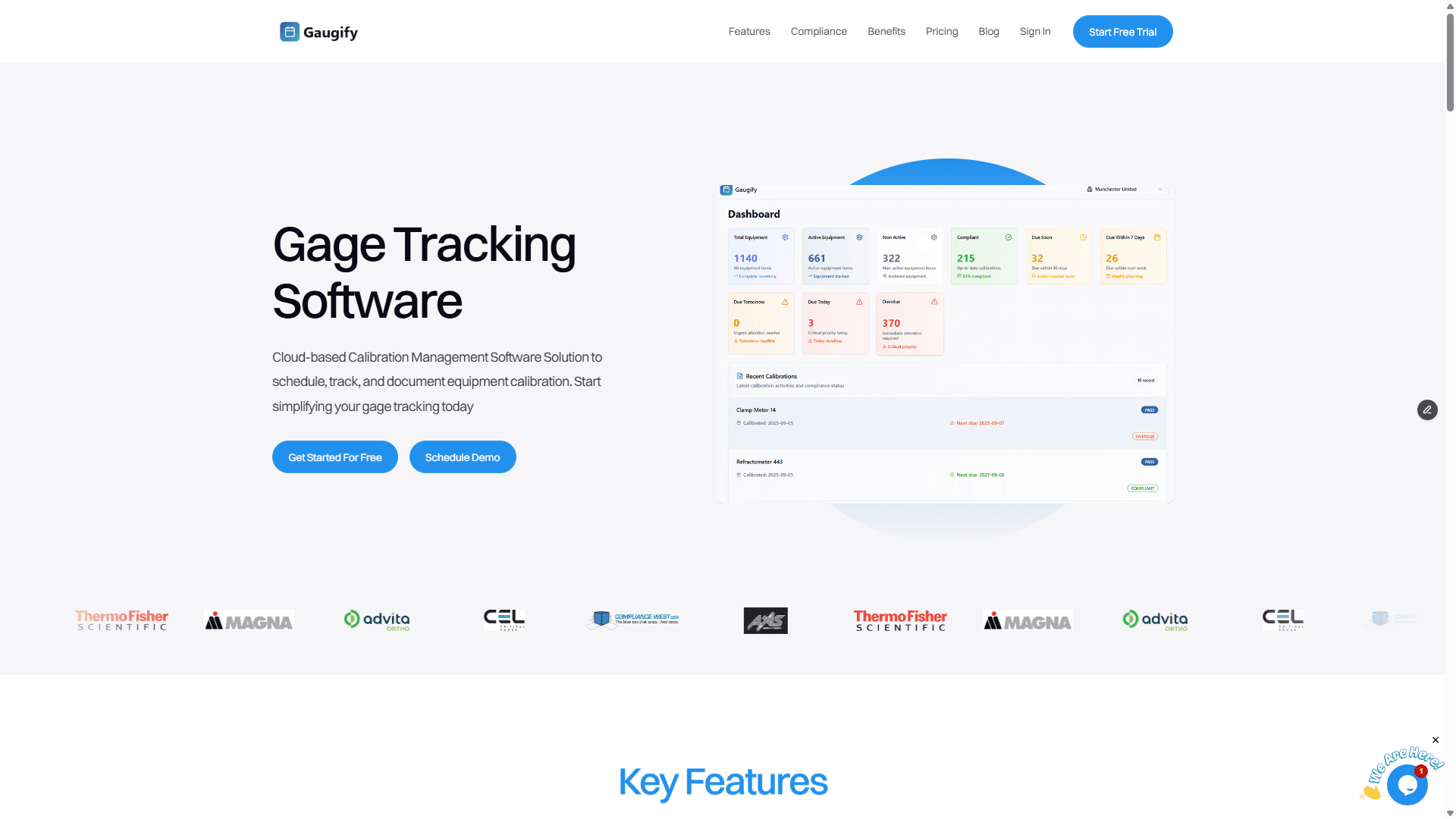
Gaugify eliminates the constant worry about missed calibration dates that plague busy welding shops. The system automatically tracks due dates for every piece of equipment, sends email alerts before calibrations expire, and provides dashboard visibility into upcoming requirements.
For welding shops managing equipment across multiple shifts and locations, this automation prevents the common scenario where a critical pyrometer expires mid-job, forcing production delays while emergency calibration services are arranged. The system can be configured to provide warnings 30, 15, and 5 days before expiration, giving shops flexibility in scheduling calibration services around production demands.
Custom calibration intervals based on equipment criticality and usage patterns ensure that your preheat monitoring equipment gets more frequent attention than less critical measuring tools. A bridge cam gauge used for root pass fit-up on critical structural joints might need quarterly calibration, while a standard steel rule used for general measurements might only require annual verification.
Digital Certificate Management and Audit Trails
Paper calibration certificates get lost, damaged, or misfiled at the worst possible times—usually right before an important audit or customer inspection. Gaugify's digital certificate management ensures that all calibration documentation is instantly accessible from any device with internet connectivity.
The system maintains complete audit trails showing who accessed calibration records, when changes were made, and what modifications occurred. When an auditor asks to see the calibration history for a specific torque wrench, you can pull up five years of records in seconds, complete with as-found and as-left readings, environmental conditions, and uncertainty calculations.
Integration capabilities allow you to connect calibration data with production records, making it easy to identify which welds were completed with specific equipment during any time period. This becomes crucial for out-of-tolerance investigations and customer notifications when calibration issues are discovered.
Measurement Uncertainty Calculations and Compliance Tracking
AWS and ASME standards don't just require calibration—they require appropriate measurement uncertainty for the application. Gaugify automatically calculates and tracks measurement uncertainty for each calibrated instrument, comparing it against the requirements of your specific welding codes and procedures.
The system flags when measurement uncertainty approaches limits that could impact procedure compliance. If your welding procedure specifies preheat temperature control to ±25°F, but your pyrometer's calibration uncertainty is ±15°F, you need to account for this in your process controls. Gaugify makes these relationships visible and manageable.
Multi-Location and Mobile Access
Welding shops often have equipment spread across multiple bays, outdoor work areas, or even separate facilities. Gaugify's cloud-based architecture provides real-time access to calibration information regardless of location, enabling supervisors to verify equipment status from anywhere on the job site.
Mobile apps allow welders and inspectors to check equipment calibration status directly from the shop floor using smartphones or tablets. QR code integration enables instant access to calibration certificates and due date information by simply scanning equipment labels.
Ready to eliminate calibration management headaches and ensure your welding operation stays compliant? Start your free trial today and see how Gaugify transforms your calibration program from a compliance burden into a competitive advantage.
Cost-Effective Calibration Management for Welding Operations
Budget constraints affect every welding shop, from small fabrication businesses to large structural steel operations. Traditional calibration management approaches often involve significant upfront investments in software licenses, server hardware, and IT support that many shops simply can't justify.
Gaugify's subscription-based pricing model eliminates these barriers by providing enterprise-grade calibration management software welding capabilities without the capital expenditure requirements. Small shops can access the same powerful features used by major fabricators, scaling their usage as business grows.
ROI Through Reduced Administrative Overhead
Consider the hidden costs of manual calibration management: quality managers spending hours creating calibration schedules, administrative staff tracking down missing certificates, production delays while someone searches for calibration records during customer audits, and the risk of regulatory noncompliance when calibrations are missed.
A typical welding shop supervisor spends 2-3 hours per week on calibration-related administrative tasks. At $35/hour loaded cost, that's $5,460 annually in administrative overhead—before considering the costs of missed calibrations, failed audits, or customer complaints about documentation quality.
Gaugify reduces this administrative burden by 80-90%, freeing quality personnel to focus on value-added activities like process improvement and defect prevention rather than paperwork management.
Avoiding Costly Compliance Failures
The cost of calibration management software pales compared to the potential costs of compliance failures. A single nonconformance finding during an ASME audit can result in production shutdowns, expedited calibration costs, customer notifications, and potential rework of affected products.
One structural steel fabricator avoided a $50,000 production delay when Gaugify's automated alerts prevented them from using an expired torque wrench on critical bolted connections. The system's 30-day advance warning allowed them to schedule calibration during a planned maintenance window rather than discovering the problem during a customer inspection.
Implementation and Integration Considerations
Welding shops considering new calibration management systems often worry about implementation complexity and disruption to ongoing operations. Gaugify's cloud-based architecture and intuitive design minimize these concerns while providing maximum operational benefit.
Data Migration and Setup
Most welding shops have some form of existing calibration records, whether in spreadsheets, paper files, or legacy software systems. Gaugify's implementation team assists with data migration, ensuring that historical calibration information transfers accurately without losing critical audit trail information.
The system accommodates the unique equipment types common in welding operations, with pre-configured templates for welding parameter monitors, temperature measurement devices, and specialized welding gauges. Custom equipment types can be easily created for specialized tools or measurement devices specific to particular welding processes or applications.
Compliance-focused features ensure that setup includes all necessary fields and workflows required by AWS, ASME, and other relevant standards from day one of operation.
User Training and Adoption
Successful calibration management software implementation depends on user adoption across all levels of the organization. Gaugify's intuitive interface minimizes training requirements, but comprehensive support ensures that everyone from shop floor technicians to quality managers can effectively use the system.
Role-based access controls allow welding shops to provide appropriate system access to different user types. Welders might only need read-only access to verify equipment calibration status, while quality managers require full administrative capabilities for scheduling calibrations and managing compliance documentation.
Online training resources, video tutorials, and responsive technical support help ensure smooth adoption without disrupting daily operations. Most users become proficient with basic system functions within their first week of use.
Future-Proofing Your Calibration Program
The welding industry continues to evolve with new materials, processes, and quality requirements. Smart welding shops invest in calibration management solutions that can adapt to changing needs rather than requiring complete system replacements every few years.
Scalability and Growth Management
Gaugify scales seamlessly from small job shops managing dozens of instruments to large fabrication operations tracking thousands of devices across multiple facilities. The cloud-based architecture eliminates concerns about server capacity or software licensing limitations as businesses grow.
Multi-location capabilities support expansion into new markets or acquisition of additional facilities without requiring separate calibration management systems. Consolidated reporting provides corporate-level visibility while maintaining site-specific operational control.
Technology Integration and Advancement
Modern welding operations increasingly rely on integrated quality management systems that connect calibration data with production records, non-destructive testing results, and customer quality requirements. Gaugify's API capabilities enable integration with ERP systems, quality management software, and specialized welding documentation platforms.
Emerging technologies like IoT sensors and automated calibration systems can be accommodated within Gaugify's flexible architecture, protecting your investment in calibration management infrastructure as technology continues to advance.
Get Started with Professional Calibration Management
Effective calibration management isn't optional for serious welding operations—it's a fundamental requirement for quality, compliance, and customer satisfaction. The question isn't whether you need professional calibration management software, but whether you'll choose a solution that understands welding industry requirements and delivers the reliability your operation demands.
Gaugify eliminates the complexity, reduces the administrative overhead, and provides the audit-ready documentation that welding shops need to focus on what they do best: producing high-quality welded products that meet or exceed customer expectations.
Don't let calibration management continue to drain resources from productive activities. Schedule a personalized demo to see how Gaugify transforms calibration from a compliance burden into a competitive advantage, or dive right in with our comprehensive free trial that includes full access to all features with sample data.
Your welding operation deserves calibration management software built for the demands of modern fabrication. Experience the difference that purpose-built, cloud-based calibration management makes for welding shops who refuse to compromise on quality or compliance.
Calibration Management Software for Welding Shops
Welding shops face unique calibration challenges that can make or break their quality management systems. From maintaining precise temperature control on preheating equipment to ensuring welding parameter monitoring devices stay within specification, calibration management software welding operations rely on demands specialized solutions that understand the critical nature of joint integrity and structural safety.
Traditional paper-based calibration tracking simply doesn't cut it when you're managing hundreds of instruments across multiple welding bays, dealing with AWS D1.1 compliance requirements, or preparing for that dreaded CWI audit. The stakes are too high, and the complexity too great, to rely on spreadsheets and filing cabinets.
Critical Equipment Requiring Calibration in Welding Operations
Welding shops depend on an extensive array of precision instruments, each requiring regular calibration to maintain weld quality and structural integrity. Understanding what needs calibration—and when—is the foundation of effective calibration management software welding programs.
Welding Parameter Monitoring Equipment
Voltage and amperage meters on your welding machines aren't just nice-to-have displays—they're critical for maintaining proper penetration and avoiding defects. A GTAW setup running at what the display shows as 150 amps might actually be delivering 165 amps if the meter hasn't been calibrated in two years. That 10% error could mean the difference between acceptable root penetration and a failed radiographic test.
Wire feed speed controllers on GMAW equipment require calibration to ensure consistent deposition rates. When your procedure calls for 250 inches per minute and your equipment is actually delivering 275 IPM, you're looking at potential lack of fusion or excessive reinforcement issues that will show up during visual inspection.
Temperature Measurement and Control Devices
Preheat and interpass temperature control is non-negotiable for many welding applications. Infrared thermometers, contact pyrometers, and temperature indicating crayons all require regular verification. A pyrometer reading 350°F when the actual temperature is 315°F could result in hydrogen-induced cracking on high-strength steel applications—a failure that might not manifest until the structure is in service.
Stress relief furnaces and post-weld heat treatment equipment demand even tighter control. When ASME Section VIII Division 1 requires holding 1150°F ±25°F for stress relief, your temperature controllers and recording devices need calibration uncertainties that won't eat into your process tolerance.
Dimensional and Measurement Tools
Welding shops use specialized gauges that standard calibration programs often overlook. Fillet weld gauges, bridge cam gauges, and pit gauges require calibration against certified reference standards. A hi-lo gauge that's supposed to measure ±1/16" root misalignment but has drifted to ±3/32" accuracy could lead to accepting welds that will fail under fatigue loading.
Ultrasonic thickness gauges for measuring base material and weld cap thickness need calibration on multiple test blocks. A gauge calibrated only on steel might read incorrectly on aluminum or stainless applications, leading to undermining or excessive reinforcement issues.
Quality Standards and Compliance Requirements for Welding Calibration
Welding operations don't exist in a regulatory vacuum. Multiple overlapping standards create a complex web of calibration management software welding compliance requirements that must be carefully managed and documented.
AWS Standards and Requirements
AWS D1.1 Structural Welding Code requires that "measuring and test equipment shall be calibrated at specified intervals." This isn't a suggestion—it's a mandatory requirement that auditors will verify during qualification reviews. The standard specifically calls for calibration intervals to be established based on stability, purpose, and degree of usage.
AWS D1.5 Bridge Welding Code takes calibration requirements even further, requiring that temperature measuring devices used for preheat verification be calibrated to an accuracy of ±3% of reading or ±5°F, whichever is greater. This level of specificity demands calibration management systems that can track and verify these exact tolerance requirements.
ASME and Pressure Vessel Requirements
ASME Section IX welding procedure qualification requires that all measuring equipment used during qualification testing be properly calibrated. This includes not just the obvious items like tensile testing machines and hardness testers, but also the thermocouples used to monitor cooling rates and the rulers used to measure test specimen dimensions.
Section VIII Division 1 fabrication requirements extend calibration demands to production welding. Every piece of equipment used to verify compliance with the welding procedure specification must have current calibration. Miss a calibration on your interpass temperature recorder, and your ASME Authorized Inspector might shut down production until compliance is restored.
ISO 3834 Welding Quality Requirements
ISO 3834 welding quality management systems require comprehensive calibration programs as part of quality planning. The standard specifically addresses measurement uncertainty and requires that calibration intervals be based on equipment stability and criticality of application. ISO 17025 calibration software capabilities become essential for shops pursuing this certification.
Common Audit Scenarios and What Auditors Examine
When auditors walk into your welding shop, they're looking for specific evidence that your calibration management software welding program actually works in practice, not just on paper. Understanding their focus areas helps you prepare for these critical reviews.
Equipment Identification and Traceability
The first thing auditors check is whether every calibrated instrument has clear identification and current calibration status. They'll randomly select equipment from your production floor—not your calibration room—and verify that calibration labels are present, legible, and within date.
A common audit finding occurs when shops have good calibration records but poor equipment identification. Finding a micrometer with a faded calibration sticker that can't be matched to calibration records is an immediate nonconformance. Auditors expect to trace any instrument from the shop floor back to its calibration certificate and forward to its next due date without confusion.
Calibration Certificate Review
Auditors scrutinize calibration certificates for completeness and technical adequacy. They're looking for proper measurement uncertainty statements, environmental conditions during calibration, and traceability to national standards. A certificate that simply states "PASS" without showing actual measurement data will trigger detailed questioning about your calibration provider's competence.
Environmental conditions become particularly important for welding shop equipment. A torque wrench calibrated in a climate-controlled lab might perform differently in a shop environment with temperature swings and high humidity. Auditors expect you to understand these limitations and account for them in your measurement uncertainty budgets.
Out-of-Tolerance Investigation
When calibration reveals that equipment was out of tolerance, auditors want to see evidence of impact assessment. If your preheat pyrometer was reading 50°F low during the calibration interval, what welds were affected? How did you evaluate the impact on product quality? What corrective actions prevented recurrence?
Many welding shops fail this audit area because they lack the documentation systems needed to quickly identify affected work. Without automated calibration management, connecting equipment serial numbers to specific jobs and weld procedures becomes a manual nightmare that consumes days of audit preparation time.
How Gaugify Solves Welding Shop Calibration Challenges
Modern welding operations need calibration management systems that understand their unique requirements and operational constraints. Gaugify's cloud-based platform addresses the specific pain points that paper-based systems and generic software solutions can't handle effectively.
Automated Scheduling and Due Date Management
Gaugify eliminates the constant worry about missed calibration dates that plague busy welding shops. The system automatically tracks due dates for every piece of equipment, sends email alerts before calibrations expire, and provides dashboard visibility into upcoming requirements.
For welding shops managing equipment across multiple shifts and locations, this automation prevents the common scenario where a critical pyrometer expires mid-job, forcing production delays while emergency calibration services are arranged. The system can be configured to provide warnings 30, 15, and 5 days before expiration, giving shops flexibility in scheduling calibration services around production demands.
Custom calibration intervals based on equipment criticality and usage patterns ensure that your preheat monitoring equipment gets more frequent attention than less critical measuring tools. A bridge cam gauge used for root pass fit-up on critical structural joints might need quarterly calibration, while a standard steel rule used for general measurements might only require annual verification.
Digital Certificate Management and Audit Trails
Paper calibration certificates get lost, damaged, or misfiled at the worst possible times—usually right before an important audit or customer inspection. Gaugify's digital certificate management ensures that all calibration documentation is instantly accessible from any device with internet connectivity.
The system maintains complete audit trails showing who accessed calibration records, when changes were made, and what modifications occurred. When an auditor asks to see the calibration history for a specific torque wrench, you can pull up five years of records in seconds, complete with as-found and as-left readings, environmental conditions, and uncertainty calculations.
Integration capabilities allow you to connect calibration data with production records, making it easy to identify which welds were completed with specific equipment during any time period. This becomes crucial for out-of-tolerance investigations and customer notifications when calibration issues are discovered.
Measurement Uncertainty Calculations and Compliance Tracking
AWS and ASME standards don't just require calibration—they require appropriate measurement uncertainty for the application. Gaugify automatically calculates and tracks measurement uncertainty for each calibrated instrument, comparing it against the requirements of your specific welding codes and procedures.
The system flags when measurement uncertainty approaches limits that could impact procedure compliance. If your welding procedure specifies preheat temperature control to ±25°F, but your pyrometer's calibration uncertainty is ±15°F, you need to account for this in your process controls. Gaugify makes these relationships visible and manageable.
Multi-Location and Mobile Access
Welding shops often have equipment spread across multiple bays, outdoor work areas, or even separate facilities. Gaugify's cloud-based architecture provides real-time access to calibration information regardless of location, enabling supervisors to verify equipment status from anywhere on the job site.
Mobile apps allow welders and inspectors to check equipment calibration status directly from the shop floor using smartphones or tablets. QR code integration enables instant access to calibration certificates and due date information by simply scanning equipment labels.
Ready to eliminate calibration management headaches and ensure your welding operation stays compliant? Start your free trial today and see how Gaugify transforms your calibration program from a compliance burden into a competitive advantage.
Cost-Effective Calibration Management for Welding Operations
Budget constraints affect every welding shop, from small fabrication businesses to large structural steel operations. Traditional calibration management approaches often involve significant upfront investments in software licenses, server hardware, and IT support that many shops simply can't justify.
Gaugify's subscription-based pricing model eliminates these barriers by providing enterprise-grade calibration management software welding capabilities without the capital expenditure requirements. Small shops can access the same powerful features used by major fabricators, scaling their usage as business grows.
ROI Through Reduced Administrative Overhead
Consider the hidden costs of manual calibration management: quality managers spending hours creating calibration schedules, administrative staff tracking down missing certificates, production delays while someone searches for calibration records during customer audits, and the risk of regulatory noncompliance when calibrations are missed.
A typical welding shop supervisor spends 2-3 hours per week on calibration-related administrative tasks. At $35/hour loaded cost, that's $5,460 annually in administrative overhead—before considering the costs of missed calibrations, failed audits, or customer complaints about documentation quality.
Gaugify reduces this administrative burden by 80-90%, freeing quality personnel to focus on value-added activities like process improvement and defect prevention rather than paperwork management.
Avoiding Costly Compliance Failures
The cost of calibration management software pales compared to the potential costs of compliance failures. A single nonconformance finding during an ASME audit can result in production shutdowns, expedited calibration costs, customer notifications, and potential rework of affected products.
One structural steel fabricator avoided a $50,000 production delay when Gaugify's automated alerts prevented them from using an expired torque wrench on critical bolted connections. The system's 30-day advance warning allowed them to schedule calibration during a planned maintenance window rather than discovering the problem during a customer inspection.
Implementation and Integration Considerations
Welding shops considering new calibration management systems often worry about implementation complexity and disruption to ongoing operations. Gaugify's cloud-based architecture and intuitive design minimize these concerns while providing maximum operational benefit.
Data Migration and Setup
Most welding shops have some form of existing calibration records, whether in spreadsheets, paper files, or legacy software systems. Gaugify's implementation team assists with data migration, ensuring that historical calibration information transfers accurately without losing critical audit trail information.
The system accommodates the unique equipment types common in welding operations, with pre-configured templates for welding parameter monitors, temperature measurement devices, and specialized welding gauges. Custom equipment types can be easily created for specialized tools or measurement devices specific to particular welding processes or applications.
Compliance-focused features ensure that setup includes all necessary fields and workflows required by AWS, ASME, and other relevant standards from day one of operation.
User Training and Adoption
Successful calibration management software implementation depends on user adoption across all levels of the organization. Gaugify's intuitive interface minimizes training requirements, but comprehensive support ensures that everyone from shop floor technicians to quality managers can effectively use the system.
Role-based access controls allow welding shops to provide appropriate system access to different user types. Welders might only need read-only access to verify equipment calibration status, while quality managers require full administrative capabilities for scheduling calibrations and managing compliance documentation.
Online training resources, video tutorials, and responsive technical support help ensure smooth adoption without disrupting daily operations. Most users become proficient with basic system functions within their first week of use.
Future-Proofing Your Calibration Program
The welding industry continues to evolve with new materials, processes, and quality requirements. Smart welding shops invest in calibration management solutions that can adapt to changing needs rather than requiring complete system replacements every few years.
Scalability and Growth Management
Gaugify scales seamlessly from small job shops managing dozens of instruments to large fabrication operations tracking thousands of devices across multiple facilities. The cloud-based architecture eliminates concerns about server capacity or software licensing limitations as businesses grow.
Multi-location capabilities support expansion into new markets or acquisition of additional facilities without requiring separate calibration management systems. Consolidated reporting provides corporate-level visibility while maintaining site-specific operational control.
Technology Integration and Advancement
Modern welding operations increasingly rely on integrated quality management systems that connect calibration data with production records, non-destructive testing results, and customer quality requirements. Gaugify's API capabilities enable integration with ERP systems, quality management software, and specialized welding documentation platforms.
Emerging technologies like IoT sensors and automated calibration systems can be accommodated within Gaugify's flexible architecture, protecting your investment in calibration management infrastructure as technology continues to advance.
Get Started with Professional Calibration Management
Effective calibration management isn't optional for serious welding operations—it's a fundamental requirement for quality, compliance, and customer satisfaction. The question isn't whether you need professional calibration management software, but whether you'll choose a solution that understands welding industry requirements and delivers the reliability your operation demands.
Gaugify eliminates the complexity, reduces the administrative overhead, and provides the audit-ready documentation that welding shops need to focus on what they do best: producing high-quality welded products that meet or exceed customer expectations.
Don't let calibration management continue to drain resources from productive activities. Schedule a personalized demo to see how Gaugify transforms calibration from a compliance burden into a competitive advantage, or dive right in with our comprehensive free trial that includes full access to all features with sample data.
Your welding operation deserves calibration management software built for the demands of modern fabrication. Experience the difference that purpose-built, cloud-based calibration management makes for welding shops who refuse to compromise on quality or compliance.