
Calibration Reporting and Analytics: Real-Time Insights
Calibration Reporting and Analytics: Real-Time Insights
David Bentley
Quality Assurance Engineer
8 min read
Calibration Reporting and Analytics: Real-Time Insights
Modern quality managers face an overwhelming challenge: transforming calibration data into actionable insights that drive operational excellence. While traditional calibration management focuses on compliance checkboxes, today's competitive manufacturing environment demands sophisticated calibration reporting software that delivers real-time analytics, predictive maintenance capabilities, and comprehensive visibility across your entire measurement ecosystem.
The difference between reactive and proactive calibration management often comes down to one critical factor: the ability to analyze calibration trends, identify potential failures before they occur, and make data-driven decisions that optimize both quality outcomes and operational costs. This is where advanced calibration reporting and analytics transform from a nice-to-have feature into a competitive necessity.
The Hidden Cost of Calibration Data Blindness
Without robust calibration reporting software, quality teams operate in a reactive mode that creates cascading operational problems. Consider a typical scenario: Your Mitutoyo digital calipers start drifting beyond their ±0.0005" tolerance specification, but without trend analysis, this degradation goes unnoticed until the next scheduled calibration interval—potentially six months away.
During those months, your team unknowingly accepts parts that should be rejected, leading to customer complaints, rework costs, and damaged supplier relationships. When the calibration finally reveals the drift, you face a painful decision: recall potentially thousands of parts or risk a customer audit finding.
This scenario plays out daily in manufacturing facilities worldwide because traditional calibration management treats each instrument as an isolated entity rather than part of an interconnected measurement system. Manual tracking in spreadsheets or basic calibration software provides historical records but lacks the analytical depth needed for proactive management.
The Ripple Effect of Poor Calibration Visibility
The consequences extend far beyond individual instrument failures. Without comprehensive reporting capabilities, quality managers struggle with:
Audit preparation nightmares: Scrambling to compile calibration reports across multiple systems and formats when ISO 9001 or AS9100 auditors arrive
Budget planning blindness: Unable to predict calibration costs or optimize intervals based on actual performance data
Vendor performance gaps: No visibility into which calibration service providers consistently deliver quality results versus those causing repeat failures
Resource allocation inefficiency: Technicians waste time on manual report generation instead of value-added calibration activities
How Calibration Reporting Software Transforms Operations
Modern calibration reporting software transforms raw calibration data into strategic intelligence through automated analytics, customizable dashboards, and predictive insights. Rather than simply storing calibration certificates, advanced systems analyze measurement patterns, identify trends, and provide actionable recommendations.
The transformation begins with data integration. Instead of maintaining separate databases for different instrument types—pressure gages in one system, torque wrenches in another, environmental chambers in a third—unified calibration reporting consolidates all measurement data into a single analytical engine.
Real-Time Dashboard Intelligence
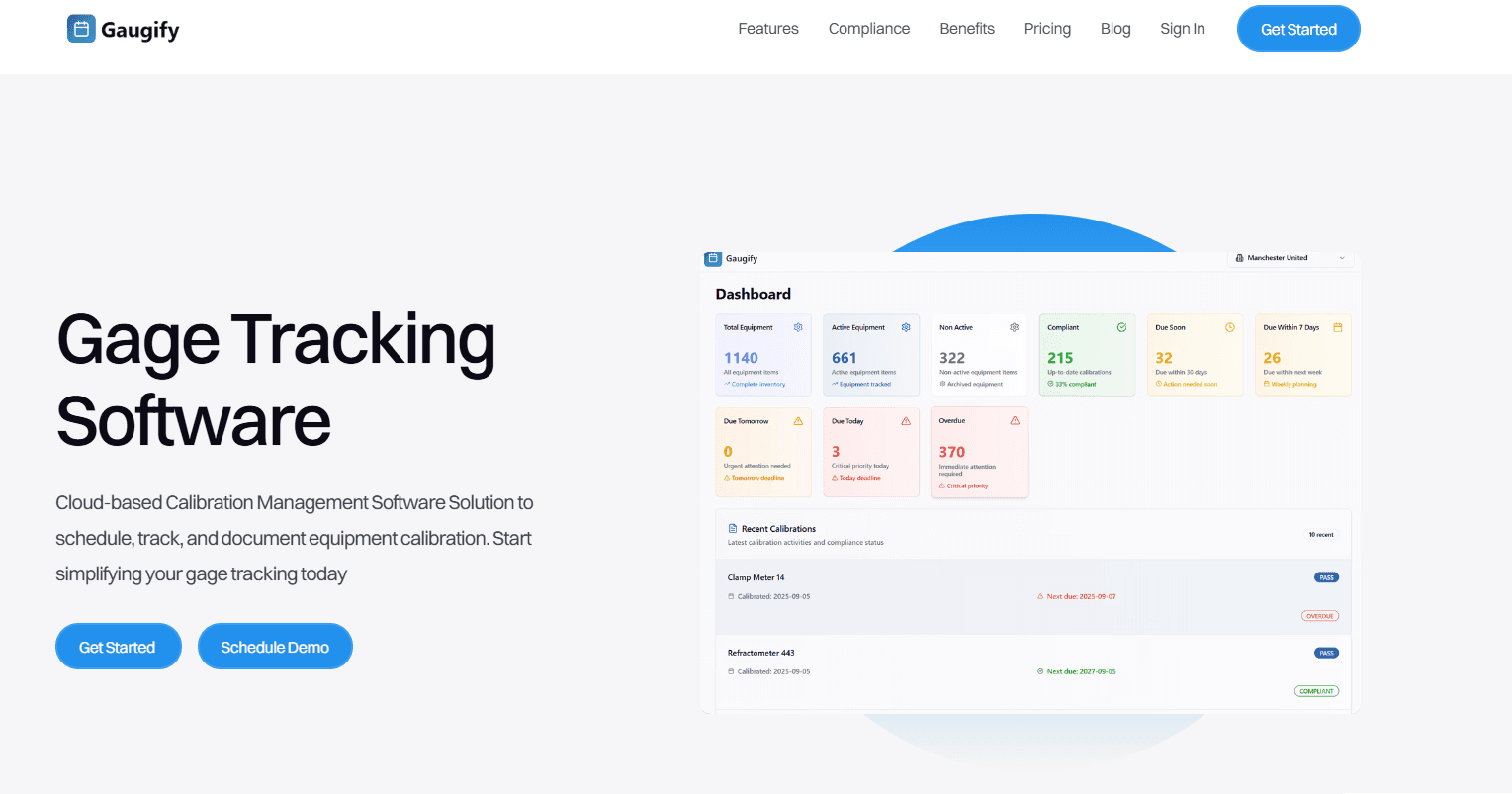
Imagine starting your day with a comprehensive view of your calibration ecosystem: instruments approaching due dates, trending analysis for critical gages, compliance status across multiple standards, and cost analysis comparing internal versus external calibration services. This level of visibility enables proactive decision-making rather than reactive problem-solving.
For example, dashboard analytics might reveal that your Fluke 87V digital multimeters consistently pass calibration with minimal drift, suggesting you could safely extend their calibration interval from 12 to 15 months. Conversely, analysis might show that certain environmental testing equipment requires more frequent calibration during high-humidity seasons, enabling you to adjust intervals dynamically.
Gaugify's Advanced Reporting and Analytics Experience
When you log into Gaugify's calibration management platform, the reporting and analytics capabilities immediately differentiate it from traditional calibration software. The system doesn't just track calibration dates—it transforms calibration data into operational intelligence.
Automated Report Generation
The platform automatically generates comprehensive calibration reports tailored to your specific compliance requirements. Whether you need detailed traceability documentation for FDA validation, measurement uncertainty analysis for ISO 17025 compliance, or summary reports for management review, Gaugify's reporting engine adapts to your needs.
For instance, when preparing for an AS9100 audit, the system automatically compiles calibration records for all gages used in aerospace production, includes measurement uncertainty calculations, and verifies traceability to national standards—all with a single click. The generated reports include statistical analysis showing calibration trends, out-of-tolerance incidents, and corrective actions taken.
Predictive Analytics and Trend Analysis
Gaugify's analytics engine continuously analyzes calibration history to identify patterns and predict future performance. The system tracks multiple variables: measurement drift over time, environmental factors affecting calibration stability, vendor performance metrics, and correlation between usage intensity and calibration intervals.
Consider a real-world example: Your Starrett micrometer set shows consistent drift patterns that correlate with heavy usage during quarterly production pushes. Gaugify's analytics identify this pattern and recommend adjusting calibration intervals or implementing interim checks during high-usage periods. This proactive approach prevents quality escapes while optimizing calibration costs.
Ready to experience these advanced analytics capabilities firsthand? Start your free trial of Gaugify and see how real-time calibration insights can transform your quality management approach.
Customizable Performance Metrics
The platform allows quality managers to define custom performance indicators that align with organizational goals. Whether tracking calibration cost per unit produced, measuring technician productivity, or analyzing the relationship between calibration frequency and quality escapes, Gaugify's flexible reporting framework accommodates diverse analytical needs.
Advanced users can create sophisticated analyses, such as correlating calibration results with production quality metrics. For example, you might discover that slight drift in your coordinate measuring machine (CMM) correlates with increased dimensional rejections in final inspection, enabling you to tighten calibration tolerances or increase calibration frequency for critical applications.
Quantifying the ROI of Advanced Calibration Reporting
The financial benefits of sophisticated calibration reporting software extend across multiple operational areas, creating measurable ROI that justifies platform investment.
Reduced Labor Costs
Manual report generation consumes significant technician time—often 2-4 hours per audit or management review. Automated reporting eliminates this burden, allowing skilled technicians to focus on calibration activities rather than administrative tasks. For a facility with 500 instruments and quarterly reporting requirements, this represents approximately 160 hours of annual labor savings.
Optimized Calibration Intervals
Data-driven interval optimization typically reduces calibration frequency by 15-25% for stable instruments while increasing frequency for problematic gages. This optimization maintains quality assurance while reducing calibration costs. A facility spending $50,000 annually on external calibration services might realize $7,500-12,500 in cost savings through intelligent interval adjustment.
Prevented Quality Escapes
Early identification of measurement system drift prevents costly quality escapes. Consider that a single customer complaint investigation averages $5,000-15,000 in internal costs, while product recalls can reach hundreds of thousands of dollars. Predictive analytics that identify potential gage failures before they impact production provide substantial risk mitigation value.
Audit Efficiency Improvements
Streamlined audit preparation reduces both internal preparation time and auditor time on-site. Comprehensive, readily available calibration reports demonstrate systematic control and often result in shortened audit duration and positive findings.
Supporting Multi-Standard Compliance Through Integrated Reporting
Modern manufacturing organizations must comply with multiple quality standards simultaneously—ISO 9001 for quality management, ISO 17025 for testing laboratories, FDA 21 CFR Part 820 for medical devices, or AS9100 for aerospace applications. Each standard has specific calibration documentation requirements, and manual compliance management becomes increasingly complex as organizations grow.
ISO 9001 and AS9100 Reporting Requirements
Calibration reporting software automatically generates documentation that satisfies ISO 9001's measurement traceability requirements (clause 7.1.5) and AS9100's enhanced calibration controls. The system maintains complete calibration records, including measurement uncertainty, environmental conditions, and traceability chains to national standards.
For aerospace manufacturers, AS9100 requires additional calibration controls, including verification of calibration intervals, documentation of measurement uncertainty, and evidence of corrective action when instruments are found out-of-tolerance. Gaugify's reporting engine automatically includes these elements in generated reports, ensuring audit readiness without manual compilation.
FDA and Medical Device Compliance
Medical device manufacturers face stringent FDA requirements under 21 CFR Part 820, which mandates comprehensive calibration documentation and statistical analysis of measurement systems. The software generates validation reports that include statistical analysis, measurement system capability studies, and documentation of calibration procedures—all essential elements for FDA compliance.
Gaugify's compliance features automatically track regulatory requirements and ensure that calibration intervals, procedures, and documentation meet FDA standards. The system alerts quality managers when calibration approaches due dates and maintains complete audit trails for regulatory inspections.
Laboratory Accreditation Support
Testing laboratories pursuing ISO 17025 accreditation require sophisticated measurement uncertainty analysis and comprehensive calibration documentation. The platform calculates measurement uncertainty propagation, maintains calibration coefficient records, and generates detailed uncertainty budgets required for accreditation.
The system also supports proficiency testing programs and inter-laboratory comparisons, automatically tracking performance against reference standards and identifying when corrective action is required.
Competitive Analysis: Why Most Calibration Software Falls Short
Many calibration management systems offer basic reporting functionality—simple lists of due dates, calibration certificates, and historical records. However, these systems lack the analytical depth needed for modern quality management. The difference between basic calibration tracking and advanced calibration reporting software lies in the intelligence layer that transforms data into actionable insights.
Spreadsheet-Based Management Limitations
Organizations still relying on Excel spreadsheets for calibration management face severe analytical limitations. While spreadsheets can store calibration data, they cannot automatically identify trends, predict failures, or generate comprehensive audit reports. Manual analysis is time-consuming, error-prone, and scales poorly as instrument populations grow.
Additionally, spreadsheet-based systems lack the security, audit trails, and access controls required for regulatory compliance. Multiple users editing shared files creates version control problems and increases the risk of data corruption or accidental deletion.
Legacy Calibration Software Shortcomings
Many established calibration software providers offer systems designed 10-15 years ago when reporting meant generating basic certificate lists and due date reports. These systems typically lack:
Real-time analytics: Reports must be manually generated and refreshed, providing outdated information
Predictive capabilities: No trend analysis or failure prediction based on historical performance
Integration flexibility: Limited ability to incorporate data from other quality systems or manufacturing databases
Mobile accessibility: Reports and analytics only available through desktop applications
Customization options: Rigid report formats that don't adapt to specific organizational needs
The Cloud-Based Advantage
Modern cloud-based calibration reporting software like Gaugify provides several advantages over traditional on-premise systems. Real-time data synchronization ensures that all users access current information, while automatic software updates deliver new features and improvements without IT involvement.
Cloud deployment also enables advanced analytics capabilities that would be cost-prohibitive for individual organizations to develop and maintain. Machine learning algorithms can analyze patterns across multiple customer datasets (while maintaining data privacy) to provide more sophisticated predictive insights.
Implementation Best Practices for Maximum Analytics Value
Successfully implementing advanced calibration reporting requires more than simply installing software—it demands a systematic approach to data management and analytical thinking.
Data Quality Foundation
Effective analytics depend on complete, accurate calibration data. This means establishing consistent procedures for recording calibration results, environmental conditions, and instrument usage patterns. Incomplete or inconsistent data leads to unreliable analytics and poor decision-making.
Organizations should implement data validation rules that ensure critical fields are completed and measurements fall within reasonable ranges. For example, if a precision balance typically shows drift of ±0.1mg between calibrations, a recorded drift of ±10mg should trigger a data review process.
Defining Key Performance Indicators
Before implementing advanced reporting, organizations should identify the key performance indicators (KPIs) that align with their quality objectives. Common calibration KPIs include:
Pass rate percentage: The percentage of instruments that pass calibration on the first attempt
Average drift rate: How much instruments typically drift between calibration intervals
Cost per calibration: Total calibration costs divided by number of instruments calibrated
Calibration cycle time: Average time from initiation to completion of calibration activities
Vendor performance metrics: Comparative analysis of different calibration service providers
Future-Proofing Your Calibration Management Strategy
The calibration management landscape continues evolving as Industry 4.0 technologies mature and regulatory requirements become more sophisticated. Organizations investing in advanced calibration reporting software today position themselves to leverage future capabilities like IoT sensor integration, artificial intelligence-driven predictive maintenance, and blockchain-based traceability verification.
Smart calibration management systems will increasingly integrate with manufacturing execution systems (MES) and enterprise resource planning (ERP) platforms, providing holistic visibility into the relationship between measurement system performance and production outcomes. This integration enables sophisticated analyses, such as correlating calibration intervals with product quality metrics or optimizing calibration scheduling based on production schedules.
Transform Your Calibration Management with Advanced Analytics
The gap between organizations using basic calibration tracking and those leveraging advanced calibration reporting software continues widening. Companies that embrace sophisticated analytics gain competitive advantages through improved quality outcomes, reduced operational costs, and enhanced regulatory compliance.
Gaugify's comprehensive reporting and analytics platform transforms calibration data into strategic intelligence, enabling proactive management decisions that optimize both quality and cost performance. From predictive failure analysis to automated compliance reporting, the platform delivers the analytical depth required for modern manufacturing excellence.
Don't let calibration data blindness limit your organization's potential. Experience the power of advanced calibration reporting and analytics through Gaugify's free trial. Discover how real-time insights, predictive analytics, and automated reporting can transform your calibration management approach and deliver measurable operational improvements.
Ready to see these capabilities in action? Schedule a personalized demo and learn how Gaugify's reporting and analytics features can address your specific calibration management challenges. Our team will walk you through real-world scenarios and demonstrate how advanced calibration reporting software drives operational excellence in organizations like yours.
Calibration Reporting and Analytics: Real-Time Insights
Modern quality managers face an overwhelming challenge: transforming calibration data into actionable insights that drive operational excellence. While traditional calibration management focuses on compliance checkboxes, today's competitive manufacturing environment demands sophisticated calibration reporting software that delivers real-time analytics, predictive maintenance capabilities, and comprehensive visibility across your entire measurement ecosystem.
The difference between reactive and proactive calibration management often comes down to one critical factor: the ability to analyze calibration trends, identify potential failures before they occur, and make data-driven decisions that optimize both quality outcomes and operational costs. This is where advanced calibration reporting and analytics transform from a nice-to-have feature into a competitive necessity.
The Hidden Cost of Calibration Data Blindness
Without robust calibration reporting software, quality teams operate in a reactive mode that creates cascading operational problems. Consider a typical scenario: Your Mitutoyo digital calipers start drifting beyond their ±0.0005" tolerance specification, but without trend analysis, this degradation goes unnoticed until the next scheduled calibration interval—potentially six months away.
During those months, your team unknowingly accepts parts that should be rejected, leading to customer complaints, rework costs, and damaged supplier relationships. When the calibration finally reveals the drift, you face a painful decision: recall potentially thousands of parts or risk a customer audit finding.
This scenario plays out daily in manufacturing facilities worldwide because traditional calibration management treats each instrument as an isolated entity rather than part of an interconnected measurement system. Manual tracking in spreadsheets or basic calibration software provides historical records but lacks the analytical depth needed for proactive management.
The Ripple Effect of Poor Calibration Visibility
The consequences extend far beyond individual instrument failures. Without comprehensive reporting capabilities, quality managers struggle with:
Audit preparation nightmares: Scrambling to compile calibration reports across multiple systems and formats when ISO 9001 or AS9100 auditors arrive
Budget planning blindness: Unable to predict calibration costs or optimize intervals based on actual performance data
Vendor performance gaps: No visibility into which calibration service providers consistently deliver quality results versus those causing repeat failures
Resource allocation inefficiency: Technicians waste time on manual report generation instead of value-added calibration activities
How Calibration Reporting Software Transforms Operations
Modern calibration reporting software transforms raw calibration data into strategic intelligence through automated analytics, customizable dashboards, and predictive insights. Rather than simply storing calibration certificates, advanced systems analyze measurement patterns, identify trends, and provide actionable recommendations.
The transformation begins with data integration. Instead of maintaining separate databases for different instrument types—pressure gages in one system, torque wrenches in another, environmental chambers in a third—unified calibration reporting consolidates all measurement data into a single analytical engine.
Real-Time Dashboard Intelligence
Imagine starting your day with a comprehensive view of your calibration ecosystem: instruments approaching due dates, trending analysis for critical gages, compliance status across multiple standards, and cost analysis comparing internal versus external calibration services. This level of visibility enables proactive decision-making rather than reactive problem-solving.
For example, dashboard analytics might reveal that your Fluke 87V digital multimeters consistently pass calibration with minimal drift, suggesting you could safely extend their calibration interval from 12 to 15 months. Conversely, analysis might show that certain environmental testing equipment requires more frequent calibration during high-humidity seasons, enabling you to adjust intervals dynamically.
Gaugify's Advanced Reporting and Analytics Experience
When you log into Gaugify's calibration management platform, the reporting and analytics capabilities immediately differentiate it from traditional calibration software. The system doesn't just track calibration dates—it transforms calibration data into operational intelligence.
Automated Report Generation
The platform automatically generates comprehensive calibration reports tailored to your specific compliance requirements. Whether you need detailed traceability documentation for FDA validation, measurement uncertainty analysis for ISO 17025 compliance, or summary reports for management review, Gaugify's reporting engine adapts to your needs.
For instance, when preparing for an AS9100 audit, the system automatically compiles calibration records for all gages used in aerospace production, includes measurement uncertainty calculations, and verifies traceability to national standards—all with a single click. The generated reports include statistical analysis showing calibration trends, out-of-tolerance incidents, and corrective actions taken.
Predictive Analytics and Trend Analysis
Gaugify's analytics engine continuously analyzes calibration history to identify patterns and predict future performance. The system tracks multiple variables: measurement drift over time, environmental factors affecting calibration stability, vendor performance metrics, and correlation between usage intensity and calibration intervals.
Consider a real-world example: Your Starrett micrometer set shows consistent drift patterns that correlate with heavy usage during quarterly production pushes. Gaugify's analytics identify this pattern and recommend adjusting calibration intervals or implementing interim checks during high-usage periods. This proactive approach prevents quality escapes while optimizing calibration costs.
Ready to experience these advanced analytics capabilities firsthand? Start your free trial of Gaugify and see how real-time calibration insights can transform your quality management approach.
Customizable Performance Metrics
The platform allows quality managers to define custom performance indicators that align with organizational goals. Whether tracking calibration cost per unit produced, measuring technician productivity, or analyzing the relationship between calibration frequency and quality escapes, Gaugify's flexible reporting framework accommodates diverse analytical needs.
Advanced users can create sophisticated analyses, such as correlating calibration results with production quality metrics. For example, you might discover that slight drift in your coordinate measuring machine (CMM) correlates with increased dimensional rejections in final inspection, enabling you to tighten calibration tolerances or increase calibration frequency for critical applications.
Quantifying the ROI of Advanced Calibration Reporting
The financial benefits of sophisticated calibration reporting software extend across multiple operational areas, creating measurable ROI that justifies platform investment.
Reduced Labor Costs
Manual report generation consumes significant technician time—often 2-4 hours per audit or management review. Automated reporting eliminates this burden, allowing skilled technicians to focus on calibration activities rather than administrative tasks. For a facility with 500 instruments and quarterly reporting requirements, this represents approximately 160 hours of annual labor savings.
Optimized Calibration Intervals
Data-driven interval optimization typically reduces calibration frequency by 15-25% for stable instruments while increasing frequency for problematic gages. This optimization maintains quality assurance while reducing calibration costs. A facility spending $50,000 annually on external calibration services might realize $7,500-12,500 in cost savings through intelligent interval adjustment.
Prevented Quality Escapes
Early identification of measurement system drift prevents costly quality escapes. Consider that a single customer complaint investigation averages $5,000-15,000 in internal costs, while product recalls can reach hundreds of thousands of dollars. Predictive analytics that identify potential gage failures before they impact production provide substantial risk mitigation value.
Audit Efficiency Improvements
Streamlined audit preparation reduces both internal preparation time and auditor time on-site. Comprehensive, readily available calibration reports demonstrate systematic control and often result in shortened audit duration and positive findings.
Supporting Multi-Standard Compliance Through Integrated Reporting
Modern manufacturing organizations must comply with multiple quality standards simultaneously—ISO 9001 for quality management, ISO 17025 for testing laboratories, FDA 21 CFR Part 820 for medical devices, or AS9100 for aerospace applications. Each standard has specific calibration documentation requirements, and manual compliance management becomes increasingly complex as organizations grow.
ISO 9001 and AS9100 Reporting Requirements
Calibration reporting software automatically generates documentation that satisfies ISO 9001's measurement traceability requirements (clause 7.1.5) and AS9100's enhanced calibration controls. The system maintains complete calibration records, including measurement uncertainty, environmental conditions, and traceability chains to national standards.
For aerospace manufacturers, AS9100 requires additional calibration controls, including verification of calibration intervals, documentation of measurement uncertainty, and evidence of corrective action when instruments are found out-of-tolerance. Gaugify's reporting engine automatically includes these elements in generated reports, ensuring audit readiness without manual compilation.
FDA and Medical Device Compliance
Medical device manufacturers face stringent FDA requirements under 21 CFR Part 820, which mandates comprehensive calibration documentation and statistical analysis of measurement systems. The software generates validation reports that include statistical analysis, measurement system capability studies, and documentation of calibration procedures—all essential elements for FDA compliance.
Gaugify's compliance features automatically track regulatory requirements and ensure that calibration intervals, procedures, and documentation meet FDA standards. The system alerts quality managers when calibration approaches due dates and maintains complete audit trails for regulatory inspections.
Laboratory Accreditation Support
Testing laboratories pursuing ISO 17025 accreditation require sophisticated measurement uncertainty analysis and comprehensive calibration documentation. The platform calculates measurement uncertainty propagation, maintains calibration coefficient records, and generates detailed uncertainty budgets required for accreditation.
The system also supports proficiency testing programs and inter-laboratory comparisons, automatically tracking performance against reference standards and identifying when corrective action is required.
Competitive Analysis: Why Most Calibration Software Falls Short
Many calibration management systems offer basic reporting functionality—simple lists of due dates, calibration certificates, and historical records. However, these systems lack the analytical depth needed for modern quality management. The difference between basic calibration tracking and advanced calibration reporting software lies in the intelligence layer that transforms data into actionable insights.
Spreadsheet-Based Management Limitations
Organizations still relying on Excel spreadsheets for calibration management face severe analytical limitations. While spreadsheets can store calibration data, they cannot automatically identify trends, predict failures, or generate comprehensive audit reports. Manual analysis is time-consuming, error-prone, and scales poorly as instrument populations grow.
Additionally, spreadsheet-based systems lack the security, audit trails, and access controls required for regulatory compliance. Multiple users editing shared files creates version control problems and increases the risk of data corruption or accidental deletion.
Legacy Calibration Software Shortcomings
Many established calibration software providers offer systems designed 10-15 years ago when reporting meant generating basic certificate lists and due date reports. These systems typically lack:
Real-time analytics: Reports must be manually generated and refreshed, providing outdated information
Predictive capabilities: No trend analysis or failure prediction based on historical performance
Integration flexibility: Limited ability to incorporate data from other quality systems or manufacturing databases
Mobile accessibility: Reports and analytics only available through desktop applications
Customization options: Rigid report formats that don't adapt to specific organizational needs
The Cloud-Based Advantage
Modern cloud-based calibration reporting software like Gaugify provides several advantages over traditional on-premise systems. Real-time data synchronization ensures that all users access current information, while automatic software updates deliver new features and improvements without IT involvement.
Cloud deployment also enables advanced analytics capabilities that would be cost-prohibitive for individual organizations to develop and maintain. Machine learning algorithms can analyze patterns across multiple customer datasets (while maintaining data privacy) to provide more sophisticated predictive insights.
Implementation Best Practices for Maximum Analytics Value
Successfully implementing advanced calibration reporting requires more than simply installing software—it demands a systematic approach to data management and analytical thinking.
Data Quality Foundation
Effective analytics depend on complete, accurate calibration data. This means establishing consistent procedures for recording calibration results, environmental conditions, and instrument usage patterns. Incomplete or inconsistent data leads to unreliable analytics and poor decision-making.
Organizations should implement data validation rules that ensure critical fields are completed and measurements fall within reasonable ranges. For example, if a precision balance typically shows drift of ±0.1mg between calibrations, a recorded drift of ±10mg should trigger a data review process.
Defining Key Performance Indicators
Before implementing advanced reporting, organizations should identify the key performance indicators (KPIs) that align with their quality objectives. Common calibration KPIs include:
Pass rate percentage: The percentage of instruments that pass calibration on the first attempt
Average drift rate: How much instruments typically drift between calibration intervals
Cost per calibration: Total calibration costs divided by number of instruments calibrated
Calibration cycle time: Average time from initiation to completion of calibration activities
Vendor performance metrics: Comparative analysis of different calibration service providers
Future-Proofing Your Calibration Management Strategy
The calibration management landscape continues evolving as Industry 4.0 technologies mature and regulatory requirements become more sophisticated. Organizations investing in advanced calibration reporting software today position themselves to leverage future capabilities like IoT sensor integration, artificial intelligence-driven predictive maintenance, and blockchain-based traceability verification.
Smart calibration management systems will increasingly integrate with manufacturing execution systems (MES) and enterprise resource planning (ERP) platforms, providing holistic visibility into the relationship between measurement system performance and production outcomes. This integration enables sophisticated analyses, such as correlating calibration intervals with product quality metrics or optimizing calibration scheduling based on production schedules.
Transform Your Calibration Management with Advanced Analytics
The gap between organizations using basic calibration tracking and those leveraging advanced calibration reporting software continues widening. Companies that embrace sophisticated analytics gain competitive advantages through improved quality outcomes, reduced operational costs, and enhanced regulatory compliance.
Gaugify's comprehensive reporting and analytics platform transforms calibration data into strategic intelligence, enabling proactive management decisions that optimize both quality and cost performance. From predictive failure analysis to automated compliance reporting, the platform delivers the analytical depth required for modern manufacturing excellence.
Don't let calibration data blindness limit your organization's potential. Experience the power of advanced calibration reporting and analytics through Gaugify's free trial. Discover how real-time insights, predictive analytics, and automated reporting can transform your calibration management approach and deliver measurable operational improvements.
Ready to see these capabilities in action? Schedule a personalized demo and learn how Gaugify's reporting and analytics features can address your specific calibration management challenges. Our team will walk you through real-world scenarios and demonstrate how advanced calibration reporting software drives operational excellence in organizations like yours.