
Gaugify vs ComplianceQuest: Calibration Module Compared
Gaugify vs ComplianceQuest: Calibration Module Compared
David Bentley
Quality Assurance Engineer
8 min read
Gaugify vs ComplianceQuest: Calibration Module Compared
When evaluating calibration management software, the choice between Gaugify vs ComplianceQuest often comes down to your organization's specific needs, budget, and technical requirements. Both platforms offer calibration tracking capabilities, but they take fundamentally different approaches to solving the same challenge: maintaining measurement accuracy and regulatory compliance in quality-critical environments.
As a quality manager or lab supervisor, you're likely dealing with hundreds or thousands of measuring instruments—from basic calipers and micrometers to complex CMMs and environmental chambers. Whether you're managing a small machine shop with 50 gages or a multi-site manufacturing operation with 10,000+ instruments, your calibration management system needs to handle scheduling, certificates, uncertainty calculations, and audit trails without breaking your budget or overwhelming your team.
This comprehensive comparison examines both platforms across the features that matter most to calibration professionals, helping you make an informed decision for your organization's measurement assurance program.
Company Background: Different Approaches to Calibration Management
ComplianceQuest has established itself as an enterprise-focused quality management platform with calibration as one module within a broader QMS suite. Founded in 2013, the company targets large manufacturers and regulated industries with comprehensive quality management needs spanning document control, CAPA, supplier management, and calibration tracking.
Gaugify, by contrast, was built from the ground up as a dedicated calibration management solution. Launched as a cloud-native platform, Gaugify focuses exclusively on solving calibration challenges with modern software architecture, intuitive design, and transparent SaaS pricing. This specialized focus allows for deeper functionality in areas like uncertainty calculations, gage R&R integration, and calibration-specific reporting.
The fundamental difference in approach means ComplianceQuest excels when you need a complete QMS ecosystem, while Gaugify delivers superior calibration-specific functionality at a fraction of the cost and complexity.
Feature Comparison: Core Calibration Capabilities
Calibration Scheduling and Due Date Management
Both platforms handle basic calibration scheduling, but with different levels of sophistication. ComplianceQuest offers rule-based scheduling within its broader workflow engine, allowing you to set calibration intervals based on instrument type, criticality, or usage patterns. However, the scheduling interface can feel cumbersome when managing large instrument populations.
Gaugify's scheduling system is purpose-built for calibration workflows. The platform automatically calculates due dates based on calibration intervals, provides intelligent rescheduling when instruments are out of tolerance, and offers flexible interval adjustments based on historical stability data. For example, if your Mitutoyo digital calipers consistently pass calibration with minimal drift, Gaugify can recommend extending the 12-month interval to 15 months while maintaining measurement confidence.
Certificate Generation and Management
Certificate handling reveals a significant capability gap between the platforms. ComplianceQuest generates basic calibration certificates through its document management system, but customization options are limited and often require IT involvement for template modifications.
Gaugify's certificate engine produces professional, branded certificates with complete measurement data, uncertainty statements, and traceability chains. The system automatically populates certificates with actual measurement values, environmental conditions, and statistical analysis. When calibrating a pressure transducer with a ±0.25% FS accuracy specification, Gaugify calculates and displays the measurement uncertainty budget, including contributions from the calibration standard, environmental factors, and measurement process variability.
Uncertainty Calculations and Measurement Assurance
This is where the platforms diverge most significantly. ComplianceQuest treats uncertainty calculations as an afterthought, requiring manual entry of uncertainty values or reliance on external spreadsheets for complex calculations.
Gaugify includes built-in uncertainty calculation engines that automatically compute measurement uncertainty according to ISO/IEC 17025 requirements. The system maintains uncertainty budgets for each measurement point, combines uncertainty sources using proper statistical methods, and ensures your Test Uncertainty Ratios (TUR) meet industry standards. For a temperature calibration at 100°C with a reference standard uncertainty of ±0.05°C, Gaugify automatically factors in resolution limits, stability contributions, and environmental effects to produce a complete uncertainty statement.
Mobile Access and Field Calibration
Field calibration capabilities are increasingly important as organizations move toward in-situ calibration and mobile service models. ComplianceQuest offers limited mobile functionality through a responsive web interface, but the user experience suffers on tablets and smartphones.
Gaugify provides native mobile access optimized for technicians performing calibrations in the field. The mobile interface allows complete calibration workflows, including data entry, photo capture, and certificate generation from any device. Technicians can calibrate torque wrenches on the production floor, immediately upload results, and generate certificates without returning to a desktop computer.
Gaugify vs ComplianceQuest: User Experience and Interface Design
User adoption often determines the success or failure of calibration management initiatives. ComplianceQuest's interface reflects its enterprise heritage—functional but complex, with multiple navigation layers and extensive configuration options that can overwhelm occasional users.
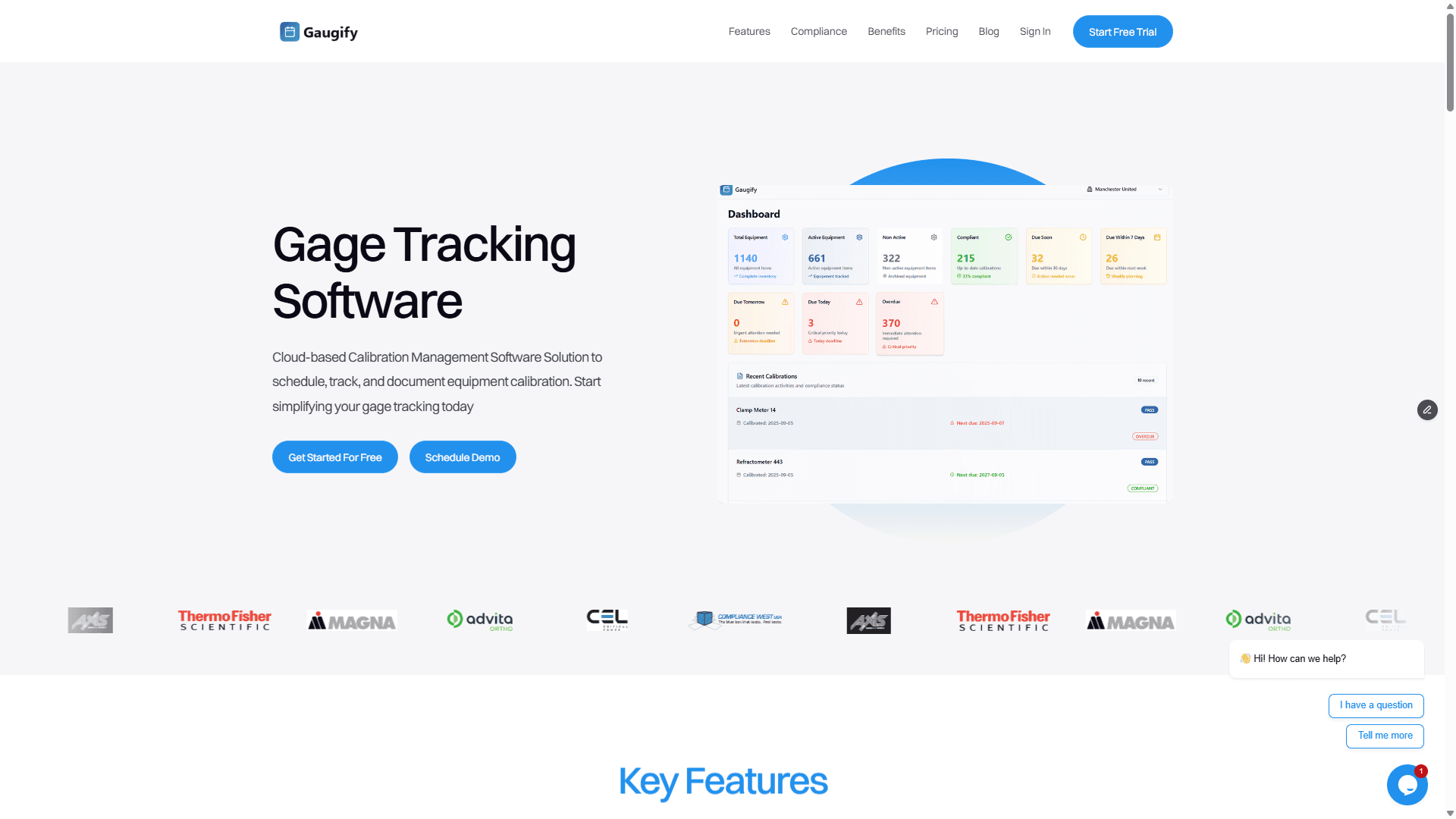
Gaugify prioritizes user experience with a clean, intuitive interface that requires minimal training. New technicians can begin entering calibration data within minutes of account creation. The dashboard provides immediate visibility into overdue calibrations, upcoming schedules, and key performance metrics without diving through multiple menu levels.
Consider a typical workflow: scheduling an annual calibration for a fleet of digital multimeters. In ComplianceQuest, this might require navigating through asset management, scheduling modules, and workflow configuration screens. In Gaugify, you simply select the instruments from the main dashboard, adjust the due date, and assign a technician—all from a single screen.
Ready to experience the difference? Start your free Gaugify trial and see how modern calibration management should work.
Pricing Models: Enterprise vs. Accessible SaaS
Pricing represents one of the most significant differences between these platforms. ComplianceQuest follows a traditional enterprise software model with complex licensing structures, implementation fees, and annual maintenance contracts. Pricing typically starts in the tens of thousands for small implementations and can reach six figures for comprehensive deployments.
Gaugify offers transparent, affordable pricing starting at $29 per user per month with no setup fees or long-term contracts. This pricing model makes professional calibration management accessible to small and medium-sized organizations that previously couldn't justify enterprise QMS costs.
For example, a 50-person machine shop tracking 500 instruments might pay $150,000+ for a ComplianceQuest implementation, while the same organization could deploy Gaugify for under $2,000 annually—a 98% cost reduction with comparable or superior calibration functionality.
Deployment Options: Cloud-Native vs. Hybrid
ComplianceQuest offers both cloud and on-premise deployment options, appealing to organizations with strict data residency requirements or legacy IT infrastructure. However, the on-premise option requires significant IT resources for installation, maintenance, and security updates.
Gaugify operates as a cloud-native SaaS platform, eliminating IT overhead while providing enterprise-grade security and availability. The platform handles automatic updates, security patches, and infrastructure scaling without customer intervention. For most organizations, this translates to faster deployment, lower total cost of ownership, and better reliability.
Data Security and Compliance
Both platforms address common regulatory requirements, but with different approaches. ComplianceQuest emphasizes its ability to support highly regulated industries with extensive audit trails, electronic signatures, and validation documentation.
Gaugify provides robust compliance features including complete audit trails, electronic signatures, and data integrity controls while maintaining simplicity. The platform supports ISO/IEC 17025 requirements out of the box, with measurement traceability, uncertainty calculations, and calibration certificate management built into core workflows.
Customer Support and Implementation
ComplianceQuest's enterprise focus extends to its support model, offering dedicated customer success managers and extensive professional services. However, this high-touch approach comes with correspondingly high costs and lengthy implementation timelines.
Gaugify provides comprehensive support through multiple channels—email, chat, and phone—with rapid response times and knowledgeable calibration professionals. The platform's intuitive design means most organizations can be operational within days rather than months, with optional training and migration services available for complex deployments.
Integration Capabilities
Enterprise organizations often require integration with existing ERP, MES, or quality systems. ComplianceQuest offers extensive integration options through APIs and pre-built connectors, though implementation typically requires professional services engagement.
Gaugify provides REST APIs for custom integrations and offers pre-built connections to common systems. The platform can integrate with equipment databases, maintenance systems, and quality platforms while maintaining its core simplicity and ease of use.
Reporting and Analytics
Both platforms offer calibration reporting, but with different strengths. ComplianceQuest provides extensive reporting capabilities across its entire QMS suite, allowing correlation between calibration data and other quality metrics.
Gaugify focuses on calibration-specific analytics that provide actionable insights for measurement professionals. Reports include calibration performance trends, uncertainty analysis, technician productivity, and cost-per-calibration metrics. The system automatically identifies instruments with stability issues, recommends interval adjustments, and highlights opportunities for measurement process improvement.
Who Each Platform Serves Best
ComplianceQuest is ideal for:
Large enterprises requiring comprehensive QMS functionality beyond calibration
Organizations with complex regulatory requirements and extensive validation needs
Companies with dedicated IT resources and substantial software budgets
Multi-site operations needing integration with existing enterprise systems
Gaugify excels for:
Organizations seeking best-in-class calibration management at affordable prices
Small to medium-sized companies without extensive IT resources
Calibration labs and service providers needing professional uncertainty calculations
Any organization prioritizing ease of use and rapid deployment
Companies requiring mobile access for field calibration activities
The Verdict: Modern Calibration Management for Today's Organizations
While ComplianceQuest serves large enterprises needing comprehensive QMS functionality, Gaugify represents the future of calibration management—purpose-built, affordable, and accessible to organizations of all sizes.
The choice between Gaugify vs ComplianceQuest ultimately depends on your priorities. If you need a complete quality management ecosystem and have the budget for enterprise software, ComplianceQuest might fit your requirements. However, if you want superior calibration functionality, modern user experience, and transparent pricing, Gaugify delivers everything most organizations need at a fraction of the cost.
Gaugify's cloud-native architecture, built-in uncertainty calculations, mobile optimization, and intuitive interface make it the clear choice for organizations focused on measurement excellence rather than software complexity.
Experience Modern Calibration Management Today
Don't take our word for it—experience the difference yourself. Gaugify offers a complete free trial with full access to all features, allowing you to import your instrument database, generate calibration certificates, and evaluate the platform's capabilities with your actual data.
Start your free Gaugify trial today and discover why hundreds of organizations have chosen modern, affordable calibration management over complex enterprise alternatives. No setup fees, no long-term contracts, and no compromise on functionality.
Need to see Gaugify in action first? Schedule a personalized demo and let our calibration experts show you how Gaugify can streamline your measurement assurance program.
Gaugify vs ComplianceQuest: Calibration Module Compared
When evaluating calibration management software, the choice between Gaugify vs ComplianceQuest often comes down to your organization's specific needs, budget, and technical requirements. Both platforms offer calibration tracking capabilities, but they take fundamentally different approaches to solving the same challenge: maintaining measurement accuracy and regulatory compliance in quality-critical environments.
As a quality manager or lab supervisor, you're likely dealing with hundreds or thousands of measuring instruments—from basic calipers and micrometers to complex CMMs and environmental chambers. Whether you're managing a small machine shop with 50 gages or a multi-site manufacturing operation with 10,000+ instruments, your calibration management system needs to handle scheduling, certificates, uncertainty calculations, and audit trails without breaking your budget or overwhelming your team.
This comprehensive comparison examines both platforms across the features that matter most to calibration professionals, helping you make an informed decision for your organization's measurement assurance program.
Company Background: Different Approaches to Calibration Management
ComplianceQuest has established itself as an enterprise-focused quality management platform with calibration as one module within a broader QMS suite. Founded in 2013, the company targets large manufacturers and regulated industries with comprehensive quality management needs spanning document control, CAPA, supplier management, and calibration tracking.
Gaugify, by contrast, was built from the ground up as a dedicated calibration management solution. Launched as a cloud-native platform, Gaugify focuses exclusively on solving calibration challenges with modern software architecture, intuitive design, and transparent SaaS pricing. This specialized focus allows for deeper functionality in areas like uncertainty calculations, gage R&R integration, and calibration-specific reporting.
The fundamental difference in approach means ComplianceQuest excels when you need a complete QMS ecosystem, while Gaugify delivers superior calibration-specific functionality at a fraction of the cost and complexity.
Feature Comparison: Core Calibration Capabilities
Calibration Scheduling and Due Date Management
Both platforms handle basic calibration scheduling, but with different levels of sophistication. ComplianceQuest offers rule-based scheduling within its broader workflow engine, allowing you to set calibration intervals based on instrument type, criticality, or usage patterns. However, the scheduling interface can feel cumbersome when managing large instrument populations.
Gaugify's scheduling system is purpose-built for calibration workflows. The platform automatically calculates due dates based on calibration intervals, provides intelligent rescheduling when instruments are out of tolerance, and offers flexible interval adjustments based on historical stability data. For example, if your Mitutoyo digital calipers consistently pass calibration with minimal drift, Gaugify can recommend extending the 12-month interval to 15 months while maintaining measurement confidence.
Certificate Generation and Management
Certificate handling reveals a significant capability gap between the platforms. ComplianceQuest generates basic calibration certificates through its document management system, but customization options are limited and often require IT involvement for template modifications.
Gaugify's certificate engine produces professional, branded certificates with complete measurement data, uncertainty statements, and traceability chains. The system automatically populates certificates with actual measurement values, environmental conditions, and statistical analysis. When calibrating a pressure transducer with a ±0.25% FS accuracy specification, Gaugify calculates and displays the measurement uncertainty budget, including contributions from the calibration standard, environmental factors, and measurement process variability.
Uncertainty Calculations and Measurement Assurance
This is where the platforms diverge most significantly. ComplianceQuest treats uncertainty calculations as an afterthought, requiring manual entry of uncertainty values or reliance on external spreadsheets for complex calculations.
Gaugify includes built-in uncertainty calculation engines that automatically compute measurement uncertainty according to ISO/IEC 17025 requirements. The system maintains uncertainty budgets for each measurement point, combines uncertainty sources using proper statistical methods, and ensures your Test Uncertainty Ratios (TUR) meet industry standards. For a temperature calibration at 100°C with a reference standard uncertainty of ±0.05°C, Gaugify automatically factors in resolution limits, stability contributions, and environmental effects to produce a complete uncertainty statement.
Mobile Access and Field Calibration
Field calibration capabilities are increasingly important as organizations move toward in-situ calibration and mobile service models. ComplianceQuest offers limited mobile functionality through a responsive web interface, but the user experience suffers on tablets and smartphones.
Gaugify provides native mobile access optimized for technicians performing calibrations in the field. The mobile interface allows complete calibration workflows, including data entry, photo capture, and certificate generation from any device. Technicians can calibrate torque wrenches on the production floor, immediately upload results, and generate certificates without returning to a desktop computer.
Gaugify vs ComplianceQuest: User Experience and Interface Design
User adoption often determines the success or failure of calibration management initiatives. ComplianceQuest's interface reflects its enterprise heritage—functional but complex, with multiple navigation layers and extensive configuration options that can overwhelm occasional users.
Gaugify prioritizes user experience with a clean, intuitive interface that requires minimal training. New technicians can begin entering calibration data within minutes of account creation. The dashboard provides immediate visibility into overdue calibrations, upcoming schedules, and key performance metrics without diving through multiple menu levels.
Consider a typical workflow: scheduling an annual calibration for a fleet of digital multimeters. In ComplianceQuest, this might require navigating through asset management, scheduling modules, and workflow configuration screens. In Gaugify, you simply select the instruments from the main dashboard, adjust the due date, and assign a technician—all from a single screen.
Ready to experience the difference? Start your free Gaugify trial and see how modern calibration management should work.
Pricing Models: Enterprise vs. Accessible SaaS
Pricing represents one of the most significant differences between these platforms. ComplianceQuest follows a traditional enterprise software model with complex licensing structures, implementation fees, and annual maintenance contracts. Pricing typically starts in the tens of thousands for small implementations and can reach six figures for comprehensive deployments.
Gaugify offers transparent, affordable pricing starting at $29 per user per month with no setup fees or long-term contracts. This pricing model makes professional calibration management accessible to small and medium-sized organizations that previously couldn't justify enterprise QMS costs.
For example, a 50-person machine shop tracking 500 instruments might pay $150,000+ for a ComplianceQuest implementation, while the same organization could deploy Gaugify for under $2,000 annually—a 98% cost reduction with comparable or superior calibration functionality.
Deployment Options: Cloud-Native vs. Hybrid
ComplianceQuest offers both cloud and on-premise deployment options, appealing to organizations with strict data residency requirements or legacy IT infrastructure. However, the on-premise option requires significant IT resources for installation, maintenance, and security updates.
Gaugify operates as a cloud-native SaaS platform, eliminating IT overhead while providing enterprise-grade security and availability. The platform handles automatic updates, security patches, and infrastructure scaling without customer intervention. For most organizations, this translates to faster deployment, lower total cost of ownership, and better reliability.
Data Security and Compliance
Both platforms address common regulatory requirements, but with different approaches. ComplianceQuest emphasizes its ability to support highly regulated industries with extensive audit trails, electronic signatures, and validation documentation.
Gaugify provides robust compliance features including complete audit trails, electronic signatures, and data integrity controls while maintaining simplicity. The platform supports ISO/IEC 17025 requirements out of the box, with measurement traceability, uncertainty calculations, and calibration certificate management built into core workflows.
Customer Support and Implementation
ComplianceQuest's enterprise focus extends to its support model, offering dedicated customer success managers and extensive professional services. However, this high-touch approach comes with correspondingly high costs and lengthy implementation timelines.
Gaugify provides comprehensive support through multiple channels—email, chat, and phone—with rapid response times and knowledgeable calibration professionals. The platform's intuitive design means most organizations can be operational within days rather than months, with optional training and migration services available for complex deployments.
Integration Capabilities
Enterprise organizations often require integration with existing ERP, MES, or quality systems. ComplianceQuest offers extensive integration options through APIs and pre-built connectors, though implementation typically requires professional services engagement.
Gaugify provides REST APIs for custom integrations and offers pre-built connections to common systems. The platform can integrate with equipment databases, maintenance systems, and quality platforms while maintaining its core simplicity and ease of use.
Reporting and Analytics
Both platforms offer calibration reporting, but with different strengths. ComplianceQuest provides extensive reporting capabilities across its entire QMS suite, allowing correlation between calibration data and other quality metrics.
Gaugify focuses on calibration-specific analytics that provide actionable insights for measurement professionals. Reports include calibration performance trends, uncertainty analysis, technician productivity, and cost-per-calibration metrics. The system automatically identifies instruments with stability issues, recommends interval adjustments, and highlights opportunities for measurement process improvement.
Who Each Platform Serves Best
ComplianceQuest is ideal for:
Large enterprises requiring comprehensive QMS functionality beyond calibration
Organizations with complex regulatory requirements and extensive validation needs
Companies with dedicated IT resources and substantial software budgets
Multi-site operations needing integration with existing enterprise systems
Gaugify excels for:
Organizations seeking best-in-class calibration management at affordable prices
Small to medium-sized companies without extensive IT resources
Calibration labs and service providers needing professional uncertainty calculations
Any organization prioritizing ease of use and rapid deployment
Companies requiring mobile access for field calibration activities
The Verdict: Modern Calibration Management for Today's Organizations
While ComplianceQuest serves large enterprises needing comprehensive QMS functionality, Gaugify represents the future of calibration management—purpose-built, affordable, and accessible to organizations of all sizes.
The choice between Gaugify vs ComplianceQuest ultimately depends on your priorities. If you need a complete quality management ecosystem and have the budget for enterprise software, ComplianceQuest might fit your requirements. However, if you want superior calibration functionality, modern user experience, and transparent pricing, Gaugify delivers everything most organizations need at a fraction of the cost.
Gaugify's cloud-native architecture, built-in uncertainty calculations, mobile optimization, and intuitive interface make it the clear choice for organizations focused on measurement excellence rather than software complexity.
Experience Modern Calibration Management Today
Don't take our word for it—experience the difference yourself. Gaugify offers a complete free trial with full access to all features, allowing you to import your instrument database, generate calibration certificates, and evaluate the platform's capabilities with your actual data.
Start your free Gaugify trial today and discover why hundreds of organizations have chosen modern, affordable calibration management over complex enterprise alternatives. No setup fees, no long-term contracts, and no compromise on functionality.
Need to see Gaugify in action first? Schedule a personalized demo and let our calibration experts show you how Gaugify can streamline your measurement assurance program.