
Gaugify vs Harrington Group HQMS Calibration
Gaugify vs Harrington Group HQMS Calibration
David Bentley
Quality Assurance Engineer
8 min read
Gaugify vs Harrington Group HQMS Calibration
When evaluating calibration management software options, quality managers often find themselves comparing Gaugify vs HQMS (Harrington Group's Quality Management System). Both platforms serve calibration labs and manufacturing facilities, but they represent fundamentally different approaches to calibration management. While HQMS offers a traditional, feature-rich solution that's been serving the industry for years, Gaugify delivers a modern, cloud-native platform designed for today's quality professionals who need efficiency without complexity.
This comprehensive comparison will help you understand which solution best fits your organization's calibration management needs, from automated scheduling and uncertainty calculations to audit compliance and mobile accessibility.
Company Background: Established vs Modern
Harrington Group has been serving the calibration industry for over two decades, building HQMS as a comprehensive quality management system with calibration capabilities. Their solution reflects years of industry feedback and feature requests, resulting in a robust but complex platform that caters to large enterprises with dedicated IT resources.
Gaugify, on the other hand, was founded with a singular focus: making calibration management simple and accessible for modern organizations. Built from the ground up as a cloud-native SaaS platform, Gaugify addresses the pain points that quality managers face with legacy systems—complexity, high costs, and poor user experience.
While HQMS carries the weight of legacy architecture and traditional deployment models, Gaugify represents the new generation of calibration software designed for teams who want powerful functionality without the overhead of enterprise-level complexity.
Gaugify vs HQMS: Core Features Comparison
Calibration Scheduling and Notifications
HQMS provides scheduling capabilities through its broader quality management framework. Users can set calibration intervals and receive notifications, but the process often requires navigation through multiple modules and screens. The system excels in complex scenarios where calibration scheduling needs to integrate with broader quality workflows.
Gaugify takes a more streamlined approach to calibration scheduling. When you add a Mitutoyo micrometer with a 12-month calibration interval, the system automatically calculates due dates, sends email notifications 30 days before expiration, and escalates reminders as instruments approach their due dates. The intuitive dashboard shows all upcoming calibrations at a glance, making it impossible to miss critical deadlines.
Calibration Certificates and Documentation
HQMS generates calibration certificates through its reporting engine, offering customization options for organizations with specific formatting requirements. However, certificate generation often requires technical knowledge to modify templates and layouts.
Gaugify automatically generates professional calibration certificates that include all required information: instrument details, calibration procedures, measurement uncertainty, environmental conditions, and traceability chains. For example, when calibrating a Fluke 87V multimeter, Gaugify's certificate automatically includes the uncertainty budget calculation and references to the standards used, all formatted to meet ISO/IEC 17025 requirements without manual intervention.
Measurement Uncertainty Calculations
This is where the two platforms diverge significantly. HQMS typically requires external calculations or manual entry of uncertainty values, placing the burden on technicians to perform complex mathematical computations outside the system.
Gaugify includes built-in uncertainty calculations that automatically compute measurement uncertainty based on instrument specifications, environmental conditions, and calibration procedures. When calibrating a pressure gauge with a ±0.1% accuracy specification, Gaugify automatically calculates the expanded uncertainty considering factors like temperature coefficients, repeatability, and reference standard uncertainty, displaying results in real-time as technicians enter measurements.
Audit Trails and Compliance
HQMS provides comprehensive audit trails as part of its quality management foundation. The system tracks changes and maintains detailed records, though accessing and interpreting this information can require significant training.
Gaugify maintains complete audit trails with user-friendly presentation. Every action—from calibration data entry to certificate generation—is automatically logged with timestamps, user identification, and change descriptions. The compliance dashboard provides auditors with clear visibility into all calibration activities, making ISO/IEC 17025 audits straightforward and stress-free.
Inventory and Crib Management
HQMS offers inventory management capabilities within its broader quality management suite. Organizations can track instrument locations, assignments, and status, though the interface may feel overwhelming for simple inventory needs.
Gaugify provides streamlined inventory management focused specifically on calibration needs. You can quickly assign a Starrett dial caliper to "Production Line A," track its location as it moves through calibration, and automatically update its status when calibration is complete. Barcode scanning capabilities make check-in and check-out processes efficient for busy calibration labs.
User Experience and Interface Design
The user experience represents perhaps the most significant difference in the Gaugify vs HQMS comparison. HQMS reflects its enterprise heritage with dense screens, multiple tabs, and complex navigation structures. While powerful, the interface can overwhelm new users and requires substantial training for proficiency. Lab technicians often struggle with the learning curve, leading to decreased adoption and potential compliance issues.
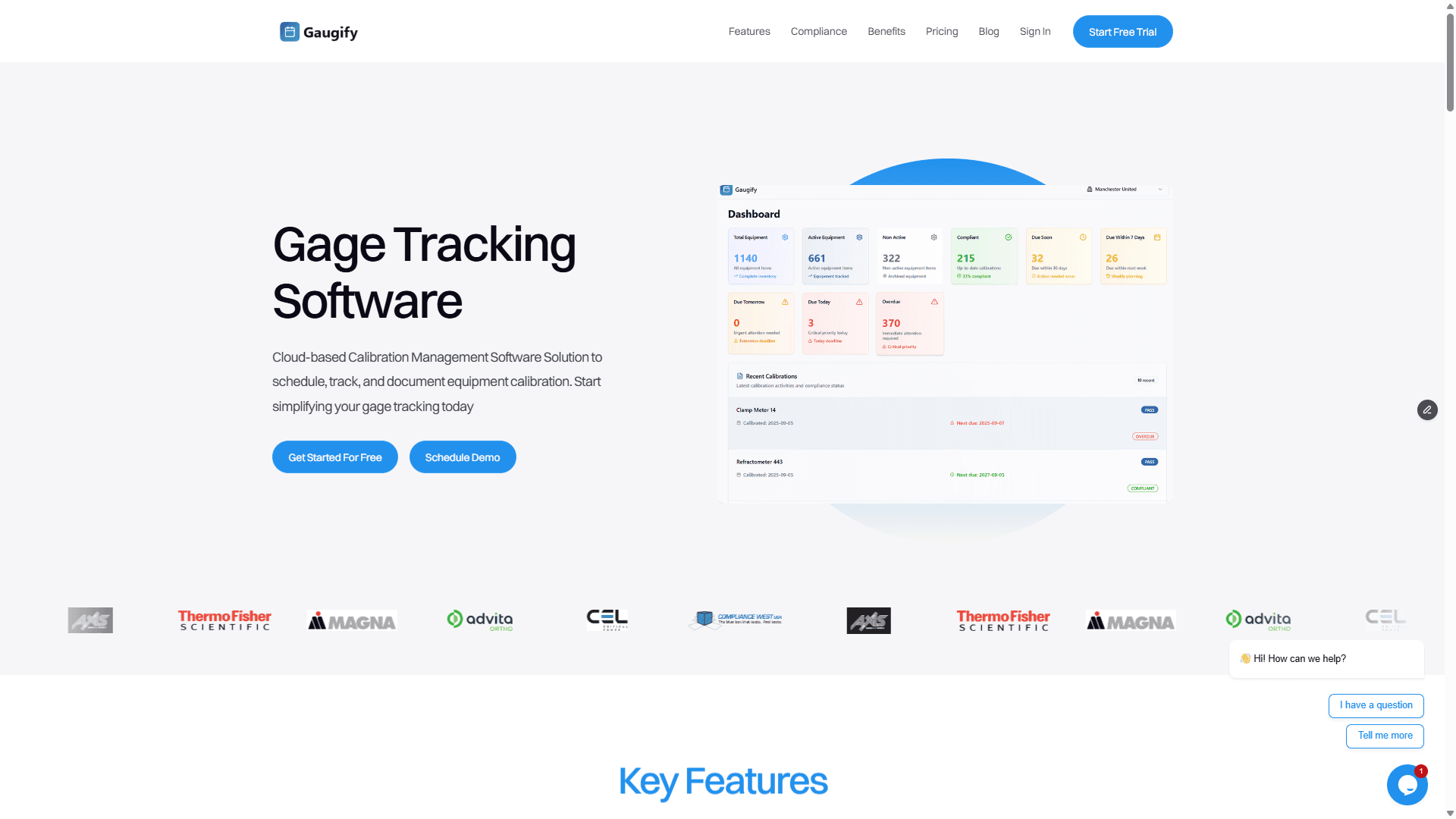
Gaugify prioritizes user experience with a clean, intuitive interface designed for daily use by busy technicians and quality managers. The dashboard presents critical information clearly—overdue calibrations appear in red, upcoming calibrations in yellow, and compliant instruments in green. Adding a new instrument or recording calibration results requires just a few clicks, not extensive training.
For example, when a technician needs to calibrate a set of gage blocks, Gaugify guides them through the process with clear prompts, automatic calculations, and immediate feedback. HQMS might require navigating through quality management modules, finding the correct forms, and manually calculating uncertainty values.
Pricing Models: Traditional vs Transparent
HQMS follows traditional enterprise software pricing with significant upfront licensing costs, annual maintenance fees, and additional charges for modules, users, and customizations. Organizations often face surprise costs for training, implementation, and ongoing support. The total cost of ownership can quickly escalate beyond initial budgets.
Gaugify offers transparent SaaS pricing starting at affordable monthly rates with no hidden fees or surprise charges. The pricing structure includes all features, unlimited certificates, automatic updates, and customer support. Organizations can start with a small team and scale pricing as they grow, making calibration management accessible to companies of all sizes.
This pricing difference makes Gaugify particularly attractive to small and medium-sized organizations that need professional calibration management without enterprise-level costs.
Deployment Options: Cloud vs On-Premise
HQMS typically requires on-premise deployment with dedicated servers, IT support, and manual updates. While some cloud options may be available, the platform was designed for traditional deployment models that require significant IT resources and ongoing maintenance.
Gaugify is exclusively cloud-based, eliminating the need for servers, IT support, or manual updates. Your calibration data is securely stored in the cloud with automatic backups, 99.9% uptime guarantees, and instant access from anywhere with an internet connection. Updates and new features are deployed automatically without disruption to your operations.
For organizations with strict data residency requirements, this represents a key decision point in the Gaugify vs HQMS comparison.
Ready to experience modern calibration management? Start your free trial of Gaugify today and see how easy calibration management can be.
Customer Support and Implementation
HQMS support typically follows enterprise patterns with account managers, support tiers, and formal processes. While comprehensive, getting answers to simple questions can involve lengthy procedures and potentially additional costs for premium support levels.
Gaugify provides direct access to calibration experts who understand your daily challenges. Whether you're setting up uncertainty calculations for torque wrenches or configuring automated reminders for environmental monitoring equipment, Gaugify's support team responds quickly with practical solutions. Implementation is typically measured in days, not months, with most organizations fully operational within a week.
Mobile Access and Field Calibration
HQMS mobile capabilities may be limited due to its traditional architecture. Field calibrations often require laptops or separate mobile solutions that sync back to the main system.
Gaugify works seamlessly on tablets and smartphones, enabling true mobile calibration management. Technicians can access calibration procedures, record measurements, and generate certificates directly from mobile devices. This capability proves invaluable for organizations performing on-site calibrations or managing distributed calibration activities.
Integration and API Capabilities
HQMS offers integration capabilities through its enterprise architecture, typically requiring custom development or professional services to connect with other systems like ERP or LIMS platforms.
Gaugify provides modern API capabilities that enable straightforward integrations with popular business systems. Organizations can automatically sync instrument lists from their ERP systems or export calibration data to quality management dashboards without custom development.
Who Each Product Serves Best
HQMS works well for:
Large enterprises with dedicated IT resources and complex quality management needs
Organizations requiring extensive customization and workflow integration
Companies with existing Harrington Group relationships and infrastructure
Facilities where calibration management is part of broader quality management initiatives
Gaugify excels for:
Small to medium-sized organizations seeking efficient calibration management
Teams wanting modern, user-friendly software that requires minimal training
Organizations prioritizing quick implementation and immediate ROI
Companies needing built-in uncertainty calculations and ISO/IEC 17025 compliance features
Facilities requiring mobile access for field calibrations
Budget-conscious organizations wanting transparent, predictable pricing
The Verdict: Modern Efficiency vs Traditional Complexity
The choice between Gaugify vs HQMS ultimately depends on your organization's priorities, resources, and calibration management philosophy. HQMS serves organizations that need extensive customization and have resources for complex implementations, while Gaugify delivers immediate value through simplicity, modern design, and focused functionality.
For most calibration labs and quality departments, Gaugify represents the optimal balance of powerful features and ease of use. The platform eliminates the complexity barriers that often prevent teams from fully utilizing their calibration management software, resulting in better compliance, reduced administrative overhead, and improved productivity.
Gaugify's built-in uncertainty calculations, automatic certificate generation, and intuitive interface mean your team can focus on calibration work rather than software navigation. The transparent pricing and cloud-based deployment remove traditional barriers to implementation, making professional calibration management accessible to organizations of all sizes.
Take the Next Step
Don't let complex software slow down your calibration management. Experience the difference that modern, purpose-built calibration software can make for your organization. Start your free trial of Gaugify today and discover why quality professionals are choosing simplicity and efficiency over complexity and confusion.
Want to see Gaugify in action with your specific calibration scenarios? Schedule a personalized demo to explore how Gaugify can streamline your calibration processes and improve compliance without the complexity of traditional calibration management systems.
Gaugify vs Harrington Group HQMS Calibration
When evaluating calibration management software options, quality managers often find themselves comparing Gaugify vs HQMS (Harrington Group's Quality Management System). Both platforms serve calibration labs and manufacturing facilities, but they represent fundamentally different approaches to calibration management. While HQMS offers a traditional, feature-rich solution that's been serving the industry for years, Gaugify delivers a modern, cloud-native platform designed for today's quality professionals who need efficiency without complexity.
This comprehensive comparison will help you understand which solution best fits your organization's calibration management needs, from automated scheduling and uncertainty calculations to audit compliance and mobile accessibility.
Company Background: Established vs Modern
Harrington Group has been serving the calibration industry for over two decades, building HQMS as a comprehensive quality management system with calibration capabilities. Their solution reflects years of industry feedback and feature requests, resulting in a robust but complex platform that caters to large enterprises with dedicated IT resources.
Gaugify, on the other hand, was founded with a singular focus: making calibration management simple and accessible for modern organizations. Built from the ground up as a cloud-native SaaS platform, Gaugify addresses the pain points that quality managers face with legacy systems—complexity, high costs, and poor user experience.
While HQMS carries the weight of legacy architecture and traditional deployment models, Gaugify represents the new generation of calibration software designed for teams who want powerful functionality without the overhead of enterprise-level complexity.
Gaugify vs HQMS: Core Features Comparison
Calibration Scheduling and Notifications
HQMS provides scheduling capabilities through its broader quality management framework. Users can set calibration intervals and receive notifications, but the process often requires navigation through multiple modules and screens. The system excels in complex scenarios where calibration scheduling needs to integrate with broader quality workflows.
Gaugify takes a more streamlined approach to calibration scheduling. When you add a Mitutoyo micrometer with a 12-month calibration interval, the system automatically calculates due dates, sends email notifications 30 days before expiration, and escalates reminders as instruments approach their due dates. The intuitive dashboard shows all upcoming calibrations at a glance, making it impossible to miss critical deadlines.
Calibration Certificates and Documentation
HQMS generates calibration certificates through its reporting engine, offering customization options for organizations with specific formatting requirements. However, certificate generation often requires technical knowledge to modify templates and layouts.
Gaugify automatically generates professional calibration certificates that include all required information: instrument details, calibration procedures, measurement uncertainty, environmental conditions, and traceability chains. For example, when calibrating a Fluke 87V multimeter, Gaugify's certificate automatically includes the uncertainty budget calculation and references to the standards used, all formatted to meet ISO/IEC 17025 requirements without manual intervention.
Measurement Uncertainty Calculations
This is where the two platforms diverge significantly. HQMS typically requires external calculations or manual entry of uncertainty values, placing the burden on technicians to perform complex mathematical computations outside the system.
Gaugify includes built-in uncertainty calculations that automatically compute measurement uncertainty based on instrument specifications, environmental conditions, and calibration procedures. When calibrating a pressure gauge with a ±0.1% accuracy specification, Gaugify automatically calculates the expanded uncertainty considering factors like temperature coefficients, repeatability, and reference standard uncertainty, displaying results in real-time as technicians enter measurements.
Audit Trails and Compliance
HQMS provides comprehensive audit trails as part of its quality management foundation. The system tracks changes and maintains detailed records, though accessing and interpreting this information can require significant training.
Gaugify maintains complete audit trails with user-friendly presentation. Every action—from calibration data entry to certificate generation—is automatically logged with timestamps, user identification, and change descriptions. The compliance dashboard provides auditors with clear visibility into all calibration activities, making ISO/IEC 17025 audits straightforward and stress-free.
Inventory and Crib Management
HQMS offers inventory management capabilities within its broader quality management suite. Organizations can track instrument locations, assignments, and status, though the interface may feel overwhelming for simple inventory needs.
Gaugify provides streamlined inventory management focused specifically on calibration needs. You can quickly assign a Starrett dial caliper to "Production Line A," track its location as it moves through calibration, and automatically update its status when calibration is complete. Barcode scanning capabilities make check-in and check-out processes efficient for busy calibration labs.
User Experience and Interface Design
The user experience represents perhaps the most significant difference in the Gaugify vs HQMS comparison. HQMS reflects its enterprise heritage with dense screens, multiple tabs, and complex navigation structures. While powerful, the interface can overwhelm new users and requires substantial training for proficiency. Lab technicians often struggle with the learning curve, leading to decreased adoption and potential compliance issues.
Gaugify prioritizes user experience with a clean, intuitive interface designed for daily use by busy technicians and quality managers. The dashboard presents critical information clearly—overdue calibrations appear in red, upcoming calibrations in yellow, and compliant instruments in green. Adding a new instrument or recording calibration results requires just a few clicks, not extensive training.
For example, when a technician needs to calibrate a set of gage blocks, Gaugify guides them through the process with clear prompts, automatic calculations, and immediate feedback. HQMS might require navigating through quality management modules, finding the correct forms, and manually calculating uncertainty values.
Pricing Models: Traditional vs Transparent
HQMS follows traditional enterprise software pricing with significant upfront licensing costs, annual maintenance fees, and additional charges for modules, users, and customizations. Organizations often face surprise costs for training, implementation, and ongoing support. The total cost of ownership can quickly escalate beyond initial budgets.
Gaugify offers transparent SaaS pricing starting at affordable monthly rates with no hidden fees or surprise charges. The pricing structure includes all features, unlimited certificates, automatic updates, and customer support. Organizations can start with a small team and scale pricing as they grow, making calibration management accessible to companies of all sizes.
This pricing difference makes Gaugify particularly attractive to small and medium-sized organizations that need professional calibration management without enterprise-level costs.
Deployment Options: Cloud vs On-Premise
HQMS typically requires on-premise deployment with dedicated servers, IT support, and manual updates. While some cloud options may be available, the platform was designed for traditional deployment models that require significant IT resources and ongoing maintenance.
Gaugify is exclusively cloud-based, eliminating the need for servers, IT support, or manual updates. Your calibration data is securely stored in the cloud with automatic backups, 99.9% uptime guarantees, and instant access from anywhere with an internet connection. Updates and new features are deployed automatically without disruption to your operations.
For organizations with strict data residency requirements, this represents a key decision point in the Gaugify vs HQMS comparison.
Ready to experience modern calibration management? Start your free trial of Gaugify today and see how easy calibration management can be.
Customer Support and Implementation
HQMS support typically follows enterprise patterns with account managers, support tiers, and formal processes. While comprehensive, getting answers to simple questions can involve lengthy procedures and potentially additional costs for premium support levels.
Gaugify provides direct access to calibration experts who understand your daily challenges. Whether you're setting up uncertainty calculations for torque wrenches or configuring automated reminders for environmental monitoring equipment, Gaugify's support team responds quickly with practical solutions. Implementation is typically measured in days, not months, with most organizations fully operational within a week.
Mobile Access and Field Calibration
HQMS mobile capabilities may be limited due to its traditional architecture. Field calibrations often require laptops or separate mobile solutions that sync back to the main system.
Gaugify works seamlessly on tablets and smartphones, enabling true mobile calibration management. Technicians can access calibration procedures, record measurements, and generate certificates directly from mobile devices. This capability proves invaluable for organizations performing on-site calibrations or managing distributed calibration activities.
Integration and API Capabilities
HQMS offers integration capabilities through its enterprise architecture, typically requiring custom development or professional services to connect with other systems like ERP or LIMS platforms.
Gaugify provides modern API capabilities that enable straightforward integrations with popular business systems. Organizations can automatically sync instrument lists from their ERP systems or export calibration data to quality management dashboards without custom development.
Who Each Product Serves Best
HQMS works well for:
Large enterprises with dedicated IT resources and complex quality management needs
Organizations requiring extensive customization and workflow integration
Companies with existing Harrington Group relationships and infrastructure
Facilities where calibration management is part of broader quality management initiatives
Gaugify excels for:
Small to medium-sized organizations seeking efficient calibration management
Teams wanting modern, user-friendly software that requires minimal training
Organizations prioritizing quick implementation and immediate ROI
Companies needing built-in uncertainty calculations and ISO/IEC 17025 compliance features
Facilities requiring mobile access for field calibrations
Budget-conscious organizations wanting transparent, predictable pricing
The Verdict: Modern Efficiency vs Traditional Complexity
The choice between Gaugify vs HQMS ultimately depends on your organization's priorities, resources, and calibration management philosophy. HQMS serves organizations that need extensive customization and have resources for complex implementations, while Gaugify delivers immediate value through simplicity, modern design, and focused functionality.
For most calibration labs and quality departments, Gaugify represents the optimal balance of powerful features and ease of use. The platform eliminates the complexity barriers that often prevent teams from fully utilizing their calibration management software, resulting in better compliance, reduced administrative overhead, and improved productivity.
Gaugify's built-in uncertainty calculations, automatic certificate generation, and intuitive interface mean your team can focus on calibration work rather than software navigation. The transparent pricing and cloud-based deployment remove traditional barriers to implementation, making professional calibration management accessible to organizations of all sizes.
Take the Next Step
Don't let complex software slow down your calibration management. Experience the difference that modern, purpose-built calibration software can make for your organization. Start your free trial of Gaugify today and discover why quality professionals are choosing simplicity and efficiency over complexity and confusion.
Want to see Gaugify in action with your specific calibration scenarios? Schedule a personalized demo to explore how Gaugify can streamline your calibration processes and improve compliance without the complexity of traditional calibration management systems.