
How a Biotech Startup Became GMP Compliant in 30 Days
How a Biotech Startup Became GMP Compliant in 30 Days
David Bentley
Quality Assurance Engineer
8 min read
How a Biotech Startup Became GMP Compliant in 30 Days
When BioDyne Labs (name changed for confidentiality) received their first FDA inspection notice, panic set in. This promising biotech startup had spent three years developing breakthrough immunotherapy treatments, but their calibration management was stuck in the Stone Age. With just 30 days to achieve biotech GMP calibration compliance, they needed a miracle—or the right calibration management software.
What followed was a complete transformation that took them from compliance chaos to audit-ready in record time. Here's exactly how they did it, and the lessons every biotech organization can apply to their own GMP compliance journey.
The Biotech Startup: Setting the Scene
BioDyne Labs operated a 15,000 square foot facility in Research Triangle Park, North Carolina. Like many biotech startups, they had prioritized R&D spending over infrastructure systems. Their lab housed critical equipment including:
12 analytical balances (±0.0001g tolerance requirements)
8 pH meters for buffer preparation
6 pipettes ranging from 10μL to 1000μL
4 temperature monitoring systems for cold storage
3 spectrophotometers for protein quantification
2 HPLC systems for purity analysis
Their quality manager, Sarah Chen, had been tracking calibrations using a combination of Excel spreadsheets, paper certificates, and sticky note reminders. "We had calibration data scattered across three different systems," Sarah recalls. "I spent more time hunting for certificates than actually managing our quality program."
The 47-person company was preparing to submit their Investigational New Drug (IND) application when reality hit: their calibration records wouldn't pass FDA scrutiny.
The Breaking Point: When Compliance Became Critical
The wake-up call came during a mock FDA audit conducted by their regulatory consultant. The findings were devastating:
23% of instruments had overdue calibrations
Traceability gaps existed in their measurement uncertainty calculations
Certificate storage was inconsistent and incomplete
No automated alerts meant calibrations were routinely missed
Audit trail documentation was virtually non-existent
"The consultant told us point-blank: 'Fix this or your IND submission will be rejected,'" says Sarah. "We had built amazing science, but our calibration management was going to kill our regulatory approval."
The timing couldn't have been worse. They had already announced their IND submission timeline to investors, and their Series B funding depended on hitting regulatory milestones. Failure wasn't an option.
That's when Sarah started researching biotech GMP calibration compliance solutions that could deliver results fast.
The Evaluation Process: Finding the Right Software
Sarah's criteria for calibration management software were specific and non-negotiable:
Must-Have Features
21 CFR Part 11 compliance with electronic signatures and audit trails
Automated scheduling to prevent overdue calibrations
Certificate management with secure cloud storage
Traceability chains back to NIST standards
Quick implementation—they needed to go live within weeks, not months
Nice-to-Have Features
Mobile access for technicians
Integration capabilities for future LIMS implementation
Measurement uncertainty calculations
Multi-location support for planned expansion
After evaluating six different platforms, Sarah narrowed it down to three finalists. Traditional calibration software providers quoted 3-6 month implementation timelines—too slow for BioDyne's urgent needs.
Gaugify's modern, cloud-based approach stood out immediately. "Other vendors talked about lengthy customization projects," Sarah explains. "Gaugify showed us a system that was ready to use out of the box, with all the GMP compliance features we needed."
Implementation: The 30-Day Sprint to GMP Compliance
BioDyne signed with Gaugify on a Friday and began implementation the following Monday. Here's how they structured their 30-day compliance sprint:
Week 1: Data Migration and User Setup
Sarah's team used Gaugify's Excel import template to upload their existing calibration data. Despite the scattered nature of their records, they managed to consolidate information for all 47 instruments within three days.
"The import process was surprisingly smooth," notes Sarah. "Gaugify's template helped us identify data gaps we didn't even know we had."
They set up user accounts for:
3 quality team members with full admin access
12 lab technicians with calibration scheduling rights
2 managers with reporting and approval authority
Week 2: Calibration Scheduling and Vendor Coordination
Using Gaugify's automated scheduling features, they established calibration frequencies for each instrument type:
Analytical balances: Quarterly (critical for batch record accuracy)
pH meters: Monthly (buffer preparation requirements)
Pipettes: Semi-annually (per ISO 8655 guidelines)
Temperature systems: Quarterly (cold chain validation)
Sarah coordinated with their three calibration vendors to begin using Gaugify's vendor portal for certificate uploads. "Instead of waiting for certificates to arrive by email—and then manually filing them—our vendors could upload directly to our system," she explains.
Week 3: Process Documentation and Training
The team developed new Standard Operating Procedures (SOPs) incorporating Gaugify workflows. Key process improvements included:
Automated alert escalation: 30-day, 14-day, and 7-day overdue notifications
Standardized approval workflows: All calibration certificates required QM review
Measurement uncertainty tracking: Automatic calculations for critical instruments
Training sessions were conducted for all lab personnel, with particular focus on the mobile app capabilities that would allow technicians to check calibration status directly from the lab floor.
Week 4: Testing and Audit Preparation
The final week involved end-to-end process testing and documentation review. Sarah's team generated their first monthly calibration report using Gaugify's automated reporting features.
"Seeing all our calibration data in one dashboard—with full traceability and compliance documentation—was incredible," recalls Sarah. "For the first time, I felt confident about our biotech GMP calibration compliance program."
Ready to transform your own calibration management in weeks, not months? Start your free Gaugify trial today and see how quickly you can achieve GMP compliance.
Results: Measurable Improvements in 30 Days
The transformation was immediate and measurable. By day 30, BioDyne had achieved remarkable improvements across every calibration metric:
Overdue Calibrations Eliminated
The 23% overdue rate dropped to zero within 30 days. Gaugify's automated scheduling meant no calibration would ever be missed again. "We went from constant firefighting to proactive planning," says Sarah.
Administrative Time Reduced by 75%
Sarah's weekly calibration management tasks dropped from 16 hours to just 4 hours. Automated certificate processing, vendor portal uploads, and elimination of manual spreadsheet updates created massive time savings.
100% Audit Trail Compliance
Every calibration action now generated a complete audit trail meeting 21 CFR Part 11 requirements. Electronic signatures, timestamp records, and change documentation provided the regulatory compliance they needed.
Certificate Retrieval Time: 30 Seconds
Previously, finding a specific calibration certificate could take 15-20 minutes of searching through physical files and email folders. With Gaugify's cloud-based storage and search capabilities, any certificate could be retrieved in under 30 seconds.
Measurement Uncertainty Documentation
For the first time, BioDyne had complete measurement uncertainty calculations for all critical instruments. This documentation would be essential for their upcoming FDA submissions and inspections.
The FDA Mock Audit: Validation of Success
Six weeks after implementation, BioDyne conducted a follow-up mock audit with the same regulatory consultant who had identified their initial compliance gaps.
The results were night and day:
Zero calibration findings compared to 15+ in the previous audit
Complete traceability documentation for all measurement equipment
Robust audit trails demonstrating data integrity compliance
Proactive calibration scheduling eliminating future overdue risks
"The consultant was amazed at the transformation," recalls Sarah. "He said our calibration program now exceeded industry standards for companies ten times our size."
Lessons Learned: Best Practices for Biotech GMP Calibration Compliance
BioDyne's success offers valuable lessons for other biotech organizations pursuing GMP calibration compliance:
1. Don't Wait for Crisis
"We should have implemented proper calibration management from day one," admits Sarah. "The cost of non-compliance—in time, stress, and regulatory risk—far exceeds the investment in proper software."
2. Prioritize Implementation Speed
Cloud-based solutions offer significant advantages over traditional on-premise software. BioDyne's 30-day implementation would have taken 6+ months with legacy systems requiring extensive customization and IT infrastructure.
3. Involve Your Calibration Vendors
Vendor portal capabilities proved crucial for maintaining real-time compliance. By enabling direct certificate uploads, BioDyne eliminated processing delays and manual data entry errors.
4. Focus on Automation Over Manual Processes
The biggest improvements came from automating routine tasks: scheduling, notifications, approvals, and reporting. This freed up quality team time for value-added activities like process improvement and regulatory strategy.
5. Think Beyond Basic Compliance
Features like measurement uncertainty calculations and advanced reporting capabilities positioned BioDyne for future growth and more sophisticated regulatory requirements.
Scaling for Growth: Beyond Initial Compliance
Six months post-implementation, BioDyne successfully submitted their IND application with complete calibration documentation supporting their analytical methods validation. They've since expanded to include additional equipment and are planning a second facility.
"Gaugify scales with our business," notes Sarah. "We started with basic GMP compliance, but now we're using advanced features for multi-location management and integrated quality workflows."
Their calibration program now serves as a model for other portfolio companies within their venture capital firm.
Take Action: Achieve Your Own Compliance Success
BioDyne's transformation from compliance chaos to audit-ready in just 30 days proves that achieving biotech GMP calibration compliance doesn't require months of complex implementation projects.
The key factors in their success were:
Choosing modern, cloud-based software designed for rapid deployment
Focusing on automation to eliminate manual errors and delays
Implementing comprehensive audit trails from day one
Establishing proactive scheduling to prevent future compliance gaps
Your biotech organization can achieve similar results. Whether you're preparing for your first FDA inspection, scaling to multiple facilities, or simply tired of managing calibrations with spreadsheets, start your free Gaugify trial today.
Join the hundreds of biotech and pharmaceutical companies already using Gaugify to maintain GMP compliance, reduce administrative burden, and focus on what matters most—bringing life-saving treatments to patients.
Schedule a personalized demo to see exactly how Gaugify can transform your calibration management in 30 days or less.
How a Biotech Startup Became GMP Compliant in 30 Days
When BioDyne Labs (name changed for confidentiality) received their first FDA inspection notice, panic set in. This promising biotech startup had spent three years developing breakthrough immunotherapy treatments, but their calibration management was stuck in the Stone Age. With just 30 days to achieve biotech GMP calibration compliance, they needed a miracle—or the right calibration management software.
What followed was a complete transformation that took them from compliance chaos to audit-ready in record time. Here's exactly how they did it, and the lessons every biotech organization can apply to their own GMP compliance journey.
The Biotech Startup: Setting the Scene
BioDyne Labs operated a 15,000 square foot facility in Research Triangle Park, North Carolina. Like many biotech startups, they had prioritized R&D spending over infrastructure systems. Their lab housed critical equipment including:
12 analytical balances (±0.0001g tolerance requirements)
8 pH meters for buffer preparation
6 pipettes ranging from 10μL to 1000μL
4 temperature monitoring systems for cold storage
3 spectrophotometers for protein quantification
2 HPLC systems for purity analysis
Their quality manager, Sarah Chen, had been tracking calibrations using a combination of Excel spreadsheets, paper certificates, and sticky note reminders. "We had calibration data scattered across three different systems," Sarah recalls. "I spent more time hunting for certificates than actually managing our quality program."
The 47-person company was preparing to submit their Investigational New Drug (IND) application when reality hit: their calibration records wouldn't pass FDA scrutiny.
The Breaking Point: When Compliance Became Critical
The wake-up call came during a mock FDA audit conducted by their regulatory consultant. The findings were devastating:
23% of instruments had overdue calibrations
Traceability gaps existed in their measurement uncertainty calculations
Certificate storage was inconsistent and incomplete
No automated alerts meant calibrations were routinely missed
Audit trail documentation was virtually non-existent
"The consultant told us point-blank: 'Fix this or your IND submission will be rejected,'" says Sarah. "We had built amazing science, but our calibration management was going to kill our regulatory approval."
The timing couldn't have been worse. They had already announced their IND submission timeline to investors, and their Series B funding depended on hitting regulatory milestones. Failure wasn't an option.
That's when Sarah started researching biotech GMP calibration compliance solutions that could deliver results fast.
The Evaluation Process: Finding the Right Software
Sarah's criteria for calibration management software were specific and non-negotiable:
Must-Have Features
21 CFR Part 11 compliance with electronic signatures and audit trails
Automated scheduling to prevent overdue calibrations
Certificate management with secure cloud storage
Traceability chains back to NIST standards
Quick implementation—they needed to go live within weeks, not months
Nice-to-Have Features
Mobile access for technicians
Integration capabilities for future LIMS implementation
Measurement uncertainty calculations
Multi-location support for planned expansion
After evaluating six different platforms, Sarah narrowed it down to three finalists. Traditional calibration software providers quoted 3-6 month implementation timelines—too slow for BioDyne's urgent needs.
Gaugify's modern, cloud-based approach stood out immediately. "Other vendors talked about lengthy customization projects," Sarah explains. "Gaugify showed us a system that was ready to use out of the box, with all the GMP compliance features we needed."
Implementation: The 30-Day Sprint to GMP Compliance
BioDyne signed with Gaugify on a Friday and began implementation the following Monday. Here's how they structured their 30-day compliance sprint:
Week 1: Data Migration and User Setup
Sarah's team used Gaugify's Excel import template to upload their existing calibration data. Despite the scattered nature of their records, they managed to consolidate information for all 47 instruments within three days.
"The import process was surprisingly smooth," notes Sarah. "Gaugify's template helped us identify data gaps we didn't even know we had."
They set up user accounts for:
3 quality team members with full admin access
12 lab technicians with calibration scheduling rights
2 managers with reporting and approval authority
Week 2: Calibration Scheduling and Vendor Coordination
Using Gaugify's automated scheduling features, they established calibration frequencies for each instrument type:
Analytical balances: Quarterly (critical for batch record accuracy)
pH meters: Monthly (buffer preparation requirements)
Pipettes: Semi-annually (per ISO 8655 guidelines)
Temperature systems: Quarterly (cold chain validation)
Sarah coordinated with their three calibration vendors to begin using Gaugify's vendor portal for certificate uploads. "Instead of waiting for certificates to arrive by email—and then manually filing them—our vendors could upload directly to our system," she explains.
Week 3: Process Documentation and Training
The team developed new Standard Operating Procedures (SOPs) incorporating Gaugify workflows. Key process improvements included:
Automated alert escalation: 30-day, 14-day, and 7-day overdue notifications
Standardized approval workflows: All calibration certificates required QM review
Measurement uncertainty tracking: Automatic calculations for critical instruments
Training sessions were conducted for all lab personnel, with particular focus on the mobile app capabilities that would allow technicians to check calibration status directly from the lab floor.
Week 4: Testing and Audit Preparation
The final week involved end-to-end process testing and documentation review. Sarah's team generated their first monthly calibration report using Gaugify's automated reporting features.
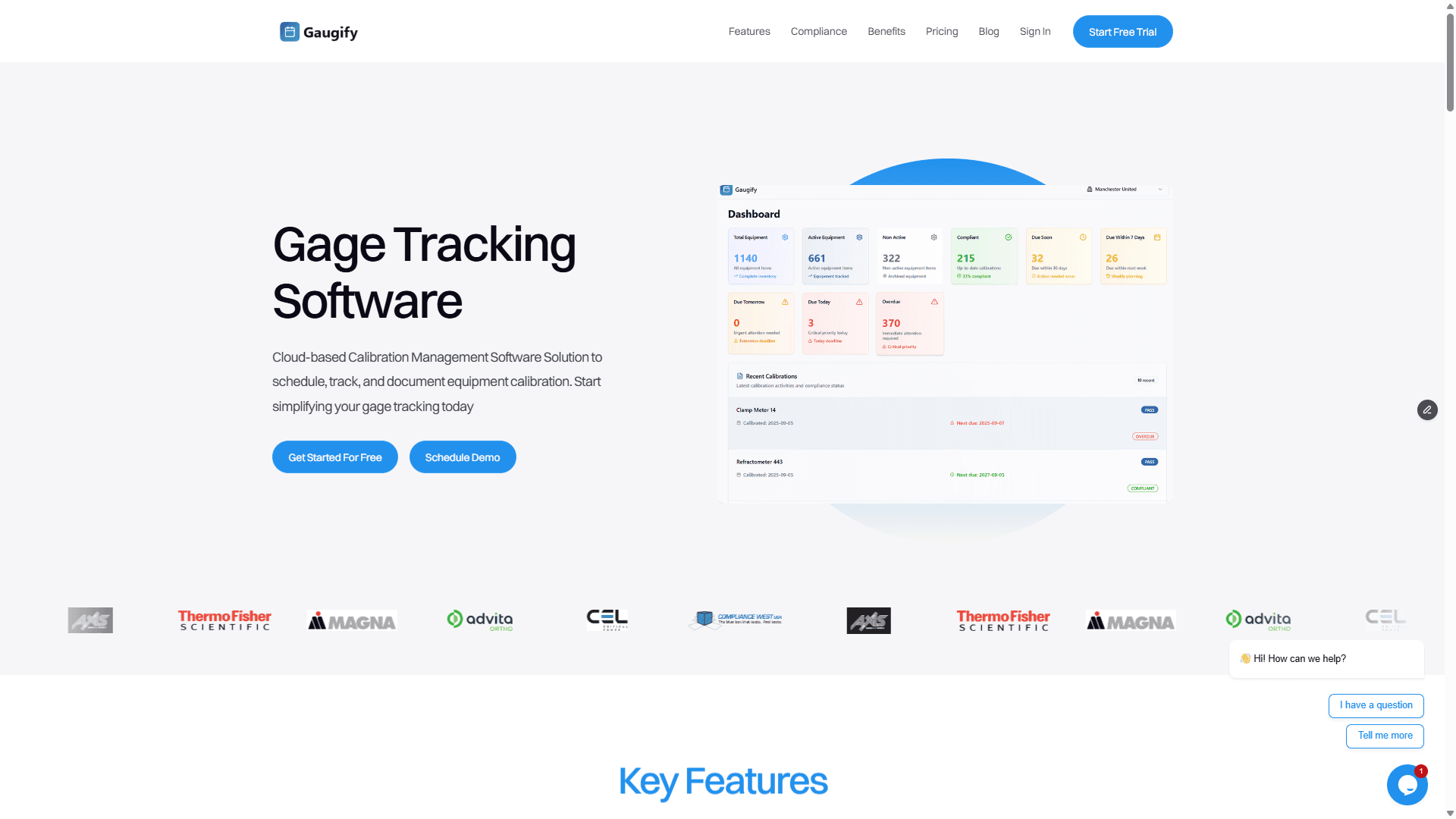
"Seeing all our calibration data in one dashboard—with full traceability and compliance documentation—was incredible," recalls Sarah. "For the first time, I felt confident about our biotech GMP calibration compliance program."
Ready to transform your own calibration management in weeks, not months? Start your free Gaugify trial today and see how quickly you can achieve GMP compliance.
Results: Measurable Improvements in 30 Days
The transformation was immediate and measurable. By day 30, BioDyne had achieved remarkable improvements across every calibration metric:
Overdue Calibrations Eliminated
The 23% overdue rate dropped to zero within 30 days. Gaugify's automated scheduling meant no calibration would ever be missed again. "We went from constant firefighting to proactive planning," says Sarah.
Administrative Time Reduced by 75%
Sarah's weekly calibration management tasks dropped from 16 hours to just 4 hours. Automated certificate processing, vendor portal uploads, and elimination of manual spreadsheet updates created massive time savings.
100% Audit Trail Compliance
Every calibration action now generated a complete audit trail meeting 21 CFR Part 11 requirements. Electronic signatures, timestamp records, and change documentation provided the regulatory compliance they needed.
Certificate Retrieval Time: 30 Seconds
Previously, finding a specific calibration certificate could take 15-20 minutes of searching through physical files and email folders. With Gaugify's cloud-based storage and search capabilities, any certificate could be retrieved in under 30 seconds.
Measurement Uncertainty Documentation
For the first time, BioDyne had complete measurement uncertainty calculations for all critical instruments. This documentation would be essential for their upcoming FDA submissions and inspections.
The FDA Mock Audit: Validation of Success
Six weeks after implementation, BioDyne conducted a follow-up mock audit with the same regulatory consultant who had identified their initial compliance gaps.
The results were night and day:
Zero calibration findings compared to 15+ in the previous audit
Complete traceability documentation for all measurement equipment
Robust audit trails demonstrating data integrity compliance
Proactive calibration scheduling eliminating future overdue risks
"The consultant was amazed at the transformation," recalls Sarah. "He said our calibration program now exceeded industry standards for companies ten times our size."
Lessons Learned: Best Practices for Biotech GMP Calibration Compliance
BioDyne's success offers valuable lessons for other biotech organizations pursuing GMP calibration compliance:
1. Don't Wait for Crisis
"We should have implemented proper calibration management from day one," admits Sarah. "The cost of non-compliance—in time, stress, and regulatory risk—far exceeds the investment in proper software."
2. Prioritize Implementation Speed
Cloud-based solutions offer significant advantages over traditional on-premise software. BioDyne's 30-day implementation would have taken 6+ months with legacy systems requiring extensive customization and IT infrastructure.
3. Involve Your Calibration Vendors
Vendor portal capabilities proved crucial for maintaining real-time compliance. By enabling direct certificate uploads, BioDyne eliminated processing delays and manual data entry errors.
4. Focus on Automation Over Manual Processes
The biggest improvements came from automating routine tasks: scheduling, notifications, approvals, and reporting. This freed up quality team time for value-added activities like process improvement and regulatory strategy.
5. Think Beyond Basic Compliance
Features like measurement uncertainty calculations and advanced reporting capabilities positioned BioDyne for future growth and more sophisticated regulatory requirements.
Scaling for Growth: Beyond Initial Compliance
Six months post-implementation, BioDyne successfully submitted their IND application with complete calibration documentation supporting their analytical methods validation. They've since expanded to include additional equipment and are planning a second facility.
"Gaugify scales with our business," notes Sarah. "We started with basic GMP compliance, but now we're using advanced features for multi-location management and integrated quality workflows."
Their calibration program now serves as a model for other portfolio companies within their venture capital firm.
Take Action: Achieve Your Own Compliance Success
BioDyne's transformation from compliance chaos to audit-ready in just 30 days proves that achieving biotech GMP calibration compliance doesn't require months of complex implementation projects.
The key factors in their success were:
Choosing modern, cloud-based software designed for rapid deployment
Focusing on automation to eliminate manual errors and delays
Implementing comprehensive audit trails from day one
Establishing proactive scheduling to prevent future compliance gaps
Your biotech organization can achieve similar results. Whether you're preparing for your first FDA inspection, scaling to multiple facilities, or simply tired of managing calibrations with spreadsheets, start your free Gaugify trial today.
Join the hundreds of biotech and pharmaceutical companies already using Gaugify to maintain GMP compliance, reduce administrative burden, and focus on what matters most—bringing life-saving treatments to patients.
Schedule a personalized demo to see exactly how Gaugify can transform your calibration management in 30 days or less.