
How AI is Transforming Calibration Management in 2026
How AI is Transforming Calibration Management in 2026
David Bentley
Quality Assurance Engineer
8 min read
How AI is Transforming Calibration Management in 2026
Picture this: It's 7:30 AM on Monday, and you're staring at a spreadsheet with 847 instruments due for calibration this quarter. Your Mitutoyo digital calipers are three weeks overdue, the pressure transducers in Building C haven't been touched in four months, and you just discovered that the torque wrench used on your aerospace contracts has an expired certificate. Meanwhile, your ISO 9001 audit is scheduled for next month, and you're drowning in manual tracking systems that can't keep up with the complexity of modern AI calibration management 2026 demands.
If this scenario sounds familiar, you're not alone. Quality managers across industries are discovering that traditional calibration management approaches—Excel spreadsheets, paper certificates, and reactive scheduling—are completely inadequate for today's regulatory environment and production demands.
The Hidden Epidemic: Why Manual Calibration Tracking is Failing More Companies Than Ever
Most quality managers believe their calibration program is "under control" because they haven't failed an audit recently. But here's what's happening behind the scenes: companies are spending 40% more time on calibration administration than they did five years ago, while simultaneously facing tighter tolerances, more frequent audit requirements, and exponentially more complex measurement equipment.
Consider the typical machine shop today versus 2020. You're not just tracking basic micrometers and height gages anymore. Your measurement arsenal includes:
Coordinate measuring machines (CMMs) with multiple probe configurations
Digital indicators with ±0.0001" tolerances
Smart torque wrenches with Bluetooth connectivity
Environmental monitoring systems for temperature and humidity
Optical comparators with digital readouts
Surface roughness testers
Hardness testers across multiple scales (Rockwell, Brinell, Vickers)
Each instrument has unique calibration intervals, multiple measurement ranges, and specific environmental requirements. Your 6-inch digital caliper might need annual calibration, but your 12-inch model requires semi-annual service due to different usage patterns. Your CMM needs monthly performance verification plus annual full calibration, and don't forget about the temperature compensation software that needs its own validation cycle.
The complexity isn't just in the equipment—it's in the documentation requirements. AS9100 aerospace customers want to see calibration uncertainty calculations. ISO 13485 medical device auditors require risk-based calibration intervals. FDA inspectors demand complete traceability chains back to NIST standards.
The Real-World Consequences: What Happens When Calibration Management Breaks Down
Let me share what happened to a Tier 1 automotive supplier in Michigan last year. During a customer audit, inspectors discovered that pressure gages used for hydraulic testing had been calibrated with an expired master standard. The downstream impact? $180,000 in product recalls, a 90-day production hold, and loss of preferred supplier status with their largest customer.
The most devastating part? This wasn't a case of negligence. The quality manager was experienced and detail-oriented. But when you're manually tracking 400+ instruments across three facilities using spreadsheets and paper certificates, critical details slip through the cracks.
Here's what calibration management failures actually cost companies:
Immediate Financial Impact:
Rush calibration fees (typically 150-300% of standard rates)
Production downtime while instruments are expedited for service
Product holds and potential scrap of work performed with out-of-tolerance equipment
Emergency purchasing of backup instruments
Audit and Compliance Consequences:
Major non-conformances that trigger corrective action requirements
Increased audit frequency and scrutiny
Customer notifications and potential loss of approved supplier status
Regulatory reporting requirements for industries like medical devices and aerospace
Hidden Productivity Losses:
Quality managers spending 20+ hours per week on calibration administration
Production delays while hunting down calibration certificates
Redundant measurements and inspections due to uncertainty about instrument status
Employee frustration and turnover in quality departments
A precision machining company in Ohio calculated that calibration-related inefficiencies were costing them 312 hours of productive time annually—equivalent to hiring an additional part-time quality technician just to handle the administrative burden.
Root Causes: Why Traditional Calibration Management Can't Handle Modern Demands
The fundamental problem isn't that quality managers are making mistakes—it's that they're using Stone Age tools to solve Space Age problems. Here are the core issues plaguing calibration management today:
Information Fragmentation: Your calibration data is scattered across multiple systems. Certificates are stored in file cabinets, due dates are tracked in Excel, calibration procedures live in SharePoint, and instrument locations are maintained in yet another system. When an auditor asks for the complete calibration history of your surface plate, you're scrambling through four different sources to piece together the story.
Reactive Scheduling: Most companies operate in crisis mode, only addressing calibrations when instruments are already overdue. This creates a cascade of problems: rush fees, production interruptions, and the constant stress of playing catch-up. Worse yet, reactive scheduling makes it impossible to optimize calibration routes or negotiate better rates with service providers.
Limited Visibility: Without real-time visibility into calibration status, managers make decisions based on outdated information. That digital indicator might show "calibrated" in your spreadsheet, but the actual certificate expired last week while the instrument was checked out to the floor.
Inconsistent Processes: Different technicians follow different procedures for the same instruments. One person might perform a 5-point calibration on pressure gages while another does 3-point. These inconsistencies create measurement uncertainty and make it impossible to establish reliable calibration intervals.
Poor Data Analysis: Excel spreadsheets can tell you what's due for calibration, but they can't identify trends, optimize intervals, or predict which instruments are likely to fail. You're missing opportunities to reduce costs and improve reliability through data-driven decision making.
This is where AI calibration management 2026 technologies become game-changers, offering predictive insights and automated workflows that transform reactive chaos into proactive control.
The AI Revolution: How Smart Calibration Management Solves These Problems
Artificial intelligence isn't just buzzword technology—it's fundamentally changing how smart companies approach calibration management. Here's exactly how AI transforms each problem area:
Predictive Calibration Scheduling
Instead of rigid annual or semi-annual intervals, AI analyzes historical calibration data to predict the optimal calibration frequency for each instrument. For example, if your 6-inch digital calipers consistently pass calibration with minimal drift over 18 months, while your 12-inch models show significant wear after 8 months, AI algorithms automatically adjust intervals to match actual performance patterns.
A contract manufacturer in Texas implemented AI-driven interval optimization and reduced their annual calibration costs by 28% while actually improving measurement reliability. Their Mitutoyo height gages that were previously calibrated every 12 months are now serviced every 15 months based on drift analysis, while high-usage micrometers moved to 9-month intervals after AI identified early degradation patterns.
Intelligent Risk Assessment
AI systems continuously evaluate calibration risk based on multiple factors: instrument type, usage frequency, environmental conditions, historical performance, and criticality to quality outcomes. When your CMM probe starts showing drift patterns that precede failures, the system flags it for early attention rather than waiting for the scheduled interval.
This risk-based approach aligns perfectly with ISO 9001:2015 requirements while providing practical benefits. Instead of treating all instruments equally, you focus resources where they'll have the greatest impact on quality outcomes.
Automated Compliance Monitoring
AI-powered calibration systems automatically verify that all calibrations meet customer-specific requirements. When you receive a new AS9100 contract requiring calibration uncertainty ratios of 4:1, the system immediately identifies which instruments and procedures need updating. No more manual cross-referencing of customer requirements against calibration capabilities.
The system also monitors regulatory changes and industry standards updates, ensuring your calibration program stays current without constant manual oversight. When ASTM releases new calibration procedures or measurement uncertainty requirements change, you're automatically notified and guided through implementation.
Smart Resource Optimization
AI algorithms optimize calibration scheduling to minimize production disruption and reduce costs. The system considers factors like instrument location, calibration provider availability, production schedules, and cost optimization to create efficient calibration routes and timing.
For example, instead of calibrating instruments individually as they come due, AI can group calibrations by location, service provider, or production downtime windows to maximize efficiency and minimize costs.
Ready to experience how AI calibration management 2026 can transform your quality operations? Start your free trial today and see immediate improvements in calibration efficiency and compliance.
Step-by-Step Implementation: Building Your AI Calibration Management System
Implementing AI-powered calibration management doesn't require a complete system overhaul. Here's the proven approach that gets results quickly while building toward long-term optimization:
Phase 1: Data Foundation (Weeks 1-2)
Start by consolidating your instrument database into a single, accurate system. This means:
Creating unique identifiers for each instrument (move beyond generic "Caliper #1" labels)
Recording complete specifications: make, model, serial number, measurement ranges, and accuracy requirements
Documenting current calibration status with actual certificate dates, not spreadsheet estimates
Establishing instrument criticality levels based on quality impact and customer requirements
For example, your Starrett micrometers used for aerospace components get "Critical" classification with 4:1 uncertainty requirements, while general shop calipers might be classified as "Standard" with 3:1 ratios acceptable.
Phase 2: Process Standardization (Weeks 3-4)
Document and standardize your calibration procedures to ensure consistent data for AI analysis:
Define calibration points and procedures for each instrument type
Establish measurement uncertainty requirements by customer and application
Create standardized data collection formats that feed AI algorithms
Set up automated notifications for due dates, overdue items, and compliance issues
This standardization phase is crucial—AI systems need consistent, quality data to generate reliable predictions and recommendations.
Phase 3: AI Activation (Weeks 5-6)
With clean data and standardized processes, activate AI features progressively:
Enable predictive scheduling based on historical calibration results
Implement risk-based interval optimization
Activate automated compliance monitoring for customer-specific requirements
Set up intelligent reporting and dashboard analytics
Phase 4: Continuous Optimization (Ongoing)
AI systems improve over time as they collect more data. Focus on:
Regular review of AI recommendations and interval adjustments
Analysis of cost savings and efficiency improvements
Expansion to additional instrument categories and locations
Integration with other quality management systems
A precision manufacturing company in California reported 35% reduction in calibration administrative time within 60 days of implementing AI-powered management, with ongoing improvements as the system learned their specific patterns and requirements.
How Gaugify Delivers AI Calibration Management 2026 Solutions Today
Gaugify isn't just another calibration tracking system—it's a comprehensive AI-powered platform designed specifically for modern quality management challenges. Here's how Gaugify prevents the calibration chaos described earlier:
Intelligent Predictive Analytics
Gaugify's AI engine analyzes your calibration history, usage patterns, and environmental factors to predict optimal calibration intervals. Instead of arbitrary annual schedules, you get data-driven recommendations that reduce costs while improving reliability. The system learns from every calibration result, continuously refining predictions to match your specific operational conditions.
Automated Compliance Management
Built-in compliance modules automatically verify adherence to ISO 17025, AS9100, ISO 13485, and other standards. Customer-specific requirements are automatically applied to relevant instruments, ensuring every calibration meets the right criteria without manual cross-referencing. When regulations change, the system updates requirements automatically.
Smart Scheduling and Resource Optimization
Gaugify's scheduling engine optimizes calibration timing based on production schedules, instrument availability, service provider capacity, and cost considerations. The system groups calibrations efficiently, minimizes production disruption, and helps negotiate better rates through volume scheduling.
Real-Time Visibility and Control
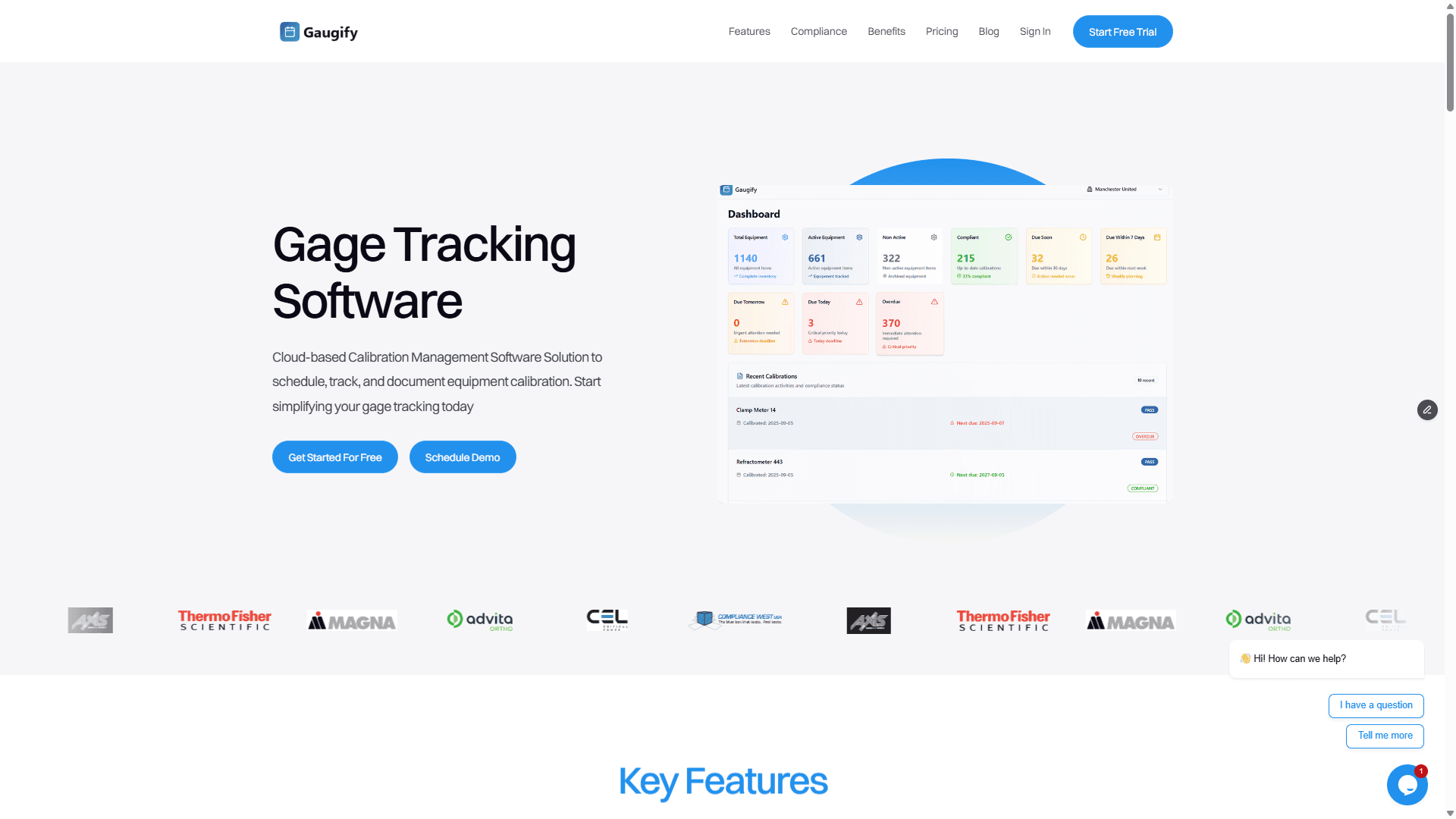
Executive dashboards provide instant visibility into calibration status, compliance metrics, and cost trends. Quality managers can see exactly which instruments are due, overdue, or at risk, with drill-down capabilities to certificate level detail. Mobile apps keep field technicians connected with real-time instrument status and digital certificate access.
Seamless Integration
Gaugify integrates with existing quality management systems, ERPs, and calibration service providers through APIs and standard data formats. You don't need to rebuild your entire quality infrastructure—Gaugify enhances what you already have while providing AI capabilities that transform efficiency.
The comprehensive feature set includes everything from basic instrument tracking to advanced analytics, all delivered through an intuitive cloud-based platform that requires no IT infrastructure investment.
Proven Results
Companies using Gaugify typically see:
40-60% reduction in calibration administrative time
25-35% optimization of calibration intervals and costs
Near-zero calibration-related audit findings
Improved measurement reliability through data-driven decision making
A medical device manufacturer in Massachusetts reduced their calibration program costs by $47,000 annually while improving compliance scores across all customer audits. Their quality manager now spends less than 5 hours per week on calibration administration, compared to 25+ hours with their previous spreadsheet system.
Transform Your Calibration Management Today
The calibration management challenges you're facing today will only get worse as equipment becomes more complex, regulations get stricter, and customer requirements become more demanding. Companies that continue relying on manual tracking systems and reactive scheduling will find themselves at a competitive disadvantage, struggling with higher costs, compliance issues, and operational inefficiencies.
But you don't have to accept this trajectory. AI calibration management 2026 technologies are available today, ready to transform your quality operations from reactive chaos to proactive control. The question isn't whether you'll eventually need to modernize your calibration management—it's whether you'll make the change proactively or be forced into it by audit failures, customer complaints, or competitive pressure.
Gaugify makes the transition straightforward and risk-free. Our cloud-based platform requires no infrastructure investment, integrates seamlessly with existing systems, and delivers immediate improvements in efficiency and compliance. With comprehensive compliance features, intelligent automation, and predictive analytics, you'll wonder how you managed calibrations manually for so long.
Don't let another month pass struggling with spreadsheets, hunting for certificates, and playing calibration catch-up. Start your free trial today and experience how AI-powered calibration management can transform your quality operations. Your future self—and your next auditor—will thank you.
Ready to see Gaugify in action with your specific calibration requirements? Schedule a personalized demo and discover exactly how much time, money, and stress you can save with modern calibration management.
How AI is Transforming Calibration Management in 2026
Picture this: It's 7:30 AM on Monday, and you're staring at a spreadsheet with 847 instruments due for calibration this quarter. Your Mitutoyo digital calipers are three weeks overdue, the pressure transducers in Building C haven't been touched in four months, and you just discovered that the torque wrench used on your aerospace contracts has an expired certificate. Meanwhile, your ISO 9001 audit is scheduled for next month, and you're drowning in manual tracking systems that can't keep up with the complexity of modern AI calibration management 2026 demands.
If this scenario sounds familiar, you're not alone. Quality managers across industries are discovering that traditional calibration management approaches—Excel spreadsheets, paper certificates, and reactive scheduling—are completely inadequate for today's regulatory environment and production demands.
The Hidden Epidemic: Why Manual Calibration Tracking is Failing More Companies Than Ever
Most quality managers believe their calibration program is "under control" because they haven't failed an audit recently. But here's what's happening behind the scenes: companies are spending 40% more time on calibration administration than they did five years ago, while simultaneously facing tighter tolerances, more frequent audit requirements, and exponentially more complex measurement equipment.
Consider the typical machine shop today versus 2020. You're not just tracking basic micrometers and height gages anymore. Your measurement arsenal includes:
Coordinate measuring machines (CMMs) with multiple probe configurations
Digital indicators with ±0.0001" tolerances
Smart torque wrenches with Bluetooth connectivity
Environmental monitoring systems for temperature and humidity
Optical comparators with digital readouts
Surface roughness testers
Hardness testers across multiple scales (Rockwell, Brinell, Vickers)
Each instrument has unique calibration intervals, multiple measurement ranges, and specific environmental requirements. Your 6-inch digital caliper might need annual calibration, but your 12-inch model requires semi-annual service due to different usage patterns. Your CMM needs monthly performance verification plus annual full calibration, and don't forget about the temperature compensation software that needs its own validation cycle.
The complexity isn't just in the equipment—it's in the documentation requirements. AS9100 aerospace customers want to see calibration uncertainty calculations. ISO 13485 medical device auditors require risk-based calibration intervals. FDA inspectors demand complete traceability chains back to NIST standards.
The Real-World Consequences: What Happens When Calibration Management Breaks Down
Let me share what happened to a Tier 1 automotive supplier in Michigan last year. During a customer audit, inspectors discovered that pressure gages used for hydraulic testing had been calibrated with an expired master standard. The downstream impact? $180,000 in product recalls, a 90-day production hold, and loss of preferred supplier status with their largest customer.
The most devastating part? This wasn't a case of negligence. The quality manager was experienced and detail-oriented. But when you're manually tracking 400+ instruments across three facilities using spreadsheets and paper certificates, critical details slip through the cracks.
Here's what calibration management failures actually cost companies:
Immediate Financial Impact:
Rush calibration fees (typically 150-300% of standard rates)
Production downtime while instruments are expedited for service
Product holds and potential scrap of work performed with out-of-tolerance equipment
Emergency purchasing of backup instruments
Audit and Compliance Consequences:
Major non-conformances that trigger corrective action requirements
Increased audit frequency and scrutiny
Customer notifications and potential loss of approved supplier status
Regulatory reporting requirements for industries like medical devices and aerospace
Hidden Productivity Losses:
Quality managers spending 20+ hours per week on calibration administration
Production delays while hunting down calibration certificates
Redundant measurements and inspections due to uncertainty about instrument status
Employee frustration and turnover in quality departments
A precision machining company in Ohio calculated that calibration-related inefficiencies were costing them 312 hours of productive time annually—equivalent to hiring an additional part-time quality technician just to handle the administrative burden.
Root Causes: Why Traditional Calibration Management Can't Handle Modern Demands
The fundamental problem isn't that quality managers are making mistakes—it's that they're using Stone Age tools to solve Space Age problems. Here are the core issues plaguing calibration management today:
Information Fragmentation: Your calibration data is scattered across multiple systems. Certificates are stored in file cabinets, due dates are tracked in Excel, calibration procedures live in SharePoint, and instrument locations are maintained in yet another system. When an auditor asks for the complete calibration history of your surface plate, you're scrambling through four different sources to piece together the story.
Reactive Scheduling: Most companies operate in crisis mode, only addressing calibrations when instruments are already overdue. This creates a cascade of problems: rush fees, production interruptions, and the constant stress of playing catch-up. Worse yet, reactive scheduling makes it impossible to optimize calibration routes or negotiate better rates with service providers.
Limited Visibility: Without real-time visibility into calibration status, managers make decisions based on outdated information. That digital indicator might show "calibrated" in your spreadsheet, but the actual certificate expired last week while the instrument was checked out to the floor.
Inconsistent Processes: Different technicians follow different procedures for the same instruments. One person might perform a 5-point calibration on pressure gages while another does 3-point. These inconsistencies create measurement uncertainty and make it impossible to establish reliable calibration intervals.
Poor Data Analysis: Excel spreadsheets can tell you what's due for calibration, but they can't identify trends, optimize intervals, or predict which instruments are likely to fail. You're missing opportunities to reduce costs and improve reliability through data-driven decision making.
This is where AI calibration management 2026 technologies become game-changers, offering predictive insights and automated workflows that transform reactive chaos into proactive control.
The AI Revolution: How Smart Calibration Management Solves These Problems
Artificial intelligence isn't just buzzword technology—it's fundamentally changing how smart companies approach calibration management. Here's exactly how AI transforms each problem area:
Predictive Calibration Scheduling
Instead of rigid annual or semi-annual intervals, AI analyzes historical calibration data to predict the optimal calibration frequency for each instrument. For example, if your 6-inch digital calipers consistently pass calibration with minimal drift over 18 months, while your 12-inch models show significant wear after 8 months, AI algorithms automatically adjust intervals to match actual performance patterns.
A contract manufacturer in Texas implemented AI-driven interval optimization and reduced their annual calibration costs by 28% while actually improving measurement reliability. Their Mitutoyo height gages that were previously calibrated every 12 months are now serviced every 15 months based on drift analysis, while high-usage micrometers moved to 9-month intervals after AI identified early degradation patterns.
Intelligent Risk Assessment
AI systems continuously evaluate calibration risk based on multiple factors: instrument type, usage frequency, environmental conditions, historical performance, and criticality to quality outcomes. When your CMM probe starts showing drift patterns that precede failures, the system flags it for early attention rather than waiting for the scheduled interval.
This risk-based approach aligns perfectly with ISO 9001:2015 requirements while providing practical benefits. Instead of treating all instruments equally, you focus resources where they'll have the greatest impact on quality outcomes.
Automated Compliance Monitoring
AI-powered calibration systems automatically verify that all calibrations meet customer-specific requirements. When you receive a new AS9100 contract requiring calibration uncertainty ratios of 4:1, the system immediately identifies which instruments and procedures need updating. No more manual cross-referencing of customer requirements against calibration capabilities.
The system also monitors regulatory changes and industry standards updates, ensuring your calibration program stays current without constant manual oversight. When ASTM releases new calibration procedures or measurement uncertainty requirements change, you're automatically notified and guided through implementation.
Smart Resource Optimization
AI algorithms optimize calibration scheduling to minimize production disruption and reduce costs. The system considers factors like instrument location, calibration provider availability, production schedules, and cost optimization to create efficient calibration routes and timing.
For example, instead of calibrating instruments individually as they come due, AI can group calibrations by location, service provider, or production downtime windows to maximize efficiency and minimize costs.
Ready to experience how AI calibration management 2026 can transform your quality operations? Start your free trial today and see immediate improvements in calibration efficiency and compliance.
Step-by-Step Implementation: Building Your AI Calibration Management System
Implementing AI-powered calibration management doesn't require a complete system overhaul. Here's the proven approach that gets results quickly while building toward long-term optimization:
Phase 1: Data Foundation (Weeks 1-2)
Start by consolidating your instrument database into a single, accurate system. This means:
Creating unique identifiers for each instrument (move beyond generic "Caliper #1" labels)
Recording complete specifications: make, model, serial number, measurement ranges, and accuracy requirements
Documenting current calibration status with actual certificate dates, not spreadsheet estimates
Establishing instrument criticality levels based on quality impact and customer requirements
For example, your Starrett micrometers used for aerospace components get "Critical" classification with 4:1 uncertainty requirements, while general shop calipers might be classified as "Standard" with 3:1 ratios acceptable.
Phase 2: Process Standardization (Weeks 3-4)
Document and standardize your calibration procedures to ensure consistent data for AI analysis:
Define calibration points and procedures for each instrument type
Establish measurement uncertainty requirements by customer and application
Create standardized data collection formats that feed AI algorithms
Set up automated notifications for due dates, overdue items, and compliance issues
This standardization phase is crucial—AI systems need consistent, quality data to generate reliable predictions and recommendations.
Phase 3: AI Activation (Weeks 5-6)
With clean data and standardized processes, activate AI features progressively:
Enable predictive scheduling based on historical calibration results
Implement risk-based interval optimization
Activate automated compliance monitoring for customer-specific requirements
Set up intelligent reporting and dashboard analytics
Phase 4: Continuous Optimization (Ongoing)
AI systems improve over time as they collect more data. Focus on:
Regular review of AI recommendations and interval adjustments
Analysis of cost savings and efficiency improvements
Expansion to additional instrument categories and locations
Integration with other quality management systems
A precision manufacturing company in California reported 35% reduction in calibration administrative time within 60 days of implementing AI-powered management, with ongoing improvements as the system learned their specific patterns and requirements.
How Gaugify Delivers AI Calibration Management 2026 Solutions Today
Gaugify isn't just another calibration tracking system—it's a comprehensive AI-powered platform designed specifically for modern quality management challenges. Here's how Gaugify prevents the calibration chaos described earlier:
Intelligent Predictive Analytics
Gaugify's AI engine analyzes your calibration history, usage patterns, and environmental factors to predict optimal calibration intervals. Instead of arbitrary annual schedules, you get data-driven recommendations that reduce costs while improving reliability. The system learns from every calibration result, continuously refining predictions to match your specific operational conditions.
Automated Compliance Management
Built-in compliance modules automatically verify adherence to ISO 17025, AS9100, ISO 13485, and other standards. Customer-specific requirements are automatically applied to relevant instruments, ensuring every calibration meets the right criteria without manual cross-referencing. When regulations change, the system updates requirements automatically.
Smart Scheduling and Resource Optimization
Gaugify's scheduling engine optimizes calibration timing based on production schedules, instrument availability, service provider capacity, and cost considerations. The system groups calibrations efficiently, minimizes production disruption, and helps negotiate better rates through volume scheduling.
Real-Time Visibility and Control
Executive dashboards provide instant visibility into calibration status, compliance metrics, and cost trends. Quality managers can see exactly which instruments are due, overdue, or at risk, with drill-down capabilities to certificate level detail. Mobile apps keep field technicians connected with real-time instrument status and digital certificate access.
Seamless Integration
Gaugify integrates with existing quality management systems, ERPs, and calibration service providers through APIs and standard data formats. You don't need to rebuild your entire quality infrastructure—Gaugify enhances what you already have while providing AI capabilities that transform efficiency.
The comprehensive feature set includes everything from basic instrument tracking to advanced analytics, all delivered through an intuitive cloud-based platform that requires no IT infrastructure investment.
Proven Results
Companies using Gaugify typically see:
40-60% reduction in calibration administrative time
25-35% optimization of calibration intervals and costs
Near-zero calibration-related audit findings
Improved measurement reliability through data-driven decision making
A medical device manufacturer in Massachusetts reduced their calibration program costs by $47,000 annually while improving compliance scores across all customer audits. Their quality manager now spends less than 5 hours per week on calibration administration, compared to 25+ hours with their previous spreadsheet system.
Transform Your Calibration Management Today
The calibration management challenges you're facing today will only get worse as equipment becomes more complex, regulations get stricter, and customer requirements become more demanding. Companies that continue relying on manual tracking systems and reactive scheduling will find themselves at a competitive disadvantage, struggling with higher costs, compliance issues, and operational inefficiencies.
But you don't have to accept this trajectory. AI calibration management 2026 technologies are available today, ready to transform your quality operations from reactive chaos to proactive control. The question isn't whether you'll eventually need to modernize your calibration management—it's whether you'll make the change proactively or be forced into it by audit failures, customer complaints, or competitive pressure.
Gaugify makes the transition straightforward and risk-free. Our cloud-based platform requires no infrastructure investment, integrates seamlessly with existing systems, and delivers immediate improvements in efficiency and compliance. With comprehensive compliance features, intelligent automation, and predictive analytics, you'll wonder how you managed calibrations manually for so long.
Don't let another month pass struggling with spreadsheets, hunting for certificates, and playing calibration catch-up. Start your free trial today and experience how AI-powered calibration management can transform your quality operations. Your future self—and your next auditor—will thank you.
Ready to see Gaugify in action with your specific calibration requirements? Schedule a personalized demo and discover exactly how much time, money, and stress you can save with modern calibration management.