
How to Benchmark Your Calibration Program
How to Benchmark Your Calibration Program
David Bentley
Quality Assurance Engineer
12 min read
How to Benchmark Your Calibration Program
When a major aerospace manufacturer discovered their calibration cycle times were 40% longer than industry standards during an AS9100 audit, it sparked a comprehensive review that ultimately saved them $200,000 annually in reduced downtime and improved efficiency. This scenario highlights why learning how to benchmark calibration program performance is critical for any organization managing measurement equipment.
Benchmarking your calibration program against industry standards and best practices isn't just about compliance—it's about optimizing costs, reducing equipment downtime, and ensuring measurement reliability. Whether you're managing 50 gages in a machine shop or 5,000 instruments across multiple facilities, systematic benchmarking reveals opportunities for improvement that directly impact your bottom line.
Why Calibration Program Benchmarking Matters
Without proper benchmarking, calibration programs operate in a vacuum, making it impossible to identify inefficiencies or validate performance. Consider these common scenarios that occur when organizations fail to benchmark their calibration programs:
A medical device manufacturer discovered they were calibrating their Mitutoyo digital calipers every 6 months while competitors safely extended intervals to 12 months based on stability data. This over-calibration was costing them $15,000 annually in unnecessary calibration fees and production interruptions.
An automotive parts supplier found their calibration recall rate was 85% compared to the industry average of 95%, indicating potential quality issues. Further investigation revealed inadequate environmental controls in their gage storage area, leading to premature drift in their Starrett micrometers and dial indicators.
A pharmaceutical lab learned their average calibration turnaround time of 14 days far exceeded the industry benchmark of 5-7 days, creating bottlenecks in their production schedule and forcing them to maintain excessive backup inventory of critical instruments like analytical balances and pH meters.
Financial Impact of Poor Calibration Performance
The cost of an unoptimized calibration program extends beyond direct calibration expenses. Late deliveries due to equipment unavailability can result in penalty clauses, while measurement uncertainties from poorly managed programs can lead to product recalls or customer complaints. Quality managers who benchmark their programs typically identify 15-25% cost reduction opportunities within the first year.
Prerequisites for Effective Calibration Program Benchmarking
Before you can effectively benchmark your calibration program, you need reliable data collection systems and clearly defined metrics. Here's what you'll need to establish:
Essential Data Collection Requirements
Your calibration management system must track key performance indicators with sufficient detail for meaningful analysis. At minimum, you need to capture:
Calibration interval data - Current intervals for each instrument type, including justification for interval assignments
As-found vs. as-left results - Measurement data showing instrument condition before and after calibration
Turnaround times - Complete cycle from equipment removal to return to service
Cost per calibration - Including internal labor, external service provider fees, and transportation costs
Recall compliance rates - Percentage of instruments calibrated on or before due dates
Out-of-tolerance rates - Frequency of instruments found outside acceptable limits during calibration
Modern calibration management software automatically captures most of this data, but legacy paper-based systems require manual compilation that can be time-intensive and error-prone.
Establishing Baseline Metrics
Calculate your current performance across all key metrics using at least 12 months of historical data to account for seasonal variations. For example, if you're tracking the performance of your pressure gage calibrations, you might find that your current metrics look like this:
Average calibration interval: 12 months
Average turnaround time: 8.5 days
Out-of-tolerance rate: 3.2%
Recall compliance rate: 92%
Cost per calibration: $145
Step-by-Step Guide to Benchmark Your Calibration Program
Step 1: Identify Relevant Industry Benchmarks
Industry benchmarks vary significantly based on your sector, criticality of measurements, and regulatory requirements. Start by consulting these authoritative sources:
ANSI/NCSL Z540.3 provides guidelines for calibration interval determination and suggests benchmark ranges for various instrument categories. For example, mechanical gages typically maintain stability allowing 12-24 month intervals, while electronic instruments may require 6-12 month cycles.
Industry trade associations often publish calibration performance surveys. The American Society for Quality (ASQ) Measurement Quality Division releases annual benchmarking data showing median performance across different sectors.
Accreditation body guidance from organizations like A2LA or ACLASS provides insight into calibration program expectations during ISO 17025 assessments.
Step 2: Segment Your Analysis by Equipment Categories
Avoid the trap of analyzing your entire program as a single entity. Different instrument types have vastly different performance characteristics and benchmarks. Create meaningful segments such as:
Dimensional measurement tools (calipers, micrometers, height gages) - typically stable with longer intervals
Force and torque instruments (torque wrenches, load cells) - subject to wear requiring closer monitoring
Electronic test equipment (multimeters, oscilloscopes) - temperature sensitive with moderate stability
Analytical instruments (balances, pH meters, spectrophotometers) - high precision requiring frequent calibration
Step 3: Compare Performance Against Industry Standards
For each equipment category, compare your metrics against established benchmarks. Here's how a typical analysis might look for dimensional gages:
Your Performance vs. Industry Benchmark:
Calibration interval: 12 months (Industry: 18 months) - Opportunity for extension
Out-of-tolerance rate: 2.1% (Industry: 3-5%) - Good performance, intervals could be extended
Turnaround time: 12 days (Industry: 7 days) - Process improvement needed
Cost per calibration: $85 (Industry: $75) - Cost reduction opportunity
Step 4: Analyze Root Causes of Performance Gaps
When you identify performance gaps, dig deeper to understand underlying causes. Extended turnaround times might result from:
Inadequate backup instrument inventory
Inefficient routing to external calibration providers
Lack of on-site calibration capabilities for routine instruments
Poor coordination between production and calibration scheduling
High calibration costs could stem from over-reliance on external providers for simple calibrations that could be performed in-house, or failure to negotiate volume discounts with service providers.
Step 5: Develop Improvement Action Plans
Create specific, measurable improvement plans for each identified gap. For example, if your torque wrench recall compliance rate is 88% versus the industry benchmark of 95%, your action plan might include:
Implement automated recall notifications 30 and 60 days before due dates
Establish backup torque wrench inventory to eliminate "can't spare it" delays
Train production supervisors on calibration scheduling requirements
Set target improvement to 95% compliance within 6 months
Ready to implement systematic calibration program improvements? Start your free trial of Gaugify to access automated benchmarking tools and performance dashboards that make continuous improvement straightforward.
Best Practices from Experienced Calibration Professionals
Leverage Statistical Process Control for Interval Optimization
Experienced quality managers use control charts to track instrument stability over time. Plot as-found measurements for each instrument type to identify trends that suggest interval adjustments. For instance, if your Fluke digital multimeters consistently show minimal drift over 24 months, you have data to support interval extension from 12 to 18 months.
Implement Risk-Based Calibration Strategies
Not all instruments require identical treatment. Critical measurement equipment used for final inspection of safety-critical components warrants more conservative calibration intervals and tighter controls than shop floor gages used for rough sorting operations.
Develop a criticality matrix considering:
Impact on product quality if the instrument fails
Regulatory requirements specific to the measurement
Historical stability data for the instrument type
Cost of calibration versus risk of measurement error
Establish Peer Benchmarking Networks
Many successful calibration managers participate in informal benchmarking networks within their industry. These relationships provide real-world performance data that's more relevant than generic industry statistics. Consider joining calibration-focused professional groups or participating in industry consortium benchmarking studies.
Monitor Leading and Lagging Indicators
Effective calibration program benchmarking tracks both leading indicators (like scheduled calibration completion rates) and lagging indicators (like customer complaints related to measurement issues). This balanced approach enables proactive management while ensuring ultimate program effectiveness.
Common Benchmarking Mistakes and How to Avoid Them
Mistake 1: Using Inappropriate Benchmark Sources
Comparing your precision machining calibration program to pharmaceutical industry benchmarks will yield misleading results. Ensure your benchmark sources reflect similar:
Industry regulatory requirements
Measurement uncertainty demands
Production environment conditions
Quality system maturity levels
Mistake 2: Focusing Solely on Cost Reduction
While cost optimization is important, the cheapest calibration program isn't necessarily the best. A machining company that extended calibration intervals too aggressively saved $8,000 annually but experienced a product recall costing $150,000 when undetected gage drift led to out-of-specification parts reaching customers.
Balance cost considerations with quality risk assessment and regulatory compliance requirements.
Mistake 3: Ignoring Environmental and Usage Factors
Industry benchmarks represent average conditions. If your instruments operate in harsh environments or see heavy usage, applying standard benchmark intervals without adjustment can lead to quality issues. A foundry operation found that their standard 12-month caliper intervals were inadequate due to extreme temperature variations and particulate contamination, requiring adjustment to 6-month cycles.
Mistake 4: Insufficient Data Quality
Benchmarking based on incomplete or inaccurate data produces misleading conclusions. Ensure your calibration management system captures complete information including:
Actual calibration dates versus scheduled dates
Complete as-found measurement data
Environmental conditions during calibration
Calibration technician identification for quality trending
How Modern Calibration Software Simplifies Benchmarking
Traditional benchmarking requires manual data compilation from multiple sources—calibration certificates, spreadsheets, work orders, and cost accounting systems. This process is time-intensive and error-prone, often limiting benchmarking to annual exercises rather than continuous improvement activities.
Modern calibration management software transforms benchmarking from a periodic chore into an ongoing strategic tool. Cloud-based systems automatically capture and analyze the data needed for comprehensive program assessment.
Automated Performance Dashboards
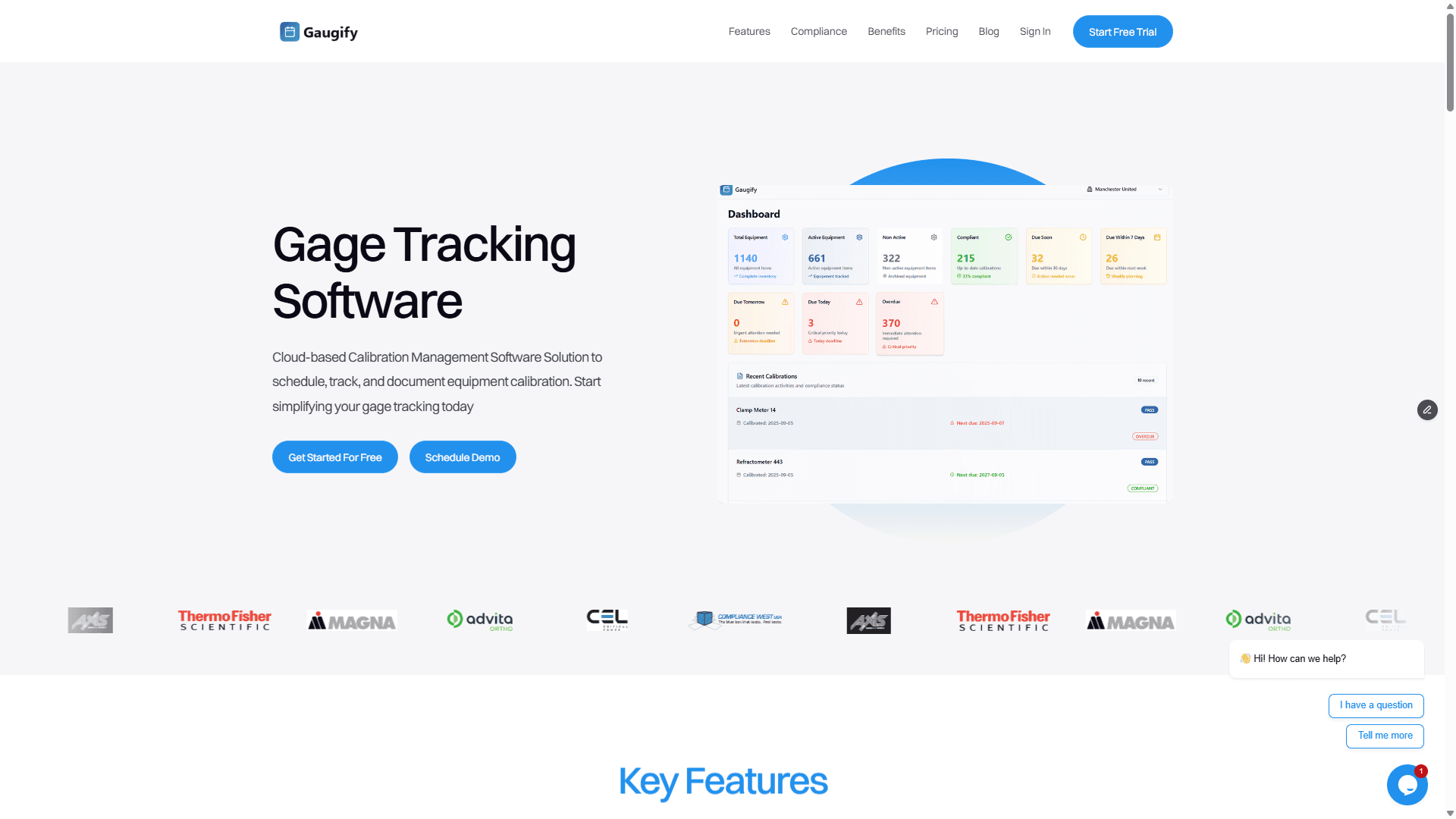
Real-time dashboards display key performance indicators without manual data compilation. Quality managers can monitor metrics like recall compliance rates, average turnaround times, and cost per calibration across different equipment categories, making it easy to spot trends and identify improvement opportunities.
Integrated Reporting and Analytics
Advanced calibration software generates detailed reports comparing your performance against configurable benchmarks. These reports can segment data by equipment type, location, calibration provider, or other relevant criteria, providing the granular analysis needed for targeted improvements.
Predictive Interval Optimization
Machine learning algorithms analyze historical calibration results to recommend optimal calibration intervals for each instrument. This data-driven approach eliminates guesswork and ensures intervals are based on actual performance rather than conservative estimates.
Streamlined Data Collection
Mobile applications allow calibration technicians to input results directly from the shop floor or lab, eliminating transcription errors and ensuring data completeness. Barcode scanning and digital signatures further improve data quality while reducing administrative overhead.
Implementing Continuous Calibration Program Improvement
Effective benchmarking isn't a one-time activity—it requires ongoing monitoring and adjustment as your program matures and industry standards evolve. Establish quarterly reviews of key performance indicators and annual comprehensive benchmarking assessments to ensure continuous improvement.
Consider implementing a formal calibration program improvement process that includes:
Monthly performance metric reviews
Quarterly benchmark comparisons for critical equipment categories
Annual comprehensive program assessments
Continuous training for calibration personnel on best practices
Regular evaluation of new technologies and methodologies
Measuring Return on Investment
Track the financial impact of benchmarking-driven improvements to demonstrate program value and justify future investments. Typical ROI measurements include:
Reduced calibration costs through interval optimization
Decreased equipment downtime from improved scheduling
Lower inventory carrying costs from better backup instrument management
Avoided quality costs from improved measurement reliability
A mid-size manufacturer documented $95,000 in annual savings after implementing systematic benchmarking, primarily through calibration interval extensions supported by statistical analysis and improved vendor management.
Start Benchmarking Your Calibration Program Today
Systematic calibration program benchmarking provides the data-driven insights needed to optimize costs, improve efficiency, and ensure measurement reliability. Whether you're managing a small machine shop or a complex multi-site operation, the principles and practices outlined in this guide will help you identify improvement opportunities and implement effective solutions.
The key to successful benchmarking lies in consistent data collection, appropriate benchmark selection, and systematic analysis of performance gaps. Modern calibration management software eliminates the manual effort traditionally required for comprehensive program assessment, making continuous improvement practical and sustainable.
Ready to transform your calibration program performance? Start your free trial of Gaugify today and discover how automated benchmarking tools can help you optimize your calibration program. With built-in performance dashboards, comprehensive reporting, and intelligent analytics, you'll have everything needed to benchmark your calibration program effectively and drive continuous improvement across your organization.
How to Benchmark Your Calibration Program
When a major aerospace manufacturer discovered their calibration cycle times were 40% longer than industry standards during an AS9100 audit, it sparked a comprehensive review that ultimately saved them $200,000 annually in reduced downtime and improved efficiency. This scenario highlights why learning how to benchmark calibration program performance is critical for any organization managing measurement equipment.
Benchmarking your calibration program against industry standards and best practices isn't just about compliance—it's about optimizing costs, reducing equipment downtime, and ensuring measurement reliability. Whether you're managing 50 gages in a machine shop or 5,000 instruments across multiple facilities, systematic benchmarking reveals opportunities for improvement that directly impact your bottom line.
Why Calibration Program Benchmarking Matters
Without proper benchmarking, calibration programs operate in a vacuum, making it impossible to identify inefficiencies or validate performance. Consider these common scenarios that occur when organizations fail to benchmark their calibration programs:
A medical device manufacturer discovered they were calibrating their Mitutoyo digital calipers every 6 months while competitors safely extended intervals to 12 months based on stability data. This over-calibration was costing them $15,000 annually in unnecessary calibration fees and production interruptions.
An automotive parts supplier found their calibration recall rate was 85% compared to the industry average of 95%, indicating potential quality issues. Further investigation revealed inadequate environmental controls in their gage storage area, leading to premature drift in their Starrett micrometers and dial indicators.
A pharmaceutical lab learned their average calibration turnaround time of 14 days far exceeded the industry benchmark of 5-7 days, creating bottlenecks in their production schedule and forcing them to maintain excessive backup inventory of critical instruments like analytical balances and pH meters.
Financial Impact of Poor Calibration Performance
The cost of an unoptimized calibration program extends beyond direct calibration expenses. Late deliveries due to equipment unavailability can result in penalty clauses, while measurement uncertainties from poorly managed programs can lead to product recalls or customer complaints. Quality managers who benchmark their programs typically identify 15-25% cost reduction opportunities within the first year.
Prerequisites for Effective Calibration Program Benchmarking
Before you can effectively benchmark your calibration program, you need reliable data collection systems and clearly defined metrics. Here's what you'll need to establish:
Essential Data Collection Requirements
Your calibration management system must track key performance indicators with sufficient detail for meaningful analysis. At minimum, you need to capture:
Calibration interval data - Current intervals for each instrument type, including justification for interval assignments
As-found vs. as-left results - Measurement data showing instrument condition before and after calibration
Turnaround times - Complete cycle from equipment removal to return to service
Cost per calibration - Including internal labor, external service provider fees, and transportation costs
Recall compliance rates - Percentage of instruments calibrated on or before due dates
Out-of-tolerance rates - Frequency of instruments found outside acceptable limits during calibration
Modern calibration management software automatically captures most of this data, but legacy paper-based systems require manual compilation that can be time-intensive and error-prone.
Establishing Baseline Metrics
Calculate your current performance across all key metrics using at least 12 months of historical data to account for seasonal variations. For example, if you're tracking the performance of your pressure gage calibrations, you might find that your current metrics look like this:
Average calibration interval: 12 months
Average turnaround time: 8.5 days
Out-of-tolerance rate: 3.2%
Recall compliance rate: 92%
Cost per calibration: $145
Step-by-Step Guide to Benchmark Your Calibration Program
Step 1: Identify Relevant Industry Benchmarks
Industry benchmarks vary significantly based on your sector, criticality of measurements, and regulatory requirements. Start by consulting these authoritative sources:
ANSI/NCSL Z540.3 provides guidelines for calibration interval determination and suggests benchmark ranges for various instrument categories. For example, mechanical gages typically maintain stability allowing 12-24 month intervals, while electronic instruments may require 6-12 month cycles.
Industry trade associations often publish calibration performance surveys. The American Society for Quality (ASQ) Measurement Quality Division releases annual benchmarking data showing median performance across different sectors.
Accreditation body guidance from organizations like A2LA or ACLASS provides insight into calibration program expectations during ISO 17025 assessments.
Step 2: Segment Your Analysis by Equipment Categories
Avoid the trap of analyzing your entire program as a single entity. Different instrument types have vastly different performance characteristics and benchmarks. Create meaningful segments such as:
Dimensional measurement tools (calipers, micrometers, height gages) - typically stable with longer intervals
Force and torque instruments (torque wrenches, load cells) - subject to wear requiring closer monitoring
Electronic test equipment (multimeters, oscilloscopes) - temperature sensitive with moderate stability
Analytical instruments (balances, pH meters, spectrophotometers) - high precision requiring frequent calibration
Step 3: Compare Performance Against Industry Standards
For each equipment category, compare your metrics against established benchmarks. Here's how a typical analysis might look for dimensional gages:
Your Performance vs. Industry Benchmark:
Calibration interval: 12 months (Industry: 18 months) - Opportunity for extension
Out-of-tolerance rate: 2.1% (Industry: 3-5%) - Good performance, intervals could be extended
Turnaround time: 12 days (Industry: 7 days) - Process improvement needed
Cost per calibration: $85 (Industry: $75) - Cost reduction opportunity
Step 4: Analyze Root Causes of Performance Gaps
When you identify performance gaps, dig deeper to understand underlying causes. Extended turnaround times might result from:
Inadequate backup instrument inventory
Inefficient routing to external calibration providers
Lack of on-site calibration capabilities for routine instruments
Poor coordination between production and calibration scheduling
High calibration costs could stem from over-reliance on external providers for simple calibrations that could be performed in-house, or failure to negotiate volume discounts with service providers.
Step 5: Develop Improvement Action Plans
Create specific, measurable improvement plans for each identified gap. For example, if your torque wrench recall compliance rate is 88% versus the industry benchmark of 95%, your action plan might include:
Implement automated recall notifications 30 and 60 days before due dates
Establish backup torque wrench inventory to eliminate "can't spare it" delays
Train production supervisors on calibration scheduling requirements
Set target improvement to 95% compliance within 6 months
Ready to implement systematic calibration program improvements? Start your free trial of Gaugify to access automated benchmarking tools and performance dashboards that make continuous improvement straightforward.
Best Practices from Experienced Calibration Professionals
Leverage Statistical Process Control for Interval Optimization
Experienced quality managers use control charts to track instrument stability over time. Plot as-found measurements for each instrument type to identify trends that suggest interval adjustments. For instance, if your Fluke digital multimeters consistently show minimal drift over 24 months, you have data to support interval extension from 12 to 18 months.
Implement Risk-Based Calibration Strategies
Not all instruments require identical treatment. Critical measurement equipment used for final inspection of safety-critical components warrants more conservative calibration intervals and tighter controls than shop floor gages used for rough sorting operations.
Develop a criticality matrix considering:
Impact on product quality if the instrument fails
Regulatory requirements specific to the measurement
Historical stability data for the instrument type
Cost of calibration versus risk of measurement error
Establish Peer Benchmarking Networks
Many successful calibration managers participate in informal benchmarking networks within their industry. These relationships provide real-world performance data that's more relevant than generic industry statistics. Consider joining calibration-focused professional groups or participating in industry consortium benchmarking studies.
Monitor Leading and Lagging Indicators
Effective calibration program benchmarking tracks both leading indicators (like scheduled calibration completion rates) and lagging indicators (like customer complaints related to measurement issues). This balanced approach enables proactive management while ensuring ultimate program effectiveness.
Common Benchmarking Mistakes and How to Avoid Them
Mistake 1: Using Inappropriate Benchmark Sources
Comparing your precision machining calibration program to pharmaceutical industry benchmarks will yield misleading results. Ensure your benchmark sources reflect similar:
Industry regulatory requirements
Measurement uncertainty demands
Production environment conditions
Quality system maturity levels
Mistake 2: Focusing Solely on Cost Reduction
While cost optimization is important, the cheapest calibration program isn't necessarily the best. A machining company that extended calibration intervals too aggressively saved $8,000 annually but experienced a product recall costing $150,000 when undetected gage drift led to out-of-specification parts reaching customers.
Balance cost considerations with quality risk assessment and regulatory compliance requirements.
Mistake 3: Ignoring Environmental and Usage Factors
Industry benchmarks represent average conditions. If your instruments operate in harsh environments or see heavy usage, applying standard benchmark intervals without adjustment can lead to quality issues. A foundry operation found that their standard 12-month caliper intervals were inadequate due to extreme temperature variations and particulate contamination, requiring adjustment to 6-month cycles.
Mistake 4: Insufficient Data Quality
Benchmarking based on incomplete or inaccurate data produces misleading conclusions. Ensure your calibration management system captures complete information including:
Actual calibration dates versus scheduled dates
Complete as-found measurement data
Environmental conditions during calibration
Calibration technician identification for quality trending
How Modern Calibration Software Simplifies Benchmarking
Traditional benchmarking requires manual data compilation from multiple sources—calibration certificates, spreadsheets, work orders, and cost accounting systems. This process is time-intensive and error-prone, often limiting benchmarking to annual exercises rather than continuous improvement activities.
Modern calibration management software transforms benchmarking from a periodic chore into an ongoing strategic tool. Cloud-based systems automatically capture and analyze the data needed for comprehensive program assessment.
Automated Performance Dashboards
Real-time dashboards display key performance indicators without manual data compilation. Quality managers can monitor metrics like recall compliance rates, average turnaround times, and cost per calibration across different equipment categories, making it easy to spot trends and identify improvement opportunities.
Integrated Reporting and Analytics
Advanced calibration software generates detailed reports comparing your performance against configurable benchmarks. These reports can segment data by equipment type, location, calibration provider, or other relevant criteria, providing the granular analysis needed for targeted improvements.
Predictive Interval Optimization
Machine learning algorithms analyze historical calibration results to recommend optimal calibration intervals for each instrument. This data-driven approach eliminates guesswork and ensures intervals are based on actual performance rather than conservative estimates.
Streamlined Data Collection
Mobile applications allow calibration technicians to input results directly from the shop floor or lab, eliminating transcription errors and ensuring data completeness. Barcode scanning and digital signatures further improve data quality while reducing administrative overhead.
Implementing Continuous Calibration Program Improvement
Effective benchmarking isn't a one-time activity—it requires ongoing monitoring and adjustment as your program matures and industry standards evolve. Establish quarterly reviews of key performance indicators and annual comprehensive benchmarking assessments to ensure continuous improvement.
Consider implementing a formal calibration program improvement process that includes:
Monthly performance metric reviews
Quarterly benchmark comparisons for critical equipment categories
Annual comprehensive program assessments
Continuous training for calibration personnel on best practices
Regular evaluation of new technologies and methodologies
Measuring Return on Investment
Track the financial impact of benchmarking-driven improvements to demonstrate program value and justify future investments. Typical ROI measurements include:
Reduced calibration costs through interval optimization
Decreased equipment downtime from improved scheduling
Lower inventory carrying costs from better backup instrument management
Avoided quality costs from improved measurement reliability
A mid-size manufacturer documented $95,000 in annual savings after implementing systematic benchmarking, primarily through calibration interval extensions supported by statistical analysis and improved vendor management.
Start Benchmarking Your Calibration Program Today
Systematic calibration program benchmarking provides the data-driven insights needed to optimize costs, improve efficiency, and ensure measurement reliability. Whether you're managing a small machine shop or a complex multi-site operation, the principles and practices outlined in this guide will help you identify improvement opportunities and implement effective solutions.
The key to successful benchmarking lies in consistent data collection, appropriate benchmark selection, and systematic analysis of performance gaps. Modern calibration management software eliminates the manual effort traditionally required for comprehensive program assessment, making continuous improvement practical and sustainable.
Ready to transform your calibration program performance? Start your free trial of Gaugify today and discover how automated benchmarking tools can help you optimize your calibration program. With built-in performance dashboards, comprehensive reporting, and intelligent analytics, you'll have everything needed to benchmark your calibration program effectively and drive continuous improvement across your organization.