
How to Calibrate a Lux Meter or Light Meter
How to Calibrate a Lux Meter or Light Meter
David Bentley
Quality Assurance Engineer
12 min read
How to Calibrate a Lux Meter or Light Meter
Lux meter calibration is a critical process that ensures accurate illuminance measurements in workplace safety assessments, energy audits, photography studios, and quality control environments. Whether you're using a simple handheld lux meter or a sophisticated spectroradiometer, maintaining measurement accuracy through proper calibration procedures protects your operations from costly errors and regulatory non-compliance.
Modern facilities rely on precise light measurements for everything from OSHA workplace lighting compliance to pharmaceutical clean room validation. A poorly calibrated lux meter can lead to inadequate lighting conditions that compromise worker safety, failed quality audits, or energy inefficiency costing thousands in operational expenses.
Understanding Lux Meters and Illuminance Measurement
A lux meter, also called an illuminance meter or light meter, measures the amount of light falling on a surface in units of lux (lumens per square meter). These instruments typically consist of a photodiode sensor with spectral response correction filters and a digital display unit.
Common lux meter types include:
Basic handheld meters: Range 0-50,000 lux, ±3-5% accuracy (Extech LT300, REED R8150)
Professional-grade meters: Range 0-200,000+ lux, ±2-3% accuracy (Konica Minolta T-10A, Hagner EC1-X)
Data logging meters: Continuous monitoring capability (Onset HOBO UX90-006)
Spectroradiometers: Full spectrum analysis (Photo Research PR-788, Konica Minolta CL-500A)
These instruments measure illuminance for applications including architectural lighting design, workplace safety compliance, horticultural lighting optimization, and photographic exposure control. The accuracy of these measurements directly impacts safety decisions, energy efficiency calculations, and quality control processes.
Why Lux Meter Calibration Is Critical
Lux meter calibration ensures measurement traceability to national standards and prevents costly errors in lighting assessments. The photosensitive components in these instruments drift over time due to aging, exposure to intense light sources, temperature cycling, and mechanical stress.
Consider these real-world consequences of poor lux meter calibration:
Safety compliance failures: OSHA requires minimum 50 lux for walkways and 500+ lux for detailed work areas. A 10% low-reading error could result in unsafe lighting conditions and regulatory violations.
Energy audit inaccuracies: Lighting retrofits based on incorrect baseline measurements can lead to over-specification, wasting 15-30% on unnecessary equipment costs.
Quality control issues: Pharmaceutical and electronics manufacturing require specific lighting conditions for inspection tasks. Measurement errors can cause good products to be rejected or defective products to pass inspection.
Failed third-party audits: ISO 9001, ISO 14001, and industry-specific standards require calibrated instruments for environmental monitoring.
Typical drift rates for lux meters range from 2-5% annually, with some older instruments showing 8-10% drift. Environmental factors like humidity, temperature extremes, and vibration can accelerate this degradation.
Step-by-Step Lux Meter Calibration Procedure
Professional lux meter calibration requires certified reference standards, controlled environmental conditions, and systematic measurement protocols. Here's the detailed procedure used by accredited calibration laboratories:
Required Equipment and Standards
Reference illuminance source: NIST-traceable tungsten-halogen lamp with known luminous intensity (typically 100W, 2856K color temperature)
Optical bench: 2-meter minimum length with precise distance measurement capability
Reference lux meter: Primary or secondary standard with uncertainty ≤1% (e.g., Gigahertz-Optik P-9710)
Neutral density filters: Calibrated filters for range verification
Environmental monitoring: Temperature, humidity, and ambient light measurement
Environmental Conditions
Maintain these conditions throughout the calibration process:
Temperature: 23°C ±2°C
Relative humidity: 45-75%
Ambient light: <1% of test illuminance levels
Vibration isolation: Optical table or stable surface
Air currents: Minimize to prevent lamp filament fluctuation
Calibration Steps
Step 1: Initial Inspection and Warm-up
Inspect the lux meter for physical damage, clean the sensor window with lens tissue, and power on for the manufacturer's specified warm-up period (typically 15-30 minutes). Record the instrument's serial number, model, and current firmware version.
Step 2: Zero Check
With the sensor completely covered (use the manufacturer's dark cap), verify the display reads zero or within the specified offset tolerance. Most meters should read 0.0 ±0.1 lux. Document any offset errors.
Step 3: Reference Point Calibration
Position the calibrated reference lamp at a measured distance to produce a known illuminance level. Use the inverse square law calculation: E = I/d², where E is illuminance (lux), I is luminous intensity (candela), and d is distance (meters). For a 100-candela source at 1 meter, the illuminance should be 100 lux.
Place both the reference standard and test meter at identical distances from the source. Compare readings and calculate the correction factor. The test meter should agree within its specified accuracy tolerance.
Step 4: Multi-Point Range Verification
Test at minimum five points across each measurement range:
10% of full scale
25% of full scale
50% of full scale
75% of full scale
90% of full scale
For a 0-20,000 lux range, test at approximately 2,000, 5,000, 10,000, 15,000, and 18,000 lux. Use varying distances or neutral density filters to achieve these levels.
Step 5: Repeatability Testing
Take 10 consecutive readings at each test point without moving the instrument. Calculate the standard deviation and verify it's within acceptable limits (typically <1% of reading for professional meters).
Step 6: Linearity Verification
Use calibrated neutral density filters to verify the meter's response linearity. A 50% transmission filter should produce a reading within 1% of exactly half the unfiltered value.
Relevant Calibration Standards for Lux Meter Calibration
Several national and international standards govern lux meter calibration procedures and acceptance criteria:
ISO/CIE 19476:2014 - Characterization of the performance of illuminance meters and luminance meters. This standard specifies test procedures for photometric instruments including spectral responsivity, cosine response, linearity, and temperature effects.
ASTM E1212-16 - Standard Practice for Measuring Light Reflectance of Machine-Readable Documents. While focused on document scanning, this standard provides guidance on illuminance measurement calibration for quality control applications.
IES LM-50-15 - Electronic Method for Measuring Luminous Flux of Light Sources Using a Goniophotometer with a Distant Detector. This Illuminating Engineering Society standard covers calibration of photometric instruments used in lighting measurement.
DIN 5032-7:2017 - Photometry - Part 7: Classification of illuminance meters and luminance meters. This German standard defines instrument classes and performance requirements.
Manufacturer specifications typically require calibration tolerances of:
Basic meters: ±5% of reading ±1 digit
Professional meters: ±3% of reading ±1 digit
Laboratory standards: ±1-2% of reading
For ISO 17025 compliance, calibration certificates must include measurement uncertainty calculations, typically 1.5-3% expanded uncertainty (k=2) for routine calibrations.
Calibration Frequency and Interval Determination
Lux meter calibration intervals depend on instrument type, usage patterns, environmental conditions, and accuracy requirements. Industry-standard recommendations include:
Annual calibration for most industrial and commercial applications. This interval provides good balance between measurement confidence and calibration costs for instruments used in routine facility lighting assessments.
Semi-annual calibration for critical applications including:
Pharmaceutical manufacturing clean rooms
Electronics assembly inspection stations
Research laboratory photometric measurements
Energy audit consultant instruments
Quarterly calibration may be required for:
Primary reference standards
Instruments exposed to extreme environmental conditions
High-usage portable meters (>20 hours/week)
Critical safety compliance applications
Monitor these factors that may require interval adjustment:
Drift history: Instruments showing >2% annual drift should have shorter intervals
Usage intensity: Frequent use accelerates sensor aging
Environmental exposure: High temperatures, humidity, or vibration increase drift rates
Critical measurements: Safety or regulatory applications may require conservative intervals
Ready to implement systematic lux meter calibration tracking? Start your free 30-day trial of Gaugify's calibration management platform and eliminate the spreadsheet chaos of manual calibration scheduling.
Common Lux Meter Calibration Mistakes and Prevention
Avoid these frequent calibration errors that compromise measurement accuracy and waste calibration budgets:
Inadequate Warm-up Time
Problem: Calibrating instruments immediately after power-on leads to unstable readings and false drift indications. LED-based meters typically stabilize within 5 minutes, while older photodiode designs may require 30+ minutes.
Solution: Always follow manufacturer warm-up specifications. Document warm-up time in calibration procedures and allow extra time for instruments stored in temperature extremes.
Contaminated Sensor Windows
Problem: Dust, fingerprints, or chemical residue on the sensor window causes consistent low readings. A thin film of contamination can reduce sensitivity by 2-5%.
Solution: Clean sensor windows with appropriate lens cleaning materials before calibration. Document cleaning procedures and train technicians on proper handling techniques.
Stray Light Contamination
Problem: Ambient light from windows, overhead fixtures, or reflective surfaces adds to the calibration source, causing erroneously high readings.
Solution: Perform calibrations in controlled lighting environments or use light-tight enclosures. Verify ambient light contributes <1% of the target illuminance level.
Incorrect Cosine Response
Problem: Many technicians only calibrate with the sensor perpendicular to the light source, missing angular response errors that affect real-world measurements.
Solution: Include angular response verification in comprehensive calibrations. Test at 30°, 45°, and 60° angles if the instrument will be used for non-perpendicular measurements.
Temperature Effects
Problem: Photodiode sensitivity changes with temperature, typically -0.1 to -0.2% per °C. Calibrating in air conditioning then using in hot environments introduces systematic errors.
Solution: Perform calibrations at typical use temperatures or apply temperature correction factors when available. Document environmental conditions on calibration certificates.
Range Switching Errors
Problem: Multi-range instruments may have different calibration factors for each range, but technicians often only calibrate the most commonly used range.
Solution: Calibrate all ranges that will be used in service. Verify range switching doesn't introduce discontinuities at transition points.
Streamlining Lux Meter Calibration Management with Gaugify
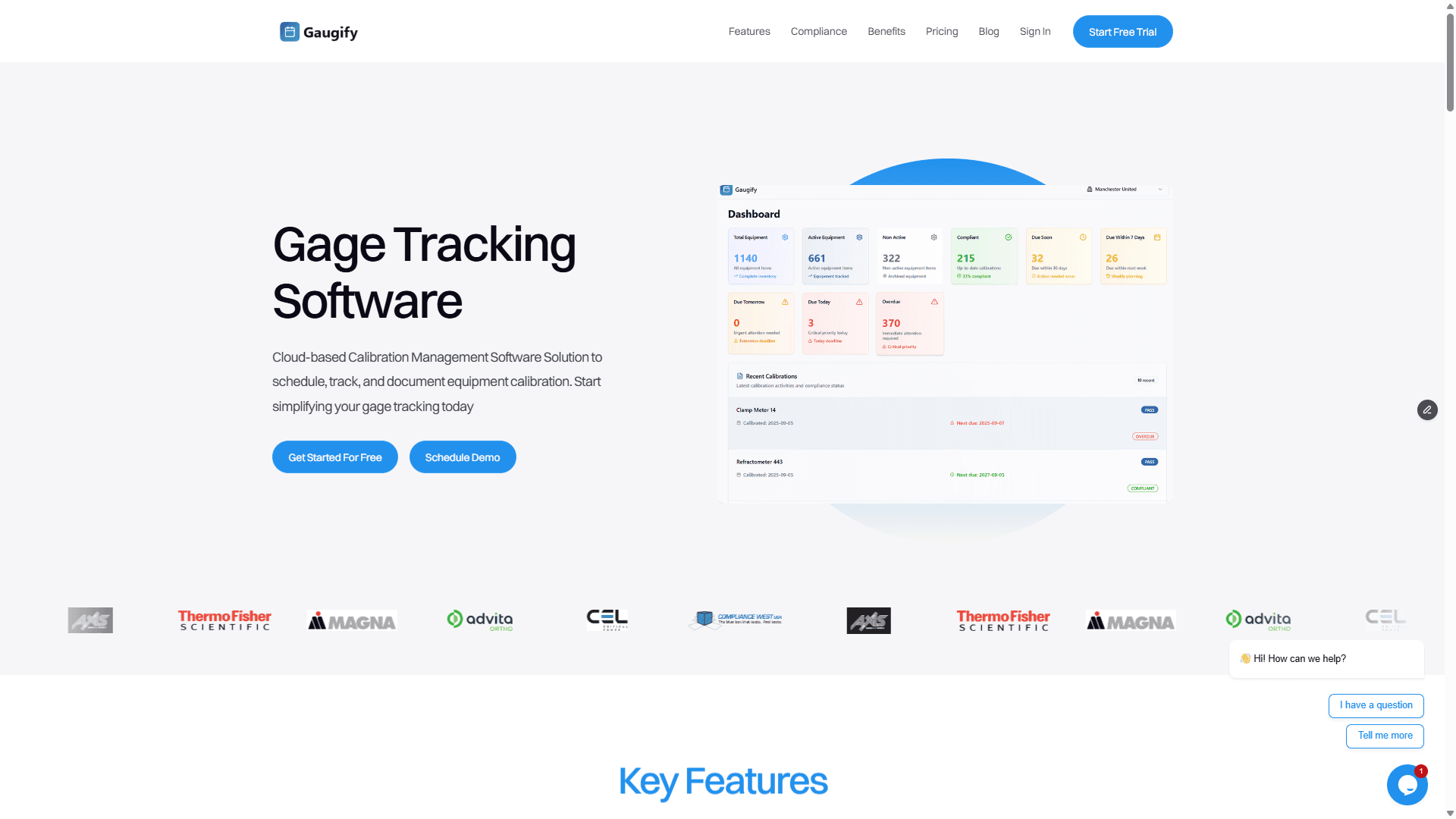
Managing lux meter calibration schedules, certificates, and compliance documentation becomes complex as your instrument population grows. Gaugify's cloud-based calibration management software eliminates manual tracking errors and ensures no critical instruments fall past due.
Automated Calibration Scheduling
Set custom calibration intervals for each lux meter based on manufacturer recommendations, usage intensity, and risk assessment. Gaugify automatically generates work orders and sends email notifications 30, 14, and 7 days before calibration due dates. No more missed calibrations or last-minute scrambles to maintain compliance.
The system tracks individual instrument history including:
Serial numbers and asset tags
Calibration intervals and next due dates
Assigned locations and responsible technicians
Manufacturer specifications and tolerance limits
Usage notes and environmental conditions
As-Found and As-Left Data Management
Document calibration results with built-in templates for lux meter testing. Record as-found readings before adjustment, then as-left values after calibration. The system automatically calculates measurement errors and flags instruments exceeding tolerance limits.
Key features include:
Digital calibration certificates with company branding
Measurement uncertainty calculations
Statistical trending of instrument drift patterns
Automatic limit checking against specifications
Photo documentation of instrument condition
Compliance Reporting and Audit Trails
Generate compliance reports instantly for internal audits, customer requirements, or regulatory inspections. Gaugify provides complete audit trails showing who performed calibrations, when instruments were last verified, and which standards were used.
The platform supports multiple compliance frameworks including:
ISO 9001:2015 quality management systems
ISO/IEC 17025:2017 testing and calibration laboratories
FDA 21 CFR Part 820 medical device manufacturing
cGMP pharmaceutical manufacturing
AS9100 aerospace quality standards
Integration with Existing Systems
Connect Gaugify with your CMMS, ERP, or laboratory information management system through REST APIs. Synchronize asset data, work orders, and calibration status automatically. Explore all available integrations and streamline your calibration workflows.
Mobile apps enable technicians to update calibration status, capture photos, and generate certificates directly from the measurement location. Offline functionality ensures data capture even in areas with poor network connectivity.
Take Control of Your Lux Meter Calibration Program
Proper lux meter calibration protects your operations from measurement errors that compromise safety, waste energy, and fail compliance requirements. Whether you're managing five handheld meters or fifty laboratory-grade instruments, systematic calibration tracking prevents costly oversights.
Gaugify's modern calibration management platform eliminates the spreadsheet chaos and manual processes that lead to missed calibrations. With automated scheduling, digital certificates, and comprehensive audit trails, you'll maintain measurement confidence while reducing administrative overhead.
Ready to modernize your calibration program? Start your free 30-day trial today and discover why hundreds of quality managers trust Gaugify to keep their instruments calibrated and compliant. No credit card required, and you'll have full access to all features during your trial period.
Questions about implementing lux meter calibration tracking for your specific requirements? Schedule a personalized demo with our calibration management experts and see how Gaugify adapts to your unique workflows and compliance needs.
How to Calibrate a Lux Meter or Light Meter
Lux meter calibration is a critical process that ensures accurate illuminance measurements in workplace safety assessments, energy audits, photography studios, and quality control environments. Whether you're using a simple handheld lux meter or a sophisticated spectroradiometer, maintaining measurement accuracy through proper calibration procedures protects your operations from costly errors and regulatory non-compliance.
Modern facilities rely on precise light measurements for everything from OSHA workplace lighting compliance to pharmaceutical clean room validation. A poorly calibrated lux meter can lead to inadequate lighting conditions that compromise worker safety, failed quality audits, or energy inefficiency costing thousands in operational expenses.
Understanding Lux Meters and Illuminance Measurement
A lux meter, also called an illuminance meter or light meter, measures the amount of light falling on a surface in units of lux (lumens per square meter). These instruments typically consist of a photodiode sensor with spectral response correction filters and a digital display unit.
Common lux meter types include:
Basic handheld meters: Range 0-50,000 lux, ±3-5% accuracy (Extech LT300, REED R8150)
Professional-grade meters: Range 0-200,000+ lux, ±2-3% accuracy (Konica Minolta T-10A, Hagner EC1-X)
Data logging meters: Continuous monitoring capability (Onset HOBO UX90-006)
Spectroradiometers: Full spectrum analysis (Photo Research PR-788, Konica Minolta CL-500A)
These instruments measure illuminance for applications including architectural lighting design, workplace safety compliance, horticultural lighting optimization, and photographic exposure control. The accuracy of these measurements directly impacts safety decisions, energy efficiency calculations, and quality control processes.
Why Lux Meter Calibration Is Critical
Lux meter calibration ensures measurement traceability to national standards and prevents costly errors in lighting assessments. The photosensitive components in these instruments drift over time due to aging, exposure to intense light sources, temperature cycling, and mechanical stress.
Consider these real-world consequences of poor lux meter calibration:
Safety compliance failures: OSHA requires minimum 50 lux for walkways and 500+ lux for detailed work areas. A 10% low-reading error could result in unsafe lighting conditions and regulatory violations.
Energy audit inaccuracies: Lighting retrofits based on incorrect baseline measurements can lead to over-specification, wasting 15-30% on unnecessary equipment costs.
Quality control issues: Pharmaceutical and electronics manufacturing require specific lighting conditions for inspection tasks. Measurement errors can cause good products to be rejected or defective products to pass inspection.
Failed third-party audits: ISO 9001, ISO 14001, and industry-specific standards require calibrated instruments for environmental monitoring.
Typical drift rates for lux meters range from 2-5% annually, with some older instruments showing 8-10% drift. Environmental factors like humidity, temperature extremes, and vibration can accelerate this degradation.
Step-by-Step Lux Meter Calibration Procedure
Professional lux meter calibration requires certified reference standards, controlled environmental conditions, and systematic measurement protocols. Here's the detailed procedure used by accredited calibration laboratories:
Required Equipment and Standards
Reference illuminance source: NIST-traceable tungsten-halogen lamp with known luminous intensity (typically 100W, 2856K color temperature)
Optical bench: 2-meter minimum length with precise distance measurement capability
Reference lux meter: Primary or secondary standard with uncertainty ≤1% (e.g., Gigahertz-Optik P-9710)
Neutral density filters: Calibrated filters for range verification
Environmental monitoring: Temperature, humidity, and ambient light measurement
Environmental Conditions
Maintain these conditions throughout the calibration process:
Temperature: 23°C ±2°C
Relative humidity: 45-75%
Ambient light: <1% of test illuminance levels
Vibration isolation: Optical table or stable surface
Air currents: Minimize to prevent lamp filament fluctuation
Calibration Steps
Step 1: Initial Inspection and Warm-up
Inspect the lux meter for physical damage, clean the sensor window with lens tissue, and power on for the manufacturer's specified warm-up period (typically 15-30 minutes). Record the instrument's serial number, model, and current firmware version.
Step 2: Zero Check
With the sensor completely covered (use the manufacturer's dark cap), verify the display reads zero or within the specified offset tolerance. Most meters should read 0.0 ±0.1 lux. Document any offset errors.
Step 3: Reference Point Calibration
Position the calibrated reference lamp at a measured distance to produce a known illuminance level. Use the inverse square law calculation: E = I/d², where E is illuminance (lux), I is luminous intensity (candela), and d is distance (meters). For a 100-candela source at 1 meter, the illuminance should be 100 lux.
Place both the reference standard and test meter at identical distances from the source. Compare readings and calculate the correction factor. The test meter should agree within its specified accuracy tolerance.
Step 4: Multi-Point Range Verification
Test at minimum five points across each measurement range:
10% of full scale
25% of full scale
50% of full scale
75% of full scale
90% of full scale
For a 0-20,000 lux range, test at approximately 2,000, 5,000, 10,000, 15,000, and 18,000 lux. Use varying distances or neutral density filters to achieve these levels.
Step 5: Repeatability Testing
Take 10 consecutive readings at each test point without moving the instrument. Calculate the standard deviation and verify it's within acceptable limits (typically <1% of reading for professional meters).
Step 6: Linearity Verification
Use calibrated neutral density filters to verify the meter's response linearity. A 50% transmission filter should produce a reading within 1% of exactly half the unfiltered value.
Relevant Calibration Standards for Lux Meter Calibration
Several national and international standards govern lux meter calibration procedures and acceptance criteria:
ISO/CIE 19476:2014 - Characterization of the performance of illuminance meters and luminance meters. This standard specifies test procedures for photometric instruments including spectral responsivity, cosine response, linearity, and temperature effects.
ASTM E1212-16 - Standard Practice for Measuring Light Reflectance of Machine-Readable Documents. While focused on document scanning, this standard provides guidance on illuminance measurement calibration for quality control applications.
IES LM-50-15 - Electronic Method for Measuring Luminous Flux of Light Sources Using a Goniophotometer with a Distant Detector. This Illuminating Engineering Society standard covers calibration of photometric instruments used in lighting measurement.
DIN 5032-7:2017 - Photometry - Part 7: Classification of illuminance meters and luminance meters. This German standard defines instrument classes and performance requirements.
Manufacturer specifications typically require calibration tolerances of:
Basic meters: ±5% of reading ±1 digit
Professional meters: ±3% of reading ±1 digit
Laboratory standards: ±1-2% of reading
For ISO 17025 compliance, calibration certificates must include measurement uncertainty calculations, typically 1.5-3% expanded uncertainty (k=2) for routine calibrations.
Calibration Frequency and Interval Determination
Lux meter calibration intervals depend on instrument type, usage patterns, environmental conditions, and accuracy requirements. Industry-standard recommendations include:
Annual calibration for most industrial and commercial applications. This interval provides good balance between measurement confidence and calibration costs for instruments used in routine facility lighting assessments.
Semi-annual calibration for critical applications including:
Pharmaceutical manufacturing clean rooms
Electronics assembly inspection stations
Research laboratory photometric measurements
Energy audit consultant instruments
Quarterly calibration may be required for:
Primary reference standards
Instruments exposed to extreme environmental conditions
High-usage portable meters (>20 hours/week)
Critical safety compliance applications
Monitor these factors that may require interval adjustment:
Drift history: Instruments showing >2% annual drift should have shorter intervals
Usage intensity: Frequent use accelerates sensor aging
Environmental exposure: High temperatures, humidity, or vibration increase drift rates
Critical measurements: Safety or regulatory applications may require conservative intervals
Ready to implement systematic lux meter calibration tracking? Start your free 30-day trial of Gaugify's calibration management platform and eliminate the spreadsheet chaos of manual calibration scheduling.
Common Lux Meter Calibration Mistakes and Prevention
Avoid these frequent calibration errors that compromise measurement accuracy and waste calibration budgets:
Inadequate Warm-up Time
Problem: Calibrating instruments immediately after power-on leads to unstable readings and false drift indications. LED-based meters typically stabilize within 5 minutes, while older photodiode designs may require 30+ minutes.
Solution: Always follow manufacturer warm-up specifications. Document warm-up time in calibration procedures and allow extra time for instruments stored in temperature extremes.
Contaminated Sensor Windows
Problem: Dust, fingerprints, or chemical residue on the sensor window causes consistent low readings. A thin film of contamination can reduce sensitivity by 2-5%.
Solution: Clean sensor windows with appropriate lens cleaning materials before calibration. Document cleaning procedures and train technicians on proper handling techniques.
Stray Light Contamination
Problem: Ambient light from windows, overhead fixtures, or reflective surfaces adds to the calibration source, causing erroneously high readings.
Solution: Perform calibrations in controlled lighting environments or use light-tight enclosures. Verify ambient light contributes <1% of the target illuminance level.
Incorrect Cosine Response
Problem: Many technicians only calibrate with the sensor perpendicular to the light source, missing angular response errors that affect real-world measurements.
Solution: Include angular response verification in comprehensive calibrations. Test at 30°, 45°, and 60° angles if the instrument will be used for non-perpendicular measurements.
Temperature Effects
Problem: Photodiode sensitivity changes with temperature, typically -0.1 to -0.2% per °C. Calibrating in air conditioning then using in hot environments introduces systematic errors.
Solution: Perform calibrations at typical use temperatures or apply temperature correction factors when available. Document environmental conditions on calibration certificates.
Range Switching Errors
Problem: Multi-range instruments may have different calibration factors for each range, but technicians often only calibrate the most commonly used range.
Solution: Calibrate all ranges that will be used in service. Verify range switching doesn't introduce discontinuities at transition points.
Streamlining Lux Meter Calibration Management with Gaugify
Managing lux meter calibration schedules, certificates, and compliance documentation becomes complex as your instrument population grows. Gaugify's cloud-based calibration management software eliminates manual tracking errors and ensures no critical instruments fall past due.
Automated Calibration Scheduling
Set custom calibration intervals for each lux meter based on manufacturer recommendations, usage intensity, and risk assessment. Gaugify automatically generates work orders and sends email notifications 30, 14, and 7 days before calibration due dates. No more missed calibrations or last-minute scrambles to maintain compliance.
The system tracks individual instrument history including:
Serial numbers and asset tags
Calibration intervals and next due dates
Assigned locations and responsible technicians
Manufacturer specifications and tolerance limits
Usage notes and environmental conditions
As-Found and As-Left Data Management
Document calibration results with built-in templates for lux meter testing. Record as-found readings before adjustment, then as-left values after calibration. The system automatically calculates measurement errors and flags instruments exceeding tolerance limits.
Key features include:
Digital calibration certificates with company branding
Measurement uncertainty calculations
Statistical trending of instrument drift patterns
Automatic limit checking against specifications
Photo documentation of instrument condition
Compliance Reporting and Audit Trails
Generate compliance reports instantly for internal audits, customer requirements, or regulatory inspections. Gaugify provides complete audit trails showing who performed calibrations, when instruments were last verified, and which standards were used.
The platform supports multiple compliance frameworks including:
ISO 9001:2015 quality management systems
ISO/IEC 17025:2017 testing and calibration laboratories
FDA 21 CFR Part 820 medical device manufacturing
cGMP pharmaceutical manufacturing
AS9100 aerospace quality standards
Integration with Existing Systems
Connect Gaugify with your CMMS, ERP, or laboratory information management system through REST APIs. Synchronize asset data, work orders, and calibration status automatically. Explore all available integrations and streamline your calibration workflows.
Mobile apps enable technicians to update calibration status, capture photos, and generate certificates directly from the measurement location. Offline functionality ensures data capture even in areas with poor network connectivity.
Take Control of Your Lux Meter Calibration Program
Proper lux meter calibration protects your operations from measurement errors that compromise safety, waste energy, and fail compliance requirements. Whether you're managing five handheld meters or fifty laboratory-grade instruments, systematic calibration tracking prevents costly oversights.
Gaugify's modern calibration management platform eliminates the spreadsheet chaos and manual processes that lead to missed calibrations. With automated scheduling, digital certificates, and comprehensive audit trails, you'll maintain measurement confidence while reducing administrative overhead.
Ready to modernize your calibration program? Start your free 30-day trial today and discover why hundreds of quality managers trust Gaugify to keep their instruments calibrated and compliant. No credit card required, and you'll have full access to all features during your trial period.
Questions about implementing lux meter calibration tracking for your specific requirements? Schedule a personalized demo with our calibration management experts and see how Gaugify adapts to your unique workflows and compliance needs.