
How to Create a Calibration Recall System
How to Create a Calibration Recall System
David Bentley
Quality Assurance Engineer
12 min read
How to Create a Calibration Recall System
A robust calibration recall system is the backbone of any quality management program. Without it, your micrometers could drift beyond their ±0.0001" tolerance, your pressure gages might fail their next ISO 9001 audit, and your lab could lose accreditation faster than you can say "measurement uncertainty." I've seen facilities scramble to recalibrate hundreds of instruments days before an audit because their recall system failed—don't let that be you.
The difference between a world-class calibration program and a compliance nightmare often comes down to one thing: knowing exactly when each instrument needs attention before it becomes a problem. Whether you're managing 50 gages or 5,000, this guide will walk you through building a calibration recall system that keeps you ahead of due dates, compliant with standards, and sleeping soundly at night.
Why Your Calibration Recall System Can Make or Break Your Quality Program
Every quality manager has horror stories about calibration failures. Last month, I spoke with a shop supervisor whose CMM hadn't been calibrated in 14 months—they discovered this during an AS9100 audit. The result? Three weeks of production holds, re-inspection of 200+ parts, and nearly $75,000 in costs.
Here's what happens when your calibration recall system fails:
Audit failures: ISO 9001 clause 7.1.5 requires demonstrated control of measurement equipment. Missing calibration dates = immediate nonconformance
Production delays: When a critical gage fails calibration, everything it measured since the last cal date becomes suspect
Customer complaints: Out-of-tolerance measurements lead to defective products reaching customers
Regulatory issues: FDA, ISO 17025, and other regulations mandate calibration control—failures can shut down operations
On the flip side, a well-designed recall system becomes your competitive advantage. It prevents surprises, optimizes calibration intervals, and demonstrates measurement control that impresses auditors and customers alike.
Prerequisites: What You Need Before Building Your Calibration Recall System
Before diving into system creation, gather these essential elements:
Complete Instrument Inventory
You can't recall what you don't know exists. Your inventory should include:
Unique asset numbers (e.g., "MIC-001-2024")
Manufacturer and model (Mitutoyo 293-340-30)
Serial numbers
Location assignments (Dept. 15, Station 3)
Current calibration certificates
Measurement ranges and tolerances (0-1" ±0.0001")
Calibration Requirements Documentation
For each instrument type, define:
Calibration intervals: Annual for most gages, semi-annual for critical measurement equipment
Applicable standards: ASME B89.1.13 for micrometers, NIST SP 960-11 for pressure gages
Environmental requirements: 68°F ±2°F, <60% RH for precision measurements
Uncertainty requirements: Typically 4:1 or 10:1 test accuracy ratio
Responsible Personnel Assignments
Clearly define who:
Receives recall notifications
Schedules calibration appointments
Transports instruments to cal labs
Updates records after calibration
Handles overdue situations
Step-by-Step Guide to Creating Your Calibration Recall System
Step 1: Establish Your Recall Notification Schedule
Effective calibration recall systems use multiple notification intervals to prevent last-minute scrambles:
90 days out: Initial planning notification for external calibrations requiring scheduling
30 days out: Action required notification to department supervisors
14 days out: Urgent notification with escalation to quality management
7 days out: Critical notification requiring immediate action
Past due: Daily notifications until resolved
For example, if your Fluke 87V multimeter (Serial: 12345678) is due for calibration on March 15th, your first notification should trigger on December 15th, giving your calibration lab adequate scheduling time.
Step 2: Configure Recall Notification Content
Effective recall notifications include specific, actionable information:
Subject line: "CALIBRATION DUE: MIC-001-2024 Due March 15, 2024"
Asset details: Description, serial number, location, current certificate number
Due date prominence: Make the date unmistakable
Contact information: Who to call with questions
Special instructions: Clean before sending, include accessories, etc.
Here's a sample notification template:
CALIBRATION RECALL NOTICE
Asset: MIC-001-2024 - Mitutoyo Outside Micrometer 0-1"
Serial Number: 12345678
Current Location: Dept. 15, Station 3
DUE DATE: March 15, 2024
Days Remaining: 14
Contact: Quality Dept. ext. 1234
Special Instructions: Clean and include setting standard
Step 3: Set Up Escalation Procedures
When instruments approach their due dates without action, escalation ensures nothing falls through cracks:
Day -14: Notify department supervisor and quality coordinator
Day -7: Add quality manager to notifications
Day 0 (due date): Mark as overdue, notify all stakeholders
Day +1: Generate overdue report for management review
Day +7: Escalate to plant manager level
Step 4: Create Standard Operating Procedures
Document exactly how your recall system operates:
SOP-CAL-001: Calibration recall notification procedures
SOP-CAL-002: Overdue instrument handling
SOP-CAL-003: Calibration scheduling and tracking
SOP-CAL-004: Record updates after calibration completion
Your procedures should specify response timeframes. For instance: "Upon receiving calibration recall notification, department supervisors have 48 hours to confirm scheduling or provide written justification for delay."
Ready to eliminate calibration surprises? Start your free trial and see how automated recalls can transform your calibration program in just minutes.
Step 5: Implement Tracking and Reporting
Your calibration recall system should generate actionable reports:
Weekly due reports: All instruments due within next 30 days
Overdue reports: Daily listing of past-due instruments by department
Calibration completion reports: Monthly summary showing on-time performance
Trend analysis: Identify patterns in overdue instruments or departments
Track key performance indicators like:
On-time calibration percentage (target: >95%)
Average days overdue for late calibrations
Percentage of recalls requiring escalation
Department compliance rankings
Best Practices from Experienced Calibration Professionals
Optimize Your Calibration Intervals
Don't blindly follow manufacturer recommendations. Use historical data to optimize intervals:
Monitor drift rates: If your Starrett micrometers consistently pass calibration with minimal adjustment, consider extending from 12 to 18 months
Apply risk-based thinking: Critical measurement equipment (CMM, surface plate) might need 6-month intervals regardless of stability
Document interval changes: ISO 9001 requires justification for calibration intervals
Leverage Calibration Certificates Intelligently
Modern calibration certificates contain valuable data for recall optimization:
As-found data: Instruments consistently found in-tolerance can have extended intervals
Uncertainty values: Ensure your 4:1 test accuracy ratio is maintained
Environmental conditions: Verify calibrations performed under appropriate conditions
Coordinate with Production Schedules
Align calibration recalls with production reality:
Schedule critical gage calibrations during planned downtime
Maintain backup instruments for high-usage applications
Consider mobile calibration services for large equipment
Build Vendor Relationships
Strong calibration lab relationships improve recall system effectiveness:
Negotiate priority scheduling for urgent recalls
Establish blanket purchase orders for streamlined processing
Request automatic electronic certificate delivery
Set up direct data interface to update your calibration records
Common Calibration Recall System Mistakes and How to Avoid Them
Mistake #1: Insufficient Lead Time
Problem: Sending calibration notifications only 7-14 days before due dates.
Solution: Start notifications 90 days out. Quality calibration labs often have 2-4 week lead times, especially for specialized equipment like coordinate measuring machines or environmental chambers.
Mistake #2: Unclear Ownership
Problem: Multiple people receive notifications but nobody takes responsibility.
Solution: Assign primary and backup owners for each instrument. Use role-based notifications: "Department Supervisor (Primary): John Smith, Backup: Mary Johnson."
Mistake #3: Ignoring Special Requirements
Problem: Sending instruments for calibration without accessories, documentation, or special preparation.
Solution: Build requirements into recall notifications. For example: "Include: setting ring, protective case, previous calibration certificate. Clean with isopropyl alcohol before shipping."
Mistake #4: Poor Overdue Management
Problem: Instruments sit overdue for weeks without escalation or resolution.
Solution: Implement automatic escalation with clear consequences. After 7 days overdue, instruments should be quarantined until calibrated.
Mistake #5: Inadequate Record Updates
Problem: Calibration certificates arrive but recall systems aren't updated, causing false overdue notifications.
Solution: Establish 24-48 hour SLA for updating records after calibration completion. Use barcode scanning or direct lab interfaces when possible.
How Technology Transforms Calibration Recall Management
Manual calibration recall systems—spreadsheets, paper logs, email reminders—fail as organizations grow. Modern calibration management software transforms recall management from reactive chaos to proactive control.
Automated Recall Notifications
Instead of manually checking spreadsheets daily, automated systems send notifications based on your predefined schedule. Gaugify monitors every instrument continuously, triggering notifications at exactly the right intervals without human intervention.
Intelligent Escalation
When instruments approach due dates without action, the system automatically escalates to appropriate personnel. No more wondering if someone saw the email—the system ensures the right people get notified at the right time.
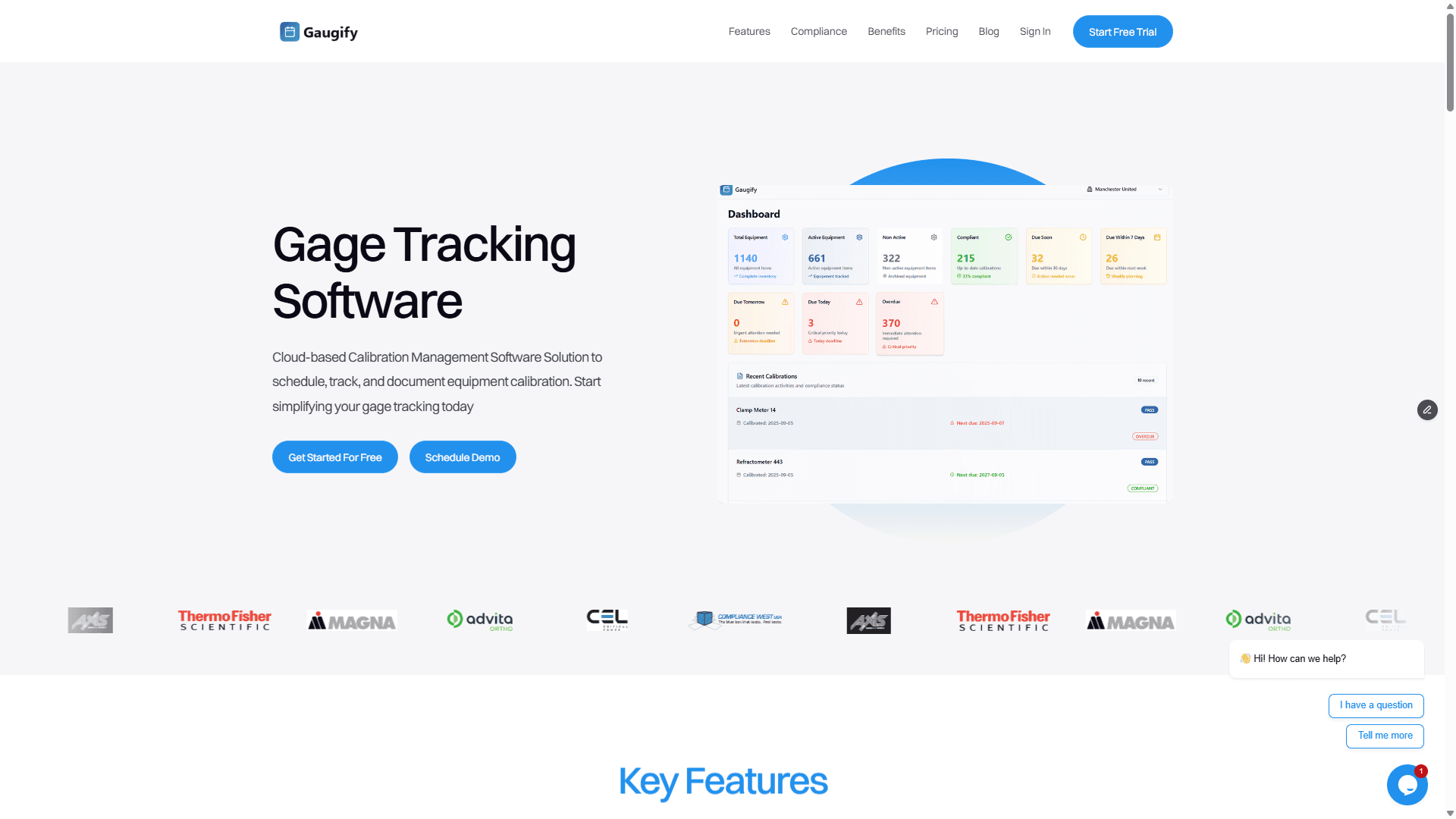
Real-Time Dashboard Visibility
Quality managers can see calibration status across the entire organization instantly. Red flags appear for overdue instruments, yellow warnings for approaching due dates, and green indicators for compliant equipment.
Seamless Record Management
Digital certificates integrate directly into the system, automatically updating due dates and storing documentation. The days of lost calibration certificates and outdated spreadsheets become history.
Audit-Ready Reporting
Generate compliance reports instantly. When auditors ask for calibration records, provide comprehensive reports showing on-time performance, certificate storage, and traceability documentation in seconds, not hours.
Mobile Access for Shop Floor Teams
Technicians can check calibration status, receive notifications, and update instrument information directly from their smartphones or tablets on the production floor.
Building Your Calibration Recall System: Start Simple, Scale Smart
The best calibration recall system is the one your team actually uses consistently. Start with core functionality—automated notifications, clear ownership, and basic reporting—then add sophisticated features as your program matures.
For organizations just beginning their calibration journey, focus on these fundamentals:
Complete, accurate instrument inventory
Reliable notification system with appropriate lead times
Clear procedures for handling recalls and overdue instruments
Regular reporting to track performance and identify improvements
As your program grows, add advanced capabilities like interval optimization, vendor integration, and predictive analytics to maximize efficiency and minimize costs.
Whether you manage 50 instruments or 5,000, the principles remain the same: know what you have, know when it needs attention, and ensure the right people take action at the right time. Your future self—and your auditors—will thank you for building this foundation correctly from the start.
Ready to transform your calibration recall management from manual chaos to automated precision? Start your free trial of Gaugify today and experience how modern calibration management software eliminates surprises, ensures compliance, and gives you complete visibility into your measurement program. No more missed due dates, no more audit surprises, no more sleepless nights wondering about calibration status.
How to Create a Calibration Recall System
A robust calibration recall system is the backbone of any quality management program. Without it, your micrometers could drift beyond their ±0.0001" tolerance, your pressure gages might fail their next ISO 9001 audit, and your lab could lose accreditation faster than you can say "measurement uncertainty." I've seen facilities scramble to recalibrate hundreds of instruments days before an audit because their recall system failed—don't let that be you.
The difference between a world-class calibration program and a compliance nightmare often comes down to one thing: knowing exactly when each instrument needs attention before it becomes a problem. Whether you're managing 50 gages or 5,000, this guide will walk you through building a calibration recall system that keeps you ahead of due dates, compliant with standards, and sleeping soundly at night.
Why Your Calibration Recall System Can Make or Break Your Quality Program
Every quality manager has horror stories about calibration failures. Last month, I spoke with a shop supervisor whose CMM hadn't been calibrated in 14 months—they discovered this during an AS9100 audit. The result? Three weeks of production holds, re-inspection of 200+ parts, and nearly $75,000 in costs.
Here's what happens when your calibration recall system fails:
Audit failures: ISO 9001 clause 7.1.5 requires demonstrated control of measurement equipment. Missing calibration dates = immediate nonconformance
Production delays: When a critical gage fails calibration, everything it measured since the last cal date becomes suspect
Customer complaints: Out-of-tolerance measurements lead to defective products reaching customers
Regulatory issues: FDA, ISO 17025, and other regulations mandate calibration control—failures can shut down operations
On the flip side, a well-designed recall system becomes your competitive advantage. It prevents surprises, optimizes calibration intervals, and demonstrates measurement control that impresses auditors and customers alike.
Prerequisites: What You Need Before Building Your Calibration Recall System
Before diving into system creation, gather these essential elements:
Complete Instrument Inventory
You can't recall what you don't know exists. Your inventory should include:
Unique asset numbers (e.g., "MIC-001-2024")
Manufacturer and model (Mitutoyo 293-340-30)
Serial numbers
Location assignments (Dept. 15, Station 3)
Current calibration certificates
Measurement ranges and tolerances (0-1" ±0.0001")
Calibration Requirements Documentation
For each instrument type, define:
Calibration intervals: Annual for most gages, semi-annual for critical measurement equipment
Applicable standards: ASME B89.1.13 for micrometers, NIST SP 960-11 for pressure gages
Environmental requirements: 68°F ±2°F, <60% RH for precision measurements
Uncertainty requirements: Typically 4:1 or 10:1 test accuracy ratio
Responsible Personnel Assignments
Clearly define who:
Receives recall notifications
Schedules calibration appointments
Transports instruments to cal labs
Updates records after calibration
Handles overdue situations
Step-by-Step Guide to Creating Your Calibration Recall System
Step 1: Establish Your Recall Notification Schedule
Effective calibration recall systems use multiple notification intervals to prevent last-minute scrambles:
90 days out: Initial planning notification for external calibrations requiring scheduling
30 days out: Action required notification to department supervisors
14 days out: Urgent notification with escalation to quality management
7 days out: Critical notification requiring immediate action
Past due: Daily notifications until resolved
For example, if your Fluke 87V multimeter (Serial: 12345678) is due for calibration on March 15th, your first notification should trigger on December 15th, giving your calibration lab adequate scheduling time.
Step 2: Configure Recall Notification Content
Effective recall notifications include specific, actionable information:
Subject line: "CALIBRATION DUE: MIC-001-2024 Due March 15, 2024"
Asset details: Description, serial number, location, current certificate number
Due date prominence: Make the date unmistakable
Contact information: Who to call with questions
Special instructions: Clean before sending, include accessories, etc.
Here's a sample notification template:
CALIBRATION RECALL NOTICE
Asset: MIC-001-2024 - Mitutoyo Outside Micrometer 0-1"
Serial Number: 12345678
Current Location: Dept. 15, Station 3
DUE DATE: March 15, 2024
Days Remaining: 14
Contact: Quality Dept. ext. 1234
Special Instructions: Clean and include setting standard
Step 3: Set Up Escalation Procedures
When instruments approach their due dates without action, escalation ensures nothing falls through cracks:
Day -14: Notify department supervisor and quality coordinator
Day -7: Add quality manager to notifications
Day 0 (due date): Mark as overdue, notify all stakeholders
Day +1: Generate overdue report for management review
Day +7: Escalate to plant manager level
Step 4: Create Standard Operating Procedures
Document exactly how your recall system operates:
SOP-CAL-001: Calibration recall notification procedures
SOP-CAL-002: Overdue instrument handling
SOP-CAL-003: Calibration scheduling and tracking
SOP-CAL-004: Record updates after calibration completion
Your procedures should specify response timeframes. For instance: "Upon receiving calibration recall notification, department supervisors have 48 hours to confirm scheduling or provide written justification for delay."
Ready to eliminate calibration surprises? Start your free trial and see how automated recalls can transform your calibration program in just minutes.
Step 5: Implement Tracking and Reporting
Your calibration recall system should generate actionable reports:
Weekly due reports: All instruments due within next 30 days
Overdue reports: Daily listing of past-due instruments by department
Calibration completion reports: Monthly summary showing on-time performance
Trend analysis: Identify patterns in overdue instruments or departments
Track key performance indicators like:
On-time calibration percentage (target: >95%)
Average days overdue for late calibrations
Percentage of recalls requiring escalation
Department compliance rankings
Best Practices from Experienced Calibration Professionals
Optimize Your Calibration Intervals
Don't blindly follow manufacturer recommendations. Use historical data to optimize intervals:
Monitor drift rates: If your Starrett micrometers consistently pass calibration with minimal adjustment, consider extending from 12 to 18 months
Apply risk-based thinking: Critical measurement equipment (CMM, surface plate) might need 6-month intervals regardless of stability
Document interval changes: ISO 9001 requires justification for calibration intervals
Leverage Calibration Certificates Intelligently
Modern calibration certificates contain valuable data for recall optimization:
As-found data: Instruments consistently found in-tolerance can have extended intervals
Uncertainty values: Ensure your 4:1 test accuracy ratio is maintained
Environmental conditions: Verify calibrations performed under appropriate conditions
Coordinate with Production Schedules
Align calibration recalls with production reality:
Schedule critical gage calibrations during planned downtime
Maintain backup instruments for high-usage applications
Consider mobile calibration services for large equipment
Build Vendor Relationships
Strong calibration lab relationships improve recall system effectiveness:
Negotiate priority scheduling for urgent recalls
Establish blanket purchase orders for streamlined processing
Request automatic electronic certificate delivery
Set up direct data interface to update your calibration records
Common Calibration Recall System Mistakes and How to Avoid Them
Mistake #1: Insufficient Lead Time
Problem: Sending calibration notifications only 7-14 days before due dates.
Solution: Start notifications 90 days out. Quality calibration labs often have 2-4 week lead times, especially for specialized equipment like coordinate measuring machines or environmental chambers.
Mistake #2: Unclear Ownership
Problem: Multiple people receive notifications but nobody takes responsibility.
Solution: Assign primary and backup owners for each instrument. Use role-based notifications: "Department Supervisor (Primary): John Smith, Backup: Mary Johnson."
Mistake #3: Ignoring Special Requirements
Problem: Sending instruments for calibration without accessories, documentation, or special preparation.
Solution: Build requirements into recall notifications. For example: "Include: setting ring, protective case, previous calibration certificate. Clean with isopropyl alcohol before shipping."
Mistake #4: Poor Overdue Management
Problem: Instruments sit overdue for weeks without escalation or resolution.
Solution: Implement automatic escalation with clear consequences. After 7 days overdue, instruments should be quarantined until calibrated.
Mistake #5: Inadequate Record Updates
Problem: Calibration certificates arrive but recall systems aren't updated, causing false overdue notifications.
Solution: Establish 24-48 hour SLA for updating records after calibration completion. Use barcode scanning or direct lab interfaces when possible.
How Technology Transforms Calibration Recall Management
Manual calibration recall systems—spreadsheets, paper logs, email reminders—fail as organizations grow. Modern calibration management software transforms recall management from reactive chaos to proactive control.
Automated Recall Notifications
Instead of manually checking spreadsheets daily, automated systems send notifications based on your predefined schedule. Gaugify monitors every instrument continuously, triggering notifications at exactly the right intervals without human intervention.
Intelligent Escalation
When instruments approach due dates without action, the system automatically escalates to appropriate personnel. No more wondering if someone saw the email—the system ensures the right people get notified at the right time.
Real-Time Dashboard Visibility
Quality managers can see calibration status across the entire organization instantly. Red flags appear for overdue instruments, yellow warnings for approaching due dates, and green indicators for compliant equipment.
Seamless Record Management
Digital certificates integrate directly into the system, automatically updating due dates and storing documentation. The days of lost calibration certificates and outdated spreadsheets become history.
Audit-Ready Reporting
Generate compliance reports instantly. When auditors ask for calibration records, provide comprehensive reports showing on-time performance, certificate storage, and traceability documentation in seconds, not hours.
Mobile Access for Shop Floor Teams
Technicians can check calibration status, receive notifications, and update instrument information directly from their smartphones or tablets on the production floor.
Building Your Calibration Recall System: Start Simple, Scale Smart
The best calibration recall system is the one your team actually uses consistently. Start with core functionality—automated notifications, clear ownership, and basic reporting—then add sophisticated features as your program matures.
For organizations just beginning their calibration journey, focus on these fundamentals:
Complete, accurate instrument inventory
Reliable notification system with appropriate lead times
Clear procedures for handling recalls and overdue instruments
Regular reporting to track performance and identify improvements
As your program grows, add advanced capabilities like interval optimization, vendor integration, and predictive analytics to maximize efficiency and minimize costs.
Whether you manage 50 instruments or 5,000, the principles remain the same: know what you have, know when it needs attention, and ensure the right people take action at the right time. Your future self—and your auditors—will thank you for building this foundation correctly from the start.
Ready to transform your calibration recall management from manual chaos to automated precision? Start your free trial of Gaugify today and experience how modern calibration management software eliminates surprises, ensures compliance, and gives you complete visibility into your measurement program. No more missed due dates, no more audit surprises, no more sleepless nights wondering about calibration status.