
How to Create a Calibration Schedule for Your Shop
How to Create a Calibration Schedule for Your Shop
David Bentley
Quality Assurance Engineer
12 min read
How to Create a Calibration Schedule for Your Shop
Getting your calibration schedule right is one of those foundational quality management tasks that either sets you up for success or creates endless headaches. When I talk to shop floor supervisors and quality managers, the same story comes up repeatedly: instruments falling out of tolerance right before a critical inspection, auditors finding expired calibration certificates, or worse—customer complaints traced back to measurements taken with an uncalibrated gage.
Learning how to create a calibration schedule that actually works for your operation isn't just about compliance checkboxes. It's about building a system that prevents quality escapes, keeps your audits smooth, and gives you confidence that every measurement in your shop is reliable. Whether you're managing a dozen micrometers or hundreds of inspection gages across multiple production lines, the principles remain the same.
Why Calibration Scheduling Matters More Than You Think
I've seen what happens when shops wing it with their calibration schedules. A precision machining company I worked with discovered during an AS9100 audit that 30% of their coordinate measuring machine (CMM) probe tips were overdue for calibration—some by six months. The result? They had to quarantine $150,000 worth of aerospace parts and re-inspect everything.
Here's what typically goes wrong without a proper schedule:
Instruments drift out of tolerance: That Mitutoyo digital caliper you've been using daily might have shifted 0.002" over the past year, but you won't know until it's too late
Audit findings: ISO 9001 and AS9100 auditors specifically look for calibration control—it's an easy target for nonconformances
Production delays: Nothing stops a production line faster than realizing your critical measurement equipment is expired right when you need it
Increased calibration costs: Rush calibrations cost 2-3x more than scheduled ones, plus you lose productivity waiting for instruments to return
The good news is that creating an effective calibration schedule doesn't require a PhD in metrology—just a systematic approach and attention to detail.
Prerequisites: What You Need Before Building Your Schedule
Before you start scheduling anything, you need to gather some essential information. This groundwork phase determines whether your schedule will be realistic and sustainable or just another document that collects dust.
Complete Equipment Inventory
Start with a comprehensive list of every measuring instrument in your facility. This includes:
Hand gages (calipers, micrometers, height gages, bore gages)
Indicating instruments (dial indicators, test indicators, DTI gages)
Fixed gages (go/no-go gages, plug gages, ring gages)
Electronic equipment (CMMs, surface roughness testers, hardness testers)
Environmental monitoring equipment (temperature/humidity sensors)
Torque tools (torque wrenches, torque analyzers)
For each instrument, document the manufacturer, model number, serial number, measurement range, and resolution. A Starrett 0-1" micrometer with 0.0001" resolution has different calibration requirements than a tape measure.
Understand Your Accuracy Requirements
Your calibration intervals should be based on the accuracy demands of your measurements, not arbitrary timeframes. If you're machining parts with ±0.001" tolerances, your measuring equipment needs to be accurate to at least ±0.0002" (following the 10:1 rule of thumb). This drives both your calibration frequency and the standards required.
Know Your Regulatory Requirements
Different standards have specific calibration requirements:
ISO 9001: Requires calibration against traceable standards at specified intervals
AS9100: Adds aerospace-specific requirements for measurement system analysis
ISO 17025: Mandates detailed calibration procedures and uncertainty calculations
FDA 21 CFR Part 820: Requires documented calibration procedures for medical devices
Step-by-Step Guide to Creating Your Calibration Schedule
Step 1: Categorize Your Equipment by Risk and Usage
Not all instruments are created equal. A CMM measuring critical aerospace features needs more frequent attention than a steel rule used for rough layout work. Create categories based on:
Critical A-Category Equipment:
CMMs and vision systems measuring critical dimensions
Gages checking safety-critical features
Equipment used for final inspection or customer acceptance
Important B-Category Equipment:
Production floor gages for in-process checking
Standard micrometers and calipers in regular use
Torque wrenches for assembly operations
Support C-Category Equipment:
Layout tools and rough measurement devices
Backup gages used occasionally
Non-critical environmental monitoring equipment
Step 2: Determine Initial Calibration Intervals
Start with manufacturer recommendations and industry standards, then adjust based on your specific conditions. Here are typical starting points:
Precision micrometers (0.0001" resolution): 12 months
Digital calipers (0.001" resolution): 12 months
CMM probes and probe tips: 6 months or every 500 measurement cycles
Go/no-go gages: 6-12 months depending on usage
Torque wrenches: 12 months or 5,000 cycles
Environmental sensors: 12 months
Consider adjusting these intervals based on:
Frequency of use (daily use vs. weekly)
Environmental conditions (temperature swings, contamination)
Handling practices (careful technicians vs. rough shop floor use)
Historical calibration data (instruments that consistently pass vs. those that drift)
Step 3: Create a Master Schedule Matrix
Build a comprehensive schedule that shows when each instrument needs calibration throughout the year. I recommend creating a monthly matrix that shows:
Instrument ID and description
Current calibration due date
Recommended calibration source (internal vs. external lab)
Estimated turnaround time
Backup instrument availability
Spread your calibrations throughout the year to avoid overwhelming your calibration provider and prevent having too many critical instruments out of service simultaneously. For example, if you have 24 micrometers on annual calibration, schedule 2 per month rather than sending them all in December.
Step 4: Identify Calibration Sources and Lead Times
Research qualified calibration providers in your area and understand their capabilities and lead times. For a typical machine shop, you might need:
Local metrology lab: 5-7 day turnaround for standard dimensional gages
Manufacturer service: 10-15 days for specialized equipment like CMMs
Mobile calibration service: Quarterly visits for large equipment that can't be moved
Internal capabilities: Daily checks using certified gage blocks or reference standards
Factor these lead times into your schedule. If your CMM probe calibration takes two weeks and you need the machine for a critical job, plan accordingly.
Step 5: Build in Contingency Planning
Equipment breaks, calibrations fail, and schedules slip. Build flexibility into your system:
Maintain backup instruments for critical measurements
Schedule calibrations 2-4 weeks before actual due dates
Identify which measurements can be temporarily covered by alternative methods
Establish relationships with multiple calibration providers
For high-volume production, consider having duplicate sets of critical gages so one set can be in calibration while the other remains in service.
Ready to streamline your calibration scheduling? Start a free trial of Gaugify to see how automated scheduling can eliminate the manual tracking headaches and ensure you never miss another calibration deadline.
Best Practices from Experienced Calibration Professionals
Use Data to Optimize Your Intervals
After your first year of calibrations, analyze the results to fine-tune your schedule. If a particular brand of digital caliper consistently returns from calibration with minimal adjustment needed, you might extend the interval from 12 to 15 months. Conversely, if gages used in a dusty environment consistently require adjustment, shorten the interval or improve the storage conditions.
Track key metrics like:
Percentage of instruments requiring adjustment during calibration
Trend analysis of measurement drift over time
Correlation between usage frequency and calibration results
Environmental factors affecting instrument stability
Implement Progressive Calibration Intervals
Consider using different intervals for new vs. established instruments. A new Mitutoyo micrometer might start with a 6-month interval until you understand its stability characteristics, then move to 12 months if it proves reliable. Older instruments approaching end-of-life might need more frequent verification.
Coordinate with Production Schedules
Align calibration schedules with planned downtime when possible. Schedule CMM calibrations during holiday shutdowns or preventive maintenance periods. For gages used on specific product lines, time calibrations between production runs to minimize disruption.
Document Everything
Maintain detailed records of calibration schedules, results, and any interval adjustments. Auditors love to see evidence that you're actively managing and optimizing your calibration program based on actual performance data. This documentation also helps justify calibration costs to management.
Common Mistakes and How to Avoid Them
Setting Unrealistic Intervals
The biggest mistake I see is shops setting overly aggressive calibration intervals that they can't sustain. Calibrating every gage monthly sounds good in theory, but if you can't execute it consistently, you're worse off than having realistic 12-month intervals that you actually follow.
Start conservative and adjust based on actual performance data. It's better to begin with 6-month intervals and extend them to 9 months based on good results than to start with 18-month intervals and discover instruments drifting out of tolerance.
Ignoring Usage-Based Scheduling
Calendar-based scheduling works for most applications, but high-usage equipment benefits from usage-based intervals. A torque wrench used 50 times daily needs different treatment than one used weekly. Consider tracking usage cycles for critical equipment and scheduling calibrations based on actual wear rather than elapsed time.
Not Planning for Calibration Failures
When instruments fail calibration, your schedule gets disrupted. Plan for this by:
Having backup instruments available
Knowing which measurements can be temporarily covered by alternative methods
Understanding the investigation requirements when instruments fail (what work might need to be re-inspected?)
Maintaining relationships with repair services for quick turnaround
Forgetting About Standards and References
Your gage blocks, reference standards, and calibration artifacts need calibration too. These often have longer intervals (annual for gage blocks, biennial for some reference standards), but they're easy to forget until you need them for an internal calibration or audit.
How Modern Software Simplifies Calibration Scheduling
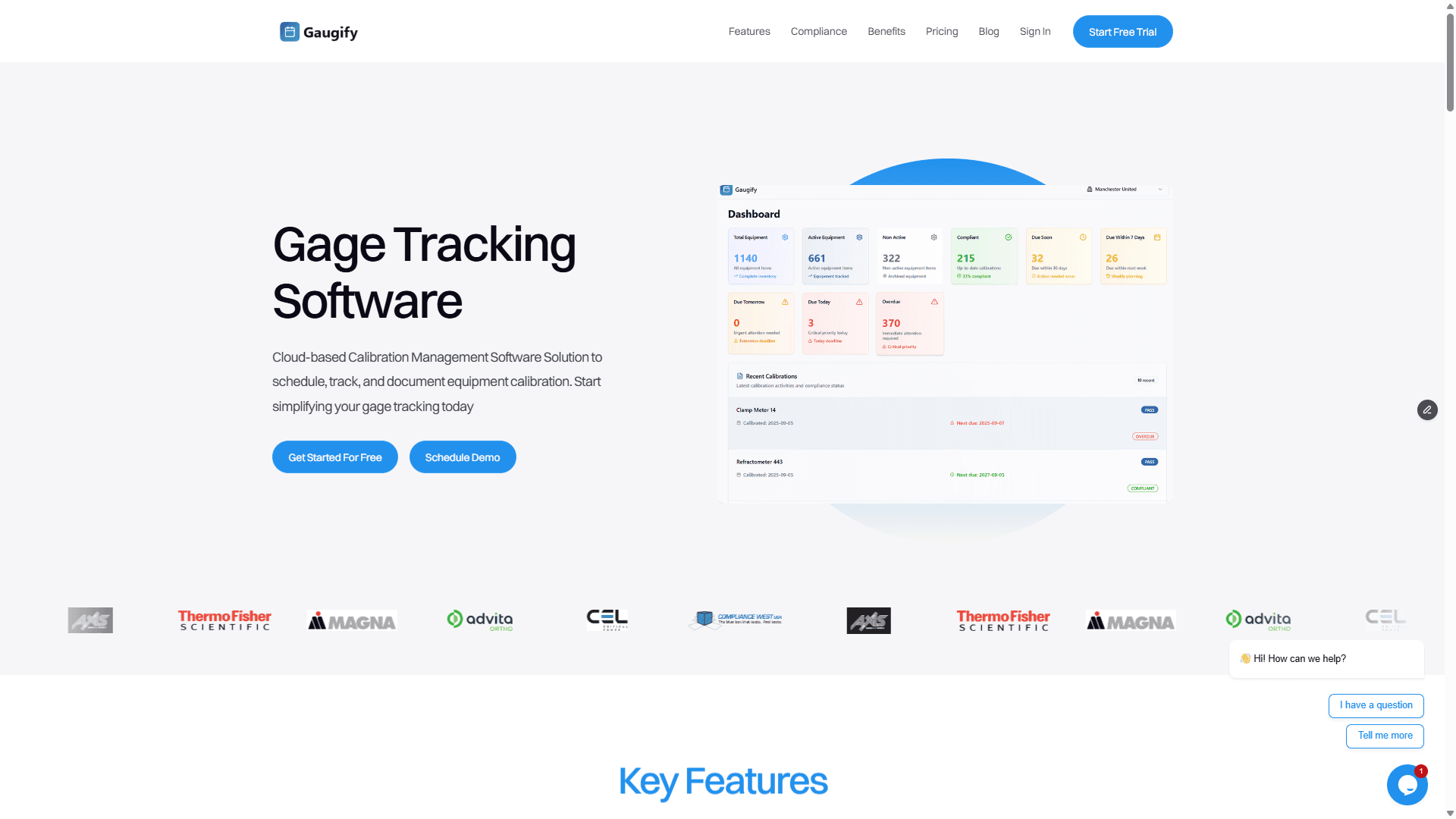
Manual calibration scheduling using spreadsheets or paper systems becomes unwieldy as your operation grows. Modern calibration management software like Gaugify automates many of the time-consuming aspects of schedule management while improving accuracy and compliance.
Automated Notifications and Alerts
Instead of manually checking due dates, the system sends automatic alerts when calibrations are approaching. You can set multiple reminder levels—say 30 days, 14 days, and 7 days before due dates—ensuring nothing falls through the cracks. This is especially valuable when managing hundreds of instruments across multiple locations.
Smart Scheduling Optimization
Advanced calibration software can optimize your schedule based on multiple factors: calibration provider availability, instrument criticality, production schedules, and historical performance data. Gaugify's scheduling features help distribute calibration workload evenly throughout the year while respecting your operational constraints.
Integration with Calibration Providers
Modern systems can integrate directly with calibration labs, automatically generating work orders, tracking instrument status during calibration, and updating records when instruments return. This eliminates the phone calls and emails that typically accompany manual scheduling systems.
Performance Analytics and Optimization
Software platforms provide detailed analytics on calibration performance, helping you optimize intervals based on actual data rather than guesswork. You can easily identify which instruments consistently pass calibration with minimal adjustment (candidates for extended intervals) and which require more frequent attention.
Compliance Documentation
For shops dealing with regulatory compliance, automated systems generate the detailed documentation required by standards like ISO 9001, AS9100, or FDA regulations. The software maintains complete audit trails showing when calibrations were due, performed, and any adjustments made to the schedule.
Building Your Implementation Plan
Creating a calibration schedule is just the first step—successful implementation requires careful planning and sustained commitment. Start by piloting your schedule with a small subset of critical equipment. This allows you to identify and resolve issues before rolling out to your entire operation.
Focus on building sustainable processes rather than perfect systems. A simple schedule that everyone follows consistently is far better than a complex system that gets abandoned after the first few months. Train your team on the importance of calibration scheduling and ensure everyone understands their role in maintaining the system.
Regular review and improvement should be built into your process. Schedule quarterly reviews to analyze calibration results, adjust intervals as needed, and incorporate lessons learned. This continuous improvement approach ensures your schedule remains optimized as your operation evolves.
Consider the total cost of calibration—not just the direct costs of calibration services, but also the indirect costs of instrument downtime, rush calibrations, and potential quality issues from uncalibrated equipment. A well-planned schedule minimizes these total costs while maintaining measurement confidence.
Taking the Next Steps
Creating an effective calibration schedule requires balancing multiple competing priorities: cost, compliance, operational efficiency, and measurement quality. The key is starting with a solid foundation based on risk assessment and actual requirements, then continuously improving based on performance data.
Modern calibration management software eliminates much of the manual effort involved in scheduling while improving accuracy and compliance. Whether you're managing a dozen instruments or thousands, the principles remain the same: understand your requirements, plan systematically, and optimize based on results.
Ready to transform your calibration scheduling from a manual headache into an automated competitive advantage? Start your free trial of Gaugify today and discover how the right tools can make calibration management both simpler and more effective. You'll wonder why you waited so long to modernize this critical quality process.
How to Create a Calibration Schedule for Your Shop
Getting your calibration schedule right is one of those foundational quality management tasks that either sets you up for success or creates endless headaches. When I talk to shop floor supervisors and quality managers, the same story comes up repeatedly: instruments falling out of tolerance right before a critical inspection, auditors finding expired calibration certificates, or worse—customer complaints traced back to measurements taken with an uncalibrated gage.
Learning how to create a calibration schedule that actually works for your operation isn't just about compliance checkboxes. It's about building a system that prevents quality escapes, keeps your audits smooth, and gives you confidence that every measurement in your shop is reliable. Whether you're managing a dozen micrometers or hundreds of inspection gages across multiple production lines, the principles remain the same.
Why Calibration Scheduling Matters More Than You Think
I've seen what happens when shops wing it with their calibration schedules. A precision machining company I worked with discovered during an AS9100 audit that 30% of their coordinate measuring machine (CMM) probe tips were overdue for calibration—some by six months. The result? They had to quarantine $150,000 worth of aerospace parts and re-inspect everything.
Here's what typically goes wrong without a proper schedule:
Instruments drift out of tolerance: That Mitutoyo digital caliper you've been using daily might have shifted 0.002" over the past year, but you won't know until it's too late
Audit findings: ISO 9001 and AS9100 auditors specifically look for calibration control—it's an easy target for nonconformances
Production delays: Nothing stops a production line faster than realizing your critical measurement equipment is expired right when you need it
Increased calibration costs: Rush calibrations cost 2-3x more than scheduled ones, plus you lose productivity waiting for instruments to return
The good news is that creating an effective calibration schedule doesn't require a PhD in metrology—just a systematic approach and attention to detail.
Prerequisites: What You Need Before Building Your Schedule
Before you start scheduling anything, you need to gather some essential information. This groundwork phase determines whether your schedule will be realistic and sustainable or just another document that collects dust.
Complete Equipment Inventory
Start with a comprehensive list of every measuring instrument in your facility. This includes:
Hand gages (calipers, micrometers, height gages, bore gages)
Indicating instruments (dial indicators, test indicators, DTI gages)
Fixed gages (go/no-go gages, plug gages, ring gages)
Electronic equipment (CMMs, surface roughness testers, hardness testers)
Environmental monitoring equipment (temperature/humidity sensors)
Torque tools (torque wrenches, torque analyzers)
For each instrument, document the manufacturer, model number, serial number, measurement range, and resolution. A Starrett 0-1" micrometer with 0.0001" resolution has different calibration requirements than a tape measure.
Understand Your Accuracy Requirements
Your calibration intervals should be based on the accuracy demands of your measurements, not arbitrary timeframes. If you're machining parts with ±0.001" tolerances, your measuring equipment needs to be accurate to at least ±0.0002" (following the 10:1 rule of thumb). This drives both your calibration frequency and the standards required.
Know Your Regulatory Requirements
Different standards have specific calibration requirements:
ISO 9001: Requires calibration against traceable standards at specified intervals
AS9100: Adds aerospace-specific requirements for measurement system analysis
ISO 17025: Mandates detailed calibration procedures and uncertainty calculations
FDA 21 CFR Part 820: Requires documented calibration procedures for medical devices
Step-by-Step Guide to Creating Your Calibration Schedule
Step 1: Categorize Your Equipment by Risk and Usage
Not all instruments are created equal. A CMM measuring critical aerospace features needs more frequent attention than a steel rule used for rough layout work. Create categories based on:
Critical A-Category Equipment:
CMMs and vision systems measuring critical dimensions
Gages checking safety-critical features
Equipment used for final inspection or customer acceptance
Important B-Category Equipment:
Production floor gages for in-process checking
Standard micrometers and calipers in regular use
Torque wrenches for assembly operations
Support C-Category Equipment:
Layout tools and rough measurement devices
Backup gages used occasionally
Non-critical environmental monitoring equipment
Step 2: Determine Initial Calibration Intervals
Start with manufacturer recommendations and industry standards, then adjust based on your specific conditions. Here are typical starting points:
Precision micrometers (0.0001" resolution): 12 months
Digital calipers (0.001" resolution): 12 months
CMM probes and probe tips: 6 months or every 500 measurement cycles
Go/no-go gages: 6-12 months depending on usage
Torque wrenches: 12 months or 5,000 cycles
Environmental sensors: 12 months
Consider adjusting these intervals based on:
Frequency of use (daily use vs. weekly)
Environmental conditions (temperature swings, contamination)
Handling practices (careful technicians vs. rough shop floor use)
Historical calibration data (instruments that consistently pass vs. those that drift)
Step 3: Create a Master Schedule Matrix
Build a comprehensive schedule that shows when each instrument needs calibration throughout the year. I recommend creating a monthly matrix that shows:
Instrument ID and description
Current calibration due date
Recommended calibration source (internal vs. external lab)
Estimated turnaround time
Backup instrument availability
Spread your calibrations throughout the year to avoid overwhelming your calibration provider and prevent having too many critical instruments out of service simultaneously. For example, if you have 24 micrometers on annual calibration, schedule 2 per month rather than sending them all in December.
Step 4: Identify Calibration Sources and Lead Times
Research qualified calibration providers in your area and understand their capabilities and lead times. For a typical machine shop, you might need:
Local metrology lab: 5-7 day turnaround for standard dimensional gages
Manufacturer service: 10-15 days for specialized equipment like CMMs
Mobile calibration service: Quarterly visits for large equipment that can't be moved
Internal capabilities: Daily checks using certified gage blocks or reference standards
Factor these lead times into your schedule. If your CMM probe calibration takes two weeks and you need the machine for a critical job, plan accordingly.
Step 5: Build in Contingency Planning
Equipment breaks, calibrations fail, and schedules slip. Build flexibility into your system:
Maintain backup instruments for critical measurements
Schedule calibrations 2-4 weeks before actual due dates
Identify which measurements can be temporarily covered by alternative methods
Establish relationships with multiple calibration providers
For high-volume production, consider having duplicate sets of critical gages so one set can be in calibration while the other remains in service.
Ready to streamline your calibration scheduling? Start a free trial of Gaugify to see how automated scheduling can eliminate the manual tracking headaches and ensure you never miss another calibration deadline.
Best Practices from Experienced Calibration Professionals
Use Data to Optimize Your Intervals
After your first year of calibrations, analyze the results to fine-tune your schedule. If a particular brand of digital caliper consistently returns from calibration with minimal adjustment needed, you might extend the interval from 12 to 15 months. Conversely, if gages used in a dusty environment consistently require adjustment, shorten the interval or improve the storage conditions.
Track key metrics like:
Percentage of instruments requiring adjustment during calibration
Trend analysis of measurement drift over time
Correlation between usage frequency and calibration results
Environmental factors affecting instrument stability
Implement Progressive Calibration Intervals
Consider using different intervals for new vs. established instruments. A new Mitutoyo micrometer might start with a 6-month interval until you understand its stability characteristics, then move to 12 months if it proves reliable. Older instruments approaching end-of-life might need more frequent verification.
Coordinate with Production Schedules
Align calibration schedules with planned downtime when possible. Schedule CMM calibrations during holiday shutdowns or preventive maintenance periods. For gages used on specific product lines, time calibrations between production runs to minimize disruption.
Document Everything
Maintain detailed records of calibration schedules, results, and any interval adjustments. Auditors love to see evidence that you're actively managing and optimizing your calibration program based on actual performance data. This documentation also helps justify calibration costs to management.
Common Mistakes and How to Avoid Them
Setting Unrealistic Intervals
The biggest mistake I see is shops setting overly aggressive calibration intervals that they can't sustain. Calibrating every gage monthly sounds good in theory, but if you can't execute it consistently, you're worse off than having realistic 12-month intervals that you actually follow.
Start conservative and adjust based on actual performance data. It's better to begin with 6-month intervals and extend them to 9 months based on good results than to start with 18-month intervals and discover instruments drifting out of tolerance.
Ignoring Usage-Based Scheduling
Calendar-based scheduling works for most applications, but high-usage equipment benefits from usage-based intervals. A torque wrench used 50 times daily needs different treatment than one used weekly. Consider tracking usage cycles for critical equipment and scheduling calibrations based on actual wear rather than elapsed time.
Not Planning for Calibration Failures
When instruments fail calibration, your schedule gets disrupted. Plan for this by:
Having backup instruments available
Knowing which measurements can be temporarily covered by alternative methods
Understanding the investigation requirements when instruments fail (what work might need to be re-inspected?)
Maintaining relationships with repair services for quick turnaround
Forgetting About Standards and References
Your gage blocks, reference standards, and calibration artifacts need calibration too. These often have longer intervals (annual for gage blocks, biennial for some reference standards), but they're easy to forget until you need them for an internal calibration or audit.
How Modern Software Simplifies Calibration Scheduling
Manual calibration scheduling using spreadsheets or paper systems becomes unwieldy as your operation grows. Modern calibration management software like Gaugify automates many of the time-consuming aspects of schedule management while improving accuracy and compliance.
Automated Notifications and Alerts
Instead of manually checking due dates, the system sends automatic alerts when calibrations are approaching. You can set multiple reminder levels—say 30 days, 14 days, and 7 days before due dates—ensuring nothing falls through the cracks. This is especially valuable when managing hundreds of instruments across multiple locations.
Smart Scheduling Optimization
Advanced calibration software can optimize your schedule based on multiple factors: calibration provider availability, instrument criticality, production schedules, and historical performance data. Gaugify's scheduling features help distribute calibration workload evenly throughout the year while respecting your operational constraints.
Integration with Calibration Providers
Modern systems can integrate directly with calibration labs, automatically generating work orders, tracking instrument status during calibration, and updating records when instruments return. This eliminates the phone calls and emails that typically accompany manual scheduling systems.
Performance Analytics and Optimization
Software platforms provide detailed analytics on calibration performance, helping you optimize intervals based on actual data rather than guesswork. You can easily identify which instruments consistently pass calibration with minimal adjustment (candidates for extended intervals) and which require more frequent attention.
Compliance Documentation
For shops dealing with regulatory compliance, automated systems generate the detailed documentation required by standards like ISO 9001, AS9100, or FDA regulations. The software maintains complete audit trails showing when calibrations were due, performed, and any adjustments made to the schedule.
Building Your Implementation Plan
Creating a calibration schedule is just the first step—successful implementation requires careful planning and sustained commitment. Start by piloting your schedule with a small subset of critical equipment. This allows you to identify and resolve issues before rolling out to your entire operation.
Focus on building sustainable processes rather than perfect systems. A simple schedule that everyone follows consistently is far better than a complex system that gets abandoned after the first few months. Train your team on the importance of calibration scheduling and ensure everyone understands their role in maintaining the system.
Regular review and improvement should be built into your process. Schedule quarterly reviews to analyze calibration results, adjust intervals as needed, and incorporate lessons learned. This continuous improvement approach ensures your schedule remains optimized as your operation evolves.
Consider the total cost of calibration—not just the direct costs of calibration services, but also the indirect costs of instrument downtime, rush calibrations, and potential quality issues from uncalibrated equipment. A well-planned schedule minimizes these total costs while maintaining measurement confidence.
Taking the Next Steps
Creating an effective calibration schedule requires balancing multiple competing priorities: cost, compliance, operational efficiency, and measurement quality. The key is starting with a solid foundation based on risk assessment and actual requirements, then continuously improving based on performance data.
Modern calibration management software eliminates much of the manual effort involved in scheduling while improving accuracy and compliance. Whether you're managing a dozen instruments or thousands, the principles remain the same: understand your requirements, plan systematically, and optimize based on results.
Ready to transform your calibration scheduling from a manual headache into an automated competitive advantage? Start your free trial of Gaugify today and discover how the right tools can make calibration management both simpler and more effective. You'll wonder why you waited so long to modernize this critical quality process.