
How to Extend Calibration Intervals Safely
How to Extend Calibration Intervals Safely
David Bentley
Quality Assurance Engineer
8 min read
How to Extend Calibration Intervals Safely
When budget constraints hit or equipment downtime becomes costly, the temptation to extend calibration intervals grows strong. But doing this wrong can lead to failed audits, product recalls, and compromised quality systems. The good news? You can safely extend calibration intervals without sacrificing measurement accuracy or compliance—if you follow a systematic, data-driven approach.
Smart calibration managers know that blindly extending intervals is risky, but so is over-calibrating stable equipment. A Mitutoyo digital caliper that's been holding ±0.001" tolerance for three years might safely go from 6-month to 12-month intervals. Meanwhile, that aging pressure transducer in your environmental chamber might need more frequent attention, not less.
Why Calibration Interval Management Matters
Before diving into how to extend calibration intervals, let's examine what happens when organizations get this wrong. Failed ISO 9001 audits often trace back to inadequate calibration interval justification. Auditors want to see objective evidence that your intervals are appropriate for each piece of equipment.
Consider this real scenario: A aerospace manufacturer extended their CMM calibration from 6 months to 12 months without proper analysis. Six months later, they discovered their Zeiss CMM had drifted beyond acceptable limits, invalidating months of critical measurements on turbine components. The resulting investigation, product holds, and customer notifications cost over $200,000.
On the flip side, a medical device manufacturer used historical data to safely extend intervals on their stable micrometers from 6 months to 18 months, saving $15,000 annually in calibration costs while maintaining measurement confidence.
Regulatory and Standard Requirements
ISO/IEC 17025 section 6.4.1 requires that calibration intervals be determined based on measurement uncertainty requirements, frequency of use, and previous calibration results. ANSI/NCSL Z540.3 provides additional guidance, emphasizing that interval decisions should be based on objective evidence rather than arbitrary timeframes.
FDA-regulated industries face additional scrutiny. The Quality System Regulation (21 CFR Part 820) requires that calibration intervals ensure continued accuracy throughout the specified period. This means you need robust data to justify any interval changes.
Prerequisites for Safe Calibration Interval Extension
Before you can safely extend calibration intervals, establish these foundational elements:
Historical Calibration Data
You need at least 12-24 months of calibration history for each instrument. This data should include:
As-found and as-left values for all calibration points
Environmental conditions during calibration
Any adjustments or repairs performed
Measurement uncertainty calculations
Usage patterns and handling conditions
For example, tracking data on a Fluke 8846A multimeter might show that voltage measurements consistently stay within ±0.003% over 18 months, while resistance measurements show slight drift after 12 months. This granular data guides interval decisions for specific functions.
Risk Assessment Framework
Establish clear criteria for evaluating risk. High-risk instruments include those used for:
Final product acceptance
Safety-critical measurements
Regulatory compliance testing
Process control in harsh environments
A hardness tester used for incoming material inspection carries higher risk than a ruler used for general layout work. Your interval extension strategy should reflect these differences.
Ready to streamline your calibration interval analysis? Start your free Gaugify trial to access automated stability tracking and interval optimization tools that make data-driven decisions easier.
Step-by-Step Guide to Extend Calibration Intervals
Step 1: Analyze Historical Performance Data
Begin with statistical analysis of your calibration records. Calculate the stability ratio for each instrument using this formula:
Stability Ratio = (Largest drift observed) / (Instrument tolerance)
For a digital micrometer with ±0.0001" tolerance that shows maximum drift of 0.00003" over 12 months, the stability ratio is 0.3. Ratios below 0.3 typically indicate good candidates for interval extension.
Look for patterns in the data:
Consistent as-found values within tolerance
Minimal adjustments required during calibration
Stable performance across different environmental conditions
No correlation between usage intensity and drift
Step 2: Evaluate Environmental and Usage Factors
Assess how each instrument is used and stored. A precision balance in a temperature-controlled metrology lab has different stability expectations than a torque wrench used on a factory floor.
Document these factors:
Usage frequency: Daily use vs. occasional use
Environmental conditions: Temperature, humidity, vibration
Handling practices: Careful laboratory use vs. shop floor conditions
Transportation: Stationary vs. frequently moved
A Starrett height gage used weekly in a climate-controlled QC lab might safely extend from 6-month to 12-month intervals. The same gage used daily on a machine shop floor should maintain shorter intervals.
Step 3: Calculate Extended Interval Uncertainty
Use the stability data to estimate measurement uncertainty at the proposed extended interval. The formula considers both calibration uncertainty and drift uncertainty:
Extended Uncertainty = √(Calibration Uncertainty² + Drift Uncertainty²)
If your current 6-month interval provides calibration uncertainty of ±0.00005" and observed drift suggests additional uncertainty of ±0.00002" over 12 months, the combined uncertainty becomes ±0.000054". Verify this remains acceptable for your measurement requirements.
Step 4: Implement Gradual Extension
Don't jump directly from 6-month to 18-month intervals. Use this staged approach:
Phase 1: Extend by 50% (6 months to 9 months)
Phase 2: Monitor performance for 2-3 cycles
Phase 3: Further extend if data supports it (9 months to 12 months)
Apply this to a subset of similar instruments first. If five identical pressure gauges perform well with extended intervals, gradually expand to the entire population.
Step 5: Establish Monitoring and Control Measures
Extended intervals require enhanced monitoring between calibrations. Implement these controls:
Functional checks: Regular verification using check standards
Cross-checking: Compare readings with other calibrated instruments
Trending analysis: Track performance indicators over time
Event-driven recalibration: Triggers for immediate recalibration
For example, establish a monthly functional check for extended-interval micrometers using certified gage blocks. If readings drift beyond predetermined limits, trigger immediate recalibration.
Best Practices for Extending Calibration Intervals
Start with Low-Risk, Stable Instruments
Begin interval extension programs with instruments that show excellent stability and aren't used for critical measurements. Steel rules, basic calipers, and reference standards often make good candidates.
Avoid extending intervals on:
Instruments with electronic drift tendencies
Equipment exposed to harsh environments
Tools subject to frequent handling or dropping
Instruments with historical reliability issues
Maintain Detailed Documentation
Auditors expect thorough justification for interval decisions. Your documentation should include:
Statistical analysis of historical data
Risk assessment criteria and results
Uncertainty calculations for extended intervals
Monitoring procedures and results
Review and approval signatures
Gaugify's compliance features automatically generate audit-ready documentation that satisfies ISO 17025 and regulatory requirements.
Establish Clear Reversal Criteria
Define specific conditions that trigger immediate return to shorter intervals:
As-found values outside tolerance
Functional check failures
Physical damage or unusual wear
Changes in usage patterns or environment
Customer or regulatory requirements
A precision torque wrench showing 3% drift at extended interval calibration should immediately return to standard intervals, even if still within tolerance.
Common Mistakes and How to Avoid Them
Extending All Instruments Uniformly
The biggest mistake is applying blanket interval extensions across all equipment. Each instrument type requires individual analysis. Your Mitutoyo digital calipers might safely extend to 18 months while environmental monitoring instruments need quarterly calibration.
Solution: Group instruments by type, usage, and risk level. Analyze each group separately and apply appropriate interval strategies.
Insufficient Historical Data
Attempting interval extensions with only 3-6 months of data leads to poor decisions. Short-term stability doesn't predict long-term performance.
Solution: Wait until you have 12-24 months of consistent data before considering extensions. Use this time to improve data collection and analysis processes.
Ignoring Usage Context
Laboratory instruments and shop floor tools require different interval strategies. A surface plate in a metrology lab has different stability expectations than one used for layout work in manufacturing.
Solution: Factor usage patterns, environmental conditions, and handling into every interval decision. The same instrument model may need different intervals in different applications.
Weak Monitoring Between Calibrations
Extended intervals without intermediate monitoring create blind spots. Equipment can drift significantly between calibrations, invalidating measurements.
Solution: Implement robust functional checking and cross-verification procedures. Monthly checks with certified artifacts help catch problems early.
How Gaugify Simplifies Calibration Interval Management
Modern calibration management software transforms how organizations approach interval optimization. Gaugify provides automated tools that make data-driven interval decisions practical and defensible.
Automated Stability Analysis
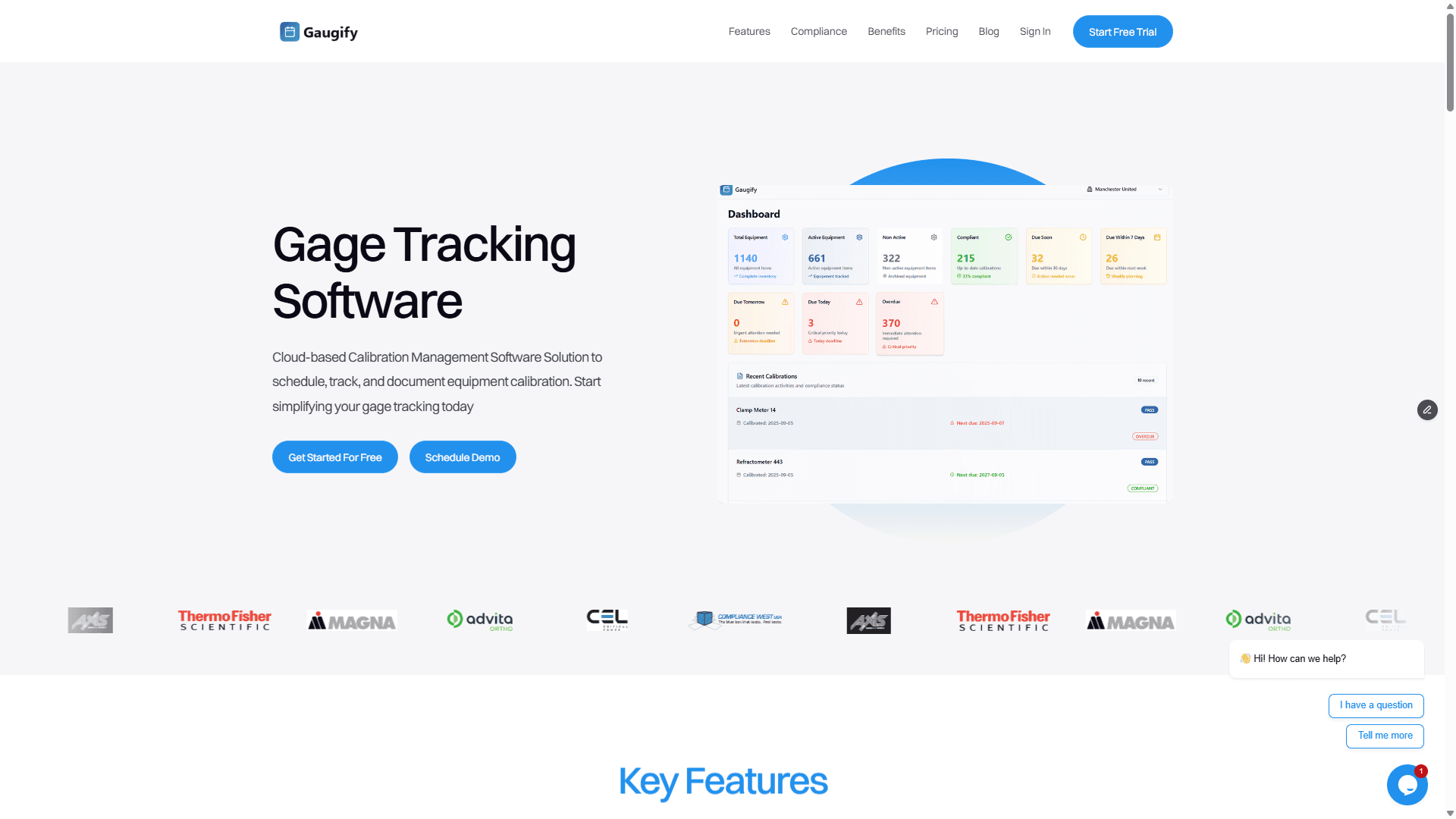
Gaugify's analytics engine automatically calculates stability ratios and identifies instruments suitable for interval extension. The system tracks performance trends and flags instruments showing unusual drift patterns.
Instead of manually analyzing spreadsheets, quality managers get dashboards showing which instruments are candidates for extension and which need closer monitoring.
Built-in Risk Assessment
The software includes configurable risk matrices that consider instrument criticality, usage patterns, and regulatory requirements. This ensures that safety-critical instruments maintain appropriate intervals while optimizing costs for stable equipment.
Audit-Ready Documentation
Every interval decision generates comprehensive documentation including statistical analysis, risk assessment, and approval workflows. ISO 17025-compliant reports satisfy auditor requirements while reducing administrative burden.
Intelligent Scheduling and Alerts
Gaugify automatically adjusts schedules when intervals change and sends alerts when functional checks are due. The system tracks which instruments are on extended intervals and ensures proper monitoring occurs.
Integration with your existing procedures means technicians get clear guidance on when to perform intermediate checks and how to interpret results.
Start Optimizing Your Calibration Intervals Today
Extending calibration intervals safely requires systematic analysis, careful implementation, and ongoing monitoring. When done correctly, you'll reduce costs while maintaining measurement confidence and regulatory compliance.
The key is starting with stable, low-risk instruments and building experience with data-driven decision making. As your program matures, you can confidently optimize intervals across your entire instrument population.
Don't let manual processes hold back your interval optimization efforts. Modern calibration management software provides the analytical tools and documentation capabilities that make systematic interval management practical for organizations of any size.
Ready to implement a data-driven approach to calibration interval management? Start your free Gaugify trial today and discover how automated stability analysis and intelligent scheduling can optimize your calibration program while maintaining full compliance. See firsthand how leading manufacturers are safely extending intervals and reducing costs without compromising quality.
How to Extend Calibration Intervals Safely
When budget constraints hit or equipment downtime becomes costly, the temptation to extend calibration intervals grows strong. But doing this wrong can lead to failed audits, product recalls, and compromised quality systems. The good news? You can safely extend calibration intervals without sacrificing measurement accuracy or compliance—if you follow a systematic, data-driven approach.
Smart calibration managers know that blindly extending intervals is risky, but so is over-calibrating stable equipment. A Mitutoyo digital caliper that's been holding ±0.001" tolerance for three years might safely go from 6-month to 12-month intervals. Meanwhile, that aging pressure transducer in your environmental chamber might need more frequent attention, not less.
Why Calibration Interval Management Matters
Before diving into how to extend calibration intervals, let's examine what happens when organizations get this wrong. Failed ISO 9001 audits often trace back to inadequate calibration interval justification. Auditors want to see objective evidence that your intervals are appropriate for each piece of equipment.
Consider this real scenario: A aerospace manufacturer extended their CMM calibration from 6 months to 12 months without proper analysis. Six months later, they discovered their Zeiss CMM had drifted beyond acceptable limits, invalidating months of critical measurements on turbine components. The resulting investigation, product holds, and customer notifications cost over $200,000.
On the flip side, a medical device manufacturer used historical data to safely extend intervals on their stable micrometers from 6 months to 18 months, saving $15,000 annually in calibration costs while maintaining measurement confidence.
Regulatory and Standard Requirements
ISO/IEC 17025 section 6.4.1 requires that calibration intervals be determined based on measurement uncertainty requirements, frequency of use, and previous calibration results. ANSI/NCSL Z540.3 provides additional guidance, emphasizing that interval decisions should be based on objective evidence rather than arbitrary timeframes.
FDA-regulated industries face additional scrutiny. The Quality System Regulation (21 CFR Part 820) requires that calibration intervals ensure continued accuracy throughout the specified period. This means you need robust data to justify any interval changes.
Prerequisites for Safe Calibration Interval Extension
Before you can safely extend calibration intervals, establish these foundational elements:
Historical Calibration Data
You need at least 12-24 months of calibration history for each instrument. This data should include:
As-found and as-left values for all calibration points
Environmental conditions during calibration
Any adjustments or repairs performed
Measurement uncertainty calculations
Usage patterns and handling conditions
For example, tracking data on a Fluke 8846A multimeter might show that voltage measurements consistently stay within ±0.003% over 18 months, while resistance measurements show slight drift after 12 months. This granular data guides interval decisions for specific functions.
Risk Assessment Framework
Establish clear criteria for evaluating risk. High-risk instruments include those used for:
Final product acceptance
Safety-critical measurements
Regulatory compliance testing
Process control in harsh environments
A hardness tester used for incoming material inspection carries higher risk than a ruler used for general layout work. Your interval extension strategy should reflect these differences.
Ready to streamline your calibration interval analysis? Start your free Gaugify trial to access automated stability tracking and interval optimization tools that make data-driven decisions easier.
Step-by-Step Guide to Extend Calibration Intervals
Step 1: Analyze Historical Performance Data
Begin with statistical analysis of your calibration records. Calculate the stability ratio for each instrument using this formula:
Stability Ratio = (Largest drift observed) / (Instrument tolerance)
For a digital micrometer with ±0.0001" tolerance that shows maximum drift of 0.00003" over 12 months, the stability ratio is 0.3. Ratios below 0.3 typically indicate good candidates for interval extension.
Look for patterns in the data:
Consistent as-found values within tolerance
Minimal adjustments required during calibration
Stable performance across different environmental conditions
No correlation between usage intensity and drift
Step 2: Evaluate Environmental and Usage Factors
Assess how each instrument is used and stored. A precision balance in a temperature-controlled metrology lab has different stability expectations than a torque wrench used on a factory floor.
Document these factors:
Usage frequency: Daily use vs. occasional use
Environmental conditions: Temperature, humidity, vibration
Handling practices: Careful laboratory use vs. shop floor conditions
Transportation: Stationary vs. frequently moved
A Starrett height gage used weekly in a climate-controlled QC lab might safely extend from 6-month to 12-month intervals. The same gage used daily on a machine shop floor should maintain shorter intervals.
Step 3: Calculate Extended Interval Uncertainty
Use the stability data to estimate measurement uncertainty at the proposed extended interval. The formula considers both calibration uncertainty and drift uncertainty:
Extended Uncertainty = √(Calibration Uncertainty² + Drift Uncertainty²)
If your current 6-month interval provides calibration uncertainty of ±0.00005" and observed drift suggests additional uncertainty of ±0.00002" over 12 months, the combined uncertainty becomes ±0.000054". Verify this remains acceptable for your measurement requirements.
Step 4: Implement Gradual Extension
Don't jump directly from 6-month to 18-month intervals. Use this staged approach:
Phase 1: Extend by 50% (6 months to 9 months)
Phase 2: Monitor performance for 2-3 cycles
Phase 3: Further extend if data supports it (9 months to 12 months)
Apply this to a subset of similar instruments first. If five identical pressure gauges perform well with extended intervals, gradually expand to the entire population.
Step 5: Establish Monitoring and Control Measures
Extended intervals require enhanced monitoring between calibrations. Implement these controls:
Functional checks: Regular verification using check standards
Cross-checking: Compare readings with other calibrated instruments
Trending analysis: Track performance indicators over time
Event-driven recalibration: Triggers for immediate recalibration
For example, establish a monthly functional check for extended-interval micrometers using certified gage blocks. If readings drift beyond predetermined limits, trigger immediate recalibration.
Best Practices for Extending Calibration Intervals
Start with Low-Risk, Stable Instruments
Begin interval extension programs with instruments that show excellent stability and aren't used for critical measurements. Steel rules, basic calipers, and reference standards often make good candidates.
Avoid extending intervals on:
Instruments with electronic drift tendencies
Equipment exposed to harsh environments
Tools subject to frequent handling or dropping
Instruments with historical reliability issues
Maintain Detailed Documentation
Auditors expect thorough justification for interval decisions. Your documentation should include:
Statistical analysis of historical data
Risk assessment criteria and results
Uncertainty calculations for extended intervals
Monitoring procedures and results
Review and approval signatures
Gaugify's compliance features automatically generate audit-ready documentation that satisfies ISO 17025 and regulatory requirements.
Establish Clear Reversal Criteria
Define specific conditions that trigger immediate return to shorter intervals:
As-found values outside tolerance
Functional check failures
Physical damage or unusual wear
Changes in usage patterns or environment
Customer or regulatory requirements
A precision torque wrench showing 3% drift at extended interval calibration should immediately return to standard intervals, even if still within tolerance.
Common Mistakes and How to Avoid Them
Extending All Instruments Uniformly
The biggest mistake is applying blanket interval extensions across all equipment. Each instrument type requires individual analysis. Your Mitutoyo digital calipers might safely extend to 18 months while environmental monitoring instruments need quarterly calibration.
Solution: Group instruments by type, usage, and risk level. Analyze each group separately and apply appropriate interval strategies.
Insufficient Historical Data
Attempting interval extensions with only 3-6 months of data leads to poor decisions. Short-term stability doesn't predict long-term performance.
Solution: Wait until you have 12-24 months of consistent data before considering extensions. Use this time to improve data collection and analysis processes.
Ignoring Usage Context
Laboratory instruments and shop floor tools require different interval strategies. A surface plate in a metrology lab has different stability expectations than one used for layout work in manufacturing.
Solution: Factor usage patterns, environmental conditions, and handling into every interval decision. The same instrument model may need different intervals in different applications.
Weak Monitoring Between Calibrations
Extended intervals without intermediate monitoring create blind spots. Equipment can drift significantly between calibrations, invalidating measurements.
Solution: Implement robust functional checking and cross-verification procedures. Monthly checks with certified artifacts help catch problems early.
How Gaugify Simplifies Calibration Interval Management
Modern calibration management software transforms how organizations approach interval optimization. Gaugify provides automated tools that make data-driven interval decisions practical and defensible.
Automated Stability Analysis
Gaugify's analytics engine automatically calculates stability ratios and identifies instruments suitable for interval extension. The system tracks performance trends and flags instruments showing unusual drift patterns.
Instead of manually analyzing spreadsheets, quality managers get dashboards showing which instruments are candidates for extension and which need closer monitoring.
Built-in Risk Assessment
The software includes configurable risk matrices that consider instrument criticality, usage patterns, and regulatory requirements. This ensures that safety-critical instruments maintain appropriate intervals while optimizing costs for stable equipment.
Audit-Ready Documentation
Every interval decision generates comprehensive documentation including statistical analysis, risk assessment, and approval workflows. ISO 17025-compliant reports satisfy auditor requirements while reducing administrative burden.
Intelligent Scheduling and Alerts
Gaugify automatically adjusts schedules when intervals change and sends alerts when functional checks are due. The system tracks which instruments are on extended intervals and ensures proper monitoring occurs.
Integration with your existing procedures means technicians get clear guidance on when to perform intermediate checks and how to interpret results.
Start Optimizing Your Calibration Intervals Today
Extending calibration intervals safely requires systematic analysis, careful implementation, and ongoing monitoring. When done correctly, you'll reduce costs while maintaining measurement confidence and regulatory compliance.
The key is starting with stable, low-risk instruments and building experience with data-driven decision making. As your program matures, you can confidently optimize intervals across your entire instrument population.
Don't let manual processes hold back your interval optimization efforts. Modern calibration management software provides the analytical tools and documentation capabilities that make systematic interval management practical for organizations of any size.
Ready to implement a data-driven approach to calibration interval management? Start your free Gaugify trial today and discover how automated stability analysis and intelligent scheduling can optimize your calibration program while maintaining full compliance. See firsthand how leading manufacturers are safely extending intervals and reducing costs without compromising quality.