
How to Perform an Internal Calibration Audit
How to Perform an Internal Calibration Audit
David Bentley
Quality Assurance Engineer
12 min read
How to Perform an Internal Calibration Audit
An internal calibration audit is your first line of defense against measurement failures that can shut down production, fail customer audits, and cost your company thousands in recalls. When done correctly, these audits catch calibration gaps before external auditors do, ensuring your measurement equipment maintains accuracy and your quality system stays compliant with ISO 9001, AS9100, and other critical standards.
Most calibration departments wait until the week before their external audit to scramble through records, only to discover expired certificates, missing traceability documentation, and gages that haven't been calibrated in months. By then, it's too late to fix systemic issues without rushing expensive emergency calibrations or pulling equipment offline during peak production.
This comprehensive guide walks you through conducting a thorough internal calibration audit that identifies problems early, maintains continuous compliance, and demonstrates proactive quality management to both internal stakeholders and external auditors.
Why Internal Calibration Audits Matter
Consider this scenario: Your automotive supplier audit is scheduled for next Tuesday. During a pre-audit check, you discover that 15% of your measuring equipment has expired calibrations, including the coordinate measuring machine (CMM) used to verify critical dimensional tolerances on transmission components. The CMM's certificate expired three weeks ago, meaning any parts measured during that period lack valid measurement traceability.
This situation triggers a cascade of problems. Production must halt on affected parts, emergency calibration services cost 3x normal rates with overnight shipping, and you'll need to quarantine and re-inspect hundreds of components. The customer audit that should have been routine becomes a major corrective action item.
Regular internal calibration audits prevent these scenarios by:
Identifying calibration gaps 30-60 days before certificates expire
Verifying measurement traceability chains remain unbroken
Confirming calibration intervals match actual equipment usage
Validating documentation completeness for regulatory compliance
Assessing measurement uncertainty for critical applications
Real-World Consequences of Poor Calibration Management
A medical device manufacturer recently faced FDA warnings after their internal audit revealed that torque wrenches used in assembly had been operating with expired calibrations for four months. The investigation required re-validating 1,200 devices already in the field, costing over $180,000 in testing and documentation.
In aerospace manufacturing, a supplier discovered during customer audit preparation that their surface roughness tester had never been calibrated since installation 18 months prior. This oversight invalidated thousands of surface finish measurements on critical flight components, requiring complete re-inspection and delaying deliveries by three weeks.
Prerequisites for an Effective Internal Calibration Audit
Before beginning your internal calibration audit, ensure you have the proper foundation in place. Attempting to audit without these prerequisites wastes time and produces incomplete results.
Essential Documentation Requirements
Master Equipment List: Your audit starts with a complete inventory of all measuring equipment requiring calibration. This includes obvious instruments like micrometers, dial indicators, and pressure gauges, but also easily overlooked items such as:
Thermometers in environmental chambers
Torque screwdrivers on assembly lines
pH meters in plating operations
Multimeters used for electrical testing
Reference standards and working standards
Calibration Procedures: Each equipment type requires documented calibration procedures referencing applicable standards such as ANSI/NCSL Z540-1, ISO/IEC 17025, or equipment-specific standards like ASME B89.1.12 for dial indicators.
Calibration Records: Current and historical calibration certificates, including any adjustments made, measurement uncertainty statements, and traceability documentation to NIST or other national metrology institutes.
Resource Planning
Allocate adequate time and personnel for your audit. A typical manufacturing facility with 200-300 instruments requires 2-3 days for a thorough internal calibration audit when conducted by experienced quality personnel. Factor in additional time if you discover issues requiring immediate attention.
Assign team members with appropriate technical backgrounds. The person auditing dimensional gages should understand measurement uncertainty principles and GD&T requirements, while someone auditing electrical test equipment needs familiarity with AC/DC standards and safety requirements.
Step-by-Step Internal Calibration Audit Process
Follow this systematic approach to ensure comprehensive coverage of your calibration system. Experienced calibration managers emphasize the importance of consistent methodology – random spot-checks miss critical gaps that systematic audits catch.
Phase 1: Documentation Review
Step 1: Verify Master Equipment List Accuracy
Begin by physically walking your production floor, labs, and inspection areas with your master equipment list. You'll typically find 5-10% of instruments that aren't on the list, especially recently purchased gages or equipment moved between departments.
For each instrument, verify:
Unique identification number matches records
Location matches documented assignment
Calibration interval remains appropriate for usage
Equipment condition supports continued use
Step 2: Review Calibration Status
Create a calibration status matrix showing current certificate expiration dates. Focus immediate attention on instruments expiring within the next 30 days and any already overdue. A modern calibration management system generates these reports automatically, but manual tracking requires careful spreadsheet management.
Document any gaps in calibration history. If a micrometer shows calibration dates of January 2023 and January 2024 with a 12-month interval, investigate what happened to the expected January 2024 calibration if it's now March 2024.
Step 3: Validate Traceability Documentation
Examine calibration certificates for proper traceability statements. Valid certificates must reference measurement standards traceable to NIST, international equivalents, or fundamental physical constants. Reject certificates showing:
Traceability statements reading "traceable to our in-house standards" without NIST reference
Missing measurement uncertainty values
Calibration dates performed after certificate issue dates
Test uncertainty ratios (TUR) below 4:1 without documented justification
Phase 2: Physical Equipment Inspection
Step 4: Conduct Physical Verification
Physically inspect a representative sample of calibrated equipment, typically 15-25% of your total inventory. For critical measurement applications, inspect 100% of related instruments.
During inspection, verify:
Calibration Label Currency: Labels should show current calibration date, due date, and calibration source. A digital caliper calibrated in March 2024 with a due date of March 2025 should display green status indicators if you use color-coded labels.
Physical Condition: Check for damage affecting measurement capability. A height gage with a bent stylus or dial indicator with cracked crystal requires immediate removal from service regardless of calibration status.
Environmental Suitability: Confirm instruments operate within specified environmental conditions. Precision gages rated for 68°F ± 2°F shouldn't be permanently stationed next to heat-treating ovens where ambient temperatures exceed 80°F.
Step 5: Sample Measurement Verification
For critical applications, perform measurement checks using certified reference standards. This step catches instruments that may have drifted since calibration or sustained damage during use.
Example verification process for micrometers:
Use certified gage blocks (Grade AS-1 or better)
Measure 0.500" and 0.750" blocks with 0.0001" resolution micrometers
Document any readings outside the micrometer's specified accuracy
Compare results to previous verification measurements
Are you spending too much time manually tracking calibration compliance? Start your free trial of Gaugify to automate audit preparation and never miss another calibration due date.
Phase 3: Process and Procedure Review
Step 6: Evaluate Calibration Procedures
Review your written calibration procedures for completeness and technical accuracy. Effective procedures specify:
Reference standards required: "Calibrate using NIST-traceable gage blocks with Grade AS-1 accuracy or better"
Environmental conditions: "Perform calibration at 68°F ± 2°F, 45% RH ± 10%"
Specific test points: "Measure at 0.100", 0.500", and 0.900" positions"
Acceptance criteria: "Maximum permissible error: ±0.0001" for 0-1" micrometers"
Adjustment procedures: Detailed steps for bringing out-of-tolerance instruments into specification
Step 7: Assess Interval Appropriateness
Analyze whether current calibration intervals match actual equipment usage and historical stability. A torque wrench used 50 times daily in production requires more frequent calibration than one used monthly for setup verification.
Review historical calibration data to identify trends:
Instruments consistently found in-tolerance may support extended intervals
Equipment requiring frequent adjustment may need shorter intervals
High-usage instruments in harsh environments typically need more frequent attention
Best Practices for Internal Calibration Audits
Experienced calibration professionals share these proven strategies for maximizing audit effectiveness:
Timing and Scheduling
Conduct Regular Mini-Audits: Rather than annual comprehensive audits, perform quarterly focused reviews covering 25% of your equipment each time. This approach distributes workload and catches problems earlier.
Align with Production Schedules: Schedule equipment inspections during planned maintenance windows or low-production periods to minimize disruption.
Coordinate with External Audits: Complete your internal audit 4-6 weeks before scheduled customer or certification body audits, allowing time to address findings.
Documentation and Record-Keeping
Standardize Audit Forms: Use consistent checklists and documentation formats. Include fields for equipment ID, calibration status, physical condition, location verification, and corrective actions required.
Photograph Evidence: Document equipment condition, calibration labels, and any deficiencies with timestamped photos. This evidence proves invaluable during corrective action follow-up.
Track Trending Data: Monitor metrics such as percentage of overdue calibrations, average time between calibration due dates and completion, and frequency of out-of-tolerance conditions.
Team Coordination
Cross-Train Audit Personnel: Ensure multiple team members can conduct audits to maintain continuity during vacations or turnover.
Involve Production Personnel: Include machine operators and technicians in the audit process. They often identify practical issues that office-based quality personnel miss.
Establish Clear Communication: Create protocols for immediately reporting overdue calibrations or damaged equipment discovered during audits.
Common Internal Calibration Audit Mistakes
Avoid these frequent pitfalls that undermine audit effectiveness:
Incomplete Equipment Coverage
The Mistake: Focusing only on obvious measurement instruments while overlooking embedded sensors, reference standards, and support equipment.
The Solution: Develop equipment categories including production gages, inspection equipment, reference standards, environmental monitoring devices, and test equipment. Many facilities forget about thermometers in ovens, pressure sensors in hydraulic systems, or the standards used to calibrate other instruments.
Surface-Level Documentation Review
The Mistake: Simply checking that calibration certificates exist without verifying technical content.
The Solution: Train auditors to evaluate measurement uncertainty, traceability statements, and test uncertainty ratios. A certificate showing calibration of a 0-1" micrometer with measurement uncertainty of ±0.001" indicates inadequate calibration capability for precision applications requiring ±0.0001" accuracy.
Ignoring Usage Context
The Mistake: Applying one-size-fits-all calibration requirements regardless of measurement criticality.
The Solution: Classify instruments based on measurement risk. Critical safety measurements, customer-specified tolerances, and regulatory requirements deserve more stringent calibration intervals and tighter control than general-purpose measurements.
Poor Follow-Up on Findings
The Mistake: Documenting problems without establishing clear corrective action timelines and responsibilities.
The Solution: Assign specific owners and due dates for each finding. Overdue calibrations require immediate action, while interval adjustments may allow 30-60 day implementation periods.
How Modern Calibration Software Transforms Internal Audits
Traditional internal calibration audits consume significant time gathering information scattered across spreadsheets, filing cabinets, and multiple software systems. Modern cloud-based calibration management platforms transform this process by centralizing all calibration data and automating routine audit tasks.
Gaugify's calibration management platform eliminates the manual data gathering that typically consumes 60-70% of audit time. Instead of walking the production floor with clipboards and spreadsheets, auditors access real-time equipment status, calibration history, and compliance reports from any device.
Automated Audit Preparation
Generate comprehensive audit reports with a few clicks:
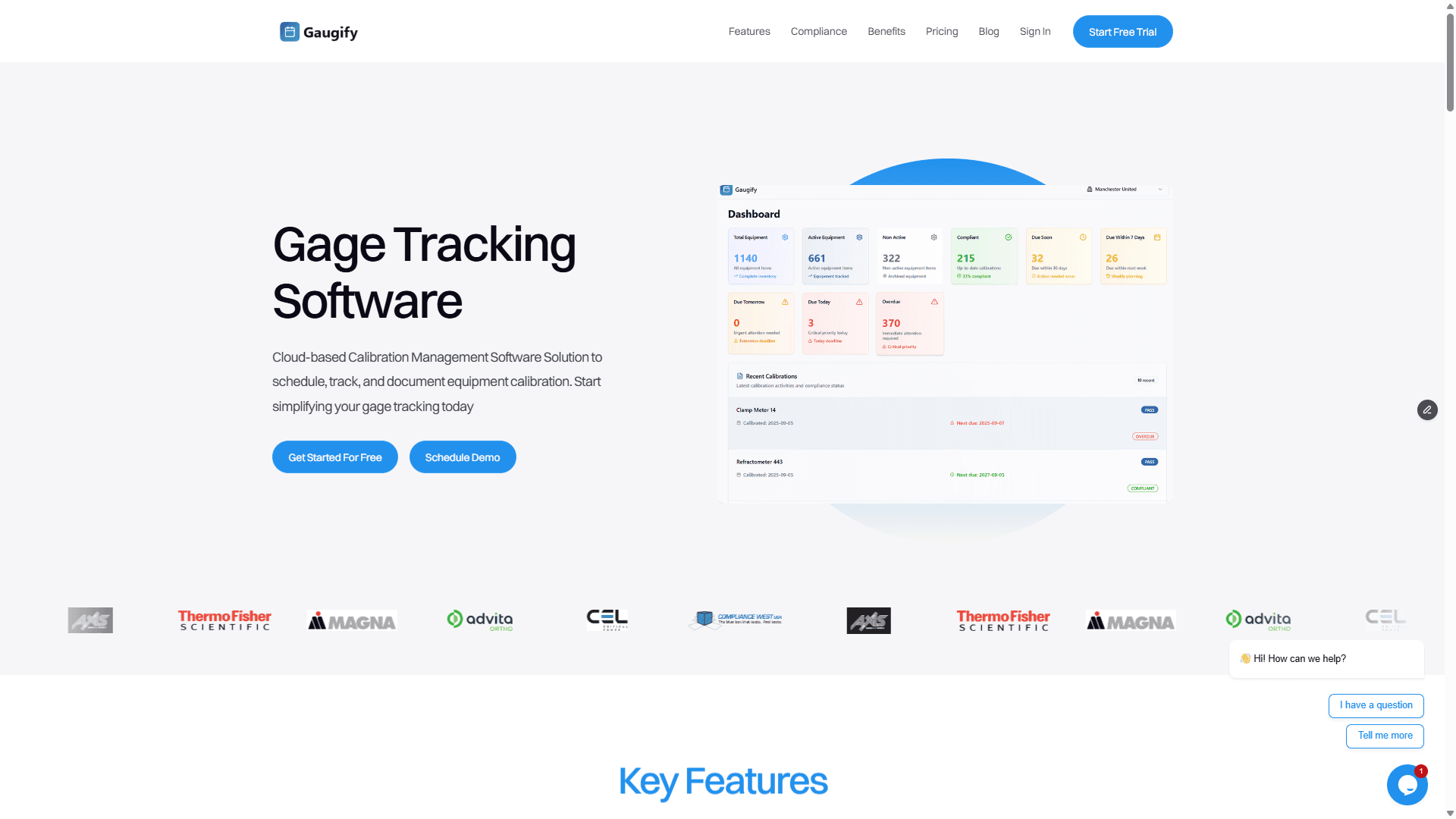
Calibration Status Dashboard: Visual overview showing equipment due within 30, 60, and 90 days
Overdue Equipment Reports: Automatic identification of expired calibrations with aging analysis
Traceability Documentation: Centralized storage of certificates with automatic expiration tracking
Historical Trend Analysis: Graphical displays of calibration frequency, out-of-tolerance rates, and cost metrics
Real-Time Compliance Monitoring
Rather than discovering compliance gaps during periodic audits, Gaugify's compliance features provide continuous monitoring with automated alerts when calibrations approach due dates or equipment moves to different departments.
Mobile accessibility allows auditors to verify equipment status, update locations, and document findings directly from the production floor. Barcode scanning confirms equipment identity and instantly displays calibration status, eliminating manual lookup time.
Streamlined Documentation
Digital calibration records eliminate the paper chase that consumes audit time. Certificates upload directly to equipment records, creating permanent traceability documentation that survives personnel changes and physical storage issues.
Automated calibration scheduling ensures consistent intervals based on equipment classification, usage patterns, and historical stability data rather than arbitrary annual cycles.
Conclusion: Making Internal Calibration Audits Strategic
Effective internal calibration audits transform from reactive compliance exercises into strategic quality management tools. By systematically reviewing equipment status, documentation completeness, and process effectiveness, you maintain continuous measurement confidence that supports both operational excellence and regulatory compliance.
The key to audit success lies in consistent methodology, thorough documentation, and prompt corrective action. Whether you conduct audits manually or leverage modern calibration management software, the fundamental principles remain the same: comprehensive coverage, technical rigor, and continuous improvement.
Regular internal calibration audits demonstrate proactive quality management to customers, reduce compliance risks, and optimize calibration costs through data-driven interval adjustments. Most importantly, they ensure your measurement systems support accurate decision-making throughout your operations.
Ready to streamline your internal calibration audit process? Start your free trial of Gaugify today and discover how modern calibration management software transforms time-consuming manual audits into efficient, comprehensive compliance reviews. Join quality managers worldwide who have reduced audit preparation time by 75% while improving compliance consistency.
How to Perform an Internal Calibration Audit
An internal calibration audit is your first line of defense against measurement failures that can shut down production, fail customer audits, and cost your company thousands in recalls. When done correctly, these audits catch calibration gaps before external auditors do, ensuring your measurement equipment maintains accuracy and your quality system stays compliant with ISO 9001, AS9100, and other critical standards.
Most calibration departments wait until the week before their external audit to scramble through records, only to discover expired certificates, missing traceability documentation, and gages that haven't been calibrated in months. By then, it's too late to fix systemic issues without rushing expensive emergency calibrations or pulling equipment offline during peak production.
This comprehensive guide walks you through conducting a thorough internal calibration audit that identifies problems early, maintains continuous compliance, and demonstrates proactive quality management to both internal stakeholders and external auditors.
Why Internal Calibration Audits Matter
Consider this scenario: Your automotive supplier audit is scheduled for next Tuesday. During a pre-audit check, you discover that 15% of your measuring equipment has expired calibrations, including the coordinate measuring machine (CMM) used to verify critical dimensional tolerances on transmission components. The CMM's certificate expired three weeks ago, meaning any parts measured during that period lack valid measurement traceability.
This situation triggers a cascade of problems. Production must halt on affected parts, emergency calibration services cost 3x normal rates with overnight shipping, and you'll need to quarantine and re-inspect hundreds of components. The customer audit that should have been routine becomes a major corrective action item.
Regular internal calibration audits prevent these scenarios by:
Identifying calibration gaps 30-60 days before certificates expire
Verifying measurement traceability chains remain unbroken
Confirming calibration intervals match actual equipment usage
Validating documentation completeness for regulatory compliance
Assessing measurement uncertainty for critical applications
Real-World Consequences of Poor Calibration Management
A medical device manufacturer recently faced FDA warnings after their internal audit revealed that torque wrenches used in assembly had been operating with expired calibrations for four months. The investigation required re-validating 1,200 devices already in the field, costing over $180,000 in testing and documentation.
In aerospace manufacturing, a supplier discovered during customer audit preparation that their surface roughness tester had never been calibrated since installation 18 months prior. This oversight invalidated thousands of surface finish measurements on critical flight components, requiring complete re-inspection and delaying deliveries by three weeks.
Prerequisites for an Effective Internal Calibration Audit
Before beginning your internal calibration audit, ensure you have the proper foundation in place. Attempting to audit without these prerequisites wastes time and produces incomplete results.
Essential Documentation Requirements
Master Equipment List: Your audit starts with a complete inventory of all measuring equipment requiring calibration. This includes obvious instruments like micrometers, dial indicators, and pressure gauges, but also easily overlooked items such as:
Thermometers in environmental chambers
Torque screwdrivers on assembly lines
pH meters in plating operations
Multimeters used for electrical testing
Reference standards and working standards
Calibration Procedures: Each equipment type requires documented calibration procedures referencing applicable standards such as ANSI/NCSL Z540-1, ISO/IEC 17025, or equipment-specific standards like ASME B89.1.12 for dial indicators.
Calibration Records: Current and historical calibration certificates, including any adjustments made, measurement uncertainty statements, and traceability documentation to NIST or other national metrology institutes.
Resource Planning
Allocate adequate time and personnel for your audit. A typical manufacturing facility with 200-300 instruments requires 2-3 days for a thorough internal calibration audit when conducted by experienced quality personnel. Factor in additional time if you discover issues requiring immediate attention.
Assign team members with appropriate technical backgrounds. The person auditing dimensional gages should understand measurement uncertainty principles and GD&T requirements, while someone auditing electrical test equipment needs familiarity with AC/DC standards and safety requirements.
Step-by-Step Internal Calibration Audit Process
Follow this systematic approach to ensure comprehensive coverage of your calibration system. Experienced calibration managers emphasize the importance of consistent methodology – random spot-checks miss critical gaps that systematic audits catch.
Phase 1: Documentation Review
Step 1: Verify Master Equipment List Accuracy
Begin by physically walking your production floor, labs, and inspection areas with your master equipment list. You'll typically find 5-10% of instruments that aren't on the list, especially recently purchased gages or equipment moved between departments.
For each instrument, verify:
Unique identification number matches records
Location matches documented assignment
Calibration interval remains appropriate for usage
Equipment condition supports continued use
Step 2: Review Calibration Status
Create a calibration status matrix showing current certificate expiration dates. Focus immediate attention on instruments expiring within the next 30 days and any already overdue. A modern calibration management system generates these reports automatically, but manual tracking requires careful spreadsheet management.
Document any gaps in calibration history. If a micrometer shows calibration dates of January 2023 and January 2024 with a 12-month interval, investigate what happened to the expected January 2024 calibration if it's now March 2024.
Step 3: Validate Traceability Documentation
Examine calibration certificates for proper traceability statements. Valid certificates must reference measurement standards traceable to NIST, international equivalents, or fundamental physical constants. Reject certificates showing:
Traceability statements reading "traceable to our in-house standards" without NIST reference
Missing measurement uncertainty values
Calibration dates performed after certificate issue dates
Test uncertainty ratios (TUR) below 4:1 without documented justification
Phase 2: Physical Equipment Inspection
Step 4: Conduct Physical Verification
Physically inspect a representative sample of calibrated equipment, typically 15-25% of your total inventory. For critical measurement applications, inspect 100% of related instruments.
During inspection, verify:
Calibration Label Currency: Labels should show current calibration date, due date, and calibration source. A digital caliper calibrated in March 2024 with a due date of March 2025 should display green status indicators if you use color-coded labels.
Physical Condition: Check for damage affecting measurement capability. A height gage with a bent stylus or dial indicator with cracked crystal requires immediate removal from service regardless of calibration status.
Environmental Suitability: Confirm instruments operate within specified environmental conditions. Precision gages rated for 68°F ± 2°F shouldn't be permanently stationed next to heat-treating ovens where ambient temperatures exceed 80°F.
Step 5: Sample Measurement Verification
For critical applications, perform measurement checks using certified reference standards. This step catches instruments that may have drifted since calibration or sustained damage during use.
Example verification process for micrometers:
Use certified gage blocks (Grade AS-1 or better)
Measure 0.500" and 0.750" blocks with 0.0001" resolution micrometers
Document any readings outside the micrometer's specified accuracy
Compare results to previous verification measurements
Are you spending too much time manually tracking calibration compliance? Start your free trial of Gaugify to automate audit preparation and never miss another calibration due date.
Phase 3: Process and Procedure Review
Step 6: Evaluate Calibration Procedures
Review your written calibration procedures for completeness and technical accuracy. Effective procedures specify:
Reference standards required: "Calibrate using NIST-traceable gage blocks with Grade AS-1 accuracy or better"
Environmental conditions: "Perform calibration at 68°F ± 2°F, 45% RH ± 10%"
Specific test points: "Measure at 0.100", 0.500", and 0.900" positions"
Acceptance criteria: "Maximum permissible error: ±0.0001" for 0-1" micrometers"
Adjustment procedures: Detailed steps for bringing out-of-tolerance instruments into specification
Step 7: Assess Interval Appropriateness
Analyze whether current calibration intervals match actual equipment usage and historical stability. A torque wrench used 50 times daily in production requires more frequent calibration than one used monthly for setup verification.
Review historical calibration data to identify trends:
Instruments consistently found in-tolerance may support extended intervals
Equipment requiring frequent adjustment may need shorter intervals
High-usage instruments in harsh environments typically need more frequent attention
Best Practices for Internal Calibration Audits
Experienced calibration professionals share these proven strategies for maximizing audit effectiveness:
Timing and Scheduling
Conduct Regular Mini-Audits: Rather than annual comprehensive audits, perform quarterly focused reviews covering 25% of your equipment each time. This approach distributes workload and catches problems earlier.
Align with Production Schedules: Schedule equipment inspections during planned maintenance windows or low-production periods to minimize disruption.
Coordinate with External Audits: Complete your internal audit 4-6 weeks before scheduled customer or certification body audits, allowing time to address findings.
Documentation and Record-Keeping
Standardize Audit Forms: Use consistent checklists and documentation formats. Include fields for equipment ID, calibration status, physical condition, location verification, and corrective actions required.
Photograph Evidence: Document equipment condition, calibration labels, and any deficiencies with timestamped photos. This evidence proves invaluable during corrective action follow-up.
Track Trending Data: Monitor metrics such as percentage of overdue calibrations, average time between calibration due dates and completion, and frequency of out-of-tolerance conditions.
Team Coordination
Cross-Train Audit Personnel: Ensure multiple team members can conduct audits to maintain continuity during vacations or turnover.
Involve Production Personnel: Include machine operators and technicians in the audit process. They often identify practical issues that office-based quality personnel miss.
Establish Clear Communication: Create protocols for immediately reporting overdue calibrations or damaged equipment discovered during audits.
Common Internal Calibration Audit Mistakes
Avoid these frequent pitfalls that undermine audit effectiveness:
Incomplete Equipment Coverage
The Mistake: Focusing only on obvious measurement instruments while overlooking embedded sensors, reference standards, and support equipment.
The Solution: Develop equipment categories including production gages, inspection equipment, reference standards, environmental monitoring devices, and test equipment. Many facilities forget about thermometers in ovens, pressure sensors in hydraulic systems, or the standards used to calibrate other instruments.
Surface-Level Documentation Review
The Mistake: Simply checking that calibration certificates exist without verifying technical content.
The Solution: Train auditors to evaluate measurement uncertainty, traceability statements, and test uncertainty ratios. A certificate showing calibration of a 0-1" micrometer with measurement uncertainty of ±0.001" indicates inadequate calibration capability for precision applications requiring ±0.0001" accuracy.
Ignoring Usage Context
The Mistake: Applying one-size-fits-all calibration requirements regardless of measurement criticality.
The Solution: Classify instruments based on measurement risk. Critical safety measurements, customer-specified tolerances, and regulatory requirements deserve more stringent calibration intervals and tighter control than general-purpose measurements.
Poor Follow-Up on Findings
The Mistake: Documenting problems without establishing clear corrective action timelines and responsibilities.
The Solution: Assign specific owners and due dates for each finding. Overdue calibrations require immediate action, while interval adjustments may allow 30-60 day implementation periods.
How Modern Calibration Software Transforms Internal Audits
Traditional internal calibration audits consume significant time gathering information scattered across spreadsheets, filing cabinets, and multiple software systems. Modern cloud-based calibration management platforms transform this process by centralizing all calibration data and automating routine audit tasks.
Gaugify's calibration management platform eliminates the manual data gathering that typically consumes 60-70% of audit time. Instead of walking the production floor with clipboards and spreadsheets, auditors access real-time equipment status, calibration history, and compliance reports from any device.
Automated Audit Preparation
Generate comprehensive audit reports with a few clicks:
Calibration Status Dashboard: Visual overview showing equipment due within 30, 60, and 90 days
Overdue Equipment Reports: Automatic identification of expired calibrations with aging analysis
Traceability Documentation: Centralized storage of certificates with automatic expiration tracking
Historical Trend Analysis: Graphical displays of calibration frequency, out-of-tolerance rates, and cost metrics
Real-Time Compliance Monitoring
Rather than discovering compliance gaps during periodic audits, Gaugify's compliance features provide continuous monitoring with automated alerts when calibrations approach due dates or equipment moves to different departments.
Mobile accessibility allows auditors to verify equipment status, update locations, and document findings directly from the production floor. Barcode scanning confirms equipment identity and instantly displays calibration status, eliminating manual lookup time.
Streamlined Documentation
Digital calibration records eliminate the paper chase that consumes audit time. Certificates upload directly to equipment records, creating permanent traceability documentation that survives personnel changes and physical storage issues.
Automated calibration scheduling ensures consistent intervals based on equipment classification, usage patterns, and historical stability data rather than arbitrary annual cycles.
Conclusion: Making Internal Calibration Audits Strategic
Effective internal calibration audits transform from reactive compliance exercises into strategic quality management tools. By systematically reviewing equipment status, documentation completeness, and process effectiveness, you maintain continuous measurement confidence that supports both operational excellence and regulatory compliance.
The key to audit success lies in consistent methodology, thorough documentation, and prompt corrective action. Whether you conduct audits manually or leverage modern calibration management software, the fundamental principles remain the same: comprehensive coverage, technical rigor, and continuous improvement.
Regular internal calibration audits demonstrate proactive quality management to customers, reduce compliance risks, and optimize calibration costs through data-driven interval adjustments. Most importantly, they ensure your measurement systems support accurate decision-making throughout your operations.
Ready to streamline your internal calibration audit process? Start your free trial of Gaugify today and discover how modern calibration management software transforms time-consuming manual audits into efficient, comprehensive compliance reviews. Join quality managers worldwide who have reduced audit preparation time by 75% while improving compliance consistency.