
How to Set Calibration Intervals Using Historical Data
How to Set Calibration Intervals Using Historical Data
David Bentley
Quality Assurance Engineer
12 min read
How to Set Calibration Intervals Using Historical Data
Setting appropriate calibration intervals is one of the most critical decisions in measurement system management. Get it wrong, and you'll either waste resources on unnecessary calibrations or risk quality failures from instruments that drift beyond specifications. Learning how to set calibration intervals using historical data transforms guesswork into data-driven decisions that optimize both cost and risk.
Most quality managers inherit calibration intervals that were set arbitrarily—often defaulting to manufacturer recommendations or copying what other companies do. But your operating environment, usage patterns, and quality requirements are unique. Historical calibration data from your own instruments provides the foundation for intervals tailored to your specific needs.
Why Historical Data-Based Calibration Intervals Matter
When calibration intervals aren't properly set using historical performance data, several costly problems emerge:
Over-calibration waste: A precision torque wrench used monthly for critical aerospace applications might be calibrated every 90 days when historical data shows it remains stable for 180 days
Under-calibration risk: A digital multimeter in a high-vibration environment might need 6-month intervals instead of the standard 12 months
Audit failures: ISO 17025 and AS9100 auditors expect evidence-based interval decisions, not manufacturer defaults
Production disruptions: Critical gages failing between calibrations can shut down production lines
Consider this real scenario: A medical device manufacturer discovered their coordinate measuring machine (CMM) probe tips were drifting beyond ±2 micron specifications after just 4 months, despite a 12-month calibration interval. Historical data analysis revealed consistent drift patterns tied to usage frequency, leading to a revised 6-month interval that prevented three potential product recalls.
The Business Impact of Poor Interval Setting
Research from the American Society for Quality shows that companies using data-driven calibration intervals reduce calibration costs by 15-25% while improving measurement reliability by up to 40%. The key is analyzing your own historical calibration data rather than relying on generic recommendations.
Prerequisites: What You Need Before Starting
Before diving into how to set calibration intervals using historical data, ensure you have these foundational elements in place:
Minimum Data Requirements
At least 3-5 calibration cycles per instrument (preferably more)
Complete as-found and as-left data for each calibration event
Environmental conditions during calibration periods
Usage frequency and conditions for each instrument
Specification limits and required measurement uncertainties
Documentation Standards
Your calibration records must include:
Specific measurement points tested (e.g., 25%, 50%, 75%, 100% of range)
Actual values measured during as-found testing
Any adjustments made during calibration
Environmental conditions (temperature, humidity, vibration)
Technician performing the calibration
Standards and procedures used
Many organizations struggle with incomplete historical records. If your data is scattered across spreadsheets or paper records, modern calibration management software can help consolidate and standardize this information going forward.
Step-by-Step Guide to Setting Calibration Intervals from Historical Data
Step 1: Collect and Organize Historical Calibration Data
Start by gathering all available calibration records for your target instruments. Create a data matrix with these columns:
Instrument ID and description
Calibration date
As-found readings at each test point
Specification limits
Pass/fail status for each point
Time since last calibration
Usage hours or cycles (if available)
Environmental factors
For example, a digital pressure gauge with a ±0.1% FS specification might show these as-found errors over time:
Month 0: +0.02% FS
Month 6: +0.05% FS
Month 12: +0.08% FS
Month 18: +0.12% FS (failure)
Step 2: Calculate Drift Rates and Patterns
Analyze how each instrument drifts over time by calculating the drift rate per month for each measurement point. Use this formula:
Drift Rate = (As-Found Error - Previous As-Left Error) / Time Interval
Plot drift patterns graphically to identify:
Linear vs. non-linear drift behavior
Seasonal variations
Usage-related degradation patterns
Sudden jumps indicating damage or environmental stress
Look for instruments showing consistent patterns. A torque wrench used for automotive assembly might show predictable linear drift of +0.5% per month, while a laboratory balance could exhibit step-function changes after heavy usage periods.
Step 3: Apply Statistical Analysis Methods
Use established statistical methods to determine optimal intervals:
Method 1: Time-Based Analysis
Calculate the time when instruments reach 75% of their specification limits. This provides a safety margin while avoiding over-calibration.
Method 2: Reliability-Based Analysis
Determine the interval where 95% of instruments pass their as-found testing. This method works well for large populations of similar instruments.
Method 3: Cost-Risk Optimization
Balance calibration costs against the risk of out-of-tolerance conditions using this decision matrix:
High-risk applications: Set intervals at 60-70% of drift-to-failure time
Medium-risk applications: Set intervals at 75-80% of drift-to-failure time
Low-risk applications: Set intervals at 85-90% of drift-to-failure time
Step 4: Factor in Usage and Environmental Conditions
Adjust base intervals based on specific operating conditions:
High-usage instruments: Reduce intervals by 15-25%
Harsh environments: Account for temperature cycling, vibration, and contamination
Critical applications: Add safety factors based on failure mode consequences
Seasonal variations: Consider more frequent calibrations during high-stress periods
A hydraulic pressure transducer in a steel mill environment might need 4-month intervals despite showing 8-month stability in laboratory conditions.
Ready to streamline your interval analysis? Start your free trial of Gaugify and access automated drift analysis tools that make these calculations simple and reliable.
Step 5: Implement and Monitor New Intervals
Roll out new intervals systematically:
Pilot program: Test new intervals on 10-20% of instruments first
Document rationale: Create interval justification reports for auditor review
Update procedures: Revise calibration schedules and work instructions
Train staff: Ensure technicians understand the new approach
Monitor performance: Track as-found pass rates and adjust as needed
Best Practices from Experienced Calibration Professionals
Start Conservative and Refine
When learning how to set calibration intervals using historical data, begin with slightly shorter intervals than your analysis suggests. As you gain confidence in your drift predictions, you can gradually extend intervals while monitoring performance.
Group Similar Instruments
Instruments of the same model, manufacturer, and application often exhibit similar drift patterns. Pooling data from multiple identical instruments provides more robust statistical analysis, especially for newer instruments with limited individual history.
Account for Measurement Uncertainty
Factor calibration uncertainty into your interval calculations. If your standard has 3:1 uncertainty ratio, ensure instruments won't drift beyond this margin between calibrations. This is particularly critical for ISO 17025 compliance.
Create Instrument-Specific Risk Profiles
Not all instruments carry equal risk. A go/no-go gauge on a final inspection line requires different interval considerations than a reference standard used monthly. Develop risk matrices that consider:
Application criticality
Failure mode consequences
Detection likelihood
Replacement availability
Leverage Automation for Continuous Improvement
Modern calibration management systems can automatically track drift patterns and recommend interval adjustments. This continuous improvement approach ensures intervals remain optimal as conditions change.
Common Mistakes and How to Avoid Them
Mistake 1: Insufficient Data Analysis
Problem: Making interval decisions based on just 2-3 calibration cycles or ignoring seasonal variations.
Solution: Collect at least 12-24 months of data before making significant interval changes. Account for seasonal effects, usage patterns, and environmental variations.
Mistake 2: Ignoring Usage Patterns
Problem: Setting intervals based purely on calendar time without considering actual instrument usage.
Solution: Track usage hours, measurement cycles, or handling frequency. A precision micrometer used daily needs different intervals than one used monthly.
Mistake 3: One-Size-Fits-All Approach
Problem: Applying the same interval to all instruments of a given type regardless of application or environment.
Solution: Consider individual instrument histories and operating conditions. Even identical instruments may require different intervals based on their specific usage patterns.
Mistake 4: Forgetting Regulatory Requirements
Problem: Setting intervals that optimize cost but violate industry standards or customer requirements.
Solution: Always verify that your data-driven intervals meet or exceed requirements from standards like ISO 17025, AS9100, or FDA 21 CFR Part 820.
Mistake 5: Poor Documentation
Problem: Failing to document the rationale and methodology used for interval determination.
Solution: Create detailed interval justification reports that auditors can review. Include statistical analysis, risk assessments, and approval documentation.
How Gaugify Simplifies Historical Data-Based Interval Setting
While manual analysis of historical calibration data is possible, modern calibration management software dramatically simplifies the process. Gaugify provides several key advantages:
Automated Drift Analysis
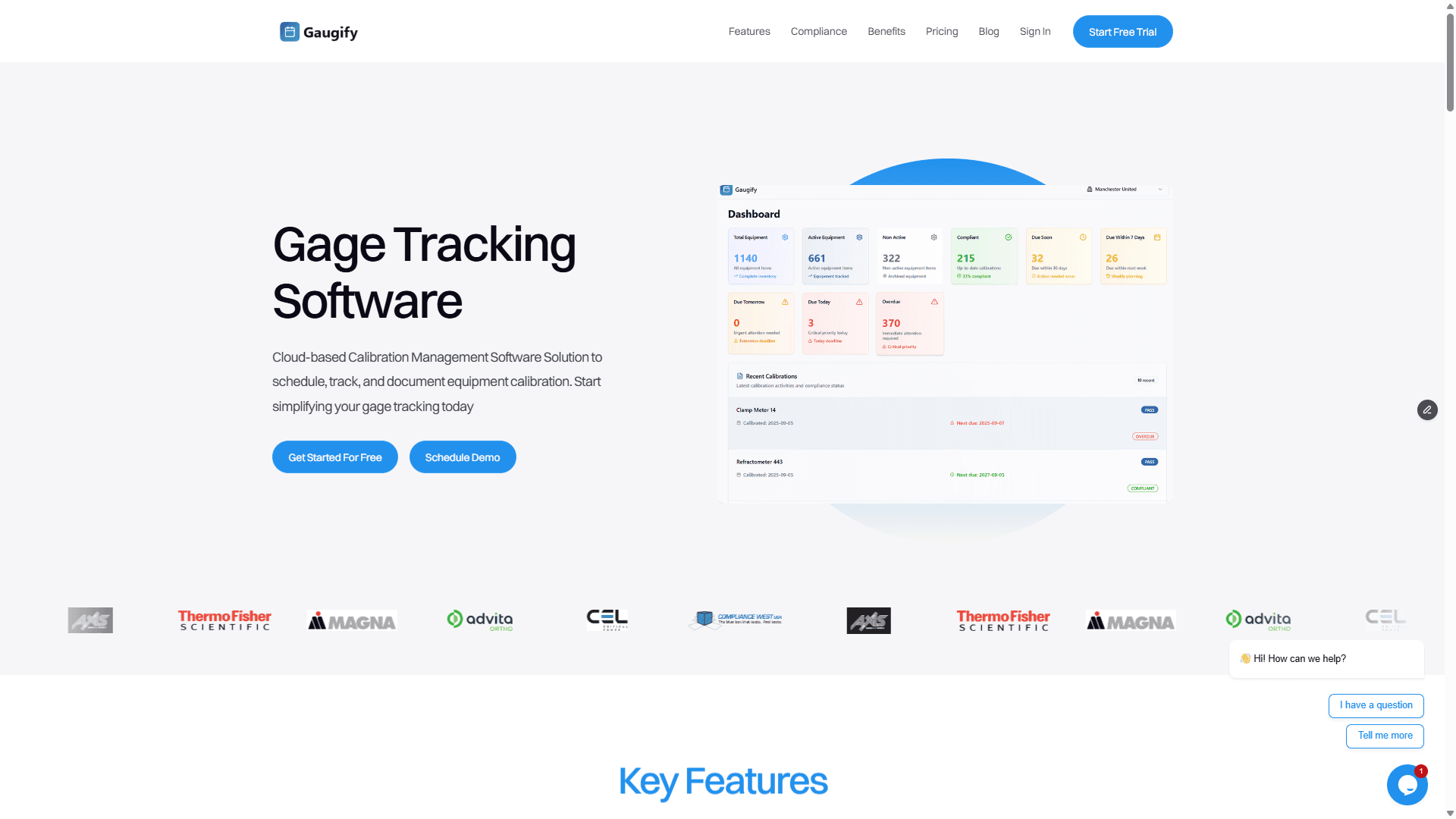
Gaugify automatically calculates drift rates, identifies trends, and flags instruments approaching their specification limits. Instead of manually plotting data points and calculating regression lines, the system provides instant visual analysis of instrument performance over time.
Statistical Interval Recommendations
The platform applies proven statistical methods to recommend optimal calibration intervals based on your historical data. You can adjust risk factors and see how interval changes affect both cost and reliability.
Compliance Documentation
Gaugify automatically generates interval justification reports that meet audit requirements for ISO 17025, AS9100, and other quality standards. This documentation includes statistical analysis, risk assessments, and approval workflows.
Continuous Monitoring and Alerts
The system continuously monitors instrument performance and alerts you when historical patterns suggest interval adjustments are needed. This proactive approach ensures intervals remain optimized as conditions change.
Integration with Usage Data
By integrating with your production systems, Gaugify can factor actual usage hours and cycles into interval calculations, moving beyond simple time-based schedules to usage-based optimization.
Predictive Analytics
Advanced analytics capabilities help predict when instruments are likely to fail, enabling predictive maintenance approaches that further optimize calibration scheduling.
Conclusion: Transform Your Calibration Program with Data-Driven Intervals
Learning how to set calibration intervals using historical data represents a fundamental shift from reactive to proactive calibration management. By analyzing your own instrument performance data, you can optimize the balance between cost and risk while meeting all regulatory requirements.
The key steps—collecting comprehensive data, analyzing drift patterns, applying appropriate statistical methods, and continuously monitoring performance—provide a systematic approach that delivers measurable results. Companies implementing these methods typically see 15-25% cost reductions while improving measurement reliability.
Remember that this is an iterative process. As you gather more data and refine your analysis methods, your interval setting will become increasingly accurate and cost-effective. The investment in proper historical data analysis pays dividends through reduced calibration costs, improved instrument reliability, and stronger audit performance.
Ready to transform your calibration interval management? Schedule a demo with Gaugify to see how automated historical data analysis can optimize your calibration intervals while ensuring full compliance with your quality standards. Take the guesswork out of calibration scheduling and start making data-driven decisions that protect your quality while controlling costs.
How to Set Calibration Intervals Using Historical Data
Setting appropriate calibration intervals is one of the most critical decisions in measurement system management. Get it wrong, and you'll either waste resources on unnecessary calibrations or risk quality failures from instruments that drift beyond specifications. Learning how to set calibration intervals using historical data transforms guesswork into data-driven decisions that optimize both cost and risk.
Most quality managers inherit calibration intervals that were set arbitrarily—often defaulting to manufacturer recommendations or copying what other companies do. But your operating environment, usage patterns, and quality requirements are unique. Historical calibration data from your own instruments provides the foundation for intervals tailored to your specific needs.
Why Historical Data-Based Calibration Intervals Matter
When calibration intervals aren't properly set using historical performance data, several costly problems emerge:
Over-calibration waste: A precision torque wrench used monthly for critical aerospace applications might be calibrated every 90 days when historical data shows it remains stable for 180 days
Under-calibration risk: A digital multimeter in a high-vibration environment might need 6-month intervals instead of the standard 12 months
Audit failures: ISO 17025 and AS9100 auditors expect evidence-based interval decisions, not manufacturer defaults
Production disruptions: Critical gages failing between calibrations can shut down production lines
Consider this real scenario: A medical device manufacturer discovered their coordinate measuring machine (CMM) probe tips were drifting beyond ±2 micron specifications after just 4 months, despite a 12-month calibration interval. Historical data analysis revealed consistent drift patterns tied to usage frequency, leading to a revised 6-month interval that prevented three potential product recalls.
The Business Impact of Poor Interval Setting
Research from the American Society for Quality shows that companies using data-driven calibration intervals reduce calibration costs by 15-25% while improving measurement reliability by up to 40%. The key is analyzing your own historical calibration data rather than relying on generic recommendations.
Prerequisites: What You Need Before Starting
Before diving into how to set calibration intervals using historical data, ensure you have these foundational elements in place:
Minimum Data Requirements
At least 3-5 calibration cycles per instrument (preferably more)
Complete as-found and as-left data for each calibration event
Environmental conditions during calibration periods
Usage frequency and conditions for each instrument
Specification limits and required measurement uncertainties
Documentation Standards
Your calibration records must include:
Specific measurement points tested (e.g., 25%, 50%, 75%, 100% of range)
Actual values measured during as-found testing
Any adjustments made during calibration
Environmental conditions (temperature, humidity, vibration)
Technician performing the calibration
Standards and procedures used
Many organizations struggle with incomplete historical records. If your data is scattered across spreadsheets or paper records, modern calibration management software can help consolidate and standardize this information going forward.
Step-by-Step Guide to Setting Calibration Intervals from Historical Data
Step 1: Collect and Organize Historical Calibration Data
Start by gathering all available calibration records for your target instruments. Create a data matrix with these columns:
Instrument ID and description
Calibration date
As-found readings at each test point
Specification limits
Pass/fail status for each point
Time since last calibration
Usage hours or cycles (if available)
Environmental factors
For example, a digital pressure gauge with a ±0.1% FS specification might show these as-found errors over time:
Month 0: +0.02% FS
Month 6: +0.05% FS
Month 12: +0.08% FS
Month 18: +0.12% FS (failure)
Step 2: Calculate Drift Rates and Patterns
Analyze how each instrument drifts over time by calculating the drift rate per month for each measurement point. Use this formula:
Drift Rate = (As-Found Error - Previous As-Left Error) / Time Interval
Plot drift patterns graphically to identify:
Linear vs. non-linear drift behavior
Seasonal variations
Usage-related degradation patterns
Sudden jumps indicating damage or environmental stress
Look for instruments showing consistent patterns. A torque wrench used for automotive assembly might show predictable linear drift of +0.5% per month, while a laboratory balance could exhibit step-function changes after heavy usage periods.
Step 3: Apply Statistical Analysis Methods
Use established statistical methods to determine optimal intervals:
Method 1: Time-Based Analysis
Calculate the time when instruments reach 75% of their specification limits. This provides a safety margin while avoiding over-calibration.
Method 2: Reliability-Based Analysis
Determine the interval where 95% of instruments pass their as-found testing. This method works well for large populations of similar instruments.
Method 3: Cost-Risk Optimization
Balance calibration costs against the risk of out-of-tolerance conditions using this decision matrix:
High-risk applications: Set intervals at 60-70% of drift-to-failure time
Medium-risk applications: Set intervals at 75-80% of drift-to-failure time
Low-risk applications: Set intervals at 85-90% of drift-to-failure time
Step 4: Factor in Usage and Environmental Conditions
Adjust base intervals based on specific operating conditions:
High-usage instruments: Reduce intervals by 15-25%
Harsh environments: Account for temperature cycling, vibration, and contamination
Critical applications: Add safety factors based on failure mode consequences
Seasonal variations: Consider more frequent calibrations during high-stress periods
A hydraulic pressure transducer in a steel mill environment might need 4-month intervals despite showing 8-month stability in laboratory conditions.
Ready to streamline your interval analysis? Start your free trial of Gaugify and access automated drift analysis tools that make these calculations simple and reliable.
Step 5: Implement and Monitor New Intervals
Roll out new intervals systematically:
Pilot program: Test new intervals on 10-20% of instruments first
Document rationale: Create interval justification reports for auditor review
Update procedures: Revise calibration schedules and work instructions
Train staff: Ensure technicians understand the new approach
Monitor performance: Track as-found pass rates and adjust as needed
Best Practices from Experienced Calibration Professionals
Start Conservative and Refine
When learning how to set calibration intervals using historical data, begin with slightly shorter intervals than your analysis suggests. As you gain confidence in your drift predictions, you can gradually extend intervals while monitoring performance.
Group Similar Instruments
Instruments of the same model, manufacturer, and application often exhibit similar drift patterns. Pooling data from multiple identical instruments provides more robust statistical analysis, especially for newer instruments with limited individual history.
Account for Measurement Uncertainty
Factor calibration uncertainty into your interval calculations. If your standard has 3:1 uncertainty ratio, ensure instruments won't drift beyond this margin between calibrations. This is particularly critical for ISO 17025 compliance.
Create Instrument-Specific Risk Profiles
Not all instruments carry equal risk. A go/no-go gauge on a final inspection line requires different interval considerations than a reference standard used monthly. Develop risk matrices that consider:
Application criticality
Failure mode consequences
Detection likelihood
Replacement availability
Leverage Automation for Continuous Improvement
Modern calibration management systems can automatically track drift patterns and recommend interval adjustments. This continuous improvement approach ensures intervals remain optimal as conditions change.
Common Mistakes and How to Avoid Them
Mistake 1: Insufficient Data Analysis
Problem: Making interval decisions based on just 2-3 calibration cycles or ignoring seasonal variations.
Solution: Collect at least 12-24 months of data before making significant interval changes. Account for seasonal effects, usage patterns, and environmental variations.
Mistake 2: Ignoring Usage Patterns
Problem: Setting intervals based purely on calendar time without considering actual instrument usage.
Solution: Track usage hours, measurement cycles, or handling frequency. A precision micrometer used daily needs different intervals than one used monthly.
Mistake 3: One-Size-Fits-All Approach
Problem: Applying the same interval to all instruments of a given type regardless of application or environment.
Solution: Consider individual instrument histories and operating conditions. Even identical instruments may require different intervals based on their specific usage patterns.
Mistake 4: Forgetting Regulatory Requirements
Problem: Setting intervals that optimize cost but violate industry standards or customer requirements.
Solution: Always verify that your data-driven intervals meet or exceed requirements from standards like ISO 17025, AS9100, or FDA 21 CFR Part 820.
Mistake 5: Poor Documentation
Problem: Failing to document the rationale and methodology used for interval determination.
Solution: Create detailed interval justification reports that auditors can review. Include statistical analysis, risk assessments, and approval documentation.
How Gaugify Simplifies Historical Data-Based Interval Setting
While manual analysis of historical calibration data is possible, modern calibration management software dramatically simplifies the process. Gaugify provides several key advantages:
Automated Drift Analysis
Gaugify automatically calculates drift rates, identifies trends, and flags instruments approaching their specification limits. Instead of manually plotting data points and calculating regression lines, the system provides instant visual analysis of instrument performance over time.
Statistical Interval Recommendations
The platform applies proven statistical methods to recommend optimal calibration intervals based on your historical data. You can adjust risk factors and see how interval changes affect both cost and reliability.
Compliance Documentation
Gaugify automatically generates interval justification reports that meet audit requirements for ISO 17025, AS9100, and other quality standards. This documentation includes statistical analysis, risk assessments, and approval workflows.
Continuous Monitoring and Alerts
The system continuously monitors instrument performance and alerts you when historical patterns suggest interval adjustments are needed. This proactive approach ensures intervals remain optimized as conditions change.
Integration with Usage Data
By integrating with your production systems, Gaugify can factor actual usage hours and cycles into interval calculations, moving beyond simple time-based schedules to usage-based optimization.
Predictive Analytics
Advanced analytics capabilities help predict when instruments are likely to fail, enabling predictive maintenance approaches that further optimize calibration scheduling.
Conclusion: Transform Your Calibration Program with Data-Driven Intervals
Learning how to set calibration intervals using historical data represents a fundamental shift from reactive to proactive calibration management. By analyzing your own instrument performance data, you can optimize the balance between cost and risk while meeting all regulatory requirements.
The key steps—collecting comprehensive data, analyzing drift patterns, applying appropriate statistical methods, and continuously monitoring performance—provide a systematic approach that delivers measurable results. Companies implementing these methods typically see 15-25% cost reductions while improving measurement reliability.
Remember that this is an iterative process. As you gather more data and refine your analysis methods, your interval setting will become increasingly accurate and cost-effective. The investment in proper historical data analysis pays dividends through reduced calibration costs, improved instrument reliability, and stronger audit performance.
Ready to transform your calibration interval management? Schedule a demo with Gaugify to see how automated historical data analysis can optimize your calibration intervals while ensuring full compliance with your quality standards. Take the guesswork out of calibration scheduling and start making data-driven decisions that protect your quality while controlling costs.