
How to Set Up a Calibration Lab In-House
How to Set Up a Calibration Lab In-House
David Bentley
Quality Assurance Engineer
12 min read
How to Set Up a Calibration Lab In-House
Setting up an in-house calibration lab is one of the most strategic investments a manufacturing company can make for quality control. When done correctly, it reduces calibration costs by 40-60%, eliminates weeks of downtime waiting for external labs, and gives you complete control over your measurement standards. However, the decision to set up in-house calibration lab capabilities isn't just about buying some reference standards and calling it done—it requires careful planning, proper documentation, and ongoing management to ensure compliance with ISO/IEC 17025 and industry standards.
The stakes are high when you get this wrong. I've seen companies spend $200,000+ on calibration equipment only to fail their first ISO audit because they couldn't demonstrate traceability or maintain proper environmental controls. Others have had to shut down production lines because their hastily-established lab couldn't handle the workload during peak calibration cycles.
Why In-House Calibration Lab Setup Matters More Than Ever
External calibration labs are experiencing unprecedented backlogs. What used to be a 2-3 week turnaround for calibrating a set of micrometers or pressure gauges has stretched to 6-8 weeks in many regions. For a automotive supplier managing 500+ measuring instruments across multiple production lines, this creates a logistics nightmare.
Consider this real scenario: A precision machining shop I worked with was paying $180 per calibration for their collection of bore gages, pin gages, and coordinate measuring machine (CMM) probes. With 200 instruments requiring annual calibration, they were spending $36,000 yearly—not including the cost of backup instruments to maintain production during calibration cycles.
After establishing their own lab, they reduced per-instrument costs to under $25 while cutting turnaround time from 4 weeks to same-day service. The return on investment was achieved in 18 months, even after accounting for technician training and compliance management software.
What Goes Wrong Without Proper Planning
The most common failure I see is companies buying calibration equipment without understanding their uncertainty budget requirements. A client once purchased a $15,000 pressure calibrator thinking it would handle all their pressure instrument needs, only to discover it couldn't achieve the 4:1 test accuracy ratio required for their most critical pressure transducers with ±0.1% accuracy specifications.
Environmental control is another critical failure point. Calibration work requiring temperature stability of ±1°C becomes impossible in a shop environment where temperatures swing 10-15°C throughout the day. The result? Failed audits and calibration certificates that aren't worth the paper they're printed on.
Prerequisites for Setting Up In-House Calibration Lab
Before you purchase your first piece of calibration equipment, you need a clear understanding of your instrument population and calibration requirements.
Instrument Inventory and Analysis
Start with a comprehensive audit of all measuring equipment requiring calibration. This isn't just your obvious instruments like calipers and micrometers—include:
Dimensional instruments (calipers, micrometers, bore gages, pin gages, height gages)
Torque instruments (torque wrenches, torque sensors, screwdrivers)
Pressure instruments (pressure gages, transducers, switches)
Temperature instruments (thermocouples, RTDs, infrared thermometers)
Electrical instruments (multimeters, oscilloscopes, function generators)
Mass/force instruments (scales, force gages, load cells)
For each category, document the accuracy requirements, measurement ranges, and current calibration frequency. A typical automotive supplier might have 40% dimensional instruments, 25% torque tools, 20% electrical instruments, and 15% pressure/temperature instruments.
Facility Requirements
Your calibration environment directly impacts measurement uncertainty. For dimensional calibration work, you need:
Temperature control: ±2°C or better (±1°C for precision work)
Humidity control: 45-75% RH with minimal fluctuation
Vibration isolation: Separate from production floor vibration
Clean environment: Minimal dust and contamination
Adequate lighting: 500+ lux for detailed inspection work
A 200-400 square foot space is typically sufficient for a small to medium facility. The investment in proper environmental controls—usually $15,000-30,000—pays for itself through reduced measurement uncertainty and improved calibration reliability.
Staffing and Training Requirements
Plan for at least one full-time calibration technician for every 300-500 instruments, depending on complexity. Your technicians need training in:
Measurement uncertainty analysis and calculation
ISO/IEC 17025 requirements and documentation
Specific calibration procedures for each instrument type
Calibration software operation and data management
Traceability requirements and certificate interpretation
Budget 2-3 weeks of initial training per technician, plus ongoing education to maintain competency.
Step-by-Step Guide to Set Up In-House Calibration Lab
Step 1: Establish Reference Standards
Your reference standards must maintain at least a 4:1 accuracy ratio compared to the instruments you're calibrating. For dimensional work, this typically means:
Gage block set: ASME Grade 1 or better (±0.12 μm for blocks up to 25mm)
Reference micrometers: ±0.5 μm accuracy for calibrating shop micrometers
Master ring gages: Class XX or XXX for bore gage calibration
Precision dial indicator tester: ±0.13 μm accuracy
For electrical calibration, start with a precision multifunction calibrator capable of ±0.015% accuracy for voltage and current measurements. Popular choices include the Fluke 5730A or Transmille 4000 series.
Document the traceability chain for each standard back to NIST or other national metrology institutes. Your gage blocks, for example, should come with calibration certificates showing measurements traceable through a NIST-recognized calibration lab.
Step 2: Develop Calibration Procedures
Each instrument type requires a documented calibration procedure specifying:
Reference standards to be used
Environmental conditions required
Calibration points and tolerances
Measurement uncertainty calculation
Pass/fail criteria and adjustment procedures
For example, a typical 0-6" digital caliper calibration procedure might specify five test points (0", 1", 2", 4", and 6") using certified gage blocks, with pass criteria of ±0.001" and measurement uncertainty of ±0.0008" at 95% confidence level.
Document your procedures according to your quality management system requirements. If you're ISO 9001 certified, these become controlled documents requiring revision control and approval processes.
Step 3: Implement Environmental Monitoring
Install calibrated temperature and humidity sensors with data logging capability. Monitor conditions continuously and establish alert limits—typically ±1°C from your target temperature for precision work.
Create environmental control charts and review them weekly. Any excursions outside acceptable limits may require re-calibration of instruments processed during those periods.
Step 4: Establish Quality Management System
Your calibration lab needs documented procedures covering:
Document control and records management
Calibration scheduling and tracking
Nonconformance handling and corrective action
Internal audit procedures
Management review processes
Many companies choose to pursue formal ISO 17025 accreditation, which provides third-party verification of your technical competence and quality management practices.
Step 5: Implement Calibration Management Software
Manual tracking systems break down quickly as your lab grows. Digital calibration management eliminates scheduling errors, automates certificate generation, and provides traceability audit trails that satisfy ISO auditors.
Key features to look for include automated scheduling, customizable calibration procedures, uncertainty calculation tools, and integration with your existing quality management system. Modern cloud-based platforms offer these capabilities without the IT infrastructure requirements of traditional software.
Best Practices from Experienced Calibration Professionals
Start Small and Scale Gradually
Don't try to bring all calibration work in-house immediately. Start with your highest-volume, lowest-complexity instruments—typically basic dimensional tools like calipers and micrometers. This allows your technicians to develop competency while generating immediate cost savings.
A successful approach I've seen repeatedly: Start with 50-100 instruments representing 60-70% of your calibration volume. Master this work before adding more complex instruments like CMM certification or advanced electrical calibration.
Invest in Proper Training
The most expensive calibration equipment is worthless without properly trained technicians. Budget for formal training programs—companies like Fluke, Tektronix, and specialized metrology training providers offer comprehensive courses covering both theory and hands-on skills.
Consider certification programs like the ASQ Certified Calibration Technician program, which provides standardized competency validation that's recognized across industries.
Plan for Calibration of Your Standards
Your reference standards require calibration too, typically annually or bi-annually depending on stability and usage. Budget 10-15% of your annual calibration costs for standards calibration, and plan for 2-3 week turnaround times when sending standards to accredited labs.
Maintain backup standards for critical measurements to avoid lab downtime during standards calibration cycles.
Document Everything
Calibration work is only as good as its documentation. Every measurement, every adjustment, every environmental condition must be recorded. This documentation serves multiple purposes:
Demonstrates compliance during audits
Provides data for measurement uncertainty analysis
Enables trending analysis for instrument performance
Supports corrective action investigations
Digital calibration management systems streamline this documentation while ensuring consistency and completeness.
Common Mistakes and How to Avoid Them
Underestimating Measurement Uncertainty
Many new labs make the mistake of assuming their reference standards' accuracy directly translates to their calibration capability. Measurement uncertainty includes multiple components:
Reference standard uncertainty
Environmental effects
Technician repeatability
Instrument resolution and stability
Calibration procedure limitations
A reference standard with ±0.0001" accuracy might result in overall calibration uncertainty of ±0.0003" when all factors are considered. Plan your standards selection accordingly to maintain the required accuracy ratios.
Inadequate Facility Planning
I've seen companies set up calibration labs in corner spaces with no environmental control, then wonder why their measurement results aren't repeatable. Environmental conditions affect every measurement—a 5°C temperature change can cause a 100mm gage block to expand or contract by over 6 micrometers.
Invest in proper facility design from the start. It's much more expensive to retrofit environmental controls than to build them in initially.
Poor Calibration Scheduling
Manual scheduling systems lead to forgotten calibrations, missed due dates, and instruments pulled from service at critical production moments. Implement automated scheduling with advance notifications—typically 30, 14, and 7 days before calibration due dates.
Consider risk-based calibration intervals rather than rigid annual schedules. Stable instruments in non-critical applications might calibrate every 18-24 months, while critical measurement tools in harsh environments might require quarterly calibration.
Inadequate Staff Planning
Calibration workload isn't evenly distributed throughout the year. Many companies schedule annual calibrations during planned maintenance shutdowns, creating peak demand periods that overwhelm understaffed labs.
Analyze your calibration schedule distribution and plan staffing accordingly. Cross-train production technicians to handle basic calibration work during peak periods, or adjust calibration intervals to spread the workload more evenly.
How Gaugify Simplifies In-House Calibration Lab Setup
Modern calibration management software eliminates many of the traditional pain points associated with running an in-house lab. Gaugify's cloud-based platform provides:
Automated Scheduling and Notifications
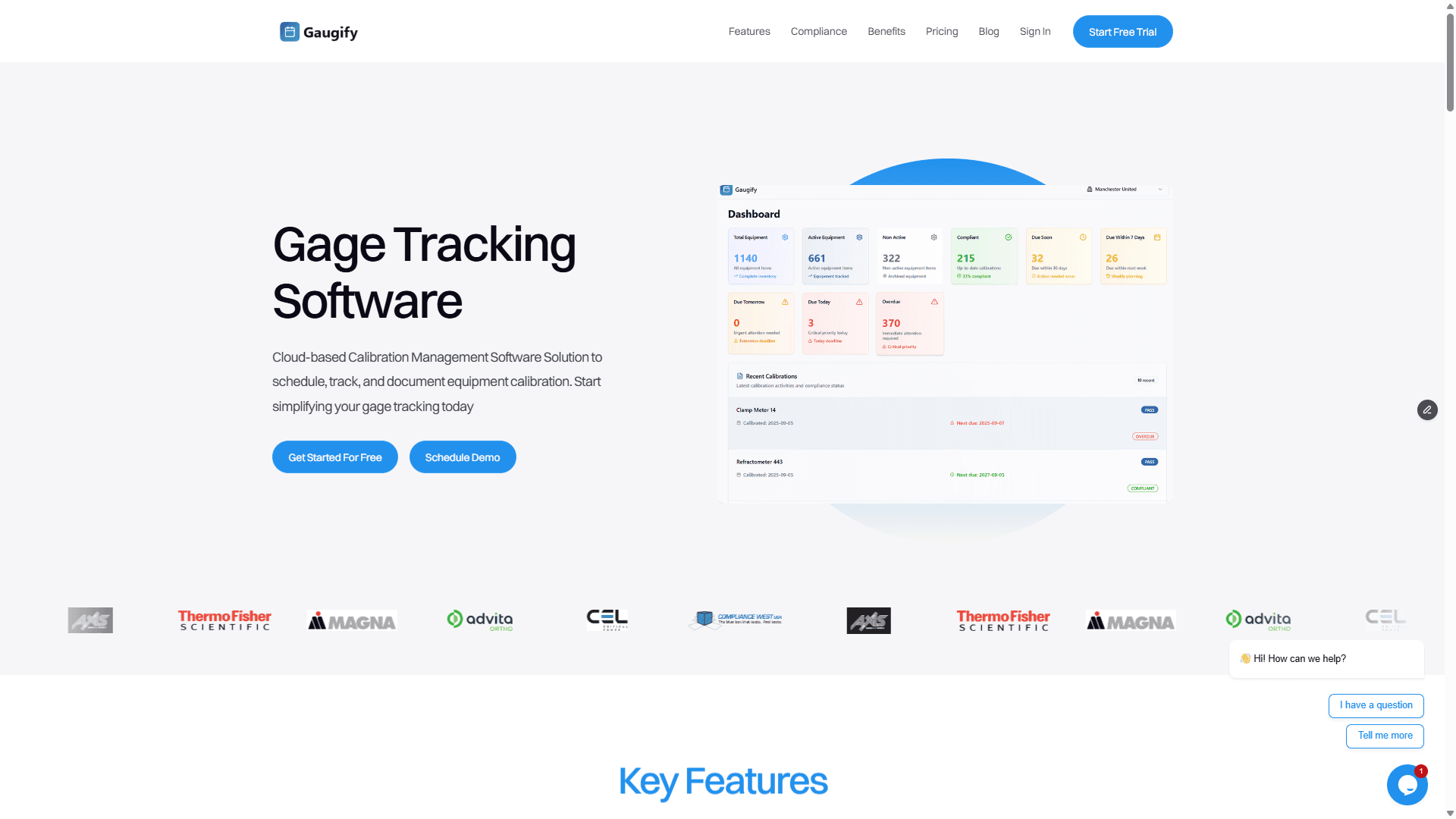
Never miss another calibration due date. Automated email notifications keep technicians and managers informed of upcoming calibrations, while dashboard views provide real-time status of all instruments in your system.
Standardized Procedures and Certificates
Built-in procedure templates for common instrument types ensure consistency across technicians and shifts. Automated certificate generation includes all required elements—traceability statements, measurement uncertainty, environmental conditions, and technician certification.
Measurement Uncertainty Calculations
Integrated uncertainty calculation tools simplify the complex mathematics required for ISO 17025 compliance. Define uncertainty components once, then let the software calculate combined uncertainty for each calibration automatically.
Audit Trail and Compliance Reporting
Complete documentation trails satisfy ISO auditors and customer quality requirements. Generate compliance reports showing calibration status, traceability documentation, and nonconformance trending with a few clicks.
The platform scales from small labs managing a few hundred instruments to enterprise installations tracking tens of thousands of devices across multiple facilities. Schedule a demo to see how it can streamline your calibration lab operations.
Implementation Timeline and Success Metrics
A typical in-house calibration lab setup follows this timeline:
Months 1-2: Facility preparation and equipment procurement
Month 3: Equipment installation and initial technician training
Month 4: Procedure development and system testing
Month 5: Pilot program with 50-100 instruments
Month 6: Full operation with complete instrument population
Track success using these key metrics:
Average calibration turnaround time (target: same day to 3 days)
Cost per calibration (should decrease 40-60% compared to external labs)
Calibration schedule compliance (target: >98% on-time completion)
Customer satisfaction scores (internal customers should see improved service)
Return on investment (typically achieved within 18-24 months)
Ready to Transform Your Calibration Operations?
Setting up an in-house calibration lab requires careful planning, proper equipment, and skilled technicians—but the payoff in reduced costs, improved turnaround times, and better control over your quality processes makes it one of the best investments a manufacturing company can make.
Don't let manual tracking systems and compliance complexity slow down your lab operations. Modern calibration management software like Gaugify streamlines everything from scheduling to certificate generation, letting your technicians focus on what they do best—ensuring your measuring instruments perform accurately and reliably.
Start your free trial today and discover how digital calibration management can transform your quality operations. Join hundreds of companies that have already streamlined their calibration processes with Gaugify's comprehensive platform.
How to Set Up a Calibration Lab In-House
Setting up an in-house calibration lab is one of the most strategic investments a manufacturing company can make for quality control. When done correctly, it reduces calibration costs by 40-60%, eliminates weeks of downtime waiting for external labs, and gives you complete control over your measurement standards. However, the decision to set up in-house calibration lab capabilities isn't just about buying some reference standards and calling it done—it requires careful planning, proper documentation, and ongoing management to ensure compliance with ISO/IEC 17025 and industry standards.
The stakes are high when you get this wrong. I've seen companies spend $200,000+ on calibration equipment only to fail their first ISO audit because they couldn't demonstrate traceability or maintain proper environmental controls. Others have had to shut down production lines because their hastily-established lab couldn't handle the workload during peak calibration cycles.
Why In-House Calibration Lab Setup Matters More Than Ever
External calibration labs are experiencing unprecedented backlogs. What used to be a 2-3 week turnaround for calibrating a set of micrometers or pressure gauges has stretched to 6-8 weeks in many regions. For a automotive supplier managing 500+ measuring instruments across multiple production lines, this creates a logistics nightmare.
Consider this real scenario: A precision machining shop I worked with was paying $180 per calibration for their collection of bore gages, pin gages, and coordinate measuring machine (CMM) probes. With 200 instruments requiring annual calibration, they were spending $36,000 yearly—not including the cost of backup instruments to maintain production during calibration cycles.
After establishing their own lab, they reduced per-instrument costs to under $25 while cutting turnaround time from 4 weeks to same-day service. The return on investment was achieved in 18 months, even after accounting for technician training and compliance management software.
What Goes Wrong Without Proper Planning
The most common failure I see is companies buying calibration equipment without understanding their uncertainty budget requirements. A client once purchased a $15,000 pressure calibrator thinking it would handle all their pressure instrument needs, only to discover it couldn't achieve the 4:1 test accuracy ratio required for their most critical pressure transducers with ±0.1% accuracy specifications.
Environmental control is another critical failure point. Calibration work requiring temperature stability of ±1°C becomes impossible in a shop environment where temperatures swing 10-15°C throughout the day. The result? Failed audits and calibration certificates that aren't worth the paper they're printed on.
Prerequisites for Setting Up In-House Calibration Lab
Before you purchase your first piece of calibration equipment, you need a clear understanding of your instrument population and calibration requirements.
Instrument Inventory and Analysis
Start with a comprehensive audit of all measuring equipment requiring calibration. This isn't just your obvious instruments like calipers and micrometers—include:
Dimensional instruments (calipers, micrometers, bore gages, pin gages, height gages)
Torque instruments (torque wrenches, torque sensors, screwdrivers)
Pressure instruments (pressure gages, transducers, switches)
Temperature instruments (thermocouples, RTDs, infrared thermometers)
Electrical instruments (multimeters, oscilloscopes, function generators)
Mass/force instruments (scales, force gages, load cells)
For each category, document the accuracy requirements, measurement ranges, and current calibration frequency. A typical automotive supplier might have 40% dimensional instruments, 25% torque tools, 20% electrical instruments, and 15% pressure/temperature instruments.
Facility Requirements
Your calibration environment directly impacts measurement uncertainty. For dimensional calibration work, you need:
Temperature control: ±2°C or better (±1°C for precision work)
Humidity control: 45-75% RH with minimal fluctuation
Vibration isolation: Separate from production floor vibration
Clean environment: Minimal dust and contamination
Adequate lighting: 500+ lux for detailed inspection work
A 200-400 square foot space is typically sufficient for a small to medium facility. The investment in proper environmental controls—usually $15,000-30,000—pays for itself through reduced measurement uncertainty and improved calibration reliability.
Staffing and Training Requirements
Plan for at least one full-time calibration technician for every 300-500 instruments, depending on complexity. Your technicians need training in:
Measurement uncertainty analysis and calculation
ISO/IEC 17025 requirements and documentation
Specific calibration procedures for each instrument type
Calibration software operation and data management
Traceability requirements and certificate interpretation
Budget 2-3 weeks of initial training per technician, plus ongoing education to maintain competency.
Step-by-Step Guide to Set Up In-House Calibration Lab
Step 1: Establish Reference Standards
Your reference standards must maintain at least a 4:1 accuracy ratio compared to the instruments you're calibrating. For dimensional work, this typically means:
Gage block set: ASME Grade 1 or better (±0.12 μm for blocks up to 25mm)
Reference micrometers: ±0.5 μm accuracy for calibrating shop micrometers
Master ring gages: Class XX or XXX for bore gage calibration
Precision dial indicator tester: ±0.13 μm accuracy
For electrical calibration, start with a precision multifunction calibrator capable of ±0.015% accuracy for voltage and current measurements. Popular choices include the Fluke 5730A or Transmille 4000 series.
Document the traceability chain for each standard back to NIST or other national metrology institutes. Your gage blocks, for example, should come with calibration certificates showing measurements traceable through a NIST-recognized calibration lab.
Step 2: Develop Calibration Procedures
Each instrument type requires a documented calibration procedure specifying:
Reference standards to be used
Environmental conditions required
Calibration points and tolerances
Measurement uncertainty calculation
Pass/fail criteria and adjustment procedures
For example, a typical 0-6" digital caliper calibration procedure might specify five test points (0", 1", 2", 4", and 6") using certified gage blocks, with pass criteria of ±0.001" and measurement uncertainty of ±0.0008" at 95% confidence level.
Document your procedures according to your quality management system requirements. If you're ISO 9001 certified, these become controlled documents requiring revision control and approval processes.
Step 3: Implement Environmental Monitoring
Install calibrated temperature and humidity sensors with data logging capability. Monitor conditions continuously and establish alert limits—typically ±1°C from your target temperature for precision work.
Create environmental control charts and review them weekly. Any excursions outside acceptable limits may require re-calibration of instruments processed during those periods.
Step 4: Establish Quality Management System
Your calibration lab needs documented procedures covering:
Document control and records management
Calibration scheduling and tracking
Nonconformance handling and corrective action
Internal audit procedures
Management review processes
Many companies choose to pursue formal ISO 17025 accreditation, which provides third-party verification of your technical competence and quality management practices.
Step 5: Implement Calibration Management Software
Manual tracking systems break down quickly as your lab grows. Digital calibration management eliminates scheduling errors, automates certificate generation, and provides traceability audit trails that satisfy ISO auditors.
Key features to look for include automated scheduling, customizable calibration procedures, uncertainty calculation tools, and integration with your existing quality management system. Modern cloud-based platforms offer these capabilities without the IT infrastructure requirements of traditional software.
Best Practices from Experienced Calibration Professionals
Start Small and Scale Gradually
Don't try to bring all calibration work in-house immediately. Start with your highest-volume, lowest-complexity instruments—typically basic dimensional tools like calipers and micrometers. This allows your technicians to develop competency while generating immediate cost savings.
A successful approach I've seen repeatedly: Start with 50-100 instruments representing 60-70% of your calibration volume. Master this work before adding more complex instruments like CMM certification or advanced electrical calibration.
Invest in Proper Training
The most expensive calibration equipment is worthless without properly trained technicians. Budget for formal training programs—companies like Fluke, Tektronix, and specialized metrology training providers offer comprehensive courses covering both theory and hands-on skills.
Consider certification programs like the ASQ Certified Calibration Technician program, which provides standardized competency validation that's recognized across industries.
Plan for Calibration of Your Standards
Your reference standards require calibration too, typically annually or bi-annually depending on stability and usage. Budget 10-15% of your annual calibration costs for standards calibration, and plan for 2-3 week turnaround times when sending standards to accredited labs.
Maintain backup standards for critical measurements to avoid lab downtime during standards calibration cycles.
Document Everything
Calibration work is only as good as its documentation. Every measurement, every adjustment, every environmental condition must be recorded. This documentation serves multiple purposes:
Demonstrates compliance during audits
Provides data for measurement uncertainty analysis
Enables trending analysis for instrument performance
Supports corrective action investigations
Digital calibration management systems streamline this documentation while ensuring consistency and completeness.
Common Mistakes and How to Avoid Them
Underestimating Measurement Uncertainty
Many new labs make the mistake of assuming their reference standards' accuracy directly translates to their calibration capability. Measurement uncertainty includes multiple components:
Reference standard uncertainty
Environmental effects
Technician repeatability
Instrument resolution and stability
Calibration procedure limitations
A reference standard with ±0.0001" accuracy might result in overall calibration uncertainty of ±0.0003" when all factors are considered. Plan your standards selection accordingly to maintain the required accuracy ratios.
Inadequate Facility Planning
I've seen companies set up calibration labs in corner spaces with no environmental control, then wonder why their measurement results aren't repeatable. Environmental conditions affect every measurement—a 5°C temperature change can cause a 100mm gage block to expand or contract by over 6 micrometers.
Invest in proper facility design from the start. It's much more expensive to retrofit environmental controls than to build them in initially.
Poor Calibration Scheduling
Manual scheduling systems lead to forgotten calibrations, missed due dates, and instruments pulled from service at critical production moments. Implement automated scheduling with advance notifications—typically 30, 14, and 7 days before calibration due dates.
Consider risk-based calibration intervals rather than rigid annual schedules. Stable instruments in non-critical applications might calibrate every 18-24 months, while critical measurement tools in harsh environments might require quarterly calibration.
Inadequate Staff Planning
Calibration workload isn't evenly distributed throughout the year. Many companies schedule annual calibrations during planned maintenance shutdowns, creating peak demand periods that overwhelm understaffed labs.
Analyze your calibration schedule distribution and plan staffing accordingly. Cross-train production technicians to handle basic calibration work during peak periods, or adjust calibration intervals to spread the workload more evenly.
How Gaugify Simplifies In-House Calibration Lab Setup
Modern calibration management software eliminates many of the traditional pain points associated with running an in-house lab. Gaugify's cloud-based platform provides:
Automated Scheduling and Notifications
Never miss another calibration due date. Automated email notifications keep technicians and managers informed of upcoming calibrations, while dashboard views provide real-time status of all instruments in your system.
Standardized Procedures and Certificates
Built-in procedure templates for common instrument types ensure consistency across technicians and shifts. Automated certificate generation includes all required elements—traceability statements, measurement uncertainty, environmental conditions, and technician certification.
Measurement Uncertainty Calculations
Integrated uncertainty calculation tools simplify the complex mathematics required for ISO 17025 compliance. Define uncertainty components once, then let the software calculate combined uncertainty for each calibration automatically.
Audit Trail and Compliance Reporting
Complete documentation trails satisfy ISO auditors and customer quality requirements. Generate compliance reports showing calibration status, traceability documentation, and nonconformance trending with a few clicks.
The platform scales from small labs managing a few hundred instruments to enterprise installations tracking tens of thousands of devices across multiple facilities. Schedule a demo to see how it can streamline your calibration lab operations.
Implementation Timeline and Success Metrics
A typical in-house calibration lab setup follows this timeline:
Months 1-2: Facility preparation and equipment procurement
Month 3: Equipment installation and initial technician training
Month 4: Procedure development and system testing
Month 5: Pilot program with 50-100 instruments
Month 6: Full operation with complete instrument population
Track success using these key metrics:
Average calibration turnaround time (target: same day to 3 days)
Cost per calibration (should decrease 40-60% compared to external labs)
Calibration schedule compliance (target: >98% on-time completion)
Customer satisfaction scores (internal customers should see improved service)
Return on investment (typically achieved within 18-24 months)
Ready to Transform Your Calibration Operations?
Setting up an in-house calibration lab requires careful planning, proper equipment, and skilled technicians—but the payoff in reduced costs, improved turnaround times, and better control over your quality processes makes it one of the best investments a manufacturing company can make.
Don't let manual tracking systems and compliance complexity slow down your lab operations. Modern calibration management software like Gaugify streamlines everything from scheduling to certificate generation, letting your technicians focus on what they do best—ensuring your measuring instruments perform accurately and reliably.
Start your free trial today and discover how digital calibration management can transform your quality operations. Join hundreds of companies that have already streamlined their calibration processes with Gaugify's comprehensive platform.