
Top 10 Cloud-Based Calibration Management Software 2026
Top 10 Cloud-Based Calibration Management Software 2026
David Bentley
Quality Assurance Engineer
12 min read
Top 10 Cloud-Based Calibration Management Software 2026
The calibration management landscape has evolved dramatically, with cloud calibration management software becoming the standard for modern quality departments. As we enter 2026, organizations are moving away from legacy desktop applications and embracing cloud-native solutions that offer real-time access, automated workflows, and seamless compliance reporting.
Whether you're managing a dozen micrometers in a small machine shop or thousands of instruments across multiple facilities, the right cloud calibration management software can transform your quality operations. This comprehensive guide examines the top 10 solutions dominating the market, comparing features, pricing, and capabilities to help you make an informed decision for your organization.
1. Gaugify - Modern Cloud Calibration Management Software
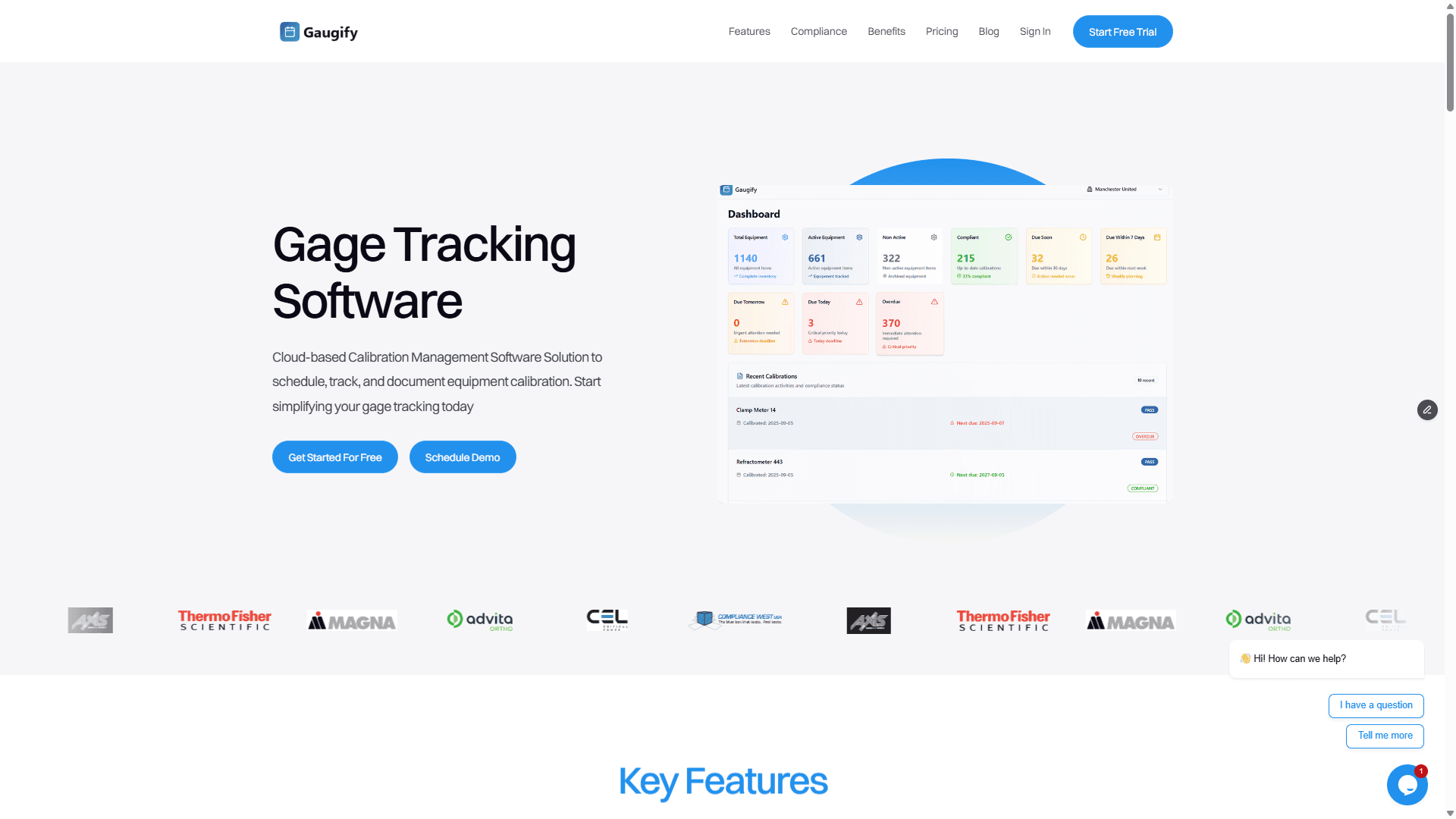
Gaugify leads our list as the most intuitive and comprehensive cloud calibration management software available today. Built from the ground up for the cloud, Gaugify eliminates the complexity traditionally associated with calibration management while maintaining the robust features demanded by ISO 17025 and AS9100 environments.
Key Strengths:
Built-in measurement uncertainty calculations with automatic propagation
Intelligent scheduling system that accounts for usage patterns and criticality
Mobile-first design for shop floor accessibility
Automated certificate generation with customizable templates
Real-time compliance dashboards and audit trails
Transparent SaaS pricing starting at $29/month
What sets Gaugify apart is its focus on user experience without sacrificing functionality. The platform handles everything from basic dimensional gages like calipers and micrometers to complex electronic test equipment, automatically calculating measurement uncertainty and maintaining complete audit trails for ISO 17025 compliance.
2. MasterControl Calibration Management
MasterControl offers a comprehensive quality management suite that includes calibration management as part of its broader platform. The solution is particularly strong for large enterprises already using other MasterControl products for document control and training management.
Key Features:
Integration with broader quality management ecosystem
Enterprise-grade security and validation
Configurable workflows and approval processes
Advanced reporting and analytics
However, the complexity and cost can be overwhelming for smaller organizations focused solely on calibration management.
3. Gage-Trak Calibration Management Software
Gage-Trak has been serving the calibration community for decades and offers both cloud and on-premise deployment options. Their solution provides solid basic functionality for traditional calibration programs.
Strengths:
Long track record in calibration management
Flexible deployment options
Strong customer support
Established user base
The interface feels dated compared to modern alternatives, and advanced features like automated uncertainty calculations require additional modules.
4. Prime Technologies CalTrak
CalTrak focuses specifically on calibration and asset management, offering a specialized solution for organizations with extensive measurement equipment inventories.
Notable Features:
Comprehensive asset tracking capabilities
Integration with popular calibration service providers
Detailed cost tracking and analysis
Barcode and RFID support
5. Indispensable Technologies CalibrateIt
CalibrateIt provides a straightforward approach to calibration management with emphasis on ease of use and quick implementation.
Key Benefits:
Simple, intuitive interface
Quick deployment
Reasonable pricing for small to medium businesses
Good customer support
Ready to experience the difference modern cloud calibration management software can make? Start your free Gaugify trial today and see why quality managers are choosing our platform for their calibration needs.
6. CyberMetrics CorporationGageSuite
GageSuite offers a comprehensive calibration management solution with strong statistical analysis capabilities and extensive customization options.
Strengths:
Advanced statistical analysis tools
Highly customizable workflows
Integration with statistical software packages
Robust reporting capabilities
The learning curve can be steep, and the interface may feel overwhelming for users seeking straightforward calibration management.
7. Fluke Calibration MET/CAL Software
MET/CAL from Fluke Calibration is widely recognized in the electronics calibration space, particularly for automated calibration procedures.
Key Features:
Extensive library of automated calibration procedures
Strong integration with Fluke calibration equipment
Proven reliability in electronics calibration
Comprehensive measurement uncertainty analysis
The software is primarily Windows-based and lacks the modern cloud-native architecture of newer solutions.
8. Beamex Calibration Management Software
Beamex offers integrated calibration management and documentation solutions, particularly strong in process industries like oil & gas and pharmaceuticals.
Notable Capabilities:
Integrated calibrator and software solutions
Strong focus on process instrumentation
Paperless calibration workflows
Industry-specific templates and procedures
9. SIMCO Calibration Management System
SIMCO provides calibration management solutions with particular strength in aerospace and defense applications.
Key Features:
AS9100 and aerospace-specific compliance features
Integration with quality management systems
Detailed audit trail and traceability
Support for complex calibration hierarchies
10. CompuCal Calibration Management Software
CompuCal rounds out our list with a focus on small to medium-sized calibration labs and quality departments.
Strengths:
Affordable pricing for smaller organizations
Simple setup and implementation
Basic calibration management functionality
Local support options
Comparing Cloud Calibration Management Software Features
When evaluating cloud calibration management software, certain features distinguish enterprise-ready solutions from basic tracking systems. Let's examine the critical capabilities that matter most for modern calibration programs.
Automated Scheduling and Notifications
The best cloud calibration management software goes beyond simple due date reminders. Gaugify's intelligent scheduling system considers factors like instrument criticality, usage patterns, and historical calibration results to optimize your calibration intervals. For example, a CMM measuring critical aerospace components might be scheduled more frequently than a standard micrometer used for general inspection.
Advanced systems also account for calibration workload balancing, ensuring your lab doesn't face overwhelming clusters of due dates. This level of sophistication separates professional-grade solutions from simple database applications.
Measurement Uncertainty Management
Proper measurement uncertainty calculation and propagation is non-negotiable for ISO 17025 compliance. Many legacy systems treat uncertainty as an afterthought, requiring manual calculations or separate spreadsheets. Modern cloud calibration management software should automatically calculate and propagate measurement uncertainty throughout the calibration hierarchy.
Consider this example: A 0-1" micrometer with an uncertainty of ±0.00005" is used to calibrate gage blocks, which in turn calibrate production gages. The software should automatically track this uncertainty chain and flag situations where the 4:1 ratio requirement isn't met.
Mobile Access and Shop Floor Integration
Quality technicians need access to calibration data on the shop floor, not just at desktop computers. The best solutions offer responsive mobile interfaces that work seamlessly on tablets and smartphones. This enables real-time gage cribbing, status updates, and even mobile calibration certificate access.
Imagine a machinist questioning a gage reading during production. With proper mobile access, they can instantly check the calibration status, view the certificate, and understand the measurement capability - all from their smartphone.
Essential Cloud Calibration Management Software Capabilities for 2026
Compliance and Audit Trail Management
Regulatory compliance drives many calibration management decisions. Whether you're operating under ISO 9001, AS9100, FDA 21 CFR Part 11, or ISO 17025, your cloud calibration management software must maintain complete audit trails and provide the documentation auditors require.
This includes tracking who performed calibrations, when changes were made to procedures, and maintaining immutable records of all calibration data. The software should also generate compliance reports automatically, showing calibration coverage, overdue items, and trending analysis.
Integration and Data Exchange
Modern calibration management doesn't operate in isolation. Your software should integrate with ERP systems, quality management platforms, and calibration equipment. API-based integrations enable automatic data exchange, reducing manual entry errors and ensuring consistency across systems.
For example, when a calibration is completed in the lab, the system should automatically update the gage status in your ERP system, notify production planning, and trigger any necessary corrective actions if the instrument failed calibration.
Advanced Analytics and Reporting
Data-driven decision making requires sophisticated analytics capabilities. The best cloud calibration management software provides insights into calibration trends, instrument performance, and program efficiency. Look for systems that offer:
Instrument drift analysis to optimize calibration intervals
Calibration cost tracking and ROI analysis
Performance trending for early failure detection
Workload forecasting and resource planning
Deployment Considerations for Cloud Calibration Management Software
The shift to cloud-based solutions offers significant advantages over traditional on-premise installations. Cloud calibration management software provides automatic updates, enhanced security through professional data centers, and eliminates the IT overhead of maintaining local servers.
However, some organizations still have concerns about data security and compliance in cloud environments. Modern solutions address these concerns through features like SOC 2 compliance, encryption at rest and in transit, and robust backup and disaster recovery procedures.
Consider the total cost of ownership when comparing deployment options. While cloud solutions may have ongoing subscription costs, they eliminate expenses for hardware, IT support, software maintenance, and upgrade projects.
User Experience: The Competitive Differentiator
The most powerful calibration management system is worthless if your team won't use it. User experience has become the primary differentiator among cloud calibration management software platforms. Systems that require extensive training or have complex navigation face resistance from shop floor personnel and lab technicians.
Modern solutions prioritize intuitive design, minimal clicks to complete common tasks, and visual dashboards that communicate status at a glance. For example, a technician should be able to check out a gage, view its calibration status, and access the certificate in under 30 seconds.
The best platforms also accommodate different user types - from quality managers who need high-level dashboards to technicians who need quick access to specific gage information.
Pricing Models and Total Cost of Ownership
Cloud calibration management software pricing varies significantly across providers. Some use per-user licensing, others charge per instrument, and some combine both approaches. Understanding the total cost of ownership requires looking beyond initial licensing fees to consider:
Implementation and setup costs
Training and onboarding expenses
Integration and customization fees
Ongoing support and maintenance
Future scalability costs
Transparent pricing models help organizations budget effectively and avoid surprise costs as they grow. Gaugify offers clear, predictable pricing with all features included, making it easy to calculate costs as your calibration program expands.
Industry-Specific Requirements
Different industries have unique calibration management requirements that influence software selection. Aerospace companies need AS9100 compliance and detailed traceability to primary standards. Medical device manufacturers require FDA 21 CFR Part 11 compliance and validation packages. Automotive suppliers need IATF 16949 alignment and integration with supplier quality systems.
The best cloud calibration management software platforms accommodate these industry-specific needs through configurable workflows, compliance templates, and specialized reporting capabilities. Generic solutions may require extensive customization to meet regulatory requirements.
Future-Proofing Your Calibration Management Investment
Technology evolution continues to accelerate, with trends like IoT integration, artificial intelligence, and predictive analytics beginning to impact calibration management. When selecting cloud calibration management software, consider the vendor's roadmap and their ability to incorporate emerging technologies.
Modern platforms are building foundations for features like automated calibration scheduling based on machine learning algorithms, predictive maintenance integration, and real-time instrument monitoring through IoT sensors.
Making the Right Choice for Your Organization
Selecting the best cloud calibration management software requires balancing functionality, usability, compliance requirements, and budget constraints. Start by clearly defining your requirements:
How many instruments need management?
What compliance standards must you meet?
Do you need mobile access for shop floor personnel?
What integrations are required with existing systems?
What's your budget for implementation and ongoing costs?
Most vendors offer demonstration systems or trial periods that allow hands-on evaluation. Take advantage of these opportunities to test the software with your actual calibration data and workflows.
Why Gaugify Leads the Cloud Calibration Management Software Market
After evaluating the top 10 cloud calibration management software solutions, Gaugify emerges as the clear leader for organizations seeking a modern, comprehensive, and user-friendly platform. Here's why quality managers are choosing Gaugify:
Modern Architecture: Built specifically for the cloud, Gaugify offers the reliability and scalability that legacy systems retrofitted for web access cannot match. The platform handles everything from real-time collaboration to automatic backups without user intervention.
Intelligent Automation: Gaugify's built-in measurement uncertainty calculations, automated scheduling algorithms, and smart notification system reduce manual work while improving calibration program effectiveness.
Exceptional User Experience: The intuitive interface requires minimal training, encouraging adoption across your entire team. Complex tasks like certificate generation, compliance reporting, and instrument tracking become simple point-and-click operations.
Transparent Pricing: No hidden fees, per-user charges, or surprise costs. Gaugify's straightforward pricing model includes all features and scales predictably as your program grows.
Comprehensive Compliance: Built-in support for ISO 17025, AS9100, and other quality standards means you're audit-ready from day one, with complete audit trails and automated documentation.
Ready to Transform Your Calibration Management?
The calibration management landscape has evolved beyond simple database tracking to sophisticated, cloud-native platforms that enhance quality operations while reducing administrative burden. As demonstrated in this comprehensive comparison, the choice of cloud calibration management software significantly impacts your program's efficiency, compliance posture, and user satisfaction.
Gaugify represents the next generation of calibration management - combining the depth of functionality demanded by quality professionals with the modern user experience expected in today's digital workplace. From automated measurement uncertainty calculations to intelligent scheduling and mobile accessibility, Gaugify eliminates the traditional pain points of calibration management.
Don't let outdated software hold back your quality program. Experience the future of calibration management with a free Gaugify trial. See firsthand how modern cloud calibration management software can streamline your operations, improve compliance, and give you the confidence that your measurement systems are under control.
Your calibration program deserves software that works as precisely as your instruments. Choose Gaugify and discover why it's the top-rated cloud calibration management software for 2026.
Top 10 Cloud-Based Calibration Management Software 2026
The calibration management landscape has evolved dramatically, with cloud calibration management software becoming the standard for modern quality departments. As we enter 2026, organizations are moving away from legacy desktop applications and embracing cloud-native solutions that offer real-time access, automated workflows, and seamless compliance reporting.
Whether you're managing a dozen micrometers in a small machine shop or thousands of instruments across multiple facilities, the right cloud calibration management software can transform your quality operations. This comprehensive guide examines the top 10 solutions dominating the market, comparing features, pricing, and capabilities to help you make an informed decision for your organization.
1. Gaugify - Modern Cloud Calibration Management Software
Gaugify leads our list as the most intuitive and comprehensive cloud calibration management software available today. Built from the ground up for the cloud, Gaugify eliminates the complexity traditionally associated with calibration management while maintaining the robust features demanded by ISO 17025 and AS9100 environments.
Key Strengths:
Built-in measurement uncertainty calculations with automatic propagation
Intelligent scheduling system that accounts for usage patterns and criticality
Mobile-first design for shop floor accessibility
Automated certificate generation with customizable templates
Real-time compliance dashboards and audit trails
Transparent SaaS pricing starting at $29/month
What sets Gaugify apart is its focus on user experience without sacrificing functionality. The platform handles everything from basic dimensional gages like calipers and micrometers to complex electronic test equipment, automatically calculating measurement uncertainty and maintaining complete audit trails for ISO 17025 compliance.
2. MasterControl Calibration Management
MasterControl offers a comprehensive quality management suite that includes calibration management as part of its broader platform. The solution is particularly strong for large enterprises already using other MasterControl products for document control and training management.
Key Features:
Integration with broader quality management ecosystem
Enterprise-grade security and validation
Configurable workflows and approval processes
Advanced reporting and analytics
However, the complexity and cost can be overwhelming for smaller organizations focused solely on calibration management.
3. Gage-Trak Calibration Management Software
Gage-Trak has been serving the calibration community for decades and offers both cloud and on-premise deployment options. Their solution provides solid basic functionality for traditional calibration programs.
Strengths:
Long track record in calibration management
Flexible deployment options
Strong customer support
Established user base
The interface feels dated compared to modern alternatives, and advanced features like automated uncertainty calculations require additional modules.
4. Prime Technologies CalTrak
CalTrak focuses specifically on calibration and asset management, offering a specialized solution for organizations with extensive measurement equipment inventories.
Notable Features:
Comprehensive asset tracking capabilities
Integration with popular calibration service providers
Detailed cost tracking and analysis
Barcode and RFID support
5. Indispensable Technologies CalibrateIt
CalibrateIt provides a straightforward approach to calibration management with emphasis on ease of use and quick implementation.
Key Benefits:
Simple, intuitive interface
Quick deployment
Reasonable pricing for small to medium businesses
Good customer support
Ready to experience the difference modern cloud calibration management software can make? Start your free Gaugify trial today and see why quality managers are choosing our platform for their calibration needs.
6. CyberMetrics CorporationGageSuite
GageSuite offers a comprehensive calibration management solution with strong statistical analysis capabilities and extensive customization options.
Strengths:
Advanced statistical analysis tools
Highly customizable workflows
Integration with statistical software packages
Robust reporting capabilities
The learning curve can be steep, and the interface may feel overwhelming for users seeking straightforward calibration management.
7. Fluke Calibration MET/CAL Software
MET/CAL from Fluke Calibration is widely recognized in the electronics calibration space, particularly for automated calibration procedures.
Key Features:
Extensive library of automated calibration procedures
Strong integration with Fluke calibration equipment
Proven reliability in electronics calibration
Comprehensive measurement uncertainty analysis
The software is primarily Windows-based and lacks the modern cloud-native architecture of newer solutions.
8. Beamex Calibration Management Software
Beamex offers integrated calibration management and documentation solutions, particularly strong in process industries like oil & gas and pharmaceuticals.
Notable Capabilities:
Integrated calibrator and software solutions
Strong focus on process instrumentation
Paperless calibration workflows
Industry-specific templates and procedures
9. SIMCO Calibration Management System
SIMCO provides calibration management solutions with particular strength in aerospace and defense applications.
Key Features:
AS9100 and aerospace-specific compliance features
Integration with quality management systems
Detailed audit trail and traceability
Support for complex calibration hierarchies
10. CompuCal Calibration Management Software
CompuCal rounds out our list with a focus on small to medium-sized calibration labs and quality departments.
Strengths:
Affordable pricing for smaller organizations
Simple setup and implementation
Basic calibration management functionality
Local support options
Comparing Cloud Calibration Management Software Features
When evaluating cloud calibration management software, certain features distinguish enterprise-ready solutions from basic tracking systems. Let's examine the critical capabilities that matter most for modern calibration programs.
Automated Scheduling and Notifications
The best cloud calibration management software goes beyond simple due date reminders. Gaugify's intelligent scheduling system considers factors like instrument criticality, usage patterns, and historical calibration results to optimize your calibration intervals. For example, a CMM measuring critical aerospace components might be scheduled more frequently than a standard micrometer used for general inspection.
Advanced systems also account for calibration workload balancing, ensuring your lab doesn't face overwhelming clusters of due dates. This level of sophistication separates professional-grade solutions from simple database applications.
Measurement Uncertainty Management
Proper measurement uncertainty calculation and propagation is non-negotiable for ISO 17025 compliance. Many legacy systems treat uncertainty as an afterthought, requiring manual calculations or separate spreadsheets. Modern cloud calibration management software should automatically calculate and propagate measurement uncertainty throughout the calibration hierarchy.
Consider this example: A 0-1" micrometer with an uncertainty of ±0.00005" is used to calibrate gage blocks, which in turn calibrate production gages. The software should automatically track this uncertainty chain and flag situations where the 4:1 ratio requirement isn't met.
Mobile Access and Shop Floor Integration
Quality technicians need access to calibration data on the shop floor, not just at desktop computers. The best solutions offer responsive mobile interfaces that work seamlessly on tablets and smartphones. This enables real-time gage cribbing, status updates, and even mobile calibration certificate access.
Imagine a machinist questioning a gage reading during production. With proper mobile access, they can instantly check the calibration status, view the certificate, and understand the measurement capability - all from their smartphone.
Essential Cloud Calibration Management Software Capabilities for 2026
Compliance and Audit Trail Management
Regulatory compliance drives many calibration management decisions. Whether you're operating under ISO 9001, AS9100, FDA 21 CFR Part 11, or ISO 17025, your cloud calibration management software must maintain complete audit trails and provide the documentation auditors require.
This includes tracking who performed calibrations, when changes were made to procedures, and maintaining immutable records of all calibration data. The software should also generate compliance reports automatically, showing calibration coverage, overdue items, and trending analysis.
Integration and Data Exchange
Modern calibration management doesn't operate in isolation. Your software should integrate with ERP systems, quality management platforms, and calibration equipment. API-based integrations enable automatic data exchange, reducing manual entry errors and ensuring consistency across systems.
For example, when a calibration is completed in the lab, the system should automatically update the gage status in your ERP system, notify production planning, and trigger any necessary corrective actions if the instrument failed calibration.
Advanced Analytics and Reporting
Data-driven decision making requires sophisticated analytics capabilities. The best cloud calibration management software provides insights into calibration trends, instrument performance, and program efficiency. Look for systems that offer:
Instrument drift analysis to optimize calibration intervals
Calibration cost tracking and ROI analysis
Performance trending for early failure detection
Workload forecasting and resource planning
Deployment Considerations for Cloud Calibration Management Software
The shift to cloud-based solutions offers significant advantages over traditional on-premise installations. Cloud calibration management software provides automatic updates, enhanced security through professional data centers, and eliminates the IT overhead of maintaining local servers.
However, some organizations still have concerns about data security and compliance in cloud environments. Modern solutions address these concerns through features like SOC 2 compliance, encryption at rest and in transit, and robust backup and disaster recovery procedures.
Consider the total cost of ownership when comparing deployment options. While cloud solutions may have ongoing subscription costs, they eliminate expenses for hardware, IT support, software maintenance, and upgrade projects.
User Experience: The Competitive Differentiator
The most powerful calibration management system is worthless if your team won't use it. User experience has become the primary differentiator among cloud calibration management software platforms. Systems that require extensive training or have complex navigation face resistance from shop floor personnel and lab technicians.
Modern solutions prioritize intuitive design, minimal clicks to complete common tasks, and visual dashboards that communicate status at a glance. For example, a technician should be able to check out a gage, view its calibration status, and access the certificate in under 30 seconds.
The best platforms also accommodate different user types - from quality managers who need high-level dashboards to technicians who need quick access to specific gage information.
Pricing Models and Total Cost of Ownership
Cloud calibration management software pricing varies significantly across providers. Some use per-user licensing, others charge per instrument, and some combine both approaches. Understanding the total cost of ownership requires looking beyond initial licensing fees to consider:
Implementation and setup costs
Training and onboarding expenses
Integration and customization fees
Ongoing support and maintenance
Future scalability costs
Transparent pricing models help organizations budget effectively and avoid surprise costs as they grow. Gaugify offers clear, predictable pricing with all features included, making it easy to calculate costs as your calibration program expands.
Industry-Specific Requirements
Different industries have unique calibration management requirements that influence software selection. Aerospace companies need AS9100 compliance and detailed traceability to primary standards. Medical device manufacturers require FDA 21 CFR Part 11 compliance and validation packages. Automotive suppliers need IATF 16949 alignment and integration with supplier quality systems.
The best cloud calibration management software platforms accommodate these industry-specific needs through configurable workflows, compliance templates, and specialized reporting capabilities. Generic solutions may require extensive customization to meet regulatory requirements.
Future-Proofing Your Calibration Management Investment
Technology evolution continues to accelerate, with trends like IoT integration, artificial intelligence, and predictive analytics beginning to impact calibration management. When selecting cloud calibration management software, consider the vendor's roadmap and their ability to incorporate emerging technologies.
Modern platforms are building foundations for features like automated calibration scheduling based on machine learning algorithms, predictive maintenance integration, and real-time instrument monitoring through IoT sensors.
Making the Right Choice for Your Organization
Selecting the best cloud calibration management software requires balancing functionality, usability, compliance requirements, and budget constraints. Start by clearly defining your requirements:
How many instruments need management?
What compliance standards must you meet?
Do you need mobile access for shop floor personnel?
What integrations are required with existing systems?
What's your budget for implementation and ongoing costs?
Most vendors offer demonstration systems or trial periods that allow hands-on evaluation. Take advantage of these opportunities to test the software with your actual calibration data and workflows.
Why Gaugify Leads the Cloud Calibration Management Software Market
After evaluating the top 10 cloud calibration management software solutions, Gaugify emerges as the clear leader for organizations seeking a modern, comprehensive, and user-friendly platform. Here's why quality managers are choosing Gaugify:
Modern Architecture: Built specifically for the cloud, Gaugify offers the reliability and scalability that legacy systems retrofitted for web access cannot match. The platform handles everything from real-time collaboration to automatic backups without user intervention.
Intelligent Automation: Gaugify's built-in measurement uncertainty calculations, automated scheduling algorithms, and smart notification system reduce manual work while improving calibration program effectiveness.
Exceptional User Experience: The intuitive interface requires minimal training, encouraging adoption across your entire team. Complex tasks like certificate generation, compliance reporting, and instrument tracking become simple point-and-click operations.
Transparent Pricing: No hidden fees, per-user charges, or surprise costs. Gaugify's straightforward pricing model includes all features and scales predictably as your program grows.
Comprehensive Compliance: Built-in support for ISO 17025, AS9100, and other quality standards means you're audit-ready from day one, with complete audit trails and automated documentation.
Ready to Transform Your Calibration Management?
The calibration management landscape has evolved beyond simple database tracking to sophisticated, cloud-native platforms that enhance quality operations while reducing administrative burden. As demonstrated in this comprehensive comparison, the choice of cloud calibration management software significantly impacts your program's efficiency, compliance posture, and user satisfaction.
Gaugify represents the next generation of calibration management - combining the depth of functionality demanded by quality professionals with the modern user experience expected in today's digital workplace. From automated measurement uncertainty calculations to intelligent scheduling and mobile accessibility, Gaugify eliminates the traditional pain points of calibration management.
Don't let outdated software hold back your quality program. Experience the future of calibration management with a free Gaugify trial. See firsthand how modern cloud calibration management software can streamline your operations, improve compliance, and give you the confidence that your measurement systems are under control.
Your calibration program deserves software that works as precisely as your instruments. Choose Gaugify and discover why it's the top-rated cloud calibration management software for 2026.