
Top 10 Gage Tracking Software Compared 2026
Top 10 Gage Tracking Software Compared 2026
David Bentley
Quality Assurance Engineer
12 min read
Top 10 Gage Tracking Software Compared 2026
Finding the best gage tracking software 2026 can make or break your calibration program's efficiency and compliance. With quality standards becoming more stringent and audits more frequent, choosing the right calibration management system is critical for manufacturing operations, testing laboratories, and quality departments worldwide.
In this comprehensive comparison, we'll evaluate the top 10 gage tracking software solutions dominating the market in 2026. Whether you're managing 50 gages or 5,000, this analysis will help you select the platform that best fits your organization's needs, budget, and compliance requirements.
The Current State of Gage Tracking Software in 2026
The calibration management software landscape has evolved significantly over the past few years. Legacy desktop solutions are rapidly being replaced by cloud-native platforms that offer real-time access, automated workflows, and advanced analytics. Modern best gage tracking software 2026 solutions now include features like automated uncertainty calculations, mobile barcode scanning, and AI-powered scheduling optimization.
Key trends shaping the market include increased demand for ISO 17025 compliance features, integration with ERP systems, and mobile-first user experiences that enable shop floor technicians to access calibration data instantly.
Top 10 Best Gage Tracking Software Solutions for 2026
1. Gaugify - Modern Cloud-First Calibration Management
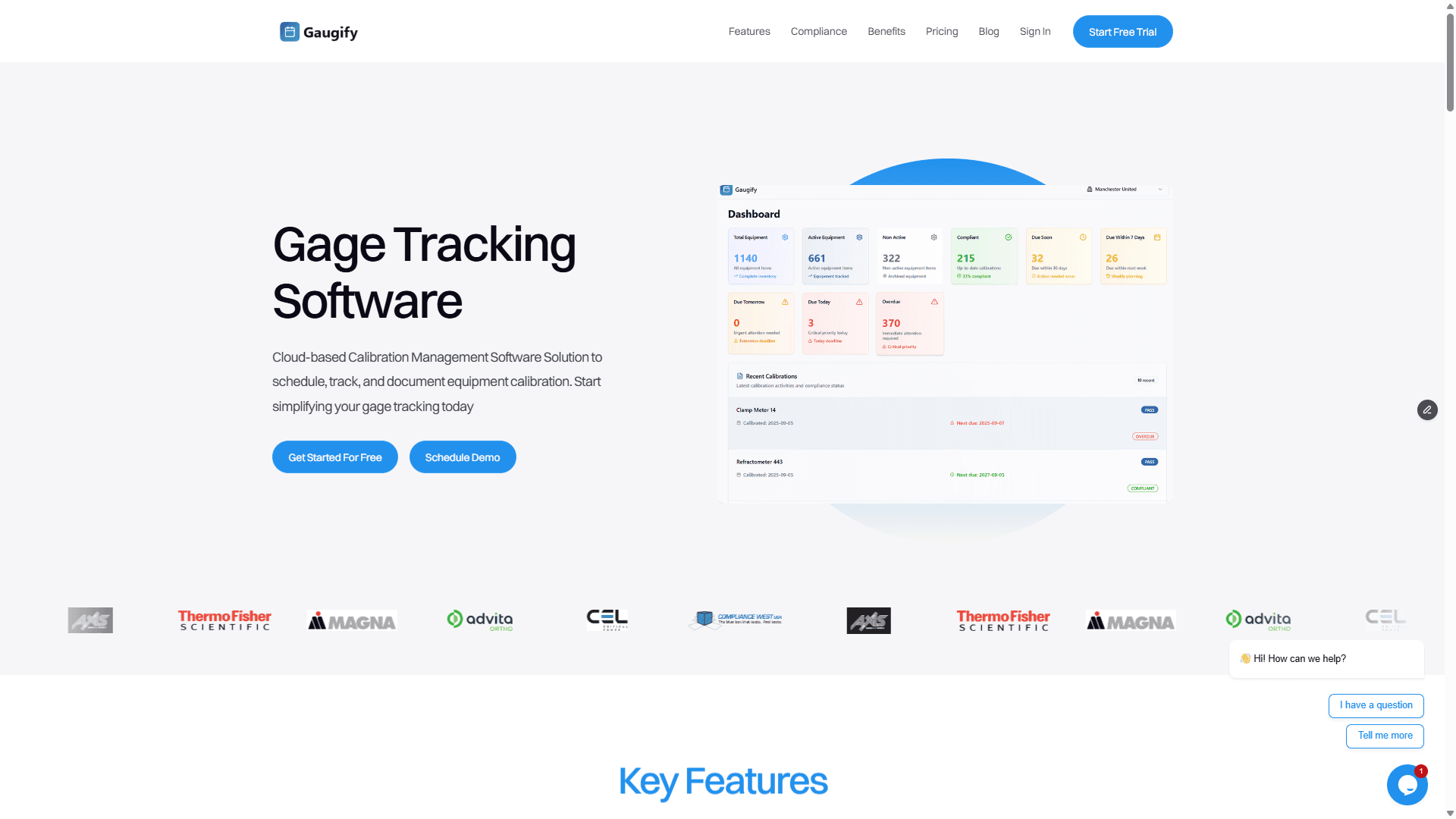
Gaugify leads our list as the most innovative cloud-native calibration management platform. Built from the ground up for modern quality teams, Gaugify combines ease of use with powerful features that streamline every aspect of gage tracking and calibration management.
Key Strengths:
Intuitive, modern interface that requires minimal training
Built-in measurement uncertainty calculations per GUM methodology
Advanced barcode and QR code scanning with mobile apps
Automated calibration scheduling with intelligent due date management
Real-time dashboard and analytics for calibration program health
Comprehensive ISO 17025 compliance features
Transparent SaaS pricing starting at competitive monthly rates
Best For: Small to medium manufacturers, testing labs, and quality departments seeking a modern, affordable solution that doesn't sacrifice functionality.
2. CyberMetrics GAGEtrak
GAGEtrak has been a stalwart in the calibration management space for decades, offering both desktop and web-based versions. Their extensive feature set covers comprehensive gage tracking needs for large enterprises.
Key Strengths:
Mature platform with extensive customization options
Strong reporting capabilities with Crystal Reports integration
Comprehensive asset management beyond just calibration
Established customer base in aerospace and automotive industries
Considerations: Interface feels dated compared to modern alternatives, and pricing can be complex with various modules and add-ons.
3. CompuCal Vero
CompuCal offers both cloud and on-premise deployment options, making it attractive to organizations with specific IT requirements or security concerns.
Key Strengths:
Flexible deployment options
Strong integration capabilities
Comprehensive calibration workflow management
Good customer support reputation
Considerations: User interface complexity can require extensive training, and feature updates are less frequent than cloud-native competitors.
Ready to see how modern calibration management should work? Start your free Gaugify trial today and experience the difference a purpose-built, cloud-native platform can make for your quality program.
4. Prime Technologies DCAM
DCAM (Dimensional Control and Asset Management) focuses heavily on the automotive and aerospace sectors, offering specialized features for these demanding industries.
Key Strengths:
Industry-specific workflows for automotive suppliers
Strong statistical process control integration
Comprehensive asset lifecycle management
Good integration with CMM and measurement systems
Considerations: Can be overkill for simpler calibration needs, and the learning curve is steep for new users.
5. Fluke MET/CAL
Fluke's MET/CAL combines calibration procedure authoring with asset management, making it popular among calibration service providers and large metrology labs.
Key Strengths:
Integrated procedure development and execution
Strong measurement uncertainty analysis
Extensive instrument driver library
Fluke brand recognition and support
Considerations: Primarily focused on electronic instruments, limited modern web interface options, and significant upfront investment required.
6. Ape Software Quality Collaboration by Design (QCbD)
QCbD takes a collaborative approach to quality management, including calibration tracking as part of a broader quality management suite.
Key Strengths:
Integrated quality management beyond just calibration
Strong collaboration features
Cloud-based architecture
Good mobile access
Considerations: Calibration features may not be as deep as dedicated solutions, and the broader focus can complicate simple calibration workflows.
7. Indyme GRID
GRID offers a modern approach to calibration management with strong emphasis on user experience and workflow optimization.
Key Strengths:
Clean, modern user interface
Good mobile capabilities
Flexible workflow configuration
Reasonable pricing structure
Considerations: Newer player in the market with smaller customer base, and some advanced features still in development.
8. Beamex Calibration Management Software
Beamex integrates calibration management with their hardware calibrators, creating a comprehensive ecosystem for process industries.
Key Strengths:
Tight integration with Beamex calibrators
Strong process industry focus
Comprehensive documentation capabilities
Good technical support from hardware manufacturer
Considerations: Best value realized when using Beamex hardware, can be limiting for mixed equipment environments.
9. Esterline AVIONICS Calibration Manager
Specialized for aviation and aerospace applications, this solution addresses the unique requirements of these highly regulated industries.
Key Strengths:
Aviation industry-specific features
Strong regulatory compliance tools
Integration with aviation maintenance systems
Comprehensive audit trail capabilities
Considerations: Highly specialized for aviation, not suitable for general manufacturing applications, and typically requires significant customization.
10. InfinityQS Enact
While primarily a statistical process control platform, Enact includes calibration tracking capabilities as part of its broader quality management suite.
Key Strengths:
Strong SPC integration
Real-time quality monitoring
Cloud-based architecture
Good analytics and reporting
Considerations: Calibration management is secondary to SPC functions, may require additional modules for comprehensive gage tracking needs.
Key Features Comparison for Best Gage Tracking Software 2026
Automated Scheduling and Notifications
Modern calibration programs require intelligent scheduling that accounts for usage patterns, criticality, and resource availability. Gaugify's automated scheduling uses smart algorithms to optimize calibration intervals based on actual usage data and historical performance. The system automatically generates work orders, sends email notifications, and can even adjust schedules based on workload capacity.
Traditional solutions like GAGEtrak offer basic scheduling but often require manual intervention to optimize workloads. Gaugify's approach eliminates the guesswork by continuously learning from your calibration patterns and suggesting optimal intervals.
Mobile Access and Barcode Scanning
Shop floor efficiency depends on mobile access to calibration data. Technicians need to quickly scan a gage barcode and instantly see calibration status, due dates, and procedures. Gaugify's mobile app provides native barcode scanning with offline capabilities, ensuring productivity isn't hampered by network connectivity issues.
Many legacy systems offer mobile access through responsive web interfaces, but dedicated mobile apps provide superior user experience with features like camera-based scanning, push notifications, and offline data synchronization.
Measurement Uncertainty Calculations
ISO 17025 and other quality standards require proper measurement uncertainty analysis. Gaugify includes built-in uncertainty calculations following the Guide to Uncertainty in Measurement (GUM), automatically combining systematic and random uncertainty components for each calibration point.
This eliminates the need for separate spreadsheet calculations that are error-prone and difficult to audit. When calibrating a digital caliper with ±0.001" accuracy against a reference standard with ±0.0005" uncertainty, Gaugify automatically calculates the combined uncertainty and determines if the calibration meets your specified requirements.
Certificate Generation and Management
Professional calibration certificates are essential for audit compliance and customer requirements. The best gage tracking software 2026 solutions provide customizable certificate templates that automatically populate with calibration data, measurement results, and uncertainty values.
Gaugify's certificate engine supports multiple templates for different gage types and customer requirements. Whether you need a simple "Pass/Fail" certificate for internal tools or a detailed measurement report for customer deliverables, the system generates professional documents automatically.
User Experience and Interface Design
User adoption is critical for calibration management success. If technicians and quality managers find the software difficult to use, compliance suffers and data quality degrades. Modern interfaces prioritize intuitive navigation, visual dashboards, and minimal click paths to common tasks.
Gaugify's interface design follows modern UX principles with clear visual hierarchy, contextual menus, and role-based dashboards. New users can typically perform basic tasks within minutes of first login, compared to legacy systems that may require days or weeks of training.
Traditional desktop applications often feel outdated and require extensive training. Web-based interfaces vary widely in quality, with some offering excellent user experience while others simply port desktop functionality to browsers without considering modern usability standards.
Pricing and Total Cost of Ownership
Understanding the true cost of calibration management software requires looking beyond initial license fees to include implementation, training, maintenance, and upgrade costs. Cloud-based solutions typically offer more predictable monthly or annual subscription pricing, while on-premise solutions often have significant upfront costs plus ongoing maintenance fees.
Gaugify's transparent pricing starts at competitive monthly rates with no hidden fees, implementation costs, or required professional services. This makes budgeting predictable and eliminates surprise expenses during renewals.
Legacy solutions may appear less expensive initially but often require additional modules, customization services, and annual maintenance fees that significantly increase total cost of ownership. When evaluating options, consider:
Initial software licensing or subscription fees
Implementation and setup costs
Training requirements and associated time costs
Ongoing maintenance and support fees
Hardware and infrastructure requirements
Upgrade and migration costs
Deployment Options: Cloud vs On-Premise
Deployment architecture significantly impacts accessibility, maintenance requirements, and total cost of ownership. Cloud-native solutions offer immediate access, automatic updates, and reduced IT overhead, while on-premise solutions provide maximum control over data and customization.
Gaugify's cloud-first architecture ensures users always have access to the latest features and security updates without requiring IT intervention. Data is securely hosted in enterprise-grade data centers with multiple redundancy levels and regular backups.
Organizations with strict data residency requirements or extensive customization needs may prefer on-premise solutions despite higher maintenance overhead. However, most manufacturers and testing labs find cloud solutions provide better value and reliability than self-managed systems.
Integration Capabilities and API Access
Modern calibration management doesn't operate in isolation. Integration with ERP systems, quality management platforms, and measurement instruments streamlines workflows and eliminates duplicate data entry. Look for solutions offering robust APIs and pre-built integrations with common business systems.
Gaugify provides RESTful APIs and webhook support for custom integrations, plus pre-built connectors for popular ERP systems like SAP and Oracle. This enables automatic synchronization of asset data, purchase orders, and calibration schedules without manual intervention.
Compliance and Audit Support
Regulatory compliance is often the primary driver for implementing calibration management software. ISO 17025 compliance features should include comprehensive audit trails, electronic signatures, data integrity controls, and standardized reporting.
The best gage tracking software 2026 solutions provide built-in compliance frameworks that automatically capture required information and generate audit reports. This reduces preparation time for ISO audits, customer assessments, and regulatory inspections.
Key compliance features to evaluate include:
Complete audit trail of all data changes
Electronic signature capabilities with user authentication
Data backup and recovery procedures
User access controls and role-based permissions
Calibration certificate templates meeting ISO requirements
Traceability to national measurement standards
Customer Support and Training
Implementation success depends heavily on vendor support quality and training resources. Evaluate support responsiveness, knowledge base quality, and training options when comparing solutions.
Gaugify provides comprehensive support including live chat, email support, and extensive documentation. Our customer success team works with new users during implementation to ensure smooth deployment and user adoption.
Consider these support factors:
Support availability (business hours vs 24/7)
Response time commitments
Training options (online, on-site, documentation)
User community and knowledge base
Implementation assistance and professional services
Who Each Solution Is Best For
Small to Medium Manufacturers (50-1000 gages)
Gaugify excels for organizations needing comprehensive functionality without complexity. The intuitive interface and transparent pricing make it ideal for teams that want to focus on quality rather than software management.
Large Enterprises (1000+ gages)
GAGEtrak and DCAM offer extensive customization and integration capabilities needed by large organizations with complex requirements and dedicated IT resources.
Testing and Calibration Labs
Gaugify and MET/CAL provide the detailed measurement uncertainty analysis and professional certificate generation required for accredited laboratories serving external customers.
Aerospace and Automotive
DCAM and specialized aviation solutions offer industry-specific features and compliance tools required in highly regulated manufacturing environments.
Process Industries
Beamex's integration with process calibrators makes it attractive for chemical, pharmaceutical, and energy companies with extensive process instrumentation.
Future Trends in Calibration Management
The best gage tracking software 2026 incorporates emerging technologies that will define the next generation of calibration management:
AI-Powered Scheduling: Machine learning algorithms optimize calibration intervals based on usage patterns, environmental conditions, and historical performance data
Predictive Maintenance: Advanced analytics identify gages likely to fail before scheduled calibration, preventing quality issues
IoT Integration: Smart gages automatically report usage, environmental exposure, and potential issues to calibration management systems
Blockchain Traceability: Immutable calibration records ensure complete traceability and prevent data tampering
Augmented Reality: AR-guided calibration procedures improve accuracy and reduce training requirements
Gaugify continues investing in these emerging technologies to ensure our platform remains at the forefront of calibration management innovation.
Making the Right Choice for Your Organization
Selecting calibration management software is a strategic decision that impacts quality, compliance, and operational efficiency for years to come. Consider these key factors when evaluating options:
Start with your requirements: Document current pain points, compliance needs, and growth projections. Don't pay for features you won't use, but ensure the platform can scale with your organization.
Evaluate total cost of ownership: Look beyond initial pricing to understand implementation, training, and ongoing costs. Cloud solutions typically offer better value and predictability.
Prioritize user experience: Software that's difficult to use will hurt adoption and compliance. Modern, intuitive interfaces reduce training time and improve data quality.
Consider vendor stability: Choose vendors with strong financial backing, active development, and growing customer bases. Avoid solutions that appear to be in maintenance mode.
Demand transparency: Vendors should provide clear pricing, realistic implementation timelines, and honest assessments of their platform's capabilities.
Conclusion: The Best Gage Tracking Software for 2026
After comprehensive analysis, Gaugify emerges as the top choice for most organizations seeking the best gage tracking software 2026. Our cloud-native platform combines powerful functionality with exceptional ease of use, transparent pricing, and comprehensive compliance features.
While legacy solutions like GAGEtrak and specialized platforms like DCAM serve specific market segments, Gaugify's modern architecture and user-centric design make it the optimal choice for small to medium manufacturers, testing labs, and quality departments ready to modernize their calibration management.
Key advantages that set Gaugify apart:
Intuitive interface requiring minimal training
Built-in measurement uncertainty calculations
Transparent, affordable pricing
Comprehensive mobile access
Automated scheduling and notifications
Professional certificate generation
Complete ISO 17025 compliance support
Responsive customer support and rapid feature development
The calibration management landscape will continue evolving rapidly as new technologies emerge and quality standards become more demanding. Organizations that choose modern, cloud-native platforms position themselves to adapt quickly and maintain competitive advantages.
Don't let outdated calibration management hold back your quality program. Experience Gaugify with a free trial and discover how modern calibration management should work. Our team is ready to help you transform your quality processes and achieve new levels of efficiency and compliance.
Ready to see Gaugify in action? Schedule a personalized demo to explore how our platform can streamline your specific calibration workflows and support your quality objectives.
Top 10 Gage Tracking Software Compared 2026
Finding the best gage tracking software 2026 can make or break your calibration program's efficiency and compliance. With quality standards becoming more stringent and audits more frequent, choosing the right calibration management system is critical for manufacturing operations, testing laboratories, and quality departments worldwide.
In this comprehensive comparison, we'll evaluate the top 10 gage tracking software solutions dominating the market in 2026. Whether you're managing 50 gages or 5,000, this analysis will help you select the platform that best fits your organization's needs, budget, and compliance requirements.
The Current State of Gage Tracking Software in 2026
The calibration management software landscape has evolved significantly over the past few years. Legacy desktop solutions are rapidly being replaced by cloud-native platforms that offer real-time access, automated workflows, and advanced analytics. Modern best gage tracking software 2026 solutions now include features like automated uncertainty calculations, mobile barcode scanning, and AI-powered scheduling optimization.
Key trends shaping the market include increased demand for ISO 17025 compliance features, integration with ERP systems, and mobile-first user experiences that enable shop floor technicians to access calibration data instantly.
Top 10 Best Gage Tracking Software Solutions for 2026
1. Gaugify - Modern Cloud-First Calibration Management
Gaugify leads our list as the most innovative cloud-native calibration management platform. Built from the ground up for modern quality teams, Gaugify combines ease of use with powerful features that streamline every aspect of gage tracking and calibration management.
Key Strengths:
Intuitive, modern interface that requires minimal training
Built-in measurement uncertainty calculations per GUM methodology
Advanced barcode and QR code scanning with mobile apps
Automated calibration scheduling with intelligent due date management
Real-time dashboard and analytics for calibration program health
Comprehensive ISO 17025 compliance features
Transparent SaaS pricing starting at competitive monthly rates
Best For: Small to medium manufacturers, testing labs, and quality departments seeking a modern, affordable solution that doesn't sacrifice functionality.
2. CyberMetrics GAGEtrak
GAGEtrak has been a stalwart in the calibration management space for decades, offering both desktop and web-based versions. Their extensive feature set covers comprehensive gage tracking needs for large enterprises.
Key Strengths:
Mature platform with extensive customization options
Strong reporting capabilities with Crystal Reports integration
Comprehensive asset management beyond just calibration
Established customer base in aerospace and automotive industries
Considerations: Interface feels dated compared to modern alternatives, and pricing can be complex with various modules and add-ons.
3. CompuCal Vero
CompuCal offers both cloud and on-premise deployment options, making it attractive to organizations with specific IT requirements or security concerns.
Key Strengths:
Flexible deployment options
Strong integration capabilities
Comprehensive calibration workflow management
Good customer support reputation
Considerations: User interface complexity can require extensive training, and feature updates are less frequent than cloud-native competitors.
Ready to see how modern calibration management should work? Start your free Gaugify trial today and experience the difference a purpose-built, cloud-native platform can make for your quality program.
4. Prime Technologies DCAM
DCAM (Dimensional Control and Asset Management) focuses heavily on the automotive and aerospace sectors, offering specialized features for these demanding industries.
Key Strengths:
Industry-specific workflows for automotive suppliers
Strong statistical process control integration
Comprehensive asset lifecycle management
Good integration with CMM and measurement systems
Considerations: Can be overkill for simpler calibration needs, and the learning curve is steep for new users.
5. Fluke MET/CAL
Fluke's MET/CAL combines calibration procedure authoring with asset management, making it popular among calibration service providers and large metrology labs.
Key Strengths:
Integrated procedure development and execution
Strong measurement uncertainty analysis
Extensive instrument driver library
Fluke brand recognition and support
Considerations: Primarily focused on electronic instruments, limited modern web interface options, and significant upfront investment required.
6. Ape Software Quality Collaboration by Design (QCbD)
QCbD takes a collaborative approach to quality management, including calibration tracking as part of a broader quality management suite.
Key Strengths:
Integrated quality management beyond just calibration
Strong collaboration features
Cloud-based architecture
Good mobile access
Considerations: Calibration features may not be as deep as dedicated solutions, and the broader focus can complicate simple calibration workflows.
7. Indyme GRID
GRID offers a modern approach to calibration management with strong emphasis on user experience and workflow optimization.
Key Strengths:
Clean, modern user interface
Good mobile capabilities
Flexible workflow configuration
Reasonable pricing structure
Considerations: Newer player in the market with smaller customer base, and some advanced features still in development.
8. Beamex Calibration Management Software
Beamex integrates calibration management with their hardware calibrators, creating a comprehensive ecosystem for process industries.
Key Strengths:
Tight integration with Beamex calibrators
Strong process industry focus
Comprehensive documentation capabilities
Good technical support from hardware manufacturer
Considerations: Best value realized when using Beamex hardware, can be limiting for mixed equipment environments.
9. Esterline AVIONICS Calibration Manager
Specialized for aviation and aerospace applications, this solution addresses the unique requirements of these highly regulated industries.
Key Strengths:
Aviation industry-specific features
Strong regulatory compliance tools
Integration with aviation maintenance systems
Comprehensive audit trail capabilities
Considerations: Highly specialized for aviation, not suitable for general manufacturing applications, and typically requires significant customization.
10. InfinityQS Enact
While primarily a statistical process control platform, Enact includes calibration tracking capabilities as part of its broader quality management suite.
Key Strengths:
Strong SPC integration
Real-time quality monitoring
Cloud-based architecture
Good analytics and reporting
Considerations: Calibration management is secondary to SPC functions, may require additional modules for comprehensive gage tracking needs.
Key Features Comparison for Best Gage Tracking Software 2026
Automated Scheduling and Notifications
Modern calibration programs require intelligent scheduling that accounts for usage patterns, criticality, and resource availability. Gaugify's automated scheduling uses smart algorithms to optimize calibration intervals based on actual usage data and historical performance. The system automatically generates work orders, sends email notifications, and can even adjust schedules based on workload capacity.
Traditional solutions like GAGEtrak offer basic scheduling but often require manual intervention to optimize workloads. Gaugify's approach eliminates the guesswork by continuously learning from your calibration patterns and suggesting optimal intervals.
Mobile Access and Barcode Scanning
Shop floor efficiency depends on mobile access to calibration data. Technicians need to quickly scan a gage barcode and instantly see calibration status, due dates, and procedures. Gaugify's mobile app provides native barcode scanning with offline capabilities, ensuring productivity isn't hampered by network connectivity issues.
Many legacy systems offer mobile access through responsive web interfaces, but dedicated mobile apps provide superior user experience with features like camera-based scanning, push notifications, and offline data synchronization.
Measurement Uncertainty Calculations
ISO 17025 and other quality standards require proper measurement uncertainty analysis. Gaugify includes built-in uncertainty calculations following the Guide to Uncertainty in Measurement (GUM), automatically combining systematic and random uncertainty components for each calibration point.
This eliminates the need for separate spreadsheet calculations that are error-prone and difficult to audit. When calibrating a digital caliper with ±0.001" accuracy against a reference standard with ±0.0005" uncertainty, Gaugify automatically calculates the combined uncertainty and determines if the calibration meets your specified requirements.
Certificate Generation and Management
Professional calibration certificates are essential for audit compliance and customer requirements. The best gage tracking software 2026 solutions provide customizable certificate templates that automatically populate with calibration data, measurement results, and uncertainty values.
Gaugify's certificate engine supports multiple templates for different gage types and customer requirements. Whether you need a simple "Pass/Fail" certificate for internal tools or a detailed measurement report for customer deliverables, the system generates professional documents automatically.
User Experience and Interface Design
User adoption is critical for calibration management success. If technicians and quality managers find the software difficult to use, compliance suffers and data quality degrades. Modern interfaces prioritize intuitive navigation, visual dashboards, and minimal click paths to common tasks.
Gaugify's interface design follows modern UX principles with clear visual hierarchy, contextual menus, and role-based dashboards. New users can typically perform basic tasks within minutes of first login, compared to legacy systems that may require days or weeks of training.
Traditional desktop applications often feel outdated and require extensive training. Web-based interfaces vary widely in quality, with some offering excellent user experience while others simply port desktop functionality to browsers without considering modern usability standards.
Pricing and Total Cost of Ownership
Understanding the true cost of calibration management software requires looking beyond initial license fees to include implementation, training, maintenance, and upgrade costs. Cloud-based solutions typically offer more predictable monthly or annual subscription pricing, while on-premise solutions often have significant upfront costs plus ongoing maintenance fees.
Gaugify's transparent pricing starts at competitive monthly rates with no hidden fees, implementation costs, or required professional services. This makes budgeting predictable and eliminates surprise expenses during renewals.
Legacy solutions may appear less expensive initially but often require additional modules, customization services, and annual maintenance fees that significantly increase total cost of ownership. When evaluating options, consider:
Initial software licensing or subscription fees
Implementation and setup costs
Training requirements and associated time costs
Ongoing maintenance and support fees
Hardware and infrastructure requirements
Upgrade and migration costs
Deployment Options: Cloud vs On-Premise
Deployment architecture significantly impacts accessibility, maintenance requirements, and total cost of ownership. Cloud-native solutions offer immediate access, automatic updates, and reduced IT overhead, while on-premise solutions provide maximum control over data and customization.
Gaugify's cloud-first architecture ensures users always have access to the latest features and security updates without requiring IT intervention. Data is securely hosted in enterprise-grade data centers with multiple redundancy levels and regular backups.
Organizations with strict data residency requirements or extensive customization needs may prefer on-premise solutions despite higher maintenance overhead. However, most manufacturers and testing labs find cloud solutions provide better value and reliability than self-managed systems.
Integration Capabilities and API Access
Modern calibration management doesn't operate in isolation. Integration with ERP systems, quality management platforms, and measurement instruments streamlines workflows and eliminates duplicate data entry. Look for solutions offering robust APIs and pre-built integrations with common business systems.
Gaugify provides RESTful APIs and webhook support for custom integrations, plus pre-built connectors for popular ERP systems like SAP and Oracle. This enables automatic synchronization of asset data, purchase orders, and calibration schedules without manual intervention.
Compliance and Audit Support
Regulatory compliance is often the primary driver for implementing calibration management software. ISO 17025 compliance features should include comprehensive audit trails, electronic signatures, data integrity controls, and standardized reporting.
The best gage tracking software 2026 solutions provide built-in compliance frameworks that automatically capture required information and generate audit reports. This reduces preparation time for ISO audits, customer assessments, and regulatory inspections.
Key compliance features to evaluate include:
Complete audit trail of all data changes
Electronic signature capabilities with user authentication
Data backup and recovery procedures
User access controls and role-based permissions
Calibration certificate templates meeting ISO requirements
Traceability to national measurement standards
Customer Support and Training
Implementation success depends heavily on vendor support quality and training resources. Evaluate support responsiveness, knowledge base quality, and training options when comparing solutions.
Gaugify provides comprehensive support including live chat, email support, and extensive documentation. Our customer success team works with new users during implementation to ensure smooth deployment and user adoption.
Consider these support factors:
Support availability (business hours vs 24/7)
Response time commitments
Training options (online, on-site, documentation)
User community and knowledge base
Implementation assistance and professional services
Who Each Solution Is Best For
Small to Medium Manufacturers (50-1000 gages)
Gaugify excels for organizations needing comprehensive functionality without complexity. The intuitive interface and transparent pricing make it ideal for teams that want to focus on quality rather than software management.
Large Enterprises (1000+ gages)
GAGEtrak and DCAM offer extensive customization and integration capabilities needed by large organizations with complex requirements and dedicated IT resources.
Testing and Calibration Labs
Gaugify and MET/CAL provide the detailed measurement uncertainty analysis and professional certificate generation required for accredited laboratories serving external customers.
Aerospace and Automotive
DCAM and specialized aviation solutions offer industry-specific features and compliance tools required in highly regulated manufacturing environments.
Process Industries
Beamex's integration with process calibrators makes it attractive for chemical, pharmaceutical, and energy companies with extensive process instrumentation.
Future Trends in Calibration Management
The best gage tracking software 2026 incorporates emerging technologies that will define the next generation of calibration management:
AI-Powered Scheduling: Machine learning algorithms optimize calibration intervals based on usage patterns, environmental conditions, and historical performance data
Predictive Maintenance: Advanced analytics identify gages likely to fail before scheduled calibration, preventing quality issues
IoT Integration: Smart gages automatically report usage, environmental exposure, and potential issues to calibration management systems
Blockchain Traceability: Immutable calibration records ensure complete traceability and prevent data tampering
Augmented Reality: AR-guided calibration procedures improve accuracy and reduce training requirements
Gaugify continues investing in these emerging technologies to ensure our platform remains at the forefront of calibration management innovation.
Making the Right Choice for Your Organization
Selecting calibration management software is a strategic decision that impacts quality, compliance, and operational efficiency for years to come. Consider these key factors when evaluating options:
Start with your requirements: Document current pain points, compliance needs, and growth projections. Don't pay for features you won't use, but ensure the platform can scale with your organization.
Evaluate total cost of ownership: Look beyond initial pricing to understand implementation, training, and ongoing costs. Cloud solutions typically offer better value and predictability.
Prioritize user experience: Software that's difficult to use will hurt adoption and compliance. Modern, intuitive interfaces reduce training time and improve data quality.
Consider vendor stability: Choose vendors with strong financial backing, active development, and growing customer bases. Avoid solutions that appear to be in maintenance mode.
Demand transparency: Vendors should provide clear pricing, realistic implementation timelines, and honest assessments of their platform's capabilities.
Conclusion: The Best Gage Tracking Software for 2026
After comprehensive analysis, Gaugify emerges as the top choice for most organizations seeking the best gage tracking software 2026. Our cloud-native platform combines powerful functionality with exceptional ease of use, transparent pricing, and comprehensive compliance features.
While legacy solutions like GAGEtrak and specialized platforms like DCAM serve specific market segments, Gaugify's modern architecture and user-centric design make it the optimal choice for small to medium manufacturers, testing labs, and quality departments ready to modernize their calibration management.
Key advantages that set Gaugify apart:
Intuitive interface requiring minimal training
Built-in measurement uncertainty calculations
Transparent, affordable pricing
Comprehensive mobile access
Automated scheduling and notifications
Professional certificate generation
Complete ISO 17025 compliance support
Responsive customer support and rapid feature development
The calibration management landscape will continue evolving rapidly as new technologies emerge and quality standards become more demanding. Organizations that choose modern, cloud-native platforms position themselves to adapt quickly and maintain competitive advantages.
Don't let outdated calibration management hold back your quality program. Experience Gaugify with a free trial and discover how modern calibration management should work. Our team is ready to help you transform your quality processes and achieve new levels of efficiency and compliance.
Ready to see Gaugify in action? Schedule a personalized demo to explore how our platform can streamline your specific calibration workflows and support your quality objectives.