
Why Your Calibration Program Fails Every Time You Scale
Why Your Calibration Program Fails Every Time You Scale
David Bentley
Quality Assurance Engineer
8 min read
Why Your Calibration Program Fails Every Time You Scale
Your calibration program worked perfectly when you had 50 instruments across two facilities. Quality managers knew every gage by name, calibration schedules lived in Excel spreadsheets, and tracking due dates was manageable with sticky notes and reminders. But now you're managing 500+ instruments across six locations, and those calibration scaling problems are crushing your operation. Overdue instruments are piling up, audit findings are multiplying, and your team is drowning in administrative chaos.
This scenario plays out in growing companies every day. What starts as a well-intentioned calibration program built for a smaller operation becomes a liability when the business scales. The systems, processes, and tools that once worked seamlessly begin to crack under the pressure of increased volume, complexity, and regulatory scrutiny.
The Scaling Crisis: More Common Than You Think
Here's the uncomfortable truth: most calibration programs aren't designed to scale. They're built around the current state of the business, using tools and processes that work for today's volume but become bottlenecks tomorrow.
Consider the case of a precision machining company that grew from 100 to 800 instruments over three years. Their original system involved:
Excel spreadsheets maintained by individual departments
Manual tracking of calibration due dates
Paper certificates filed in binders
Phone calls to coordinate instrument availability
Handwritten logs for calibration history
At 100 instruments, this system required about 5 hours per week to maintain. At 800 instruments across multiple shifts and locations, it became a 40-hour weekly burden that still couldn't prevent overdue instruments from slipping through the cracks.
The warning signs of calibration scaling problems typically appear gradually:
Increasing administrative burden: More time spent managing the system than using instruments
Communication breakdowns: Instruments pulled for production during scheduled calibration windows
Data fragmentation: Critical information scattered across multiple systems and locations
Compliance gaps: Difficulty producing complete audit trails during inspections
Resource conflicts: Multiple departments competing for limited calibration slots
The Multiplier Effect
Scaling doesn't just multiply your instrument count—it exponentially increases complexity. When you have instruments across multiple locations, shifts, and departments, the number of potential coordination points grows dramatically. A single missed calibration can cascade into production delays, quality holds, and customer complaints.
Real-World Consequences: The Cost of Calibration Scaling Problems
The financial and operational impact of failing to scale your calibration program extends far beyond administrative inconvenience. Here's what companies actually face when their programs buckle under growth pressure:
Failed Audits and Regulatory Action
A medical device manufacturer discovered during an FDA inspection that 23% of their measurement equipment was overdue for calibration. The inspector found instruments with tolerances of ±0.001" that hadn't been verified in over 14 months—well beyond their required 12-month intervals. The resulting 483 observation required extensive corrective action, production holds, and a follow-up inspection that cost over $300,000 in lost production time.
Customer Losses and Contract Penalties
An aerospace supplier lost a $2.3 million contract when their customer discovered that torque wrenches used on critical assemblies were calibrated using an out-of-tolerance standard. The calibration tracking system had failed to flag that the reference standard was 60 days overdue, invalidating six months of production data and requiring extensive rework.
Scrap and Rework Costs
Poor calibration program scaling often reveals itself through increased scrap rates. When measurement uncertainty isn't properly managed across growing operations, products that should pass inspection get rejected, while out-of-specification parts slip through. One automotive parts manufacturer tracked a 340% increase in customer returns directly to inadequate calibration program management during a period of rapid facility expansion.
Insurance and Liability Exposure
Product liability claims often focus on measurement and testing equipment calibration status. When calibration programs can't demonstrate traceability and compliance across scaled operations, companies face increased exposure. Legal discovery processes can be particularly damaging when calibration records are incomplete, contradictory, or missing entirely.
Root Causes: Why Calibration Programs Break During Scaling
Understanding why calibration scaling problems occur requires examining the fundamental assumptions built into most programs. These systems work initially but contain inherent limitations that become critical bottlenecks during growth.
Tool Limitations
Excel spreadsheets and paper-based systems can't handle the complexity of scaled operations. When you need to coordinate calibration schedules across multiple locations, track measurement uncertainty calculations for hundreds of instruments, and maintain audit trails for regulatory compliance, spreadsheet-based solutions become impossible to maintain accurately.
Consider tracking measurement uncertainty for a coordinate measuring machine (CMM) with 15 different probe configurations across three shifts. Each configuration requires different uncertainty calculations, and the spreadsheet rapidly becomes unwieldy. Multiply this by 50+ CMMs across multiple facilities, and the system collapses.
Communication Breakdowns
Scaling creates communication complexity that manual systems can't handle. When calibration coordinators need to notify production planners, quality engineers, and shift supervisors about upcoming calibrations, email chains and phone calls become inadequate. Critical information gets lost, leading to instruments being unavailable when needed or pulled from production during scheduled calibration windows.
Resource Planning Failures
Growing operations require sophisticated resource planning that considers instrument criticality, production schedules, calibration capacity, and cost optimization. Manual systems can't optimize calibration scheduling to minimize production impact while ensuring compliance. The result is either excessive downtime or rushed calibrations that compromise quality.
Data Integration Problems
Scaled operations often involve multiple calibration service providers, internal calibration labs, and field calibrations. Without integrated systems, calibration data becomes fragmented across different sources, making it impossible to maintain complete, auditable records. This fragmentation becomes particularly problematic during audits or when investigating product quality issues.
The Step-by-Step Solution to Calibration Scaling Problems
Solving calibration scaling problems requires a systematic approach that addresses both immediate operational needs and long-term scalability. Here's the proven methodology successful companies use:
Step 1: Audit Your Current State
Begin with a comprehensive assessment of your existing calibration program. Document every instrument, calibration frequency, service provider, and administrative process. Identify specific pain points where scaling has created problems:
Instruments with unclear or missing calibration histories
Gaps in measurement uncertainty documentation
Communication failures between departments
Recurring compliance issues during internal audits
Use this audit to quantify the true cost of your current approach, including administrative time, compliance risks, and operational inefficiencies.
Step 2: Establish Scalable Processes
Design standardized processes that work regardless of facility size or instrument count. This includes:
Standardized calibration procedures that apply across all locations
Automated notification systems for upcoming calibrations
Centralized scheduling that considers production impact
Consistent documentation requirements for all calibration activities
These processes should be documented in detail and designed to minimize manual intervention while maintaining flexibility for different operational requirements.
Step 3: Implement Technology Solutions
Manual systems simply cannot scale effectively. Modern calibration management software provides the foundation for scalable operations through automated scheduling, integrated notifications, and centralized data management.
Key technology requirements include:
Cloud-based accessibility for multi-location coordination
Automated calibration scheduling and notifications
Integration with production planning systems
Mobile access for field calibrations and inspections
Comprehensive reporting for regulatory compliance
Ready to eliminate calibration scaling problems in your operation? Start your free trial and see how modern calibration management can support your growth without the administrative burden.
Step 4: Centralize Data Management
Consolidate all calibration data into a single, authoritative system. This eliminates the fragmentation that creates compliance risks and operational inefficiencies. Ensure your system can handle:
Complete calibration histories for every instrument
Measurement uncertainty calculations and tracking
Certificate management and storage
Audit trail documentation for regulatory compliance
Integration with external calibration service providers
Step 5: Establish Performance Metrics
Implement metrics that provide early warning of scaling problems before they impact operations:
Calibration compliance rate: Percentage of instruments calibrated within required intervals
Administrative efficiency: Time spent managing calibrations per instrument
Production impact: Downtime caused by calibration activities
Cost per calibration: Total program cost divided by number of instruments managed
Track these metrics continuously and establish trigger points for process improvements or additional resources.
Step 6: Plan for Continued Growth
Design your calibration program to handle 2-3x your current instrument count without major process changes. This forward-looking approach prevents future scaling crises and supports sustainable growth.
How Gaugify Prevents Calibration Scaling Problems
Gaugify was specifically designed to solve the calibration scaling problems that crush growing operations. Unlike legacy systems or spreadsheet-based approaches, Gaugify scales seamlessly from dozens to thousands of instruments without increasing administrative burden.
Automated Scaling Architecture
Gaugify's cloud-based architecture automatically handles increased instrument counts, multiple locations, and complex scheduling requirements. When you add new facilities or expand instrument inventory, the system scales without requiring additional IT infrastructure or administrative overhead.
The platform manages everything from simple handheld micrometers with ±0.0001" tolerances to complex environmental chambers with multiple calibration points, providing consistent workflow regardless of instrument complexity or quantity.
Intelligent Scheduling and Coordination
Advanced scheduling algorithms consider production schedules, instrument criticality, calibration capacity, and cost optimization to minimize operational impact. The system automatically coordinates between multiple departments, shifts, and external service providers to ensure instruments are available when needed and calibrated within required intervals.
For example, when scheduling calibration for a production line's measurement equipment, Gaugify considers planned downtime, alternative instrument availability, and calibration service capacity to optimize timing automatically.
Comprehensive Compliance Management
Gaugify's compliance features are designed for scaled operations where audit preparation can't rely on manual data compilation. The system maintains complete audit trails, generates compliance reports automatically, and ensures ISO 17025 compliance across all locations and instrument types.
During audits, users can instantly generate comprehensive reports showing calibration status, measurement uncertainty documentation, and traceability records for any time period or instrument subset.
Real-Time Visibility and Control
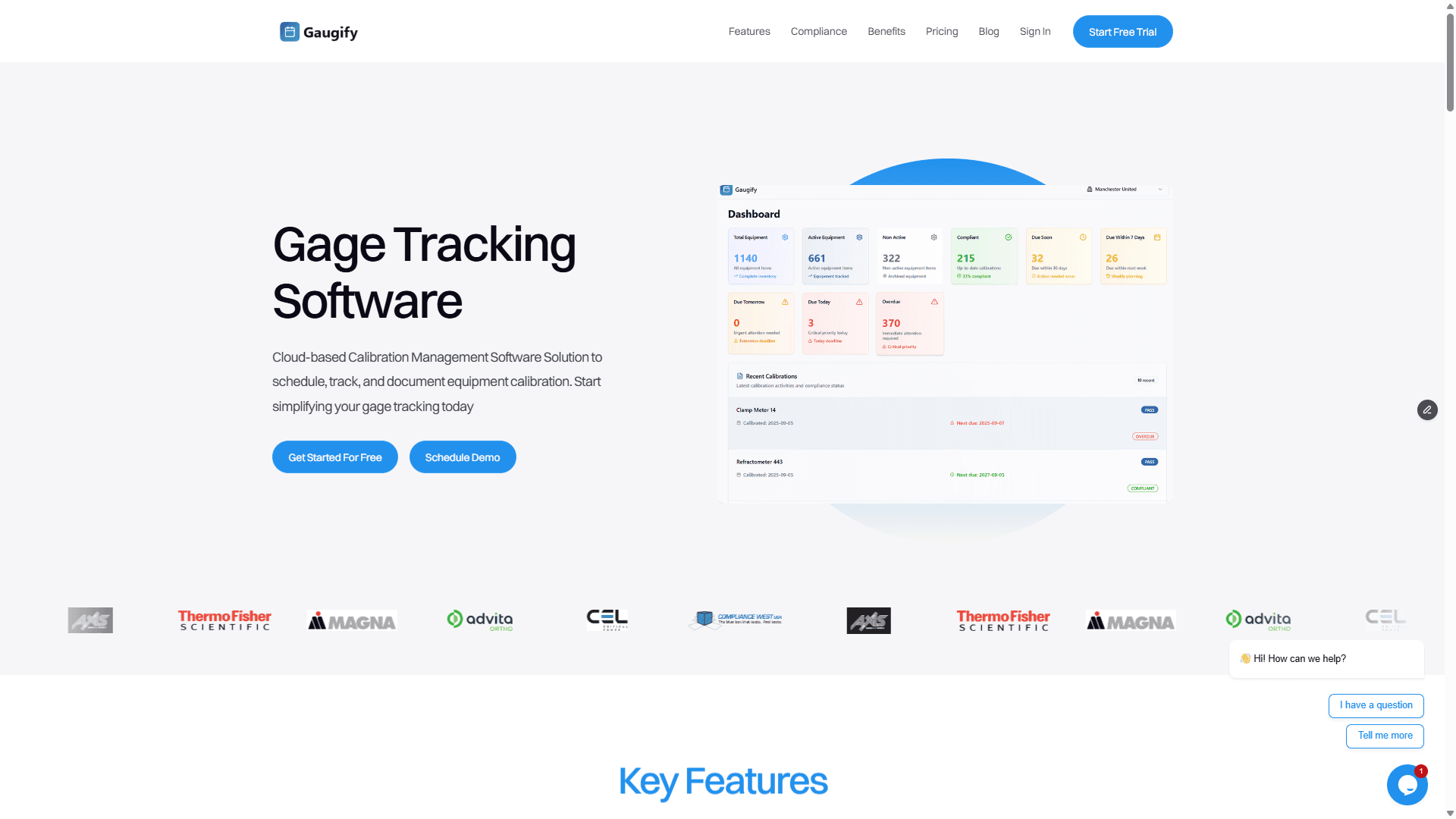
Dashboards provide immediate visibility into calibration program performance across all locations, enabling proactive management rather than reactive problem-solving. Quality managers can identify potential issues before they impact compliance or production, and optimize resource allocation based on real-time data.
Integration and Data Management
Gaugify integrates with existing quality management systems, ERP platforms, and external calibration service providers to maintain centralized data while supporting diverse operational requirements. This eliminates the data fragmentation that creates scaling problems in manual systems.
Transform Your Calibration Program for Sustainable Growth
Calibration scaling problems don't have to be inevitable consequences of business growth. Companies that proactively address these challenges with appropriate technology and processes can scale confidently while maintaining compliance and operational efficiency.
The key is recognizing that calibration program scaling requires purpose-built solutions, not just more of the same manual processes that worked at smaller scales. Modern calibration management platforms like Gaugify provide the foundation for sustainable growth by automating administrative tasks, optimizing resource utilization, and maintaining comprehensive compliance documentation.
Don't wait until your next audit or customer complaint to address calibration scaling problems. The companies that scale successfully are those that invest in proper calibration management infrastructure before problems become crises.
Ready to solve your calibration scaling problems? Start your free trial of Gaugify today and discover how modern calibration management can support your growth without the administrative burden. Or schedule a personalized demo to see exactly how Gaugify addresses your specific scaling challenges.
Take control of your calibration program's growth trajectory. Your future operations—and audit results—will thank you.
Why Your Calibration Program Fails Every Time You Scale
Your calibration program worked perfectly when you had 50 instruments across two facilities. Quality managers knew every gage by name, calibration schedules lived in Excel spreadsheets, and tracking due dates was manageable with sticky notes and reminders. But now you're managing 500+ instruments across six locations, and those calibration scaling problems are crushing your operation. Overdue instruments are piling up, audit findings are multiplying, and your team is drowning in administrative chaos.
This scenario plays out in growing companies every day. What starts as a well-intentioned calibration program built for a smaller operation becomes a liability when the business scales. The systems, processes, and tools that once worked seamlessly begin to crack under the pressure of increased volume, complexity, and regulatory scrutiny.
The Scaling Crisis: More Common Than You Think
Here's the uncomfortable truth: most calibration programs aren't designed to scale. They're built around the current state of the business, using tools and processes that work for today's volume but become bottlenecks tomorrow.
Consider the case of a precision machining company that grew from 100 to 800 instruments over three years. Their original system involved:
Excel spreadsheets maintained by individual departments
Manual tracking of calibration due dates
Paper certificates filed in binders
Phone calls to coordinate instrument availability
Handwritten logs for calibration history
At 100 instruments, this system required about 5 hours per week to maintain. At 800 instruments across multiple shifts and locations, it became a 40-hour weekly burden that still couldn't prevent overdue instruments from slipping through the cracks.
The warning signs of calibration scaling problems typically appear gradually:
Increasing administrative burden: More time spent managing the system than using instruments
Communication breakdowns: Instruments pulled for production during scheduled calibration windows
Data fragmentation: Critical information scattered across multiple systems and locations
Compliance gaps: Difficulty producing complete audit trails during inspections
Resource conflicts: Multiple departments competing for limited calibration slots
The Multiplier Effect
Scaling doesn't just multiply your instrument count—it exponentially increases complexity. When you have instruments across multiple locations, shifts, and departments, the number of potential coordination points grows dramatically. A single missed calibration can cascade into production delays, quality holds, and customer complaints.
Real-World Consequences: The Cost of Calibration Scaling Problems
The financial and operational impact of failing to scale your calibration program extends far beyond administrative inconvenience. Here's what companies actually face when their programs buckle under growth pressure:
Failed Audits and Regulatory Action
A medical device manufacturer discovered during an FDA inspection that 23% of their measurement equipment was overdue for calibration. The inspector found instruments with tolerances of ±0.001" that hadn't been verified in over 14 months—well beyond their required 12-month intervals. The resulting 483 observation required extensive corrective action, production holds, and a follow-up inspection that cost over $300,000 in lost production time.
Customer Losses and Contract Penalties
An aerospace supplier lost a $2.3 million contract when their customer discovered that torque wrenches used on critical assemblies were calibrated using an out-of-tolerance standard. The calibration tracking system had failed to flag that the reference standard was 60 days overdue, invalidating six months of production data and requiring extensive rework.
Scrap and Rework Costs
Poor calibration program scaling often reveals itself through increased scrap rates. When measurement uncertainty isn't properly managed across growing operations, products that should pass inspection get rejected, while out-of-specification parts slip through. One automotive parts manufacturer tracked a 340% increase in customer returns directly to inadequate calibration program management during a period of rapid facility expansion.
Insurance and Liability Exposure
Product liability claims often focus on measurement and testing equipment calibration status. When calibration programs can't demonstrate traceability and compliance across scaled operations, companies face increased exposure. Legal discovery processes can be particularly damaging when calibration records are incomplete, contradictory, or missing entirely.
Root Causes: Why Calibration Programs Break During Scaling
Understanding why calibration scaling problems occur requires examining the fundamental assumptions built into most programs. These systems work initially but contain inherent limitations that become critical bottlenecks during growth.
Tool Limitations
Excel spreadsheets and paper-based systems can't handle the complexity of scaled operations. When you need to coordinate calibration schedules across multiple locations, track measurement uncertainty calculations for hundreds of instruments, and maintain audit trails for regulatory compliance, spreadsheet-based solutions become impossible to maintain accurately.
Consider tracking measurement uncertainty for a coordinate measuring machine (CMM) with 15 different probe configurations across three shifts. Each configuration requires different uncertainty calculations, and the spreadsheet rapidly becomes unwieldy. Multiply this by 50+ CMMs across multiple facilities, and the system collapses.
Communication Breakdowns
Scaling creates communication complexity that manual systems can't handle. When calibration coordinators need to notify production planners, quality engineers, and shift supervisors about upcoming calibrations, email chains and phone calls become inadequate. Critical information gets lost, leading to instruments being unavailable when needed or pulled from production during scheduled calibration windows.
Resource Planning Failures
Growing operations require sophisticated resource planning that considers instrument criticality, production schedules, calibration capacity, and cost optimization. Manual systems can't optimize calibration scheduling to minimize production impact while ensuring compliance. The result is either excessive downtime or rushed calibrations that compromise quality.
Data Integration Problems
Scaled operations often involve multiple calibration service providers, internal calibration labs, and field calibrations. Without integrated systems, calibration data becomes fragmented across different sources, making it impossible to maintain complete, auditable records. This fragmentation becomes particularly problematic during audits or when investigating product quality issues.
The Step-by-Step Solution to Calibration Scaling Problems
Solving calibration scaling problems requires a systematic approach that addresses both immediate operational needs and long-term scalability. Here's the proven methodology successful companies use:
Step 1: Audit Your Current State
Begin with a comprehensive assessment of your existing calibration program. Document every instrument, calibration frequency, service provider, and administrative process. Identify specific pain points where scaling has created problems:
Instruments with unclear or missing calibration histories
Gaps in measurement uncertainty documentation
Communication failures between departments
Recurring compliance issues during internal audits
Use this audit to quantify the true cost of your current approach, including administrative time, compliance risks, and operational inefficiencies.
Step 2: Establish Scalable Processes
Design standardized processes that work regardless of facility size or instrument count. This includes:
Standardized calibration procedures that apply across all locations
Automated notification systems for upcoming calibrations
Centralized scheduling that considers production impact
Consistent documentation requirements for all calibration activities
These processes should be documented in detail and designed to minimize manual intervention while maintaining flexibility for different operational requirements.
Step 3: Implement Technology Solutions
Manual systems simply cannot scale effectively. Modern calibration management software provides the foundation for scalable operations through automated scheduling, integrated notifications, and centralized data management.
Key technology requirements include:
Cloud-based accessibility for multi-location coordination
Automated calibration scheduling and notifications
Integration with production planning systems
Mobile access for field calibrations and inspections
Comprehensive reporting for regulatory compliance
Ready to eliminate calibration scaling problems in your operation? Start your free trial and see how modern calibration management can support your growth without the administrative burden.
Step 4: Centralize Data Management
Consolidate all calibration data into a single, authoritative system. This eliminates the fragmentation that creates compliance risks and operational inefficiencies. Ensure your system can handle:
Complete calibration histories for every instrument
Measurement uncertainty calculations and tracking
Certificate management and storage
Audit trail documentation for regulatory compliance
Integration with external calibration service providers
Step 5: Establish Performance Metrics
Implement metrics that provide early warning of scaling problems before they impact operations:
Calibration compliance rate: Percentage of instruments calibrated within required intervals
Administrative efficiency: Time spent managing calibrations per instrument
Production impact: Downtime caused by calibration activities
Cost per calibration: Total program cost divided by number of instruments managed
Track these metrics continuously and establish trigger points for process improvements or additional resources.
Step 6: Plan for Continued Growth
Design your calibration program to handle 2-3x your current instrument count without major process changes. This forward-looking approach prevents future scaling crises and supports sustainable growth.
How Gaugify Prevents Calibration Scaling Problems
Gaugify was specifically designed to solve the calibration scaling problems that crush growing operations. Unlike legacy systems or spreadsheet-based approaches, Gaugify scales seamlessly from dozens to thousands of instruments without increasing administrative burden.
Automated Scaling Architecture
Gaugify's cloud-based architecture automatically handles increased instrument counts, multiple locations, and complex scheduling requirements. When you add new facilities or expand instrument inventory, the system scales without requiring additional IT infrastructure or administrative overhead.
The platform manages everything from simple handheld micrometers with ±0.0001" tolerances to complex environmental chambers with multiple calibration points, providing consistent workflow regardless of instrument complexity or quantity.
Intelligent Scheduling and Coordination
Advanced scheduling algorithms consider production schedules, instrument criticality, calibration capacity, and cost optimization to minimize operational impact. The system automatically coordinates between multiple departments, shifts, and external service providers to ensure instruments are available when needed and calibrated within required intervals.
For example, when scheduling calibration for a production line's measurement equipment, Gaugify considers planned downtime, alternative instrument availability, and calibration service capacity to optimize timing automatically.
Comprehensive Compliance Management
Gaugify's compliance features are designed for scaled operations where audit preparation can't rely on manual data compilation. The system maintains complete audit trails, generates compliance reports automatically, and ensures ISO 17025 compliance across all locations and instrument types.
During audits, users can instantly generate comprehensive reports showing calibration status, measurement uncertainty documentation, and traceability records for any time period or instrument subset.
Real-Time Visibility and Control
Dashboards provide immediate visibility into calibration program performance across all locations, enabling proactive management rather than reactive problem-solving. Quality managers can identify potential issues before they impact compliance or production, and optimize resource allocation based on real-time data.
Integration and Data Management
Gaugify integrates with existing quality management systems, ERP platforms, and external calibration service providers to maintain centralized data while supporting diverse operational requirements. This eliminates the data fragmentation that creates scaling problems in manual systems.
Transform Your Calibration Program for Sustainable Growth
Calibration scaling problems don't have to be inevitable consequences of business growth. Companies that proactively address these challenges with appropriate technology and processes can scale confidently while maintaining compliance and operational efficiency.
The key is recognizing that calibration program scaling requires purpose-built solutions, not just more of the same manual processes that worked at smaller scales. Modern calibration management platforms like Gaugify provide the foundation for sustainable growth by automating administrative tasks, optimizing resource utilization, and maintaining comprehensive compliance documentation.
Don't wait until your next audit or customer complaint to address calibration scaling problems. The companies that scale successfully are those that invest in proper calibration management infrastructure before problems become crises.
Ready to solve your calibration scaling problems? Start your free trial of Gaugify today and discover how modern calibration management can support your growth without the administrative burden. Or schedule a personalized demo to see exactly how Gaugify addresses your specific scaling challenges.
Take control of your calibration program's growth trajectory. Your future operations—and audit results—will thank you.