
Calibration Management Software for Glass Manufacturing
Calibration Management Software for Glass Manufacturing
David Bentley
Quality Assurance Engineer
12 min read
Calibration Management Software for Glass Manufacturing
Glass manufacturing operations demand precision at every stage of production, from raw material measurement to final product inspection. Managing calibration schedules for hundreds of measuring instruments across multiple production lines while maintaining compliance with ISO 9001, ISO 14001, and customer-specific quality requirements creates a complex web of responsibilities. Modern calibration management software glass manufacturing facilities need must handle everything from basic dimensional gages to sophisticated thermal analysis equipment, all while providing the detailed documentation required for automotive, aerospace, and pharmaceutical glass applications.
Traditional paper-based calibration systems simply cannot keep pace with the demands of today's glass manufacturing environment. When a critical pyrometer goes out of tolerance during a float glass production run, or when an automotive customer audit reveals gaps in your calibration records, the cost of poor calibration management becomes immediately apparent. The right calibration management software transforms these challenges into streamlined processes that protect product quality while reducing administrative overhead.
Critical Calibration Challenges in Glass Manufacturing
Glass manufacturing facilities face unique calibration management challenges that stem from both the high-temperature nature of glass production and the precision requirements of end-use applications. Production environments routinely expose measuring equipment to temperatures exceeding 1500°C, creating accelerated drift rates that require more frequent calibration intervals than typical manufacturing operations.
The complexity multiplies when considering the variety of measuring parameters essential to glass production. Temperature measurement alone involves multiple technologies: thermocouples for furnace monitoring, infrared pyrometers for non-contact measurement, and resistance temperature detectors (RTDs) for annealing lehr control. Each requires different calibration approaches, with pyrometers needing blackbody calibration sources capable of reaching 1600°C and thermocouples requiring ice point and fixed-point calibrations.
Dimensional measurement presents another layer of complexity. Float glass thickness measurement systems using beta ray transmission must maintain calibration to ±0.1mm across widths up to 3.5 meters. Container glass manufacturing requires precise control of wall thickness, with pneumatic measurement systems needing calibration to ensure ±0.05mm accuracy on critical dimensions.
Documentation requirements add significant administrative burden. Automotive glass suppliers must maintain calibration records meeting IATF 16949 requirements, while pharmaceutical glass manufacturers face FDA validation requirements. Each standard demands specific documentation formats, retention periods, and traceability requirements that manual systems struggle to maintain consistently.
Essential Equipment Types Requiring Calibration
Glass manufacturing facilities typically maintain calibration programs covering 200-500 individual instruments across multiple measurement disciplines. Understanding the scope of equipment requiring calibration helps facility managers appreciate the complexity of effective calibration management software glass operations demand.
Temperature Measurement Equipment
Temperature measurement represents the largest category of calibrated equipment in most glass facilities. Furnace monitoring systems utilize Type R, S, and B thermocouples capable of measuring temperatures up to 1700°C, with required accuracies typically ±3°C at operating temperatures. These high-temperature applications create significant calibration challenges, as the platinum-based thermocouples are subject to contamination and drift that accelerates at extreme temperatures.
Infrared pyrometers used for non-contact temperature measurement require specialized calibration using blackbody sources. Two-color pyrometers commonly used in glass manufacturing for measuring temperatures through furnace atmospheres need calibration at multiple temperature points, typically 1000°C, 1300°C, and 1600°C, with accuracy requirements of ±5°C or ±0.3% of reading.
Annealing lehr temperature control depends on RTD sensors, typically Pt100 elements with 4-wire configurations for maximum accuracy. These sensors require calibration to ±0.1°C to maintain proper stress relief in finished glass products, with calibration points at 0°C, 100°C, 400°C, and 600°C covering the typical annealing temperature range.
Dimensional and Thickness Measurement Systems
Glass thickness measurement systems vary significantly between float glass, container glass, and specialty glass operations. Float glass lines typically employ beta ray transmission systems for continuous thickness measurement, requiring calibration with certified glass standards at thickness values ranging from 2mm to 25mm, with accuracy requirements of ±0.05mm.
Container glass manufacturing utilizes infrared thickness measurement for hot-end inspection and pneumatic systems for cold-end measurement. Hot-end infrared systems require calibration with glass containers of known wall thickness, typically covering ranges from 1.0mm to 6.0mm with ±0.1mm accuracy. Pneumatic measurement systems used for finish dimensions need calibration to ±0.025mm for critical sealing surfaces.
Optical measurement systems for surface quality inspection require calibration of both dimensional and optical parameters. Coordinate measuring machines (CMMs) used for precision glass components need calibration with certified reference standards, typically ball plates or step heights, with measurement uncertainties better than ±0.005mm for aerospace glass applications.
Process Control Instrumentation
Glass manufacturing process control relies heavily on pressure, flow, and level measurement instruments that require regular calibration. Furnace pressure control systems typically operate at low pressures, with differential pressure transmitters requiring calibration ranges of ±25Pa with accuracies of ±0.25% of span to maintain proper furnace atmosphere control.
Natural gas flow measurement for furnace fuel control utilizes mass flow meters or volumetric flow meters with pressure and temperature compensation. These systems require calibration at multiple flow points across their operating range, typically 25%, 50%, 75%, and 100% of maximum flow, with accuracy requirements of ±1% of reading for fuel cost optimization.
Batch house weighing systems demand high accuracy to ensure consistent glass chemistry. Platform scales handling raw materials require calibration with certified test weights, typically at 25%, 50%, 75%, and 100% of capacity, with accuracy requirements ranging from ±0.1% for precision optical glass to ±0.5% for container glass applications.
Quality Standards and Compliance Requirements for Calibration Management Software Glass Operations
Glass manufacturing facilities must navigate multiple quality standards depending on their target markets, each imposing specific calibration requirements that effective calibration management software glass systems must address. Understanding these requirements helps facility managers select appropriate software solutions and establish compliant calibration programs.
ISO 9001 and Glass Manufacturing
ISO 9001 forms the foundation of most glass manufacturing quality systems, with calibration requirements detailed in clause 7.1.5 covering monitoring and measuring resources. The standard requires organizations to ensure measuring equipment is calibrated at specified intervals against measurement standards traceable to international or national standards. For glass manufacturing, this means establishing calibration intervals based on equipment stability, usage frequency, and measurement criticality.
Glass facilities typically establish calibration intervals ranging from 3 months for critical pyrometers in high-temperature applications to 12 months for dimensional gages in controlled environments. The calibration management software glass operations deploy must maintain records demonstrating traceability to national standards through accredited calibration laboratories or certified reference materials.
Documentation requirements under ISO 9001 include calibration procedures, calibration records, and evidence of corrective action when equipment is found out of tolerance. Modern calibration software automates these documentation requirements while providing the audit trails necessary for certification body reviews.
Automotive Glass Standards (IATF 16949)
Automotive glass suppliers must comply with IATF 16949, which imposes additional calibration requirements beyond ISO 9001. The standard requires statistical analysis of calibration data to identify trends and potential equipment problems before they impact product quality. This means calibration management software glass automotive suppliers use must provide statistical process control capabilities for calibration data.
IATF 16949 also requires measurement system analysis (MSA) studies for all gages used in control plans. Glass manufacturers must conduct gage repeatability and reproducibility (GR&R) studies for dimensional measurement equipment, with acceptable GR&R values typically below 30% for inspection gages and below 10% for process control applications.
The standard mandates customer-specific requirements integration, meaning calibration programs must accommodate varying accuracy requirements from different automotive OEMs. Some customers require calibration uncertainties no greater than 25% of the specification tolerance, while others accept 33% ratios for non-critical dimensions.
Pharmaceutical Glass Compliance (FDA 21 CFR Part 11)
Pharmaceutical glass manufacturers face unique calibration challenges due to FDA validation requirements. Title 21 CFR Part 11 governs electronic records and signatures, requiring calibration management systems to provide secure, tamper-evident records with complete audit trails. This means calibration management software glass pharmaceutical suppliers implement must include electronic signature capabilities, user access controls, and comprehensive change control procedures.
FDA validation requires documented evidence that calibration procedures produce accurate, reliable results consistently over time. This includes installation qualification (IQ), operational qualification (OQ), and performance qualification (PQ) for calibration management systems. The software must demonstrate data integrity throughout the calibration lifecycle, from schedule generation through record retention.
Calibration interval justification becomes critical under FDA oversight, requiring statistical analysis of historical calibration data to support interval decisions. Pharmaceutical glass manufacturers must demonstrate that calibration intervals ensure equipment remains within tolerance between calibrations with acceptable confidence levels, typically 95% statistical confidence.
Common Audit Scenarios and Auditor Expectations
Understanding typical audit scenarios helps glass manufacturing facilities prepare their calibration programs and select calibration management software glass operations need to pass rigorous third-party examinations. Auditors focus on system effectiveness, not just compliance documentation, making robust software capabilities essential for audit success.
ISO 9001 Surveillance Audits
ISO 9001 surveillance audits typically begin with calibration system overview requests, where auditors examine calibration procedures, equipment inventories, and calibration scheduling systems. They expect to see evidence of systematic calibration management, including risk-based approaches to calibration interval determination and clear procedures for handling out-of-tolerance conditions.
Auditors commonly select specific pieces of equipment for detailed review, tracing calibration history from current certificates back through multiple calibration cycles. For example, an auditor might select a critical pyrometer used for annealing temperature control and request evidence of calibration traceability, interval justification, and any corrective actions taken when the instrument was found out of tolerance.
The calibration management software glass facilities use must provide immediate access to complete calibration histories, including calibration certificates, interval change documentation, and evidence of timely corrective action. Auditors particularly focus on overdue calibrations, expecting to see systematic controls preventing use of out-of-calibration equipment in production.
Customer Quality Audits
Automotive customer audits often focus on measurement system capability, examining both calibration records and measurement system analysis data. Auditors expect to see evidence that critical measurement systems maintain adequate discrimination and stability over time. This requires calibration management software capable of trending calibration data and alerting quality managers to deteriorating measurement system performance.
Container glass customers frequently audit calibration programs for dimensional measurement equipment used in quality control. They expect calibration uncertainties to be appropriate for the measurements being made, typically requiring 4:1 or 10:1 test accuracy ratios depending on the application criticality. The software must calculate and document measurement uncertainty for each calibrated instrument.
Pharmaceutical customers conduct particularly rigorous audits focusing on data integrity and change control. They expect complete audit trails showing who performed calibrations, when they were performed, and any changes made to calibration data or procedures. Electronic signature capabilities and user access controls become essential for passing these audits.
Regulatory Inspections
FDA inspections of pharmaceutical glass manufacturers include detailed examination of calibration validation documentation. Inspectors expect to see evidence that calibration management systems have been properly validated, including installation, operational, and performance qualification protocols. They also review change control procedures to ensure modifications to calibration programs receive appropriate review and approval.
OSHA inspections may include calibration program reviews for safety-related instrumentation. Glass manufacturing facilities using combustible gas detectors, oxygen analyzers, or noise measurement equipment must demonstrate proper calibration and maintenance. The calibration management software glass operations implement should include safety-related instrumentation alongside production measurement equipment.
Environmental audits examine calibration programs for emissions monitoring equipment, stack testing instruments, and ambient air quality monitors. Auditors expect calibration procedures to meet EPA method requirements and maintain appropriate documentation for environmental compliance reporting.
How Modern Calibration Management Software Glass Manufacturing Needs
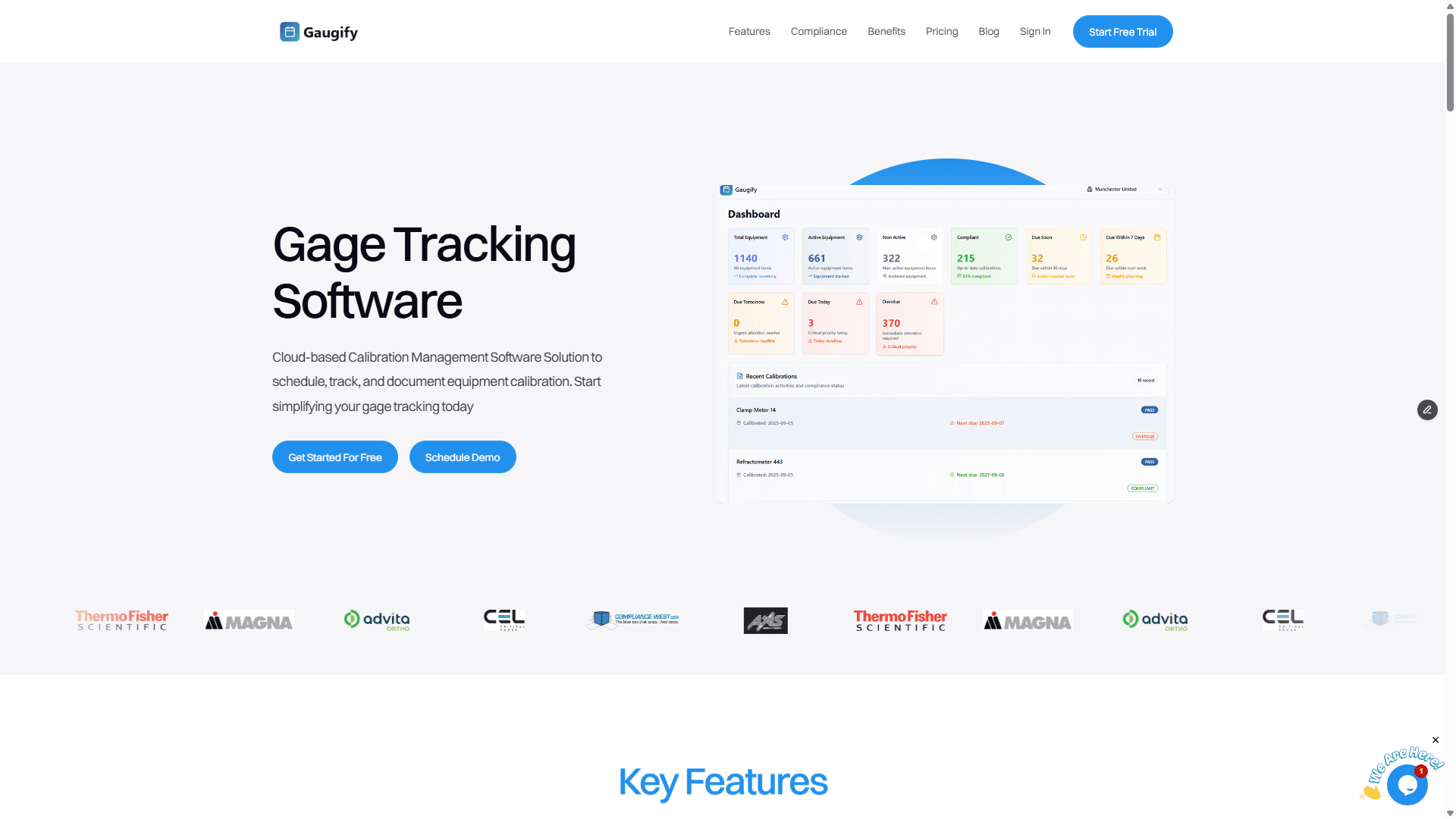
Effective calibration management software addresses each pain point glass manufacturing facilities face while providing the scalability and integration capabilities modern operations demand. Gaugify's cloud-based calibration management platform specifically addresses the unique challenges glass manufacturers encounter in maintaining compliant, efficient calibration programs.
Intelligent Scheduling and Workflow Management
Traditional calibration scheduling relies on fixed intervals that often result in unnecessary calibrations or unexpected equipment failures. Modern calibration management software glass operations benefit from utilizes predictive scheduling algorithms that analyze historical calibration data, equipment usage patterns, and environmental factors to optimize calibration intervals.
For glass manufacturing applications, this means pyrometers operating in high-temperature environments receive shortened intervals based on their exposure conditions, while dimensional gages in controlled environments can safely extend intervals when calibration history demonstrates stability. Gaugify's intelligent scheduling features automatically adjust intervals based on calibration results, reducing both calibration costs and the risk of undetected equipment drift.
Workflow management capabilities ensure calibrations are performed by qualified technicians using appropriate procedures and equipment. The software can route different instrument types to specialized calibration laboratories or internal technicians based on calibration complexity and capability requirements. For example, high-temperature pyrometers might automatically route to external laboratories with blackbody capability, while RTD sensors route to internal technicians with dry-block calibrators.
Integration with maintenance management systems prevents conflicts between calibration and maintenance activities. When a furnace pyrometer requires calibration during a scheduled maintenance shutdown, the software coordinates activities to minimize production impact while ensuring calibration requirements are met.
Automated Documentation and Certificate Generation
Manual calibration documentation creates opportunities for errors and inconsistencies that can cause audit failures. Modern calibration management software automatically generates calibration certificates with consistent formatting, appropriate measurement uncertainty statements, and complete traceability documentation.
For glass manufacturing applications, this includes specialized certificate formats for different instrument types. Pyrometer certificates include emissivity settings and distance-to-target ratios, while dimensional gage certificates document measurement points and environmental conditions. The software maintains templates for different customer requirements, ensuring automotive certificates include required statistical data while pharmaceutical certificates meet FDA formatting requirements.
Automated certificate distribution ensures stakeholders receive calibration documentation immediately upon completion. Production supervisors receive notifications when critical equipment calibrations are complete, while quality managers receive summary reports identifying any equipment found out of tolerance.
Electronic signature capabilities provide the security and tamper-evidence pharmaceutical applications require while streamlining approval workflows. Calibration technicians can sign certificates electronically using validated procedures, and quality managers can approve calibration procedures or interval changes through secure electronic workflows.
Measurement Uncertainty Calculations
Proper measurement uncertainty analysis requires complex calculations considering calibration standard uncertainty, instrument resolution, environmental conditions, and calibration procedure contributions. Manual uncertainty calculations are time-consuming and error-prone, leading many facilities to use overly conservative uncertainty estimates that may not meet customer requirements.
Modern calibration management software glass manufacturers use automates uncertainty calculations according to ISO/IEC Guide 98-3 (GUM) methodology, providing defensible uncertainty statements for each calibrated instrument. The software maintains uncertainty budgets for different calibration procedures, automatically updating calculations when calibration standards are recalibrated or procedures are modified.
For glass manufacturing applications, this means pyrometer uncertainty calculations include blackbody source uncertainty, distance-to-target effects, and atmospheric absorption corrections. Dimensional gage uncertainty calculations consider temperature coefficients, stylus force variations, and surface finish effects on measurement results.
The software can evaluate measurement uncertainty against customer requirements, automatically flagging situations where calibration uncertainty exceeds acceptable ratios. This helps quality managers make informed decisions about calibration laboratory selection, calibration procedure improvements, or measurement system upgrades.
Comprehensive Audit Trails and Compliance Reporting
Regulatory compliance requires comprehensive audit trails documenting all calibration activities, procedure changes, and system modifications. Manual systems struggle to maintain complete records while providing the search and reporting capabilities auditors expect.
Cloud-based calibration management software provides automatic audit trail generation with tamper-evident records of all system activities. Gaugify's compliance features include user access logging, change control documentation, and automated backup procedures that ensure calibration records remain available throughout required retention periods.
Compliance reporting capabilities provide pre-formatted reports for common audit scenarios. ISO 9001 compliance reports summarize calibration status, overdue items, and interval changes for management review. IATF 16949 reports include statistical analysis of calibration data and measurement system analysis results. FDA validation reports provide complete documentation of system qualification and change control activities.
The software can generate custom reports for specific customer requirements, ensuring automotive glass suppliers provide required calibration summaries with certificate packages while pharmaceutical suppliers meet validation documentation requirements.
Ready to transform your glass manufacturing calibration program? Start your free Gaugify trial today and experience how modern calibration management software can streamline your operations while ensuring complete compliance with industry standards.
Integration Capabilities and Scalability
Glass manufacturing facilities require calibration management software that integrates seamlessly with existing quality systems, ERP platforms, and production management systems. Standalone calibration systems create data silos that reduce efficiency and increase the risk of compliance gaps.
Modern calibration management software glass operations deploy provides API connectivity for integration with popular ERP systems like SAP, Oracle, and Microsoft Dynamics. This enables automatic synchronization of equipment master data, cost center assignments, and calibration cost allocation. When new equipment is added to the ERP system, it automatically appears in the calibration management system with appropriate calibration requirements based on equipment type and application.
Integration with quality management systems ensures calibration status is considered in production planning and quality decision-making. When a critical measurement system approaches its calibration due date, integrated systems can automatically restrict its use in production until calibration is complete. This prevents the use of out-of-calibration equipment while minimizing production disruptions.
Cloud-based architecture provides the scalability glass manufacturing facilities need as they grow or add new product lines. Gaugify's flexible pricing model scales with your facility size, accommodating everything from single-location operations to global glass manufacturing corporations with multiple facilities and thousands of instruments.
Mobile Capabilities for Shop Floor Efficiency
Glass manufacturing environments often make it challenging to access desktop computers for calibration documentation and schedule updates. Mobile capabilities enable calibration technicians to update records, upload certificates, and receive schedule notifications directly from the shop floor using tablets or smartphones.
Mobile applications provide offline capability for areas with limited network connectivity, automatically synchronizing data when connections are restored. This ensures calibration records remain current even when work is performed in areas with poor cellular or WiFi coverage.
Barcode scanning capabilities streamline equipment identification and reduce transcription errors. Technicians can scan equipment barcodes to access calibration history, update due dates, and upload new certificates without manual data entry. This improves accuracy while reducing the time required for calibration documentation.
Advanced Analytics and Continuous Improvement
Effective calibration management goes beyond simple scheduling and documentation to provide insights for continuous improvement. Advanced analytics capabilities help glass manufacturing facilities optimize calibration intervals, identify equipment reliability trends, and reduce calibration costs while maintaining compliance.
Statistical analysis of calibration data reveals equipment drift patterns that inform interval optimization decisions. Instruments demonstrating consistent stability over multiple calibration cycles can safely extend intervals, while equipment showing increasing drift rates may require more frequent calibration or replacement consideration.
Cost analysis capabilities help facilities balance calibration costs against risk levels. The software can model the impact of interval changes on both calibration costs and the probability of equipment being out of tolerance during use. This enables data-driven decisions about calibration frequency optimization.
Predictive maintenance integration uses calibration data to support equipment replacement decisions. When measurement system repeatability begins degrading or calibration adjustments become increasingly frequent, the software can recommend proactive equipment replacement before failures impact production quality.
Implementation Best Practices for Glass Manufacturing
Successful calibration management software implementation requires careful planning and consideration of glass manufacturing-specific requirements. Understanding implementation best practices helps facilities maximize software benefits while minimizing disruption to ongoing operations.
Begin implementation with a comprehensive equipment inventory that includes not only measurement instruments but also calibration standards, reference materials, and support equipment. Glass manufacturing facilities typically discover 15-20% more calibration items during detailed inventories, including items like optical flats, surface plates, and certified glass thickness standards that may not be tracked in existing systems.
Establish calibration procedures that reflect actual practice rather than theoretical requirements. Many facilities have evolved calibration methods that provide better results than standard procedures for their specific applications. For example, pyrometer calibrations in glass manufacturing often require specific emissivity settings and viewing angles that differ from generic calibration procedures.
Plan data migration carefully, recognizing that historical calibration data may exist in multiple formats and locations. Gaugify's implementation support includes data migration assistance to ensure historical calibration records are preserved and accessible in the new system.
Provide comprehensive training that covers not just software operation but also calibration principles and compliance requirements. Glass manufacturing technicians benefit from training that explains why specific calibration requirements exist and how calibration relates to product quality and customer satisfaction.
Change Management and User Adoption
Successful software implementation requires strong change management to ensure user adoption and sustained benefits. Glass manufacturing facilities often have experienced technicians who are comfortable with existing paper-based or spreadsheet systems and may resist changes to familiar procedures.
Involve key users in software selection and configuration to build ownership and ensure the system meets actual operational needs. Calibration technicians, quality managers, and production supervisors should all participate in system design discussions to ensure the software supports their specific workflows and reporting requirements.
Implement the system gradually, starting with a pilot area or specific equipment types before expanding to the entire facility. This allows users to become comfortable with new procedures while providing opportunities to refine system configuration based on actual use experience.
Establish success metrics that demonstrate software benefits in terms relevant to different user groups. Production managers care about reduced downtime from calibration scheduling conflicts, while quality managers focus on improved compliance and reduced audit findings. Calibration technicians appreciate reduced paperwork and automated scheduling capabilities.
Future-Proofing Your Calibration Management Investment
Glass manufacturing technology continues evolving with advances in automation, Industry 4.0 integration, and quality control methods. Selecting calibration management software that can adapt to future requirements protects your investment while ensuring long-term compliance and efficiency benefits.
Cloud-based platforms provide automatic updates and new feature rollouts without requiring local IT resources or system downtime. This ensures your calibration management system stays current with evolving standards and regulations while providing access to new capabilities as they become available.
API-first architecture enables integration with emerging technologies like IoT sensors, artificial intelligence, and machine learning applications. As glass manufacturing facilities implement smart factory concepts, calibration management systems must integrate with these technologies to provide comprehensive quality management.
Consider platforms that support multiple languages and international standards if your organization has global operations or expansion plans. Gaugify's ISO 17025 compliance capabilities support international accreditation requirements while providing localization for different regional standards and languages.
Plan for scalability not just in terms of equipment quantities but also functional capabilities. Your initial implementation might focus on basic calibration scheduling and documentation, but future needs might include statistical process control, measurement system analysis, or advanced uncertainty calculations.
Measuring Return on Investment
Glass manufacturing facilities invest in calibration management software to improve compliance, reduce costs, and enhance operational efficiency. Understanding how to measure return on investment helps justify initial costs while demonstrating ongoing value to management.
Quantify time savings from automated scheduling, certificate generation, and reporting capabilities. Glass manufacturing facilities typically reduce calibration administration time by 40-60% when implementing comprehensive calibration management software, translating to significant labor cost savings for facilities with large calibration programs.
Calculate cost reductions from optimized calibration intervals and improved vendor management. Facilities often reduce calibration costs by 15-25% through better interval optimization and competitive vendor selection while maintaining or improving compliance performance.
Document compliance improvements through reduced audit findings, faster audit responses, and improved customer satisfaction scores. The cost of compliance failures - including customer complaints, regulatory actions, and potential product recalls - far exceeds calibration management software costs for most facilities.
Track operational improvements like reduced equipment downtime from better scheduling coordination and fewer production holds due to calibration issues. Glass manufacturing facilities often achieve 2-3% improvements in equipment availability through better calibration management.
Modern glass manufacturing demands precision, compliance, and operational efficiency that manual calibration management systems simply cannot provide. The complexity of managing hundreds of measurement instruments across multiple production lines, while maintaining compliance with ISO 9001, IATF 16949, and FDA requirements, requires sophisticated software solutions designed specifically for manufacturing environments.
Gaugify's cloud-based calibration management platform addresses every challenge glass manufacturing facilities face - from intelligent scheduling that reduces costs to automated documentation that ensures compliance. With capabilities spanning measurement uncertainty calculations, comprehensive audit trails, mobile access, and seamless integration with existing quality systems, Gaugify transforms calibration management from a compliance burden into a competitive advantage.
The return on investment is clear: reduced administrative costs, improved compliance performance, optimized calibration intervals, and enhanced operational efficiency that supports your facility's quality objectives and customer satisfaction goals. Don't let outdated calibration management systems limit your glass manufacturing operation's potential.
Ready to revolutionize your glass manufacturing calibration program? Start your free 30-day Gaugify trial today and discover how modern calibration management software can streamline your operations while ensuring complete compliance with industry standards. Experience firsthand how intelligent scheduling, automated documentation, and comprehensive analytics can transform your calibration program into a strategic advantage. Schedule a personalized demo to see Gaugify in action with glass manufacturing-specific examples and learn how other glass manufacturers have achieved measurable improvements in efficiency and compliance.
Calibration Management Software for Glass Manufacturing
Glass manufacturing operations demand precision at every stage of production, from raw material measurement to final product inspection. Managing calibration schedules for hundreds of measuring instruments across multiple production lines while maintaining compliance with ISO 9001, ISO 14001, and customer-specific quality requirements creates a complex web of responsibilities. Modern calibration management software glass manufacturing facilities need must handle everything from basic dimensional gages to sophisticated thermal analysis equipment, all while providing the detailed documentation required for automotive, aerospace, and pharmaceutical glass applications.
Traditional paper-based calibration systems simply cannot keep pace with the demands of today's glass manufacturing environment. When a critical pyrometer goes out of tolerance during a float glass production run, or when an automotive customer audit reveals gaps in your calibration records, the cost of poor calibration management becomes immediately apparent. The right calibration management software transforms these challenges into streamlined processes that protect product quality while reducing administrative overhead.
Critical Calibration Challenges in Glass Manufacturing
Glass manufacturing facilities face unique calibration management challenges that stem from both the high-temperature nature of glass production and the precision requirements of end-use applications. Production environments routinely expose measuring equipment to temperatures exceeding 1500°C, creating accelerated drift rates that require more frequent calibration intervals than typical manufacturing operations.
The complexity multiplies when considering the variety of measuring parameters essential to glass production. Temperature measurement alone involves multiple technologies: thermocouples for furnace monitoring, infrared pyrometers for non-contact measurement, and resistance temperature detectors (RTDs) for annealing lehr control. Each requires different calibration approaches, with pyrometers needing blackbody calibration sources capable of reaching 1600°C and thermocouples requiring ice point and fixed-point calibrations.
Dimensional measurement presents another layer of complexity. Float glass thickness measurement systems using beta ray transmission must maintain calibration to ±0.1mm across widths up to 3.5 meters. Container glass manufacturing requires precise control of wall thickness, with pneumatic measurement systems needing calibration to ensure ±0.05mm accuracy on critical dimensions.
Documentation requirements add significant administrative burden. Automotive glass suppliers must maintain calibration records meeting IATF 16949 requirements, while pharmaceutical glass manufacturers face FDA validation requirements. Each standard demands specific documentation formats, retention periods, and traceability requirements that manual systems struggle to maintain consistently.
Essential Equipment Types Requiring Calibration
Glass manufacturing facilities typically maintain calibration programs covering 200-500 individual instruments across multiple measurement disciplines. Understanding the scope of equipment requiring calibration helps facility managers appreciate the complexity of effective calibration management software glass operations demand.
Temperature Measurement Equipment
Temperature measurement represents the largest category of calibrated equipment in most glass facilities. Furnace monitoring systems utilize Type R, S, and B thermocouples capable of measuring temperatures up to 1700°C, with required accuracies typically ±3°C at operating temperatures. These high-temperature applications create significant calibration challenges, as the platinum-based thermocouples are subject to contamination and drift that accelerates at extreme temperatures.
Infrared pyrometers used for non-contact temperature measurement require specialized calibration using blackbody sources. Two-color pyrometers commonly used in glass manufacturing for measuring temperatures through furnace atmospheres need calibration at multiple temperature points, typically 1000°C, 1300°C, and 1600°C, with accuracy requirements of ±5°C or ±0.3% of reading.
Annealing lehr temperature control depends on RTD sensors, typically Pt100 elements with 4-wire configurations for maximum accuracy. These sensors require calibration to ±0.1°C to maintain proper stress relief in finished glass products, with calibration points at 0°C, 100°C, 400°C, and 600°C covering the typical annealing temperature range.
Dimensional and Thickness Measurement Systems
Glass thickness measurement systems vary significantly between float glass, container glass, and specialty glass operations. Float glass lines typically employ beta ray transmission systems for continuous thickness measurement, requiring calibration with certified glass standards at thickness values ranging from 2mm to 25mm, with accuracy requirements of ±0.05mm.
Container glass manufacturing utilizes infrared thickness measurement for hot-end inspection and pneumatic systems for cold-end measurement. Hot-end infrared systems require calibration with glass containers of known wall thickness, typically covering ranges from 1.0mm to 6.0mm with ±0.1mm accuracy. Pneumatic measurement systems used for finish dimensions need calibration to ±0.025mm for critical sealing surfaces.
Optical measurement systems for surface quality inspection require calibration of both dimensional and optical parameters. Coordinate measuring machines (CMMs) used for precision glass components need calibration with certified reference standards, typically ball plates or step heights, with measurement uncertainties better than ±0.005mm for aerospace glass applications.
Process Control Instrumentation
Glass manufacturing process control relies heavily on pressure, flow, and level measurement instruments that require regular calibration. Furnace pressure control systems typically operate at low pressures, with differential pressure transmitters requiring calibration ranges of ±25Pa with accuracies of ±0.25% of span to maintain proper furnace atmosphere control.
Natural gas flow measurement for furnace fuel control utilizes mass flow meters or volumetric flow meters with pressure and temperature compensation. These systems require calibration at multiple flow points across their operating range, typically 25%, 50%, 75%, and 100% of maximum flow, with accuracy requirements of ±1% of reading for fuel cost optimization.
Batch house weighing systems demand high accuracy to ensure consistent glass chemistry. Platform scales handling raw materials require calibration with certified test weights, typically at 25%, 50%, 75%, and 100% of capacity, with accuracy requirements ranging from ±0.1% for precision optical glass to ±0.5% for container glass applications.
Quality Standards and Compliance Requirements for Calibration Management Software Glass Operations
Glass manufacturing facilities must navigate multiple quality standards depending on their target markets, each imposing specific calibration requirements that effective calibration management software glass systems must address. Understanding these requirements helps facility managers select appropriate software solutions and establish compliant calibration programs.
ISO 9001 and Glass Manufacturing
ISO 9001 forms the foundation of most glass manufacturing quality systems, with calibration requirements detailed in clause 7.1.5 covering monitoring and measuring resources. The standard requires organizations to ensure measuring equipment is calibrated at specified intervals against measurement standards traceable to international or national standards. For glass manufacturing, this means establishing calibration intervals based on equipment stability, usage frequency, and measurement criticality.
Glass facilities typically establish calibration intervals ranging from 3 months for critical pyrometers in high-temperature applications to 12 months for dimensional gages in controlled environments. The calibration management software glass operations deploy must maintain records demonstrating traceability to national standards through accredited calibration laboratories or certified reference materials.
Documentation requirements under ISO 9001 include calibration procedures, calibration records, and evidence of corrective action when equipment is found out of tolerance. Modern calibration software automates these documentation requirements while providing the audit trails necessary for certification body reviews.
Automotive Glass Standards (IATF 16949)
Automotive glass suppliers must comply with IATF 16949, which imposes additional calibration requirements beyond ISO 9001. The standard requires statistical analysis of calibration data to identify trends and potential equipment problems before they impact product quality. This means calibration management software glass automotive suppliers use must provide statistical process control capabilities for calibration data.
IATF 16949 also requires measurement system analysis (MSA) studies for all gages used in control plans. Glass manufacturers must conduct gage repeatability and reproducibility (GR&R) studies for dimensional measurement equipment, with acceptable GR&R values typically below 30% for inspection gages and below 10% for process control applications.
The standard mandates customer-specific requirements integration, meaning calibration programs must accommodate varying accuracy requirements from different automotive OEMs. Some customers require calibration uncertainties no greater than 25% of the specification tolerance, while others accept 33% ratios for non-critical dimensions.
Pharmaceutical Glass Compliance (FDA 21 CFR Part 11)
Pharmaceutical glass manufacturers face unique calibration challenges due to FDA validation requirements. Title 21 CFR Part 11 governs electronic records and signatures, requiring calibration management systems to provide secure, tamper-evident records with complete audit trails. This means calibration management software glass pharmaceutical suppliers implement must include electronic signature capabilities, user access controls, and comprehensive change control procedures.
FDA validation requires documented evidence that calibration procedures produce accurate, reliable results consistently over time. This includes installation qualification (IQ), operational qualification (OQ), and performance qualification (PQ) for calibration management systems. The software must demonstrate data integrity throughout the calibration lifecycle, from schedule generation through record retention.
Calibration interval justification becomes critical under FDA oversight, requiring statistical analysis of historical calibration data to support interval decisions. Pharmaceutical glass manufacturers must demonstrate that calibration intervals ensure equipment remains within tolerance between calibrations with acceptable confidence levels, typically 95% statistical confidence.
Common Audit Scenarios and Auditor Expectations
Understanding typical audit scenarios helps glass manufacturing facilities prepare their calibration programs and select calibration management software glass operations need to pass rigorous third-party examinations. Auditors focus on system effectiveness, not just compliance documentation, making robust software capabilities essential for audit success.
ISO 9001 Surveillance Audits
ISO 9001 surveillance audits typically begin with calibration system overview requests, where auditors examine calibration procedures, equipment inventories, and calibration scheduling systems. They expect to see evidence of systematic calibration management, including risk-based approaches to calibration interval determination and clear procedures for handling out-of-tolerance conditions.
Auditors commonly select specific pieces of equipment for detailed review, tracing calibration history from current certificates back through multiple calibration cycles. For example, an auditor might select a critical pyrometer used for annealing temperature control and request evidence of calibration traceability, interval justification, and any corrective actions taken when the instrument was found out of tolerance.
The calibration management software glass facilities use must provide immediate access to complete calibration histories, including calibration certificates, interval change documentation, and evidence of timely corrective action. Auditors particularly focus on overdue calibrations, expecting to see systematic controls preventing use of out-of-calibration equipment in production.
Customer Quality Audits
Automotive customer audits often focus on measurement system capability, examining both calibration records and measurement system analysis data. Auditors expect to see evidence that critical measurement systems maintain adequate discrimination and stability over time. This requires calibration management software capable of trending calibration data and alerting quality managers to deteriorating measurement system performance.
Container glass customers frequently audit calibration programs for dimensional measurement equipment used in quality control. They expect calibration uncertainties to be appropriate for the measurements being made, typically requiring 4:1 or 10:1 test accuracy ratios depending on the application criticality. The software must calculate and document measurement uncertainty for each calibrated instrument.
Pharmaceutical customers conduct particularly rigorous audits focusing on data integrity and change control. They expect complete audit trails showing who performed calibrations, when they were performed, and any changes made to calibration data or procedures. Electronic signature capabilities and user access controls become essential for passing these audits.
Regulatory Inspections
FDA inspections of pharmaceutical glass manufacturers include detailed examination of calibration validation documentation. Inspectors expect to see evidence that calibration management systems have been properly validated, including installation, operational, and performance qualification protocols. They also review change control procedures to ensure modifications to calibration programs receive appropriate review and approval.
OSHA inspections may include calibration program reviews for safety-related instrumentation. Glass manufacturing facilities using combustible gas detectors, oxygen analyzers, or noise measurement equipment must demonstrate proper calibration and maintenance. The calibration management software glass operations implement should include safety-related instrumentation alongside production measurement equipment.
Environmental audits examine calibration programs for emissions monitoring equipment, stack testing instruments, and ambient air quality monitors. Auditors expect calibration procedures to meet EPA method requirements and maintain appropriate documentation for environmental compliance reporting.
How Modern Calibration Management Software Glass Manufacturing Needs
Effective calibration management software addresses each pain point glass manufacturing facilities face while providing the scalability and integration capabilities modern operations demand. Gaugify's cloud-based calibration management platform specifically addresses the unique challenges glass manufacturers encounter in maintaining compliant, efficient calibration programs.
Intelligent Scheduling and Workflow Management
Traditional calibration scheduling relies on fixed intervals that often result in unnecessary calibrations or unexpected equipment failures. Modern calibration management software glass operations benefit from utilizes predictive scheduling algorithms that analyze historical calibration data, equipment usage patterns, and environmental factors to optimize calibration intervals.
For glass manufacturing applications, this means pyrometers operating in high-temperature environments receive shortened intervals based on their exposure conditions, while dimensional gages in controlled environments can safely extend intervals when calibration history demonstrates stability. Gaugify's intelligent scheduling features automatically adjust intervals based on calibration results, reducing both calibration costs and the risk of undetected equipment drift.
Workflow management capabilities ensure calibrations are performed by qualified technicians using appropriate procedures and equipment. The software can route different instrument types to specialized calibration laboratories or internal technicians based on calibration complexity and capability requirements. For example, high-temperature pyrometers might automatically route to external laboratories with blackbody capability, while RTD sensors route to internal technicians with dry-block calibrators.
Integration with maintenance management systems prevents conflicts between calibration and maintenance activities. When a furnace pyrometer requires calibration during a scheduled maintenance shutdown, the software coordinates activities to minimize production impact while ensuring calibration requirements are met.
Automated Documentation and Certificate Generation
Manual calibration documentation creates opportunities for errors and inconsistencies that can cause audit failures. Modern calibration management software automatically generates calibration certificates with consistent formatting, appropriate measurement uncertainty statements, and complete traceability documentation.
For glass manufacturing applications, this includes specialized certificate formats for different instrument types. Pyrometer certificates include emissivity settings and distance-to-target ratios, while dimensional gage certificates document measurement points and environmental conditions. The software maintains templates for different customer requirements, ensuring automotive certificates include required statistical data while pharmaceutical certificates meet FDA formatting requirements.
Automated certificate distribution ensures stakeholders receive calibration documentation immediately upon completion. Production supervisors receive notifications when critical equipment calibrations are complete, while quality managers receive summary reports identifying any equipment found out of tolerance.
Electronic signature capabilities provide the security and tamper-evidence pharmaceutical applications require while streamlining approval workflows. Calibration technicians can sign certificates electronically using validated procedures, and quality managers can approve calibration procedures or interval changes through secure electronic workflows.
Measurement Uncertainty Calculations
Proper measurement uncertainty analysis requires complex calculations considering calibration standard uncertainty, instrument resolution, environmental conditions, and calibration procedure contributions. Manual uncertainty calculations are time-consuming and error-prone, leading many facilities to use overly conservative uncertainty estimates that may not meet customer requirements.
Modern calibration management software glass manufacturers use automates uncertainty calculations according to ISO/IEC Guide 98-3 (GUM) methodology, providing defensible uncertainty statements for each calibrated instrument. The software maintains uncertainty budgets for different calibration procedures, automatically updating calculations when calibration standards are recalibrated or procedures are modified.
For glass manufacturing applications, this means pyrometer uncertainty calculations include blackbody source uncertainty, distance-to-target effects, and atmospheric absorption corrections. Dimensional gage uncertainty calculations consider temperature coefficients, stylus force variations, and surface finish effects on measurement results.
The software can evaluate measurement uncertainty against customer requirements, automatically flagging situations where calibration uncertainty exceeds acceptable ratios. This helps quality managers make informed decisions about calibration laboratory selection, calibration procedure improvements, or measurement system upgrades.
Comprehensive Audit Trails and Compliance Reporting
Regulatory compliance requires comprehensive audit trails documenting all calibration activities, procedure changes, and system modifications. Manual systems struggle to maintain complete records while providing the search and reporting capabilities auditors expect.
Cloud-based calibration management software provides automatic audit trail generation with tamper-evident records of all system activities. Gaugify's compliance features include user access logging, change control documentation, and automated backup procedures that ensure calibration records remain available throughout required retention periods.
Compliance reporting capabilities provide pre-formatted reports for common audit scenarios. ISO 9001 compliance reports summarize calibration status, overdue items, and interval changes for management review. IATF 16949 reports include statistical analysis of calibration data and measurement system analysis results. FDA validation reports provide complete documentation of system qualification and change control activities.
The software can generate custom reports for specific customer requirements, ensuring automotive glass suppliers provide required calibration summaries with certificate packages while pharmaceutical suppliers meet validation documentation requirements.
Ready to transform your glass manufacturing calibration program? Start your free Gaugify trial today and experience how modern calibration management software can streamline your operations while ensuring complete compliance with industry standards.
Integration Capabilities and Scalability
Glass manufacturing facilities require calibration management software that integrates seamlessly with existing quality systems, ERP platforms, and production management systems. Standalone calibration systems create data silos that reduce efficiency and increase the risk of compliance gaps.
Modern calibration management software glass operations deploy provides API connectivity for integration with popular ERP systems like SAP, Oracle, and Microsoft Dynamics. This enables automatic synchronization of equipment master data, cost center assignments, and calibration cost allocation. When new equipment is added to the ERP system, it automatically appears in the calibration management system with appropriate calibration requirements based on equipment type and application.
Integration with quality management systems ensures calibration status is considered in production planning and quality decision-making. When a critical measurement system approaches its calibration due date, integrated systems can automatically restrict its use in production until calibration is complete. This prevents the use of out-of-calibration equipment while minimizing production disruptions.
Cloud-based architecture provides the scalability glass manufacturing facilities need as they grow or add new product lines. Gaugify's flexible pricing model scales with your facility size, accommodating everything from single-location operations to global glass manufacturing corporations with multiple facilities and thousands of instruments.
Mobile Capabilities for Shop Floor Efficiency
Glass manufacturing environments often make it challenging to access desktop computers for calibration documentation and schedule updates. Mobile capabilities enable calibration technicians to update records, upload certificates, and receive schedule notifications directly from the shop floor using tablets or smartphones.
Mobile applications provide offline capability for areas with limited network connectivity, automatically synchronizing data when connections are restored. This ensures calibration records remain current even when work is performed in areas with poor cellular or WiFi coverage.
Barcode scanning capabilities streamline equipment identification and reduce transcription errors. Technicians can scan equipment barcodes to access calibration history, update due dates, and upload new certificates without manual data entry. This improves accuracy while reducing the time required for calibration documentation.
Advanced Analytics and Continuous Improvement
Effective calibration management goes beyond simple scheduling and documentation to provide insights for continuous improvement. Advanced analytics capabilities help glass manufacturing facilities optimize calibration intervals, identify equipment reliability trends, and reduce calibration costs while maintaining compliance.
Statistical analysis of calibration data reveals equipment drift patterns that inform interval optimization decisions. Instruments demonstrating consistent stability over multiple calibration cycles can safely extend intervals, while equipment showing increasing drift rates may require more frequent calibration or replacement consideration.
Cost analysis capabilities help facilities balance calibration costs against risk levels. The software can model the impact of interval changes on both calibration costs and the probability of equipment being out of tolerance during use. This enables data-driven decisions about calibration frequency optimization.
Predictive maintenance integration uses calibration data to support equipment replacement decisions. When measurement system repeatability begins degrading or calibration adjustments become increasingly frequent, the software can recommend proactive equipment replacement before failures impact production quality.
Implementation Best Practices for Glass Manufacturing
Successful calibration management software implementation requires careful planning and consideration of glass manufacturing-specific requirements. Understanding implementation best practices helps facilities maximize software benefits while minimizing disruption to ongoing operations.
Begin implementation with a comprehensive equipment inventory that includes not only measurement instruments but also calibration standards, reference materials, and support equipment. Glass manufacturing facilities typically discover 15-20% more calibration items during detailed inventories, including items like optical flats, surface plates, and certified glass thickness standards that may not be tracked in existing systems.
Establish calibration procedures that reflect actual practice rather than theoretical requirements. Many facilities have evolved calibration methods that provide better results than standard procedures for their specific applications. For example, pyrometer calibrations in glass manufacturing often require specific emissivity settings and viewing angles that differ from generic calibration procedures.
Plan data migration carefully, recognizing that historical calibration data may exist in multiple formats and locations. Gaugify's implementation support includes data migration assistance to ensure historical calibration records are preserved and accessible in the new system.
Provide comprehensive training that covers not just software operation but also calibration principles and compliance requirements. Glass manufacturing technicians benefit from training that explains why specific calibration requirements exist and how calibration relates to product quality and customer satisfaction.
Change Management and User Adoption
Successful software implementation requires strong change management to ensure user adoption and sustained benefits. Glass manufacturing facilities often have experienced technicians who are comfortable with existing paper-based or spreadsheet systems and may resist changes to familiar procedures.
Involve key users in software selection and configuration to build ownership and ensure the system meets actual operational needs. Calibration technicians, quality managers, and production supervisors should all participate in system design discussions to ensure the software supports their specific workflows and reporting requirements.
Implement the system gradually, starting with a pilot area or specific equipment types before expanding to the entire facility. This allows users to become comfortable with new procedures while providing opportunities to refine system configuration based on actual use experience.
Establish success metrics that demonstrate software benefits in terms relevant to different user groups. Production managers care about reduced downtime from calibration scheduling conflicts, while quality managers focus on improved compliance and reduced audit findings. Calibration technicians appreciate reduced paperwork and automated scheduling capabilities.
Future-Proofing Your Calibration Management Investment
Glass manufacturing technology continues evolving with advances in automation, Industry 4.0 integration, and quality control methods. Selecting calibration management software that can adapt to future requirements protects your investment while ensuring long-term compliance and efficiency benefits.
Cloud-based platforms provide automatic updates and new feature rollouts without requiring local IT resources or system downtime. This ensures your calibration management system stays current with evolving standards and regulations while providing access to new capabilities as they become available.
API-first architecture enables integration with emerging technologies like IoT sensors, artificial intelligence, and machine learning applications. As glass manufacturing facilities implement smart factory concepts, calibration management systems must integrate with these technologies to provide comprehensive quality management.
Consider platforms that support multiple languages and international standards if your organization has global operations or expansion plans. Gaugify's ISO 17025 compliance capabilities support international accreditation requirements while providing localization for different regional standards and languages.
Plan for scalability not just in terms of equipment quantities but also functional capabilities. Your initial implementation might focus on basic calibration scheduling and documentation, but future needs might include statistical process control, measurement system analysis, or advanced uncertainty calculations.
Measuring Return on Investment
Glass manufacturing facilities invest in calibration management software to improve compliance, reduce costs, and enhance operational efficiency. Understanding how to measure return on investment helps justify initial costs while demonstrating ongoing value to management.
Quantify time savings from automated scheduling, certificate generation, and reporting capabilities. Glass manufacturing facilities typically reduce calibration administration time by 40-60% when implementing comprehensive calibration management software, translating to significant labor cost savings for facilities with large calibration programs.
Calculate cost reductions from optimized calibration intervals and improved vendor management. Facilities often reduce calibration costs by 15-25% through better interval optimization and competitive vendor selection while maintaining or improving compliance performance.
Document compliance improvements through reduced audit findings, faster audit responses, and improved customer satisfaction scores. The cost of compliance failures - including customer complaints, regulatory actions, and potential product recalls - far exceeds calibration management software costs for most facilities.
Track operational improvements like reduced equipment downtime from better scheduling coordination and fewer production holds due to calibration issues. Glass manufacturing facilities often achieve 2-3% improvements in equipment availability through better calibration management.
Modern glass manufacturing demands precision, compliance, and operational efficiency that manual calibration management systems simply cannot provide. The complexity of managing hundreds of measurement instruments across multiple production lines, while maintaining compliance with ISO 9001, IATF 16949, and FDA requirements, requires sophisticated software solutions designed specifically for manufacturing environments.
Gaugify's cloud-based calibration management platform addresses every challenge glass manufacturing facilities face - from intelligent scheduling that reduces costs to automated documentation that ensures compliance. With capabilities spanning measurement uncertainty calculations, comprehensive audit trails, mobile access, and seamless integration with existing quality systems, Gaugify transforms calibration management from a compliance burden into a competitive advantage.
The return on investment is clear: reduced administrative costs, improved compliance performance, optimized calibration intervals, and enhanced operational efficiency that supports your facility's quality objectives and customer satisfaction goals. Don't let outdated calibration management systems limit your glass manufacturing operation's potential.
Ready to revolutionize your glass manufacturing calibration program? Start your free 30-day Gaugify trial today and discover how modern calibration management software can streamline your operations while ensuring complete compliance with industry standards. Experience firsthand how intelligent scheduling, automated documentation, and comprehensive analytics can transform your calibration program into a strategic advantage. Schedule a personalized demo to see Gaugify in action with glass manufacturing-specific examples and learn how other glass manufacturers have achieved measurable improvements in efficiency and compliance.