
Calibration Management Software for Cement and Concrete Plants
Calibration Management Software for Cement and Concrete Plants
David Bentley
Quality Assurance Engineer
8 min read
Calibration Management Software for Cement and Concrete Plants
Cement and concrete manufacturing facilities face unique challenges when managing calibration programs for their critical measuring equipment. From maintaining precise aggregate proportions to ensuring accurate compressive strength measurements, calibration management software for cement and concrete plants must handle everything from basic dimensional gages to sophisticated testing equipment. Traditional paper-based systems and spreadsheets simply can't keep pace with the volume of instruments, complex calibration schedules, and stringent quality requirements that define modern cement and concrete operations.
Quality managers in cement plants know that a single out-of-tolerance scale can result in off-spec concrete mixes, costly rework, and potential structural failures in the field. Meanwhile, concrete testing laboratories must maintain impeccable calibration records to satisfy ASTM, AASHTO, and customer audit requirements. The financial and safety implications of calibration failures make robust calibration management software an operational necessity, not a luxury.
Critical Equipment Requiring Calibration in Cement and Concrete Operations
Cement and concrete facilities rely on an extensive array of measuring and testing equipment that demands regular calibration to maintain product quality and regulatory compliance. Understanding the scope of this equipment helps illustrate why specialized calibration management software for cement and concrete plants is essential.
Weighing and Batching Systems
The foundation of quality concrete starts with accurate batching. Belt scales measuring limestone, clay, and iron ore must maintain accuracies within ±0.5% of actual weight to ensure proper clinker chemistry. Aggregate scales in concrete plants typically require calibration to ±0.2% accuracy, while cement and admixture scales demand even tighter tolerances of ±0.1% to prevent strength variations.
Truck scales present particular challenges, often requiring monthly calibration checks using certified test weights up to 80,000 pounds. Documentation requirements include not just the calibration certificate, but also verification that the scale maintains accuracy across its full operating range under varying environmental conditions.
Laboratory Testing Equipment
Concrete testing laboratories maintain extensive instrument inventories requiring calibration management. Compression testing machines must be calibrated annually using proving rings or load cells traceable to NIST standards, with verification loads typically applied at 10%, 50%, and 100% of capacity. Force measurement accuracy requirements typically fall within ±1.0% of applied load.
Air content meters, slump cones, and temperature measuring devices each have specific calibration requirements. Thermometers used in concrete temperature measurements require calibration to ±1°F accuracy, while air meters must demonstrate repeatability within ±0.2% air content to meet ASTM C231 requirements.
Process Control Instrumentation
Kiln operations depend on accurately calibrated temperature sensors, pressure transducers, and flow meters. Thermocouple accuracy becomes critical when maintaining kiln temperatures around 2700°F, where even small measurement errors can affect fuel consumption and clinker quality. Pressure sensors monitoring baghouse differential pressure must maintain accuracy within ±2% of reading to ensure proper dust collection performance.
X-ray fluorescence analyzers used for real-time chemistry control require regular standardization using certified reference materials, with calibration drift checks performed multiple times per shift to maintain analytical accuracy within specification limits.
Quality Standards and Compliance Requirements for Cement and Concrete Calibration
The cement and concrete industry operates under multiple overlapping quality frameworks that drive calibration requirements. Effective calibration management software for cement and concrete operations must accommodate these diverse standards while maintaining audit-ready documentation.
ASTM and AASHTO Standards
ASTM C1077 governs laboratories engaged in concrete and concrete aggregate testing, requiring documented calibration procedures, calibration intervals, and measurement uncertainty calculations. Testing equipment must demonstrate traceability to national standards, with calibration certificates showing uncertainty values that don't compromise test method requirements.
AASHTO accredited laboratories face additional requirements for proficiency testing, calibration verification, and measurement system analysis. Calibration intervals must be justified based on instrument stability, usage patterns, and historical performance data—requirements that manual tracking systems struggle to manage effectively.
ISO 9001 and ISO 17025 Requirements
Many cement manufacturers maintain ISO 9001 certification, which requires calibrated measuring equipment used in quality management processes. This extends beyond laboratory instruments to include production scales, flow meters, and process control devices that affect product conformity.
Concrete testing laboratories increasingly pursue ISO 17025 accreditation, which imposes rigorous calibration management requirements including measurement uncertainty budgets, calibration status identification, and systematic equipment records. The standard requires laboratories to validate that measurement uncertainty doesn't invalidate test results—a calculation that modern calibration management software can automate.
Customer and Regulatory Requirements
Department of Transportation contracts often specify calibration requirements beyond standard industry practice. Nuclear density gages used in concrete placement verification require annual calibration with specific documentation requirements, including leak testing records and radiation safety compliance.
Ready-mix concrete producers serving commercial construction must satisfy customer audit requirements that scrutinize calibration programs. Auditors routinely verify calibration certificates, check due date compliance, and trace measurement uncertainty through the entire testing process.
Common Audit Scenarios and Auditor Focus Areas
Understanding what auditors examine during calibration system reviews helps cement and concrete facilities prepare comprehensive defense strategies. Modern auditors combine traditional document reviews with data analysis techniques that can quickly identify systemic calibration management weaknesses.
Calibration Certificate Analysis
Auditors systematically review calibration certificates for completeness, traceability, and technical adequacy. They verify that calibration laboratories hold appropriate accreditations and that measurement uncertainties are suitable for intended applications. Missing certificates or those approaching expiration immediately trigger corrective action requests.
Certificate analysis extends to technical content verification. Auditors check that calibration points span the instrument's actual use range and that environmental conditions during calibration match operating conditions. For example, a pressure transducer calibrated only at room temperature but used in 150°F kiln applications creates an audit finding.
Calibration Interval Justification
Modern auditors expect facilities to justify calibration intervals based on data rather than arbitrary schedules. They review instrument histories looking for patterns of drift, out-of-tolerance conditions, and calibration adjustments that might indicate inappropriate intervals.
Facilities using 12-month intervals for all instruments without technical justification face scrutiny. Auditors prefer seeing risk-based approaches where critical instruments receive more frequent attention while stable, non-critical devices operate on extended intervals supported by performance data.
Measurement Uncertainty Management
Sophisticated auditors now examine measurement uncertainty budgets and their impact on test result validity. They verify that calibration uncertainty, environmental effects, and operator variability combine to produce acceptable overall measurement uncertainty.
This analysis reveals whether facilities truly understand their measurement capabilities. A concrete testing lab claiming ±50 psi compressive strength accuracy while using calibration services with ±100 psi uncertainty creates an obvious audit finding that questions all reported results.
How Gaugify Solves Cement and Concrete Calibration Challenges
Modern cement and concrete operations require calibration management solutions that understand industry-specific requirements while providing the automation and visibility needed for efficient operations. Gaugify's cloud-based platform addresses each pain point that quality managers and lab technicians face daily.
Intelligent Calibration Scheduling
Gaugify automatically generates calibration schedules based on customizable intervals while accounting for production calendars, maintenance windows, and resource availability. The system sends automated notifications at 30, 14, and 7 days before calibration due dates, preventing unexpected instrument downtime during critical production periods.
For cement plants operating continuous kilns, Gaugify schedules temperature sensor calibrations during planned maintenance outages. Concrete lab managers can coordinate compression testing machine calibrations with testing schedules to minimize disruption to customer commitments. The platform learns from historical patterns to optimize scheduling recommendations over time.
Comprehensive Certificate Management
Digital certificate storage with OCR-powered data extraction eliminates manual entry errors while ensuring complete calibration records. Gaugify automatically extracts key data points including calibration dates, uncertainties, and As Found/As Left values, building a comprehensive database for trend analysis.
The system maintains complete audit trails showing who uploaded certificates, when modifications occurred, and approval workflows for non-conforming instruments. Quality managers can instantly generate certificate packages for customer audits, DOT inspections, or accreditation body reviews.
Ready to Transform Your Calibration Management?
See how Gaugify can streamline your cement or concrete plant's calibration program. Our cloud-based platform eliminates scheduling conflicts, automates compliance reporting, and provides the audit trail visibility that modern operations demand.
Automated Uncertainty Calculations
Gaugify performs measurement uncertainty calculations automatically, combining calibration uncertainty with environmental factors, repeatability studies, and operator effects. The system maintains uncertainty budgets for each instrument and alerts users when combined uncertainties threaten test method validity.
For concrete compression testing, the platform calculates total measurement uncertainty including machine calibration, specimen preparation effects, and operator variability. Quality managers receive immediate alerts when uncertainty levels exceed ASTM method requirements, enabling proactive corrective action before invalid results reach customers.
Advanced Reporting and Analytics
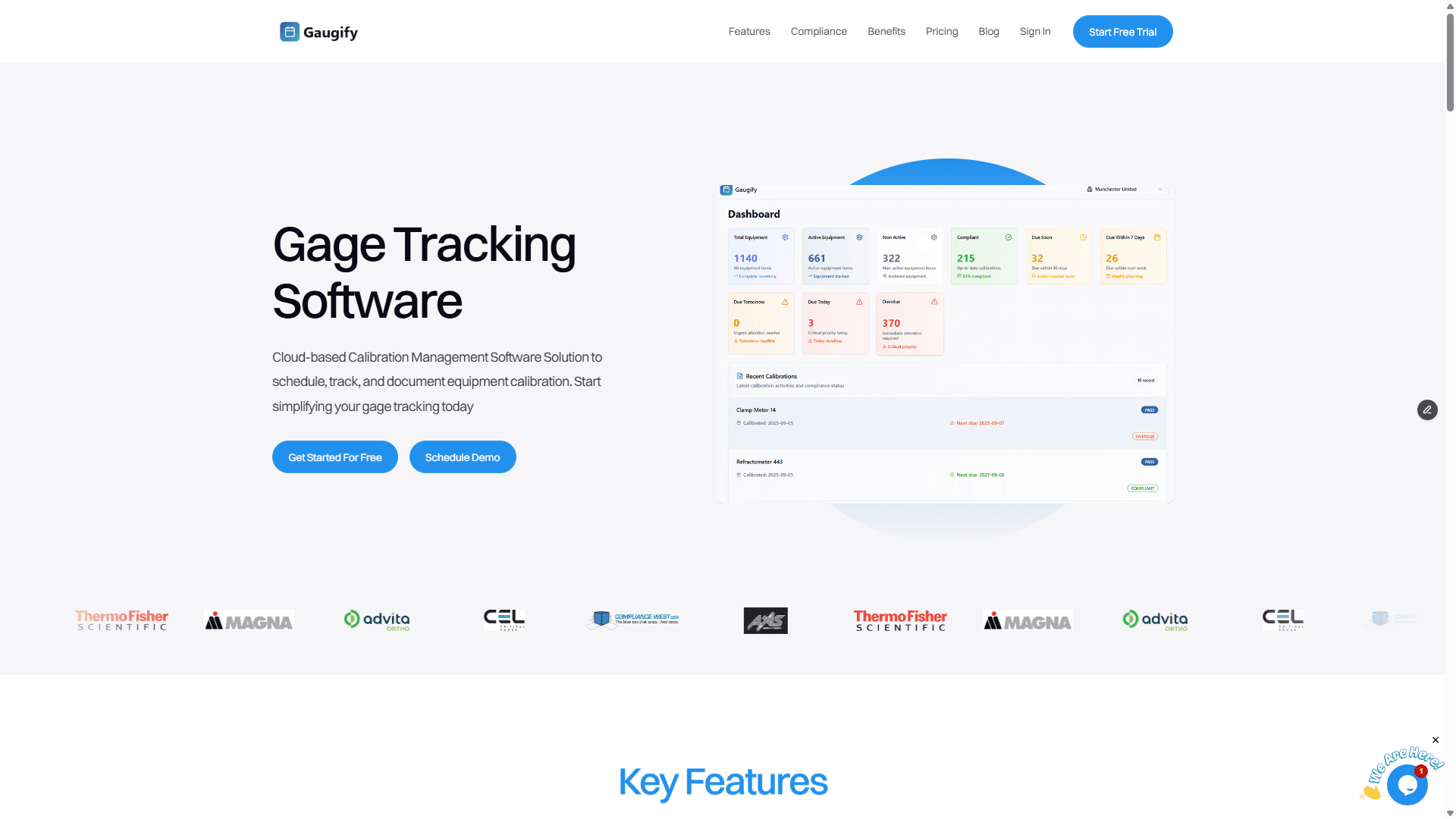
Built-in analytics identify trends in instrument performance, calibration costs, and interval optimization opportunities. Gaugify's dashboards show calibration compliance rates, overdue instrument counts, and upcoming scheduling requirements in real-time visualizations that support data-driven decision making.
The platform generates automated compliance reports for ISO 9001, ISO 17025, and customer-specific requirements. Reports include calibration certificate summaries, interval justifications, and measurement uncertainty analyses formatted for direct inclusion in quality manual documentation.
Streamlined Audit Preparation and Response
When audit notifications arrive, Gaugify transforms preparation from weeks of frantic document gathering into automated report generation. The system maintains complete calibration histories, tracks all certificate revisions, and provides instant access to any calibration record through powerful search capabilities.
Auditors can access real-time calibration status dashboards showing compliance percentages, overdue instruments, and trend analyses. The transparency typically impresses audit teams while demonstrating systematic calibration management maturity that strengthens overall quality system evaluations.
Integration with Existing Systems
Gaugify integrates seamlessly with laboratory information management systems (LIMS), enterprise resource planning (ERP) platforms, and maintenance management software commonly used in cement and concrete operations. API connectivity enables automated data sharing that eliminates duplicate entry while maintaining data consistency across platforms.
The integration extends to calibration service providers, enabling automatic certificate upload and data synchronization. When external calibration labs complete work, certificates and data flow directly into Gaugify without manual intervention, reducing administrative overhead while improving data accuracy.
Cost Optimization and Resource Management
Effective calibration management software for cement and concrete plants must balance regulatory compliance with operational efficiency. Gaugify provides cost optimization tools that help facilities reduce calibration expenses while maintaining measurement integrity.
The platform analyzes instrument performance histories to identify candidates for interval extension, potentially saving thousands of dollars annually in calibration costs. Conversely, instruments showing stability issues receive recommendations for shortened intervals or replacement evaluation.
Resource planning tools help coordinate internal calibration activities with external service provider schedules. Quality managers can optimize technician time allocation, minimize instrument downtime, and negotiate better pricing through consolidated service orders.
Mobile Accessibility for Field Operations
Cement and concrete operations span multiple locations including quarries, batch plants, and job sites where calibration activities occur. Gaugify's mobile applications enable field technicians to access calibration schedules, upload certificates, and update instrument status from any location with internet connectivity.
Mobile functionality proves particularly valuable for ready-mix operations where trucks and portable testing equipment move constantly between locations. Technicians can verify calibration status, document field checks, and maintain compliance regardless of their physical location.
Scalability for Growing Operations
As cement and concrete operations expand through acquisitions, new locations, or additional testing capabilities, Gaugify scales seamlessly to accommodate growth. The cloud-based architecture eliminates server capacity concerns while maintaining consistent performance regardless of user counts or data volumes.
Multi-location visibility enables corporate quality managers to monitor calibration compliance across all facilities from a single dashboard. Standardized procedures and reporting formats ensure consistent calibration management practices throughout expanding organizations.
Training and Change Management Support
Implementing new calibration management software requires comprehensive training and change management support. Gaugify provides structured training programs designed specifically for cement and concrete industry requirements, ensuring rapid user adoption and full feature utilization.
The platform includes built-in help resources, video tutorials, and context-sensitive guidance that reduces learning curves. Compliance-focused documentation helps quality managers understand how features support specific regulatory requirements.
Data Security and Backup Protection
Calibration records represent critical quality system assets that require protection against loss or unauthorized access. Gaugify employs enterprise-grade security measures including encrypted data transmission, role-based access controls, and automated backup systems that ensure data integrity and availability.
The platform maintains complete audit trails showing all data access, modifications, and user activities. These security features satisfy ISO 17025 requirements while providing the peace of mind that comes with professional-grade data protection.
Future-Proofing Calibration Management
The cement and concrete industry continues evolving with new testing methods, regulatory requirements, and quality expectations. Gaugify's development roadmap incorporates emerging industry needs including enhanced measurement uncertainty analysis, predictive calibration scheduling, and integration with Industry 4.0 manufacturing systems.
Regular platform updates deliver new features and capabilities without disrupting existing operations. Users benefit from continuous improvement without the costs and complications associated with traditional software upgrades.
Transform Your Calibration Management Today
Cement and concrete operations can no longer afford the risks and inefficiencies associated with manual calibration management systems. The combination of regulatory requirements, customer expectations, and operational complexity demands purpose-built software solutions that understand industry-specific challenges.
Gaugify delivers the comprehensive calibration management software for cement and concrete plants that modern operations require. From intelligent scheduling and automated uncertainty calculations to audit-ready reporting and mobile field access, the platform addresses every aspect of calibration management while reducing administrative overhead and improving compliance visibility.
Quality managers who implement Gaugify report significant improvements in audit performance, reduced calibration costs, and enhanced operational efficiency. The platform's industry-specific features combined with cloud-based accessibility create a calibration management solution that grows with expanding operations while maintaining the compliance rigor that cement and concrete facilities demand.
Don't let outdated calibration management practices compromise your quality system or create audit vulnerabilities. Schedule a personalized demonstration to see how Gaugify can transform your calibration management program, or start your free trial today to experience the difference that modern calibration management software makes in cement and concrete operations.
Calibration Management Software for Cement and Concrete Plants
Cement and concrete manufacturing facilities face unique challenges when managing calibration programs for their critical measuring equipment. From maintaining precise aggregate proportions to ensuring accurate compressive strength measurements, calibration management software for cement and concrete plants must handle everything from basic dimensional gages to sophisticated testing equipment. Traditional paper-based systems and spreadsheets simply can't keep pace with the volume of instruments, complex calibration schedules, and stringent quality requirements that define modern cement and concrete operations.
Quality managers in cement plants know that a single out-of-tolerance scale can result in off-spec concrete mixes, costly rework, and potential structural failures in the field. Meanwhile, concrete testing laboratories must maintain impeccable calibration records to satisfy ASTM, AASHTO, and customer audit requirements. The financial and safety implications of calibration failures make robust calibration management software an operational necessity, not a luxury.
Critical Equipment Requiring Calibration in Cement and Concrete Operations
Cement and concrete facilities rely on an extensive array of measuring and testing equipment that demands regular calibration to maintain product quality and regulatory compliance. Understanding the scope of this equipment helps illustrate why specialized calibration management software for cement and concrete plants is essential.
Weighing and Batching Systems
The foundation of quality concrete starts with accurate batching. Belt scales measuring limestone, clay, and iron ore must maintain accuracies within ±0.5% of actual weight to ensure proper clinker chemistry. Aggregate scales in concrete plants typically require calibration to ±0.2% accuracy, while cement and admixture scales demand even tighter tolerances of ±0.1% to prevent strength variations.
Truck scales present particular challenges, often requiring monthly calibration checks using certified test weights up to 80,000 pounds. Documentation requirements include not just the calibration certificate, but also verification that the scale maintains accuracy across its full operating range under varying environmental conditions.
Laboratory Testing Equipment
Concrete testing laboratories maintain extensive instrument inventories requiring calibration management. Compression testing machines must be calibrated annually using proving rings or load cells traceable to NIST standards, with verification loads typically applied at 10%, 50%, and 100% of capacity. Force measurement accuracy requirements typically fall within ±1.0% of applied load.
Air content meters, slump cones, and temperature measuring devices each have specific calibration requirements. Thermometers used in concrete temperature measurements require calibration to ±1°F accuracy, while air meters must demonstrate repeatability within ±0.2% air content to meet ASTM C231 requirements.
Process Control Instrumentation
Kiln operations depend on accurately calibrated temperature sensors, pressure transducers, and flow meters. Thermocouple accuracy becomes critical when maintaining kiln temperatures around 2700°F, where even small measurement errors can affect fuel consumption and clinker quality. Pressure sensors monitoring baghouse differential pressure must maintain accuracy within ±2% of reading to ensure proper dust collection performance.
X-ray fluorescence analyzers used for real-time chemistry control require regular standardization using certified reference materials, with calibration drift checks performed multiple times per shift to maintain analytical accuracy within specification limits.
Quality Standards and Compliance Requirements for Cement and Concrete Calibration
The cement and concrete industry operates under multiple overlapping quality frameworks that drive calibration requirements. Effective calibration management software for cement and concrete operations must accommodate these diverse standards while maintaining audit-ready documentation.
ASTM and AASHTO Standards
ASTM C1077 governs laboratories engaged in concrete and concrete aggregate testing, requiring documented calibration procedures, calibration intervals, and measurement uncertainty calculations. Testing equipment must demonstrate traceability to national standards, with calibration certificates showing uncertainty values that don't compromise test method requirements.
AASHTO accredited laboratories face additional requirements for proficiency testing, calibration verification, and measurement system analysis. Calibration intervals must be justified based on instrument stability, usage patterns, and historical performance data—requirements that manual tracking systems struggle to manage effectively.
ISO 9001 and ISO 17025 Requirements
Many cement manufacturers maintain ISO 9001 certification, which requires calibrated measuring equipment used in quality management processes. This extends beyond laboratory instruments to include production scales, flow meters, and process control devices that affect product conformity.
Concrete testing laboratories increasingly pursue ISO 17025 accreditation, which imposes rigorous calibration management requirements including measurement uncertainty budgets, calibration status identification, and systematic equipment records. The standard requires laboratories to validate that measurement uncertainty doesn't invalidate test results—a calculation that modern calibration management software can automate.
Customer and Regulatory Requirements
Department of Transportation contracts often specify calibration requirements beyond standard industry practice. Nuclear density gages used in concrete placement verification require annual calibration with specific documentation requirements, including leak testing records and radiation safety compliance.
Ready-mix concrete producers serving commercial construction must satisfy customer audit requirements that scrutinize calibration programs. Auditors routinely verify calibration certificates, check due date compliance, and trace measurement uncertainty through the entire testing process.
Common Audit Scenarios and Auditor Focus Areas
Understanding what auditors examine during calibration system reviews helps cement and concrete facilities prepare comprehensive defense strategies. Modern auditors combine traditional document reviews with data analysis techniques that can quickly identify systemic calibration management weaknesses.
Calibration Certificate Analysis
Auditors systematically review calibration certificates for completeness, traceability, and technical adequacy. They verify that calibration laboratories hold appropriate accreditations and that measurement uncertainties are suitable for intended applications. Missing certificates or those approaching expiration immediately trigger corrective action requests.
Certificate analysis extends to technical content verification. Auditors check that calibration points span the instrument's actual use range and that environmental conditions during calibration match operating conditions. For example, a pressure transducer calibrated only at room temperature but used in 150°F kiln applications creates an audit finding.
Calibration Interval Justification
Modern auditors expect facilities to justify calibration intervals based on data rather than arbitrary schedules. They review instrument histories looking for patterns of drift, out-of-tolerance conditions, and calibration adjustments that might indicate inappropriate intervals.
Facilities using 12-month intervals for all instruments without technical justification face scrutiny. Auditors prefer seeing risk-based approaches where critical instruments receive more frequent attention while stable, non-critical devices operate on extended intervals supported by performance data.
Measurement Uncertainty Management
Sophisticated auditors now examine measurement uncertainty budgets and their impact on test result validity. They verify that calibration uncertainty, environmental effects, and operator variability combine to produce acceptable overall measurement uncertainty.
This analysis reveals whether facilities truly understand their measurement capabilities. A concrete testing lab claiming ±50 psi compressive strength accuracy while using calibration services with ±100 psi uncertainty creates an obvious audit finding that questions all reported results.
How Gaugify Solves Cement and Concrete Calibration Challenges
Modern cement and concrete operations require calibration management solutions that understand industry-specific requirements while providing the automation and visibility needed for efficient operations. Gaugify's cloud-based platform addresses each pain point that quality managers and lab technicians face daily.
Intelligent Calibration Scheduling
Gaugify automatically generates calibration schedules based on customizable intervals while accounting for production calendars, maintenance windows, and resource availability. The system sends automated notifications at 30, 14, and 7 days before calibration due dates, preventing unexpected instrument downtime during critical production periods.
For cement plants operating continuous kilns, Gaugify schedules temperature sensor calibrations during planned maintenance outages. Concrete lab managers can coordinate compression testing machine calibrations with testing schedules to minimize disruption to customer commitments. The platform learns from historical patterns to optimize scheduling recommendations over time.
Comprehensive Certificate Management
Digital certificate storage with OCR-powered data extraction eliminates manual entry errors while ensuring complete calibration records. Gaugify automatically extracts key data points including calibration dates, uncertainties, and As Found/As Left values, building a comprehensive database for trend analysis.
The system maintains complete audit trails showing who uploaded certificates, when modifications occurred, and approval workflows for non-conforming instruments. Quality managers can instantly generate certificate packages for customer audits, DOT inspections, or accreditation body reviews.
Ready to Transform Your Calibration Management?
See how Gaugify can streamline your cement or concrete plant's calibration program. Our cloud-based platform eliminates scheduling conflicts, automates compliance reporting, and provides the audit trail visibility that modern operations demand.
Automated Uncertainty Calculations
Gaugify performs measurement uncertainty calculations automatically, combining calibration uncertainty with environmental factors, repeatability studies, and operator effects. The system maintains uncertainty budgets for each instrument and alerts users when combined uncertainties threaten test method validity.
For concrete compression testing, the platform calculates total measurement uncertainty including machine calibration, specimen preparation effects, and operator variability. Quality managers receive immediate alerts when uncertainty levels exceed ASTM method requirements, enabling proactive corrective action before invalid results reach customers.
Advanced Reporting and Analytics
Built-in analytics identify trends in instrument performance, calibration costs, and interval optimization opportunities. Gaugify's dashboards show calibration compliance rates, overdue instrument counts, and upcoming scheduling requirements in real-time visualizations that support data-driven decision making.
The platform generates automated compliance reports for ISO 9001, ISO 17025, and customer-specific requirements. Reports include calibration certificate summaries, interval justifications, and measurement uncertainty analyses formatted for direct inclusion in quality manual documentation.
Streamlined Audit Preparation and Response
When audit notifications arrive, Gaugify transforms preparation from weeks of frantic document gathering into automated report generation. The system maintains complete calibration histories, tracks all certificate revisions, and provides instant access to any calibration record through powerful search capabilities.
Auditors can access real-time calibration status dashboards showing compliance percentages, overdue instruments, and trend analyses. The transparency typically impresses audit teams while demonstrating systematic calibration management maturity that strengthens overall quality system evaluations.
Integration with Existing Systems
Gaugify integrates seamlessly with laboratory information management systems (LIMS), enterprise resource planning (ERP) platforms, and maintenance management software commonly used in cement and concrete operations. API connectivity enables automated data sharing that eliminates duplicate entry while maintaining data consistency across platforms.
The integration extends to calibration service providers, enabling automatic certificate upload and data synchronization. When external calibration labs complete work, certificates and data flow directly into Gaugify without manual intervention, reducing administrative overhead while improving data accuracy.
Cost Optimization and Resource Management
Effective calibration management software for cement and concrete plants must balance regulatory compliance with operational efficiency. Gaugify provides cost optimization tools that help facilities reduce calibration expenses while maintaining measurement integrity.
The platform analyzes instrument performance histories to identify candidates for interval extension, potentially saving thousands of dollars annually in calibration costs. Conversely, instruments showing stability issues receive recommendations for shortened intervals or replacement evaluation.
Resource planning tools help coordinate internal calibration activities with external service provider schedules. Quality managers can optimize technician time allocation, minimize instrument downtime, and negotiate better pricing through consolidated service orders.
Mobile Accessibility for Field Operations
Cement and concrete operations span multiple locations including quarries, batch plants, and job sites where calibration activities occur. Gaugify's mobile applications enable field technicians to access calibration schedules, upload certificates, and update instrument status from any location with internet connectivity.
Mobile functionality proves particularly valuable for ready-mix operations where trucks and portable testing equipment move constantly between locations. Technicians can verify calibration status, document field checks, and maintain compliance regardless of their physical location.
Scalability for Growing Operations
As cement and concrete operations expand through acquisitions, new locations, or additional testing capabilities, Gaugify scales seamlessly to accommodate growth. The cloud-based architecture eliminates server capacity concerns while maintaining consistent performance regardless of user counts or data volumes.
Multi-location visibility enables corporate quality managers to monitor calibration compliance across all facilities from a single dashboard. Standardized procedures and reporting formats ensure consistent calibration management practices throughout expanding organizations.
Training and Change Management Support
Implementing new calibration management software requires comprehensive training and change management support. Gaugify provides structured training programs designed specifically for cement and concrete industry requirements, ensuring rapid user adoption and full feature utilization.
The platform includes built-in help resources, video tutorials, and context-sensitive guidance that reduces learning curves. Compliance-focused documentation helps quality managers understand how features support specific regulatory requirements.
Data Security and Backup Protection
Calibration records represent critical quality system assets that require protection against loss or unauthorized access. Gaugify employs enterprise-grade security measures including encrypted data transmission, role-based access controls, and automated backup systems that ensure data integrity and availability.
The platform maintains complete audit trails showing all data access, modifications, and user activities. These security features satisfy ISO 17025 requirements while providing the peace of mind that comes with professional-grade data protection.
Future-Proofing Calibration Management
The cement and concrete industry continues evolving with new testing methods, regulatory requirements, and quality expectations. Gaugify's development roadmap incorporates emerging industry needs including enhanced measurement uncertainty analysis, predictive calibration scheduling, and integration with Industry 4.0 manufacturing systems.
Regular platform updates deliver new features and capabilities without disrupting existing operations. Users benefit from continuous improvement without the costs and complications associated with traditional software upgrades.
Transform Your Calibration Management Today
Cement and concrete operations can no longer afford the risks and inefficiencies associated with manual calibration management systems. The combination of regulatory requirements, customer expectations, and operational complexity demands purpose-built software solutions that understand industry-specific challenges.
Gaugify delivers the comprehensive calibration management software for cement and concrete plants that modern operations require. From intelligent scheduling and automated uncertainty calculations to audit-ready reporting and mobile field access, the platform addresses every aspect of calibration management while reducing administrative overhead and improving compliance visibility.
Quality managers who implement Gaugify report significant improvements in audit performance, reduced calibration costs, and enhanced operational efficiency. The platform's industry-specific features combined with cloud-based accessibility create a calibration management solution that grows with expanding operations while maintaining the compliance rigor that cement and concrete facilities demand.
Don't let outdated calibration management practices compromise your quality system or create audit vulnerabilities. Schedule a personalized demonstration to see how Gaugify can transform your calibration management program, or start your free trial today to experience the difference that modern calibration management software makes in cement and concrete operations.