
Calibration Management Software for Medical Device Manufacturers
Calibration Management Software for Medical Device Manufacturers
David Bentley
Quality Assurance Engineer
12 min read
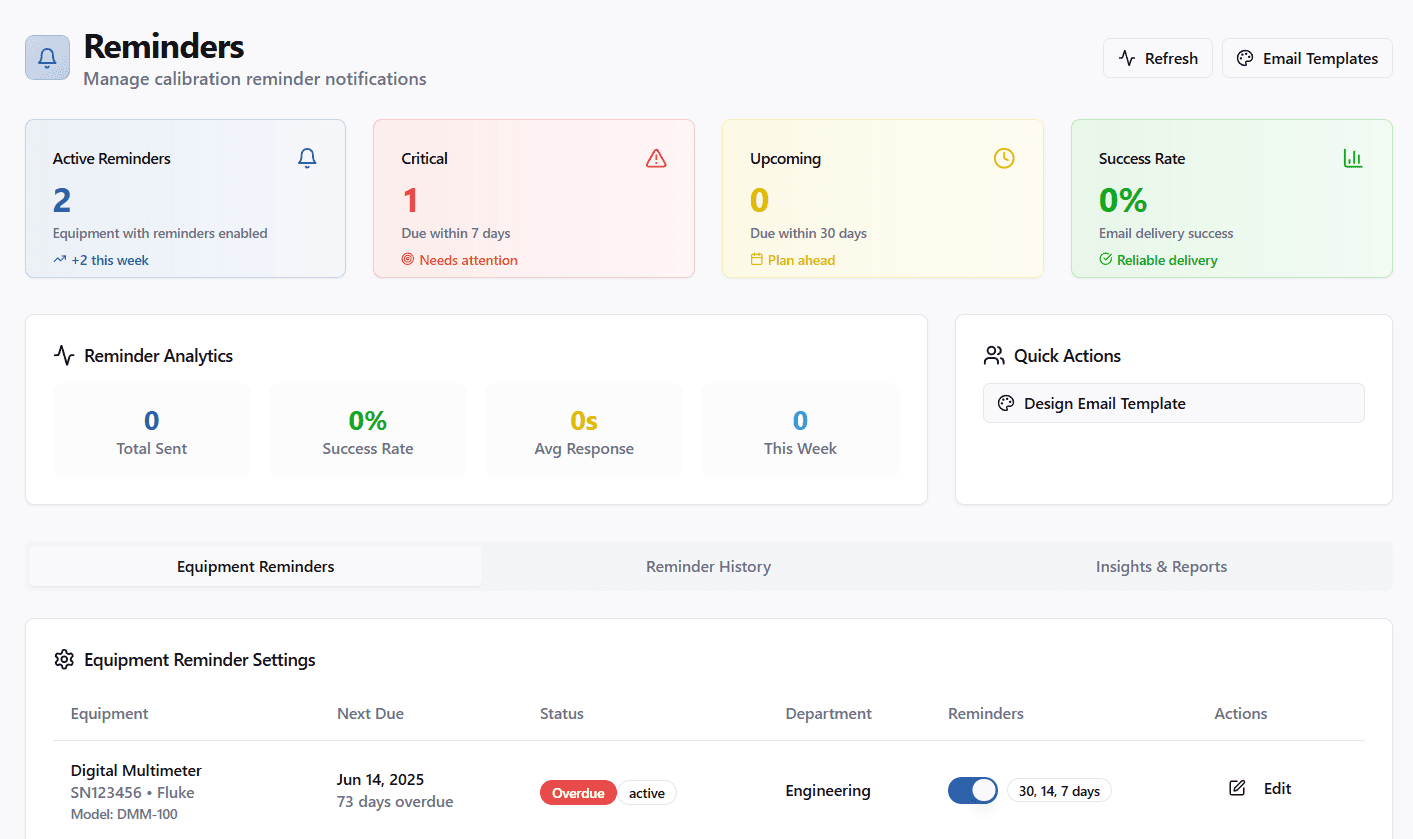
Calibration Management Software for Medical Device Manufacturers
Medical device manufacturers face some of the most stringent calibration requirements in any industry. When your measuring equipment directly impacts patient safety—from blood glucose meters to MRI machines—there's zero tolerance for measurement uncertainty or compliance gaps. Traditional calibration management software medical device companies rely on often falls short of handling the complex regulatory landscape, multi-site operations, and rigorous documentation requirements that define this critical industry.
The consequences of calibration failures in medical device manufacturing extend far beyond failed audits. A single out-of-tolerance micrometer could compromise the seal integrity on implantable devices. An uncalibrated pressure transducer might affect the accuracy of ventilator components. These scenarios underscore why medical device manufacturers need robust, specialized calibration management systems that go beyond basic scheduling and certificate storage.
Critical Equipment Requiring Calibration in Medical Device Manufacturing
Medical device manufacturers maintain extensive inventories of precision measurement equipment, each with unique calibration requirements and criticality levels. Understanding these equipment types helps illustrate why generic calibration software often proves inadequate for this industry.
Dimensional Measurement Equipment
Precision is paramount when manufacturing components like stents, catheters, and surgical instruments. Common dimensional equipment includes:
Digital micrometers (±0.0001" tolerance) for measuring catheter wall thickness
Height gages for surgical instrument dimensions
Pin gages for verifying lumen diameters in cannulas
Surface roughness testers for implant surface specifications
Coordinate measuring machines (CMMs) for complex geometries
These instruments often require calibration every 6-12 months, with some critical applications demanding quarterly verification. The calibration certificates must include detailed uncertainty calculations and traceability to NIST standards.
Force and Pressure Measurement
Medical devices frequently involve force and pressure specifications that directly impact functionality:
Force gages for testing syringe plunger forces (typically 15-35 lbf)
Pressure transducers for blood pressure monitor validation
Torque wrenches for assembly specifications (often 5-50 in-lbs range)
Tensile testing equipment for suture strength verification
Environmental and Electrical Testing Equipment
Medical devices must perform reliably across various environmental conditions:
Temperature chambers for thermal cycling tests
Humidity sensors for storage condition validation
Oscilloscopes for electrical safety testing
Multimeters for leakage current measurements
Biocompatibility testing equipment
Navigating Complex Regulatory Requirements for Calibration Management Software Medical Device Applications
Medical device manufacturers must comply with an intricate web of regulations that directly impact calibration management practices. These requirements go far beyond basic traceability, demanding comprehensive documentation, statistical analysis, and risk-based approaches.
FDA 21 CFR Part 820 Quality System Regulation
The FDA's QSR specifically addresses equipment control in Section 820.72, requiring that inspection, measuring, and test equipment be calibrated to ensure continued accuracy. Key requirements include:
Established procedures for calibration activities
Calibration standards traceable to national standards
Documentation of calibration procedures and results
Investigation and corrective action when equipment is found out-of-tolerance
Product impact assessments when calibration discrepancies are discovered
The QSR doesn't just require calibration—it demands a systematic approach that includes statistical process control and continuous improvement. When a torque wrench used for pacemaker battery compartment assembly is found reading 10% high during calibration, manufacturers must evaluate all products assembled since the last successful calibration and implement corrective actions.
ISO 13485 Medical Device Quality Management
ISO 13485 builds upon the FDA requirements with additional emphasis on:
Risk-based calibration intervals
Competency requirements for calibration personnel
Environmental condition monitoring during calibration
Validation of calibration software and automated systems
For example, a CMM used to verify orthopedic implant dimensions might require daily environmental monitoring, quarterly interim checks, and annual full calibration—all with different documentation requirements.
International Harmonization Requirements
Companies selling globally must navigate additional standards:
EU MDR 2017/745 for European markets
Health Canada MDR for Canadian distribution
PMDA QMS for Japanese market access
NMPA requirements for Chinese medical device sales
Each jurisdiction may have specific calibration documentation formats, uncertainty calculation methods, and audit trail requirements that calibration management software medical device manufacturers must accommodate.
Real-World Audit Scenarios: What Inspectors Examine
Understanding common audit scenarios helps illustrate why robust calibration management software is essential for medical device manufacturers. These real-world examples demonstrate the level of scrutiny and documentation depth required.
FDA Inspection Focus Areas
During a recent FDA inspection at a Class II medical device manufacturer, investigators focused heavily on calibration management practices. Key examination areas included:
Equipment Identification and Status: Inspectors randomly selected a digital caliper (ID: CAL-2847) from the production floor. They immediately verified its calibration status, due date (found to be due in 3 days), and current measurement uncertainty (±0.0002"). The inspector then traced this specific instrument through six months of calibration records, examining interim checks, environmental conditions during calibration, and technician qualifications.
Out-of-Tolerance Investigations: The audit revealed a pressure transducer that had failed calibration three months earlier, reading 15% high on the 50 PSI range. Investigators examined the manufacturer's investigation report, product impact assessment, and corrective actions. They specifically looked for:
Timeline between discovery and investigation initiation
Identification of all products potentially affected
Root cause analysis methodology
Effectiveness checks for implemented corrections
Calibration Certificate Validation: Inspectors selected calibration certificates at random and verified traceability chains back to NIST. They examined uncertainty budgets, environmental conditions, and calibration procedures used by third-party labs.
ISO 13485 Audit Deep Dives
A multinational medical device manufacturer recently underwent ISO 13485 surveillance audits across three facilities. Auditors conducted detailed examinations of calibration management practices:
Risk-Based Calibration Intervals: For a tensile tester used in suture strength validation, auditors reviewed the risk analysis that established the 6-month calibration interval. They examined historical calibration data, drift patterns, and the statistical basis for interval determination. The manufacturer had to demonstrate that their 6-month interval provided adequate confidence that the equipment remained within specification throughout the calibration cycle.
Multi-Site Consistency: Auditors compared calibration practices between facilities in Massachusetts, Ireland, and Singapore. They identified inconsistencies in uncertainty calculations and required the implementation of standardized procedures across all locations.
How Advanced Calibration Management Software Medical Device Manufacturers Trust
Modern medical device manufacturers require calibration management solutions that address industry-specific challenges while streamlining compliance activities. Gaugify's calibration management platform provides the specialized capabilities medical device companies need to maintain regulatory compliance while optimizing operational efficiency.
Automated Scheduling with Risk-Based Intervals
Traditional calibration software uses fixed scheduling intervals that don't account for actual equipment performance or criticality. Gaugify enables medical device manufacturers to implement sophisticated scheduling strategies:
Statistical Interval Analysis: For a CMM measuring orthopedic implant dimensions, Gaugify analyzes historical calibration data to identify drift patterns. If the equipment consistently passes calibration with minimal drift over 18 months, the system can recommend interval extension while maintaining required confidence levels.
Risk-Based Prioritization: Equipment used for critical safety measurements receives priority scheduling and automatic escalation. A durometer used for catheter hardness testing (critical for patient safety) gets different treatment than a scale used for shipping verification.
Multi-Site Coordination: For manufacturers with multiple facilities, Gaugify coordinates calibration schedules to optimize resource utilization. If similar equipment exists at Boston and Dublin facilities, the system can stagger calibrations to share learnings and reduce overall program costs.
Comprehensive Certificate Management
Medical device manufacturers often maintain thousands of calibration certificates with complex traceability requirements. Gaugify's certificate management capabilities address these needs:
Automated certificate validation against predefined acceptance criteria
Traceability verification to NIST/international standards
Uncertainty budget analysis for measurement systems
Multi-language certificate support for global operations
Advanced Uncertainty Calculations
Medical device applications often require sophisticated measurement uncertainty analysis. Gaugify's advanced features include:
Automated Uncertainty Propagation: When calibrating a pressure measurement system used for blood pressure monitor testing, Gaugify automatically calculates combined uncertainty from multiple sources: calibration standard uncertainty, environmental effects, resolution limitations, and repeatability studies.
Guard Band Implementation: For critical measurements, Gaugify helps implement appropriate guard bands. A micrometer used for catheter wall thickness (specification: 0.025" ±0.002") might use a 2:1 guard band, requiring calibration uncertainty ≤0.001" to ensure adequate discrimination.
Ready to see how Gaugify can streamline your medical device calibration management? Start your free trial today and experience the difference specialized calibration software makes for regulatory compliance and operational efficiency.
Audit Trail and Documentation Excellence
Medical device manufacturers face intense scrutiny during regulatory inspections, making comprehensive audit trails essential. Gaugify provides the documentation depth and accessibility that satisfies the most demanding auditors.
Complete Activity Logging
Every action within Gaugify creates timestamped, user-attributed log entries that cannot be altered or deleted. This includes:
Calibration scheduling modifications with justification codes
Certificate uploads with digital signatures and checksums
Out-of-tolerance investigations with complete workflows
Equipment status changes with approval hierarchies
Report generation with parameter tracking
When an FDA inspector asks about a specific piece of equipment, quality managers can instantly produce complete history reports showing every interaction, modification, and decision point over multiple years.
Regulatory Report Generation
Gaugify's compliance features generate audit-ready reports that align with regulatory expectations:
Equipment Master Lists: Comprehensive inventories with criticality classifications, calibration intervals, and current status. These reports can be filtered by location, equipment type, or compliance status for targeted audit responses.
Calibration Status Reports: Real-time status across entire equipment populations with aging analysis and trend identification. Auditors can quickly verify that no equipment is operating beyond calibration due dates.
Out-of-Tolerance Analysis: Statistical summaries of calibration failures with trend analysis and effectiveness tracking of corrective actions.
Integration with Quality Management Systems
Medical device manufacturers typically operate integrated quality management systems where calibration data feeds multiple processes. Gaugify provides robust integration capabilities:
CAPA System Integration: Automatic CAPA initiation for out-of-tolerance conditions
Non-Conformance Linking: Direct connections between calibration issues and product non-conformances
Document Control Interface: Automatic procedure updates when calibration requirements change
Training System Connectivity: Triggering retraining requirements when calibration procedures are modified
Cost Optimization Without Compromising Compliance
Medical device manufacturers constantly balance regulatory compliance requirements with operational efficiency. Gaugify helps optimize calibration costs while maintaining or improving compliance posture.
Vendor Management and Cost Control
Many medical device companies use multiple calibration service providers, making cost comparison and quality assessment challenging. Gaugify provides comprehensive vendor management tools:
Performance Scorecarding: Track key metrics across calibration vendors including on-time delivery, first-pass rates, turnaround times, and cost per calibration. A recent analysis helped one manufacturer identify that Vendor A had 95% on-time delivery versus Vendor B's 78%, justifying consolidated purchasing despite slightly higher per-unit costs.
Automated Quote Comparison: For high-value calibrations like CMM certifications, Gaugify can manage quote requests across multiple vendors and facilitate direct comparison of capabilities, timing, and pricing.
Internal Capability Development
Strategic medical device manufacturers increasingly develop internal calibration capabilities for common equipment types. Gaugify supports this transition:
Procedure Development Tools: Templates and workflows for creating ISO 17025-compliant calibration procedures
Technician Competency Tracking: Management of training records, certifications, and performance metrics for internal calibration staff
Reference Standard Management: Comprehensive tracking of calibration standards including their own calibration requirements and uncertainty contributions
Predictive Maintenance Integration
Forward-thinking manufacturers integrate calibration management with predictive maintenance programs. Gaugify's analytics identify patterns that optimize both calibration intervals and maintenance schedules:
A precision scale used for API weighing showed increasing calibration drift correlated with bearing wear. By coordinating calibration schedules with bearing replacement, the manufacturer reduced both calibration failures and unplanned downtime.
Global Operations and Multi-Site Management
Medical device manufacturers increasingly operate global supply chains with manufacturing, testing, and distribution facilities worldwide. Managing calibration programs across multiple jurisdictions requires sophisticated software capabilities.
Regulatory Jurisdiction Management
Different markets impose varying calibration requirements that must be tracked and managed systematically:
Certificate Format Compliance: EU facilities might require DKD-accredited certificates while US operations accept A2LA accreditation. Gaugify manages these requirements automatically, ensuring appropriate certificates are obtained for each location's regulatory needs.
Language and Units Support: Multi-national operations require calibration documentation in local languages with appropriate measurement units. Gaugify automatically converts between measurement systems and maintains compliance documentation in required languages.
Centralized Oversight with Local Autonomy
Global medical device manufacturers need visibility across all locations while allowing local teams operational flexibility. Gaugify provides:
Corporate dashboards with real-time status across all facilities
Standardized procedures with local customization capabilities
Global vendor management with regional service provider options
Best practice sharing between facilities with similar equipment
Future-Proofing Medical Device Calibration Management
The medical device industry continues evolving with new technologies, changing regulations, and increased digitization. Gaugify's platform architecture anticipates these trends and provides capabilities that grow with manufacturer needs.
Industry 4.0 Integration
Smart manufacturing initiatives increasingly connect measurement equipment directly to calibration management systems:
IoT Sensor Integration: Modern precision equipment can report real-time performance data that informs calibration scheduling. A CMM with integrated environmental sensors might automatically adjust calibration intervals based on operating conditions and usage patterns.
Automated Data Collection: Gaugify can receive calibration data directly from modern calibration equipment, reducing transcription errors and improving data integrity. Digital certificates with embedded metadata streamline certificate processing and validation.
Artificial Intelligence and Machine Learning
Gaugify incorporates AI capabilities that learn from historical data to optimize calibration programs:
Predictive Analytics: Identifying equipment likely to fail calibration based on historical patterns and usage data
Optimal Interval Calculation: Machine learning algorithms that analyze equipment stability to recommend optimal calibration intervals
Anomaly Detection: Automatic identification of unusual calibration results that might indicate equipment problems or measurement errors
Regulatory Technology Adoption
Regulatory agencies increasingly embrace digital technologies that streamline compliance verification:
Blockchain Verification: Some manufacturers are exploring blockchain technology for calibration certificate authenticity verification. Gaugify's architecture supports integration with emerging technologies while maintaining backward compatibility.
Electronic Submissions: FDA and other agencies increasingly accept electronic calibration documentation for regulatory submissions. Gaugify generates appropriately formatted electronic packages that meet submission requirements.
Implementation Success Strategies
Successful calibration management software implementation in medical device manufacturing requires careful planning and stakeholder engagement. Organizations that achieve the best results follow proven implementation strategies.
Stakeholder Alignment and Change Management
Medical device calibration management involves multiple departments with different priorities and requirements:
Quality Assurance Teams focus on regulatory compliance and audit readiness. They need comprehensive documentation, traceability, and reporting capabilities that satisfy inspector requirements.
Production Managers prioritize equipment availability and minimal disruption to manufacturing schedules. They need predictable calibration schedules and rapid turnaround times for critical equipment.
Maintenance Departments require integration with existing maintenance management systems and coordination of calibration with preventive maintenance activities.
Successful implementations begin with cross-functional workshops that identify each group's requirements and establish success metrics that align with overall organizational objectives.
Data Migration and System Integration
Medical device manufacturers typically have years or decades of historical calibration data stored in various systems. Gaugify provides comprehensive data migration services that preserve historical records while establishing clean data structures for ongoing operations.
Legacy System Analysis: Gaugify's implementation team analyzes existing calibration data to identify improvement opportunities and ensure regulatory continuity. This includes mapping equipment identification schemes, standardizing calibration procedures, and establishing consistent uncertainty calculations.
Gradual Transition Strategies: Rather than attempting complete system replacement overnight, successful implementations often use phased approaches. Critical equipment might be migrated first, followed by less critical items as users become comfortable with the new system.
Measuring Return on Investment
Medical device manufacturers implementing advanced calibration management software typically see returns through multiple channels. Understanding these benefits helps justify investment and measure success.
Direct Cost Reductions
Quantifiable savings often include:
Administrative Time Reduction: Automated scheduling, certificate processing, and report generation typically reduce calibration program administration time by 40-60%. For a facility managing 1,000 pieces of equipment, this often translates to 0.5-1.0 FTE reduction in administrative overhead.
Vendor Management Optimization: Consolidated purchasing and performance-based vendor selection typically reduce calibration costs by 10-15% while improving service quality.
Interval Optimization: Data-driven calibration interval adjustments can reduce unnecessary calibrations while maintaining required confidence levels. A 10% reduction in calibration frequency across a large equipment population generates substantial savings.
Risk Mitigation Benefits
Less quantifiable but equally important benefits include:
Regulatory Compliance Assurance: Reduced risk of FDA warning letters or inspection findings
Product Recall Prevention: Better measurement system control reduces risk of measurement-related product issues
Audit Efficiency: Faster, more confident audit responses with comprehensive documentation
One Class III medical device manufacturer estimated that avoiding a single FDA warning letter justified their entire calibration management software investment through reduced regulatory remediation costs and faster product approvals.
Getting Started with Professional Calibration Management
Medical device manufacturers ready to modernize their calibration management practices should begin with a comprehensive assessment of current capabilities and future requirements. Schedule a demo with Gaugify to see how specialized calibration management software addresses the unique challenges facing medical device manufacturers.
Our implementation team understands the regulatory complexities, multi-site challenges, and operational requirements that define medical device calibration management. We provide not just software, but industry expertise that ensures successful long-term outcomes.
The medical device industry demands excellence in every aspect of quality management. Your calibration program should be no exception. With flexible pricing options and proven implementation methodologies, Gaugify provides the foundation for regulatory compliance, operational efficiency, and continuous improvement.
Don't let outdated calibration management practices jeopardize your regulatory compliance or operational efficiency. Start your free trial of Gaugify today and discover why medical device manufacturers worldwide trust our platform for their most critical calibration management requirements.
Calibration Management Software for Medical Device Manufacturers
Medical device manufacturers face some of the most stringent calibration requirements in any industry. When your measuring equipment directly impacts patient safety—from blood glucose meters to MRI machines—there's zero tolerance for measurement uncertainty or compliance gaps. Traditional calibration management software medical device companies rely on often falls short of handling the complex regulatory landscape, multi-site operations, and rigorous documentation requirements that define this critical industry.
The consequences of calibration failures in medical device manufacturing extend far beyond failed audits. A single out-of-tolerance micrometer could compromise the seal integrity on implantable devices. An uncalibrated pressure transducer might affect the accuracy of ventilator components. These scenarios underscore why medical device manufacturers need robust, specialized calibration management systems that go beyond basic scheduling and certificate storage.
Critical Equipment Requiring Calibration in Medical Device Manufacturing
Medical device manufacturers maintain extensive inventories of precision measurement equipment, each with unique calibration requirements and criticality levels. Understanding these equipment types helps illustrate why generic calibration software often proves inadequate for this industry.
Dimensional Measurement Equipment
Precision is paramount when manufacturing components like stents, catheters, and surgical instruments. Common dimensional equipment includes:
Digital micrometers (±0.0001" tolerance) for measuring catheter wall thickness
Height gages for surgical instrument dimensions
Pin gages for verifying lumen diameters in cannulas
Surface roughness testers for implant surface specifications
Coordinate measuring machines (CMMs) for complex geometries
These instruments often require calibration every 6-12 months, with some critical applications demanding quarterly verification. The calibration certificates must include detailed uncertainty calculations and traceability to NIST standards.
Force and Pressure Measurement
Medical devices frequently involve force and pressure specifications that directly impact functionality:
Force gages for testing syringe plunger forces (typically 15-35 lbf)
Pressure transducers for blood pressure monitor validation
Torque wrenches for assembly specifications (often 5-50 in-lbs range)
Tensile testing equipment for suture strength verification
Environmental and Electrical Testing Equipment
Medical devices must perform reliably across various environmental conditions:
Temperature chambers for thermal cycling tests
Humidity sensors for storage condition validation
Oscilloscopes for electrical safety testing
Multimeters for leakage current measurements
Biocompatibility testing equipment
Navigating Complex Regulatory Requirements for Calibration Management Software Medical Device Applications
Medical device manufacturers must comply with an intricate web of regulations that directly impact calibration management practices. These requirements go far beyond basic traceability, demanding comprehensive documentation, statistical analysis, and risk-based approaches.
FDA 21 CFR Part 820 Quality System Regulation
The FDA's QSR specifically addresses equipment control in Section 820.72, requiring that inspection, measuring, and test equipment be calibrated to ensure continued accuracy. Key requirements include:
Established procedures for calibration activities
Calibration standards traceable to national standards
Documentation of calibration procedures and results
Investigation and corrective action when equipment is found out-of-tolerance
Product impact assessments when calibration discrepancies are discovered
The QSR doesn't just require calibration—it demands a systematic approach that includes statistical process control and continuous improvement. When a torque wrench used for pacemaker battery compartment assembly is found reading 10% high during calibration, manufacturers must evaluate all products assembled since the last successful calibration and implement corrective actions.
ISO 13485 Medical Device Quality Management
ISO 13485 builds upon the FDA requirements with additional emphasis on:
Risk-based calibration intervals
Competency requirements for calibration personnel
Environmental condition monitoring during calibration
Validation of calibration software and automated systems
For example, a CMM used to verify orthopedic implant dimensions might require daily environmental monitoring, quarterly interim checks, and annual full calibration—all with different documentation requirements.
International Harmonization Requirements
Companies selling globally must navigate additional standards:
EU MDR 2017/745 for European markets
Health Canada MDR for Canadian distribution
PMDA QMS for Japanese market access
NMPA requirements for Chinese medical device sales
Each jurisdiction may have specific calibration documentation formats, uncertainty calculation methods, and audit trail requirements that calibration management software medical device manufacturers must accommodate.
Real-World Audit Scenarios: What Inspectors Examine
Understanding common audit scenarios helps illustrate why robust calibration management software is essential for medical device manufacturers. These real-world examples demonstrate the level of scrutiny and documentation depth required.
FDA Inspection Focus Areas
During a recent FDA inspection at a Class II medical device manufacturer, investigators focused heavily on calibration management practices. Key examination areas included:
Equipment Identification and Status: Inspectors randomly selected a digital caliper (ID: CAL-2847) from the production floor. They immediately verified its calibration status, due date (found to be due in 3 days), and current measurement uncertainty (±0.0002"). The inspector then traced this specific instrument through six months of calibration records, examining interim checks, environmental conditions during calibration, and technician qualifications.
Out-of-Tolerance Investigations: The audit revealed a pressure transducer that had failed calibration three months earlier, reading 15% high on the 50 PSI range. Investigators examined the manufacturer's investigation report, product impact assessment, and corrective actions. They specifically looked for:
Timeline between discovery and investigation initiation
Identification of all products potentially affected
Root cause analysis methodology
Effectiveness checks for implemented corrections
Calibration Certificate Validation: Inspectors selected calibration certificates at random and verified traceability chains back to NIST. They examined uncertainty budgets, environmental conditions, and calibration procedures used by third-party labs.
ISO 13485 Audit Deep Dives
A multinational medical device manufacturer recently underwent ISO 13485 surveillance audits across three facilities. Auditors conducted detailed examinations of calibration management practices:
Risk-Based Calibration Intervals: For a tensile tester used in suture strength validation, auditors reviewed the risk analysis that established the 6-month calibration interval. They examined historical calibration data, drift patterns, and the statistical basis for interval determination. The manufacturer had to demonstrate that their 6-month interval provided adequate confidence that the equipment remained within specification throughout the calibration cycle.
Multi-Site Consistency: Auditors compared calibration practices between facilities in Massachusetts, Ireland, and Singapore. They identified inconsistencies in uncertainty calculations and required the implementation of standardized procedures across all locations.
How Advanced Calibration Management Software Medical Device Manufacturers Trust
Modern medical device manufacturers require calibration management solutions that address industry-specific challenges while streamlining compliance activities. Gaugify's calibration management platform provides the specialized capabilities medical device companies need to maintain regulatory compliance while optimizing operational efficiency.
Automated Scheduling with Risk-Based Intervals
Traditional calibration software uses fixed scheduling intervals that don't account for actual equipment performance or criticality. Gaugify enables medical device manufacturers to implement sophisticated scheduling strategies:
Statistical Interval Analysis: For a CMM measuring orthopedic implant dimensions, Gaugify analyzes historical calibration data to identify drift patterns. If the equipment consistently passes calibration with minimal drift over 18 months, the system can recommend interval extension while maintaining required confidence levels.
Risk-Based Prioritization: Equipment used for critical safety measurements receives priority scheduling and automatic escalation. A durometer used for catheter hardness testing (critical for patient safety) gets different treatment than a scale used for shipping verification.
Multi-Site Coordination: For manufacturers with multiple facilities, Gaugify coordinates calibration schedules to optimize resource utilization. If similar equipment exists at Boston and Dublin facilities, the system can stagger calibrations to share learnings and reduce overall program costs.
Comprehensive Certificate Management
Medical device manufacturers often maintain thousands of calibration certificates with complex traceability requirements. Gaugify's certificate management capabilities address these needs:
Automated certificate validation against predefined acceptance criteria
Traceability verification to NIST/international standards
Uncertainty budget analysis for measurement systems
Multi-language certificate support for global operations
Advanced Uncertainty Calculations
Medical device applications often require sophisticated measurement uncertainty analysis. Gaugify's advanced features include:
Automated Uncertainty Propagation: When calibrating a pressure measurement system used for blood pressure monitor testing, Gaugify automatically calculates combined uncertainty from multiple sources: calibration standard uncertainty, environmental effects, resolution limitations, and repeatability studies.
Guard Band Implementation: For critical measurements, Gaugify helps implement appropriate guard bands. A micrometer used for catheter wall thickness (specification: 0.025" ±0.002") might use a 2:1 guard band, requiring calibration uncertainty ≤0.001" to ensure adequate discrimination.
Ready to see how Gaugify can streamline your medical device calibration management? Start your free trial today and experience the difference specialized calibration software makes for regulatory compliance and operational efficiency.
Audit Trail and Documentation Excellence
Medical device manufacturers face intense scrutiny during regulatory inspections, making comprehensive audit trails essential. Gaugify provides the documentation depth and accessibility that satisfies the most demanding auditors.
Complete Activity Logging
Every action within Gaugify creates timestamped, user-attributed log entries that cannot be altered or deleted. This includes:
Calibration scheduling modifications with justification codes
Certificate uploads with digital signatures and checksums
Out-of-tolerance investigations with complete workflows
Equipment status changes with approval hierarchies
Report generation with parameter tracking
When an FDA inspector asks about a specific piece of equipment, quality managers can instantly produce complete history reports showing every interaction, modification, and decision point over multiple years.
Regulatory Report Generation
Gaugify's compliance features generate audit-ready reports that align with regulatory expectations:
Equipment Master Lists: Comprehensive inventories with criticality classifications, calibration intervals, and current status. These reports can be filtered by location, equipment type, or compliance status for targeted audit responses.
Calibration Status Reports: Real-time status across entire equipment populations with aging analysis and trend identification. Auditors can quickly verify that no equipment is operating beyond calibration due dates.
Out-of-Tolerance Analysis: Statistical summaries of calibration failures with trend analysis and effectiveness tracking of corrective actions.
Integration with Quality Management Systems
Medical device manufacturers typically operate integrated quality management systems where calibration data feeds multiple processes. Gaugify provides robust integration capabilities:
CAPA System Integration: Automatic CAPA initiation for out-of-tolerance conditions
Non-Conformance Linking: Direct connections between calibration issues and product non-conformances
Document Control Interface: Automatic procedure updates when calibration requirements change
Training System Connectivity: Triggering retraining requirements when calibration procedures are modified
Cost Optimization Without Compromising Compliance
Medical device manufacturers constantly balance regulatory compliance requirements with operational efficiency. Gaugify helps optimize calibration costs while maintaining or improving compliance posture.
Vendor Management and Cost Control
Many medical device companies use multiple calibration service providers, making cost comparison and quality assessment challenging. Gaugify provides comprehensive vendor management tools:
Performance Scorecarding: Track key metrics across calibration vendors including on-time delivery, first-pass rates, turnaround times, and cost per calibration. A recent analysis helped one manufacturer identify that Vendor A had 95% on-time delivery versus Vendor B's 78%, justifying consolidated purchasing despite slightly higher per-unit costs.
Automated Quote Comparison: For high-value calibrations like CMM certifications, Gaugify can manage quote requests across multiple vendors and facilitate direct comparison of capabilities, timing, and pricing.
Internal Capability Development
Strategic medical device manufacturers increasingly develop internal calibration capabilities for common equipment types. Gaugify supports this transition:
Procedure Development Tools: Templates and workflows for creating ISO 17025-compliant calibration procedures
Technician Competency Tracking: Management of training records, certifications, and performance metrics for internal calibration staff
Reference Standard Management: Comprehensive tracking of calibration standards including their own calibration requirements and uncertainty contributions
Predictive Maintenance Integration
Forward-thinking manufacturers integrate calibration management with predictive maintenance programs. Gaugify's analytics identify patterns that optimize both calibration intervals and maintenance schedules:
A precision scale used for API weighing showed increasing calibration drift correlated with bearing wear. By coordinating calibration schedules with bearing replacement, the manufacturer reduced both calibration failures and unplanned downtime.
Global Operations and Multi-Site Management
Medical device manufacturers increasingly operate global supply chains with manufacturing, testing, and distribution facilities worldwide. Managing calibration programs across multiple jurisdictions requires sophisticated software capabilities.
Regulatory Jurisdiction Management
Different markets impose varying calibration requirements that must be tracked and managed systematically:
Certificate Format Compliance: EU facilities might require DKD-accredited certificates while US operations accept A2LA accreditation. Gaugify manages these requirements automatically, ensuring appropriate certificates are obtained for each location's regulatory needs.
Language and Units Support: Multi-national operations require calibration documentation in local languages with appropriate measurement units. Gaugify automatically converts between measurement systems and maintains compliance documentation in required languages.
Centralized Oversight with Local Autonomy
Global medical device manufacturers need visibility across all locations while allowing local teams operational flexibility. Gaugify provides:
Corporate dashboards with real-time status across all facilities
Standardized procedures with local customization capabilities
Global vendor management with regional service provider options
Best practice sharing between facilities with similar equipment
Future-Proofing Medical Device Calibration Management
The medical device industry continues evolving with new technologies, changing regulations, and increased digitization. Gaugify's platform architecture anticipates these trends and provides capabilities that grow with manufacturer needs.
Industry 4.0 Integration
Smart manufacturing initiatives increasingly connect measurement equipment directly to calibration management systems:
IoT Sensor Integration: Modern precision equipment can report real-time performance data that informs calibration scheduling. A CMM with integrated environmental sensors might automatically adjust calibration intervals based on operating conditions and usage patterns.
Automated Data Collection: Gaugify can receive calibration data directly from modern calibration equipment, reducing transcription errors and improving data integrity. Digital certificates with embedded metadata streamline certificate processing and validation.
Artificial Intelligence and Machine Learning
Gaugify incorporates AI capabilities that learn from historical data to optimize calibration programs:
Predictive Analytics: Identifying equipment likely to fail calibration based on historical patterns and usage data
Optimal Interval Calculation: Machine learning algorithms that analyze equipment stability to recommend optimal calibration intervals
Anomaly Detection: Automatic identification of unusual calibration results that might indicate equipment problems or measurement errors
Regulatory Technology Adoption
Regulatory agencies increasingly embrace digital technologies that streamline compliance verification:
Blockchain Verification: Some manufacturers are exploring blockchain technology for calibration certificate authenticity verification. Gaugify's architecture supports integration with emerging technologies while maintaining backward compatibility.
Electronic Submissions: FDA and other agencies increasingly accept electronic calibration documentation for regulatory submissions. Gaugify generates appropriately formatted electronic packages that meet submission requirements.
Implementation Success Strategies
Successful calibration management software implementation in medical device manufacturing requires careful planning and stakeholder engagement. Organizations that achieve the best results follow proven implementation strategies.
Stakeholder Alignment and Change Management
Medical device calibration management involves multiple departments with different priorities and requirements:
Quality Assurance Teams focus on regulatory compliance and audit readiness. They need comprehensive documentation, traceability, and reporting capabilities that satisfy inspector requirements.
Production Managers prioritize equipment availability and minimal disruption to manufacturing schedules. They need predictable calibration schedules and rapid turnaround times for critical equipment.
Maintenance Departments require integration with existing maintenance management systems and coordination of calibration with preventive maintenance activities.
Successful implementations begin with cross-functional workshops that identify each group's requirements and establish success metrics that align with overall organizational objectives.
Data Migration and System Integration
Medical device manufacturers typically have years or decades of historical calibration data stored in various systems. Gaugify provides comprehensive data migration services that preserve historical records while establishing clean data structures for ongoing operations.
Legacy System Analysis: Gaugify's implementation team analyzes existing calibration data to identify improvement opportunities and ensure regulatory continuity. This includes mapping equipment identification schemes, standardizing calibration procedures, and establishing consistent uncertainty calculations.
Gradual Transition Strategies: Rather than attempting complete system replacement overnight, successful implementations often use phased approaches. Critical equipment might be migrated first, followed by less critical items as users become comfortable with the new system.
Measuring Return on Investment
Medical device manufacturers implementing advanced calibration management software typically see returns through multiple channels. Understanding these benefits helps justify investment and measure success.
Direct Cost Reductions
Quantifiable savings often include:
Administrative Time Reduction: Automated scheduling, certificate processing, and report generation typically reduce calibration program administration time by 40-60%. For a facility managing 1,000 pieces of equipment, this often translates to 0.5-1.0 FTE reduction in administrative overhead.
Vendor Management Optimization: Consolidated purchasing and performance-based vendor selection typically reduce calibration costs by 10-15% while improving service quality.
Interval Optimization: Data-driven calibration interval adjustments can reduce unnecessary calibrations while maintaining required confidence levels. A 10% reduction in calibration frequency across a large equipment population generates substantial savings.
Risk Mitigation Benefits
Less quantifiable but equally important benefits include:
Regulatory Compliance Assurance: Reduced risk of FDA warning letters or inspection findings
Product Recall Prevention: Better measurement system control reduces risk of measurement-related product issues
Audit Efficiency: Faster, more confident audit responses with comprehensive documentation
One Class III medical device manufacturer estimated that avoiding a single FDA warning letter justified their entire calibration management software investment through reduced regulatory remediation costs and faster product approvals.
Getting Started with Professional Calibration Management
Medical device manufacturers ready to modernize their calibration management practices should begin with a comprehensive assessment of current capabilities and future requirements. Schedule a demo with Gaugify to see how specialized calibration management software addresses the unique challenges facing medical device manufacturers.
Our implementation team understands the regulatory complexities, multi-site challenges, and operational requirements that define medical device calibration management. We provide not just software, but industry expertise that ensures successful long-term outcomes.
The medical device industry demands excellence in every aspect of quality management. Your calibration program should be no exception. With flexible pricing options and proven implementation methodologies, Gaugify provides the foundation for regulatory compliance, operational efficiency, and continuous improvement.
Don't let outdated calibration management practices jeopardize your regulatory compliance or operational efficiency. Start your free trial of Gaugify today and discover why medical device manufacturers worldwide trust our platform for their most critical calibration management requirements.