
Calibration Management Software for Semiconductor Manufacturing
Calibration Management Software for Semiconductor Manufacturing
David Bentley
Quality Assurance Engineer
12 min read
Calibration Management Software for Semiconductor Manufacturing
Semiconductor manufacturing demands precision that goes beyond what most industries require. When your production tolerances are measured in nanometers and a single out-of-spec measurement tool can scrap millions of dollars worth of wafers, robust calibration management software semiconductor facilities rely on becomes absolutely critical. Traditional paper-based calibration systems or basic spreadsheet tracking simply cannot handle the complexity, traceability requirements, and audit intensity that characterize modern semiconductor fabs.
The semiconductor industry faces unique calibration challenges that set it apart from other manufacturing sectors. Clean room environments, 24/7 production schedules, stringent regulatory requirements from multiple standards bodies, and the sheer volume of precision measurement equipment create a perfect storm of calibration management complexity. A typical 300mm fab might have over 10,000 individual measurement points across thousands of instruments, each requiring different calibration frequencies, uncertainty budgets, and documentation standards.
Critical Equipment Requiring Calibration Management Software in Semiconductor Facilities
Semiconductor manufacturing relies on an extensive array of precision measurement and process control equipment, each with specific calibration requirements and tolerance specifications. Understanding these equipment types and their calibration needs is essential for implementing effective calibration management software semiconductor operations depend on.
Dimensional Measurement Equipment
Critical dimension scanning electron microscopes (CD-SEMs) represent some of the most precise measurement tools in the fab, typically requiring calibration to within ±0.5nm uncertainty. These instruments measure feature widths, line edge roughness, and sidewall angles on wafers, directly impacting yield calculations. Atomic force microscopes (AFMs) used for surface roughness measurements need calibration standards traceable to NIST, with typical uncertainty requirements of ±0.1nm for Z-axis measurements.
Optical measurement systems, including ellipsometers and reflectometers used for thin film thickness measurements, require regular calibration with certified reference standards. A typical ellipsometer might need calibration verification every 30 days with thickness standards ranging from 10Å to 10,000Å, each with specific uncertainty budgets that must be maintained and documented.
Process Control Instrumentation
Temperature measurement and control systems throughout the fab require calibration to extremely tight tolerances. Rapid thermal processing (RTP) systems typically need temperature uniformity within ±2°C across the wafer, requiring thermocouple calibrations traceable to ITS-90 temperature scale. Furnace temperature controllers for diffusion and oxidation processes often require calibration uncertainties better than ±0.5°C to maintain process control.
Mass flow controllers (MFCs) used in chemical vapor deposition and etching processes require calibration for each gas type, with typical accuracy requirements of ±1% of full scale. A single etch tool might have 20+ MFCs, each requiring individual calibration certificates and uncertainty calculations.
Chemical Analysis Equipment
Inductively coupled plasma mass spectrometry (ICP-MS) systems used for trace metal analysis require multi-point calibrations with certified reference materials. Typical detection limits for metallic contaminants in semiconductor applications require calibration standards with uncertainties at the parts-per-trillion level.
Ion chromatography systems for anion analysis in ultrapure water and chemical solutions need regular calibration with NIST-traceable standards. A typical calibration might include fluoride, chloride, and sulfate standards ranging from 1 ppb to 100 ppm, each requiring individual uncertainty calculations and traceability documentation.
Quality Standards and Compliance Requirements for Calibration Management Software Semiconductor Applications
Semiconductor manufacturing operates under a complex web of quality standards and regulatory requirements that directly impact calibration management practices. These standards define not just what must be calibrated, but how calibration data must be collected, analyzed, and maintained for compliance purposes.
ISO Standards and Implementation
ISO 9001 quality management system requirements form the foundation for calibration management in semiconductor facilities, but the industry typically goes far beyond basic ISO 9001 compliance. Most semiconductor manufacturers implement ISO 17025 calibration software systems to ensure their internal calibration capabilities meet international standards for testing and calibration laboratories.
ISO 17025 requirements include measurement uncertainty calculations for every calibration, traceability to national standards, proper environmental controls during calibration, and comprehensive documentation of calibration procedures and results. For a semiconductor fab, this might mean maintaining uncertainty budgets for thousands of measurement points while ensuring calibration intervals are optimized based on historical stability data.
SEMI standards, developed specifically for the semiconductor industry, provide additional requirements. SEMI F47 (Specification for Contamination-Free Manufacturing) includes specific requirements for calibration of contamination monitoring equipment. SEMI E10 (Specification for Definition and Measurement of Equipment Reliability, Availability, and Maintainability) includes requirements for measurement system reliability that directly impact calibration scheduling and management.
Customer and Regulatory Requirements
Major semiconductor customers often impose additional calibration requirements beyond standard industry practices. Automotive semiconductor suppliers must comply with IATF 16949 requirements, which include specific measurement system analysis (MSA) requirements and calibration documentation standards. Aerospace and defense semiconductor suppliers face additional requirements under AS9100 and various military specifications.
FDA-regulated semiconductor devices used in medical applications require compliance with 21 CFR Part 820 quality system regulations, including specific requirements for calibration of measurement equipment used in design controls and production. These requirements often mandate shorter calibration intervals and more extensive documentation than typical commercial semiconductor applications.
Common Audit Scenarios and Calibration Management Software Requirements
Semiconductor facilities face frequent and intensive audits from customers, certification bodies, and regulatory agencies. These audits typically focus heavily on measurement system integrity and calibration management practices, making robust calibration management software semiconductor operations essential for audit success.
Customer Qualification Audits
During a typical customer qualification audit, auditors will select a random sample of measurement equipment and trace the calibration history back through multiple calibration cycles. They're looking for evidence of proper calibration intervals, appropriate measurement uncertainty calculations, and corrective actions taken when equipment is found out of tolerance.
A common audit scenario involves an auditor selecting a CD-SEM used for critical dimension measurements on a key customer product. The auditor will want to see the current calibration certificate, evidence that the calibration was performed by qualified personnel using appropriate standards, calculation of measurement uncertainty including all contributing factors, and documentation of any corrective actions taken when the instrument was last found outside tolerance limits.
Auditors frequently ask for trend analysis of calibration results over time, looking for evidence of drift patterns or systematic errors that might impact product quality. They want to see that calibration intervals are optimized based on actual stability data rather than arbitrary time periods, and that measurement uncertainty is properly incorporated into product specifications and control limits.
Certification Body Audits
ISO 9001 and AS9100 certification audits include detailed examination of calibration management practices. Auditors typically review the calibration system for completeness, checking that all measurement equipment affecting product quality is properly identified, calibrated, and controlled. They look for evidence that calibration requirements are clearly defined, calibration procedures are followed consistently, and calibration records are complete and accurate.
A certification auditor might select a sample of temperature controllers used in diffusion furnaces and trace the calibration chain back to national standards. They want to see evidence of proper traceability, appropriate calibration intervals based on equipment stability and criticality, and proper handling of equipment found out of tolerance during calibration.
How Gaugify Solves Semiconductor Calibration Management Challenges
Modern calibration management software semiconductor facilities require must address the unique challenges of high-volume, high-precision manufacturing environments. Gaugify's cloud-based calibration management platform was designed specifically to handle the complexity and scale requirements of semiconductor manufacturing operations.
Automated Scheduling and Workflow Management
Gaugify's intelligent scheduling system automatically manages calibration due dates for thousands of instruments while optimizing technician workloads and minimizing production disruption. The system considers equipment criticality, historical stability data, and production schedules to optimize calibration timing. For example, critical CD-SEMs can be automatically flagged for priority scheduling, while less critical equipment can be grouped for efficient batch calibration.
The platform's workflow management capabilities ensure that calibration procedures are followed consistently across all shifts and technicians. Digital work instructions guide technicians through complex multi-point calibrations, while automated data validation prevents transcription errors and ensures measurement uncertainty calculations are performed correctly.
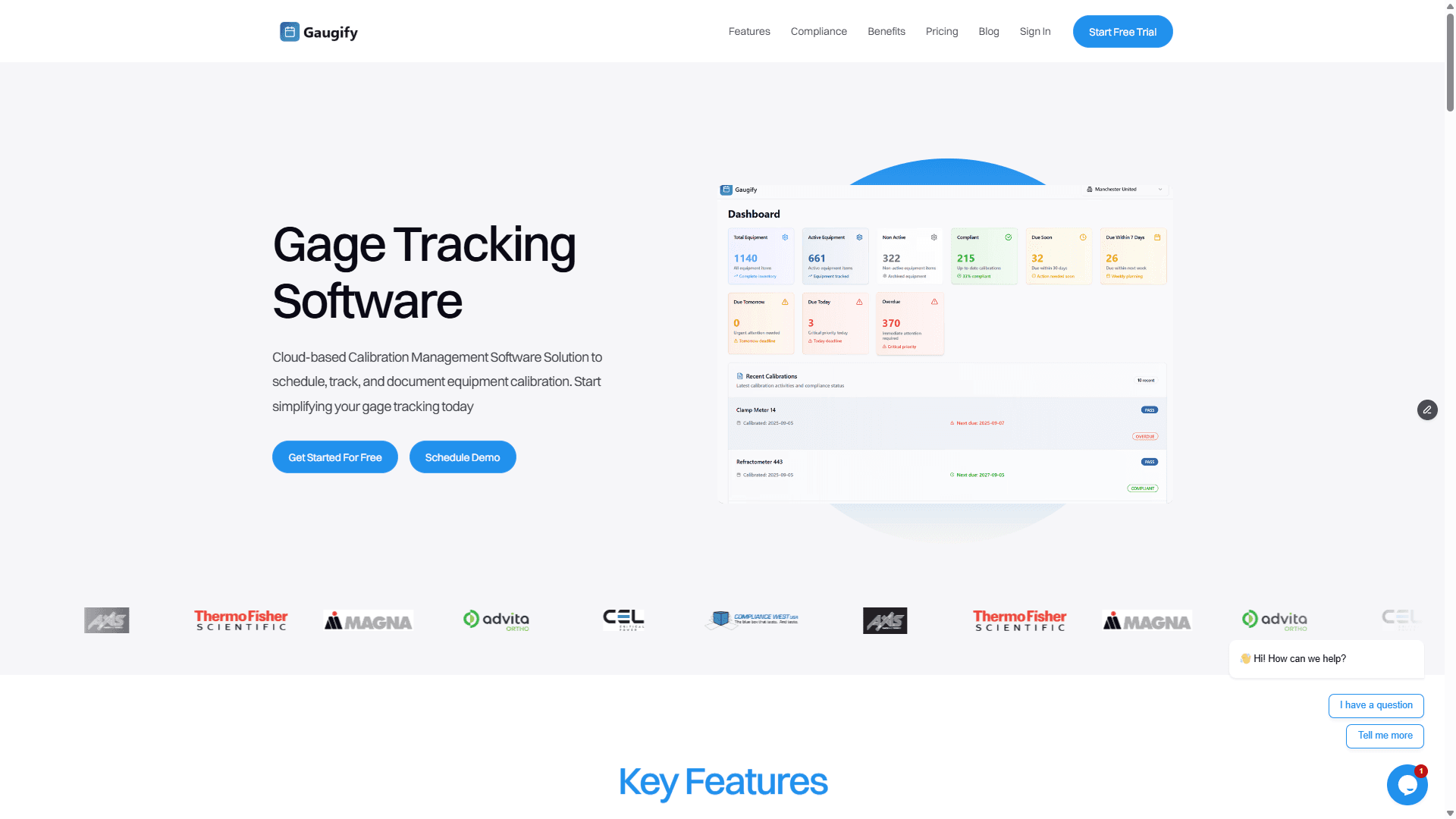
Real-time dashboards provide visibility into calibration status across the entire facility, allowing managers to identify potential issues before they impact production. Automated alerts notify responsible personnel when equipment approaches due dates or when calibration results indicate potential problems.
Comprehensive Certificate Management and Uncertainty Calculations
Gaugify automatically generates professional calibration certificates that meet ISO 17025 requirements and customer specifications. The system maintains complete traceability chains back to national standards, automatically calculating and documenting measurement uncertainty using proper statistical methods. For semiconductor applications, this includes consideration of environmental effects, standard uncertainties, and coverage factors appropriate for the measurement application.
The platform's advanced features include automated uncertainty propagation calculations for complex measurement chains common in semiconductor manufacturing. When calibrating a dimensional measurement system, for example, Gaugify automatically combines uncertainties from the reference standards, environmental conditions, measurement procedure, and equipment resolution to provide a complete uncertainty budget.
Digital certificate storage and retrieval eliminates the paper-based filing systems that often fail during audits. Certificates are automatically linked to equipment records, calibration procedures, and measurement data, providing auditors with instant access to complete calibration documentation.
Audit Trail and Compliance Documentation
Every action in Gaugify is automatically logged with timestamps and user identification, creating a complete audit trail that meets the most stringent regulatory requirements. The system maintains version control for calibration procedures, tracks changes to equipment configurations, and documents all corrective actions taken when equipment is found out of tolerance.
The platform's compliance features include automated generation of audit reports, trending analysis, and measurement system capability studies. When preparing for customer audits, quality managers can instantly generate reports showing calibration status, overdue items, and historical performance for any piece of equipment or group of equipment.
Ready to see how Gaugify can transform your semiconductor calibration management? Start your free trial today and discover why leading semiconductor manufacturers choose our platform to manage their critical measurement equipment calibration requirements.
Integration with Semiconductor Manufacturing Systems
Effective calibration management software semiconductor operations use must integrate seamlessly with existing manufacturing execution systems (MES), statistical process control (SPC) systems, and equipment automation platforms. Gaugify provides robust API capabilities and pre-built integrations with common semiconductor manufacturing software platforms.
Integration with SPC systems allows real-time correlation between measurement system performance and process control charts. When a measurement tool shows drift during calibration, the system can automatically flag potentially affected product lots and trigger appropriate investigations. This integration is particularly valuable for high-volume production where even small measurement biases can impact yield significantly.
Equipment data historians can be automatically populated with calibration results, providing engineers with complete visibility into measurement system performance over time. This integration supports advanced analytics and machine learning applications that can predict calibration needs and optimize calibration intervals based on actual equipment performance rather than conservative time-based schedules.
Multi-Site and Global Operations Support
Many semiconductor companies operate multiple fabs across different geographic regions, each with potentially different regulatory requirements and customer specifications. Gaugify's cloud-based architecture supports global operations while maintaining local compliance requirements and providing centralized visibility for corporate quality management.
The platform supports multiple currencies, languages, and regulatory frameworks within a single system instance. Calibration procedures can be standardized across sites while allowing for local variations required by specific customer contracts or regulatory requirements. Global calibration trending and analysis capabilities help identify systematic issues across multiple facilities and support continuous improvement initiatives.
Advanced Analytics and Continuous Improvement
Modern semiconductor manufacturing relies heavily on data analytics to drive continuous improvement and optimize operations. Gaugify's advanced analytics capabilities provide insights that go far beyond basic calibration tracking and compliance reporting.
Measurement system capability analysis tools help engineers understand the contribution of measurement uncertainty to overall process variation. For critical measurements like gate oxide thickness or junction depth, the platform can automatically calculate measurement system capability ratios and alert engineers when measurement uncertainty becomes a significant contributor to process variation.
Predictive analytics capabilities use machine learning algorithms to analyze historical calibration data and predict optimal calibration intervals for individual instruments. This approach can significantly reduce calibration costs while maintaining measurement reliability by extending intervals for stable equipment while shortening intervals for equipment showing degradation patterns.
The platform's trending and analysis tools support root cause analysis when measurement systems show unexpected behavior. Statistical analysis of calibration results can identify environmental factors, procedural variations, or equipment issues that contribute to measurement variability, supporting targeted improvement efforts.
Cost Management and Resource Optimization
Calibration costs represent a significant operational expense for semiconductor manufacturers, often running into millions of dollars annually for large fabs. Gaugify's cost management features help optimize calibration spending while maintaining measurement quality and compliance requirements.
Detailed cost tracking capabilities monitor calibration expenses by equipment type, department, or product line. The system tracks both internal labor costs and external calibration service expenses, providing managers with complete visibility into calibration spending patterns. Automated reporting capabilities support budgeting and cost allocation processes.
Resource optimization tools help balance calibration workloads across available technicians and facilities. The system considers technician qualifications, equipment locations, and production schedules to minimize travel time and maximize calibration efficiency. For external calibration services, the platform can optimize shipment schedules to minimize shipping costs and equipment downtime.
Security and Data Protection
Semiconductor intellectual property represents billions of dollars in research and development investment, making data security a critical consideration for any software platform used in the manufacturing environment. Gaugify implements enterprise-grade security measures designed to protect sensitive calibration data and measurement results.
The platform uses encryption for data at rest and in transit, multi-factor authentication, and role-based access controls to ensure that calibration data is protected against unauthorized access. Audit logging includes detailed tracking of all data access and modifications, supporting both compliance requirements and security incident investigation.
Data backup and disaster recovery capabilities ensure that critical calibration records are protected against system failures or other disruptions. The cloud-based architecture provides automatic geographic redundancy while maintaining compliance with data sovereignty requirements for international operations.
Implementation and Migration Support
Transitioning from legacy calibration management systems to modern cloud-based platforms requires careful planning and execution to minimize disruption to ongoing operations. Gaugify provides comprehensive implementation support designed specifically for the complexity of semiconductor manufacturing environments.
Data migration services help transfer historical calibration records, equipment databases, and calibration procedures from existing systems. The migration process includes data validation and verification steps to ensure accuracy and completeness of transferred information. Historical trending data is preserved to maintain continuity of analysis and reporting capabilities.
Training programs are customized for different user roles, from shop floor technicians to quality managers and auditors. The platform's intuitive user interface minimizes training requirements while providing powerful capabilities for advanced users. Ongoing support includes access to calibration management experts who understand the unique requirements of semiconductor manufacturing.
Phased implementation approaches allow gradual transition from legacy systems while maintaining operational continuity. Critical equipment can be migrated first to demonstrate value and build user confidence, followed by systematic migration of remaining equipment based on operational priorities and resource availability.
Transform your semiconductor calibration management today. Leading semiconductor manufacturers worldwide trust Gaugify to manage their most critical measurement equipment calibration requirements. Our cloud-based platform delivers the scalability, reliability, and advanced features your facility needs to maintain compliance while optimizing costs and improving operational efficiency. Schedule a personalized demo to see how Gaugify can address your specific calibration management challenges and support your facility's quality and productivity goals.
Calibration Management Software for Semiconductor Manufacturing
Semiconductor manufacturing demands precision that goes beyond what most industries require. When your production tolerances are measured in nanometers and a single out-of-spec measurement tool can scrap millions of dollars worth of wafers, robust calibration management software semiconductor facilities rely on becomes absolutely critical. Traditional paper-based calibration systems or basic spreadsheet tracking simply cannot handle the complexity, traceability requirements, and audit intensity that characterize modern semiconductor fabs.
The semiconductor industry faces unique calibration challenges that set it apart from other manufacturing sectors. Clean room environments, 24/7 production schedules, stringent regulatory requirements from multiple standards bodies, and the sheer volume of precision measurement equipment create a perfect storm of calibration management complexity. A typical 300mm fab might have over 10,000 individual measurement points across thousands of instruments, each requiring different calibration frequencies, uncertainty budgets, and documentation standards.
Critical Equipment Requiring Calibration Management Software in Semiconductor Facilities
Semiconductor manufacturing relies on an extensive array of precision measurement and process control equipment, each with specific calibration requirements and tolerance specifications. Understanding these equipment types and their calibration needs is essential for implementing effective calibration management software semiconductor operations depend on.
Dimensional Measurement Equipment
Critical dimension scanning electron microscopes (CD-SEMs) represent some of the most precise measurement tools in the fab, typically requiring calibration to within ±0.5nm uncertainty. These instruments measure feature widths, line edge roughness, and sidewall angles on wafers, directly impacting yield calculations. Atomic force microscopes (AFMs) used for surface roughness measurements need calibration standards traceable to NIST, with typical uncertainty requirements of ±0.1nm for Z-axis measurements.
Optical measurement systems, including ellipsometers and reflectometers used for thin film thickness measurements, require regular calibration with certified reference standards. A typical ellipsometer might need calibration verification every 30 days with thickness standards ranging from 10Å to 10,000Å, each with specific uncertainty budgets that must be maintained and documented.
Process Control Instrumentation
Temperature measurement and control systems throughout the fab require calibration to extremely tight tolerances. Rapid thermal processing (RTP) systems typically need temperature uniformity within ±2°C across the wafer, requiring thermocouple calibrations traceable to ITS-90 temperature scale. Furnace temperature controllers for diffusion and oxidation processes often require calibration uncertainties better than ±0.5°C to maintain process control.
Mass flow controllers (MFCs) used in chemical vapor deposition and etching processes require calibration for each gas type, with typical accuracy requirements of ±1% of full scale. A single etch tool might have 20+ MFCs, each requiring individual calibration certificates and uncertainty calculations.
Chemical Analysis Equipment
Inductively coupled plasma mass spectrometry (ICP-MS) systems used for trace metal analysis require multi-point calibrations with certified reference materials. Typical detection limits for metallic contaminants in semiconductor applications require calibration standards with uncertainties at the parts-per-trillion level.
Ion chromatography systems for anion analysis in ultrapure water and chemical solutions need regular calibration with NIST-traceable standards. A typical calibration might include fluoride, chloride, and sulfate standards ranging from 1 ppb to 100 ppm, each requiring individual uncertainty calculations and traceability documentation.
Quality Standards and Compliance Requirements for Calibration Management Software Semiconductor Applications
Semiconductor manufacturing operates under a complex web of quality standards and regulatory requirements that directly impact calibration management practices. These standards define not just what must be calibrated, but how calibration data must be collected, analyzed, and maintained for compliance purposes.
ISO Standards and Implementation
ISO 9001 quality management system requirements form the foundation for calibration management in semiconductor facilities, but the industry typically goes far beyond basic ISO 9001 compliance. Most semiconductor manufacturers implement ISO 17025 calibration software systems to ensure their internal calibration capabilities meet international standards for testing and calibration laboratories.
ISO 17025 requirements include measurement uncertainty calculations for every calibration, traceability to national standards, proper environmental controls during calibration, and comprehensive documentation of calibration procedures and results. For a semiconductor fab, this might mean maintaining uncertainty budgets for thousands of measurement points while ensuring calibration intervals are optimized based on historical stability data.
SEMI standards, developed specifically for the semiconductor industry, provide additional requirements. SEMI F47 (Specification for Contamination-Free Manufacturing) includes specific requirements for calibration of contamination monitoring equipment. SEMI E10 (Specification for Definition and Measurement of Equipment Reliability, Availability, and Maintainability) includes requirements for measurement system reliability that directly impact calibration scheduling and management.
Customer and Regulatory Requirements
Major semiconductor customers often impose additional calibration requirements beyond standard industry practices. Automotive semiconductor suppliers must comply with IATF 16949 requirements, which include specific measurement system analysis (MSA) requirements and calibration documentation standards. Aerospace and defense semiconductor suppliers face additional requirements under AS9100 and various military specifications.
FDA-regulated semiconductor devices used in medical applications require compliance with 21 CFR Part 820 quality system regulations, including specific requirements for calibration of measurement equipment used in design controls and production. These requirements often mandate shorter calibration intervals and more extensive documentation than typical commercial semiconductor applications.
Common Audit Scenarios and Calibration Management Software Requirements
Semiconductor facilities face frequent and intensive audits from customers, certification bodies, and regulatory agencies. These audits typically focus heavily on measurement system integrity and calibration management practices, making robust calibration management software semiconductor operations essential for audit success.
Customer Qualification Audits
During a typical customer qualification audit, auditors will select a random sample of measurement equipment and trace the calibration history back through multiple calibration cycles. They're looking for evidence of proper calibration intervals, appropriate measurement uncertainty calculations, and corrective actions taken when equipment is found out of tolerance.
A common audit scenario involves an auditor selecting a CD-SEM used for critical dimension measurements on a key customer product. The auditor will want to see the current calibration certificate, evidence that the calibration was performed by qualified personnel using appropriate standards, calculation of measurement uncertainty including all contributing factors, and documentation of any corrective actions taken when the instrument was last found outside tolerance limits.
Auditors frequently ask for trend analysis of calibration results over time, looking for evidence of drift patterns or systematic errors that might impact product quality. They want to see that calibration intervals are optimized based on actual stability data rather than arbitrary time periods, and that measurement uncertainty is properly incorporated into product specifications and control limits.
Certification Body Audits
ISO 9001 and AS9100 certification audits include detailed examination of calibration management practices. Auditors typically review the calibration system for completeness, checking that all measurement equipment affecting product quality is properly identified, calibrated, and controlled. They look for evidence that calibration requirements are clearly defined, calibration procedures are followed consistently, and calibration records are complete and accurate.
A certification auditor might select a sample of temperature controllers used in diffusion furnaces and trace the calibration chain back to national standards. They want to see evidence of proper traceability, appropriate calibration intervals based on equipment stability and criticality, and proper handling of equipment found out of tolerance during calibration.
How Gaugify Solves Semiconductor Calibration Management Challenges
Modern calibration management software semiconductor facilities require must address the unique challenges of high-volume, high-precision manufacturing environments. Gaugify's cloud-based calibration management platform was designed specifically to handle the complexity and scale requirements of semiconductor manufacturing operations.
Automated Scheduling and Workflow Management
Gaugify's intelligent scheduling system automatically manages calibration due dates for thousands of instruments while optimizing technician workloads and minimizing production disruption. The system considers equipment criticality, historical stability data, and production schedules to optimize calibration timing. For example, critical CD-SEMs can be automatically flagged for priority scheduling, while less critical equipment can be grouped for efficient batch calibration.
The platform's workflow management capabilities ensure that calibration procedures are followed consistently across all shifts and technicians. Digital work instructions guide technicians through complex multi-point calibrations, while automated data validation prevents transcription errors and ensures measurement uncertainty calculations are performed correctly.
Real-time dashboards provide visibility into calibration status across the entire facility, allowing managers to identify potential issues before they impact production. Automated alerts notify responsible personnel when equipment approaches due dates or when calibration results indicate potential problems.
Comprehensive Certificate Management and Uncertainty Calculations
Gaugify automatically generates professional calibration certificates that meet ISO 17025 requirements and customer specifications. The system maintains complete traceability chains back to national standards, automatically calculating and documenting measurement uncertainty using proper statistical methods. For semiconductor applications, this includes consideration of environmental effects, standard uncertainties, and coverage factors appropriate for the measurement application.
The platform's advanced features include automated uncertainty propagation calculations for complex measurement chains common in semiconductor manufacturing. When calibrating a dimensional measurement system, for example, Gaugify automatically combines uncertainties from the reference standards, environmental conditions, measurement procedure, and equipment resolution to provide a complete uncertainty budget.
Digital certificate storage and retrieval eliminates the paper-based filing systems that often fail during audits. Certificates are automatically linked to equipment records, calibration procedures, and measurement data, providing auditors with instant access to complete calibration documentation.
Audit Trail and Compliance Documentation
Every action in Gaugify is automatically logged with timestamps and user identification, creating a complete audit trail that meets the most stringent regulatory requirements. The system maintains version control for calibration procedures, tracks changes to equipment configurations, and documents all corrective actions taken when equipment is found out of tolerance.
The platform's compliance features include automated generation of audit reports, trending analysis, and measurement system capability studies. When preparing for customer audits, quality managers can instantly generate reports showing calibration status, overdue items, and historical performance for any piece of equipment or group of equipment.
Ready to see how Gaugify can transform your semiconductor calibration management? Start your free trial today and discover why leading semiconductor manufacturers choose our platform to manage their critical measurement equipment calibration requirements.
Integration with Semiconductor Manufacturing Systems
Effective calibration management software semiconductor operations use must integrate seamlessly with existing manufacturing execution systems (MES), statistical process control (SPC) systems, and equipment automation platforms. Gaugify provides robust API capabilities and pre-built integrations with common semiconductor manufacturing software platforms.
Integration with SPC systems allows real-time correlation between measurement system performance and process control charts. When a measurement tool shows drift during calibration, the system can automatically flag potentially affected product lots and trigger appropriate investigations. This integration is particularly valuable for high-volume production where even small measurement biases can impact yield significantly.
Equipment data historians can be automatically populated with calibration results, providing engineers with complete visibility into measurement system performance over time. This integration supports advanced analytics and machine learning applications that can predict calibration needs and optimize calibration intervals based on actual equipment performance rather than conservative time-based schedules.
Multi-Site and Global Operations Support
Many semiconductor companies operate multiple fabs across different geographic regions, each with potentially different regulatory requirements and customer specifications. Gaugify's cloud-based architecture supports global operations while maintaining local compliance requirements and providing centralized visibility for corporate quality management.
The platform supports multiple currencies, languages, and regulatory frameworks within a single system instance. Calibration procedures can be standardized across sites while allowing for local variations required by specific customer contracts or regulatory requirements. Global calibration trending and analysis capabilities help identify systematic issues across multiple facilities and support continuous improvement initiatives.
Advanced Analytics and Continuous Improvement
Modern semiconductor manufacturing relies heavily on data analytics to drive continuous improvement and optimize operations. Gaugify's advanced analytics capabilities provide insights that go far beyond basic calibration tracking and compliance reporting.
Measurement system capability analysis tools help engineers understand the contribution of measurement uncertainty to overall process variation. For critical measurements like gate oxide thickness or junction depth, the platform can automatically calculate measurement system capability ratios and alert engineers when measurement uncertainty becomes a significant contributor to process variation.
Predictive analytics capabilities use machine learning algorithms to analyze historical calibration data and predict optimal calibration intervals for individual instruments. This approach can significantly reduce calibration costs while maintaining measurement reliability by extending intervals for stable equipment while shortening intervals for equipment showing degradation patterns.
The platform's trending and analysis tools support root cause analysis when measurement systems show unexpected behavior. Statistical analysis of calibration results can identify environmental factors, procedural variations, or equipment issues that contribute to measurement variability, supporting targeted improvement efforts.
Cost Management and Resource Optimization
Calibration costs represent a significant operational expense for semiconductor manufacturers, often running into millions of dollars annually for large fabs. Gaugify's cost management features help optimize calibration spending while maintaining measurement quality and compliance requirements.
Detailed cost tracking capabilities monitor calibration expenses by equipment type, department, or product line. The system tracks both internal labor costs and external calibration service expenses, providing managers with complete visibility into calibration spending patterns. Automated reporting capabilities support budgeting and cost allocation processes.
Resource optimization tools help balance calibration workloads across available technicians and facilities. The system considers technician qualifications, equipment locations, and production schedules to minimize travel time and maximize calibration efficiency. For external calibration services, the platform can optimize shipment schedules to minimize shipping costs and equipment downtime.
Security and Data Protection
Semiconductor intellectual property represents billions of dollars in research and development investment, making data security a critical consideration for any software platform used in the manufacturing environment. Gaugify implements enterprise-grade security measures designed to protect sensitive calibration data and measurement results.
The platform uses encryption for data at rest and in transit, multi-factor authentication, and role-based access controls to ensure that calibration data is protected against unauthorized access. Audit logging includes detailed tracking of all data access and modifications, supporting both compliance requirements and security incident investigation.
Data backup and disaster recovery capabilities ensure that critical calibration records are protected against system failures or other disruptions. The cloud-based architecture provides automatic geographic redundancy while maintaining compliance with data sovereignty requirements for international operations.
Implementation and Migration Support
Transitioning from legacy calibration management systems to modern cloud-based platforms requires careful planning and execution to minimize disruption to ongoing operations. Gaugify provides comprehensive implementation support designed specifically for the complexity of semiconductor manufacturing environments.
Data migration services help transfer historical calibration records, equipment databases, and calibration procedures from existing systems. The migration process includes data validation and verification steps to ensure accuracy and completeness of transferred information. Historical trending data is preserved to maintain continuity of analysis and reporting capabilities.
Training programs are customized for different user roles, from shop floor technicians to quality managers and auditors. The platform's intuitive user interface minimizes training requirements while providing powerful capabilities for advanced users. Ongoing support includes access to calibration management experts who understand the unique requirements of semiconductor manufacturing.
Phased implementation approaches allow gradual transition from legacy systems while maintaining operational continuity. Critical equipment can be migrated first to demonstrate value and build user confidence, followed by systematic migration of remaining equipment based on operational priorities and resource availability.
Transform your semiconductor calibration management today. Leading semiconductor manufacturers worldwide trust Gaugify to manage their most critical measurement equipment calibration requirements. Our cloud-based platform delivers the scalability, reliability, and advanced features your facility needs to maintain compliance while optimizing costs and improving operational efficiency. Schedule a personalized demo to see how Gaugify can address your specific calibration management challenges and support your facility's quality and productivity goals.