
Calibration Management Software for Water Treatment Facilities
Calibration Management Software for Water Treatment Facilities
David Bentley
Quality Assurance Engineer
12 min read
Calibration Management Software for Water Treatment Facilities
Water treatment facilities face unique calibration management challenges that can make or break regulatory compliance and operational efficiency. From pH meters requiring daily verification to turbidimeters needing quarterly calibrations, managing hundreds of instruments across multiple treatment stages demands precision that spreadsheets and paper systems simply cannot deliver. Calibration management software for water treatment facilities has become essential for maintaining water quality standards while streamlining operations and ensuring regulatory compliance.
The stakes couldn't be higher in water treatment operations. A single miscalibrated chlorine analyzer could lead to inadequate disinfection, while an out-of-spec pH meter might cause treatment chemicals to perform poorly, resulting in regulatory violations and potential public health risks. Traditional calibration tracking methods leave facilities vulnerable to missed calibrations, lost certificates, and failed audits that can shut down operations.
Critical Instruments Requiring Calibration in Water Treatment Operations
Water treatment facilities rely on dozens of instrument types, each with specific calibration requirements and tolerance specifications. Understanding these instruments and their calibration needs is the first step toward implementing effective calibration management software for water treatment operations.
Chemical Analysis Instruments
pH meters and controllers form the backbone of chemical treatment processes. These instruments typically require calibration with NIST-traceable buffer solutions at pH 4.01, 7.00, and 10.01, with accuracy requirements of ±0.1 pH units for most municipal applications. Daily verification checks using pH 7.00 buffer are common, with full three-point calibrations performed weekly or monthly depending on the application.
Chlorine analyzers, including both free and total chlorine instruments, need calibration with certified chlorine standards. DPD colorimetric analyzers typically require calibration every 30 days with standards traceable to NIST, while amperometric sensors may need weekly calibration checks. Accuracy requirements often fall within ±0.02 mg/L for drinking water applications.
Turbidimeters measure water clarity and require calibration with certified formazin standards. EPA Method 180.1 specifies calibration with 0.1, 1.0, 10, and 100 NTU standards, with linearity checks performed monthly. For drinking water applications, turbidimeters must maintain accuracy within ±2% or 0.01 NTU, whichever is greater.
Flow and Level Measurement
Flow meters across treatment systems require periodic calibration to ensure accurate chemical dosing and process control. Magnetic flow meters typically need calibration every 12 months with uncertainty requirements of ±0.5% of reading. Ultrasonic flow meters may require more frequent calibration every 6 months due to potential fouling effects.
Level transmitters in clarifiers, storage tanks, and chemical feed systems need calibration with certified pressure sources or dimensional measurements. Hydrostatic level sensors require calibration every 6-12 months with accuracy specifications typically ±0.25% of full scale.
Pressure and Temperature Instruments
Pressure transmitters throughout filtration and pumping systems require calibration with deadweight testers or certified pressure standards. Filter differential pressure transmitters need calibration every 6 months with accuracy requirements of ±0.1% of span for critical applications.
Temperature sensors in chemical feed systems and process monitoring require calibration with NIST-traceable temperature sources. RTD sensors typically need calibration every 12 months with accuracy requirements of ±0.1°C for critical applications.
Regulatory Standards Governing Water Treatment Calibration
Water treatment facilities must comply with multiple regulatory frameworks that dictate calibration requirements and documentation standards. These regulations make robust calibration management software for water treatment essential for maintaining compliance and avoiding costly violations.
EPA Safe Drinking Water Act Requirements
The EPA's Safe Drinking Water Act establishes minimum calibration frequencies for monitoring equipment used in compliance testing. Turbidimeters used for filter performance monitoring must be calibrated at least monthly, while pH meters used for corrosion control monitoring require calibration before each use or daily, whichever is more frequent.
EPA regulations also require that calibration standards be NIST-traceable with certificates of analysis documenting traceability chains. Facilities must maintain calibration records for at least three years and make them available for regulatory inspection within 24 hours of request.
ISO 17025 Laboratory Accreditation
Many water treatment facilities maintain ISO 17025 accredited laboratories for in-house testing. This standard requires rigorous calibration management including measurement uncertainty calculations, environmental condition monitoring, and comprehensive calibration certificates.
ISO 17025 mandates that calibration intervals be determined based on instrument stability, frequency of use, and measurement criticality. Facilities must document the technical justification for chosen intervals and adjust them based on historical performance data.
State and Local Regulations
State primacy agencies often impose additional calibration requirements beyond federal minimums. For example, California's Division of Drinking Water requires daily calibration verification for continuous turbidimeters, while Texas requires weekly calibration of pH meters used for corrosion control.
Local health departments may impose even stricter requirements, particularly for facilities serving sensitive populations like hospitals or schools. Understanding and managing these multi-layered requirements demands sophisticated calibration tracking capabilities.
Common Audit Scenarios and Inspector Expectations
Water treatment facility audits focus heavily on calibration management, with inspectors examining both technical compliance and documentation integrity. Understanding what auditors look for helps facilities prepare and highlights why comprehensive calibration management software for water treatment is critical for audit success.
Documentation Review Scenarios
Inspectors typically begin audits by requesting calibration records for critical instruments. They expect to see complete calibration certificates showing as-found and as-left readings, environmental conditions, standards used, and technician signatures. Missing or incomplete records immediately raise red flags.
A common audit scenario involves an inspector selecting a turbidimeter from the treatment plant floor and asking to see its complete calibration history. They want to verify that monthly calibrations were performed on schedule, that NIST-traceable standards were used, and that any out-of-tolerance conditions were properly addressed with impact assessments.
Inspectors also examine calibration intervals and their technical justification. They may question why a pH meter is calibrated weekly when the manufacturer recommends monthly intervals, or why a critical chlorine analyzer has a 60-day interval when similar facilities use 30-day intervals.
Measurement Uncertainty Evaluations
Advanced audits increasingly focus on measurement uncertainty calculations and their impact on compliance decisions. Inspectors may ask facilities to demonstrate how they account for calibration uncertainty when reporting compliance data.
For example, if a turbidimeter has a calibration uncertainty of ±0.02 NTU and measures 0.28 NTU against a 0.3 NTU regulatory limit, inspectors want to see documented evidence that the facility considered the measurement uncertainty in their compliance determination.
Corrective Action Investigations
When calibrations reveal out-of-tolerance conditions, inspectors expect to see comprehensive corrective action documentation. This includes impact assessments on data collected since the last successful calibration, notifications to regulatory agencies if required, and preventive measures to avoid recurrence.
A typical scenario might involve a chlorine analyzer found 15% high during calibration. Inspectors would expect to see documentation showing how the facility assessed the impact on disinfection adequacy, whether any regulatory notifications were required, and what steps were taken to prevent similar occurrences.
How Modern Calibration Management Software Addresses Water Treatment Challenges
Gaugify's calibration management platform specifically addresses the complex requirements of water treatment facilities through features designed for regulatory compliance and operational efficiency.
Automated Scheduling and Notifications
Water treatment facilities can't afford missed calibrations. Gaugify's intelligent scheduling system automatically generates work orders based on instrument-specific intervals while accounting for weekends, holidays, and maintenance shutdowns. The system sends escalating notifications via email and SMS to ensure critical calibrations are never missed.
For example, a facility managing 200 instruments with varying calibration frequencies from daily pH checks to annual pressure transmitter calibrations can rely on automated scheduling to ensure 100% on-time performance. The system even accounts for lead times on external calibration services, automatically scheduling pickups to ensure instruments return before their due dates.
Comprehensive Certificate Management
Gaugify's certificate management features ensure complete documentation for every calibration event. The platform automatically captures as-found and as-left readings, environmental conditions, standards used, and uncertainty calculations in standardized certificate formats.
When an EPA inspector requests three years of turbidimeter calibration records, facility managers can instantly generate complete documentation packages including certificate details, traceability chains for all standards used, and trend analyses showing instrument stability over time.
Real-Time Compliance Monitoring
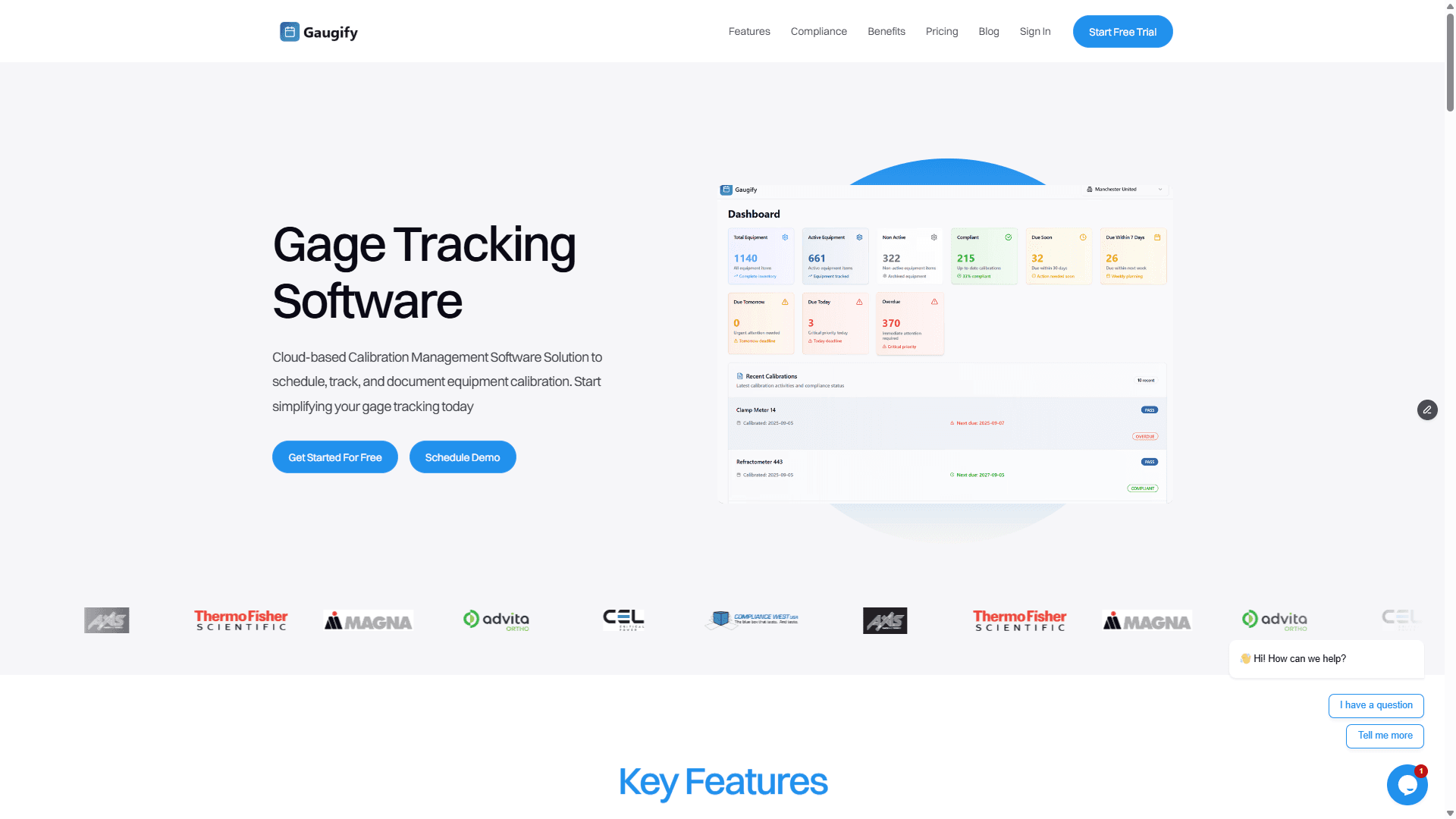
The platform provides real-time visibility into calibration status across the entire facility. Dashboard views highlight instruments approaching due dates, overdue calibrations, and trending issues that might indicate emerging problems.
Quality managers can instantly see that 23 of 25 pH meters are current, identify the two requiring attention, and drill down to see specific technician assignments and completion status. This real-time visibility prevents surprises during regulatory inspections.
Ready to transform your calibration management? Start your free trial and experience how Gaugify can streamline your water treatment facility's calibration operations while ensuring complete regulatory compliance.
Advanced Measurement Uncertainty Calculations
Gaugify automatically calculates measurement uncertainty for each calibration using ISO/IEC Guide 98-3 methodologies. The platform combines uncertainties from calibration standards, environmental conditions, instrument resolution, and historical repeatability data to provide comprehensive uncertainty budgets.
For a chlorine analyzer calibration, the system automatically combines uncertainties from the certified chlorine standard (±0.01 mg/L), temperature effects (±0.002 mg/L), technician repeatability (±0.005 mg/L), and instrument resolution (±0.001 mg/L) to calculate the overall calibration uncertainty. This automated calculation ensures consistent methodology and eliminates manual calculation errors.
Robust Audit Trail and Change Control
Gaugify's compliance features maintain complete audit trails for all calibration activities. Every data entry, modification, and approval is logged with user identification, timestamps, and change justifications. This creates the comprehensive documentation trail that auditors expect.
The platform's electronic signature capabilities ensure that calibration certificates meet 21 CFR Part 11 requirements where applicable. Technicians can sign calibrations electronically with full traceability, eliminating the risk of lost paper records while maintaining regulatory acceptability.
Integration with Plant Control Systems
Modern water treatment facilities increasingly integrate calibration management with plant control and data acquisition systems. Gaugify's API-first architecture enables seamless integration with SCADA systems, laboratory information management systems (LIMS), and plant historians.
This integration allows automatic import of instrument lists, real-time synchronization of calibration status with control systems, and automated flagging of instruments requiring calibration before critical measurements. When a turbidimeter approaches its calibration due date, the integration can automatically flag its readings in the SCADA system until calibration is completed.
Mobile Calibration Capabilities
Technicians performing field calibrations can use Gaugify's mobile applications to complete calibration workflows directly from smartphones or tablets. The mobile app supports barcode scanning for instrument identification, photo capture for documentation, and offline operation when network connectivity is limited.
A technician calibrating flow meters in a remote pump station can scan instrument barcodes, enter calibration data, capture photos of equipment nameplate information, and synchronize everything with the central database once back in cellular range. This eliminates transcription errors and ensures immediate data availability.
Cost Justification and ROI for Water Treatment Facilities
Implementing comprehensive calibration management software for water treatment delivers measurable return on investment through multiple channels. Facilities typically see payback within 12-18 months through reduced labor costs, eliminated regulatory violations, and improved operational efficiency.
Labor Cost Reduction
Manual calibration management consumes significant labor hours through scheduling coordination, paperwork completion, and record maintenance. A typical 50 MGD treatment plant might spend 20-30 hours weekly on calibration administration tasks.
Gaugify's automation reduces this administrative burden by 70-80%, freeing skilled technicians for higher-value activities. The time savings on a 200-instrument facility typically amounts to $25,000-$35,000 annually in avoided labor costs.
Regulatory Violation Avoidance
EPA violations for inadequate calibration can result in fines ranging from $5,000 to $25,000 per violation, plus mandatory corrective actions costing additional thousands. A single missed turbidimeter calibration during a compliance monitoring period could trigger violations costing $15,000-$30,000.
The automated scheduling and notification features virtually eliminate missed calibrations, providing substantial risk mitigation value. Even preventing one major violation annually justifies the software investment for most facilities.
Implementation Best Practices for Water Treatment Facilities
Successful calibration software implementation requires careful planning and stakeholder engagement. Facilities should begin by conducting comprehensive instrument inventories and documenting current calibration procedures before transitioning to automated systems.
Phased Implementation Approach
Smart facilities implement calibration software in phases, starting with the most critical instruments and gradually expanding coverage. Beginning with turbidimeters, chlorine analyzers, and pH meters ensures immediate compliance benefits while allowing staff to become comfortable with new workflows.
The second phase typically includes flow meters and pressure transmitters, followed by temperature sensors and other secondary instruments. This phased approach minimizes disruption while building confidence in the new system.
Staff Training and Change Management
Successful implementation requires comprehensive staff training on both software functionality and updated calibration procedures. Gaugify provides extensive training resources including video tutorials, documentation templates, and hands-on support during initial implementation.
Change management is equally important, as technicians accustomed to paper-based systems may initially resist electronic workflows. Highlighting the benefits of automated scheduling, easier record retrieval, and reduced paperwork helps build staff buy-in.
Future-Proofing Water Treatment Calibration Management
The regulatory landscape for water treatment continues evolving, with increasing emphasis on measurement uncertainty, data integrity, and real-time monitoring. Forward-thinking facilities are positioning themselves for these changes by implementing comprehensive calibration management systems now.
Emerging regulations may require more frequent calibrations for certain instruments, enhanced documentation of measurement uncertainty, and improved integration between calibration and compliance monitoring systems. Facilities using modern calibration management software will adapt to these changes much more easily than those relying on manual systems.
Technology Integration Trends
The future of calibration management includes increased integration with IoT sensors, artificial intelligence for predictive maintenance, and blockchain for tamper-proof record keeping. Gaugify's cloud-based architecture and API-first design ensure compatibility with these emerging technologies.
Smart instruments with built-in calibration capabilities are becoming more common, requiring calibration management systems that can interface directly with instrument firmware. This evolution toward automated, self-documenting calibrations will further reduce manual labor while improving accuracy and compliance.
Transform Your Water Treatment Calibration Management Today
Water treatment facilities can't afford calibration management failures that compromise regulatory compliance and operational efficiency. The complex requirements of EPA regulations, state primacy agencies, and quality standards demand sophisticated calibration tracking capabilities that manual systems simply cannot provide.
Gaugify's calibration management platform delivers the comprehensive functionality water treatment facilities need to maintain complete regulatory compliance while reducing administrative burden and improving operational efficiency. From automated scheduling and notification systems to advanced measurement uncertainty calculations and robust audit trails, Gaugify addresses every aspect of modern calibration management.
The benefits extend far beyond compliance, delivering measurable ROI through reduced labor costs, eliminated regulatory violations, and improved operational visibility. Facilities implementing comprehensive calibration management typically see payback within 12-18 months while positioning themselves for future regulatory changes.
Don't let inadequate calibration management put your facility at risk. Schedule a personalized demo to see how Gaugify can transform your calibration operations, or start your free trial today and experience the difference modern calibration management software makes for water treatment facilities.
Calibration Management Software for Water Treatment Facilities
Water treatment facilities face unique calibration management challenges that can make or break regulatory compliance and operational efficiency. From pH meters requiring daily verification to turbidimeters needing quarterly calibrations, managing hundreds of instruments across multiple treatment stages demands precision that spreadsheets and paper systems simply cannot deliver. Calibration management software for water treatment facilities has become essential for maintaining water quality standards while streamlining operations and ensuring regulatory compliance.
The stakes couldn't be higher in water treatment operations. A single miscalibrated chlorine analyzer could lead to inadequate disinfection, while an out-of-spec pH meter might cause treatment chemicals to perform poorly, resulting in regulatory violations and potential public health risks. Traditional calibration tracking methods leave facilities vulnerable to missed calibrations, lost certificates, and failed audits that can shut down operations.
Critical Instruments Requiring Calibration in Water Treatment Operations
Water treatment facilities rely on dozens of instrument types, each with specific calibration requirements and tolerance specifications. Understanding these instruments and their calibration needs is the first step toward implementing effective calibration management software for water treatment operations.
Chemical Analysis Instruments
pH meters and controllers form the backbone of chemical treatment processes. These instruments typically require calibration with NIST-traceable buffer solutions at pH 4.01, 7.00, and 10.01, with accuracy requirements of ±0.1 pH units for most municipal applications. Daily verification checks using pH 7.00 buffer are common, with full three-point calibrations performed weekly or monthly depending on the application.
Chlorine analyzers, including both free and total chlorine instruments, need calibration with certified chlorine standards. DPD colorimetric analyzers typically require calibration every 30 days with standards traceable to NIST, while amperometric sensors may need weekly calibration checks. Accuracy requirements often fall within ±0.02 mg/L for drinking water applications.
Turbidimeters measure water clarity and require calibration with certified formazin standards. EPA Method 180.1 specifies calibration with 0.1, 1.0, 10, and 100 NTU standards, with linearity checks performed monthly. For drinking water applications, turbidimeters must maintain accuracy within ±2% or 0.01 NTU, whichever is greater.
Flow and Level Measurement
Flow meters across treatment systems require periodic calibration to ensure accurate chemical dosing and process control. Magnetic flow meters typically need calibration every 12 months with uncertainty requirements of ±0.5% of reading. Ultrasonic flow meters may require more frequent calibration every 6 months due to potential fouling effects.
Level transmitters in clarifiers, storage tanks, and chemical feed systems need calibration with certified pressure sources or dimensional measurements. Hydrostatic level sensors require calibration every 6-12 months with accuracy specifications typically ±0.25% of full scale.
Pressure and Temperature Instruments
Pressure transmitters throughout filtration and pumping systems require calibration with deadweight testers or certified pressure standards. Filter differential pressure transmitters need calibration every 6 months with accuracy requirements of ±0.1% of span for critical applications.
Temperature sensors in chemical feed systems and process monitoring require calibration with NIST-traceable temperature sources. RTD sensors typically need calibration every 12 months with accuracy requirements of ±0.1°C for critical applications.
Regulatory Standards Governing Water Treatment Calibration
Water treatment facilities must comply with multiple regulatory frameworks that dictate calibration requirements and documentation standards. These regulations make robust calibration management software for water treatment essential for maintaining compliance and avoiding costly violations.
EPA Safe Drinking Water Act Requirements
The EPA's Safe Drinking Water Act establishes minimum calibration frequencies for monitoring equipment used in compliance testing. Turbidimeters used for filter performance monitoring must be calibrated at least monthly, while pH meters used for corrosion control monitoring require calibration before each use or daily, whichever is more frequent.
EPA regulations also require that calibration standards be NIST-traceable with certificates of analysis documenting traceability chains. Facilities must maintain calibration records for at least three years and make them available for regulatory inspection within 24 hours of request.
ISO 17025 Laboratory Accreditation
Many water treatment facilities maintain ISO 17025 accredited laboratories for in-house testing. This standard requires rigorous calibration management including measurement uncertainty calculations, environmental condition monitoring, and comprehensive calibration certificates.
ISO 17025 mandates that calibration intervals be determined based on instrument stability, frequency of use, and measurement criticality. Facilities must document the technical justification for chosen intervals and adjust them based on historical performance data.
State and Local Regulations
State primacy agencies often impose additional calibration requirements beyond federal minimums. For example, California's Division of Drinking Water requires daily calibration verification for continuous turbidimeters, while Texas requires weekly calibration of pH meters used for corrosion control.
Local health departments may impose even stricter requirements, particularly for facilities serving sensitive populations like hospitals or schools. Understanding and managing these multi-layered requirements demands sophisticated calibration tracking capabilities.
Common Audit Scenarios and Inspector Expectations
Water treatment facility audits focus heavily on calibration management, with inspectors examining both technical compliance and documentation integrity. Understanding what auditors look for helps facilities prepare and highlights why comprehensive calibration management software for water treatment is critical for audit success.
Documentation Review Scenarios
Inspectors typically begin audits by requesting calibration records for critical instruments. They expect to see complete calibration certificates showing as-found and as-left readings, environmental conditions, standards used, and technician signatures. Missing or incomplete records immediately raise red flags.
A common audit scenario involves an inspector selecting a turbidimeter from the treatment plant floor and asking to see its complete calibration history. They want to verify that monthly calibrations were performed on schedule, that NIST-traceable standards were used, and that any out-of-tolerance conditions were properly addressed with impact assessments.
Inspectors also examine calibration intervals and their technical justification. They may question why a pH meter is calibrated weekly when the manufacturer recommends monthly intervals, or why a critical chlorine analyzer has a 60-day interval when similar facilities use 30-day intervals.
Measurement Uncertainty Evaluations
Advanced audits increasingly focus on measurement uncertainty calculations and their impact on compliance decisions. Inspectors may ask facilities to demonstrate how they account for calibration uncertainty when reporting compliance data.
For example, if a turbidimeter has a calibration uncertainty of ±0.02 NTU and measures 0.28 NTU against a 0.3 NTU regulatory limit, inspectors want to see documented evidence that the facility considered the measurement uncertainty in their compliance determination.
Corrective Action Investigations
When calibrations reveal out-of-tolerance conditions, inspectors expect to see comprehensive corrective action documentation. This includes impact assessments on data collected since the last successful calibration, notifications to regulatory agencies if required, and preventive measures to avoid recurrence.
A typical scenario might involve a chlorine analyzer found 15% high during calibration. Inspectors would expect to see documentation showing how the facility assessed the impact on disinfection adequacy, whether any regulatory notifications were required, and what steps were taken to prevent similar occurrences.
How Modern Calibration Management Software Addresses Water Treatment Challenges
Gaugify's calibration management platform specifically addresses the complex requirements of water treatment facilities through features designed for regulatory compliance and operational efficiency.
Automated Scheduling and Notifications
Water treatment facilities can't afford missed calibrations. Gaugify's intelligent scheduling system automatically generates work orders based on instrument-specific intervals while accounting for weekends, holidays, and maintenance shutdowns. The system sends escalating notifications via email and SMS to ensure critical calibrations are never missed.
For example, a facility managing 200 instruments with varying calibration frequencies from daily pH checks to annual pressure transmitter calibrations can rely on automated scheduling to ensure 100% on-time performance. The system even accounts for lead times on external calibration services, automatically scheduling pickups to ensure instruments return before their due dates.
Comprehensive Certificate Management
Gaugify's certificate management features ensure complete documentation for every calibration event. The platform automatically captures as-found and as-left readings, environmental conditions, standards used, and uncertainty calculations in standardized certificate formats.
When an EPA inspector requests three years of turbidimeter calibration records, facility managers can instantly generate complete documentation packages including certificate details, traceability chains for all standards used, and trend analyses showing instrument stability over time.
Real-Time Compliance Monitoring
The platform provides real-time visibility into calibration status across the entire facility. Dashboard views highlight instruments approaching due dates, overdue calibrations, and trending issues that might indicate emerging problems.
Quality managers can instantly see that 23 of 25 pH meters are current, identify the two requiring attention, and drill down to see specific technician assignments and completion status. This real-time visibility prevents surprises during regulatory inspections.
Ready to transform your calibration management? Start your free trial and experience how Gaugify can streamline your water treatment facility's calibration operations while ensuring complete regulatory compliance.
Advanced Measurement Uncertainty Calculations
Gaugify automatically calculates measurement uncertainty for each calibration using ISO/IEC Guide 98-3 methodologies. The platform combines uncertainties from calibration standards, environmental conditions, instrument resolution, and historical repeatability data to provide comprehensive uncertainty budgets.
For a chlorine analyzer calibration, the system automatically combines uncertainties from the certified chlorine standard (±0.01 mg/L), temperature effects (±0.002 mg/L), technician repeatability (±0.005 mg/L), and instrument resolution (±0.001 mg/L) to calculate the overall calibration uncertainty. This automated calculation ensures consistent methodology and eliminates manual calculation errors.
Robust Audit Trail and Change Control
Gaugify's compliance features maintain complete audit trails for all calibration activities. Every data entry, modification, and approval is logged with user identification, timestamps, and change justifications. This creates the comprehensive documentation trail that auditors expect.
The platform's electronic signature capabilities ensure that calibration certificates meet 21 CFR Part 11 requirements where applicable. Technicians can sign calibrations electronically with full traceability, eliminating the risk of lost paper records while maintaining regulatory acceptability.
Integration with Plant Control Systems
Modern water treatment facilities increasingly integrate calibration management with plant control and data acquisition systems. Gaugify's API-first architecture enables seamless integration with SCADA systems, laboratory information management systems (LIMS), and plant historians.
This integration allows automatic import of instrument lists, real-time synchronization of calibration status with control systems, and automated flagging of instruments requiring calibration before critical measurements. When a turbidimeter approaches its calibration due date, the integration can automatically flag its readings in the SCADA system until calibration is completed.
Mobile Calibration Capabilities
Technicians performing field calibrations can use Gaugify's mobile applications to complete calibration workflows directly from smartphones or tablets. The mobile app supports barcode scanning for instrument identification, photo capture for documentation, and offline operation when network connectivity is limited.
A technician calibrating flow meters in a remote pump station can scan instrument barcodes, enter calibration data, capture photos of equipment nameplate information, and synchronize everything with the central database once back in cellular range. This eliminates transcription errors and ensures immediate data availability.
Cost Justification and ROI for Water Treatment Facilities
Implementing comprehensive calibration management software for water treatment delivers measurable return on investment through multiple channels. Facilities typically see payback within 12-18 months through reduced labor costs, eliminated regulatory violations, and improved operational efficiency.
Labor Cost Reduction
Manual calibration management consumes significant labor hours through scheduling coordination, paperwork completion, and record maintenance. A typical 50 MGD treatment plant might spend 20-30 hours weekly on calibration administration tasks.
Gaugify's automation reduces this administrative burden by 70-80%, freeing skilled technicians for higher-value activities. The time savings on a 200-instrument facility typically amounts to $25,000-$35,000 annually in avoided labor costs.
Regulatory Violation Avoidance
EPA violations for inadequate calibration can result in fines ranging from $5,000 to $25,000 per violation, plus mandatory corrective actions costing additional thousands. A single missed turbidimeter calibration during a compliance monitoring period could trigger violations costing $15,000-$30,000.
The automated scheduling and notification features virtually eliminate missed calibrations, providing substantial risk mitigation value. Even preventing one major violation annually justifies the software investment for most facilities.
Implementation Best Practices for Water Treatment Facilities
Successful calibration software implementation requires careful planning and stakeholder engagement. Facilities should begin by conducting comprehensive instrument inventories and documenting current calibration procedures before transitioning to automated systems.
Phased Implementation Approach
Smart facilities implement calibration software in phases, starting with the most critical instruments and gradually expanding coverage. Beginning with turbidimeters, chlorine analyzers, and pH meters ensures immediate compliance benefits while allowing staff to become comfortable with new workflows.
The second phase typically includes flow meters and pressure transmitters, followed by temperature sensors and other secondary instruments. This phased approach minimizes disruption while building confidence in the new system.
Staff Training and Change Management
Successful implementation requires comprehensive staff training on both software functionality and updated calibration procedures. Gaugify provides extensive training resources including video tutorials, documentation templates, and hands-on support during initial implementation.
Change management is equally important, as technicians accustomed to paper-based systems may initially resist electronic workflows. Highlighting the benefits of automated scheduling, easier record retrieval, and reduced paperwork helps build staff buy-in.
Future-Proofing Water Treatment Calibration Management
The regulatory landscape for water treatment continues evolving, with increasing emphasis on measurement uncertainty, data integrity, and real-time monitoring. Forward-thinking facilities are positioning themselves for these changes by implementing comprehensive calibration management systems now.
Emerging regulations may require more frequent calibrations for certain instruments, enhanced documentation of measurement uncertainty, and improved integration between calibration and compliance monitoring systems. Facilities using modern calibration management software will adapt to these changes much more easily than those relying on manual systems.
Technology Integration Trends
The future of calibration management includes increased integration with IoT sensors, artificial intelligence for predictive maintenance, and blockchain for tamper-proof record keeping. Gaugify's cloud-based architecture and API-first design ensure compatibility with these emerging technologies.
Smart instruments with built-in calibration capabilities are becoming more common, requiring calibration management systems that can interface directly with instrument firmware. This evolution toward automated, self-documenting calibrations will further reduce manual labor while improving accuracy and compliance.
Transform Your Water Treatment Calibration Management Today
Water treatment facilities can't afford calibration management failures that compromise regulatory compliance and operational efficiency. The complex requirements of EPA regulations, state primacy agencies, and quality standards demand sophisticated calibration tracking capabilities that manual systems simply cannot provide.
Gaugify's calibration management platform delivers the comprehensive functionality water treatment facilities need to maintain complete regulatory compliance while reducing administrative burden and improving operational efficiency. From automated scheduling and notification systems to advanced measurement uncertainty calculations and robust audit trails, Gaugify addresses every aspect of modern calibration management.
The benefits extend far beyond compliance, delivering measurable ROI through reduced labor costs, eliminated regulatory violations, and improved operational visibility. Facilities implementing comprehensive calibration management typically see payback within 12-18 months while positioning themselves for future regulatory changes.
Don't let inadequate calibration management put your facility at risk. Schedule a personalized demo to see how Gaugify can transform your calibration operations, or start your free trial today and experience the difference modern calibration management software makes for water treatment facilities.