
Calibration Management Software for Sheet Metal Fabrication
Calibration Management Software for Sheet Metal Fabrication
David Bentley
Quality Assurance Engineer
12 min read
Calibration Management Software for Sheet Metal Fabrication
Sheet metal fabrication shops face unique calibration challenges that can make or break their quality management systems. From precision micrometers measuring 0.001" tolerances to coordinate measuring machines (CMMs) validating complex aerospace components, effective calibration management software for sheet metal operations must handle diverse equipment types, tight deadlines, and stringent compliance requirements. Modern fabrication facilities can't afford calibration lapses that lead to scrapped parts, failed audits, or customer complaints.
Traditional paper-based calibration tracking systems crumble under the pressure of managing hundreds of measuring instruments across multiple production lines. When a Mitutoyo digital caliper goes out of tolerance during a critical aerospace job, or when an auditor questions the uncertainty calculations on your CMM certificates, you need robust digital systems that provide instant access to calibration records, automated scheduling, and complete audit trails.
Critical Equipment Requiring Calibration in Sheet Metal Operations
Sheet metal fabrication facilities rely on an extensive array of precision measuring equipment, each with specific calibration requirements and tolerance specifications. Understanding these instruments and their calibration needs is essential for maintaining quality standards and avoiding costly production delays.
Dimensional Measurement Tools
Micrometers represent the backbone of precision measurement in sheet metal work, typically requiring calibration to maintain accuracy within ±0.0001" across their measurement range. Starrett, Mitutoyo, and Brown & Sharpe micrometers are common in fabrication shops measuring everything from 0.250" aluminum brackets to 4.000" steel flanges. These instruments need calibration every 6-12 months depending on usage frequency and environmental conditions.
Digital calipers, while less precise than micrometers, handle the bulk of daily measurements in most shops. Quality operations managers typically maintain calibration schedules for 20-50 calipers per facility, with tolerance requirements of ±0.001" for most applications. Vernier calipers, dial calipers, and digital models all require different calibration approaches and documentation standards.
Height gauges and depth gauges play crucial roles in validating formed parts and assemblies. Starrett height masters and Mitutoyo depth micrometers commonly found in sheet metal shops require calibration against certified gauge blocks to maintain traceability to NIST standards.
Geometric and Form Measurement Equipment
Coordinate measuring machines (CMMs) represent the most complex calibration challenge in sheet metal fabrication. These systems, whether they're compact Mitutoyo Crysta-Apex models or large Zeiss bridge-type CMMs, require comprehensive calibration programs covering linear accuracy, probe qualification, and software validation. CMM calibration intervals typically range from 3-12 months, with uncertainty requirements often specified at 2-5 micrometers depending on the application.
Surface plates and granite inspection tables form the foundation for manual inspection operations. These references require periodic calibration to verify flatness within specified tolerances, typically 0.0002" per foot for precision work. Grade A surface plates used in aerospace applications demand more stringent calibration protocols than Grade B plates used for general fabrication.
Angle plates, sine plates, and other geometric references need regular validation to maintain angular accuracy within ±2-5 arc seconds for precision work. These tools are often overlooked in calibration programs but are essential for validating bent parts and complex assemblies.
Specialized Sheet Metal Measurement Equipment
Sheet metal thickness gauges, including both mechanical and ultrasonic types, require calibration against certified thickness standards. Fabrication shops working with materials from 0.010" to 0.500" thick need calibration programs that cover the full measurement range with appropriate uncertainty calculations.
Bend angle measurement tools, such as digital protractors and specialized bend angle gauges, need calibration to maintain accuracy within ±0.1-0.5 degrees depending on application requirements. These instruments are critical for validating formed parts against engineering drawings.
Hardness testers, while not always considered measuring equipment, play important roles in material verification and require calibration using certified hardness reference blocks. Rockwell, Brinell, and Shore hardness testers each have specific calibration requirements and documentation needs.
Quality Standards and Compliance Requirements for Sheet Metal Calibration Management
Sheet metal fabrication operations must navigate complex webs of quality standards and compliance requirements that directly impact their calibration management programs. Understanding these requirements and implementing appropriate calibration management software for sheet metal operations ensures continued compliance and customer satisfaction.
ISO 9001 and Quality Management System Requirements
ISO 9001:2015 clause 7.1.5 specifically addresses monitoring and measuring resources, requiring organizations to ensure measurement equipment is calibrated and verified at specified intervals against traceable standards. For sheet metal fabricators, this means maintaining detailed calibration records for every instrument used in quality control processes, from basic calipers to sophisticated CMMs.
The standard demands that calibration activities be documented with sufficient detail to demonstrate traceability and competence. This includes maintaining records of calibration dates, results, acceptance criteria, and any adjustments made to equipment. Sheet metal shops must also establish calibration intervals based on equipment stability, usage patterns, and measurement uncertainty requirements.
Aerospace and Defense Standards (AS9100, ISO/TS 16949)
Aerospace customers typically require AS9100 compliance, which builds upon ISO 9001 with additional requirements for configuration management and risk assessment. Sheet metal fabricators serving aerospace markets must maintain calibration programs that meet more stringent documentation requirements and demonstrate statistical control of measurement processes.
AS9100 requires calibration intervals to be established based on statistical analysis of historical calibration data, equipment stability studies, and risk assessments. This means fabrication shops need calibration management software for sheet metal operations that can track trending data, calculate measurement uncertainty, and generate statistical reports for interval optimization.
Automotive suppliers operating under ISO/TS 16949 face similar requirements, with additional emphasis on measurement system analysis (MSA) and gauge repeatability and reproducibility (GRR) studies. These requirements necessitate software systems capable of managing complex measurement uncertainty calculations and maintaining detailed audit trails.
Industry-Specific Compliance Requirements
Medical device manufacturers working with sheet metal components must comply with FDA 21 CFR Part 820 and ISO 13485 requirements. These standards require calibration programs that demonstrate equipment suitability for intended use and maintain detailed records of all calibration activities throughout the equipment lifecycle.
Nuclear industry suppliers face additional requirements under 10 CFR Part 50 Appendix B, which mandates calibration programs with enhanced documentation, qualified calibration personnel, and rigorous control of calibration standards. Sheet metal fabricators serving nuclear customers need software systems capable of managing these complex requirements while maintaining complete traceability.
Common Audit Scenarios and Auditor Expectations
Quality auditors examining sheet metal fabrication facilities focus heavily on calibration management systems, often making calibration compliance a make-or-break factor for certification maintenance. Understanding what auditors look for and preparing comprehensive responses can mean the difference between successful audits and costly non-conformances.
Equipment Identification and Calibration Status
Auditors typically begin calibration reviews by randomly selecting measuring equipment from the shop floor and verifying its calibration status. They expect to find clear identification labels showing calibration due dates, and they want immediate access to current calibration certificates. A common audit scenario involves an auditor picking up a Mitutoyo digital caliper from a workbench and asking to see its calibration record within minutes.
Effective calibration management software for sheet metal operations provides instant access to equipment records through barcode scanning or equipment search functions. Auditors appreciate systems that can quickly display calibration certificates, uncertainty calculations, and complete calibration histories without lengthy database searches or paper file retrievals.
When auditors find overdue equipment, they expect to see documented procedures for equipment quarantine and impact assessments. They want evidence that organizations have evaluated all measurements taken with out-of-calibration equipment and determined the impact on product quality. This requires software systems capable of tracking equipment usage and generating impact assessment reports.
Calibration Interval Justification
Experienced auditors question calibration intervals, particularly for expensive equipment like CMMs where organizations might be tempted to extend intervals for cost savings. They expect data-driven justifications based on historical calibration results, equipment stability studies, and risk assessments. A typical audit scenario involves reviewing CMM calibration intervals and asking for statistical evidence supporting 12-month intervals instead of 6-month schedules.
Auditors look for trending analysis that demonstrates equipment stability over time. They want to see charts showing measurement drift patterns, out-of-tolerance incidents, and correlation between calibration intervals and equipment performance. Software systems must provide robust reporting capabilities that present this data in clear, defensible formats.
Measurement Uncertainty and Traceability
Modern auditors increasingly focus on measurement uncertainty calculations and traceability chains. They expect fabrication shops to demonstrate that their measurement uncertainty is appropriate for the tolerances being measured. For example, when measuring ±0.005" tolerances on aerospace brackets, auditors want evidence that the measurement system uncertainty is 10:1 or better relative to the tolerance being verified.
Auditors trace calibration certificates back to national standards, looking for unbroken chains of traceability through accredited calibration laboratories. They examine calibration certificates for completeness, checking that uncertainty statements, environmental conditions, and calibration procedures are properly documented. Organizations need software systems that can store and organize these certificates while flagging any gaps in documentation.
How Gaugify Solves Sheet Metal Calibration Challenges
Modern sheet metal fabrication facilities need sophisticated digital solutions that address the unique calibration challenges of their industry. Gaugify provides comprehensive calibration management capabilities specifically designed to handle the complex requirements of sheet metal operations, from small job shops to large production facilities.
Automated Scheduling and Equipment Tracking
Gaugify's intelligent scheduling system eliminates the chaos of managing calibration due dates across diverse equipment types. The platform automatically generates calibration schedules based on equipment-specific intervals, usage patterns, and risk assessments. When your Starrett micrometer set approaches its due date, automated notifications ensure calibration activities are scheduled before equipment goes overdue.
The system handles complex scheduling scenarios common in sheet metal operations, such as coordinating CMM calibrations with production schedules or managing portable equipment that moves between work centers. Equipment can be easily tracked through barcode scanning or manual searches, providing instant access to calibration status information directly from the shop floor.
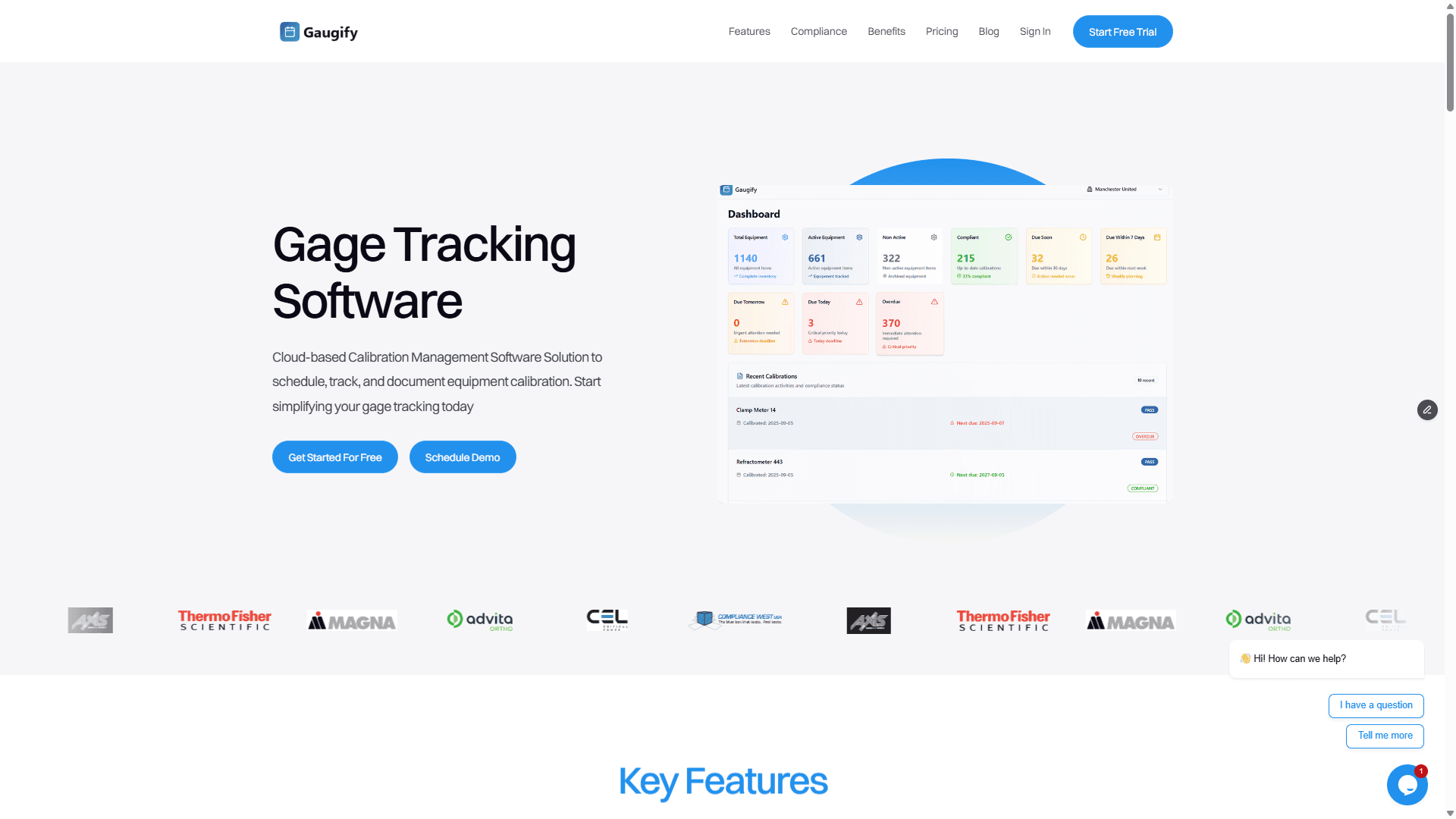
For operations managing 100+ instruments across multiple shifts, Gaugify's dashboard provides real-time visibility into calibration status, overdue equipment, and upcoming requirements. Quality managers can quickly identify potential issues and take corrective action before audits or customer inspections.
Comprehensive Certificate Management
Gaugify stores and organizes calibration certificates with searchable metadata, making audit preparation effortless. The platform validates certificate completeness, flagging missing uncertainty statements, environmental conditions, or traceability information that auditors frequently scrutinize. Digital storage eliminates lost certificates and provides instant access to historical calibration records.
The system manages complex certification requirements for different customer bases, ensuring aerospace CMM certificates include required uncertainty calculations while automotive certificates meet MSA requirements. Custom fields allow organizations to capture industry-specific information that traditional paper systems often miss.
Certificate templates can be configured for different equipment types and customer requirements, streamlining the documentation process while ensuring consistency across all calibration activities.
Advanced Uncertainty Calculations and Compliance Reporting
Gaugify's advanced features include built-in measurement uncertainty calculations that comply with ISO/IEC Guide 98-3 (GUM) requirements. The system automatically calculates combined uncertainties for complex measurement systems, ensuring that measurement capability studies meet customer requirements and industry standards.
Compliance reporting features generate audit-ready documentation for ISO 9001, AS9100, and other quality standards. Pre-configured report templates address common auditor requests, such as calibration interval justifications, equipment listing by location, and overdue equipment reports. Custom reports can be created to meet specific customer or regulatory requirements.
The platform maintains complete audit trails for all calibration activities, recording who performed calibrations, when they were completed, and any adjustments made to equipment. This level of documentation detail satisfies the most stringent audit requirements while providing valuable data for continuous improvement initiatives.
Ready to streamline your sheet metal calibration management? Start your free trial today and experience how modern calibration software can transform your quality management operations.
Integration with Existing Quality Management Systems
Sheet metal fabrication facilities often operate multiple software systems for ERP, quality management, and production planning. Gaugify integrates seamlessly with existing quality infrastructures, avoiding the disruption and cost of wholesale system replacements while extending calibration management capabilities across the organization.
ERP System Integration
Gaugify connects with popular ERP systems like SAP, Oracle, and Microsoft Dynamics to synchronize equipment master data and cost center information. This integration ensures calibration costs are properly allocated to production jobs while maintaining consistent equipment identification across all systems.
Work order integration allows calibration activities to be automatically triggered based on production schedules, usage hours, or quality events. For high-volume sheet metal operations, this capability ensures measuring equipment is always available when needed while minimizing calibration costs through optimized scheduling.
Quality Management System Connectivity
Gaugify's compliance features integrate with quality management platforms to provide comprehensive equipment validation data for nonconformance investigations and corrective action systems. When product issues arise, quality teams can quickly access calibration histories to determine if measurement system problems contributed to the issue.
The platform supports data export in multiple formats, enabling integration with statistical analysis software, customer reporting systems, and regulatory submission packages. This flexibility ensures calibration data can be leveraged across the entire quality management ecosystem.
Cost-Effective Implementation and Scalability
Implementing comprehensive calibration management software for sheet metal operations doesn't require massive capital investments or lengthy implementation projects. Gaugify's cloud-based architecture provides immediate access to enterprise-level calibration management capabilities without the complexity and cost of traditional on-premise solutions.
Rapid Deployment and User Adoption
Gaugify can be deployed within days rather than months, with intuitive interfaces that minimize training requirements for shop floor personnel and quality managers. Equipment data can be imported from existing spreadsheets or databases, preserving historical calibration information while transitioning to modern digital management.
The platform scales effortlessly from small job shops managing 50 instruments to large fabrication facilities with 1000+ pieces of measuring equipment. Flexible pricing models ensure organizations pay only for the capabilities they need while maintaining the ability to expand functionality as requirements grow.
Return on Investment Through Operational Efficiency
Organizations typically see immediate returns through reduced administrative overhead, eliminated lost certificates, and improved audit performance. The platform's automated scheduling and notification systems prevent costly equipment downtime while ensuring compliance with customer requirements and industry standards.
Advanced reporting capabilities support calibration interval optimization studies that can significantly reduce calibration costs without compromising measurement quality. For large sheet metal operations, interval optimization can yield thousands of dollars in annual savings while maintaining or improving measurement system performance.
Industry-Specific Features for Sheet Metal Applications
Gaugify includes specialized features that address the unique requirements of sheet metal fabrication operations, from managing portable measuring equipment to handling complex customer-specific calibration requirements.
Mobile Equipment Management
Sheet metal shops often move measuring equipment between work centers, production lines, and customer sites. Gaugify's mobile-friendly interface allows equipment status checks and calibration updates from any location, ensuring accurate tracking regardless of where equipment is used.
Location tracking features help organizations maintain visibility into equipment deployment while ensuring proper environmental controls and usage documentation. This capability is particularly important for aerospace and medical device applications where equipment usage history affects validation requirements.
Customer-Specific Calibration Requirements
Different customers often specify unique calibration requirements, intervals, or certificate formats. Gaugify manages these variations through configurable customer profiles that automatically apply appropriate requirements based on which products are being manufactured.
The system can maintain separate calibration schedules for the same equipment depending on customer requirements, ensuring aerospace customers receive 6-month CMM calibrations while commercial customers may accept 12-month intervals. This flexibility eliminates the need to over-calibrate equipment while ensuring all customer requirements are met.
Custom certificate templates can be configured for specific customers or applications, ensuring calibration documentation meets exact requirements without manual formatting or editing. This capability is essential for organizations serving multiple market segments with varying quality requirements.
Advanced Analytics and Continuous Improvement
Modern calibration management extends beyond simple scheduling and record keeping to provide actionable insights that drive continuous improvement initiatives and cost optimization. Gaugify's analytics capabilities transform calibration data into strategic business intelligence that supports operational excellence.
Equipment Performance Trending and Analysis
Gaugify tracks calibration results over time, identifying equipment that consistently requires adjustment or shows concerning drift patterns. This trending capability helps quality managers make informed decisions about equipment replacement, maintenance intervals, and calibration frequency optimization.
Statistical analysis tools identify correlations between equipment performance, usage patterns, and environmental conditions. For sheet metal operations, this might reveal that micrometers used in high-temperature forming areas require more frequent calibration or that CMMs in certain locations show seasonal drift patterns.
Predictive analytics capabilities flag equipment likely to fail calibration before scheduled dates, allowing proactive maintenance or replacement decisions that prevent production disruptions and quality issues.
Cost Analysis and Budget Planning
Comprehensive cost tracking features capture both internal and external calibration expenses, providing accurate data for budget planning and cost center allocation. Organizations can analyze calibration costs by equipment type, location, or customer program to identify optimization opportunities.
The platform supports make-vs-buy analysis for calibration services, helping organizations determine when internal calibration capabilities make economic sense versus outsourcing to commercial laboratories. This analysis considers not just direct costs but also factors like turnaround time, transportation expenses, and opportunity costs.
Budget forecasting tools project future calibration expenses based on equipment additions, interval changes, and historical cost trends. This capability supports strategic planning and helps organizations secure appropriate funding for calibration activities.
Ensuring Long-Term Success with Modern Calibration Management
Successful sheet metal fabrication operations recognize that effective calibration management is not just about compliance—it's about building sustainable competitive advantages through superior quality systems and operational efficiency. Organizations that invest in modern calibration management software for sheet metal operations position themselves for long-term success in increasingly demanding markets.
Gaugify's comprehensive platform addresses every aspect of calibration management, from basic scheduling and record keeping to advanced analytics and customer-specific requirements. The system grows with your organization, supporting expansion into new markets, additional product lines, and more sophisticated quality requirements.
The platform's cloud-based architecture ensures your calibration management system stays current with evolving industry standards, regulatory requirements, and best practices. Regular updates and feature enhancements provide continuous value without additional implementation costs or system disruptions.
Quality managers, shop floor supervisors, and laboratory technicians all benefit from Gaugify's intuitive interfaces and comprehensive functionality. The system eliminates the administrative burden of manual calibration management while providing the documentation rigor and analytical capabilities needed for modern manufacturing excellence.
Don't let outdated calibration management systems hold back your sheet metal fabrication operations. Modern cloud-based solutions like Gaugify provide immediate access to enterprise-level capabilities at a fraction of the cost and complexity of traditional systems. Your customers, auditors, and bottom line will all benefit from the improved efficiency, compliance, and quality that comes with professional calibration management.
Take the first step toward transforming your calibration management today. Schedule a personalized demo to see how Gaugify can address your specific sheet metal calibration challenges and start building a more efficient, compliant, and profitable operation.
Calibration Management Software for Sheet Metal Fabrication
Sheet metal fabrication shops face unique calibration challenges that can make or break their quality management systems. From precision micrometers measuring 0.001" tolerances to coordinate measuring machines (CMMs) validating complex aerospace components, effective calibration management software for sheet metal operations must handle diverse equipment types, tight deadlines, and stringent compliance requirements. Modern fabrication facilities can't afford calibration lapses that lead to scrapped parts, failed audits, or customer complaints.
Traditional paper-based calibration tracking systems crumble under the pressure of managing hundreds of measuring instruments across multiple production lines. When a Mitutoyo digital caliper goes out of tolerance during a critical aerospace job, or when an auditor questions the uncertainty calculations on your CMM certificates, you need robust digital systems that provide instant access to calibration records, automated scheduling, and complete audit trails.
Critical Equipment Requiring Calibration in Sheet Metal Operations
Sheet metal fabrication facilities rely on an extensive array of precision measuring equipment, each with specific calibration requirements and tolerance specifications. Understanding these instruments and their calibration needs is essential for maintaining quality standards and avoiding costly production delays.
Dimensional Measurement Tools
Micrometers represent the backbone of precision measurement in sheet metal work, typically requiring calibration to maintain accuracy within ±0.0001" across their measurement range. Starrett, Mitutoyo, and Brown & Sharpe micrometers are common in fabrication shops measuring everything from 0.250" aluminum brackets to 4.000" steel flanges. These instruments need calibration every 6-12 months depending on usage frequency and environmental conditions.
Digital calipers, while less precise than micrometers, handle the bulk of daily measurements in most shops. Quality operations managers typically maintain calibration schedules for 20-50 calipers per facility, with tolerance requirements of ±0.001" for most applications. Vernier calipers, dial calipers, and digital models all require different calibration approaches and documentation standards.
Height gauges and depth gauges play crucial roles in validating formed parts and assemblies. Starrett height masters and Mitutoyo depth micrometers commonly found in sheet metal shops require calibration against certified gauge blocks to maintain traceability to NIST standards.
Geometric and Form Measurement Equipment
Coordinate measuring machines (CMMs) represent the most complex calibration challenge in sheet metal fabrication. These systems, whether they're compact Mitutoyo Crysta-Apex models or large Zeiss bridge-type CMMs, require comprehensive calibration programs covering linear accuracy, probe qualification, and software validation. CMM calibration intervals typically range from 3-12 months, with uncertainty requirements often specified at 2-5 micrometers depending on the application.
Surface plates and granite inspection tables form the foundation for manual inspection operations. These references require periodic calibration to verify flatness within specified tolerances, typically 0.0002" per foot for precision work. Grade A surface plates used in aerospace applications demand more stringent calibration protocols than Grade B plates used for general fabrication.
Angle plates, sine plates, and other geometric references need regular validation to maintain angular accuracy within ±2-5 arc seconds for precision work. These tools are often overlooked in calibration programs but are essential for validating bent parts and complex assemblies.
Specialized Sheet Metal Measurement Equipment
Sheet metal thickness gauges, including both mechanical and ultrasonic types, require calibration against certified thickness standards. Fabrication shops working with materials from 0.010" to 0.500" thick need calibration programs that cover the full measurement range with appropriate uncertainty calculations.
Bend angle measurement tools, such as digital protractors and specialized bend angle gauges, need calibration to maintain accuracy within ±0.1-0.5 degrees depending on application requirements. These instruments are critical for validating formed parts against engineering drawings.
Hardness testers, while not always considered measuring equipment, play important roles in material verification and require calibration using certified hardness reference blocks. Rockwell, Brinell, and Shore hardness testers each have specific calibration requirements and documentation needs.
Quality Standards and Compliance Requirements for Sheet Metal Calibration Management
Sheet metal fabrication operations must navigate complex webs of quality standards and compliance requirements that directly impact their calibration management programs. Understanding these requirements and implementing appropriate calibration management software for sheet metal operations ensures continued compliance and customer satisfaction.
ISO 9001 and Quality Management System Requirements
ISO 9001:2015 clause 7.1.5 specifically addresses monitoring and measuring resources, requiring organizations to ensure measurement equipment is calibrated and verified at specified intervals against traceable standards. For sheet metal fabricators, this means maintaining detailed calibration records for every instrument used in quality control processes, from basic calipers to sophisticated CMMs.
The standard demands that calibration activities be documented with sufficient detail to demonstrate traceability and competence. This includes maintaining records of calibration dates, results, acceptance criteria, and any adjustments made to equipment. Sheet metal shops must also establish calibration intervals based on equipment stability, usage patterns, and measurement uncertainty requirements.
Aerospace and Defense Standards (AS9100, ISO/TS 16949)
Aerospace customers typically require AS9100 compliance, which builds upon ISO 9001 with additional requirements for configuration management and risk assessment. Sheet metal fabricators serving aerospace markets must maintain calibration programs that meet more stringent documentation requirements and demonstrate statistical control of measurement processes.
AS9100 requires calibration intervals to be established based on statistical analysis of historical calibration data, equipment stability studies, and risk assessments. This means fabrication shops need calibration management software for sheet metal operations that can track trending data, calculate measurement uncertainty, and generate statistical reports for interval optimization.
Automotive suppliers operating under ISO/TS 16949 face similar requirements, with additional emphasis on measurement system analysis (MSA) and gauge repeatability and reproducibility (GRR) studies. These requirements necessitate software systems capable of managing complex measurement uncertainty calculations and maintaining detailed audit trails.
Industry-Specific Compliance Requirements
Medical device manufacturers working with sheet metal components must comply with FDA 21 CFR Part 820 and ISO 13485 requirements. These standards require calibration programs that demonstrate equipment suitability for intended use and maintain detailed records of all calibration activities throughout the equipment lifecycle.
Nuclear industry suppliers face additional requirements under 10 CFR Part 50 Appendix B, which mandates calibration programs with enhanced documentation, qualified calibration personnel, and rigorous control of calibration standards. Sheet metal fabricators serving nuclear customers need software systems capable of managing these complex requirements while maintaining complete traceability.
Common Audit Scenarios and Auditor Expectations
Quality auditors examining sheet metal fabrication facilities focus heavily on calibration management systems, often making calibration compliance a make-or-break factor for certification maintenance. Understanding what auditors look for and preparing comprehensive responses can mean the difference between successful audits and costly non-conformances.
Equipment Identification and Calibration Status
Auditors typically begin calibration reviews by randomly selecting measuring equipment from the shop floor and verifying its calibration status. They expect to find clear identification labels showing calibration due dates, and they want immediate access to current calibration certificates. A common audit scenario involves an auditor picking up a Mitutoyo digital caliper from a workbench and asking to see its calibration record within minutes.
Effective calibration management software for sheet metal operations provides instant access to equipment records through barcode scanning or equipment search functions. Auditors appreciate systems that can quickly display calibration certificates, uncertainty calculations, and complete calibration histories without lengthy database searches or paper file retrievals.
When auditors find overdue equipment, they expect to see documented procedures for equipment quarantine and impact assessments. They want evidence that organizations have evaluated all measurements taken with out-of-calibration equipment and determined the impact on product quality. This requires software systems capable of tracking equipment usage and generating impact assessment reports.
Calibration Interval Justification
Experienced auditors question calibration intervals, particularly for expensive equipment like CMMs where organizations might be tempted to extend intervals for cost savings. They expect data-driven justifications based on historical calibration results, equipment stability studies, and risk assessments. A typical audit scenario involves reviewing CMM calibration intervals and asking for statistical evidence supporting 12-month intervals instead of 6-month schedules.
Auditors look for trending analysis that demonstrates equipment stability over time. They want to see charts showing measurement drift patterns, out-of-tolerance incidents, and correlation between calibration intervals and equipment performance. Software systems must provide robust reporting capabilities that present this data in clear, defensible formats.
Measurement Uncertainty and Traceability
Modern auditors increasingly focus on measurement uncertainty calculations and traceability chains. They expect fabrication shops to demonstrate that their measurement uncertainty is appropriate for the tolerances being measured. For example, when measuring ±0.005" tolerances on aerospace brackets, auditors want evidence that the measurement system uncertainty is 10:1 or better relative to the tolerance being verified.
Auditors trace calibration certificates back to national standards, looking for unbroken chains of traceability through accredited calibration laboratories. They examine calibration certificates for completeness, checking that uncertainty statements, environmental conditions, and calibration procedures are properly documented. Organizations need software systems that can store and organize these certificates while flagging any gaps in documentation.
How Gaugify Solves Sheet Metal Calibration Challenges
Modern sheet metal fabrication facilities need sophisticated digital solutions that address the unique calibration challenges of their industry. Gaugify provides comprehensive calibration management capabilities specifically designed to handle the complex requirements of sheet metal operations, from small job shops to large production facilities.
Automated Scheduling and Equipment Tracking
Gaugify's intelligent scheduling system eliminates the chaos of managing calibration due dates across diverse equipment types. The platform automatically generates calibration schedules based on equipment-specific intervals, usage patterns, and risk assessments. When your Starrett micrometer set approaches its due date, automated notifications ensure calibration activities are scheduled before equipment goes overdue.
The system handles complex scheduling scenarios common in sheet metal operations, such as coordinating CMM calibrations with production schedules or managing portable equipment that moves between work centers. Equipment can be easily tracked through barcode scanning or manual searches, providing instant access to calibration status information directly from the shop floor.
For operations managing 100+ instruments across multiple shifts, Gaugify's dashboard provides real-time visibility into calibration status, overdue equipment, and upcoming requirements. Quality managers can quickly identify potential issues and take corrective action before audits or customer inspections.
Comprehensive Certificate Management
Gaugify stores and organizes calibration certificates with searchable metadata, making audit preparation effortless. The platform validates certificate completeness, flagging missing uncertainty statements, environmental conditions, or traceability information that auditors frequently scrutinize. Digital storage eliminates lost certificates and provides instant access to historical calibration records.
The system manages complex certification requirements for different customer bases, ensuring aerospace CMM certificates include required uncertainty calculations while automotive certificates meet MSA requirements. Custom fields allow organizations to capture industry-specific information that traditional paper systems often miss.
Certificate templates can be configured for different equipment types and customer requirements, streamlining the documentation process while ensuring consistency across all calibration activities.
Advanced Uncertainty Calculations and Compliance Reporting
Gaugify's advanced features include built-in measurement uncertainty calculations that comply with ISO/IEC Guide 98-3 (GUM) requirements. The system automatically calculates combined uncertainties for complex measurement systems, ensuring that measurement capability studies meet customer requirements and industry standards.
Compliance reporting features generate audit-ready documentation for ISO 9001, AS9100, and other quality standards. Pre-configured report templates address common auditor requests, such as calibration interval justifications, equipment listing by location, and overdue equipment reports. Custom reports can be created to meet specific customer or regulatory requirements.
The platform maintains complete audit trails for all calibration activities, recording who performed calibrations, when they were completed, and any adjustments made to equipment. This level of documentation detail satisfies the most stringent audit requirements while providing valuable data for continuous improvement initiatives.
Ready to streamline your sheet metal calibration management? Start your free trial today and experience how modern calibration software can transform your quality management operations.
Integration with Existing Quality Management Systems
Sheet metal fabrication facilities often operate multiple software systems for ERP, quality management, and production planning. Gaugify integrates seamlessly with existing quality infrastructures, avoiding the disruption and cost of wholesale system replacements while extending calibration management capabilities across the organization.
ERP System Integration
Gaugify connects with popular ERP systems like SAP, Oracle, and Microsoft Dynamics to synchronize equipment master data and cost center information. This integration ensures calibration costs are properly allocated to production jobs while maintaining consistent equipment identification across all systems.
Work order integration allows calibration activities to be automatically triggered based on production schedules, usage hours, or quality events. For high-volume sheet metal operations, this capability ensures measuring equipment is always available when needed while minimizing calibration costs through optimized scheduling.
Quality Management System Connectivity
Gaugify's compliance features integrate with quality management platforms to provide comprehensive equipment validation data for nonconformance investigations and corrective action systems. When product issues arise, quality teams can quickly access calibration histories to determine if measurement system problems contributed to the issue.
The platform supports data export in multiple formats, enabling integration with statistical analysis software, customer reporting systems, and regulatory submission packages. This flexibility ensures calibration data can be leveraged across the entire quality management ecosystem.
Cost-Effective Implementation and Scalability
Implementing comprehensive calibration management software for sheet metal operations doesn't require massive capital investments or lengthy implementation projects. Gaugify's cloud-based architecture provides immediate access to enterprise-level calibration management capabilities without the complexity and cost of traditional on-premise solutions.
Rapid Deployment and User Adoption
Gaugify can be deployed within days rather than months, with intuitive interfaces that minimize training requirements for shop floor personnel and quality managers. Equipment data can be imported from existing spreadsheets or databases, preserving historical calibration information while transitioning to modern digital management.
The platform scales effortlessly from small job shops managing 50 instruments to large fabrication facilities with 1000+ pieces of measuring equipment. Flexible pricing models ensure organizations pay only for the capabilities they need while maintaining the ability to expand functionality as requirements grow.
Return on Investment Through Operational Efficiency
Organizations typically see immediate returns through reduced administrative overhead, eliminated lost certificates, and improved audit performance. The platform's automated scheduling and notification systems prevent costly equipment downtime while ensuring compliance with customer requirements and industry standards.
Advanced reporting capabilities support calibration interval optimization studies that can significantly reduce calibration costs without compromising measurement quality. For large sheet metal operations, interval optimization can yield thousands of dollars in annual savings while maintaining or improving measurement system performance.
Industry-Specific Features for Sheet Metal Applications
Gaugify includes specialized features that address the unique requirements of sheet metal fabrication operations, from managing portable measuring equipment to handling complex customer-specific calibration requirements.
Mobile Equipment Management
Sheet metal shops often move measuring equipment between work centers, production lines, and customer sites. Gaugify's mobile-friendly interface allows equipment status checks and calibration updates from any location, ensuring accurate tracking regardless of where equipment is used.
Location tracking features help organizations maintain visibility into equipment deployment while ensuring proper environmental controls and usage documentation. This capability is particularly important for aerospace and medical device applications where equipment usage history affects validation requirements.
Customer-Specific Calibration Requirements
Different customers often specify unique calibration requirements, intervals, or certificate formats. Gaugify manages these variations through configurable customer profiles that automatically apply appropriate requirements based on which products are being manufactured.
The system can maintain separate calibration schedules for the same equipment depending on customer requirements, ensuring aerospace customers receive 6-month CMM calibrations while commercial customers may accept 12-month intervals. This flexibility eliminates the need to over-calibrate equipment while ensuring all customer requirements are met.
Custom certificate templates can be configured for specific customers or applications, ensuring calibration documentation meets exact requirements without manual formatting or editing. This capability is essential for organizations serving multiple market segments with varying quality requirements.
Advanced Analytics and Continuous Improvement
Modern calibration management extends beyond simple scheduling and record keeping to provide actionable insights that drive continuous improvement initiatives and cost optimization. Gaugify's analytics capabilities transform calibration data into strategic business intelligence that supports operational excellence.
Equipment Performance Trending and Analysis
Gaugify tracks calibration results over time, identifying equipment that consistently requires adjustment or shows concerning drift patterns. This trending capability helps quality managers make informed decisions about equipment replacement, maintenance intervals, and calibration frequency optimization.
Statistical analysis tools identify correlations between equipment performance, usage patterns, and environmental conditions. For sheet metal operations, this might reveal that micrometers used in high-temperature forming areas require more frequent calibration or that CMMs in certain locations show seasonal drift patterns.
Predictive analytics capabilities flag equipment likely to fail calibration before scheduled dates, allowing proactive maintenance or replacement decisions that prevent production disruptions and quality issues.
Cost Analysis and Budget Planning
Comprehensive cost tracking features capture both internal and external calibration expenses, providing accurate data for budget planning and cost center allocation. Organizations can analyze calibration costs by equipment type, location, or customer program to identify optimization opportunities.
The platform supports make-vs-buy analysis for calibration services, helping organizations determine when internal calibration capabilities make economic sense versus outsourcing to commercial laboratories. This analysis considers not just direct costs but also factors like turnaround time, transportation expenses, and opportunity costs.
Budget forecasting tools project future calibration expenses based on equipment additions, interval changes, and historical cost trends. This capability supports strategic planning and helps organizations secure appropriate funding for calibration activities.
Ensuring Long-Term Success with Modern Calibration Management
Successful sheet metal fabrication operations recognize that effective calibration management is not just about compliance—it's about building sustainable competitive advantages through superior quality systems and operational efficiency. Organizations that invest in modern calibration management software for sheet metal operations position themselves for long-term success in increasingly demanding markets.
Gaugify's comprehensive platform addresses every aspect of calibration management, from basic scheduling and record keeping to advanced analytics and customer-specific requirements. The system grows with your organization, supporting expansion into new markets, additional product lines, and more sophisticated quality requirements.
The platform's cloud-based architecture ensures your calibration management system stays current with evolving industry standards, regulatory requirements, and best practices. Regular updates and feature enhancements provide continuous value without additional implementation costs or system disruptions.
Quality managers, shop floor supervisors, and laboratory technicians all benefit from Gaugify's intuitive interfaces and comprehensive functionality. The system eliminates the administrative burden of manual calibration management while providing the documentation rigor and analytical capabilities needed for modern manufacturing excellence.
Don't let outdated calibration management systems hold back your sheet metal fabrication operations. Modern cloud-based solutions like Gaugify provide immediate access to enterprise-level capabilities at a fraction of the cost and complexity of traditional systems. Your customers, auditors, and bottom line will all benefit from the improved efficiency, compliance, and quality that comes with professional calibration management.
Take the first step toward transforming your calibration management today. Schedule a personalized demo to see how Gaugify can address your specific sheet metal calibration challenges and start building a more efficient, compliant, and profitable operation.