
Calibration Management Software for Fastener Manufacturing
Calibration Management Software for Fastener Manufacturing
David Bentley
Quality Assurance Engineer
12 min read
Calibration Management Software for Fastener Manufacturing
Fastener manufacturing demands precision at every level—from thread pitch measurements to torque specifications that can mean the difference between structural integrity and catastrophic failure. Your calibration management software fastener program needs to handle hundreds of measuring instruments while maintaining traceability to NIST standards and meeting stringent automotive, aerospace, and construction industry requirements. Manual calibration tracking simply can't keep pace with the complexity and volume of modern fastener production.
When a major automotive supplier recently faced a customer audit that revealed expired calibration certificates on critical thread pitch gages used for M8 x 1.25 bolts, the resulting production shutdown cost over $150,000 in just three days. This scenario plays out across fastener manufacturing facilities when calibration management systems fail to provide real-time visibility and automated scheduling.
Critical Equipment Requiring Calibration in Fastener Manufacturing
Fastener manufacturing relies on an extensive array of measuring equipment that requires precise calibration management. Understanding which instruments need calibration and their specific requirements is crucial for maintaining quality standards.
Thread Measurement Equipment
Thread pitch gages, thread ring gages, and thread plug gages form the backbone of fastener quality control. These instruments typically require calibration every 12 months with measurement uncertainties of ±0.005mm for standard metric threads. Thread micrometers used for measuring major and minor diameters need calibration every 6-12 months depending on usage frequency.
Go/No-Go thread gages present unique calibration challenges since they're often considered standards themselves but still require periodic verification against master gages. Your calibration management software fastener system must track both the verification schedule and the condition of these critical tools.
Dimensional Measurement Instruments
Coordinate Measuring Machines (CMMs) used for dimensional verification of fastener geometry require comprehensive calibration programs. Ball bar tests, laser interferometer checks, and probe qualification must be scheduled and documented according to ISO 10360 standards. Many fastener manufacturers run CMM verification cycles every 90 days for high-volume production lines.
Digital calipers and micrometers used on the shop floor for routine checks need calibration every 6-12 months. With tolerance requirements often within ±0.01mm for precision fasteners, these instruments require calibration certificates showing measurement uncertainty ratios of at least 4:1.
Torque and Force Testing Equipment
Torque wrenches and torque analyzers used for fastener testing require calibration at multiple points across their range. A typical torque wrench calibration covers 20%, 60%, and 100% of full scale with uncertainties typically within ±2-4% of reading. Force testing machines used for tensile and proof load testing need calibration according to ASTM E4 standards.
Torque transducers and load cells in production testing equipment often require quarterly calibration due to their critical role in determining fastener mechanical properties. These instruments may need calibration at 10-15 different load points to ensure accuracy across the full operating range.
Hardness Testing Equipment
Rockwell, Brinell, and Vickers hardness testers used for fastener material verification require both machine calibration and test block verification. Rockwell hardness testers typically need calibration every 12 months using certified reference blocks at multiple hardness levels (HRC 25, 45, and 62 for steel fasteners).
Portable hardness testers used on the shop floor may require more frequent calibration every 6 months due to handling and environmental conditions. Your calibration management system must track both the instrument calibration and the reference blocks used for daily verification checks.
Quality Standards and Compliance Requirements for Fastener Calibration Management Software
Fastener manufacturing operates under multiple overlapping quality standards that directly impact calibration requirements. Understanding these standards ensures your calibration management software fastener program meets all necessary compliance obligations.
ISO/TS 16949 and IATF 16949 Requirements
Automotive fastener suppliers must comply with IATF 16949, which requires calibration of all measurement equipment used for product acceptance. This includes maintaining calibration records showing traceability to national or international standards, typically NIST or PTB. The standard requires calibration intervals to be established based on stability, purpose, and previous calibration history.
Measurement System Analysis (MSA) requirements under IATF 16949 mandate that gage R&R studies be performed on critical measurement systems. For thread measurement equipment, this often means quarterly MSA studies with acceptance criteria of less than 10% variation for critical characteristics like thread pitch and major diameter.
AS9100 Aerospace Standards
Aerospace fastener manufacturers must meet AS9100 requirements, which include specific calibration management provisions. Key requirements include maintaining calibration status identification on all instruments, ensuring measurement uncertainty is considered in acceptance decisions, and establishing calibration intervals based on risk assessment.
The aerospace industry often requires calibration intervals shorter than general manufacturing—typically 6 months for critical measurement equipment used on flight-critical fasteners. Calibration certificates must show measurement uncertainty calculations, and the uncertainty must be included in product acceptance decisions.
ISO 9001 and ISO 17025 Integration
Many fastener manufacturers maintain both ISO 9001 certification and operate ISO 17025 accredited calibration laboratories. This requires calibration management software that can handle both internal calibration activities and external vendor management.
ISO 17025 requirements include maintaining detailed calibration procedures, environmental condition monitoring, and comprehensive measurement uncertainty budgets. Your calibration management system must support uncertainty calculations that include contributions from the reference standard, environmental conditions, and measurement procedure.
Common Audit Scenarios in Fastener Manufacturing
Understanding what auditors look for during calibration system assessments helps you prepare your calibration management software fastener program for success. These scenarios are based on actual audit experiences across multiple fastener manufacturing facilities.
Customer Audit Scenario: Automotive Tier 1 Supplier Assessment
During a recent customer audit at a fastener manufacturer producing M12 x 1.75 bolts for suspension components, the auditor requested evidence of calibration for all measurement equipment used in the production line. The audit team specifically wanted to see:
Real-time calibration status for thread ring gages used on the production line
Calibration certificates for the CMM used for first article inspection
Evidence that measurement uncertainty was considered in product acceptance decisions
Traceability records showing calibration path back to NIST standards
The manufacturer's manual spreadsheet system couldn't quickly produce this information, resulting in a major nonconformance and requirement for immediate corrective action. Modern calibration management software would have provided instant access to all required documentation.
AS9100 Surveillance Audit Focus Areas
Aerospace auditors examining fastener manufacturing calibration systems typically focus on risk-based calibration intervals and measurement uncertainty management. They want to see evidence that calibration intervals are established based on:
Equipment stability and drift characteristics
Usage frequency and environmental conditions
Consequences of measurement error on product safety
Historical calibration data analysis
Auditors also examine how measurement uncertainty is calculated and applied in product acceptance decisions. For aerospace fasteners with tolerance requirements of ±0.025mm, they expect to see uncertainty budgets and evidence that total measurement uncertainty doesn't exceed 25% of the product tolerance.
ISO 17025 Technical Assessment
Technical assessors evaluating fastener manufacturer calibration laboratories focus heavily on measurement uncertainty calculations and environmental condition monitoring. They examine:
Detailed uncertainty budgets for each calibration procedure
Environmental monitoring records for temperature and humidity
Reference standard calibration certificates and uncertainty contributions
Proficiency testing participation and results
A common finding involves inadequate documentation of environmental corrections, especially for dimensional measurements where thermal expansion can significantly impact results.
How Calibration Management Software Fastener Solutions Address Industry Pain Points
Modern calibration management software addresses the specific challenges faced by fastener manufacturers through automated scheduling, comprehensive documentation, and real-time visibility into calibration status.
Automated Scheduling and Notifications
Advanced calibration management features include automated scheduling that considers equipment criticality, usage patterns, and historical performance. For fastener manufacturing, this means different scheduling strategies for different equipment types.
Thread measurement gages used on critical automotive production lines might be scheduled every 6 months, while reference standards used quarterly might have 12-month intervals. The system automatically generates work orders 30-60 days before due dates and escalates notifications if calibrations become overdue.
Risk-based scheduling capabilities allow you to establish different intervals based on equipment criticality. Tools used for safety-critical aerospace fasteners can have shorter intervals than those used for general industrial applications, all managed automatically by the software.
Comprehensive Certificate Management
Digital certificate storage eliminates the paper filing systems that create audit nightmares. Each calibration certificate is automatically linked to the specific instrument and includes all required information:
Calibration data and as-found/as-left conditions
Measurement uncertainty calculations
Environmental conditions during calibration
Traceability chain to national standards
Technician qualifications and signatures
The system can generate instant reports showing calibration status for any date range, making customer audits straightforward and stress-free.
Measurement Uncertainty Calculations
Built-in uncertainty calculation tools help fastener manufacturers comply with ISO 17025 and customer requirements. The software can calculate combined uncertainty from multiple sources including reference standards, environmental conditions, and measurement procedures.
For thread pitch measurements, the system might combine uncertainties from the master thread gage (±0.002mm), temperature effects (±0.001mm), and measurement procedure repeatability (±0.0015mm) to calculate a combined uncertainty of ±0.0026mm.
Complete Audit Trail Management
Every action in the calibration management system creates an audit trail entry, providing complete traceability of all calibration activities. This includes who performed calibrations, when they were completed, any adjustments made, and approval signatures.
The system maintains historical records indefinitely, allowing you to demonstrate calibration compliance over multiple years during customer assessments or regulatory audits.
Ready to streamline your fastener manufacturing calibration management? See how modern calibration software can eliminate manual tracking, ensure compliance, and pass every audit. Start your free trial today and experience automated scheduling, digital certificates, and real-time calibration status visibility.
Integration with Manufacturing Systems
Modern calibration management software fastener solutions integrate seamlessly with existing manufacturing systems, providing real-time calibration status information where it's needed most.
ERP System Integration
Integration with ERP systems allows calibration status to be checked automatically during production planning. If a critical thread gage is overdue for calibration, the system can prevent work orders from being released until calibration is completed.
This prevents the costly scenario of discovering expired calibrations mid-production run, which can result in product quarantine and customer notifications.
Quality Management System Connection
Links to quality management systems ensure that calibration status is automatically checked during inspection activities. When a quality technician scans a gage ID to record inspection results, the system verifies current calibration status and alerts if calibration is due soon.
Nonconformance integration automatically creates calibration alerts when measurement equipment is involved in quality issues. If a batch of fasteners fails dimensional inspection, the system can flag all related measurement equipment for immediate calibration verification.
Real-Time Dashboard Visibility
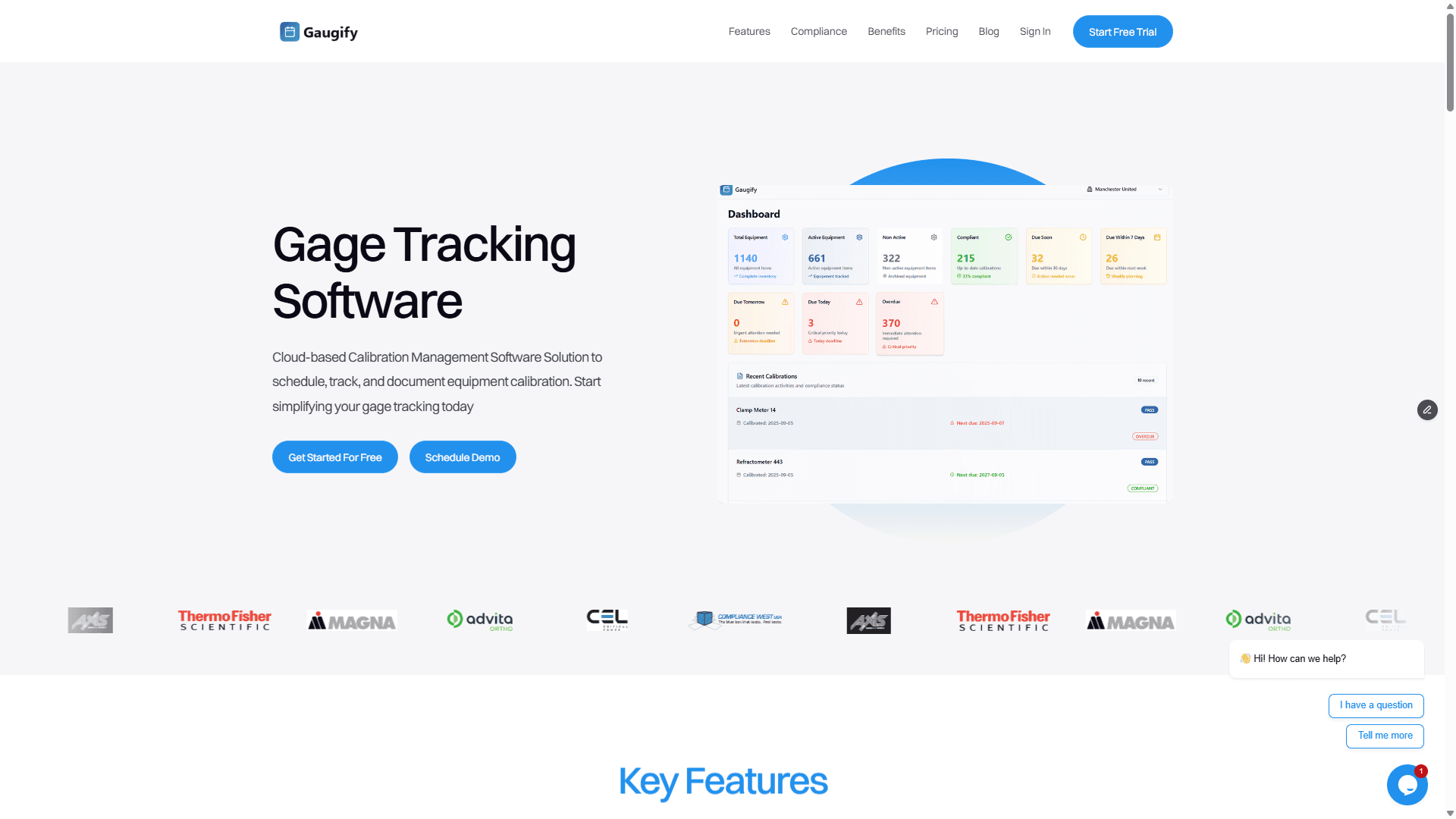
Management dashboards provide instant visibility into calibration program health across the entire facility. Key metrics include:
Percentage of instruments in calibration
Upcoming calibration requirements by department
Overdue calibrations requiring immediate attention
Calibration costs by equipment category
Vendor performance for external calibrations
This visibility enables proactive management rather than reactive fire-fighting when calibrations become overdue.
Cost Management and ROI for Fastener Manufacturers
Implementing calibration management software delivers measurable ROI through reduced administrative overhead, eliminated production delays, and improved audit performance.
Administrative Cost Reduction
Manual calibration tracking typically requires 2-4 hours per week of administrative time in a medium-sized fastener manufacturing facility. Automated scheduling and certificate management can reduce this to 30 minutes per week, saving 150+ hours annually.
At an average burden rate of $75/hour for quality technicians, this represents $11,250 in annual savings just from administrative efficiency improvements.
Production Delay Prevention
The cost of discovering expired calibrations during production can be substantial. A typical production line stoppage while waiting for urgent calibration service costs $2,000-5,000 per day in lost productivity, not including potential customer notification requirements.
Preventing just two production stoppages per year through automated calibration scheduling can save $10,000-20,000 annually.
Audit Performance Improvement
Failed audits result in corrective action costs, potential customer penalties, and management time investment. The average cost of a major audit nonconformance in fastener manufacturing ranges from $15,000-50,000 including corrective actions and follow-up audits.
Comprehensive compliance management helps ensure audit success and avoid these costly failures.
Implementation Best Practices for Fastener Manufacturing
Successful implementation of calibration management software fastener systems requires careful planning and attention to industry-specific requirements.
Equipment Inventory and Criticality Assessment
Start implementation with a complete inventory of all measurement equipment, including identification tags, current calibration status, and criticality assessment. For fastener manufacturing, this typically includes:
Critical equipment: Thread gages for safety-critical fasteners (6-month intervals)
Important equipment: CMMs and force testing machines (12-month intervals)
Standard equipment: Calipers and micrometers for routine checks (12-24 month intervals)
The criticality assessment drives calibration interval determination and scheduling priorities within the software system.
Procedure Documentation and Uncertainty Budgets
Document all calibration procedures with detailed uncertainty budgets before system implementation. This ensures the software can automatically calculate and report measurement uncertainty as required by customer specifications.
For thread measurement equipment, uncertainty budgets typically include contributions from reference standards (±0.002mm), environmental conditions (±0.001mm), and measurement procedure (±0.001-0.002mm).
Vendor Management Setup
Configure vendor management capabilities to handle external calibration services. Many fastener manufacturers use external providers for specialized equipment like CMMs, force testing machines, and environmental chambers.
The system should track vendor performance metrics including on-time delivery, certificate quality, and calibration results to enable data-driven vendor selection decisions.
Future-Proofing Your Calibration Management Program
Modern calibration management software fastener solutions prepare your organization for evolving industry requirements and technology advances.
Industry 4.0 Integration
Smart manufacturing initiatives require calibration systems that integrate with IoT sensors and automated data collection. Advanced calibration software can receive measurement data directly from connected instruments and automatically schedule calibrations based on usage patterns and drift analysis.
This capability becomes increasingly important as fastener manufacturing adopts automated measurement systems and inline quality control technologies.
Advanced Analytics and Predictive Maintenance
Machine learning capabilities analyze historical calibration data to predict instrument drift and optimize calibration intervals. For thread measurement gages, the system might analyze thousands of calibration records to identify patterns that indicate when intervals can be safely extended or need to be shortened.
This data-driven approach to calibration management reduces costs while maintaining compliance and quality standards.
Regulatory Evolution Management
As quality standards evolve, your calibration management system must adapt to new requirements. Cloud-based solutions receive automatic updates that incorporate new compliance requirements and industry best practices.
This ensures your fastener manufacturing calibration program remains compliant with changing automotive, aerospace, and general industry standards without requiring system overhauls.
Modern fastener manufacturing demands precision, compliance, and efficiency in every aspect of operations—especially calibration management. The complexity of managing hundreds of measurement instruments while meeting stringent automotive, aerospace, and industrial standards requires more than manual spreadsheets and paper certificates.
Gaugify's cloud-based calibration management platform provides fastener manufacturers with the tools needed to automate scheduling, maintain comprehensive documentation, calculate measurement uncertainties, and pass every audit with confidence. From thread gages to CMMs, torque equipment to hardness testers, our platform handles the full spectrum of fastener manufacturing calibration requirements.
The ROI is clear: reduced administrative overhead, eliminated production delays, improved audit performance, and the peace of mind that comes from knowing your calibration program meets every industry standard. Don't let manual calibration management put your quality system at risk or cost you valuable production time.
Take control of your fastener manufacturing calibration management today. Start your free trial and discover how modern calibration software can transform your quality operations, ensure compliance, and eliminate the stress of customer audits. Your precision fastener manufacturing deserves precision calibration management.
Calibration Management Software for Fastener Manufacturing
Fastener manufacturing demands precision at every level—from thread pitch measurements to torque specifications that can mean the difference between structural integrity and catastrophic failure. Your calibration management software fastener program needs to handle hundreds of measuring instruments while maintaining traceability to NIST standards and meeting stringent automotive, aerospace, and construction industry requirements. Manual calibration tracking simply can't keep pace with the complexity and volume of modern fastener production.
When a major automotive supplier recently faced a customer audit that revealed expired calibration certificates on critical thread pitch gages used for M8 x 1.25 bolts, the resulting production shutdown cost over $150,000 in just three days. This scenario plays out across fastener manufacturing facilities when calibration management systems fail to provide real-time visibility and automated scheduling.
Critical Equipment Requiring Calibration in Fastener Manufacturing
Fastener manufacturing relies on an extensive array of measuring equipment that requires precise calibration management. Understanding which instruments need calibration and their specific requirements is crucial for maintaining quality standards.
Thread Measurement Equipment
Thread pitch gages, thread ring gages, and thread plug gages form the backbone of fastener quality control. These instruments typically require calibration every 12 months with measurement uncertainties of ±0.005mm for standard metric threads. Thread micrometers used for measuring major and minor diameters need calibration every 6-12 months depending on usage frequency.
Go/No-Go thread gages present unique calibration challenges since they're often considered standards themselves but still require periodic verification against master gages. Your calibration management software fastener system must track both the verification schedule and the condition of these critical tools.
Dimensional Measurement Instruments
Coordinate Measuring Machines (CMMs) used for dimensional verification of fastener geometry require comprehensive calibration programs. Ball bar tests, laser interferometer checks, and probe qualification must be scheduled and documented according to ISO 10360 standards. Many fastener manufacturers run CMM verification cycles every 90 days for high-volume production lines.
Digital calipers and micrometers used on the shop floor for routine checks need calibration every 6-12 months. With tolerance requirements often within ±0.01mm for precision fasteners, these instruments require calibration certificates showing measurement uncertainty ratios of at least 4:1.
Torque and Force Testing Equipment
Torque wrenches and torque analyzers used for fastener testing require calibration at multiple points across their range. A typical torque wrench calibration covers 20%, 60%, and 100% of full scale with uncertainties typically within ±2-4% of reading. Force testing machines used for tensile and proof load testing need calibration according to ASTM E4 standards.
Torque transducers and load cells in production testing equipment often require quarterly calibration due to their critical role in determining fastener mechanical properties. These instruments may need calibration at 10-15 different load points to ensure accuracy across the full operating range.
Hardness Testing Equipment
Rockwell, Brinell, and Vickers hardness testers used for fastener material verification require both machine calibration and test block verification. Rockwell hardness testers typically need calibration every 12 months using certified reference blocks at multiple hardness levels (HRC 25, 45, and 62 for steel fasteners).
Portable hardness testers used on the shop floor may require more frequent calibration every 6 months due to handling and environmental conditions. Your calibration management system must track both the instrument calibration and the reference blocks used for daily verification checks.
Quality Standards and Compliance Requirements for Fastener Calibration Management Software
Fastener manufacturing operates under multiple overlapping quality standards that directly impact calibration requirements. Understanding these standards ensures your calibration management software fastener program meets all necessary compliance obligations.
ISO/TS 16949 and IATF 16949 Requirements
Automotive fastener suppliers must comply with IATF 16949, which requires calibration of all measurement equipment used for product acceptance. This includes maintaining calibration records showing traceability to national or international standards, typically NIST or PTB. The standard requires calibration intervals to be established based on stability, purpose, and previous calibration history.
Measurement System Analysis (MSA) requirements under IATF 16949 mandate that gage R&R studies be performed on critical measurement systems. For thread measurement equipment, this often means quarterly MSA studies with acceptance criteria of less than 10% variation for critical characteristics like thread pitch and major diameter.
AS9100 Aerospace Standards
Aerospace fastener manufacturers must meet AS9100 requirements, which include specific calibration management provisions. Key requirements include maintaining calibration status identification on all instruments, ensuring measurement uncertainty is considered in acceptance decisions, and establishing calibration intervals based on risk assessment.
The aerospace industry often requires calibration intervals shorter than general manufacturing—typically 6 months for critical measurement equipment used on flight-critical fasteners. Calibration certificates must show measurement uncertainty calculations, and the uncertainty must be included in product acceptance decisions.
ISO 9001 and ISO 17025 Integration
Many fastener manufacturers maintain both ISO 9001 certification and operate ISO 17025 accredited calibration laboratories. This requires calibration management software that can handle both internal calibration activities and external vendor management.
ISO 17025 requirements include maintaining detailed calibration procedures, environmental condition monitoring, and comprehensive measurement uncertainty budgets. Your calibration management system must support uncertainty calculations that include contributions from the reference standard, environmental conditions, and measurement procedure.
Common Audit Scenarios in Fastener Manufacturing
Understanding what auditors look for during calibration system assessments helps you prepare your calibration management software fastener program for success. These scenarios are based on actual audit experiences across multiple fastener manufacturing facilities.
Customer Audit Scenario: Automotive Tier 1 Supplier Assessment
During a recent customer audit at a fastener manufacturer producing M12 x 1.75 bolts for suspension components, the auditor requested evidence of calibration for all measurement equipment used in the production line. The audit team specifically wanted to see:
Real-time calibration status for thread ring gages used on the production line
Calibration certificates for the CMM used for first article inspection
Evidence that measurement uncertainty was considered in product acceptance decisions
Traceability records showing calibration path back to NIST standards
The manufacturer's manual spreadsheet system couldn't quickly produce this information, resulting in a major nonconformance and requirement for immediate corrective action. Modern calibration management software would have provided instant access to all required documentation.
AS9100 Surveillance Audit Focus Areas
Aerospace auditors examining fastener manufacturing calibration systems typically focus on risk-based calibration intervals and measurement uncertainty management. They want to see evidence that calibration intervals are established based on:
Equipment stability and drift characteristics
Usage frequency and environmental conditions
Consequences of measurement error on product safety
Historical calibration data analysis
Auditors also examine how measurement uncertainty is calculated and applied in product acceptance decisions. For aerospace fasteners with tolerance requirements of ±0.025mm, they expect to see uncertainty budgets and evidence that total measurement uncertainty doesn't exceed 25% of the product tolerance.
ISO 17025 Technical Assessment
Technical assessors evaluating fastener manufacturer calibration laboratories focus heavily on measurement uncertainty calculations and environmental condition monitoring. They examine:
Detailed uncertainty budgets for each calibration procedure
Environmental monitoring records for temperature and humidity
Reference standard calibration certificates and uncertainty contributions
Proficiency testing participation and results
A common finding involves inadequate documentation of environmental corrections, especially for dimensional measurements where thermal expansion can significantly impact results.
How Calibration Management Software Fastener Solutions Address Industry Pain Points
Modern calibration management software addresses the specific challenges faced by fastener manufacturers through automated scheduling, comprehensive documentation, and real-time visibility into calibration status.
Automated Scheduling and Notifications
Advanced calibration management features include automated scheduling that considers equipment criticality, usage patterns, and historical performance. For fastener manufacturing, this means different scheduling strategies for different equipment types.
Thread measurement gages used on critical automotive production lines might be scheduled every 6 months, while reference standards used quarterly might have 12-month intervals. The system automatically generates work orders 30-60 days before due dates and escalates notifications if calibrations become overdue.
Risk-based scheduling capabilities allow you to establish different intervals based on equipment criticality. Tools used for safety-critical aerospace fasteners can have shorter intervals than those used for general industrial applications, all managed automatically by the software.
Comprehensive Certificate Management
Digital certificate storage eliminates the paper filing systems that create audit nightmares. Each calibration certificate is automatically linked to the specific instrument and includes all required information:
Calibration data and as-found/as-left conditions
Measurement uncertainty calculations
Environmental conditions during calibration
Traceability chain to national standards
Technician qualifications and signatures
The system can generate instant reports showing calibration status for any date range, making customer audits straightforward and stress-free.
Measurement Uncertainty Calculations
Built-in uncertainty calculation tools help fastener manufacturers comply with ISO 17025 and customer requirements. The software can calculate combined uncertainty from multiple sources including reference standards, environmental conditions, and measurement procedures.
For thread pitch measurements, the system might combine uncertainties from the master thread gage (±0.002mm), temperature effects (±0.001mm), and measurement procedure repeatability (±0.0015mm) to calculate a combined uncertainty of ±0.0026mm.
Complete Audit Trail Management
Every action in the calibration management system creates an audit trail entry, providing complete traceability of all calibration activities. This includes who performed calibrations, when they were completed, any adjustments made, and approval signatures.
The system maintains historical records indefinitely, allowing you to demonstrate calibration compliance over multiple years during customer assessments or regulatory audits.
Ready to streamline your fastener manufacturing calibration management? See how modern calibration software can eliminate manual tracking, ensure compliance, and pass every audit. Start your free trial today and experience automated scheduling, digital certificates, and real-time calibration status visibility.
Integration with Manufacturing Systems
Modern calibration management software fastener solutions integrate seamlessly with existing manufacturing systems, providing real-time calibration status information where it's needed most.
ERP System Integration
Integration with ERP systems allows calibration status to be checked automatically during production planning. If a critical thread gage is overdue for calibration, the system can prevent work orders from being released until calibration is completed.
This prevents the costly scenario of discovering expired calibrations mid-production run, which can result in product quarantine and customer notifications.
Quality Management System Connection
Links to quality management systems ensure that calibration status is automatically checked during inspection activities. When a quality technician scans a gage ID to record inspection results, the system verifies current calibration status and alerts if calibration is due soon.
Nonconformance integration automatically creates calibration alerts when measurement equipment is involved in quality issues. If a batch of fasteners fails dimensional inspection, the system can flag all related measurement equipment for immediate calibration verification.
Real-Time Dashboard Visibility
Management dashboards provide instant visibility into calibration program health across the entire facility. Key metrics include:
Percentage of instruments in calibration
Upcoming calibration requirements by department
Overdue calibrations requiring immediate attention
Calibration costs by equipment category
Vendor performance for external calibrations
This visibility enables proactive management rather than reactive fire-fighting when calibrations become overdue.
Cost Management and ROI for Fastener Manufacturers
Implementing calibration management software delivers measurable ROI through reduced administrative overhead, eliminated production delays, and improved audit performance.
Administrative Cost Reduction
Manual calibration tracking typically requires 2-4 hours per week of administrative time in a medium-sized fastener manufacturing facility. Automated scheduling and certificate management can reduce this to 30 minutes per week, saving 150+ hours annually.
At an average burden rate of $75/hour for quality technicians, this represents $11,250 in annual savings just from administrative efficiency improvements.
Production Delay Prevention
The cost of discovering expired calibrations during production can be substantial. A typical production line stoppage while waiting for urgent calibration service costs $2,000-5,000 per day in lost productivity, not including potential customer notification requirements.
Preventing just two production stoppages per year through automated calibration scheduling can save $10,000-20,000 annually.
Audit Performance Improvement
Failed audits result in corrective action costs, potential customer penalties, and management time investment. The average cost of a major audit nonconformance in fastener manufacturing ranges from $15,000-50,000 including corrective actions and follow-up audits.
Comprehensive compliance management helps ensure audit success and avoid these costly failures.
Implementation Best Practices for Fastener Manufacturing
Successful implementation of calibration management software fastener systems requires careful planning and attention to industry-specific requirements.
Equipment Inventory and Criticality Assessment
Start implementation with a complete inventory of all measurement equipment, including identification tags, current calibration status, and criticality assessment. For fastener manufacturing, this typically includes:
Critical equipment: Thread gages for safety-critical fasteners (6-month intervals)
Important equipment: CMMs and force testing machines (12-month intervals)
Standard equipment: Calipers and micrometers for routine checks (12-24 month intervals)
The criticality assessment drives calibration interval determination and scheduling priorities within the software system.
Procedure Documentation and Uncertainty Budgets
Document all calibration procedures with detailed uncertainty budgets before system implementation. This ensures the software can automatically calculate and report measurement uncertainty as required by customer specifications.
For thread measurement equipment, uncertainty budgets typically include contributions from reference standards (±0.002mm), environmental conditions (±0.001mm), and measurement procedure (±0.001-0.002mm).
Vendor Management Setup
Configure vendor management capabilities to handle external calibration services. Many fastener manufacturers use external providers for specialized equipment like CMMs, force testing machines, and environmental chambers.
The system should track vendor performance metrics including on-time delivery, certificate quality, and calibration results to enable data-driven vendor selection decisions.
Future-Proofing Your Calibration Management Program
Modern calibration management software fastener solutions prepare your organization for evolving industry requirements and technology advances.
Industry 4.0 Integration
Smart manufacturing initiatives require calibration systems that integrate with IoT sensors and automated data collection. Advanced calibration software can receive measurement data directly from connected instruments and automatically schedule calibrations based on usage patterns and drift analysis.
This capability becomes increasingly important as fastener manufacturing adopts automated measurement systems and inline quality control technologies.
Advanced Analytics and Predictive Maintenance
Machine learning capabilities analyze historical calibration data to predict instrument drift and optimize calibration intervals. For thread measurement gages, the system might analyze thousands of calibration records to identify patterns that indicate when intervals can be safely extended or need to be shortened.
This data-driven approach to calibration management reduces costs while maintaining compliance and quality standards.
Regulatory Evolution Management
As quality standards evolve, your calibration management system must adapt to new requirements. Cloud-based solutions receive automatic updates that incorporate new compliance requirements and industry best practices.
This ensures your fastener manufacturing calibration program remains compliant with changing automotive, aerospace, and general industry standards without requiring system overhauls.
Modern fastener manufacturing demands precision, compliance, and efficiency in every aspect of operations—especially calibration management. The complexity of managing hundreds of measurement instruments while meeting stringent automotive, aerospace, and industrial standards requires more than manual spreadsheets and paper certificates.
Gaugify's cloud-based calibration management platform provides fastener manufacturers with the tools needed to automate scheduling, maintain comprehensive documentation, calculate measurement uncertainties, and pass every audit with confidence. From thread gages to CMMs, torque equipment to hardness testers, our platform handles the full spectrum of fastener manufacturing calibration requirements.
The ROI is clear: reduced administrative overhead, eliminated production delays, improved audit performance, and the peace of mind that comes from knowing your calibration program meets every industry standard. Don't let manual calibration management put your quality system at risk or cost you valuable production time.
Take control of your fastener manufacturing calibration management today. Start your free trial and discover how modern calibration software can transform your quality operations, ensure compliance, and eliminate the stress of customer audits. Your precision fastener manufacturing deserves precision calibration management.