
Calibration Management Software for Veterinary Labs
Calibration Management Software for Veterinary Labs
David Bentley
Quality Assurance Engineer
12 min read
Calibration Management Software for Veterinary Labs
Veterinary laboratories face unique challenges when managing calibration programs for their critical testing equipment. From ensuring accurate diagnostic results that could mean the difference between life and death for animals, to maintaining compliance with FDA, USDA, and state veterinary board requirements, choosing the right calibration management software veterinary labs can rely on is crucial for operational success.
Unlike human medical labs that primarily focus on clinical diagnostics, veterinary facilities must calibrate equipment used for everything from routine wellness screenings to complex toxicology analyses for livestock feed safety. The stakes are high – a miscalibrated spectrophotometer could lead to incorrect antibiotic sensitivity results, while an out-of-tolerance analytical balance might compromise food safety testing that protects entire agricultural operations.
Common Calibration Challenges in Veterinary Laboratory Operations
Veterinary labs typically operate with smaller teams and tighter budgets than their human counterpart facilities, yet face equally stringent accuracy requirements. Quality managers often struggle with tracking calibration due dates across dozens of instruments while managing the daily workflow of urgent diagnostic cases.
Consider a typical mixed-animal veterinary laboratory processing 200+ samples daily. Their quality manager might oversee calibrations for analytical balances (±0.1mg tolerance), spectrophotometers requiring wavelength accuracy within ±1nm, and incubators that must maintain temperature stability within ±0.5°C. Managing these diverse calibration schedules manually creates significant compliance risks.
Many veterinary labs still rely on spreadsheets or paper logs, leading to missed calibration deadlines, lost certificates, and panic-inducing moments when auditors request documentation. The laboratory supervisor at a large equine diagnostic facility recently shared how they discovered three critical instruments were overdue for calibration only when preparing for their annual AAVLD accreditation inspection.
Equipment Diversity Creates Scheduling Complexity
Veterinary laboratories maintain an exceptionally diverse instrument inventory. A single facility might calibrate monthly pH meters for urinalysis, quarterly pipettes for serology testing, semi-annual centrifuges for hematology work, and annual spectrophotometers for chemistry panels. Each instrument type requires different calibration frequencies, creating a complex scheduling matrix that's nearly impossible to manage without dedicated software.
Limited Staff Resources
Most veterinary labs operate with 2-5 technical staff members who wear multiple hats. The same person performing morning hematology might be responsible for afternoon microbiology cultures and evening equipment maintenance. This reality makes manual calibration tracking particularly challenging, as busy technicians can easily overlook upcoming due dates while focused on patient care.
Essential Equipment Requiring Calibration in Veterinary Labs
Veterinary diagnostic facilities typically maintain 15-50+ instruments requiring regular calibration, depending on their service scope and patient volume. Understanding this equipment landscape is essential for implementing effective calibration management software veterinary operations can depend on.
Analytical Instruments
Spectrophotometers represent the backbone of most veterinary chemistry testing. These instruments require wavelength accuracy verification using certified holmium oxide filters, with typical tolerances of ±1-2nm across the UV-visible spectrum. Many labs use the Idexx VetTest 8008 or similar analyzers that need monthly calibration verification and annual full-service calibrations.
Atomic absorption spectrophotometers for trace mineral analysis require more complex calibrations involving multiple wavelength checks and flame temperature verification. A dairy nutrition laboratory might calibrate their AA unit quarterly, tracking over 20 different parameters including lamp energy output and monochromator accuracy.
Sample Preparation Equipment
Analytical balances in veterinary labs typically require monthly calibration using certified mass standards. A feed testing laboratory might maintain three different balance types: a high-capacity balance (±10mg at 5000g) for bulk sample preparation, an analytical balance (±0.1mg at 200g) for precise reagent weighing, and a microbalance (±0.01mg at 20g) for potent drug residue analysis.
Pipettes demand attention based on usage frequency rather than calendar schedules. High-volume diagnostic labs might calibrate frequently-used pipettes quarterly, while specialized research instruments might need only annual verification. Each pipette requires testing at multiple volume points – a 1000µL pipette typically gets checked at 100µL, 500µL, and 1000µL using gravimetric methods.
Environmental Control Equipment
Incubators and water baths require temperature mapping using calibrated thermometers or data loggers. A microbiology laboratory's bacterial culture incubator needs verification at its operating temperature (typically 37°C ±0.5°C) using multiple sensor points to ensure uniform heating. Many labs use VWR or Thermo Scientific incubators that require quarterly temperature validation.
Refrigerators and freezers storing vaccines, reagents, and samples need similar attention. A large animal practice might maintain separate units at 2-8°C for vaccines, -20°C for serum storage, and -80°C for molecular biology reagents, each requiring monthly temperature monitoring and annual calibration verification.
Veterinary Lab Compliance Requirements and Quality Standards
Veterinary laboratories operate under multiple overlapping regulatory frameworks, making comprehensive calibration documentation essential for maintaining operating licenses and accreditation status. The complexity of these requirements makes choosing appropriate calibration management software veterinary facilities can trust even more critical.
Federal Regulatory Requirements
The FDA's Center for Veterinary Medicine oversees laboratories performing drug residue testing in food-producing animals. These facilities must maintain instrument calibration records demonstrating traceability to NIST standards, with documentation spanning at least three years. A poultry processing plant's laboratory testing for antibiotic residues must prove their HPLC systems maintain accuracy within specified limits throughout the testing period.
USDA regulations govern laboratories supporting meat and poultry inspection programs. Their FSIS Compliance Guidelines require calibrated instruments for pathogen detection, with specific requirements for temperature monitoring equipment and analytical balances used in sampling procedures.
State Veterinary Board Requirements
Individual states maintain varying requirements for veterinary diagnostic laboratories. California's requirements under the Food and Agricultural Code mandate calibration records for all quantitative testing equipment, while Texas focuses specifically on instruments used for regulatory compliance testing in livestock operations.
Most states require annual inspections where calibration documentation receives significant scrutiny. A mixed-animal practice in Colorado recently faced license suspension threats when inspectors discovered gaps in their centrifuge calibration records during a routine compliance review.
Professional Accreditation Standards
The American Association of Veterinary Laboratory Diagnosticians (AAVLD) maintains accreditation standards requiring comprehensive calibration programs. Their requirements specify calibration frequencies, acceptable tolerance limits, and documentation standards that align with ISO/IEC 17025 principles adapted for veterinary applications.
Many veterinary labs pursue ISO 17025 accreditation to demonstrate technical competence for specialized testing services. This standard demands robust calibration programs with detailed uncertainty calculations, equipment verification procedures, and comprehensive audit trails – requirements that manual tracking systems simply cannot meet effectively.
What Auditors Look for During Veterinary Lab Inspections
Understanding auditor expectations helps veterinary lab managers prepare comprehensive calibration documentation that demonstrates compliance and technical competence. Recent audit trends show increasing focus on data integrity and traceability rather than simple procedural compliance.
Calibration Schedule Adherence
Auditors typically begin by reviewing calibration schedules against actual performance records. They look for evidence that laboratories maintain consistent calibration intervals based on manufacturer recommendations, usage patterns, and historical performance data. A laboratory using monthly calibration intervals for analytical balances should demonstrate completion within acceptable grace periods (typically ±10% of the interval).
Red flags include frequent schedule extensions, missing calibration records, or inconsistent intervals without technical justification. One veterinary diagnostic lab faced major nonconformances when auditors discovered their spectrophotometer hadn't been calibrated for 18 months, despite established quarterly requirements.
Documentation Quality and Completeness
Modern auditors expect calibration certificates containing detailed measurement data, not just pass/fail results. They want to see actual measurement values, reference standards used, environmental conditions during calibration, and uncertainty calculations where applicable. A properly documented balance calibration should include linearity data across the working range, not just single-point verification.
Auditors frequently request historical trending data to evaluate instrument stability over time. They look for evidence that laboratories investigate unusual calibration results and take appropriate corrective actions when instruments approach tolerance limits.
Traceability to National Standards
Every calibration must demonstrate an unbroken chain of traceability to national measurement standards through accredited calibration laboratories. Auditors verify that reference standards carry valid calibration certificates and that laboratories maintain appropriate environmental controls during calibration activities.
A common audit finding involves expired reference standard certificates or inadequate documentation of calibration conditions. Temperature and humidity documentation becomes particularly important for dimensional measurements and mass determinations.
How Calibration Management Software Addresses Veterinary Lab Pain Points
Modern calibration management software veterinary laboratories choose must address the unique operational challenges of animal diagnostic testing while providing robust compliance documentation. Gaugify's cloud-based platform specifically addresses the pain points veterinary lab managers face daily.
Automated Scheduling Eliminates Missed Calibrations
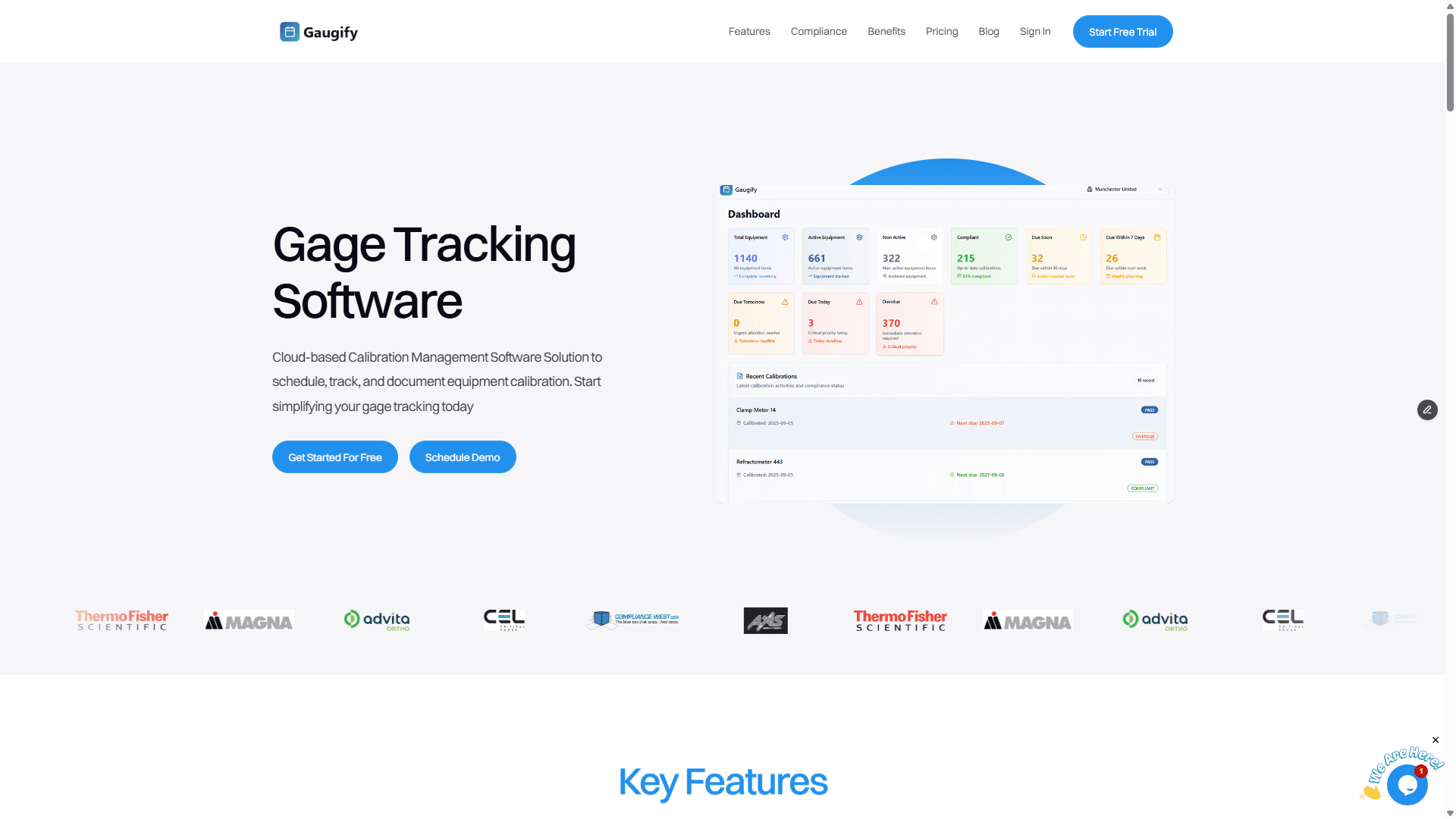
Gaugify's automated scheduling system tracks calibration due dates across diverse instrument types while accommodating the complex scheduling requirements veterinary labs face. The system automatically generates work orders based on configurable lead times, ensuring technicians receive advance notice for upcoming calibrations.
For example, a veterinary laboratory can configure their IDEXX VetTest analyzer for monthly verification checks while scheduling their reference thermometer for annual calibration. The system tracks both schedules independently while providing dashboard visibility of all upcoming due dates. Email notifications ensure responsible staff receive reminders even during busy diagnostic periods.
The software accommodates grace periods and emergency extensions while maintaining audit trail documentation of any schedule modifications. When a critical instrument requires urgent repairs that delay calibration, managers can document the delay reason and revised schedule without losing compliance visibility.
Digital Certificate Management
Manual certificate filing creates significant compliance risks, especially during audit preparation. Gaugify provides centralized digital storage for all calibration certificates with intelligent search capabilities and automatic backup protection.
Veterinary lab managers can upload calibration certificates directly from calibration service providers or generate internal certificates for routine verification procedures. The system maintains version control and historical records, ensuring auditors can access complete documentation chains spanning multiple years.
Integration capabilities allow direct certificate import from major calibration service providers, eliminating manual data entry while ensuring accuracy. When auditors request calibration documentation during inspections, managers can instantly access relevant certificates through simple search functions.
Comprehensive Audit Trail Documentation
Gaugify's compliance features maintain detailed audit trails of all calibration activities, schedule modifications, and certificate updates. The system timestamps all activities and maintains user accountability, providing the documentation depth modern auditors expect.
The platform generates comprehensive compliance reports showing calibration status across all instruments, overdue items, and upcoming requirements. These reports help veterinary lab managers demonstrate proactive calibration management during regulatory inspections.
Custom reporting capabilities allow laboratories to generate documentation matching specific auditor requirements or regulatory standards. Whether preparing for AAVLD accreditation or state licensing inspections, managers can quickly compile relevant calibration documentation.
Ready to eliminate calibration management headaches in your veterinary laboratory? Start your free Gaugify trial today and experience how modern software can transform your compliance program.
Advanced Features for Veterinary Laboratory Applications
Beyond basic scheduling and documentation, comprehensive calibration management software must address the specialized needs of veterinary diagnostic operations. Gaugify includes advanced functionality designed specifically for laboratories managing diverse testing programs.
Equipment Maintenance Integration
Veterinary laboratories benefit from coordinating calibration schedules with preventive maintenance activities. Gaugify allows managers to link calibration and maintenance schedules, optimizing instrument downtime while ensuring comprehensive equipment care.
For example, a laboratory can schedule annual spectrophotometer calibration to coincide with lamp replacement and optical system cleaning. This coordination minimizes service disruptions while ensuring optimal instrument performance throughout the calibration interval.
Multi-Location Management
Veterinary practices operating multiple locations need centralized visibility of calibration programs across all sites. Gaugify's multi-location capabilities allow corporate quality managers to monitor calibration compliance at satellite laboratories while maintaining local scheduling flexibility.
A regional veterinary chain can standardize calibration procedures across locations while accommodating local variations in instrument usage and service provider relationships. Corporate dashboards provide enterprise-wide visibility while local managers maintain operational control.
Integration with Laboratory Information Systems
Modern veterinary labs rely on integrated software systems for efficient operations. Gaugify's integration capabilities allow connection with popular veterinary LIMS platforms, ensuring calibration status visibility during result reporting.
When instruments approach calibration due dates, the system can automatically flag results or prevent testing until calibration completion. This integration prevents release of questionable results while maintaining workflow efficiency.
Cost Considerations for Veterinary Lab Software Implementation
Veterinary laboratories operate under tight budget constraints that require careful evaluation of software investments. Understanding the total cost of ownership helps managers justify calibration management software purchases while demonstrating clear return on investment.
Direct Cost Savings
Automated calibration management eliminates manual tracking labor while reducing compliance risks that could result in costly audit findings or license suspensions. A typical veterinary laboratory spending 5-10 hours monthly on manual calibration tracking can redirect this effort toward revenue-generating testing activities.
Reduced service call expenses result from better preventive maintenance coordination and early identification of instrument performance trends. Many laboratories report 20-30% reductions in emergency repair costs after implementing systematic calibration management.
Risk Mitigation Value
The cost of regulatory non-compliance far exceeds software investment costs. License suspensions, failed accreditation audits, or compromised test results can devastate veterinary laboratory operations. Comprehensive calibration management provides insurance against these business-threatening scenarios.
Gaugify's transparent pricing structure allows laboratories to budget accurately for calibration management capabilities without hidden fees or complicated licensing terms. The cloud-based deployment eliminates IT infrastructure costs while providing automatic software updates and security management.
Implementation Best Practices for Veterinary Laboratories
Successful calibration management software implementation requires careful planning and staff engagement. Veterinary laboratories should approach software deployment systematically to ensure maximum benefit realization.
Inventory and Assessment Phase
Begin implementation by conducting comprehensive equipment inventories identifying all instruments requiring calibration. Document current calibration schedules, service providers, and historical compliance issues. This assessment provides baseline data for system configuration and helps identify improvement opportunities.
Many veterinary labs discover previously overlooked instruments during this process. pH meters, thermometers, and timers often lack formal calibration programs despite their critical role in testing accuracy.
Staff Training and Change Management
Successful software adoption requires comprehensive staff training and change management support. Veterinary laboratory technicians often have limited time for training activities, making efficient knowledge transfer essential.
Gaugify provides comprehensive training resources including video tutorials, documentation, and direct support to ensure smooth software adoption. The intuitive interface minimizes learning curves while powerful features support advanced users.
Future-Proofing Your Veterinary Laboratory Calibration Program
The veterinary diagnostic industry continues evolving with new testing methodologies, regulatory requirements, and technology advances. Choosing calibration management software with growth capabilities ensures long-term value realization.
Regulatory Compliance Evolution
Regulatory requirements for veterinary laboratories continue expanding as food safety concerns drive increased oversight of animal health testing. ISO 17025 compliance capabilities position laboratories for future accreditation requirements while demonstrating technical competence to clients.
Emerging regulations around antimicrobial resistance testing and environmental monitoring will likely require enhanced calibration documentation. Software platforms with flexible reporting capabilities can adapt to new requirements without major system overhauls.
Technology Integration Opportunities
IoT sensors and automated data collection technologies are increasingly common in veterinary laboratories. Modern calibration management software must accommodate integration with these technologies while maintaining data integrity and audit trail requirements.
Gaugify's API capabilities support integration with emerging laboratory technologies while maintaining backward compatibility with existing instruments and procedures. This flexibility ensures continued value as laboratory technology evolves.
Take Control of Your Veterinary Lab's Calibration Program Today
Managing calibration programs manually in today's regulatory environment creates unnecessary risks and inefficiencies that veterinary laboratories can no longer afford. The complexity of modern veterinary diagnostic operations demands professional-grade calibration management software that addresses the unique challenges of animal health testing.
Gaugify provides the comprehensive functionality veterinary laboratories need while maintaining the simplicity busy diagnostic teams require. From automated scheduling that prevents missed calibrations to comprehensive audit documentation that satisfies the most demanding regulatory inspections, Gaugify transforms calibration management from a compliance burden into a competitive advantage.
Don't let manual calibration tracking jeopardize your laboratory's compliance status or operational efficiency. The peace of mind that comes from knowing your calibration program is professionally managed allows you to focus on what matters most – providing accurate diagnostic results that support animal health and welfare.
Schedule a personalized demo to see how Gaugify can transform your veterinary laboratory's calibration management program. Join the growing number of veterinary professionals who have discovered that modern calibration management software isn't just a nice-to-have tool – it's an essential component of professional laboratory operations in the 21st century.
Calibration Management Software for Veterinary Labs
Veterinary laboratories face unique challenges when managing calibration programs for their critical testing equipment. From ensuring accurate diagnostic results that could mean the difference between life and death for animals, to maintaining compliance with FDA, USDA, and state veterinary board requirements, choosing the right calibration management software veterinary labs can rely on is crucial for operational success.
Unlike human medical labs that primarily focus on clinical diagnostics, veterinary facilities must calibrate equipment used for everything from routine wellness screenings to complex toxicology analyses for livestock feed safety. The stakes are high – a miscalibrated spectrophotometer could lead to incorrect antibiotic sensitivity results, while an out-of-tolerance analytical balance might compromise food safety testing that protects entire agricultural operations.
Common Calibration Challenges in Veterinary Laboratory Operations
Veterinary labs typically operate with smaller teams and tighter budgets than their human counterpart facilities, yet face equally stringent accuracy requirements. Quality managers often struggle with tracking calibration due dates across dozens of instruments while managing the daily workflow of urgent diagnostic cases.
Consider a typical mixed-animal veterinary laboratory processing 200+ samples daily. Their quality manager might oversee calibrations for analytical balances (±0.1mg tolerance), spectrophotometers requiring wavelength accuracy within ±1nm, and incubators that must maintain temperature stability within ±0.5°C. Managing these diverse calibration schedules manually creates significant compliance risks.
Many veterinary labs still rely on spreadsheets or paper logs, leading to missed calibration deadlines, lost certificates, and panic-inducing moments when auditors request documentation. The laboratory supervisor at a large equine diagnostic facility recently shared how they discovered three critical instruments were overdue for calibration only when preparing for their annual AAVLD accreditation inspection.
Equipment Diversity Creates Scheduling Complexity
Veterinary laboratories maintain an exceptionally diverse instrument inventory. A single facility might calibrate monthly pH meters for urinalysis, quarterly pipettes for serology testing, semi-annual centrifuges for hematology work, and annual spectrophotometers for chemistry panels. Each instrument type requires different calibration frequencies, creating a complex scheduling matrix that's nearly impossible to manage without dedicated software.
Limited Staff Resources
Most veterinary labs operate with 2-5 technical staff members who wear multiple hats. The same person performing morning hematology might be responsible for afternoon microbiology cultures and evening equipment maintenance. This reality makes manual calibration tracking particularly challenging, as busy technicians can easily overlook upcoming due dates while focused on patient care.
Essential Equipment Requiring Calibration in Veterinary Labs
Veterinary diagnostic facilities typically maintain 15-50+ instruments requiring regular calibration, depending on their service scope and patient volume. Understanding this equipment landscape is essential for implementing effective calibration management software veterinary operations can depend on.
Analytical Instruments
Spectrophotometers represent the backbone of most veterinary chemistry testing. These instruments require wavelength accuracy verification using certified holmium oxide filters, with typical tolerances of ±1-2nm across the UV-visible spectrum. Many labs use the Idexx VetTest 8008 or similar analyzers that need monthly calibration verification and annual full-service calibrations.
Atomic absorption spectrophotometers for trace mineral analysis require more complex calibrations involving multiple wavelength checks and flame temperature verification. A dairy nutrition laboratory might calibrate their AA unit quarterly, tracking over 20 different parameters including lamp energy output and monochromator accuracy.
Sample Preparation Equipment
Analytical balances in veterinary labs typically require monthly calibration using certified mass standards. A feed testing laboratory might maintain three different balance types: a high-capacity balance (±10mg at 5000g) for bulk sample preparation, an analytical balance (±0.1mg at 200g) for precise reagent weighing, and a microbalance (±0.01mg at 20g) for potent drug residue analysis.
Pipettes demand attention based on usage frequency rather than calendar schedules. High-volume diagnostic labs might calibrate frequently-used pipettes quarterly, while specialized research instruments might need only annual verification. Each pipette requires testing at multiple volume points – a 1000µL pipette typically gets checked at 100µL, 500µL, and 1000µL using gravimetric methods.
Environmental Control Equipment
Incubators and water baths require temperature mapping using calibrated thermometers or data loggers. A microbiology laboratory's bacterial culture incubator needs verification at its operating temperature (typically 37°C ±0.5°C) using multiple sensor points to ensure uniform heating. Many labs use VWR or Thermo Scientific incubators that require quarterly temperature validation.
Refrigerators and freezers storing vaccines, reagents, and samples need similar attention. A large animal practice might maintain separate units at 2-8°C for vaccines, -20°C for serum storage, and -80°C for molecular biology reagents, each requiring monthly temperature monitoring and annual calibration verification.
Veterinary Lab Compliance Requirements and Quality Standards
Veterinary laboratories operate under multiple overlapping regulatory frameworks, making comprehensive calibration documentation essential for maintaining operating licenses and accreditation status. The complexity of these requirements makes choosing appropriate calibration management software veterinary facilities can trust even more critical.
Federal Regulatory Requirements
The FDA's Center for Veterinary Medicine oversees laboratories performing drug residue testing in food-producing animals. These facilities must maintain instrument calibration records demonstrating traceability to NIST standards, with documentation spanning at least three years. A poultry processing plant's laboratory testing for antibiotic residues must prove their HPLC systems maintain accuracy within specified limits throughout the testing period.
USDA regulations govern laboratories supporting meat and poultry inspection programs. Their FSIS Compliance Guidelines require calibrated instruments for pathogen detection, with specific requirements for temperature monitoring equipment and analytical balances used in sampling procedures.
State Veterinary Board Requirements
Individual states maintain varying requirements for veterinary diagnostic laboratories. California's requirements under the Food and Agricultural Code mandate calibration records for all quantitative testing equipment, while Texas focuses specifically on instruments used for regulatory compliance testing in livestock operations.
Most states require annual inspections where calibration documentation receives significant scrutiny. A mixed-animal practice in Colorado recently faced license suspension threats when inspectors discovered gaps in their centrifuge calibration records during a routine compliance review.
Professional Accreditation Standards
The American Association of Veterinary Laboratory Diagnosticians (AAVLD) maintains accreditation standards requiring comprehensive calibration programs. Their requirements specify calibration frequencies, acceptable tolerance limits, and documentation standards that align with ISO/IEC 17025 principles adapted for veterinary applications.
Many veterinary labs pursue ISO 17025 accreditation to demonstrate technical competence for specialized testing services. This standard demands robust calibration programs with detailed uncertainty calculations, equipment verification procedures, and comprehensive audit trails – requirements that manual tracking systems simply cannot meet effectively.
What Auditors Look for During Veterinary Lab Inspections
Understanding auditor expectations helps veterinary lab managers prepare comprehensive calibration documentation that demonstrates compliance and technical competence. Recent audit trends show increasing focus on data integrity and traceability rather than simple procedural compliance.
Calibration Schedule Adherence
Auditors typically begin by reviewing calibration schedules against actual performance records. They look for evidence that laboratories maintain consistent calibration intervals based on manufacturer recommendations, usage patterns, and historical performance data. A laboratory using monthly calibration intervals for analytical balances should demonstrate completion within acceptable grace periods (typically ±10% of the interval).
Red flags include frequent schedule extensions, missing calibration records, or inconsistent intervals without technical justification. One veterinary diagnostic lab faced major nonconformances when auditors discovered their spectrophotometer hadn't been calibrated for 18 months, despite established quarterly requirements.
Documentation Quality and Completeness
Modern auditors expect calibration certificates containing detailed measurement data, not just pass/fail results. They want to see actual measurement values, reference standards used, environmental conditions during calibration, and uncertainty calculations where applicable. A properly documented balance calibration should include linearity data across the working range, not just single-point verification.
Auditors frequently request historical trending data to evaluate instrument stability over time. They look for evidence that laboratories investigate unusual calibration results and take appropriate corrective actions when instruments approach tolerance limits.
Traceability to National Standards
Every calibration must demonstrate an unbroken chain of traceability to national measurement standards through accredited calibration laboratories. Auditors verify that reference standards carry valid calibration certificates and that laboratories maintain appropriate environmental controls during calibration activities.
A common audit finding involves expired reference standard certificates or inadequate documentation of calibration conditions. Temperature and humidity documentation becomes particularly important for dimensional measurements and mass determinations.
How Calibration Management Software Addresses Veterinary Lab Pain Points
Modern calibration management software veterinary laboratories choose must address the unique operational challenges of animal diagnostic testing while providing robust compliance documentation. Gaugify's cloud-based platform specifically addresses the pain points veterinary lab managers face daily.
Automated Scheduling Eliminates Missed Calibrations
Gaugify's automated scheduling system tracks calibration due dates across diverse instrument types while accommodating the complex scheduling requirements veterinary labs face. The system automatically generates work orders based on configurable lead times, ensuring technicians receive advance notice for upcoming calibrations.
For example, a veterinary laboratory can configure their IDEXX VetTest analyzer for monthly verification checks while scheduling their reference thermometer for annual calibration. The system tracks both schedules independently while providing dashboard visibility of all upcoming due dates. Email notifications ensure responsible staff receive reminders even during busy diagnostic periods.
The software accommodates grace periods and emergency extensions while maintaining audit trail documentation of any schedule modifications. When a critical instrument requires urgent repairs that delay calibration, managers can document the delay reason and revised schedule without losing compliance visibility.
Digital Certificate Management
Manual certificate filing creates significant compliance risks, especially during audit preparation. Gaugify provides centralized digital storage for all calibration certificates with intelligent search capabilities and automatic backup protection.
Veterinary lab managers can upload calibration certificates directly from calibration service providers or generate internal certificates for routine verification procedures. The system maintains version control and historical records, ensuring auditors can access complete documentation chains spanning multiple years.
Integration capabilities allow direct certificate import from major calibration service providers, eliminating manual data entry while ensuring accuracy. When auditors request calibration documentation during inspections, managers can instantly access relevant certificates through simple search functions.
Comprehensive Audit Trail Documentation
Gaugify's compliance features maintain detailed audit trails of all calibration activities, schedule modifications, and certificate updates. The system timestamps all activities and maintains user accountability, providing the documentation depth modern auditors expect.
The platform generates comprehensive compliance reports showing calibration status across all instruments, overdue items, and upcoming requirements. These reports help veterinary lab managers demonstrate proactive calibration management during regulatory inspections.
Custom reporting capabilities allow laboratories to generate documentation matching specific auditor requirements or regulatory standards. Whether preparing for AAVLD accreditation or state licensing inspections, managers can quickly compile relevant calibration documentation.
Ready to eliminate calibration management headaches in your veterinary laboratory? Start your free Gaugify trial today and experience how modern software can transform your compliance program.
Advanced Features for Veterinary Laboratory Applications
Beyond basic scheduling and documentation, comprehensive calibration management software must address the specialized needs of veterinary diagnostic operations. Gaugify includes advanced functionality designed specifically for laboratories managing diverse testing programs.
Equipment Maintenance Integration
Veterinary laboratories benefit from coordinating calibration schedules with preventive maintenance activities. Gaugify allows managers to link calibration and maintenance schedules, optimizing instrument downtime while ensuring comprehensive equipment care.
For example, a laboratory can schedule annual spectrophotometer calibration to coincide with lamp replacement and optical system cleaning. This coordination minimizes service disruptions while ensuring optimal instrument performance throughout the calibration interval.
Multi-Location Management
Veterinary practices operating multiple locations need centralized visibility of calibration programs across all sites. Gaugify's multi-location capabilities allow corporate quality managers to monitor calibration compliance at satellite laboratories while maintaining local scheduling flexibility.
A regional veterinary chain can standardize calibration procedures across locations while accommodating local variations in instrument usage and service provider relationships. Corporate dashboards provide enterprise-wide visibility while local managers maintain operational control.
Integration with Laboratory Information Systems
Modern veterinary labs rely on integrated software systems for efficient operations. Gaugify's integration capabilities allow connection with popular veterinary LIMS platforms, ensuring calibration status visibility during result reporting.
When instruments approach calibration due dates, the system can automatically flag results or prevent testing until calibration completion. This integration prevents release of questionable results while maintaining workflow efficiency.
Cost Considerations for Veterinary Lab Software Implementation
Veterinary laboratories operate under tight budget constraints that require careful evaluation of software investments. Understanding the total cost of ownership helps managers justify calibration management software purchases while demonstrating clear return on investment.
Direct Cost Savings
Automated calibration management eliminates manual tracking labor while reducing compliance risks that could result in costly audit findings or license suspensions. A typical veterinary laboratory spending 5-10 hours monthly on manual calibration tracking can redirect this effort toward revenue-generating testing activities.
Reduced service call expenses result from better preventive maintenance coordination and early identification of instrument performance trends. Many laboratories report 20-30% reductions in emergency repair costs after implementing systematic calibration management.
Risk Mitigation Value
The cost of regulatory non-compliance far exceeds software investment costs. License suspensions, failed accreditation audits, or compromised test results can devastate veterinary laboratory operations. Comprehensive calibration management provides insurance against these business-threatening scenarios.
Gaugify's transparent pricing structure allows laboratories to budget accurately for calibration management capabilities without hidden fees or complicated licensing terms. The cloud-based deployment eliminates IT infrastructure costs while providing automatic software updates and security management.
Implementation Best Practices for Veterinary Laboratories
Successful calibration management software implementation requires careful planning and staff engagement. Veterinary laboratories should approach software deployment systematically to ensure maximum benefit realization.
Inventory and Assessment Phase
Begin implementation by conducting comprehensive equipment inventories identifying all instruments requiring calibration. Document current calibration schedules, service providers, and historical compliance issues. This assessment provides baseline data for system configuration and helps identify improvement opportunities.
Many veterinary labs discover previously overlooked instruments during this process. pH meters, thermometers, and timers often lack formal calibration programs despite their critical role in testing accuracy.
Staff Training and Change Management
Successful software adoption requires comprehensive staff training and change management support. Veterinary laboratory technicians often have limited time for training activities, making efficient knowledge transfer essential.
Gaugify provides comprehensive training resources including video tutorials, documentation, and direct support to ensure smooth software adoption. The intuitive interface minimizes learning curves while powerful features support advanced users.
Future-Proofing Your Veterinary Laboratory Calibration Program
The veterinary diagnostic industry continues evolving with new testing methodologies, regulatory requirements, and technology advances. Choosing calibration management software with growth capabilities ensures long-term value realization.
Regulatory Compliance Evolution
Regulatory requirements for veterinary laboratories continue expanding as food safety concerns drive increased oversight of animal health testing. ISO 17025 compliance capabilities position laboratories for future accreditation requirements while demonstrating technical competence to clients.
Emerging regulations around antimicrobial resistance testing and environmental monitoring will likely require enhanced calibration documentation. Software platforms with flexible reporting capabilities can adapt to new requirements without major system overhauls.
Technology Integration Opportunities
IoT sensors and automated data collection technologies are increasingly common in veterinary laboratories. Modern calibration management software must accommodate integration with these technologies while maintaining data integrity and audit trail requirements.
Gaugify's API capabilities support integration with emerging laboratory technologies while maintaining backward compatibility with existing instruments and procedures. This flexibility ensures continued value as laboratory technology evolves.
Take Control of Your Veterinary Lab's Calibration Program Today
Managing calibration programs manually in today's regulatory environment creates unnecessary risks and inefficiencies that veterinary laboratories can no longer afford. The complexity of modern veterinary diagnostic operations demands professional-grade calibration management software that addresses the unique challenges of animal health testing.
Gaugify provides the comprehensive functionality veterinary laboratories need while maintaining the simplicity busy diagnostic teams require. From automated scheduling that prevents missed calibrations to comprehensive audit documentation that satisfies the most demanding regulatory inspections, Gaugify transforms calibration management from a compliance burden into a competitive advantage.
Don't let manual calibration tracking jeopardize your laboratory's compliance status or operational efficiency. The peace of mind that comes from knowing your calibration program is professionally managed allows you to focus on what matters most – providing accurate diagnostic results that support animal health and welfare.
Schedule a personalized demo to see how Gaugify can transform your veterinary laboratory's calibration management program. Join the growing number of veterinary professionals who have discovered that modern calibration management software isn't just a nice-to-have tool – it's an essential component of professional laboratory operations in the 21st century.