
Calibration Management Software in Connecticut
Calibration Management Software in Connecticut
David Bentley
Quality Assurance Engineer
6 min read
Calibration Management Software in Connecticut
Connecticut's precision manufacturing sector demands rigorous quality control, making reliable calibration management software Connecticut businesses can trust more critical than ever. From Pratt & Whitney's aircraft engines in East Hartford to the pharmaceutical facilities dotting Fairfield County, Connecticut manufacturers rely on precisely calibrated instruments to meet stringent industry standards and maintain their competitive edge in global markets.
The Constitution State's strategic location between New York and Boston, combined with its highly skilled workforce and advanced manufacturing infrastructure, has created a thriving industrial ecosystem where measurement accuracy isn't just important—it's business-critical. Whether you're managing torque wrenches for submarine manufacturing at Electric Boat or maintaining temperature sensors in biotech facilities, the right calibration management system can make the difference between compliance and costly audit findings.
Connecticut's Precision Manufacturing Landscape
Connecticut punches above its weight in advanced manufacturing, with the state generating over $15 billion annually in manufactured goods. The state's industrial heritage dates back centuries, but today's Connecticut manufacturers are focused on high-tech, high-precision industries where measurement uncertainty can mean the difference between a successful product launch and a catastrophic recall.
The state's manufacturing sector employs over 165,000 people across nearly 4,000 establishments, with the highest concentration in Fairfield and Hartford counties. These facilities range from small job shops producing specialized components to massive operations like Sikorsky Aircraft, where every bolt torque specification and dimensional measurement must be traceable and within tolerance.
Connecticut's proximity to major metropolitan markets, world-class universities like Yale and UConn, and established transportation networks has created an environment where precision manufacturing thrives. This success, however, comes with the responsibility of maintaining measurement systems that can satisfy the most demanding quality requirements in industries where failure isn't an option.
Dominant Industries Requiring Calibration Management Software Connecticut Facilities
Aerospace and Defense Manufacturing
Connecticut is home to some of the world's most sophisticated aerospace manufacturers. Pratt & Whitney, based in East Hartford, produces engines for commercial and military aircraft that must meet exacting specifications. Their calibration requirements include everything from coordinate measuring machines (CMMs) with uncertainty requirements of ±0.0001" to pressure transducers capable of measuring turbine pressures with traceable accuracy.
Electric Boat in Groton builds nuclear submarines for the U.S. Navy, where calibration isn't just about quality—it's about national security. Their welding parameter monitors, ultrasonic thickness gauges, and dimensional measurement equipment must maintain calibration intervals that satisfy both Navy specifications and nuclear regulatory requirements.
Sikorsky Aircraft (now part of Lockheed Martin) in Stratford manufactures helicopters where rotor blade balance and engine mount tolerances measured in thousandths of an inch determine flight safety. Their calibration program includes vibration analyzers, torque transducers up to 10,000 ft-lbs, and environmental chambers maintaining temperatures within ±2°C.
Precision Manufacturing and Machining
Connecticut's network of precision machine shops supports industries from medical devices to industrial equipment. Companies like Kaman Precision Products in Bloomfield maintain measurement systems including optical comparators with 0.0001" resolution, surface roughness testers, and coordinate measuring machines requiring environmental controls and regular calibration cycles.
These facilities often work with exotic materials like titanium alloys and Inconel, where thermal expansion coefficients affect measurement accuracy. Their calibration programs must account for temperature compensation factors and maintain traceability for gage blocks, micrometers ranging from 0-12 inches, and bore gauges with tolerance requirements as tight as ±0.0002".
Pharmaceutical and Biotechnology
Connecticut's biopharmaceutical corridor includes major facilities from companies like Boehringer Ingelheim in Ridgefield and numerous smaller biotech companies throughout Fairfield County. These facilities require calibration of analytical balances with readability to 0.01 mg, temperature mapping systems for stability chambers, and pH meters with accuracy requirements of ±0.01 pH units.
The FDA's expectation for continuous process verification means these companies need calibration management systems that can demonstrate ongoing control of measurement processes. This includes maintaining calibration records for spectrophotometers, HPLC systems, and environmental monitoring equipment with documentation that can withstand regulatory scrutiny.
Critical Quality Standards for Connecticut Manufacturers
AS9100 and Aerospace Requirements
Connecticut's aerospace manufacturers must comply with AS9100, which builds upon ISO 9001 with additional aerospace-specific requirements. This standard demands rigorous control of measurement and test equipment, with calibration intervals based on stability, purpose, and previous calibration history. For a CMM measuring turbine blade airfoils, this might mean monthly calibration checks using certified artifacts with dimensional uncertainty ratios of 10:1 or better.
The standard also requires measurement system analysis (MSA) studies for critical characteristics, where gage repeatability and reproducibility must typically achieve %GRR values below 30%. Connecticut aerospace suppliers using calibration management software that supports these requirements can automate these calculations and maintain the detailed records AS9100 auditors expect to see.
ISO 13485 for Medical Device Manufacturing
Medical device manufacturers throughout Connecticut must maintain calibration programs that satisfy ISO 13485 requirements. This includes documented calibration procedures, environmental controls for measurement processes, and traceability to national standards. For a company manufacturing orthopedic implants, this might involve calibrating hardness testers to HRC 60 ±1 scale, dimensional measurement systems with uncertainty budgets, and surface finish measurement equipment.
FDA Regulations and 21 CFR Part 11
Connecticut pharmaceutical companies must ensure their calibration management systems comply with 21 CFR Part 11 for electronic records. This means audit trails for all calibration data changes, electronic signatures for approvals, and systems that prevent unauthorized access to calibration records. When an FDA inspector arrives for a pre-approval inspection, they expect to see calibration records that demonstrate continuous control of measurement processes throughout the product lifecycle.
Ready to streamline your calibration compliance? Start your free trial today and see how Gaugify can help your Connecticut facility meet the most demanding regulatory requirements while reducing administrative overhead.
Regional Calibration Challenges in Connecticut
Seasonal Temperature Variations
Connecticut's continental climate creates unique challenges for precision measurement. Summer temperatures regularly exceed 85°F while winter conditions can drop below 10°F. For facilities without adequate environmental controls, this temperature swing affects the accuracy of dimensional measurements. A steel gage block expands approximately 0.000012 inches per inch per degree Fahrenheit—meaning a 6-inch gage block could vary by over 0.0005" between summer and winter conditions.
Leading Connecticut manufacturers address this by maintaining controlled measurement environments at 68°F ±2°F, but this requires calibration management systems that can track environmental conditions during calibration events and flag measurements performed outside acceptable ranges.
Humidity and Coastal Conditions
Connecticut's proximity to Long Island Sound creates humidity challenges, particularly for facilities in coastal areas like New London and Stamford. Electronic measurement equipment, precision balances, and optical measurement systems can drift when exposed to humidity variations exceeding 45-75% RH. Calibration programs must account for these environmental factors, particularly for equipment sensitive to moisture exposure.
Supply Chain and Calibration Service Access
While Connecticut's central location provides advantages, many facilities struggle with calibration service logistics. Shipping sensitive measurement equipment to calibration labs in Boston or New York creates risks of damage and extended downtime. This has led many Connecticut manufacturers to invest in expanded internal calibration capabilities, requiring calibration management software that can handle both internal and external calibration workflows.
How Gaugify Serves Connecticut Manufacturers
Connecticut businesses choose Gaugify's cloud-based calibration management platform because it addresses the unique challenges facing precision manufacturers in the Constitution State. Our software eliminates the need for local server installations, reducing IT overhead while providing secure access from any location—whether you're managing calibrations at your main facility in Hartford or reviewing compliance status from a customer site in Stamford.
Cloud-Based Accessibility
Gaugify's cloud architecture means your calibration data is accessible 24/7 from anywhere with an internet connection. For Connecticut manufacturers with multiple locations—like a main production facility in Waterbury and a quality lab in New Haven—this means seamless coordination of calibration activities without the complexity of syncing local databases or managing VPN connections.
Our platform's mobile responsiveness allows quality managers to review calibration status during customer audits, approve calibration certificates while traveling between facilities, and receive real-time notifications about upcoming calibration due dates regardless of their location.
Comprehensive Standards Support
Connecticut's diverse manufacturing base requires calibration management software that supports multiple quality standards simultaneously. Gaugify supports ISO 17025, AS9100, ISO 13485, and FDA 21 CFR Part 11 requirements within a single platform. This means a Connecticut facility serving both aerospace and medical device markets can maintain separate calibration workflows while managing all equipment from one system.
Our software automatically generates the documentation required for different standards, from AS9100's measurement system analysis reports to ISO 13485's calibration procedures and FDA-compliant electronic records with full audit trails.
Advanced Reporting and Analytics
Connecticut manufacturers use Gaugify's reporting capabilities to optimize their calibration programs and reduce costs. Our platform tracks calibration history trends, identifies equipment with excessive drift rates, and provides analytics that help determine optimal calibration intervals. For a precision machining facility in Danbury, this might reveal that their CMM probe calibration can be safely extended from monthly to quarterly checks, reducing calibration costs while maintaining measurement reliability.
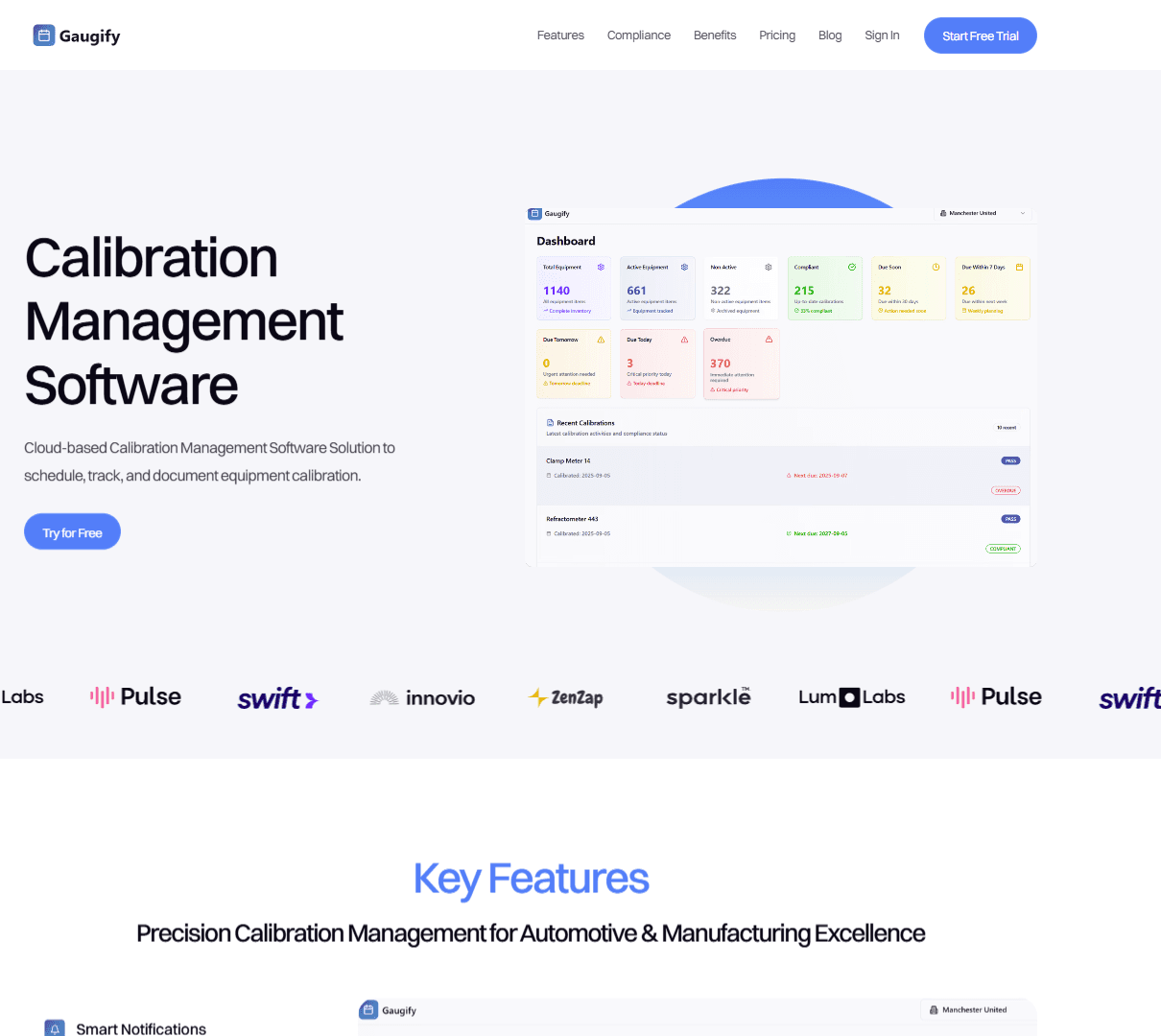
The software also provides real-time dashboards showing calibration compliance status across all equipment, helping Connecticut manufacturers maintain the continuous monitoring that modern quality standards require.
Start Optimizing Your Connecticut Calibration Program Today
Connecticut's competitive manufacturing environment demands calibration management systems that can keep pace with industry requirements while reducing administrative overhead. Whether you're a small machine shop in Torrington managing 50 gages or a major aerospace facility in East Hartford with thousands of measurement devices, Gaugify provides the scalability, security, and standards compliance your operation needs.
Our cloud-based platform eliminates the IT infrastructure requirements that often prevent smaller Connecticut manufacturers from implementing comprehensive calibration management systems, while providing the advanced features that large facilities require for complex multi-site operations.
Don't let outdated calibration management processes limit your Connecticut facility's potential. Schedule a personalized demo to see how Gaugify can streamline your calibration workflows, improve compliance documentation, and reduce the time your quality team spends on administrative tasks. Join the growing number of Connecticut manufacturers who trust Gaugify to manage their most critical measurement systems.
Calibration Management Software in Connecticut
Connecticut's precision manufacturing sector demands rigorous quality control, making reliable calibration management software Connecticut businesses can trust more critical than ever. From Pratt & Whitney's aircraft engines in East Hartford to the pharmaceutical facilities dotting Fairfield County, Connecticut manufacturers rely on precisely calibrated instruments to meet stringent industry standards and maintain their competitive edge in global markets.
The Constitution State's strategic location between New York and Boston, combined with its highly skilled workforce and advanced manufacturing infrastructure, has created a thriving industrial ecosystem where measurement accuracy isn't just important—it's business-critical. Whether you're managing torque wrenches for submarine manufacturing at Electric Boat or maintaining temperature sensors in biotech facilities, the right calibration management system can make the difference between compliance and costly audit findings.
Connecticut's Precision Manufacturing Landscape
Connecticut punches above its weight in advanced manufacturing, with the state generating over $15 billion annually in manufactured goods. The state's industrial heritage dates back centuries, but today's Connecticut manufacturers are focused on high-tech, high-precision industries where measurement uncertainty can mean the difference between a successful product launch and a catastrophic recall.
The state's manufacturing sector employs over 165,000 people across nearly 4,000 establishments, with the highest concentration in Fairfield and Hartford counties. These facilities range from small job shops producing specialized components to massive operations like Sikorsky Aircraft, where every bolt torque specification and dimensional measurement must be traceable and within tolerance.
Connecticut's proximity to major metropolitan markets, world-class universities like Yale and UConn, and established transportation networks has created an environment where precision manufacturing thrives. This success, however, comes with the responsibility of maintaining measurement systems that can satisfy the most demanding quality requirements in industries where failure isn't an option.
Dominant Industries Requiring Calibration Management Software Connecticut Facilities
Aerospace and Defense Manufacturing
Connecticut is home to some of the world's most sophisticated aerospace manufacturers. Pratt & Whitney, based in East Hartford, produces engines for commercial and military aircraft that must meet exacting specifications. Their calibration requirements include everything from coordinate measuring machines (CMMs) with uncertainty requirements of ±0.0001" to pressure transducers capable of measuring turbine pressures with traceable accuracy.
Electric Boat in Groton builds nuclear submarines for the U.S. Navy, where calibration isn't just about quality—it's about national security. Their welding parameter monitors, ultrasonic thickness gauges, and dimensional measurement equipment must maintain calibration intervals that satisfy both Navy specifications and nuclear regulatory requirements.
Sikorsky Aircraft (now part of Lockheed Martin) in Stratford manufactures helicopters where rotor blade balance and engine mount tolerances measured in thousandths of an inch determine flight safety. Their calibration program includes vibration analyzers, torque transducers up to 10,000 ft-lbs, and environmental chambers maintaining temperatures within ±2°C.
Precision Manufacturing and Machining
Connecticut's network of precision machine shops supports industries from medical devices to industrial equipment. Companies like Kaman Precision Products in Bloomfield maintain measurement systems including optical comparators with 0.0001" resolution, surface roughness testers, and coordinate measuring machines requiring environmental controls and regular calibration cycles.
These facilities often work with exotic materials like titanium alloys and Inconel, where thermal expansion coefficients affect measurement accuracy. Their calibration programs must account for temperature compensation factors and maintain traceability for gage blocks, micrometers ranging from 0-12 inches, and bore gauges with tolerance requirements as tight as ±0.0002".
Pharmaceutical and Biotechnology
Connecticut's biopharmaceutical corridor includes major facilities from companies like Boehringer Ingelheim in Ridgefield and numerous smaller biotech companies throughout Fairfield County. These facilities require calibration of analytical balances with readability to 0.01 mg, temperature mapping systems for stability chambers, and pH meters with accuracy requirements of ±0.01 pH units.
The FDA's expectation for continuous process verification means these companies need calibration management systems that can demonstrate ongoing control of measurement processes. This includes maintaining calibration records for spectrophotometers, HPLC systems, and environmental monitoring equipment with documentation that can withstand regulatory scrutiny.
Critical Quality Standards for Connecticut Manufacturers
AS9100 and Aerospace Requirements
Connecticut's aerospace manufacturers must comply with AS9100, which builds upon ISO 9001 with additional aerospace-specific requirements. This standard demands rigorous control of measurement and test equipment, with calibration intervals based on stability, purpose, and previous calibration history. For a CMM measuring turbine blade airfoils, this might mean monthly calibration checks using certified artifacts with dimensional uncertainty ratios of 10:1 or better.
The standard also requires measurement system analysis (MSA) studies for critical characteristics, where gage repeatability and reproducibility must typically achieve %GRR values below 30%. Connecticut aerospace suppliers using calibration management software that supports these requirements can automate these calculations and maintain the detailed records AS9100 auditors expect to see.
ISO 13485 for Medical Device Manufacturing
Medical device manufacturers throughout Connecticut must maintain calibration programs that satisfy ISO 13485 requirements. This includes documented calibration procedures, environmental controls for measurement processes, and traceability to national standards. For a company manufacturing orthopedic implants, this might involve calibrating hardness testers to HRC 60 ±1 scale, dimensional measurement systems with uncertainty budgets, and surface finish measurement equipment.
FDA Regulations and 21 CFR Part 11
Connecticut pharmaceutical companies must ensure their calibration management systems comply with 21 CFR Part 11 for electronic records. This means audit trails for all calibration data changes, electronic signatures for approvals, and systems that prevent unauthorized access to calibration records. When an FDA inspector arrives for a pre-approval inspection, they expect to see calibration records that demonstrate continuous control of measurement processes throughout the product lifecycle.
Ready to streamline your calibration compliance? Start your free trial today and see how Gaugify can help your Connecticut facility meet the most demanding regulatory requirements while reducing administrative overhead.
Regional Calibration Challenges in Connecticut
Seasonal Temperature Variations
Connecticut's continental climate creates unique challenges for precision measurement. Summer temperatures regularly exceed 85°F while winter conditions can drop below 10°F. For facilities without adequate environmental controls, this temperature swing affects the accuracy of dimensional measurements. A steel gage block expands approximately 0.000012 inches per inch per degree Fahrenheit—meaning a 6-inch gage block could vary by over 0.0005" between summer and winter conditions.
Leading Connecticut manufacturers address this by maintaining controlled measurement environments at 68°F ±2°F, but this requires calibration management systems that can track environmental conditions during calibration events and flag measurements performed outside acceptable ranges.
Humidity and Coastal Conditions
Connecticut's proximity to Long Island Sound creates humidity challenges, particularly for facilities in coastal areas like New London and Stamford. Electronic measurement equipment, precision balances, and optical measurement systems can drift when exposed to humidity variations exceeding 45-75% RH. Calibration programs must account for these environmental factors, particularly for equipment sensitive to moisture exposure.
Supply Chain and Calibration Service Access
While Connecticut's central location provides advantages, many facilities struggle with calibration service logistics. Shipping sensitive measurement equipment to calibration labs in Boston or New York creates risks of damage and extended downtime. This has led many Connecticut manufacturers to invest in expanded internal calibration capabilities, requiring calibration management software that can handle both internal and external calibration workflows.
How Gaugify Serves Connecticut Manufacturers
Connecticut businesses choose Gaugify's cloud-based calibration management platform because it addresses the unique challenges facing precision manufacturers in the Constitution State. Our software eliminates the need for local server installations, reducing IT overhead while providing secure access from any location—whether you're managing calibrations at your main facility in Hartford or reviewing compliance status from a customer site in Stamford.
Cloud-Based Accessibility
Gaugify's cloud architecture means your calibration data is accessible 24/7 from anywhere with an internet connection. For Connecticut manufacturers with multiple locations—like a main production facility in Waterbury and a quality lab in New Haven—this means seamless coordination of calibration activities without the complexity of syncing local databases or managing VPN connections.
Our platform's mobile responsiveness allows quality managers to review calibration status during customer audits, approve calibration certificates while traveling between facilities, and receive real-time notifications about upcoming calibration due dates regardless of their location.
Comprehensive Standards Support
Connecticut's diverse manufacturing base requires calibration management software that supports multiple quality standards simultaneously. Gaugify supports ISO 17025, AS9100, ISO 13485, and FDA 21 CFR Part 11 requirements within a single platform. This means a Connecticut facility serving both aerospace and medical device markets can maintain separate calibration workflows while managing all equipment from one system.
Our software automatically generates the documentation required for different standards, from AS9100's measurement system analysis reports to ISO 13485's calibration procedures and FDA-compliant electronic records with full audit trails.
Advanced Reporting and Analytics
Connecticut manufacturers use Gaugify's reporting capabilities to optimize their calibration programs and reduce costs. Our platform tracks calibration history trends, identifies equipment with excessive drift rates, and provides analytics that help determine optimal calibration intervals. For a precision machining facility in Danbury, this might reveal that their CMM probe calibration can be safely extended from monthly to quarterly checks, reducing calibration costs while maintaining measurement reliability.
The software also provides real-time dashboards showing calibration compliance status across all equipment, helping Connecticut manufacturers maintain the continuous monitoring that modern quality standards require.
Start Optimizing Your Connecticut Calibration Program Today
Connecticut's competitive manufacturing environment demands calibration management systems that can keep pace with industry requirements while reducing administrative overhead. Whether you're a small machine shop in Torrington managing 50 gages or a major aerospace facility in East Hartford with thousands of measurement devices, Gaugify provides the scalability, security, and standards compliance your operation needs.
Our cloud-based platform eliminates the IT infrastructure requirements that often prevent smaller Connecticut manufacturers from implementing comprehensive calibration management systems, while providing the advanced features that large facilities require for complex multi-site operations.
Don't let outdated calibration management processes limit your Connecticut facility's potential. Schedule a personalized demo to see how Gaugify can streamline your calibration workflows, improve compliance documentation, and reduce the time your quality team spends on administrative tasks. Join the growing number of Connecticut manufacturers who trust Gaugify to manage their most critical measurement systems.