
How to Calibrate Eddy Current Testing Equipment
How to Calibrate Eddy Current Testing Equipment
David Bentley
Quality Assurance Engineer
12 min read
How to Calibrate Eddy Current Testing Equipment
Eddy current testing (ECT) equipment is a critical non-destructive testing tool used across aerospace, automotive, power generation, and manufacturing industries to detect surface and near-surface flaws in conductive materials. Proper eddy current calibration ensures these instruments provide accurate measurements for crack detection, conductivity testing, and coating thickness measurement. Without regular calibration to traceable standards, your ECT equipment could miss critical defects or generate false positives, leading to catastrophic failures or costly production delays.
This comprehensive guide walks through the complete eddy current calibration process, from understanding the fundamental principles to implementing a robust calibration management system that maintains compliance with industry standards like ASTM E1004 and ISO 9712.
Understanding Eddy Current Testing Equipment and Its Measurements
Eddy current testing equipment operates on electromagnetic induction principles, using alternating current in a probe coil to generate eddy currents in conductive test materials. These instruments measure several key parameters:
Conductivity: Material electrical conductivity measurements typically ranging from 1-65 MS/m (megasiemens per meter)
Lift-off: Distance between probe and test surface, usually measured in mils or millimeters
Phase angle: The relationship between impedance components, critical for flaw characterization
Amplitude: Signal strength variations indicating material property changes or defects
Common ECT equipment types include portable flaw detectors like the Olympus NORTEC series, multi-frequency instruments such as the GE Phasec series, and specialized probes including pencil probes (0.030" to 0.125" diameter), encircling coils for tube inspection, and surface array probes for large area scanning.
These instruments are essential for inspecting aircraft engine components where fatigue cracks as small as 0.020" deep must be detected, automotive brake disc inspection requiring ±0.001" thickness accuracy, and heat exchanger tube inspection detecting wall thinning of 10% or greater.
Key Performance Parameters
ECT equipment calibration focuses on several critical performance parameters. Sensitivity ensures detection of minimum required flaw sizes - typically verified using electrical discharge machined (EDM) notches of specific depths like 0.005", 0.010", and 0.020". Linearity confirms accurate measurement across the full operating range, verified using conductivity standards spanning 10-60 MS/m. Stability maintains consistent readings over time and temperature variations, typically requiring ±2% drift tolerance over 8-hour operating periods.
Why Eddy Current Calibration is Critical
Eddy current calibration is absolutely essential because these instruments directly impact product safety and regulatory compliance. In aerospace applications, missing a 0.015" deep fatigue crack in a turbine blade due to insufficient instrument sensitivity could result in catastrophic engine failure. The economic impact extends beyond safety - false positive readings lead to unnecessary part rejection, while false negatives allow defective components into service.
Regulatory bodies mandate specific calibration requirements. The Federal Aviation Administration (FAA) requires aerospace ECT equipment calibration every 40 hours of use or monthly, whichever occurs first. Nuclear power facilities following ASME Section XI require daily instrument checks and quarterly calibrations. Automotive suppliers meeting IATF 16949 standards typically calibrate annually or after 200 inspection hours.
Temperature drift significantly affects ECT measurements. A typical instrument may experience 0.1% conductivity reading change per degree Celsius temperature variation. Without proper calibration accounting for environmental conditions, measurements can drift outside acceptable tolerances, leading to inspection errors.
Real-World Calibration Failures
Consider an automotive brake disc manufacturer using ECT for crack detection. Their equipment drifted 15% over six months due to skipped calibrations, resulting in 300 defective discs shipped to customers and a $2.3 million recall. Regular eddy current calibration using traceable standards would have prevented this costly oversight.
Step-by-Step Eddy Current Calibration Procedure
Successful ECT calibration requires meticulous attention to environmental conditions, reference standards, and procedural details. This comprehensive procedure ensures measurement accuracy and regulatory compliance.
Environmental Requirements
Establish controlled calibration conditions before beginning. Temperature must remain stable within ±2°C throughout the calibration, typically maintained between 18-28°C. Relative humidity should stay between 45-75% to prevent condensation on probes and standards. Electromagnetic interference from welding equipment, motors, or radio transmissions can corrupt calibration readings, so choose a magnetically quiet environment at least 10 feet from potential sources.
Allow ECT equipment to stabilize for minimum 30 minutes after power-on. High-frequency instruments require longer stabilization periods - up to 60 minutes for frequencies above 1 MHz. Verify line voltage stability within ±5% of rated voltage to prevent measurement drift during calibration.
Reference Standards Selection
Choose NIST-traceable calibration standards appropriate for your specific application. Conductivity standards should bracket your measurement range with certified values. Common aluminum standards include 17.5, 27.5, and 37.7 MS/m, while copper standards typically range from 45-58 MS/m with uncertainties of ±0.5 MS/m or better.
For flaw detection applications, use reference standards with artificial flaws. EDM notches provide the most consistent calibration references, with typical dimensions of 0.005" x 0.030", 0.010" x 0.060", and 0.020" x 0.120" (depth x length). These standards must include material certificates confirming conductivity within ±3% of nominal values.
Lift-off standards consisting of precision shims (0.001", 0.002", 0.005", 0.010") allow verification of probe spacing compensation accuracy. Use non-conductive materials like Kapton or PTFE with thickness tolerances of ±0.0002".
Calibration Procedure Steps
Step 1: Visual Inspection
Examine probe cables for kinks, cuts, or connector damage. Inspect probe tip for wear, contamination, or dimensional changes. Replace any damaged components before proceeding. Check instrument displays for proper function and clean connector contacts with isopropyl alcohol.
Step 2: Instrument Setup
Configure instrument parameters matching your inspection application. Set operating frequency (typically 100 kHz for ferrous materials, 500 kHz for aluminum), gain levels, and filter settings. Document all configuration parameters for reproducibility.
Step 3: Conductivity Calibration
Begin with the lowest conductivity standard. Place probe perpendicular to standard surface with consistent contact pressure (approximately 2-5 ounces force). Record five consecutive readings, calculating average and standard deviation. Acceptable repeatability is typically ±1% of reading or ±0.5 MS/m, whichever is greater.
Repeat measurements on remaining conductivity standards, verifying instrument linearity across the full range. Calculate percent error for each standard: ((Indicated - Actual) / Actual) × 100. Maximum allowable error is typically ±2% of reading.
Step 4: Sensitivity Verification
Using reference standards with artificial flaws, verify minimum detectable flaw size. Position probe over each flaw, recording signal amplitude and phase angle. Compare readings against previous calibrations to identify sensitivity drift. Document as-found conditions before making adjustments.
Step 5: Lift-off Compensation
Place precision shims between probe and conductivity standard, verifying lift-off compensation accuracy. Readings should remain within ±5% of direct contact values up to maximum specified lift-off distance. This verification ensures accurate measurements despite surface roughness or contaminants.
Step 6: Final Verification
Perform complete measurement sequence on check standards different from calibration standards. This independent verification confirms calibration accuracy using separate references. Document as-left performance data for calibration certificates.
Ready to streamline your eddy current calibration tracking and ensure you never miss critical calibration dates? Start your free 30-day trial of Gaugify and see how modern calibration management software eliminates manual tracking headaches.
Relevant Standards for Eddy Current Calibration
Multiple international and industry standards govern eddy current calibration procedures, ensuring consistency and reliability across different organizations and applications.
Primary Standards
ASTM E1004 - "Standard Test Method for Determining Electrical Conductivity Using the Electromagnetic (Eddy Current) Method" provides comprehensive guidance for conductivity measurements. This standard specifies calibration frequencies, reference standard requirements, and measurement uncertainties. Key requirements include using minimum three conductivity standards spanning the measurement range and maintaining calibration uncertainties below 3%.
ISO 15549 - "Non-destructive testing - Eddy current testing - General principles" establishes international requirements for ECT procedures and equipment verification. This standard emphasizes operator qualification requirements and mandates documented calibration procedures with specific acceptance criteria.
ASNT SNT-TC-1A and ISO 9712 address personnel qualification requirements for ECT operations, including calibration responsibilities. These standards require Level II or Level III certified technicians to perform equipment calibrations, ensuring adequate technical knowledge and experience.
Industry-Specific Standards
Aerospace applications follow AMS 2644 for inspection of aerospace materials and ASTM E2338 for characterization of discontinuities. These standards specify tighter calibration tolerances (typically ±1.5% for conductivity) and more frequent calibration intervals reflecting critical safety requirements.
Nuclear industry applications reference ASME Section V Article 8, requiring specific calibration block configurations and documented sensitivity demonstrations. Power generation facilities often implement daily instrument checks using simplified reference standards, supplementing periodic comprehensive calibrations.
Automotive standards like ASTM E3052 address ECT applications for automotive components, specifying calibration requirements for production line inspection systems. These applications emphasize measurement repeatability and long-term stability requirements.
Manufacturer Specifications
Equipment manufacturers provide detailed calibration procedures specific to instrument models. Olympus NORTEC instruments specify calibration using their proprietary conductivity standards with defined measurement sequences. GE Phasec systems include self-calibration routines supplementing external standard verifications. Always consult manufacturer documentation for model-specific requirements that may exceed general industry standards.
Recommended Calibration Intervals for Eddy Current Equipment
Determining appropriate eddy current calibration intervals requires balancing measurement accuracy requirements with operational efficiency. Industry experience and regulatory guidance provide frameworks for establishing these intervals.
Standard Interval Guidelines
Annual calibration represents the most common interval for general industrial applications where ECT equipment operates in controlled environments with moderate usage. Manufacturing facilities using ECT for incoming inspection or quality control typically follow 12-month intervals, providing adequate accuracy assurance while minimizing calibration costs.
Quarterly calibration applies to critical safety applications or high-usage environments. Nuclear facilities, aerospace manufacturers, and petrochemical plants often implement 3-month intervals reflecting the critical nature of their applications and regulatory requirements.
Monthly or usage-based intervals suit field inspection equipment experiencing harsh environmental conditions or extensive use. Pipeline inspection services, power plant maintenance teams, and aerospace field operations frequently calibrate every 30 days or after 40 hours of active use.
Factors Affecting Calibration Frequency
Several factors influence optimal calibration intervals for ECT equipment. Environmental conditions significantly impact instrument stability. Equipment operating in temperature extremes, high humidity, or corrosive atmospheres requires more frequent calibration than laboratory instruments in controlled conditions.
Usage intensity affects both mechanical wear and electronic drift. Portable instruments experiencing frequent transport, probe cable flexing, and varied operating conditions need shorter intervals than stationary systems with consistent usage patterns.
Measurement criticality drives calibration frequency for safety-critical applications. Aircraft engine inspection equipment detecting fatigue cracks requires more frequent calibration than general material sorting applications where measurement errors have limited consequences.
Historical performance data provides objective evidence for interval optimization. Instruments consistently passing calibration with minimal adjustments may qualify for extended intervals, while equipment showing drift patterns needs more frequent attention.
Establishing Risk-Based Intervals
Modern calibration programs increasingly adopt risk-based approaches considering measurement uncertainty, application criticality, and instrument reliability. High-reliability instruments in non-critical applications may extend to 18-month intervals, while critical safety applications maintain 30-day schedules regardless of instrument stability.
Document interval decisions with supporting technical justification, including measurement uncertainty analysis, failure mode evaluation, and cost-benefit considerations. This documentation supports regulatory audits and provides evidence for interval modifications based on operational experience.
Common Eddy Current Calibration Mistakes and Prevention
Even experienced technicians encounter pitfalls during eddy current calibration that compromise measurement accuracy and waste valuable time. Understanding these common mistakes and their prevention strategies ensures successful calibration outcomes.
Environmental Control Failures
The most frequent calibration error involves inadequate environmental control during the calibration process. Temperature variations exceeding ±2°C during calibration create measurement drift that invalidates results. For example, a temperature increase from 20°C to 25°C during calibration can shift conductivity readings by 0.5 MS/m in aluminum standards, exceeding typical ±0.3 MS/m calibration tolerances.
Prevention: Implement environmental monitoring throughout calibration procedures. Use digital thermometers with 0.1°C resolution and log temperatures at 15-minute intervals. Schedule calibrations during stable environmental periods, avoiding morning startup periods when HVAC systems cycle frequently.
Reference Standard Contamination
Conductivity and flaw detection standards accumulate surface contamination from handling, environmental exposure, and probe contact. Oxidation on aluminum standards can reduce apparent conductivity by 2-3 MS/m, while oil films from handling create inconsistent probe coupling. Magnetic particles on steel reference standards interfere with eddy current field patterns, creating false flaw indications.
Prevention: Establish standard cleaning procedures using isopropyl alcohol and lint-free wipes. Store standards in protective cases with desiccant packs to prevent moisture exposure. Implement standard rotation schedules, using different standards for calibration and verification to identify contamination effects. Replace standards showing surface degradation or dimensional changes.
Probe Positioning Inconsistencies
Inconsistent probe positioning during calibration creates measurement variations that appear as instrument instability. Angular variations of just 5° from perpendicular can change conductivity readings by 1-2%. Variable contact pressure affects lift-off compensation accuracy, while probe cable positioning near metal surfaces creates stray coupling effects.
Prevention: Use probe positioning fixtures or guides ensuring consistent probe angle and contact pressure. Maintain consistent cable routing during calibration measurements. Train technicians on proper probe handling techniques, emphasizing steady hand position and consistent contact pressure (typically 2-5 ounces force).
Inadequate Stabilization Time
Rushing calibration procedures without adequate instrument stabilization creates measurement errors and false adjustment needs. Electronic components require thermal stabilization after power-on, typically 30-60 minutes depending on instrument complexity. Probe temperature equilibration with reference standards prevents thermal drift during measurements.
Prevention: Implement mandatory stabilization periods in calibration procedures. Use instrument self-monitoring features indicating thermal stability before beginning calibrations. Schedule calibration appointments allowing adequate preparation time without pressure to rush procedures.
Documentation and Traceability Errors
Incomplete calibration documentation creates compliance violations and prevents trend analysis for interval optimization. Common errors include missing environmental conditions, undefined measurement uncertainties, and inadequate reference standard traceability documentation. These oversights create audit findings and question measurement validity.
Prevention: Develop comprehensive calibration data sheets capturing all required information. Implement calibration software systems automatically recording environmental data, reference standard information, and measurement results with timestamps and technician identification.
Tracking Eddy Current Calibration with Modern Software
Managing eddy current calibration schedules, documentation, and compliance requirements manually creates unnecessary risks and inefficiencies. Modern calibration management software like Gaugify transforms ECT calibration tracking from a paper-based burden into an automated, compliance-focused system.
Automated Scheduling and Notifications
Gaugify's intelligent scheduling system tracks individual ECT instruments by serial number, model, and usage patterns. The system automatically calculates due dates based on configurable intervals - whether calendar-based (monthly, quarterly, annually) or usage-based (every 40 inspection hours). Automated email notifications alert technicians 30, 14, and 7 days before calibration due dates, preventing overdue equipment and compliance violations.
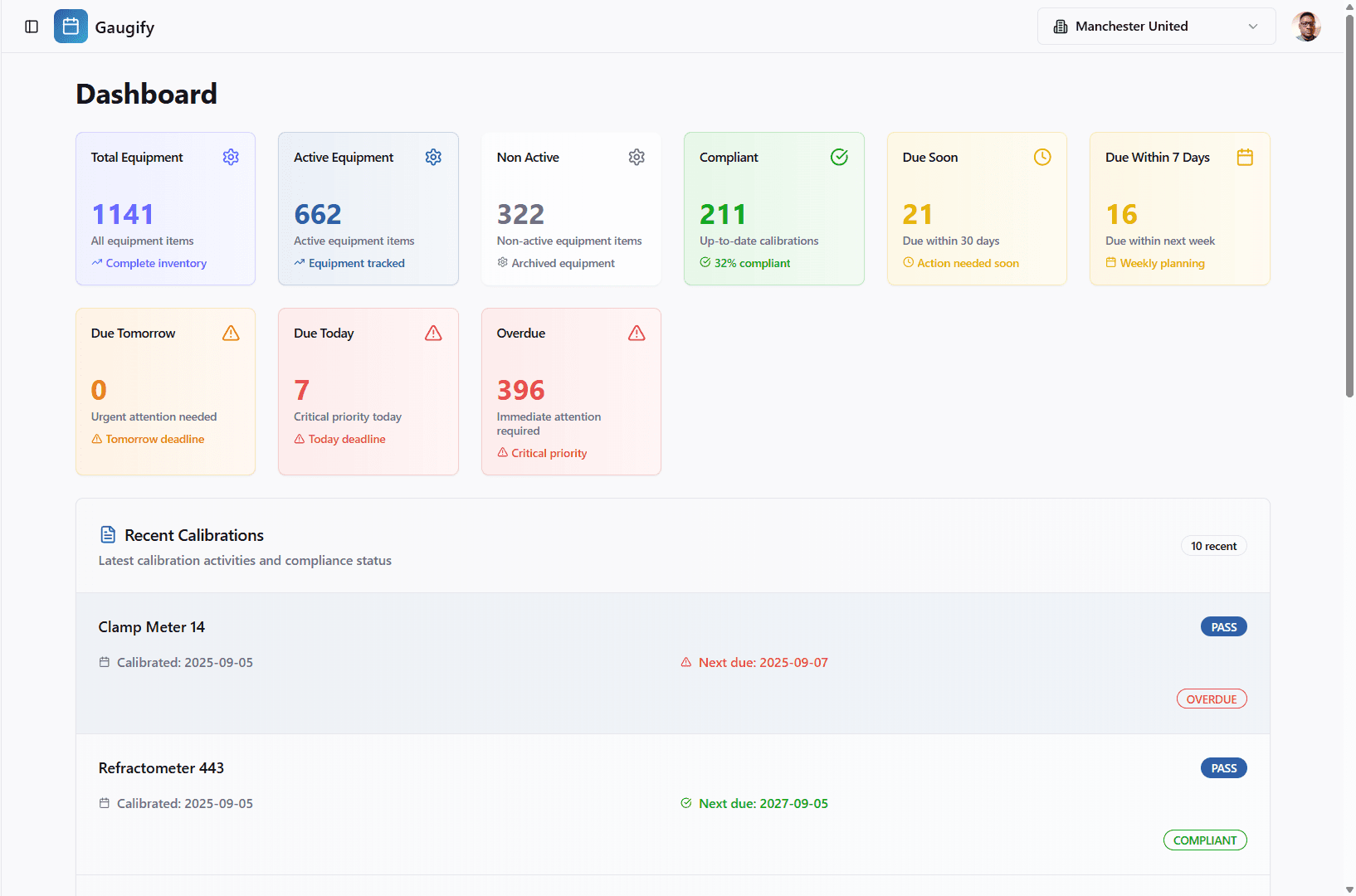
For organizations with multiple ECT instruments, the dashboard provides visual status indicators showing calibration currency across the entire fleet. Color-coded status indicators immediately identify instruments nearing due dates or requiring immediate attention, enabling proactive calibration scheduling that prevents production disruptions.
Comprehensive Data Recording
Digital calibration certificates capture complete as-found and as-left data for conductivity standards, sensitivity verification, and lift-off compensation checks. The system records environmental conditions during calibration, reference standard traceability information, and detailed measurement results with statistical analysis including averages, standard deviations, and trend indicators.
Customizable data entry forms accommodate different ECT instrument types and calibration procedures. Whether calibrating portable flaw detectors, multi-frequency conductivity meters, or specialized array probes, Gaugify adapts to specific measurement parameters and acceptance criteria for each instrument category.
Regulatory Compliance Features
Built-in compliance frameworks support aerospace (AS9100), nuclear (10 CFR Part 50), automotive (IATF 16949), and general manufacturing (ISO 9001) requirements. The compliance module automatically generates audit trails, calibration histories, and regulatory reports meeting specific industry standards.
Certificate templates include all required elements: measurement uncertainty statements, environmental conditions, reference standard traceability chains, and technician certification information. Digital signatures and tamper-evident formatting ensure certificate integrity and authenticity for regulatory submissions.
Trend Analysis and Optimization
Historical data analysis identifies instrument drift patterns, calibration interval optimization opportunities, and equipment reliability trends. Graphical trending shows conductivity accuracy drift over time, helping predict when instruments approach specification limits and require preventive maintenance.
The system tracks calibration costs, technician time allocation, and interval effectiveness, providing data-driven insights for calibration program optimization. Organizations typically reduce calibration costs by 15-25% through interval optimization while maintaining measurement accuracy requirements.
Integration and Mobility
Cloud-based architecture enables calibration data access from any location with internet connectivity. Field calibration teams can upload results immediately using mobile devices, while laboratory managers monitor calibration status from desktop computers. Advanced features include barcode scanning for instrument identification, photo documentation of calibration setups, and GPS location recording for field calibrations.
API integration connects with existing ERP, LIMS, and quality management systems, eliminating duplicate data entry and maintaining information consistency across organizational systems.
Start Optimizing Your Eddy Current Calibration Program Today
Effective eddy current calibration management requires more than just following procedures - it demands systematic tracking, automated scheduling, and comprehensive documentation that scales with your organization's needs. Manual calibration tracking systems inevitably fail under the complexity of multiple instruments, varying intervals, and regulatory requirements.
Gaugify's modern calibration management platform eliminates these traditional challenges while reducing costs and improving compliance outcomes. Organizations using Gaugify report 40% reduction in calibration administrative time, 95% improvement in on-time calibration completion, and zero regulatory audit findings related to calibration documentation.
The platform's intuitive interface requires minimal training while providing enterprise-grade functionality including unlimited user access, comprehensive reporting capabilities, and 99.9% uptime reliability. Flexible pricing plans accommodate organizations from small job shops with a few ECT instruments to large manufacturers managing thousands of calibrated devices.
Don't let outdated calibration tracking methods compromise your ECT program effectiveness. Start your free 30-day trial today and experience how modern calibration management transforms your quality assurance processes. No credit card required - just immediate access to all Gaugify features including automated scheduling, digital certificates, compliance reporting, and mobile accessibility.
Ready to see Gaugify in action with your specific ECT calibration requirements? Schedule a personalized demo and discover how leading organizations are revolutionizing their calibration management programs with cloud-based automation and intelligence.
How to Calibrate Eddy Current Testing Equipment
Eddy current testing (ECT) equipment is a critical non-destructive testing tool used across aerospace, automotive, power generation, and manufacturing industries to detect surface and near-surface flaws in conductive materials. Proper eddy current calibration ensures these instruments provide accurate measurements for crack detection, conductivity testing, and coating thickness measurement. Without regular calibration to traceable standards, your ECT equipment could miss critical defects or generate false positives, leading to catastrophic failures or costly production delays.
This comprehensive guide walks through the complete eddy current calibration process, from understanding the fundamental principles to implementing a robust calibration management system that maintains compliance with industry standards like ASTM E1004 and ISO 9712.
Understanding Eddy Current Testing Equipment and Its Measurements
Eddy current testing equipment operates on electromagnetic induction principles, using alternating current in a probe coil to generate eddy currents in conductive test materials. These instruments measure several key parameters:
Conductivity: Material electrical conductivity measurements typically ranging from 1-65 MS/m (megasiemens per meter)
Lift-off: Distance between probe and test surface, usually measured in mils or millimeters
Phase angle: The relationship between impedance components, critical for flaw characterization
Amplitude: Signal strength variations indicating material property changes or defects
Common ECT equipment types include portable flaw detectors like the Olympus NORTEC series, multi-frequency instruments such as the GE Phasec series, and specialized probes including pencil probes (0.030" to 0.125" diameter), encircling coils for tube inspection, and surface array probes for large area scanning.
These instruments are essential for inspecting aircraft engine components where fatigue cracks as small as 0.020" deep must be detected, automotive brake disc inspection requiring ±0.001" thickness accuracy, and heat exchanger tube inspection detecting wall thinning of 10% or greater.
Key Performance Parameters
ECT equipment calibration focuses on several critical performance parameters. Sensitivity ensures detection of minimum required flaw sizes - typically verified using electrical discharge machined (EDM) notches of specific depths like 0.005", 0.010", and 0.020". Linearity confirms accurate measurement across the full operating range, verified using conductivity standards spanning 10-60 MS/m. Stability maintains consistent readings over time and temperature variations, typically requiring ±2% drift tolerance over 8-hour operating periods.
Why Eddy Current Calibration is Critical
Eddy current calibration is absolutely essential because these instruments directly impact product safety and regulatory compliance. In aerospace applications, missing a 0.015" deep fatigue crack in a turbine blade due to insufficient instrument sensitivity could result in catastrophic engine failure. The economic impact extends beyond safety - false positive readings lead to unnecessary part rejection, while false negatives allow defective components into service.
Regulatory bodies mandate specific calibration requirements. The Federal Aviation Administration (FAA) requires aerospace ECT equipment calibration every 40 hours of use or monthly, whichever occurs first. Nuclear power facilities following ASME Section XI require daily instrument checks and quarterly calibrations. Automotive suppliers meeting IATF 16949 standards typically calibrate annually or after 200 inspection hours.
Temperature drift significantly affects ECT measurements. A typical instrument may experience 0.1% conductivity reading change per degree Celsius temperature variation. Without proper calibration accounting for environmental conditions, measurements can drift outside acceptable tolerances, leading to inspection errors.
Real-World Calibration Failures
Consider an automotive brake disc manufacturer using ECT for crack detection. Their equipment drifted 15% over six months due to skipped calibrations, resulting in 300 defective discs shipped to customers and a $2.3 million recall. Regular eddy current calibration using traceable standards would have prevented this costly oversight.
Step-by-Step Eddy Current Calibration Procedure
Successful ECT calibration requires meticulous attention to environmental conditions, reference standards, and procedural details. This comprehensive procedure ensures measurement accuracy and regulatory compliance.
Environmental Requirements
Establish controlled calibration conditions before beginning. Temperature must remain stable within ±2°C throughout the calibration, typically maintained between 18-28°C. Relative humidity should stay between 45-75% to prevent condensation on probes and standards. Electromagnetic interference from welding equipment, motors, or radio transmissions can corrupt calibration readings, so choose a magnetically quiet environment at least 10 feet from potential sources.
Allow ECT equipment to stabilize for minimum 30 minutes after power-on. High-frequency instruments require longer stabilization periods - up to 60 minutes for frequencies above 1 MHz. Verify line voltage stability within ±5% of rated voltage to prevent measurement drift during calibration.
Reference Standards Selection
Choose NIST-traceable calibration standards appropriate for your specific application. Conductivity standards should bracket your measurement range with certified values. Common aluminum standards include 17.5, 27.5, and 37.7 MS/m, while copper standards typically range from 45-58 MS/m with uncertainties of ±0.5 MS/m or better.
For flaw detection applications, use reference standards with artificial flaws. EDM notches provide the most consistent calibration references, with typical dimensions of 0.005" x 0.030", 0.010" x 0.060", and 0.020" x 0.120" (depth x length). These standards must include material certificates confirming conductivity within ±3% of nominal values.
Lift-off standards consisting of precision shims (0.001", 0.002", 0.005", 0.010") allow verification of probe spacing compensation accuracy. Use non-conductive materials like Kapton or PTFE with thickness tolerances of ±0.0002".
Calibration Procedure Steps
Step 1: Visual Inspection
Examine probe cables for kinks, cuts, or connector damage. Inspect probe tip for wear, contamination, or dimensional changes. Replace any damaged components before proceeding. Check instrument displays for proper function and clean connector contacts with isopropyl alcohol.
Step 2: Instrument Setup
Configure instrument parameters matching your inspection application. Set operating frequency (typically 100 kHz for ferrous materials, 500 kHz for aluminum), gain levels, and filter settings. Document all configuration parameters for reproducibility.
Step 3: Conductivity Calibration
Begin with the lowest conductivity standard. Place probe perpendicular to standard surface with consistent contact pressure (approximately 2-5 ounces force). Record five consecutive readings, calculating average and standard deviation. Acceptable repeatability is typically ±1% of reading or ±0.5 MS/m, whichever is greater.
Repeat measurements on remaining conductivity standards, verifying instrument linearity across the full range. Calculate percent error for each standard: ((Indicated - Actual) / Actual) × 100. Maximum allowable error is typically ±2% of reading.
Step 4: Sensitivity Verification
Using reference standards with artificial flaws, verify minimum detectable flaw size. Position probe over each flaw, recording signal amplitude and phase angle. Compare readings against previous calibrations to identify sensitivity drift. Document as-found conditions before making adjustments.
Step 5: Lift-off Compensation
Place precision shims between probe and conductivity standard, verifying lift-off compensation accuracy. Readings should remain within ±5% of direct contact values up to maximum specified lift-off distance. This verification ensures accurate measurements despite surface roughness or contaminants.
Step 6: Final Verification
Perform complete measurement sequence on check standards different from calibration standards. This independent verification confirms calibration accuracy using separate references. Document as-left performance data for calibration certificates.
Ready to streamline your eddy current calibration tracking and ensure you never miss critical calibration dates? Start your free 30-day trial of Gaugify and see how modern calibration management software eliminates manual tracking headaches.
Relevant Standards for Eddy Current Calibration
Multiple international and industry standards govern eddy current calibration procedures, ensuring consistency and reliability across different organizations and applications.
Primary Standards
ASTM E1004 - "Standard Test Method for Determining Electrical Conductivity Using the Electromagnetic (Eddy Current) Method" provides comprehensive guidance for conductivity measurements. This standard specifies calibration frequencies, reference standard requirements, and measurement uncertainties. Key requirements include using minimum three conductivity standards spanning the measurement range and maintaining calibration uncertainties below 3%.
ISO 15549 - "Non-destructive testing - Eddy current testing - General principles" establishes international requirements for ECT procedures and equipment verification. This standard emphasizes operator qualification requirements and mandates documented calibration procedures with specific acceptance criteria.
ASNT SNT-TC-1A and ISO 9712 address personnel qualification requirements for ECT operations, including calibration responsibilities. These standards require Level II or Level III certified technicians to perform equipment calibrations, ensuring adequate technical knowledge and experience.
Industry-Specific Standards
Aerospace applications follow AMS 2644 for inspection of aerospace materials and ASTM E2338 for characterization of discontinuities. These standards specify tighter calibration tolerances (typically ±1.5% for conductivity) and more frequent calibration intervals reflecting critical safety requirements.
Nuclear industry applications reference ASME Section V Article 8, requiring specific calibration block configurations and documented sensitivity demonstrations. Power generation facilities often implement daily instrument checks using simplified reference standards, supplementing periodic comprehensive calibrations.
Automotive standards like ASTM E3052 address ECT applications for automotive components, specifying calibration requirements for production line inspection systems. These applications emphasize measurement repeatability and long-term stability requirements.
Manufacturer Specifications
Equipment manufacturers provide detailed calibration procedures specific to instrument models. Olympus NORTEC instruments specify calibration using their proprietary conductivity standards with defined measurement sequences. GE Phasec systems include self-calibration routines supplementing external standard verifications. Always consult manufacturer documentation for model-specific requirements that may exceed general industry standards.
Recommended Calibration Intervals for Eddy Current Equipment
Determining appropriate eddy current calibration intervals requires balancing measurement accuracy requirements with operational efficiency. Industry experience and regulatory guidance provide frameworks for establishing these intervals.
Standard Interval Guidelines
Annual calibration represents the most common interval for general industrial applications where ECT equipment operates in controlled environments with moderate usage. Manufacturing facilities using ECT for incoming inspection or quality control typically follow 12-month intervals, providing adequate accuracy assurance while minimizing calibration costs.
Quarterly calibration applies to critical safety applications or high-usage environments. Nuclear facilities, aerospace manufacturers, and petrochemical plants often implement 3-month intervals reflecting the critical nature of their applications and regulatory requirements.
Monthly or usage-based intervals suit field inspection equipment experiencing harsh environmental conditions or extensive use. Pipeline inspection services, power plant maintenance teams, and aerospace field operations frequently calibrate every 30 days or after 40 hours of active use.
Factors Affecting Calibration Frequency
Several factors influence optimal calibration intervals for ECT equipment. Environmental conditions significantly impact instrument stability. Equipment operating in temperature extremes, high humidity, or corrosive atmospheres requires more frequent calibration than laboratory instruments in controlled conditions.
Usage intensity affects both mechanical wear and electronic drift. Portable instruments experiencing frequent transport, probe cable flexing, and varied operating conditions need shorter intervals than stationary systems with consistent usage patterns.
Measurement criticality drives calibration frequency for safety-critical applications. Aircraft engine inspection equipment detecting fatigue cracks requires more frequent calibration than general material sorting applications where measurement errors have limited consequences.
Historical performance data provides objective evidence for interval optimization. Instruments consistently passing calibration with minimal adjustments may qualify for extended intervals, while equipment showing drift patterns needs more frequent attention.
Establishing Risk-Based Intervals
Modern calibration programs increasingly adopt risk-based approaches considering measurement uncertainty, application criticality, and instrument reliability. High-reliability instruments in non-critical applications may extend to 18-month intervals, while critical safety applications maintain 30-day schedules regardless of instrument stability.
Document interval decisions with supporting technical justification, including measurement uncertainty analysis, failure mode evaluation, and cost-benefit considerations. This documentation supports regulatory audits and provides evidence for interval modifications based on operational experience.
Common Eddy Current Calibration Mistakes and Prevention
Even experienced technicians encounter pitfalls during eddy current calibration that compromise measurement accuracy and waste valuable time. Understanding these common mistakes and their prevention strategies ensures successful calibration outcomes.
Environmental Control Failures
The most frequent calibration error involves inadequate environmental control during the calibration process. Temperature variations exceeding ±2°C during calibration create measurement drift that invalidates results. For example, a temperature increase from 20°C to 25°C during calibration can shift conductivity readings by 0.5 MS/m in aluminum standards, exceeding typical ±0.3 MS/m calibration tolerances.
Prevention: Implement environmental monitoring throughout calibration procedures. Use digital thermometers with 0.1°C resolution and log temperatures at 15-minute intervals. Schedule calibrations during stable environmental periods, avoiding morning startup periods when HVAC systems cycle frequently.
Reference Standard Contamination
Conductivity and flaw detection standards accumulate surface contamination from handling, environmental exposure, and probe contact. Oxidation on aluminum standards can reduce apparent conductivity by 2-3 MS/m, while oil films from handling create inconsistent probe coupling. Magnetic particles on steel reference standards interfere with eddy current field patterns, creating false flaw indications.
Prevention: Establish standard cleaning procedures using isopropyl alcohol and lint-free wipes. Store standards in protective cases with desiccant packs to prevent moisture exposure. Implement standard rotation schedules, using different standards for calibration and verification to identify contamination effects. Replace standards showing surface degradation or dimensional changes.
Probe Positioning Inconsistencies
Inconsistent probe positioning during calibration creates measurement variations that appear as instrument instability. Angular variations of just 5° from perpendicular can change conductivity readings by 1-2%. Variable contact pressure affects lift-off compensation accuracy, while probe cable positioning near metal surfaces creates stray coupling effects.
Prevention: Use probe positioning fixtures or guides ensuring consistent probe angle and contact pressure. Maintain consistent cable routing during calibration measurements. Train technicians on proper probe handling techniques, emphasizing steady hand position and consistent contact pressure (typically 2-5 ounces force).
Inadequate Stabilization Time
Rushing calibration procedures without adequate instrument stabilization creates measurement errors and false adjustment needs. Electronic components require thermal stabilization after power-on, typically 30-60 minutes depending on instrument complexity. Probe temperature equilibration with reference standards prevents thermal drift during measurements.
Prevention: Implement mandatory stabilization periods in calibration procedures. Use instrument self-monitoring features indicating thermal stability before beginning calibrations. Schedule calibration appointments allowing adequate preparation time without pressure to rush procedures.
Documentation and Traceability Errors
Incomplete calibration documentation creates compliance violations and prevents trend analysis for interval optimization. Common errors include missing environmental conditions, undefined measurement uncertainties, and inadequate reference standard traceability documentation. These oversights create audit findings and question measurement validity.
Prevention: Develop comprehensive calibration data sheets capturing all required information. Implement calibration software systems automatically recording environmental data, reference standard information, and measurement results with timestamps and technician identification.
Tracking Eddy Current Calibration with Modern Software
Managing eddy current calibration schedules, documentation, and compliance requirements manually creates unnecessary risks and inefficiencies. Modern calibration management software like Gaugify transforms ECT calibration tracking from a paper-based burden into an automated, compliance-focused system.
Automated Scheduling and Notifications
Gaugify's intelligent scheduling system tracks individual ECT instruments by serial number, model, and usage patterns. The system automatically calculates due dates based on configurable intervals - whether calendar-based (monthly, quarterly, annually) or usage-based (every 40 inspection hours). Automated email notifications alert technicians 30, 14, and 7 days before calibration due dates, preventing overdue equipment and compliance violations.
For organizations with multiple ECT instruments, the dashboard provides visual status indicators showing calibration currency across the entire fleet. Color-coded status indicators immediately identify instruments nearing due dates or requiring immediate attention, enabling proactive calibration scheduling that prevents production disruptions.
Comprehensive Data Recording
Digital calibration certificates capture complete as-found and as-left data for conductivity standards, sensitivity verification, and lift-off compensation checks. The system records environmental conditions during calibration, reference standard traceability information, and detailed measurement results with statistical analysis including averages, standard deviations, and trend indicators.
Customizable data entry forms accommodate different ECT instrument types and calibration procedures. Whether calibrating portable flaw detectors, multi-frequency conductivity meters, or specialized array probes, Gaugify adapts to specific measurement parameters and acceptance criteria for each instrument category.
Regulatory Compliance Features
Built-in compliance frameworks support aerospace (AS9100), nuclear (10 CFR Part 50), automotive (IATF 16949), and general manufacturing (ISO 9001) requirements. The compliance module automatically generates audit trails, calibration histories, and regulatory reports meeting specific industry standards.
Certificate templates include all required elements: measurement uncertainty statements, environmental conditions, reference standard traceability chains, and technician certification information. Digital signatures and tamper-evident formatting ensure certificate integrity and authenticity for regulatory submissions.
Trend Analysis and Optimization
Historical data analysis identifies instrument drift patterns, calibration interval optimization opportunities, and equipment reliability trends. Graphical trending shows conductivity accuracy drift over time, helping predict when instruments approach specification limits and require preventive maintenance.
The system tracks calibration costs, technician time allocation, and interval effectiveness, providing data-driven insights for calibration program optimization. Organizations typically reduce calibration costs by 15-25% through interval optimization while maintaining measurement accuracy requirements.
Integration and Mobility
Cloud-based architecture enables calibration data access from any location with internet connectivity. Field calibration teams can upload results immediately using mobile devices, while laboratory managers monitor calibration status from desktop computers. Advanced features include barcode scanning for instrument identification, photo documentation of calibration setups, and GPS location recording for field calibrations.
API integration connects with existing ERP, LIMS, and quality management systems, eliminating duplicate data entry and maintaining information consistency across organizational systems.
Start Optimizing Your Eddy Current Calibration Program Today
Effective eddy current calibration management requires more than just following procedures - it demands systematic tracking, automated scheduling, and comprehensive documentation that scales with your organization's needs. Manual calibration tracking systems inevitably fail under the complexity of multiple instruments, varying intervals, and regulatory requirements.
Gaugify's modern calibration management platform eliminates these traditional challenges while reducing costs and improving compliance outcomes. Organizations using Gaugify report 40% reduction in calibration administrative time, 95% improvement in on-time calibration completion, and zero regulatory audit findings related to calibration documentation.
The platform's intuitive interface requires minimal training while providing enterprise-grade functionality including unlimited user access, comprehensive reporting capabilities, and 99.9% uptime reliability. Flexible pricing plans accommodate organizations from small job shops with a few ECT instruments to large manufacturers managing thousands of calibrated devices.
Don't let outdated calibration tracking methods compromise your ECT program effectiveness. Start your free 30-day trial today and experience how modern calibration management transforms your quality assurance processes. No credit card required - just immediate access to all Gaugify features including automated scheduling, digital certificates, compliance reporting, and mobile accessibility.
Ready to see Gaugify in action with your specific ECT calibration requirements? Schedule a personalized demo and discover how leading organizations are revolutionizing their calibration management programs with cloud-based automation and intelligence.