
Gaugify vs Caliber Calibration Software
Gaugify vs Caliber Calibration Software
David Bentley
Quality Assurance Engineer
12 min read
Gaugify vs Caliber Calibration Software
When evaluating calibration management solutions, the Gaugify vs Caliber comparison frequently surfaces among quality professionals seeking robust yet user-friendly software. Both platforms serve manufacturers, laboratories, and quality departments managing precision instruments, but they take distinctly different approaches to calibration workflow automation and compliance tracking.
This comprehensive analysis examines how these two calibration management systems stack up across critical factors including functionality, ease of use, pricing transparency, and deployment flexibility. Whether you're a quality manager overseeing hundreds of micrometers and torque wrenches or a lab technician tracking certificate compliance for analytical balances, understanding these platforms' strengths helps inform your software selection decision.
Company Background and Market Position
Caliber represents an established player in the calibration software space, serving primarily larger manufacturing organizations with complex instrument portfolios. The platform has built its reputation through years of serving enterprise clients who require extensive customization and on-premise deployment capabilities.
Gaugify takes a modern, cloud-first approach to calibration management. Built specifically for today's quality professionals who need immediate access to calibration data across multiple locations, Gaugify focuses on intuitive design, transparent pricing, and rapid implementation. The platform serves companies ranging from small job shops tracking 50 gages to mid-size manufacturers managing thousands of instruments across multiple facilities.
The fundamental difference lies in philosophy: Caliber emphasizes traditional enterprise software capabilities, while Gaugify prioritizes user experience and accessibility without sacrificing compliance or functionality.
Feature-by-Feature Analysis: Gaugify vs Caliber Capabilities
Calibration Scheduling and Notifications
Both platforms handle automatic scheduling for instruments like dial indicators, pressure gauges, and temperature sensors. Caliber offers extensive customization options for scheduling rules, allowing complex scenarios such as usage-based intervals or conditional scheduling based on measurement uncertainty requirements.
Gaugify streamlines scheduling with intelligent automation that most quality teams actually use. The system automatically generates work orders 30, 60, and 90 days before due dates, sends email notifications to relevant technicians, and provides dashboard alerts for overdue items. For a typical manufacturing environment tracking 500+ gages with tolerances ranging from ±0.0001" to ±0.010", Gaugify's approach eliminates scheduling complexity while maintaining compliance.
Certificate Generation and Management
Certificate handling reveals significant differences between platforms. Caliber provides extensive template customization, allowing organizations to create highly detailed certificates meeting specific customer requirements or industry standards.
Gaugify generates professional certificates automatically upon calibration completion, incorporating measurement data, uncertainty calculations, and compliance statements. The system stores certificates indefinitely with instant retrieval capabilities. For ISO 9001 audits requiring certificate evidence for critical gages like go/no-go rings or CMM probe qualifications, technicians can access certificates within seconds rather than searching file systems.
Measurement Uncertainty Calculations
This area showcases Gaugify's significant advantage. While Caliber handles uncertainty through manual entry or complex configuration, Gaugify includes built-in uncertainty calculations following GUM (Guide to Uncertainty in Measurement) principles. The system automatically computes Type A and Type B uncertainties, combines components using root-sum-squares methodology, and determines expanded uncertainty with appropriate coverage factors.
For practical application, consider calibrating a digital caliper with 0.001" resolution against a gage block set. Gaugify automatically incorporates the standard's uncertainty (typically ±0.00005"), resolution uncertainty, repeatability from measurement data, and environmental factors to produce compliant uncertainty statements required for ISO 17025 accreditation.
Audit Trail and Compliance Tracking
Both systems maintain comprehensive audit trails, but implementation differs substantially. Caliber provides detailed logging with extensive data fields, supporting complex compliance scenarios but requiring significant administrative overhead.
Gaugify automatically captures all calibration activities, changes, and user actions without manual intervention. The system tracks who performed calibrations, when measurements occurred, what standards were used, and environmental conditions during testing. For FDA-regulated environments requiring 21 CFR Part 11 compliance, Gaugify's electronic signatures and tamper-evident records satisfy regulatory requirements while remaining user-friendly.
Crib and Asset Management
Instrument tracking capabilities vary between platforms. Caliber offers extensive asset management features including depreciation tracking, maintenance histories, and complex hierarchical organization structures.
Gaugify focuses on practical crib management needs: tracking instrument locations, assignment to specific users or departments, and monitoring usage patterns. The system handles check-in/check-out procedures, maintains custody chains, and alerts supervisors when critical instruments remain checked out beyond normal periods. For a tool crib managing 200+ micrometers, height gages, and inspection fixtures, Gaugify's streamlined approach reduces administrative burden while maintaining accountability.
Ready to experience modern calibration management? Start your free Gaugify trial and see how intuitive calibration software should work.
Mobile Access and Field Calibrations
Mobile functionality represents another area where modern design philosophy matters. Caliber's mobile access typically requires VPN connections for on-premise deployments, limiting field usability.
Gaugify provides full mobile responsiveness through standard web browsers, enabling field calibrations without additional software installations. Technicians can access instrument records, enter measurement data, and generate certificates directly from tablets or smartphones. This proves invaluable for calibrating large equipment like coordinate measuring machines or environmental chambers that cannot be transported to controlled lab environments.
User Experience and Interface Design
The Gaugify vs Caliber user experience comparison reveals generational differences in software design approaches. Caliber's interface reflects traditional enterprise software conventions with extensive menu structures, multiple windows, and configuration-heavy workflows. While powerful, the learning curve is substantial, often requiring formal training and ongoing support.
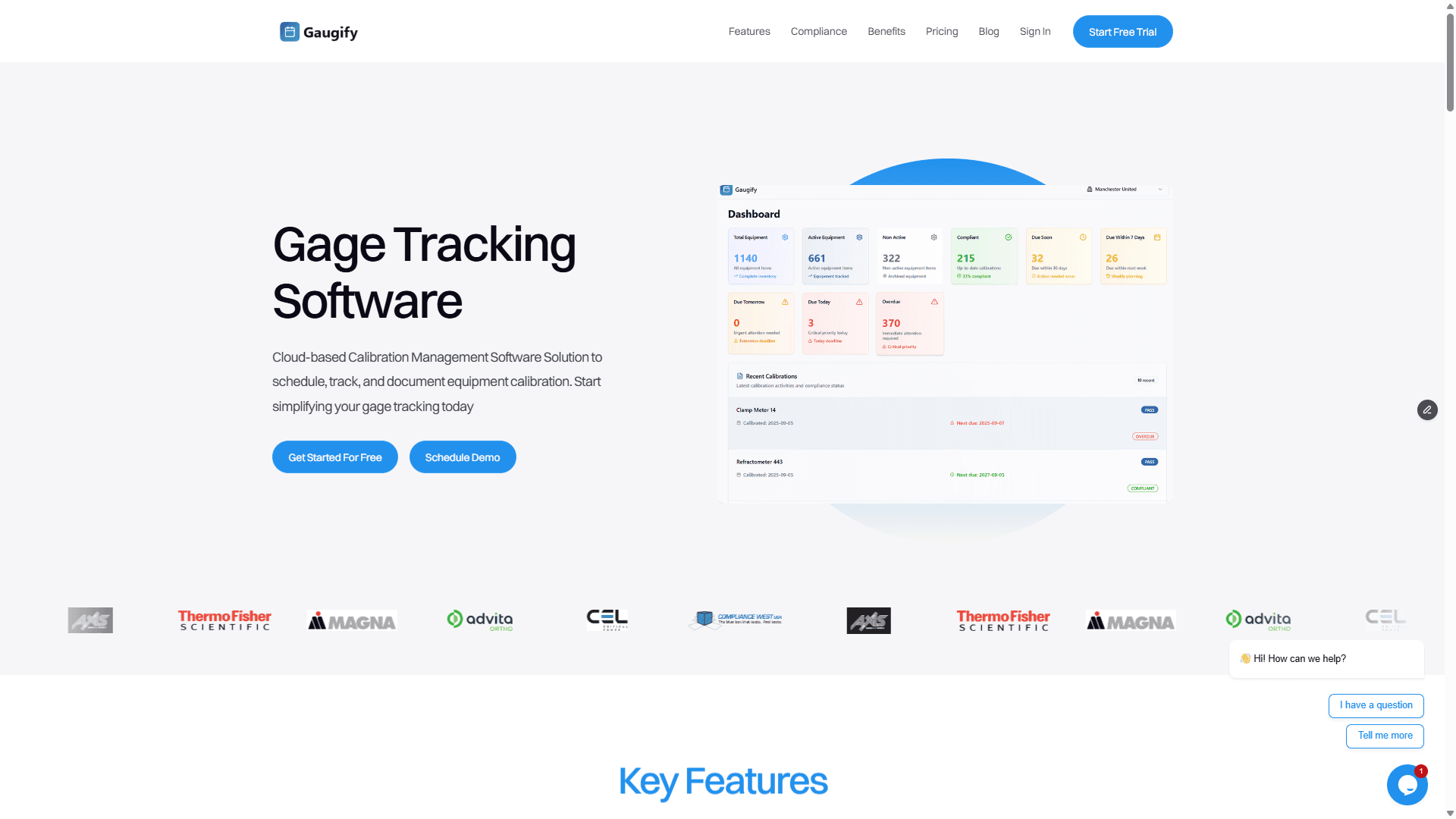
Gaugify prioritizes intuitive design following modern web application standards. The dashboard provides immediate visibility into overdue calibrations, recent activities, and key performance metrics. Common tasks like scheduling calibrations, entering measurement data, or generating reports require minimal clicks and follow logical workflows. New users typically become productive within hours rather than weeks.
Consider the practical impact: a quality technician calibrating a batch of bore gages needs to enter diameter measurements, record environmental conditions, and generate certificates. In Gaugify, this workflow happens seamlessly within a single interface, while traditional systems often require navigating multiple screens and dialog boxes.
Pricing Structure and Total Cost Comparison
Pricing transparency differs dramatically between these platforms. Caliber follows traditional enterprise software pricing with complex licensing structures, implementation fees, and customization costs that often remain unclear until deep into the sales process.
Gaugify offers transparent SaaS pricing starting at predictable monthly rates based on instrument count. The pricing includes all features, automatic updates, and standard support without hidden fees or forced customizations. Organizations can calculate exact costs and begin trials immediately without lengthy procurement processes.
For total cost of ownership analysis, consider a mid-size manufacturer tracking 1,000 instruments. Gaugify's subscription model includes hosting, security, backups, and updates automatically, while traditional on-premise solutions require dedicated IT resources for maintenance, security patches, and infrastructure management.
Deployment Options and Technical Requirements
Deployment flexibility reveals fundamental architectural differences. Caliber offers primarily on-premise installations requiring dedicated servers, database management, and ongoing IT support. While some cloud options exist, the platform originated as installed software with associated complexity.
Gaugify operates exclusively as cloud-native software, eliminating server requirements and IT overhead. Organizations access the system through standard web browsers with enterprise-grade security, automatic backups, and guaranteed uptime. This approach enables rapid deployment—most companies complete implementation within days rather than months.
Cloud deployment also ensures automatic feature updates and security patches without service interruptions, maintaining compliance with evolving standards like ISO 17025:2017 requirements.
Customer Support and Implementation Services
Support models reflect each platform's target market approach. Caliber typically provides dedicated account management and extensive consulting services, particularly valuable for large enterprises requiring significant customization or integration with existing ERP systems.
Gaugify emphasizes self-service capabilities with comprehensive online documentation, video tutorials, and responsive email support. The intuitive design reduces support requirements, while the development team maintains close customer relationships to drive continuous product improvement based on real-world usage patterns.
Implementation speed varies accordingly. Caliber installations often require months for server setup, customization, testing, and user training. Gaugify customers typically complete setup within days, importing existing instrument data through Excel uploads and beginning productive use immediately.
Integration Capabilities and Data Exchange
Both platforms handle data integration, but through different approaches. Caliber offers extensive API capabilities and custom integration development, supporting complex scenarios like real-time ERP synchronization or automated measurement device interfaces.
Gaugify provides practical integration options including Excel import/export, REST API access, and standard data formats. The platform focuses on common integration needs—synchronizing instrument lists with asset management systems or exporting calibration data for quality reports—without requiring extensive customization.
For most organizations, Gaugify's streamlined integration approach addresses actual business needs while avoiding over-engineering and associated costs.
Who Each Platform Serves Best
Caliber suits large enterprises with complex requirements, dedicated IT resources, and budgets for extensive customization. Organizations needing deep ERP integration, highly specific certificate formats, or unusual workflow requirements may benefit from Caliber's extensive customization capabilities.
Gaugify serves quality-focused organizations seeking modern, efficient calibration management without unnecessary complexity. The platform excels for:
Small to mid-size manufacturers tracking 50-5000+ instruments
Quality departments needing immediate productivity without lengthy implementations
Organizations requiring built-in uncertainty calculations and automated compliance
Companies with multiple locations needing cloud-based access
Teams prioritizing user experience and modern software design
Compliance and Standards Support
Both platforms support major quality standards, but implementation approaches differ. Caliber handles compliance through extensive configuration options, allowing organizations to customize workflows matching specific interpretations of standards like ISO 9001, AS9100, or ISO 17025.
Gaugify builds compliance directly into standard workflows, ensuring automatic adherence to requirements without manual configuration. The system maintains complete calibration records, provides traceability to national standards, calculates measurement uncertainties per GUM guidelines, and generates audit-ready reports supporting various quality frameworks.
For practical compliance, consider ISO 9001 audit scenarios. Auditors typically request evidence of calibration schedules, overdue instrument lists, and traceability documentation. Gaugify generates these reports instantly, while traditional systems often require manual data compilation or custom report development.
Final Verdict: Modern Calibration Management
The Gaugify vs Caliber comparison ultimately centers on organizational priorities and resource allocation. Caliber serves enterprises requiring extensive customization and possessing dedicated implementation resources. However, for most quality organizations, Gaugify provides superior value through modern design, transparent pricing, rapid deployment, and comprehensive functionality.
Gaugify's cloud-native architecture, built-in uncertainty calculations, intuitive interface, and focus on practical compliance needs represent the future of calibration management software. The platform eliminates traditional barriers to effective calibration management—complex installations, lengthy training requirements, and unclear pricing—while delivering enterprise-grade functionality.
Key advantages supporting Gaugify selection include:
Immediate deployment without IT infrastructure requirements
Transparent pricing enabling accurate budgeting
Built-in uncertainty calculations following international standards
Modern, intuitive interface requiring minimal training
Automatic compliance with ISO 9001, AS9100, and ISO 17025 requirements
Mobile access supporting field calibrations
Continuous updates and feature improvements
Experience the Difference with Gaugify
Rather than navigating complex sales processes and uncertain implementation timelines, experience modern calibration management directly. Gaugify's free trial provides immediate access to all platform features, allowing evaluation with your actual instrument data and workflows.
The trial includes sample data demonstrating uncertainty calculations, certificate generation, and compliance reporting capabilities. You can import your instrument list, configure calibration schedules, and experience the streamlined workflows that make quality teams more efficient and effective.
Ready to modernize your calibration management? Start your free Gaugify trial today and discover why quality professionals choose cloud-native calibration software that actually works the way you do. No lengthy demos, complex installations, or unclear pricing—just professional calibration management software designed for today's quality requirements.
Questions about specific features or implementation scenarios? Schedule a personalized demo to see exactly how Gaugify handles your calibration management challenges.
Gaugify vs Caliber Calibration Software
When evaluating calibration management solutions, the Gaugify vs Caliber comparison frequently surfaces among quality professionals seeking robust yet user-friendly software. Both platforms serve manufacturers, laboratories, and quality departments managing precision instruments, but they take distinctly different approaches to calibration workflow automation and compliance tracking.
This comprehensive analysis examines how these two calibration management systems stack up across critical factors including functionality, ease of use, pricing transparency, and deployment flexibility. Whether you're a quality manager overseeing hundreds of micrometers and torque wrenches or a lab technician tracking certificate compliance for analytical balances, understanding these platforms' strengths helps inform your software selection decision.
Company Background and Market Position
Caliber represents an established player in the calibration software space, serving primarily larger manufacturing organizations with complex instrument portfolios. The platform has built its reputation through years of serving enterprise clients who require extensive customization and on-premise deployment capabilities.
Gaugify takes a modern, cloud-first approach to calibration management. Built specifically for today's quality professionals who need immediate access to calibration data across multiple locations, Gaugify focuses on intuitive design, transparent pricing, and rapid implementation. The platform serves companies ranging from small job shops tracking 50 gages to mid-size manufacturers managing thousands of instruments across multiple facilities.
The fundamental difference lies in philosophy: Caliber emphasizes traditional enterprise software capabilities, while Gaugify prioritizes user experience and accessibility without sacrificing compliance or functionality.
Feature-by-Feature Analysis: Gaugify vs Caliber Capabilities
Calibration Scheduling and Notifications
Both platforms handle automatic scheduling for instruments like dial indicators, pressure gauges, and temperature sensors. Caliber offers extensive customization options for scheduling rules, allowing complex scenarios such as usage-based intervals or conditional scheduling based on measurement uncertainty requirements.
Gaugify streamlines scheduling with intelligent automation that most quality teams actually use. The system automatically generates work orders 30, 60, and 90 days before due dates, sends email notifications to relevant technicians, and provides dashboard alerts for overdue items. For a typical manufacturing environment tracking 500+ gages with tolerances ranging from ±0.0001" to ±0.010", Gaugify's approach eliminates scheduling complexity while maintaining compliance.
Certificate Generation and Management
Certificate handling reveals significant differences between platforms. Caliber provides extensive template customization, allowing organizations to create highly detailed certificates meeting specific customer requirements or industry standards.
Gaugify generates professional certificates automatically upon calibration completion, incorporating measurement data, uncertainty calculations, and compliance statements. The system stores certificates indefinitely with instant retrieval capabilities. For ISO 9001 audits requiring certificate evidence for critical gages like go/no-go rings or CMM probe qualifications, technicians can access certificates within seconds rather than searching file systems.
Measurement Uncertainty Calculations
This area showcases Gaugify's significant advantage. While Caliber handles uncertainty through manual entry or complex configuration, Gaugify includes built-in uncertainty calculations following GUM (Guide to Uncertainty in Measurement) principles. The system automatically computes Type A and Type B uncertainties, combines components using root-sum-squares methodology, and determines expanded uncertainty with appropriate coverage factors.
For practical application, consider calibrating a digital caliper with 0.001" resolution against a gage block set. Gaugify automatically incorporates the standard's uncertainty (typically ±0.00005"), resolution uncertainty, repeatability from measurement data, and environmental factors to produce compliant uncertainty statements required for ISO 17025 accreditation.
Audit Trail and Compliance Tracking
Both systems maintain comprehensive audit trails, but implementation differs substantially. Caliber provides detailed logging with extensive data fields, supporting complex compliance scenarios but requiring significant administrative overhead.
Gaugify automatically captures all calibration activities, changes, and user actions without manual intervention. The system tracks who performed calibrations, when measurements occurred, what standards were used, and environmental conditions during testing. For FDA-regulated environments requiring 21 CFR Part 11 compliance, Gaugify's electronic signatures and tamper-evident records satisfy regulatory requirements while remaining user-friendly.
Crib and Asset Management
Instrument tracking capabilities vary between platforms. Caliber offers extensive asset management features including depreciation tracking, maintenance histories, and complex hierarchical organization structures.
Gaugify focuses on practical crib management needs: tracking instrument locations, assignment to specific users or departments, and monitoring usage patterns. The system handles check-in/check-out procedures, maintains custody chains, and alerts supervisors when critical instruments remain checked out beyond normal periods. For a tool crib managing 200+ micrometers, height gages, and inspection fixtures, Gaugify's streamlined approach reduces administrative burden while maintaining accountability.
Ready to experience modern calibration management? Start your free Gaugify trial and see how intuitive calibration software should work.
Mobile Access and Field Calibrations
Mobile functionality represents another area where modern design philosophy matters. Caliber's mobile access typically requires VPN connections for on-premise deployments, limiting field usability.
Gaugify provides full mobile responsiveness through standard web browsers, enabling field calibrations without additional software installations. Technicians can access instrument records, enter measurement data, and generate certificates directly from tablets or smartphones. This proves invaluable for calibrating large equipment like coordinate measuring machines or environmental chambers that cannot be transported to controlled lab environments.
User Experience and Interface Design
The Gaugify vs Caliber user experience comparison reveals generational differences in software design approaches. Caliber's interface reflects traditional enterprise software conventions with extensive menu structures, multiple windows, and configuration-heavy workflows. While powerful, the learning curve is substantial, often requiring formal training and ongoing support.
Gaugify prioritizes intuitive design following modern web application standards. The dashboard provides immediate visibility into overdue calibrations, recent activities, and key performance metrics. Common tasks like scheduling calibrations, entering measurement data, or generating reports require minimal clicks and follow logical workflows. New users typically become productive within hours rather than weeks.
Consider the practical impact: a quality technician calibrating a batch of bore gages needs to enter diameter measurements, record environmental conditions, and generate certificates. In Gaugify, this workflow happens seamlessly within a single interface, while traditional systems often require navigating multiple screens and dialog boxes.
Pricing Structure and Total Cost Comparison
Pricing transparency differs dramatically between these platforms. Caliber follows traditional enterprise software pricing with complex licensing structures, implementation fees, and customization costs that often remain unclear until deep into the sales process.
Gaugify offers transparent SaaS pricing starting at predictable monthly rates based on instrument count. The pricing includes all features, automatic updates, and standard support without hidden fees or forced customizations. Organizations can calculate exact costs and begin trials immediately without lengthy procurement processes.
For total cost of ownership analysis, consider a mid-size manufacturer tracking 1,000 instruments. Gaugify's subscription model includes hosting, security, backups, and updates automatically, while traditional on-premise solutions require dedicated IT resources for maintenance, security patches, and infrastructure management.
Deployment Options and Technical Requirements
Deployment flexibility reveals fundamental architectural differences. Caliber offers primarily on-premise installations requiring dedicated servers, database management, and ongoing IT support. While some cloud options exist, the platform originated as installed software with associated complexity.
Gaugify operates exclusively as cloud-native software, eliminating server requirements and IT overhead. Organizations access the system through standard web browsers with enterprise-grade security, automatic backups, and guaranteed uptime. This approach enables rapid deployment—most companies complete implementation within days rather than months.
Cloud deployment also ensures automatic feature updates and security patches without service interruptions, maintaining compliance with evolving standards like ISO 17025:2017 requirements.
Customer Support and Implementation Services
Support models reflect each platform's target market approach. Caliber typically provides dedicated account management and extensive consulting services, particularly valuable for large enterprises requiring significant customization or integration with existing ERP systems.
Gaugify emphasizes self-service capabilities with comprehensive online documentation, video tutorials, and responsive email support. The intuitive design reduces support requirements, while the development team maintains close customer relationships to drive continuous product improvement based on real-world usage patterns.
Implementation speed varies accordingly. Caliber installations often require months for server setup, customization, testing, and user training. Gaugify customers typically complete setup within days, importing existing instrument data through Excel uploads and beginning productive use immediately.
Integration Capabilities and Data Exchange
Both platforms handle data integration, but through different approaches. Caliber offers extensive API capabilities and custom integration development, supporting complex scenarios like real-time ERP synchronization or automated measurement device interfaces.
Gaugify provides practical integration options including Excel import/export, REST API access, and standard data formats. The platform focuses on common integration needs—synchronizing instrument lists with asset management systems or exporting calibration data for quality reports—without requiring extensive customization.
For most organizations, Gaugify's streamlined integration approach addresses actual business needs while avoiding over-engineering and associated costs.
Who Each Platform Serves Best
Caliber suits large enterprises with complex requirements, dedicated IT resources, and budgets for extensive customization. Organizations needing deep ERP integration, highly specific certificate formats, or unusual workflow requirements may benefit from Caliber's extensive customization capabilities.
Gaugify serves quality-focused organizations seeking modern, efficient calibration management without unnecessary complexity. The platform excels for:
Small to mid-size manufacturers tracking 50-5000+ instruments
Quality departments needing immediate productivity without lengthy implementations
Organizations requiring built-in uncertainty calculations and automated compliance
Companies with multiple locations needing cloud-based access
Teams prioritizing user experience and modern software design
Compliance and Standards Support
Both platforms support major quality standards, but implementation approaches differ. Caliber handles compliance through extensive configuration options, allowing organizations to customize workflows matching specific interpretations of standards like ISO 9001, AS9100, or ISO 17025.
Gaugify builds compliance directly into standard workflows, ensuring automatic adherence to requirements without manual configuration. The system maintains complete calibration records, provides traceability to national standards, calculates measurement uncertainties per GUM guidelines, and generates audit-ready reports supporting various quality frameworks.
For practical compliance, consider ISO 9001 audit scenarios. Auditors typically request evidence of calibration schedules, overdue instrument lists, and traceability documentation. Gaugify generates these reports instantly, while traditional systems often require manual data compilation or custom report development.
Final Verdict: Modern Calibration Management
The Gaugify vs Caliber comparison ultimately centers on organizational priorities and resource allocation. Caliber serves enterprises requiring extensive customization and possessing dedicated implementation resources. However, for most quality organizations, Gaugify provides superior value through modern design, transparent pricing, rapid deployment, and comprehensive functionality.
Gaugify's cloud-native architecture, built-in uncertainty calculations, intuitive interface, and focus on practical compliance needs represent the future of calibration management software. The platform eliminates traditional barriers to effective calibration management—complex installations, lengthy training requirements, and unclear pricing—while delivering enterprise-grade functionality.
Key advantages supporting Gaugify selection include:
Immediate deployment without IT infrastructure requirements
Transparent pricing enabling accurate budgeting
Built-in uncertainty calculations following international standards
Modern, intuitive interface requiring minimal training
Automatic compliance with ISO 9001, AS9100, and ISO 17025 requirements
Mobile access supporting field calibrations
Continuous updates and feature improvements
Experience the Difference with Gaugify
Rather than navigating complex sales processes and uncertain implementation timelines, experience modern calibration management directly. Gaugify's free trial provides immediate access to all platform features, allowing evaluation with your actual instrument data and workflows.
The trial includes sample data demonstrating uncertainty calculations, certificate generation, and compliance reporting capabilities. You can import your instrument list, configure calibration schedules, and experience the streamlined workflows that make quality teams more efficient and effective.
Ready to modernize your calibration management? Start your free Gaugify trial today and discover why quality professionals choose cloud-native calibration software that actually works the way you do. No lengthy demos, complex installations, or unclear pricing—just professional calibration management software designed for today's quality requirements.
Questions about specific features or implementation scenarios? Schedule a personalized demo to see exactly how Gaugify handles your calibration management challenges.