
Gaugify vs eMaint Calibration Tracking
Gaugify vs eMaint Calibration Tracking
David Bentley
Quality Assurance Engineer
8 min read
Gaugify vs eMaint Calibration Tracking
When evaluating Gaugify vs eMaint for calibration management, quality managers face a choice between two fundamentally different approaches. Gaugify represents the modern, cloud-native generation of calibration software, while eMaint brings decades of CMMS experience with calibration tracking as part of its broader maintenance platform. Both solutions serve quality teams managing precision instruments, but their philosophies, capabilities, and target audiences differ significantly.
This comprehensive comparison examines both platforms across key criteria that matter most to quality managers, lab technicians, and shop floor supervisors. Whether you're calibrating Mitutoyo micrometers to ±0.0001" tolerance, managing precision balances in pharmaceutical labs, or tracking torque wrench certifications across manufacturing facilities, understanding these differences will help you choose the right solution for your calibration program.
Company Background and Market Position
eMaint entered the market in 1986 as a computerized maintenance management system (CMMS), later adding calibration tracking as one of many modules within their enterprise asset management platform. Now owned by Fluke Corporation, eMaint serves large enterprises across industries like manufacturing, healthcare, and utilities. Their calibration module operates as part of a broader maintenance ecosystem, which can be advantageous for organizations seeking integrated asset management but may feel overwhelming for teams focused purely on calibration compliance.
Gaugify, founded as a calibration-first solution, takes a specialized approach. Built from the ground up for modern calibration programs, Gaugify focuses exclusively on measurement equipment management, uncertainty calculations, and compliance workflows. This singular focus allows for deeper functionality in areas like built-in uncertainty budgets, streamlined certificate generation, and intuitive calibration scheduling that doesn't compete with work order management or facility maintenance features.
Core Calibration Features: Gaugify vs eMaint
Calibration Scheduling and Work Management
eMaint's scheduling operates within their broader work order system, treating calibrations as maintenance tasks. This approach works well for organizations already using eMaint for facility management, as calibration due dates appear alongside pump maintenance and HVAC service requests. However, calibration-specific needs—like uncertainty requirements, environmental conditions, or measurement point tracking—often get buried within generic work order fields.
Gaugify's scheduling system understands calibration workflows natively. When a Fluke 87V multimeter comes due for calibration, the system automatically suggests appropriate measurement points (DC voltage, AC voltage, resistance, frequency), tracks environmental conditions, and calculates measurement uncertainty at each point. The scheduling interface shows calibration-specific information like tolerance ratios, measurement capability, and compliance status without navigating through maintenance work order screens.
Certificate Generation and Documentation
Certificate generation reveals significant differences between the platforms. eMaint provides basic certificate templates that can be customized, but creating professional calibration certificates often requires additional formatting work or third-party reporting tools. The system tracks calibration results but may lack advanced features like automatic uncertainty propagation or statistical analysis of measurement data.
Gaugify excels in this area with professional certificate templates that automatically calculate and display measurement uncertainty. When calibrating a precision balance with a 0.1mg readability, Gaugify automatically calculates the expanded uncertainty (typically ±0.2mg at k=2) based on your equipment capabilities, environmental factors, and measurement procedures. Certificates include uncertainty budgets, traceability chains, and statistical analysis without requiring manual calculations or external tools.
Uncertainty Calculations and MSA
This represents one of the clearest differentiators between Gaugify vs eMaint. eMaint's calibration module provides basic measurement tracking but typically requires external tools or manual calculations for uncertainty analysis. Quality managers often find themselves exporting data to Excel for uncertainty calculations or maintaining separate measurement system analysis (MSA) documentation.
Gaugify's built-in uncertainty calculations handle complex scenarios automatically. For a torque wrench calibration at 50 ft-lbs, the system factors in standard uncertainty, repeatability, hysteresis, and environmental conditions to calculate the total measurement uncertainty. This automation ensures consistency across calibration technicians and eliminates the expertise barrier that often prevents smaller organizations from implementing proper uncertainty analysis.
User Experience and Interface Design
eMaint's interface reflects its CMMS heritage, with extensive menus, multiple modules, and configuration options that serve enterprise maintenance departments well. However, calibration technicians often report feeling overwhelmed by options irrelevant to their daily work. Finding specific calibration functions requires navigating through broader maintenance management screens, which can slow down routine tasks like updating calibration results or generating certificates.
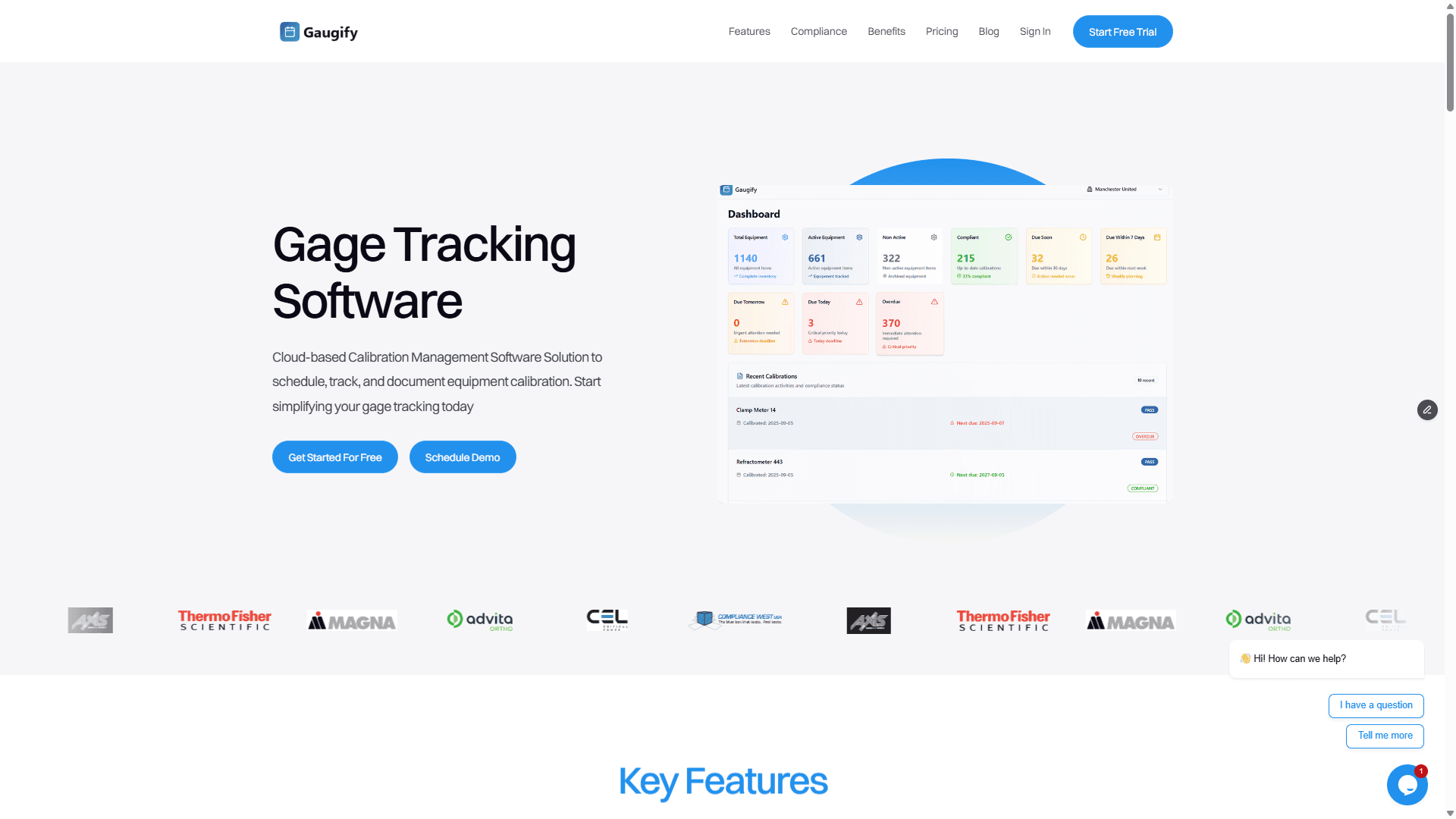
Gaugify prioritizes calibration-focused user experience with clean, intuitive interfaces designed specifically for measurement professionals. The dashboard immediately shows overdue calibrations, upcoming due dates, and compliance status without competing information about facility maintenance or inventory management. Lab technicians can complete calibration records, generate certificates, and update asset information through streamlined workflows that don't require extensive training or system administration expertise.
Mobile access also differs significantly. eMaint's mobile application serves the broader maintenance workforce, with calibration features accessible but not optimized for measurement professionals working in labs or on shop floors. Gaugify's mobile interface focuses on calibration-specific needs like barcode scanning for asset identification, photo capture for calibration evidence, and offline data entry for environments with limited connectivity.
Pricing and Total Cost of Ownership
eMaint typically requires enterprise-level investments, with pricing based on user counts, modules selected, and implementation services. Organizations often purchase calibration tracking as part of broader CMMS implementations, making it difficult to isolate the true cost of calibration management functionality. Implementation timelines can extend months, requiring significant IT involvement and change management across multiple departments.
Gaugify offers transparent SaaS pricing starting at predictable monthly rates per instrument managed. This approach allows organizations to budget calibration management costs separately from broader maintenance initiatives. The cloud-native architecture eliminates server maintenance, backup management, and software update complexity that often increases eMaint's total cost of ownership over time.
Start your free trial to experience how Gaugify's focused approach can streamline your calibration program without the complexity and cost of enterprise maintenance platforms.
Deployment Options and IT Requirements
eMaint offers both cloud and on-premise deployment options, appealing to organizations with strict data residency requirements or existing IT infrastructure investments. However, on-premise deployments require dedicated IT resources for server management, database administration, and software updates. Cloud deployments reduce these requirements but may still need integration work with existing enterprise systems.
Gaugify operates as a cloud-first solution, eliminating server management and reducing IT overhead significantly. This approach particularly benefits smaller to mid-sized organizations that need professional calibration management without dedicated IT departments. Data security meets industry standards while providing accessibility from any location with internet connectivity—crucial for organizations with multiple facilities or remote calibration work.
Compliance and Regulatory Support
Both platforms address regulatory compliance, but with different approaches. eMaint's compliance features serve multiple regulatory environments simultaneously—calibration requirements alongside safety regulations, environmental compliance, and maintenance standards. This breadth can provide value for organizations managing diverse regulatory requirements but may lack depth in specific calibration standards.
Gaugify's compliance focus centers specifically on calibration and measurement standards like ISO 17025, ISO 9001 quality requirements, and FDA validation needs. The system includes pre-built workflows for calibration-specific compliance scenarios, such as maintaining traceability chains, managing measurement capability studies, and documenting uncertainty calculations that auditors expect to see.
For organizations in highly regulated industries like pharmaceuticals or medical devices, Gaugify's ISO 17025 calibration software provides specific features like measurement capability analysis, proficiency testing management, and statistical validation that may require custom development in broader maintenance platforms.
Customer Support and Implementation
eMaint's support structure reflects their enterprise focus, with dedicated account managers, implementation consultants, and technical support teams. This approach works well for large organizations with complex requirements and dedicated project teams, but smaller organizations may find the process overly complex for straightforward calibration management needs.
Gaugify emphasizes rapid deployment and intuitive operation that minimizes support requirements. Most organizations can begin using the system within days rather than months, with calibration-specific support staff who understand measurement uncertainty, traceability requirements, and compliance workflows. This specialized support proves valuable when calibration questions arise, as support representatives understand the technical context rather than treating calibration as just another maintenance activity.
Integration Capabilities
eMaint offers extensive integration options with enterprise systems like ERP platforms, financial systems, and other maintenance tools. These integrations can provide significant value for organizations seeking comprehensive asset lifecycle management but require IT resources and ongoing maintenance.
Gaugify focuses on calibration-relevant integrations, such as connecting with calibration equipment for automated data collection, integrating with quality management systems, and providing APIs for custom reporting needs. This targeted approach reduces complexity while ensuring that essential calibration data flows efficiently to systems that need it.
Who Each Solution Serves Best
eMaint calibration tracking works best for large enterprises already invested in eMaint's broader CMMS platform, organizations that need calibration management integrated with facility maintenance workflows, and companies with dedicated IT departments capable of managing complex system implementations. The platform serves organizations where calibration represents one component of broader asset management strategies.
Gaugify excels for organizations where calibration management represents a primary focus—precision manufacturing companies, testing laboratories, pharmaceutical manufacturers, and medical device companies. The platform particularly benefits organizations seeking professional calibration capabilities without enterprise software complexity, those requiring built-in uncertainty calculations, and teams that need rapid deployment without extensive IT involvement.
Final Verdict: Choosing Between Gaugify vs eMaint
The choice between Gaugify vs eMaint ultimately depends on your organization's priorities and existing system landscape. eMaint serves organizations seeking comprehensive asset management with calibration as one component, while Gaugify provides specialized calibration excellence for organizations prioritizing measurement precision, compliance efficiency, and rapid deployment.
For most quality-focused organizations, Gaugify's specialized approach delivers superior calibration management capabilities at lower total cost and complexity. The platform's built-in uncertainty calculations, calibration-specific workflows, and transparent pricing make it the practical choice for organizations serious about measurement quality without enterprise software overhead.
Modern calibration programs need modern solutions. While eMaint brings decades of maintenance management experience, calibration management has evolved beyond simple scheduling and record-keeping. Today's quality managers need uncertainty analysis, statistical process control, and compliance workflows that understand measurement science—areas where Gaugify's specialized focus provides clear advantages.
Organizations evaluating both options should consider their primary objectives: comprehensive facility management integration versus calibration excellence and ease of use. For most quality-driven organizations, Gaugify's focused approach delivers better results with less complexity and cost.
Ready to experience the difference specialized calibration software makes? Start your free trial of Gaugify today and discover how modern calibration management can improve your measurement quality, reduce compliance overhead, and streamline your calibration program. No complex implementation required—just professional calibration management that works the way your quality team thinks.
Gaugify vs eMaint Calibration Tracking
When evaluating Gaugify vs eMaint for calibration management, quality managers face a choice between two fundamentally different approaches. Gaugify represents the modern, cloud-native generation of calibration software, while eMaint brings decades of CMMS experience with calibration tracking as part of its broader maintenance platform. Both solutions serve quality teams managing precision instruments, but their philosophies, capabilities, and target audiences differ significantly.
This comprehensive comparison examines both platforms across key criteria that matter most to quality managers, lab technicians, and shop floor supervisors. Whether you're calibrating Mitutoyo micrometers to ±0.0001" tolerance, managing precision balances in pharmaceutical labs, or tracking torque wrench certifications across manufacturing facilities, understanding these differences will help you choose the right solution for your calibration program.
Company Background and Market Position
eMaint entered the market in 1986 as a computerized maintenance management system (CMMS), later adding calibration tracking as one of many modules within their enterprise asset management platform. Now owned by Fluke Corporation, eMaint serves large enterprises across industries like manufacturing, healthcare, and utilities. Their calibration module operates as part of a broader maintenance ecosystem, which can be advantageous for organizations seeking integrated asset management but may feel overwhelming for teams focused purely on calibration compliance.
Gaugify, founded as a calibration-first solution, takes a specialized approach. Built from the ground up for modern calibration programs, Gaugify focuses exclusively on measurement equipment management, uncertainty calculations, and compliance workflows. This singular focus allows for deeper functionality in areas like built-in uncertainty budgets, streamlined certificate generation, and intuitive calibration scheduling that doesn't compete with work order management or facility maintenance features.
Core Calibration Features: Gaugify vs eMaint
Calibration Scheduling and Work Management
eMaint's scheduling operates within their broader work order system, treating calibrations as maintenance tasks. This approach works well for organizations already using eMaint for facility management, as calibration due dates appear alongside pump maintenance and HVAC service requests. However, calibration-specific needs—like uncertainty requirements, environmental conditions, or measurement point tracking—often get buried within generic work order fields.
Gaugify's scheduling system understands calibration workflows natively. When a Fluke 87V multimeter comes due for calibration, the system automatically suggests appropriate measurement points (DC voltage, AC voltage, resistance, frequency), tracks environmental conditions, and calculates measurement uncertainty at each point. The scheduling interface shows calibration-specific information like tolerance ratios, measurement capability, and compliance status without navigating through maintenance work order screens.
Certificate Generation and Documentation
Certificate generation reveals significant differences between the platforms. eMaint provides basic certificate templates that can be customized, but creating professional calibration certificates often requires additional formatting work or third-party reporting tools. The system tracks calibration results but may lack advanced features like automatic uncertainty propagation or statistical analysis of measurement data.
Gaugify excels in this area with professional certificate templates that automatically calculate and display measurement uncertainty. When calibrating a precision balance with a 0.1mg readability, Gaugify automatically calculates the expanded uncertainty (typically ±0.2mg at k=2) based on your equipment capabilities, environmental factors, and measurement procedures. Certificates include uncertainty budgets, traceability chains, and statistical analysis without requiring manual calculations or external tools.
Uncertainty Calculations and MSA
This represents one of the clearest differentiators between Gaugify vs eMaint. eMaint's calibration module provides basic measurement tracking but typically requires external tools or manual calculations for uncertainty analysis. Quality managers often find themselves exporting data to Excel for uncertainty calculations or maintaining separate measurement system analysis (MSA) documentation.
Gaugify's built-in uncertainty calculations handle complex scenarios automatically. For a torque wrench calibration at 50 ft-lbs, the system factors in standard uncertainty, repeatability, hysteresis, and environmental conditions to calculate the total measurement uncertainty. This automation ensures consistency across calibration technicians and eliminates the expertise barrier that often prevents smaller organizations from implementing proper uncertainty analysis.
User Experience and Interface Design
eMaint's interface reflects its CMMS heritage, with extensive menus, multiple modules, and configuration options that serve enterprise maintenance departments well. However, calibration technicians often report feeling overwhelmed by options irrelevant to their daily work. Finding specific calibration functions requires navigating through broader maintenance management screens, which can slow down routine tasks like updating calibration results or generating certificates.
Gaugify prioritizes calibration-focused user experience with clean, intuitive interfaces designed specifically for measurement professionals. The dashboard immediately shows overdue calibrations, upcoming due dates, and compliance status without competing information about facility maintenance or inventory management. Lab technicians can complete calibration records, generate certificates, and update asset information through streamlined workflows that don't require extensive training or system administration expertise.
Mobile access also differs significantly. eMaint's mobile application serves the broader maintenance workforce, with calibration features accessible but not optimized for measurement professionals working in labs or on shop floors. Gaugify's mobile interface focuses on calibration-specific needs like barcode scanning for asset identification, photo capture for calibration evidence, and offline data entry for environments with limited connectivity.
Pricing and Total Cost of Ownership
eMaint typically requires enterprise-level investments, with pricing based on user counts, modules selected, and implementation services. Organizations often purchase calibration tracking as part of broader CMMS implementations, making it difficult to isolate the true cost of calibration management functionality. Implementation timelines can extend months, requiring significant IT involvement and change management across multiple departments.
Gaugify offers transparent SaaS pricing starting at predictable monthly rates per instrument managed. This approach allows organizations to budget calibration management costs separately from broader maintenance initiatives. The cloud-native architecture eliminates server maintenance, backup management, and software update complexity that often increases eMaint's total cost of ownership over time.
Start your free trial to experience how Gaugify's focused approach can streamline your calibration program without the complexity and cost of enterprise maintenance platforms.
Deployment Options and IT Requirements
eMaint offers both cloud and on-premise deployment options, appealing to organizations with strict data residency requirements or existing IT infrastructure investments. However, on-premise deployments require dedicated IT resources for server management, database administration, and software updates. Cloud deployments reduce these requirements but may still need integration work with existing enterprise systems.
Gaugify operates as a cloud-first solution, eliminating server management and reducing IT overhead significantly. This approach particularly benefits smaller to mid-sized organizations that need professional calibration management without dedicated IT departments. Data security meets industry standards while providing accessibility from any location with internet connectivity—crucial for organizations with multiple facilities or remote calibration work.
Compliance and Regulatory Support
Both platforms address regulatory compliance, but with different approaches. eMaint's compliance features serve multiple regulatory environments simultaneously—calibration requirements alongside safety regulations, environmental compliance, and maintenance standards. This breadth can provide value for organizations managing diverse regulatory requirements but may lack depth in specific calibration standards.
Gaugify's compliance focus centers specifically on calibration and measurement standards like ISO 17025, ISO 9001 quality requirements, and FDA validation needs. The system includes pre-built workflows for calibration-specific compliance scenarios, such as maintaining traceability chains, managing measurement capability studies, and documenting uncertainty calculations that auditors expect to see.
For organizations in highly regulated industries like pharmaceuticals or medical devices, Gaugify's ISO 17025 calibration software provides specific features like measurement capability analysis, proficiency testing management, and statistical validation that may require custom development in broader maintenance platforms.
Customer Support and Implementation
eMaint's support structure reflects their enterprise focus, with dedicated account managers, implementation consultants, and technical support teams. This approach works well for large organizations with complex requirements and dedicated project teams, but smaller organizations may find the process overly complex for straightforward calibration management needs.
Gaugify emphasizes rapid deployment and intuitive operation that minimizes support requirements. Most organizations can begin using the system within days rather than months, with calibration-specific support staff who understand measurement uncertainty, traceability requirements, and compliance workflows. This specialized support proves valuable when calibration questions arise, as support representatives understand the technical context rather than treating calibration as just another maintenance activity.
Integration Capabilities
eMaint offers extensive integration options with enterprise systems like ERP platforms, financial systems, and other maintenance tools. These integrations can provide significant value for organizations seeking comprehensive asset lifecycle management but require IT resources and ongoing maintenance.
Gaugify focuses on calibration-relevant integrations, such as connecting with calibration equipment for automated data collection, integrating with quality management systems, and providing APIs for custom reporting needs. This targeted approach reduces complexity while ensuring that essential calibration data flows efficiently to systems that need it.
Who Each Solution Serves Best
eMaint calibration tracking works best for large enterprises already invested in eMaint's broader CMMS platform, organizations that need calibration management integrated with facility maintenance workflows, and companies with dedicated IT departments capable of managing complex system implementations. The platform serves organizations where calibration represents one component of broader asset management strategies.
Gaugify excels for organizations where calibration management represents a primary focus—precision manufacturing companies, testing laboratories, pharmaceutical manufacturers, and medical device companies. The platform particularly benefits organizations seeking professional calibration capabilities without enterprise software complexity, those requiring built-in uncertainty calculations, and teams that need rapid deployment without extensive IT involvement.
Final Verdict: Choosing Between Gaugify vs eMaint
The choice between Gaugify vs eMaint ultimately depends on your organization's priorities and existing system landscape. eMaint serves organizations seeking comprehensive asset management with calibration as one component, while Gaugify provides specialized calibration excellence for organizations prioritizing measurement precision, compliance efficiency, and rapid deployment.
For most quality-focused organizations, Gaugify's specialized approach delivers superior calibration management capabilities at lower total cost and complexity. The platform's built-in uncertainty calculations, calibration-specific workflows, and transparent pricing make it the practical choice for organizations serious about measurement quality without enterprise software overhead.
Modern calibration programs need modern solutions. While eMaint brings decades of maintenance management experience, calibration management has evolved beyond simple scheduling and record-keeping. Today's quality managers need uncertainty analysis, statistical process control, and compliance workflows that understand measurement science—areas where Gaugify's specialized focus provides clear advantages.
Organizations evaluating both options should consider their primary objectives: comprehensive facility management integration versus calibration excellence and ease of use. For most quality-driven organizations, Gaugify's focused approach delivers better results with less complexity and cost.
Ready to experience the difference specialized calibration software makes? Start your free trial of Gaugify today and discover how modern calibration management can improve your measurement quality, reduce compliance overhead, and streamline your calibration program. No complex implementation required—just professional calibration management that works the way your quality team thinks.