
How to Calibrate a Clamp Meter
How to Calibrate a Clamp Meter
David Bentley
Quality Assurance Engineer
12 min read
How to Calibrate a Clamp Meter
Clamp meters are indispensable tools in electrical maintenance, manufacturing, and testing environments where accurate current measurements are critical for safety and quality assurance. These versatile instruments measure AC and DC current without breaking circuit continuity, making them essential for troubleshooting electrical systems, verifying motor performance, and conducting energy audits. However, like all precision measurement instruments, clamp meters require regular clamp meter calibration to maintain their accuracy and ensure reliable results that you can trust for critical decisions.
Whether you're measuring 10 ampere loads on control circuits or 600 ampere draws on industrial motors, an improperly calibrated clamp meter can lead to costly equipment failures, safety hazards, or compliance violations. This comprehensive guide will walk you through the complete clamp meter calibration process, from understanding why calibration is essential to implementing a robust calibration management system.
Understanding Clamp Meters and Their Measurement Capabilities
Clamp meters, also known as clamp-on ammeters or current clamps, use electromagnetic induction or Hall effect sensors to measure electrical current flowing through conductors. Modern clamp meters typically measure:
AC Current: From 0.1A to 2000A or higher, depending on the model
DC Current: Available on Hall effect models, typically 0.1A to 1000A
AC/DC Voltage: Usually 0.1V to 1000V through test leads
Resistance: From 0.1Ω to 40MΩ on multimeter models
Frequency: Typically 10Hz to 1kHz for AC measurements
Popular models like the Fluke 376 FC, Fluke 902 FC, and Amprobe ACD-51NAV are commonly found in industrial settings where precise current measurements are crucial for motor analysis, power quality studies, and electrical system maintenance. These instruments must maintain accuracy within specified tolerances—typically ±1.5% to ±3% of reading plus digits—to provide reliable measurements for critical applications.
Why Clamp Meter Calibration Is Critical
Clamp meters operate in harsh industrial environments where they're exposed to electromagnetic interference, temperature variations, mechanical shock, and contamination. These factors gradually degrade measurement accuracy, potentially leading to:
Electrical Safety Risks: Underestimating current loads can result in undersized protective devices, creating fire hazards or equipment damage
Motor Efficiency Issues: Inaccurate current readings lead to improper motor analysis, missing efficiency problems that waste energy
Power Quality Problems: Drift in frequency or harmonic measurements can mask power quality issues affecting sensitive equipment
Compliance Violations: Industries following ISO 9001, AS9100, or FDA regulations require traceable calibration of all measurement equipment
For example, a manufacturing facility using clamp meters to verify 50-ampere servo motor currents with a ±2% accuracy requirement cannot tolerate a meter that's drifted to ±5% accuracy. Such drift could mask a 15% current increase indicating bearing wear or misalignment, leading to unexpected downtime and repair costs.
Step-by-Step Clamp Meter Calibration Procedure
Proper clamp meter calibration requires controlled environmental conditions, appropriate reference standards, and systematic testing procedures. Here's the complete calibration process:
Environmental Requirements
Establish proper environmental conditions before beginning calibration:
Temperature: 23°C ±5°C (73°F ±9°F)
Relative Humidity: 45% to 75% RH
Warm-up Period: Allow both the clamp meter and reference standards to stabilize for at least 30 minutes
Electromagnetic Interference: Minimize nearby sources of EMI that could affect measurements
Required Reference Standards
Select reference standards with uncertainty ratios of at least 4:1 compared to the clamp meter's specifications:
AC Current Source: Fluke 5522A or equivalent, capable of 0.1A to 100A with ±0.025% accuracy
Current Loop: Single-turn primary loop for clamp-on measurement setup
Precision Multimeter: Fluke 8846A or similar for voltage and resistance verification
DC Current Source: For DC-capable clamp meters, use standards like the Fluke 5520A
AC Current Calibration Procedure
Follow this systematic approach for AC current calibration:
Step 1: Configure the current source to provide a stable AC current through a single-turn loop. Position the clamp meter's jaws around the current-carrying conductor, ensuring proper jaw closure and centering.
Step 2: Test the following current values across each range:
10% of full scale (e.g., 1.0A on 10A range)
50% of full scale (e.g., 5.0A on 10A range)
90% of full scale (e.g., 9.0A on 10A range)
Step 3: Record both the reference current value and the clamp meter's displayed reading for each test point. Calculate the error as: Error (%) = [(Displayed - Reference) / Reference] × 100
Step 4: Verify that all errors fall within the manufacturer's accuracy specifications. For example, a Fluke 376 FC should maintain ±1.5% + 5 digits accuracy on its 60A range.
DC Current Calibration (Hall Effect Models)
For clamp meters with DC current capability, repeat the AC procedure using DC current sources. Pay special attention to zero offset by testing with no current applied—the display should read 0.00A ±1 digit.
Voltage and Resistance Functions
If the clamp meter includes multimeter functions, calibrate these using standard DMM procedures:
AC Voltage: Test at 1V, 10V, 100V, and 600V using precision voltage sources
DC Voltage: Similar test points with DC precision sources
Resistance: Test using precision decade resistance boxes at 100Ω, 1kΩ, 10kΩ, and 100kΩ
Ready to streamline your clamp meter calibration tracking? Start your free trial of Gaugify today and see how easy it is to manage calibration schedules, store as-found/as-left data, and generate compliance certificates.
Relevant Calibration Standards
Several standards govern clamp meter calibration procedures and requirements:
ISO/IEC 17025 Requirements
Laboratories performing clamp meter calibrations must follow ISO/IEC 17025 requirements for:
Documented calibration procedures with measurement uncertainty calculations
Traceability to national standards through accredited calibration providers
Environmental monitoring and control during calibrations
Competency requirements for calibration technicians
ANSI/NCSL Z540.3
This standard provides requirements for calibration laboratories and measurement uncertainty analysis. It specifies:
Minimum 4:1 accuracy ratios between reference standards and units under test
Statistical analysis methods for measurement uncertainty
Documentation requirements for calibration procedures and results
Manufacturer Specifications
Always reference the specific manufacturer's calibration procedures and accuracy specifications. For example:
Fluke: Provides detailed service manuals with calibration procedures, adjustment methods, and performance verification tests
Amprobe: Specifies calibration intervals, environmental requirements, and acceptance criteria in user manuals
Klein Tools: Includes calibration procedures and warranty requirements in technical documentation
Recommended Calibration Intervals
Determining appropriate calibration intervals for clamp meters depends on several factors that affect measurement stability and drift rates.
Standard Calibration Intervals
Most manufacturers and industry standards recommend:
General Industrial Use: 12 months for normal workshop and field service applications
Critical Measurements: 6 months for precision applications or regulatory compliance
Harsh Environments: 6 months or quarterly for extreme temperature, humidity, or contamination exposure
Laboratory Standards: 12 to 24 months for reference-grade instruments in controlled environments
Factors Affecting Calibration Frequency
Consider these factors when establishing calibration intervals:
Usage Frequency: Daily use requires more frequent calibration than occasional use
Environmental Severity: High temperature, humidity, or vibration accelerates component aging
Measurement Criticality: Safety-related measurements may require shorter intervals
Historical Drift Data: Track calibration results over time to optimize intervals based on actual performance
Manufacturer Recommendations: Follow specific guidance for each model and application
For example, clamp meters used for motor current analysis in a steel mill's hot, dusty environment might require 6-month calibration intervals, while similar instruments used occasionally in a climate-controlled electronics lab could extend to 18-month intervals based on historical stability data.
Common Calibration Mistakes and Prevention
Avoid these frequent errors that compromise clamp meter calibration accuracy and reliability:
Inadequate Warm-Up Time
Mistake: Beginning calibration immediately after powering on instruments.
Prevention: Always allow 30 minutes minimum warm-up for both the clamp meter and reference standards. Electronic components must reach thermal equilibrium for stable, accurate measurements.
Poor Jaw Contact and Positioning
Mistake: Incomplete jaw closure or off-center conductor positioning during current measurements.
Prevention: Ensure complete jaw closure with no air gaps. Center the current-carrying conductor within the jaw opening and maintain consistent positioning for all test points.
Insufficient Test Points
Mistake: Testing only one point per range, missing non-linearities across the measurement span.
Prevention: Test minimum three points per range (10%, 50%, 90% of full scale) to verify linearity and catch range-specific errors.
Ignoring Environmental Factors
Mistake: Performing calibrations in uncontrolled temperature or high EMI environments.
Prevention: Monitor and document environmental conditions. Relocate calibrations away from motors, transformers, or other EMI sources that could affect measurements.
Inadequate Documentation
Mistake: Poor record keeping of calibration procedures, results, and adjustments.
Prevention: Use standardized calibration data sheets that capture all required information: environmental conditions, reference standards used, as-found data, adjustments made, and as-left performance verification.
Managing Clamp Meter Calibration with Modern Software
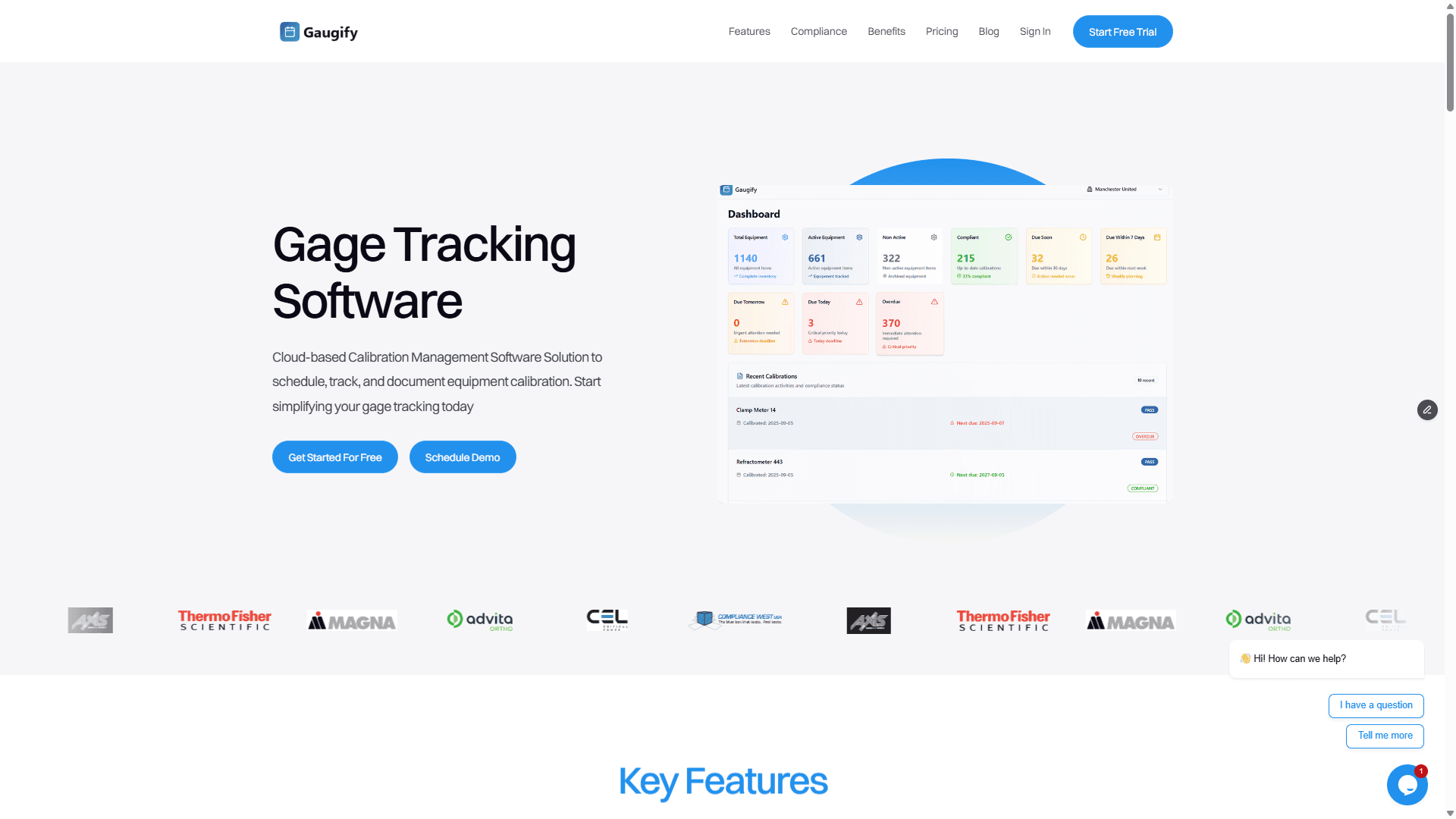
Manual tracking of clamp meter calibrations becomes unwieldy as your instrument inventory grows. Gaugify's cloud-based calibration management platform streamlines the entire process with features specifically designed for electrical measurement instruments:
Automated Scheduling and Reminders
Set up custom calibration intervals for each clamp meter based on its specific use case, environment, and criticality. The system automatically generates work orders and sends email reminders well before due dates, ensuring no instruments fall overdue.
For example, configure your Fluke 376 FC units used for motor analysis on 6-month intervals while setting laboratory reference clamp meters to 12-month schedules. The system tracks each instrument individually and accounts for usage patterns and drift history.
Comprehensive Data Management
Gaugify's calibration tracking features capture all essential calibration data:
As-Found Data: Record initial readings before any adjustments
As-Left Data: Document final performance after calibration
Environmental Conditions: Log temperature, humidity, and other factors
Reference Standards: Track which standards were used and their certification status
Uncertainty Analysis: Calculate and document measurement uncertainty for each calibration
Compliance and Certificate Generation
Generate professional calibration certificates automatically with all required information for regulatory compliance. Each certificate includes:
Traceability statements linking to national standards
Complete measurement data with uncertainties
Acceptance criteria and pass/fail status
Digital signatures and tamper-evident security
Custom branding and format options
Trend Analysis and Optimization
Track calibration results over time to identify instruments requiring more frequent attention or those that could extend intervals safely. The platform's analytics help optimize your calibration program by:
Identifying instruments with excessive drift rates
Highlighting environmental or usage factors affecting stability
Recommending interval adjustments based on historical performance
Predicting potential failures before they occur
Best Practices for Clamp Meter Calibration Programs
Implement these proven strategies to maximize your clamp meter calibration program effectiveness:
Risk-Based Calibration Approach
Not all clamp meters require identical calibration intervals. Classify instruments based on:
Critical Safety Applications: Shorter intervals for meters used in electrical safety assessments
Quality Control Functions: Standard intervals for production testing and quality verification
General Maintenance: Extended intervals for routine troubleshooting and non-critical measurements
Calibration Procedure Standardization
Develop written procedures specific to each clamp meter model, including:
Step-by-step calibration instructions
Required reference standards and their specifications
Environmental requirements and monitoring procedures
Acceptance criteria and troubleshooting guidance
Documentation requirements and data recording methods
Technician Training and Competency
Ensure calibration technicians understand:
Clamp meter operating principles and measurement techniques
Proper use of reference standards and measurement uncertainty concepts
Environmental factors affecting calibration accuracy
Safety procedures for working with current sources and electrical equipment
Documentation requirements and quality system compliance
Regular training updates keep technicians current with new instrument models, calibration techniques, and regulatory requirements that evolve over time.
Conclusion: Ensuring Reliable Clamp Meter Performance
Proper clamp meter calibration is essential for maintaining measurement accuracy, ensuring electrical safety, and meeting regulatory compliance requirements in industrial environments. By following systematic calibration procedures, using appropriate reference standards, and implementing robust documentation practices, you can ensure your clamp meters provide reliable, traceable measurements when you need them most.
The key to successful calibration management lies in consistent execution of proven procedures, appropriate calibration intervals based on actual usage patterns, and comprehensive record keeping that demonstrates compliance with applicable standards. Whether you're managing a dozen instruments or several hundred, the principles remain the same: systematic approach, proper documentation, and continuous improvement based on historical performance data.
Modern calibration management software like Gaugify transforms this process from a manual, paper-based system into an efficient, automated workflow that reduces errors, ensures compliance, and provides valuable insights into instrument performance trends. The result is improved measurement reliability, reduced downtime, and lower total cost of ownership for your electrical measurement equipment.
Ready to revolutionize your clamp meter calibration management? Start your free trial today and discover how easy it is to track calibrations, generate professional certificates, and maintain complete compliance documentation. Your measurement accuracy and regulatory compliance are too important to leave to manual processes and spreadsheets—let Gaugify handle the complexity while you focus on what matters most.
How to Calibrate a Clamp Meter
Clamp meters are indispensable tools in electrical maintenance, manufacturing, and testing environments where accurate current measurements are critical for safety and quality assurance. These versatile instruments measure AC and DC current without breaking circuit continuity, making them essential for troubleshooting electrical systems, verifying motor performance, and conducting energy audits. However, like all precision measurement instruments, clamp meters require regular clamp meter calibration to maintain their accuracy and ensure reliable results that you can trust for critical decisions.
Whether you're measuring 10 ampere loads on control circuits or 600 ampere draws on industrial motors, an improperly calibrated clamp meter can lead to costly equipment failures, safety hazards, or compliance violations. This comprehensive guide will walk you through the complete clamp meter calibration process, from understanding why calibration is essential to implementing a robust calibration management system.
Understanding Clamp Meters and Their Measurement Capabilities
Clamp meters, also known as clamp-on ammeters or current clamps, use electromagnetic induction or Hall effect sensors to measure electrical current flowing through conductors. Modern clamp meters typically measure:
AC Current: From 0.1A to 2000A or higher, depending on the model
DC Current: Available on Hall effect models, typically 0.1A to 1000A
AC/DC Voltage: Usually 0.1V to 1000V through test leads
Resistance: From 0.1Ω to 40MΩ on multimeter models
Frequency: Typically 10Hz to 1kHz for AC measurements
Popular models like the Fluke 376 FC, Fluke 902 FC, and Amprobe ACD-51NAV are commonly found in industrial settings where precise current measurements are crucial for motor analysis, power quality studies, and electrical system maintenance. These instruments must maintain accuracy within specified tolerances—typically ±1.5% to ±3% of reading plus digits—to provide reliable measurements for critical applications.
Why Clamp Meter Calibration Is Critical
Clamp meters operate in harsh industrial environments where they're exposed to electromagnetic interference, temperature variations, mechanical shock, and contamination. These factors gradually degrade measurement accuracy, potentially leading to:
Electrical Safety Risks: Underestimating current loads can result in undersized protective devices, creating fire hazards or equipment damage
Motor Efficiency Issues: Inaccurate current readings lead to improper motor analysis, missing efficiency problems that waste energy
Power Quality Problems: Drift in frequency or harmonic measurements can mask power quality issues affecting sensitive equipment
Compliance Violations: Industries following ISO 9001, AS9100, or FDA regulations require traceable calibration of all measurement equipment
For example, a manufacturing facility using clamp meters to verify 50-ampere servo motor currents with a ±2% accuracy requirement cannot tolerate a meter that's drifted to ±5% accuracy. Such drift could mask a 15% current increase indicating bearing wear or misalignment, leading to unexpected downtime and repair costs.
Step-by-Step Clamp Meter Calibration Procedure
Proper clamp meter calibration requires controlled environmental conditions, appropriate reference standards, and systematic testing procedures. Here's the complete calibration process:
Environmental Requirements
Establish proper environmental conditions before beginning calibration:
Temperature: 23°C ±5°C (73°F ±9°F)
Relative Humidity: 45% to 75% RH
Warm-up Period: Allow both the clamp meter and reference standards to stabilize for at least 30 minutes
Electromagnetic Interference: Minimize nearby sources of EMI that could affect measurements
Required Reference Standards
Select reference standards with uncertainty ratios of at least 4:1 compared to the clamp meter's specifications:
AC Current Source: Fluke 5522A or equivalent, capable of 0.1A to 100A with ±0.025% accuracy
Current Loop: Single-turn primary loop for clamp-on measurement setup
Precision Multimeter: Fluke 8846A or similar for voltage and resistance verification
DC Current Source: For DC-capable clamp meters, use standards like the Fluke 5520A
AC Current Calibration Procedure
Follow this systematic approach for AC current calibration:
Step 1: Configure the current source to provide a stable AC current through a single-turn loop. Position the clamp meter's jaws around the current-carrying conductor, ensuring proper jaw closure and centering.
Step 2: Test the following current values across each range:
10% of full scale (e.g., 1.0A on 10A range)
50% of full scale (e.g., 5.0A on 10A range)
90% of full scale (e.g., 9.0A on 10A range)
Step 3: Record both the reference current value and the clamp meter's displayed reading for each test point. Calculate the error as: Error (%) = [(Displayed - Reference) / Reference] × 100
Step 4: Verify that all errors fall within the manufacturer's accuracy specifications. For example, a Fluke 376 FC should maintain ±1.5% + 5 digits accuracy on its 60A range.
DC Current Calibration (Hall Effect Models)
For clamp meters with DC current capability, repeat the AC procedure using DC current sources. Pay special attention to zero offset by testing with no current applied—the display should read 0.00A ±1 digit.
Voltage and Resistance Functions
If the clamp meter includes multimeter functions, calibrate these using standard DMM procedures:
AC Voltage: Test at 1V, 10V, 100V, and 600V using precision voltage sources
DC Voltage: Similar test points with DC precision sources
Resistance: Test using precision decade resistance boxes at 100Ω, 1kΩ, 10kΩ, and 100kΩ
Ready to streamline your clamp meter calibration tracking? Start your free trial of Gaugify today and see how easy it is to manage calibration schedules, store as-found/as-left data, and generate compliance certificates.
Relevant Calibration Standards
Several standards govern clamp meter calibration procedures and requirements:
ISO/IEC 17025 Requirements
Laboratories performing clamp meter calibrations must follow ISO/IEC 17025 requirements for:
Documented calibration procedures with measurement uncertainty calculations
Traceability to national standards through accredited calibration providers
Environmental monitoring and control during calibrations
Competency requirements for calibration technicians
ANSI/NCSL Z540.3
This standard provides requirements for calibration laboratories and measurement uncertainty analysis. It specifies:
Minimum 4:1 accuracy ratios between reference standards and units under test
Statistical analysis methods for measurement uncertainty
Documentation requirements for calibration procedures and results
Manufacturer Specifications
Always reference the specific manufacturer's calibration procedures and accuracy specifications. For example:
Fluke: Provides detailed service manuals with calibration procedures, adjustment methods, and performance verification tests
Amprobe: Specifies calibration intervals, environmental requirements, and acceptance criteria in user manuals
Klein Tools: Includes calibration procedures and warranty requirements in technical documentation
Recommended Calibration Intervals
Determining appropriate calibration intervals for clamp meters depends on several factors that affect measurement stability and drift rates.
Standard Calibration Intervals
Most manufacturers and industry standards recommend:
General Industrial Use: 12 months for normal workshop and field service applications
Critical Measurements: 6 months for precision applications or regulatory compliance
Harsh Environments: 6 months or quarterly for extreme temperature, humidity, or contamination exposure
Laboratory Standards: 12 to 24 months for reference-grade instruments in controlled environments
Factors Affecting Calibration Frequency
Consider these factors when establishing calibration intervals:
Usage Frequency: Daily use requires more frequent calibration than occasional use
Environmental Severity: High temperature, humidity, or vibration accelerates component aging
Measurement Criticality: Safety-related measurements may require shorter intervals
Historical Drift Data: Track calibration results over time to optimize intervals based on actual performance
Manufacturer Recommendations: Follow specific guidance for each model and application
For example, clamp meters used for motor current analysis in a steel mill's hot, dusty environment might require 6-month calibration intervals, while similar instruments used occasionally in a climate-controlled electronics lab could extend to 18-month intervals based on historical stability data.
Common Calibration Mistakes and Prevention
Avoid these frequent errors that compromise clamp meter calibration accuracy and reliability:
Inadequate Warm-Up Time
Mistake: Beginning calibration immediately after powering on instruments.
Prevention: Always allow 30 minutes minimum warm-up for both the clamp meter and reference standards. Electronic components must reach thermal equilibrium for stable, accurate measurements.
Poor Jaw Contact and Positioning
Mistake: Incomplete jaw closure or off-center conductor positioning during current measurements.
Prevention: Ensure complete jaw closure with no air gaps. Center the current-carrying conductor within the jaw opening and maintain consistent positioning for all test points.
Insufficient Test Points
Mistake: Testing only one point per range, missing non-linearities across the measurement span.
Prevention: Test minimum three points per range (10%, 50%, 90% of full scale) to verify linearity and catch range-specific errors.
Ignoring Environmental Factors
Mistake: Performing calibrations in uncontrolled temperature or high EMI environments.
Prevention: Monitor and document environmental conditions. Relocate calibrations away from motors, transformers, or other EMI sources that could affect measurements.
Inadequate Documentation
Mistake: Poor record keeping of calibration procedures, results, and adjustments.
Prevention: Use standardized calibration data sheets that capture all required information: environmental conditions, reference standards used, as-found data, adjustments made, and as-left performance verification.
Managing Clamp Meter Calibration with Modern Software
Manual tracking of clamp meter calibrations becomes unwieldy as your instrument inventory grows. Gaugify's cloud-based calibration management platform streamlines the entire process with features specifically designed for electrical measurement instruments:
Automated Scheduling and Reminders
Set up custom calibration intervals for each clamp meter based on its specific use case, environment, and criticality. The system automatically generates work orders and sends email reminders well before due dates, ensuring no instruments fall overdue.
For example, configure your Fluke 376 FC units used for motor analysis on 6-month intervals while setting laboratory reference clamp meters to 12-month schedules. The system tracks each instrument individually and accounts for usage patterns and drift history.
Comprehensive Data Management
Gaugify's calibration tracking features capture all essential calibration data:
As-Found Data: Record initial readings before any adjustments
As-Left Data: Document final performance after calibration
Environmental Conditions: Log temperature, humidity, and other factors
Reference Standards: Track which standards were used and their certification status
Uncertainty Analysis: Calculate and document measurement uncertainty for each calibration
Compliance and Certificate Generation
Generate professional calibration certificates automatically with all required information for regulatory compliance. Each certificate includes:
Traceability statements linking to national standards
Complete measurement data with uncertainties
Acceptance criteria and pass/fail status
Digital signatures and tamper-evident security
Custom branding and format options
Trend Analysis and Optimization
Track calibration results over time to identify instruments requiring more frequent attention or those that could extend intervals safely. The platform's analytics help optimize your calibration program by:
Identifying instruments with excessive drift rates
Highlighting environmental or usage factors affecting stability
Recommending interval adjustments based on historical performance
Predicting potential failures before they occur
Best Practices for Clamp Meter Calibration Programs
Implement these proven strategies to maximize your clamp meter calibration program effectiveness:
Risk-Based Calibration Approach
Not all clamp meters require identical calibration intervals. Classify instruments based on:
Critical Safety Applications: Shorter intervals for meters used in electrical safety assessments
Quality Control Functions: Standard intervals for production testing and quality verification
General Maintenance: Extended intervals for routine troubleshooting and non-critical measurements
Calibration Procedure Standardization
Develop written procedures specific to each clamp meter model, including:
Step-by-step calibration instructions
Required reference standards and their specifications
Environmental requirements and monitoring procedures
Acceptance criteria and troubleshooting guidance
Documentation requirements and data recording methods
Technician Training and Competency
Ensure calibration technicians understand:
Clamp meter operating principles and measurement techniques
Proper use of reference standards and measurement uncertainty concepts
Environmental factors affecting calibration accuracy
Safety procedures for working with current sources and electrical equipment
Documentation requirements and quality system compliance
Regular training updates keep technicians current with new instrument models, calibration techniques, and regulatory requirements that evolve over time.
Conclusion: Ensuring Reliable Clamp Meter Performance
Proper clamp meter calibration is essential for maintaining measurement accuracy, ensuring electrical safety, and meeting regulatory compliance requirements in industrial environments. By following systematic calibration procedures, using appropriate reference standards, and implementing robust documentation practices, you can ensure your clamp meters provide reliable, traceable measurements when you need them most.
The key to successful calibration management lies in consistent execution of proven procedures, appropriate calibration intervals based on actual usage patterns, and comprehensive record keeping that demonstrates compliance with applicable standards. Whether you're managing a dozen instruments or several hundred, the principles remain the same: systematic approach, proper documentation, and continuous improvement based on historical performance data.
Modern calibration management software like Gaugify transforms this process from a manual, paper-based system into an efficient, automated workflow that reduces errors, ensures compliance, and provides valuable insights into instrument performance trends. The result is improved measurement reliability, reduced downtime, and lower total cost of ownership for your electrical measurement equipment.
Ready to revolutionize your clamp meter calibration management? Start your free trial today and discover how easy it is to track calibrations, generate professional certificates, and maintain complete compliance documentation. Your measurement accuracy and regulatory compliance are too important to leave to manual processes and spreadsheets—let Gaugify handle the complexity while you focus on what matters most.