
How to Calibrate a Snap Gage
How to Calibrate a Snap Gage
David Bentley
Quality Assurance Engineer
12 min read
How to Calibrate a Snap Gage
Snap gages are essential fixed-limit measuring instruments used across manufacturing industries to perform rapid go/no-go dimensional checks on shafts, rods, and cylindrical parts. Proper snap gage calibration ensures these critical quality control tools maintain their accuracy and reliability, preventing costly production errors and customer rejections. Whether you're measuring automotive transmission shafts with ±0.0005" tolerances or hydraulic cylinder rods requiring ±0.002" precision, understanding the complete calibration process is fundamental to maintaining measurement integrity in your quality system.
This comprehensive guide covers everything quality managers, shop floor supervisors, and calibration technicians need to know about snap gage calibration, from preparation through documentation. We'll walk through specific procedures, acceptance criteria, and industry standards that govern these critical measurements.
Understanding Snap Gages and Their Measurement Applications
A snap gage consists of two anvils – one fixed and one adjustable – that create a gap corresponding to the nominal dimension being checked. The workpiece either "goes" through the gap (indicating it's within tolerance) or "doesn't go" (indicating it's oversized). Common applications include:
Automotive components: Crankshaft journals, camshaft lobes, transmission shafts
Hydraulic systems: Cylinder rods, valve stems, piston pins
Aerospace parts: Landing gear components, engine mount bushings
General machining: Turned shafts, ground rods, extruded profiles
Unlike variable gages that provide specific measurements, snap gages deliver binary results. This makes them incredibly fast for production environments but requires precise calibration to ensure the go/no-go decision points align exactly with drawing specifications.
Types of Snap Gages Requiring Calibration
Manufacturing facilities typically maintain several snap gage configurations:
Fixed snap gages: Both anvils permanently set to specific dimensions
Adjustable snap gages: One or both anvils can be repositioned and locked
Progressive snap gages: Single tool with both "go" and "no-go" gaps
Indicating snap gages: Include dial indicators for additional measurement feedback
Why Snap Gage Calibration is Critical for Quality Control
Snap gages experience significant wear from repeated contact with production parts, environmental factors, and handling. Without proper snap gage calibration, these tools can drift from their intended dimensions, leading to serious quality issues:
Accept bad parts: If the "go" gap opens beyond specification due to anvil wear, oversized parts may incorrectly pass inspection. For example, a snap gage set for 1.2500" ±0.0010" that has worn to 1.2515" will accept parts up to 1.2514", potentially causing assembly problems downstream.
Reject good parts: Conversely, if the gap closes due to debris accumulation or anvil damage, properly sized parts may be incorrectly rejected, increasing scrap costs and production delays.
Measurement uncertainty: Uncalibrated snap gages introduce unknown errors into your measurement system, making it impossible to calculate realistic measurement uncertainty budgets required by ISO 9001 and customer quality agreements.
Consider a real-world scenario: An automotive supplier using snap gages to check transmission input shaft diameters discovered during a customer audit that their primary snap gage had drifted 0.003" over six months. This resulted in shipping 847 shafts that were oversized, requiring a costly field service campaign and significant warranty exposure.
Step-by-Step Snap Gage Calibration Procedure
Professional snap gage calibration requires proper reference standards, controlled environmental conditions, and systematic methodology. Here's the detailed procedure used by accredited calibration laboratories:
Required Equipment and Standards
Before beginning calibration, assemble these essential items:
Gage blocks: Class AS-1 or better, covering the snap gage's measurement range
Calibrated micrometers: 0-1", 1-2", etc., with 0.000050" resolution minimum
Surface plate: Grade A granite, properly supported
Cleaning materials: Lint-free cloths, acetone or alcohol
Temperature monitoring: Calibrated thermometer reading to 0.5°F
Environmental Conditions
Establish proper measurement conditions before starting:
Temperature: 68°F ±5°F (20°C ±3°C)
Humidity: 45-75% RH to prevent corrosion
Vibration: Isolated surface away from machinery
Cleanliness: Dust-free environment with adequate lighting
Allow all equipment to temperature stabilize for at least 2 hours before beginning measurements.
Calibration Steps
Step 1: Initial Inspection and Cleaning
Examine the snap gage for obvious damage, wear, or contamination. Clean all measuring surfaces with appropriate solvents and verify smooth operation of any adjustable components.
Step 2: Determine Nominal Dimensions
Identify the intended "go" and "no-go" dimensions from the gage's documentation or work order. For example, a snap gage for 0.7500" +0.0000/-0.0015" parts should have:
Go gap: 0.7500" (maximum material size)
No-go gap: 0.7485" (minimum material size)
Step 3: Measure Actual Gap Dimensions
Using calibrated gage blocks, determine the actual gap dimensions:
Start with a gage block slightly smaller than the nominal dimension
Gradually increase size until the block just begins to bind in the gap
Record this dimension as the measured gap size
Repeat for both go and no-go gaps if applicable
Step 4: Calculate Errors and Uncertainties
Determine the difference between measured and nominal dimensions. For our example:
If the "go" gap measures 0.7503", the error is +0.0003"
If the "no-go" gap measures 0.7483", the error is -0.0002"
Step 5: Apply Acceptance Criteria
Compare measured errors against established tolerance limits. Typical acceptance criteria for snap gages require errors within ±20% of the part tolerance being checked.
Ready to streamline your calibration tracking? Start your free Gaugify trial and see how cloud-based calibration management eliminates manual paperwork while ensuring nothing falls through the cracks.
Relevant Standards Governing Snap Gage Calibration
Several industry standards provide guidance for proper snap gage calibration procedures and acceptance criteria:
ASME B89.1.5 - Measurement of Plain External Diameters
This standard covers snap gages used for external diameter measurements, specifying:
Calibration methods using gage blocks or ring gages
Uncertainty calculations for different gage types
Environmental requirements during calibration
Documentation and traceability requirements
ISO 463 - Gauges for ISO Metric Screw Threads
For snap gages used in thread measurement applications, this standard defines:
Specific tolerance grades for different thread classes
Calibration intervals based on usage frequency
Marking requirements for traceability
Manufacturer Specifications
Leading snap gage manufacturers like Starrett, Mitutoyo, and Vermont Gage provide specific calibration procedures for their products, including:
Recommended calibration methods
Acceptance tolerances for different accuracy grades
Adjustment procedures for out-of-tolerance conditions
Maintenance schedules to extend calibration intervals
ISO 17025 Requirements
Accredited calibration laboratories must follow ISO 17025 requirements for snap gage calibration, including complete uncertainty budgets and measurement traceability. Gaugify's ISO 17025 compliance features help organizations maintain the detailed records and documentation required for accreditation.
Recommended Calibration Intervals for Snap Gages
Determining appropriate snap gage calibration intervals requires balancing measurement risk against calibration costs. Several factors influence optimal scheduling:
Usage-Based Intervals
High-volume production environments require more frequent calibration:
Heavy use (1000+ parts/day): Monthly calibration
Moderate use (100-1000 parts/day): Quarterly calibration
Light use (<100 parts/day): Semi-annual calibration
Infrequent use: Annual calibration with pre-use checks
Application-Specific Considerations
Critical applications may require shorter intervals regardless of usage:
Aerospace components: Monthly regardless of volume
Medical device manufacturing: Quarterly with intermediate checks
Automotive safety items: Based on control plan requirements
General commercial products: Annual with risk-based adjustments
Environmental Factors
Harsh conditions accelerate wear and drift:
Temperature cycling: Reduces interval by 25-50%
Contaminated environments: Increases cleaning frequency
High humidity: May cause corrosion and binding
Vibration exposure: Can loosen adjustable components
Common Snap Gage Calibration Mistakes and Prevention
Avoiding these frequent calibration errors ensures reliable results and prevents quality issues:
Inadequate Temperature Stabilization
Mistake: Rushing calibration without allowing temperature equilibrium
Prevention: Allow minimum 2-hour stabilization time. For precision work requiring ±0.0001" accuracy, consider 4-hour stabilization periods.
Contaminated Measuring Surfaces
Mistake: Failing to thoroughly clean gage blocks and snap gage anvils
Prevention: Use proper cleaning solvents and lint-free cloths. Inspect surfaces under magnification for residual contamination.
Example: A machine shop discovered their snap gage calibrations were inconsistent due to microscopic metal particles embedded in the anvil surfaces. Implementing ultrasonic cleaning resolved the issue.
Incorrect Reference Standards
Mistake: Using gage blocks with insufficient accuracy for the application
Prevention: Ensure reference standards have 4:1 accuracy ratio minimum compared to the snap gage tolerance. For ±0.001" snap gages, use Class AS-1 gage blocks (±0.000020").
Poor Documentation Practices
Mistake: Incomplete or illegible calibration records
Prevention: Use standardized data sheets with all required information fields. Modern calibration management software eliminates handwriting issues and ensures complete data capture.
Ignoring Measurement Uncertainty
Mistake: Accepting or rejecting gages without considering measurement uncertainty
Prevention: Calculate and apply proper uncertainty budgets. A snap gage measuring exactly at its tolerance limit may still be acceptable when uncertainty is considered.
Tracking Snap Gage Calibration with Modern Software
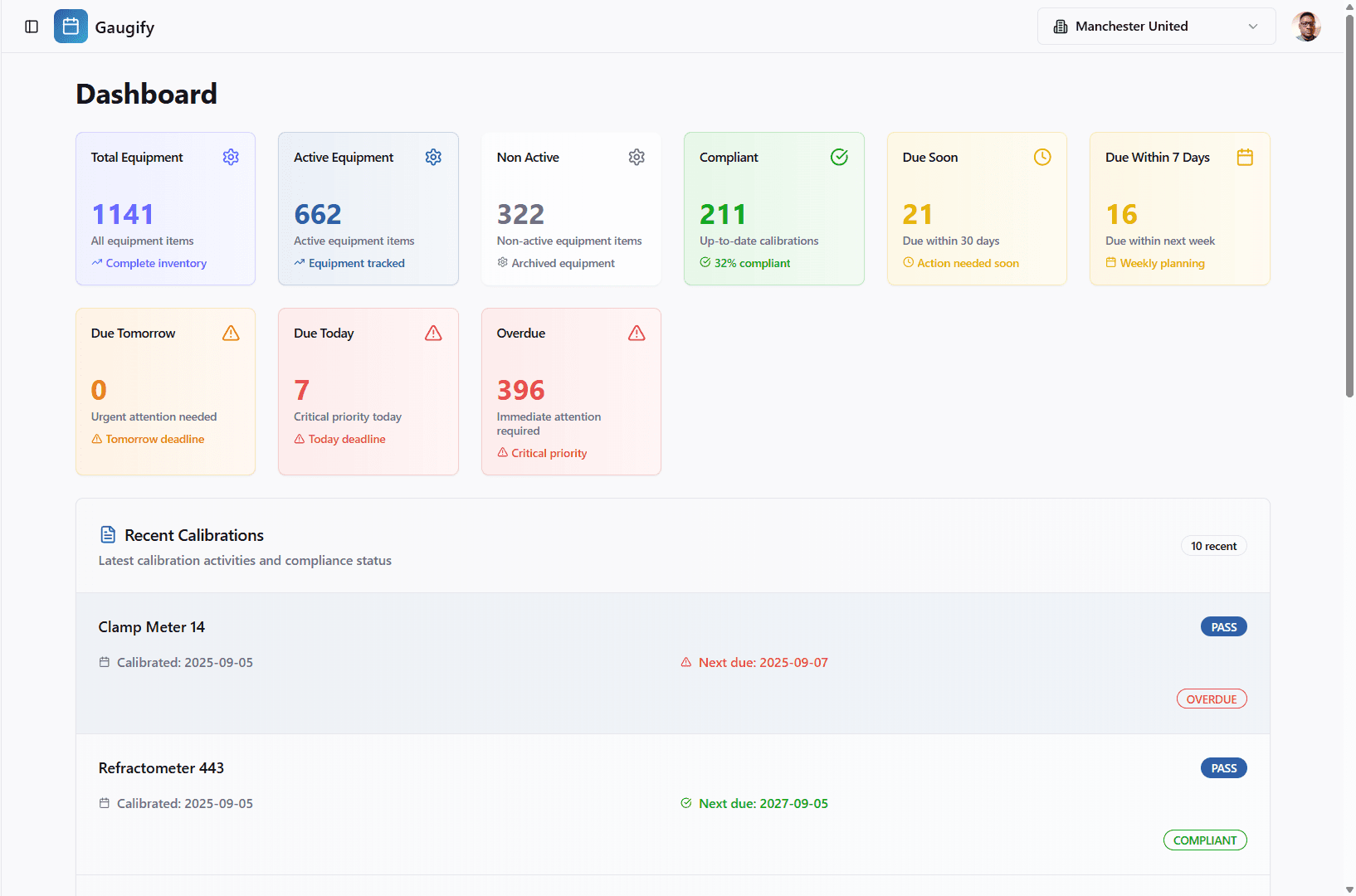
Manual tracking of snap gage calibration records creates opportunities for errors, missed due dates, and compliance issues. Modern cloud-based systems like Gaugify provide comprehensive solutions specifically designed for calibration management:
Automated Scheduling and Reminders
Never miss another calibration due date with intelligent scheduling that accounts for:
Individual gage calibration intervals
Usage-based adjustments
Holiday and shutdown periods
Vendor capacity and lead times
Gaugify automatically generates email reminders at configurable intervals (30, 15, 7, and 1 day before due dates) to ensure snap gages are submitted for calibration on schedule.
Complete As-Found and As-Left Data Management
Capture critical calibration data including:
Pre-calibration measurements (as-found condition)
Post-calibration or adjustment results (as-left condition)
Environmental conditions during calibration
Reference standards used with their calibration dates
Technician identification and qualifications
This comprehensive data enables trend analysis to identify gages requiring more frequent calibration or replacement.
Digital Certificate Storage and Access
Eliminate lost calibration certificates with secure cloud storage providing:
Instant access from any device with internet connection
Automatic backup and disaster recovery
Integration with customer portals for easy sharing
Advanced search capabilities by gage ID, location, or date range
Compliance Reporting and Audit Support
Generate comprehensive reports for internal audits, customer assessments, and regulatory compliance:
Calibration status summaries by department or product line
Overdue equipment lists with responsible personnel
Calibration history reports showing trends and patterns
Measurement uncertainty summaries for capability studies
Gaugify's compliance features ensure your snap gage calibration program meets ISO 9001, AS9100, ISO 13485, and other quality system requirements.
Mobile Access for Shop Floor Teams
Empower production supervisors and quality technicians with mobile access to:
Real-time calibration status for any snap gage
Immediate identification of overdue equipment
Digital calibration certificates viewable on tablets or smartphones
Quick photo capture for damage documentation
Implementing a Robust Snap Gage Calibration Program
Success requires more than just following procedures – it demands systematic program management addressing people, processes, and technology.
Staff Training and Competency
Ensure calibration technicians understand:
Proper handling techniques to prevent damage
Environmental requirements and their importance
Measurement uncertainty concepts and applications
Documentation requirements for traceability
Regular Program Reviews
Quarterly reviews should evaluate:
Calibration interval effectiveness based on stability data
Cost optimization opportunities
Vendor performance and alternative suppliers
Technology upgrades and automation possibilities
Continuous Improvement Integration
Use calibration data to drive broader quality improvements:
Identify measurement system capability issues
Support root cause analysis for quality problems
Validate new supplier capabilities
Optimize inspection frequencies based on gage performance
Start Managing Your Snap Gage Calibrations More Effectively
Proper snap gage calibration is essential for maintaining dimensional quality in manufacturing operations. From automotive transmission shafts requiring ±0.0005" precision to general machining applications with ±0.005" tolerances, these critical gages must perform reliably day after day.
The combination of systematic calibration procedures, appropriate intervals, and modern tracking systems ensures your snap gages provide accurate go/no-go decisions when you need them most. By following industry standards, avoiding common mistakes, and leveraging technology to automate routine tasks, quality professionals can focus on value-added activities while maintaining compliance confidence.
Ready to transform your calibration management from reactive to proactive? Start your free 30-day Gaugify trial today and discover how cloud-based calibration tracking eliminates missed due dates, reduces administrative overhead, and provides complete visibility into your measurement system performance. Join hundreds of quality professionals who have already streamlined their calibration programs with Gaugify's intuitive platform.
Have questions about implementing a snap gage calibration program or want to see Gaugify in action? Schedule a personalized demo with our calibration experts and learn how to optimize your measurement system management.
How to Calibrate a Snap Gage
Snap gages are essential fixed-limit measuring instruments used across manufacturing industries to perform rapid go/no-go dimensional checks on shafts, rods, and cylindrical parts. Proper snap gage calibration ensures these critical quality control tools maintain their accuracy and reliability, preventing costly production errors and customer rejections. Whether you're measuring automotive transmission shafts with ±0.0005" tolerances or hydraulic cylinder rods requiring ±0.002" precision, understanding the complete calibration process is fundamental to maintaining measurement integrity in your quality system.
This comprehensive guide covers everything quality managers, shop floor supervisors, and calibration technicians need to know about snap gage calibration, from preparation through documentation. We'll walk through specific procedures, acceptance criteria, and industry standards that govern these critical measurements.
Understanding Snap Gages and Their Measurement Applications
A snap gage consists of two anvils – one fixed and one adjustable – that create a gap corresponding to the nominal dimension being checked. The workpiece either "goes" through the gap (indicating it's within tolerance) or "doesn't go" (indicating it's oversized). Common applications include:
Automotive components: Crankshaft journals, camshaft lobes, transmission shafts
Hydraulic systems: Cylinder rods, valve stems, piston pins
Aerospace parts: Landing gear components, engine mount bushings
General machining: Turned shafts, ground rods, extruded profiles
Unlike variable gages that provide specific measurements, snap gages deliver binary results. This makes them incredibly fast for production environments but requires precise calibration to ensure the go/no-go decision points align exactly with drawing specifications.
Types of Snap Gages Requiring Calibration
Manufacturing facilities typically maintain several snap gage configurations:
Fixed snap gages: Both anvils permanently set to specific dimensions
Adjustable snap gages: One or both anvils can be repositioned and locked
Progressive snap gages: Single tool with both "go" and "no-go" gaps
Indicating snap gages: Include dial indicators for additional measurement feedback
Why Snap Gage Calibration is Critical for Quality Control
Snap gages experience significant wear from repeated contact with production parts, environmental factors, and handling. Without proper snap gage calibration, these tools can drift from their intended dimensions, leading to serious quality issues:
Accept bad parts: If the "go" gap opens beyond specification due to anvil wear, oversized parts may incorrectly pass inspection. For example, a snap gage set for 1.2500" ±0.0010" that has worn to 1.2515" will accept parts up to 1.2514", potentially causing assembly problems downstream.
Reject good parts: Conversely, if the gap closes due to debris accumulation or anvil damage, properly sized parts may be incorrectly rejected, increasing scrap costs and production delays.
Measurement uncertainty: Uncalibrated snap gages introduce unknown errors into your measurement system, making it impossible to calculate realistic measurement uncertainty budgets required by ISO 9001 and customer quality agreements.
Consider a real-world scenario: An automotive supplier using snap gages to check transmission input shaft diameters discovered during a customer audit that their primary snap gage had drifted 0.003" over six months. This resulted in shipping 847 shafts that were oversized, requiring a costly field service campaign and significant warranty exposure.
Step-by-Step Snap Gage Calibration Procedure
Professional snap gage calibration requires proper reference standards, controlled environmental conditions, and systematic methodology. Here's the detailed procedure used by accredited calibration laboratories:
Required Equipment and Standards
Before beginning calibration, assemble these essential items:
Gage blocks: Class AS-1 or better, covering the snap gage's measurement range
Calibrated micrometers: 0-1", 1-2", etc., with 0.000050" resolution minimum
Surface plate: Grade A granite, properly supported
Cleaning materials: Lint-free cloths, acetone or alcohol
Temperature monitoring: Calibrated thermometer reading to 0.5°F
Environmental Conditions
Establish proper measurement conditions before starting:
Temperature: 68°F ±5°F (20°C ±3°C)
Humidity: 45-75% RH to prevent corrosion
Vibration: Isolated surface away from machinery
Cleanliness: Dust-free environment with adequate lighting
Allow all equipment to temperature stabilize for at least 2 hours before beginning measurements.
Calibration Steps
Step 1: Initial Inspection and Cleaning
Examine the snap gage for obvious damage, wear, or contamination. Clean all measuring surfaces with appropriate solvents and verify smooth operation of any adjustable components.
Step 2: Determine Nominal Dimensions
Identify the intended "go" and "no-go" dimensions from the gage's documentation or work order. For example, a snap gage for 0.7500" +0.0000/-0.0015" parts should have:
Go gap: 0.7500" (maximum material size)
No-go gap: 0.7485" (minimum material size)
Step 3: Measure Actual Gap Dimensions
Using calibrated gage blocks, determine the actual gap dimensions:
Start with a gage block slightly smaller than the nominal dimension
Gradually increase size until the block just begins to bind in the gap
Record this dimension as the measured gap size
Repeat for both go and no-go gaps if applicable
Step 4: Calculate Errors and Uncertainties
Determine the difference between measured and nominal dimensions. For our example:
If the "go" gap measures 0.7503", the error is +0.0003"
If the "no-go" gap measures 0.7483", the error is -0.0002"
Step 5: Apply Acceptance Criteria
Compare measured errors against established tolerance limits. Typical acceptance criteria for snap gages require errors within ±20% of the part tolerance being checked.
Ready to streamline your calibration tracking? Start your free Gaugify trial and see how cloud-based calibration management eliminates manual paperwork while ensuring nothing falls through the cracks.
Relevant Standards Governing Snap Gage Calibration
Several industry standards provide guidance for proper snap gage calibration procedures and acceptance criteria:
ASME B89.1.5 - Measurement of Plain External Diameters
This standard covers snap gages used for external diameter measurements, specifying:
Calibration methods using gage blocks or ring gages
Uncertainty calculations for different gage types
Environmental requirements during calibration
Documentation and traceability requirements
ISO 463 - Gauges for ISO Metric Screw Threads
For snap gages used in thread measurement applications, this standard defines:
Specific tolerance grades for different thread classes
Calibration intervals based on usage frequency
Marking requirements for traceability
Manufacturer Specifications
Leading snap gage manufacturers like Starrett, Mitutoyo, and Vermont Gage provide specific calibration procedures for their products, including:
Recommended calibration methods
Acceptance tolerances for different accuracy grades
Adjustment procedures for out-of-tolerance conditions
Maintenance schedules to extend calibration intervals
ISO 17025 Requirements
Accredited calibration laboratories must follow ISO 17025 requirements for snap gage calibration, including complete uncertainty budgets and measurement traceability. Gaugify's ISO 17025 compliance features help organizations maintain the detailed records and documentation required for accreditation.
Recommended Calibration Intervals for Snap Gages
Determining appropriate snap gage calibration intervals requires balancing measurement risk against calibration costs. Several factors influence optimal scheduling:
Usage-Based Intervals
High-volume production environments require more frequent calibration:
Heavy use (1000+ parts/day): Monthly calibration
Moderate use (100-1000 parts/day): Quarterly calibration
Light use (<100 parts/day): Semi-annual calibration
Infrequent use: Annual calibration with pre-use checks
Application-Specific Considerations
Critical applications may require shorter intervals regardless of usage:
Aerospace components: Monthly regardless of volume
Medical device manufacturing: Quarterly with intermediate checks
Automotive safety items: Based on control plan requirements
General commercial products: Annual with risk-based adjustments
Environmental Factors
Harsh conditions accelerate wear and drift:
Temperature cycling: Reduces interval by 25-50%
Contaminated environments: Increases cleaning frequency
High humidity: May cause corrosion and binding
Vibration exposure: Can loosen adjustable components
Common Snap Gage Calibration Mistakes and Prevention
Avoiding these frequent calibration errors ensures reliable results and prevents quality issues:
Inadequate Temperature Stabilization
Mistake: Rushing calibration without allowing temperature equilibrium
Prevention: Allow minimum 2-hour stabilization time. For precision work requiring ±0.0001" accuracy, consider 4-hour stabilization periods.
Contaminated Measuring Surfaces
Mistake: Failing to thoroughly clean gage blocks and snap gage anvils
Prevention: Use proper cleaning solvents and lint-free cloths. Inspect surfaces under magnification for residual contamination.
Example: A machine shop discovered their snap gage calibrations were inconsistent due to microscopic metal particles embedded in the anvil surfaces. Implementing ultrasonic cleaning resolved the issue.
Incorrect Reference Standards
Mistake: Using gage blocks with insufficient accuracy for the application
Prevention: Ensure reference standards have 4:1 accuracy ratio minimum compared to the snap gage tolerance. For ±0.001" snap gages, use Class AS-1 gage blocks (±0.000020").
Poor Documentation Practices
Mistake: Incomplete or illegible calibration records
Prevention: Use standardized data sheets with all required information fields. Modern calibration management software eliminates handwriting issues and ensures complete data capture.
Ignoring Measurement Uncertainty
Mistake: Accepting or rejecting gages without considering measurement uncertainty
Prevention: Calculate and apply proper uncertainty budgets. A snap gage measuring exactly at its tolerance limit may still be acceptable when uncertainty is considered.
Tracking Snap Gage Calibration with Modern Software
Manual tracking of snap gage calibration records creates opportunities for errors, missed due dates, and compliance issues. Modern cloud-based systems like Gaugify provide comprehensive solutions specifically designed for calibration management:
Automated Scheduling and Reminders
Never miss another calibration due date with intelligent scheduling that accounts for:
Individual gage calibration intervals
Usage-based adjustments
Holiday and shutdown periods
Vendor capacity and lead times
Gaugify automatically generates email reminders at configurable intervals (30, 15, 7, and 1 day before due dates) to ensure snap gages are submitted for calibration on schedule.
Complete As-Found and As-Left Data Management
Capture critical calibration data including:
Pre-calibration measurements (as-found condition)
Post-calibration or adjustment results (as-left condition)
Environmental conditions during calibration
Reference standards used with their calibration dates
Technician identification and qualifications
This comprehensive data enables trend analysis to identify gages requiring more frequent calibration or replacement.
Digital Certificate Storage and Access
Eliminate lost calibration certificates with secure cloud storage providing:
Instant access from any device with internet connection
Automatic backup and disaster recovery
Integration with customer portals for easy sharing
Advanced search capabilities by gage ID, location, or date range
Compliance Reporting and Audit Support
Generate comprehensive reports for internal audits, customer assessments, and regulatory compliance:
Calibration status summaries by department or product line
Overdue equipment lists with responsible personnel
Calibration history reports showing trends and patterns
Measurement uncertainty summaries for capability studies
Gaugify's compliance features ensure your snap gage calibration program meets ISO 9001, AS9100, ISO 13485, and other quality system requirements.
Mobile Access for Shop Floor Teams
Empower production supervisors and quality technicians with mobile access to:
Real-time calibration status for any snap gage
Immediate identification of overdue equipment
Digital calibration certificates viewable on tablets or smartphones
Quick photo capture for damage documentation
Implementing a Robust Snap Gage Calibration Program
Success requires more than just following procedures – it demands systematic program management addressing people, processes, and technology.
Staff Training and Competency
Ensure calibration technicians understand:
Proper handling techniques to prevent damage
Environmental requirements and their importance
Measurement uncertainty concepts and applications
Documentation requirements for traceability
Regular Program Reviews
Quarterly reviews should evaluate:
Calibration interval effectiveness based on stability data
Cost optimization opportunities
Vendor performance and alternative suppliers
Technology upgrades and automation possibilities
Continuous Improvement Integration
Use calibration data to drive broader quality improvements:
Identify measurement system capability issues
Support root cause analysis for quality problems
Validate new supplier capabilities
Optimize inspection frequencies based on gage performance
Start Managing Your Snap Gage Calibrations More Effectively
Proper snap gage calibration is essential for maintaining dimensional quality in manufacturing operations. From automotive transmission shafts requiring ±0.0005" precision to general machining applications with ±0.005" tolerances, these critical gages must perform reliably day after day.
The combination of systematic calibration procedures, appropriate intervals, and modern tracking systems ensures your snap gages provide accurate go/no-go decisions when you need them most. By following industry standards, avoiding common mistakes, and leveraging technology to automate routine tasks, quality professionals can focus on value-added activities while maintaining compliance confidence.
Ready to transform your calibration management from reactive to proactive? Start your free 30-day Gaugify trial today and discover how cloud-based calibration tracking eliminates missed due dates, reduces administrative overhead, and provides complete visibility into your measurement system performance. Join hundreds of quality professionals who have already streamlined their calibration programs with Gaugify's intuitive platform.
Have questions about implementing a snap gage calibration program or want to see Gaugify in action? Schedule a personalized demo with our calibration experts and learn how to optimize your measurement system management.