
How to Calibrate Depth Micrometers
How to Calibrate Depth Micrometers
David Bentley
Quality Assurance Engineer
12 min read
How to Calibrate Depth Micrometers
Depth micrometer calibration is a critical process that ensures these precision instruments maintain their accuracy for measuring the depth of holes, grooves, shoulders, and other recessed features. Whether you're working with a simple 0-1" depth micrometer or a complex digital set covering 0-6" ranges, proper calibration procedures are essential for maintaining measurement integrity in quality control applications.
Depth micrometers are among the most sensitive measuring instruments in any quality lab or machine shop. Unlike standard outside micrometers, these tools must account for additional variables like base flatness, spindle perpendicularity, and extension rod accuracy. A poorly calibrated depth micrometer can lead to rejected parts, rework costs, and potential safety issues in critical applications like aerospace or medical device manufacturing.
Understanding Depth Micrometers and Their Measurement Applications
A depth micrometer consists of a flat base, a measuring head with graduated sleeve and thimble, and interchangeable measuring rods or spindles. The base sits flush against the reference surface while the spindle extends into the depth being measured. Common applications include:
Counterbore depths in machined parts with tolerances of ±0.002" or tighter
Shoulder heights on stepped shafts where dimensional accuracy affects assembly fit
Groove depths in O-ring housings where improper depth affects sealing performance
Thread engagement depths in tapped holes for fastener applications
Material thickness measurements from one side when access is limited
Digital depth micrometers typically offer resolution to 0.00005" (0.001mm), while mechanical versions commonly read to 0.001" (0.01mm). The measurement range depends on the rod set, with common configurations covering 0-6", 0-9", or 0-12" ranges using individual rods for each inch of measurement.
Critical Components Affecting Measurement Accuracy
Several components directly impact depth micrometer accuracy and must be considered during calibration:
Base flatness: The measuring base must be flat within 0.0001" across its surface to ensure proper reference
Spindle perpendicularity: The measuring spindle must be perpendicular to the base within 0.0002" per inch
Thread accuracy: The spindle threads must maintain consistent pitch for accurate linear movement
Rod interchangeability: Extension rods must maintain consistent length relationships
Why Depth Micrometer Calibration is Critical
Depth micrometer calibration becomes critical due to the instrument's susceptible design and demanding applications. Unlike handheld calipers that might drift gradually, depth micrometers can experience sudden accuracy shifts from impacts, temperature changes, or contamination buildup on the base surface.
Consider a manufacturing scenario where counterbore depths control the seating of cap screws in aluminum aircraft components. If the depth micrometer reads 0.002" shallow due to calibration drift, approved parts may actually have insufficient material thickness, potentially leading to fastener breakthrough during torque application.
Common Failure Modes
Depth micrometers typically fail calibration due to:
Base damage: Nicks, burrs, or wear on the measuring base create false reference surfaces
Spindle wear: Thread wear causes backlash and inconsistent readings
Contamination: Chips, coolant residue, or corrosion affect moving parts
Temperature effects: Thermal expansion differences between the instrument and workpiece
Mechanical shock: Drops or impacts that affect internal alignment
Step-by-Step Depth Micrometer Calibration Procedure
Proper depth micrometer calibration requires controlled environmental conditions, appropriate reference standards, and systematic measurement procedures. This detailed process ensures reliable results and traceability to national standards.
Required Equipment and Standards
Before beginning calibration, gather these essential items:
Gage block set: Grade 2 or better blocks covering the instrument's range
Surface plate: Grade A granite surface plate for stable reference
Ring gages or setting standards: Certified depth standards when available
Cleaning materials: Lint-free cloths and approved solvents
Temperature monitoring: Thermometer accurate to ±1°F
Environmental Requirements
Maintain calibration laboratory conditions within these parameters:
Temperature: 68°F ± 2°F (20°C ± 1°C) with thermal equilibrium
Humidity: 45-65% relative humidity to prevent corrosion
Vibration: Minimal vibration environment using isolation if necessary
Lighting: Adequate lighting for clear scale reading without glare
Detailed Calibration Steps
Step 1: Visual and Mechanical Inspection
Examine the depth micrometer for physical damage, wear, or contamination. Check that the base is clean and free of nicks. Verify smooth spindle operation through the full range without binding or excessive play. Replace or repair any damaged components before proceeding.
Step 2: Cleaning and Preparation
Clean all measuring surfaces with appropriate solvent and lint-free cloths. Remove any corrosion, adhesive residue, or metal particles. Allow the instrument and reference standards to reach thermal equilibrium in the calibration environment for at least 30 minutes.
Step 3: Zero Setting Verification
With the shortest measuring rod installed, place the depth micrometer on the surface plate with the spindle retracted. Slowly extend the spindle until it just touches the surface plate. The reading should indicate zero within the instrument's specified accuracy. Record any zero error for correction or adjustment.
Start your free Gaugify trial to automatically track zero error measurements and maintain complete calibration records for all your depth micrometers.
Step 4: Point-by-Point Accuracy Verification
Using certified gage blocks, verify accuracy at multiple points throughout the instrument's range:
Select gage blocks representing 10%, 25%, 50%, 75%, and 100% of each rod's range
Place the gage block on the surface plate and position the depth micrometer base over it
Extend the spindle until it contacts the gage block surface with proper measuring force
Record the indicated reading and compare to the gage block nominal value
Calculate the measurement error and verify it falls within acceptable limits
Step 5: Extension Rod Verification
For depth micrometers with interchangeable rods, verify the accuracy of each rod length:
Install each extension rod and verify proper engagement with the measuring head
Use appropriately sized gage block stacks to check rod accuracy
Verify that rod transitions (1", 2", 3", etc.) read correctly
Document any rod-specific errors or adjustments needed
Step 6: Repeatability Assessment
Perform repeatability testing by taking multiple measurements at the same nominal depth:
Select a mid-range gage block for testing
Take 10 consecutive measurements, resetting the instrument between each
Calculate the range and standard deviation of readings
Verify repeatability meets manufacturer specifications
Relevant Calibration Standards and Specifications
Several industry standards govern depth micrometer calibration procedures and acceptance criteria. Understanding these requirements ensures compliant calibration practices and supports quality system audits.
ISO and International Standards
ISO 3599: This standard specifies requirements for depth micrometers including accuracy grades, measuring force, and environmental conditions. It defines accuracy classes and provides guidance for calibration intervals based on usage conditions.
ISO 17025: For laboratories performing depth micrometer calibrations, this standard establishes requirements for measurement uncertainty, traceability, and quality management systems. Gaugify's ISO 17025 calibration software helps maintain compliance with documentation and procedure requirements.
National and Industry Standards
ASME B89.1.5: American standard covering dimensional metrology including micrometer calibration procedures, uncertainty calculations, and reporting requirements.
ASTM E74: While primarily focused on force measurement, this standard provides guidance on calibration laboratory practices applicable to precision measuring instruments.
Manufacturer specifications: Companies like Mitutoyo, Starrett, and Brown & Sharpe provide detailed calibration procedures and acceptance criteria specific to their depth micrometer models.
Typical Acceptance Criteria
Common acceptance criteria for depth micrometer calibration include:
Accuracy: ±0.001" for mechanical instruments, ±0.0002" for digital models
Repeatability: Within ±0.0005" for 95% of measurements
Zero setting: Within ±0.0002" of true zero
Rod accuracy: Each extension rod within ±0.0005" of nominal length
Recommended Depth Micrometer Calibration Intervals
Establishing appropriate calibration intervals balances measurement reliability with operational efficiency. Unlike simple go/no-go gages that might calibrate annually, precision depth micrometers typically require more frequent attention due to their mechanical complexity and critical applications.
Standard Calibration Frequencies
Industry-standard calibration intervals for depth micrometers typically fall within these ranges:
Production environment: Every 6 months for daily use in manufacturing
Quality lab: Every 12 months for controlled environment usage
Inspection applications: Every 3-6 months for high-precision requirements
Tool room storage: Every 18-24 months for occasional use instruments
Factors Affecting Calibration Frequency
Several operational factors should influence your depth micrometer calibration schedule:
Usage intensity: Instruments used multiple times daily require more frequent calibration than occasionally used tools. A depth micrometer checking counterbore depths on a CNC machining line needs quarterly calibration, while one used weekly for inspection might calibrate annually.
Environmental conditions: Temperature variations, humidity levels, and contamination exposure affect calibration stability. Shop floor instruments exposed to coolant mist and temperature swings need more frequent calibration than climate-controlled lab instruments.
Critical tolerance requirements: Applications with tight tolerances (±0.001" or less) justify shorter calibration intervals to ensure continued accuracy. Aerospace or medical device applications often mandate 6-month or quarterly calibration regardless of usage.
Historical performance: Instruments with stable calibration history might qualify for extended intervals, while those showing drift patterns need increased frequency.
Common Depth Micrometer Calibration Mistakes
Even experienced technicians can make errors during depth micrometer calibration that compromise results or create false confidence in instrument accuracy. Understanding these common mistakes helps establish robust calibration procedures.
Temperature-Related Errors
Insufficient thermal equilibrium: Rushing calibration before instruments and standards reach environmental temperature leads to thermal expansion errors. A steel depth micrometer brought from a 50°F storage area to a 70°F lab will read differently until temperatures equalize.
Solution: Allow minimum 30 minutes equilibrium time and monitor temperatures with calibrated thermometers.
Reference Standard Issues
Using inappropriate gage blocks: Employing worn, damaged, or improperly certified gage blocks introduces measurement errors. Grade 3 shop blocks lack the accuracy needed for precision micrometer calibration.
Solution: Use Grade 2 or better gage blocks with current calibration certificates and inspect for damage before use.
Technique Problems
Inconsistent measuring force: Applying excessive or insufficient force during calibration creates repeatability issues and false readings. Heavy-handed technicians might compress gage blocks or deflect measuring components.
Solution: Develop consistent measuring technique using gentle, uniform contact pressure and multiple readings for verification.
Base contamination: Failing to clean the measuring base thoroughly leaves particles that create false reference surfaces and measurement errors.
Solution: Establish cleaning procedures using appropriate solvents and verification of clean surfaces before calibration.
Documentation Errors
Incomplete data recording: Missing environmental conditions, reference standard information, or measurement uncertainty calculations compromise calibration validity and traceability.
Solution: Use systematic data collection forms and verify completeness before finalizing calibration certificates.
Tracking Depth Micrometer Calibration with Modern Software
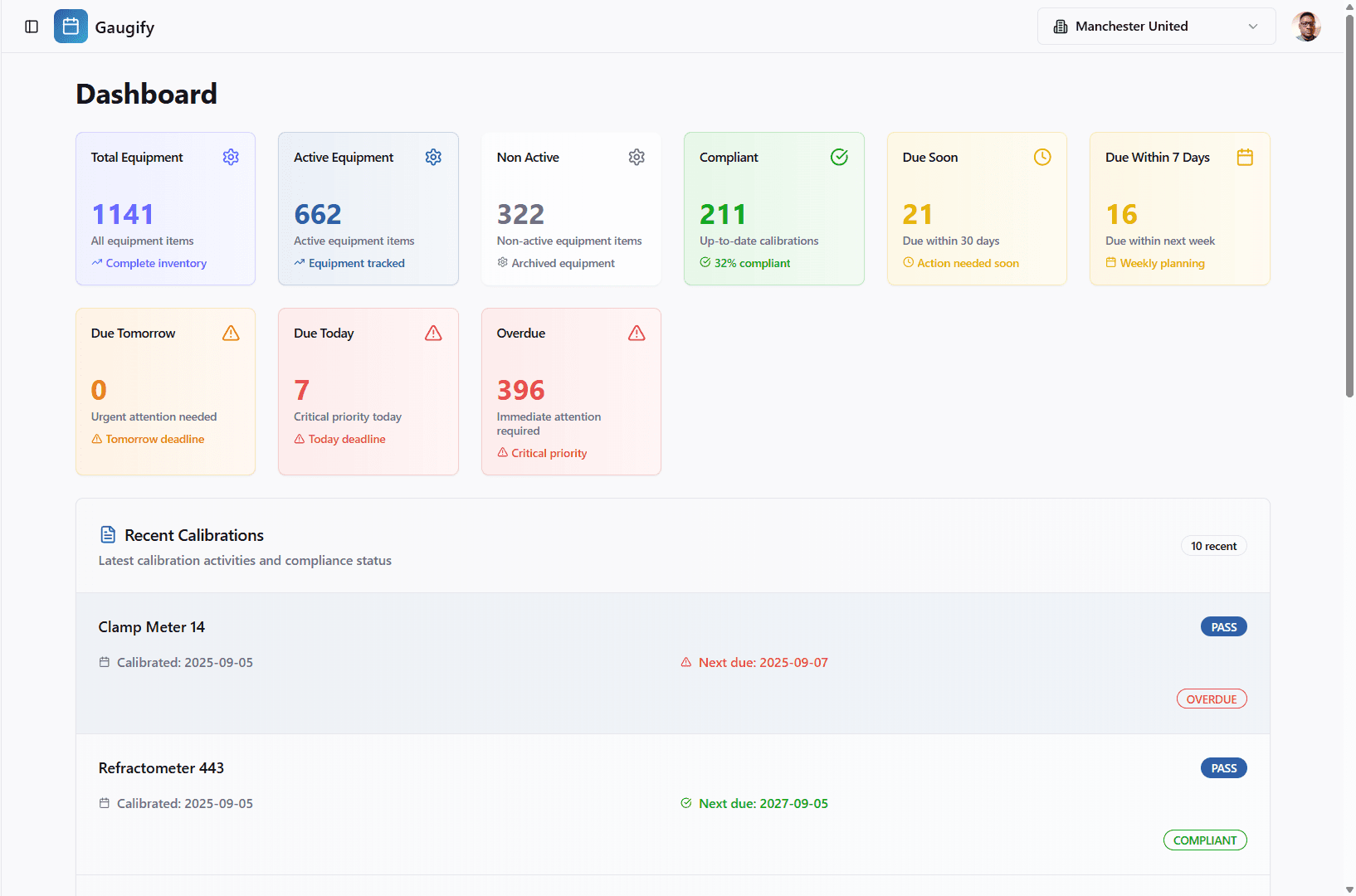
Manual calibration tracking using spreadsheets or paper records creates opportunities for missed calibrations, lost certificates, and compliance gaps. Modern calibration management software like Gaugify automates scheduling, documentation, and compliance monitoring for depth micrometers and other precision instruments.
Automated Scheduling and Reminders
Gaugify's intelligent scheduling system tracks calibration due dates for each depth micrometer based on your established intervals. The system accounts for usage patterns, critical applications, and regulatory requirements to optimize calibration timing. Automated email reminders notify responsible personnel 30, 14, and 7 days before calibration due dates, preventing overdue instruments and compliance issues.
For organizations managing multiple depth micrometer models across different locations, Gaugify's advanced features provide centralized visibility and control over the entire calibration program.
As-Found and As-Left Data Management
The software captures detailed as-found measurements during calibration, identifying trends that might indicate premature wear, environmental issues, or usage problems. As-left data documents post-calibration performance and provides baseline measurements for future calibrations.
This historical data proves invaluable for:
Trend analysis: Identifying instruments requiring increased calibration frequency
Root cause analysis: Investigating measurement issues or quality problems
Calibration interval optimization: Extending or shortening intervals based on performance data
Regulatory compliance: Demonstrating measurement control for audit purposes
Certificate Generation and Storage
Gaugify automatically generates professional calibration certificates containing all required information including measurement data, environmental conditions, reference standards used, and measurement uncertainty calculations. Certificates are digitally stored with secure access controls and can be retrieved instantly for customer requirements or audit purposes.
The system maintains complete traceability chains showing how each depth micrometer's calibration links back to national standards through certified reference standards. This documentation satisfies compliance requirements for ISO 9001, AS9100, ISO 13485, and other quality standards.
Integration with Quality Management Systems
Modern calibration management integrates seamlessly with existing quality management systems, ERP platforms, and maintenance software. This integration eliminates duplicate data entry while ensuring calibration status visibility throughout the organization.
Production managers can verify instrument calibration status before releasing critical measurements, while quality engineers receive immediate notification of calibration issues that might affect product compliance.
Optimize Your Depth Micrometer Calibration Program
Effective depth micrometer calibration requires more than just technical procedures—it demands systematic management, proper documentation, and continuous improvement. Organizations that implement comprehensive calibration management systems achieve better measurement reliability, reduced compliance risks, and improved operational efficiency.
Whether you're managing a handful of depth micrometers in a small machine shop or hundreds of instruments across multiple facilities, modern calibration management software provides the tools needed for success. Schedule a Gaugify demonstration to see how automated calibration management can transform your quality program while ensuring measurement accuracy and regulatory compliance.
Don't let manual calibration tracking compromise your measurement integrity or create compliance gaps. Start your free Gaugify trial today and experience the benefits of professional calibration management software designed specifically for manufacturing and quality professionals.
How to Calibrate Depth Micrometers
Depth micrometer calibration is a critical process that ensures these precision instruments maintain their accuracy for measuring the depth of holes, grooves, shoulders, and other recessed features. Whether you're working with a simple 0-1" depth micrometer or a complex digital set covering 0-6" ranges, proper calibration procedures are essential for maintaining measurement integrity in quality control applications.
Depth micrometers are among the most sensitive measuring instruments in any quality lab or machine shop. Unlike standard outside micrometers, these tools must account for additional variables like base flatness, spindle perpendicularity, and extension rod accuracy. A poorly calibrated depth micrometer can lead to rejected parts, rework costs, and potential safety issues in critical applications like aerospace or medical device manufacturing.
Understanding Depth Micrometers and Their Measurement Applications
A depth micrometer consists of a flat base, a measuring head with graduated sleeve and thimble, and interchangeable measuring rods or spindles. The base sits flush against the reference surface while the spindle extends into the depth being measured. Common applications include:
Counterbore depths in machined parts with tolerances of ±0.002" or tighter
Shoulder heights on stepped shafts where dimensional accuracy affects assembly fit
Groove depths in O-ring housings where improper depth affects sealing performance
Thread engagement depths in tapped holes for fastener applications
Material thickness measurements from one side when access is limited
Digital depth micrometers typically offer resolution to 0.00005" (0.001mm), while mechanical versions commonly read to 0.001" (0.01mm). The measurement range depends on the rod set, with common configurations covering 0-6", 0-9", or 0-12" ranges using individual rods for each inch of measurement.
Critical Components Affecting Measurement Accuracy
Several components directly impact depth micrometer accuracy and must be considered during calibration:
Base flatness: The measuring base must be flat within 0.0001" across its surface to ensure proper reference
Spindle perpendicularity: The measuring spindle must be perpendicular to the base within 0.0002" per inch
Thread accuracy: The spindle threads must maintain consistent pitch for accurate linear movement
Rod interchangeability: Extension rods must maintain consistent length relationships
Why Depth Micrometer Calibration is Critical
Depth micrometer calibration becomes critical due to the instrument's susceptible design and demanding applications. Unlike handheld calipers that might drift gradually, depth micrometers can experience sudden accuracy shifts from impacts, temperature changes, or contamination buildup on the base surface.
Consider a manufacturing scenario where counterbore depths control the seating of cap screws in aluminum aircraft components. If the depth micrometer reads 0.002" shallow due to calibration drift, approved parts may actually have insufficient material thickness, potentially leading to fastener breakthrough during torque application.
Common Failure Modes
Depth micrometers typically fail calibration due to:
Base damage: Nicks, burrs, or wear on the measuring base create false reference surfaces
Spindle wear: Thread wear causes backlash and inconsistent readings
Contamination: Chips, coolant residue, or corrosion affect moving parts
Temperature effects: Thermal expansion differences between the instrument and workpiece
Mechanical shock: Drops or impacts that affect internal alignment
Step-by-Step Depth Micrometer Calibration Procedure
Proper depth micrometer calibration requires controlled environmental conditions, appropriate reference standards, and systematic measurement procedures. This detailed process ensures reliable results and traceability to national standards.
Required Equipment and Standards
Before beginning calibration, gather these essential items:
Gage block set: Grade 2 or better blocks covering the instrument's range
Surface plate: Grade A granite surface plate for stable reference
Ring gages or setting standards: Certified depth standards when available
Cleaning materials: Lint-free cloths and approved solvents
Temperature monitoring: Thermometer accurate to ±1°F
Environmental Requirements
Maintain calibration laboratory conditions within these parameters:
Temperature: 68°F ± 2°F (20°C ± 1°C) with thermal equilibrium
Humidity: 45-65% relative humidity to prevent corrosion
Vibration: Minimal vibration environment using isolation if necessary
Lighting: Adequate lighting for clear scale reading without glare
Detailed Calibration Steps
Step 1: Visual and Mechanical Inspection
Examine the depth micrometer for physical damage, wear, or contamination. Check that the base is clean and free of nicks. Verify smooth spindle operation through the full range without binding or excessive play. Replace or repair any damaged components before proceeding.
Step 2: Cleaning and Preparation
Clean all measuring surfaces with appropriate solvent and lint-free cloths. Remove any corrosion, adhesive residue, or metal particles. Allow the instrument and reference standards to reach thermal equilibrium in the calibration environment for at least 30 minutes.
Step 3: Zero Setting Verification
With the shortest measuring rod installed, place the depth micrometer on the surface plate with the spindle retracted. Slowly extend the spindle until it just touches the surface plate. The reading should indicate zero within the instrument's specified accuracy. Record any zero error for correction or adjustment.
Start your free Gaugify trial to automatically track zero error measurements and maintain complete calibration records for all your depth micrometers.
Step 4: Point-by-Point Accuracy Verification
Using certified gage blocks, verify accuracy at multiple points throughout the instrument's range:
Select gage blocks representing 10%, 25%, 50%, 75%, and 100% of each rod's range
Place the gage block on the surface plate and position the depth micrometer base over it
Extend the spindle until it contacts the gage block surface with proper measuring force
Record the indicated reading and compare to the gage block nominal value
Calculate the measurement error and verify it falls within acceptable limits
Step 5: Extension Rod Verification
For depth micrometers with interchangeable rods, verify the accuracy of each rod length:
Install each extension rod and verify proper engagement with the measuring head
Use appropriately sized gage block stacks to check rod accuracy
Verify that rod transitions (1", 2", 3", etc.) read correctly
Document any rod-specific errors or adjustments needed
Step 6: Repeatability Assessment
Perform repeatability testing by taking multiple measurements at the same nominal depth:
Select a mid-range gage block for testing
Take 10 consecutive measurements, resetting the instrument between each
Calculate the range and standard deviation of readings
Verify repeatability meets manufacturer specifications
Relevant Calibration Standards and Specifications
Several industry standards govern depth micrometer calibration procedures and acceptance criteria. Understanding these requirements ensures compliant calibration practices and supports quality system audits.
ISO and International Standards
ISO 3599: This standard specifies requirements for depth micrometers including accuracy grades, measuring force, and environmental conditions. It defines accuracy classes and provides guidance for calibration intervals based on usage conditions.
ISO 17025: For laboratories performing depth micrometer calibrations, this standard establishes requirements for measurement uncertainty, traceability, and quality management systems. Gaugify's ISO 17025 calibration software helps maintain compliance with documentation and procedure requirements.
National and Industry Standards
ASME B89.1.5: American standard covering dimensional metrology including micrometer calibration procedures, uncertainty calculations, and reporting requirements.
ASTM E74: While primarily focused on force measurement, this standard provides guidance on calibration laboratory practices applicable to precision measuring instruments.
Manufacturer specifications: Companies like Mitutoyo, Starrett, and Brown & Sharpe provide detailed calibration procedures and acceptance criteria specific to their depth micrometer models.
Typical Acceptance Criteria
Common acceptance criteria for depth micrometer calibration include:
Accuracy: ±0.001" for mechanical instruments, ±0.0002" for digital models
Repeatability: Within ±0.0005" for 95% of measurements
Zero setting: Within ±0.0002" of true zero
Rod accuracy: Each extension rod within ±0.0005" of nominal length
Recommended Depth Micrometer Calibration Intervals
Establishing appropriate calibration intervals balances measurement reliability with operational efficiency. Unlike simple go/no-go gages that might calibrate annually, precision depth micrometers typically require more frequent attention due to their mechanical complexity and critical applications.
Standard Calibration Frequencies
Industry-standard calibration intervals for depth micrometers typically fall within these ranges:
Production environment: Every 6 months for daily use in manufacturing
Quality lab: Every 12 months for controlled environment usage
Inspection applications: Every 3-6 months for high-precision requirements
Tool room storage: Every 18-24 months for occasional use instruments
Factors Affecting Calibration Frequency
Several operational factors should influence your depth micrometer calibration schedule:
Usage intensity: Instruments used multiple times daily require more frequent calibration than occasionally used tools. A depth micrometer checking counterbore depths on a CNC machining line needs quarterly calibration, while one used weekly for inspection might calibrate annually.
Environmental conditions: Temperature variations, humidity levels, and contamination exposure affect calibration stability. Shop floor instruments exposed to coolant mist and temperature swings need more frequent calibration than climate-controlled lab instruments.
Critical tolerance requirements: Applications with tight tolerances (±0.001" or less) justify shorter calibration intervals to ensure continued accuracy. Aerospace or medical device applications often mandate 6-month or quarterly calibration regardless of usage.
Historical performance: Instruments with stable calibration history might qualify for extended intervals, while those showing drift patterns need increased frequency.
Common Depth Micrometer Calibration Mistakes
Even experienced technicians can make errors during depth micrometer calibration that compromise results or create false confidence in instrument accuracy. Understanding these common mistakes helps establish robust calibration procedures.
Temperature-Related Errors
Insufficient thermal equilibrium: Rushing calibration before instruments and standards reach environmental temperature leads to thermal expansion errors. A steel depth micrometer brought from a 50°F storage area to a 70°F lab will read differently until temperatures equalize.
Solution: Allow minimum 30 minutes equilibrium time and monitor temperatures with calibrated thermometers.
Reference Standard Issues
Using inappropriate gage blocks: Employing worn, damaged, or improperly certified gage blocks introduces measurement errors. Grade 3 shop blocks lack the accuracy needed for precision micrometer calibration.
Solution: Use Grade 2 or better gage blocks with current calibration certificates and inspect for damage before use.
Technique Problems
Inconsistent measuring force: Applying excessive or insufficient force during calibration creates repeatability issues and false readings. Heavy-handed technicians might compress gage blocks or deflect measuring components.
Solution: Develop consistent measuring technique using gentle, uniform contact pressure and multiple readings for verification.
Base contamination: Failing to clean the measuring base thoroughly leaves particles that create false reference surfaces and measurement errors.
Solution: Establish cleaning procedures using appropriate solvents and verification of clean surfaces before calibration.
Documentation Errors
Incomplete data recording: Missing environmental conditions, reference standard information, or measurement uncertainty calculations compromise calibration validity and traceability.
Solution: Use systematic data collection forms and verify completeness before finalizing calibration certificates.
Tracking Depth Micrometer Calibration with Modern Software
Manual calibration tracking using spreadsheets or paper records creates opportunities for missed calibrations, lost certificates, and compliance gaps. Modern calibration management software like Gaugify automates scheduling, documentation, and compliance monitoring for depth micrometers and other precision instruments.
Automated Scheduling and Reminders
Gaugify's intelligent scheduling system tracks calibration due dates for each depth micrometer based on your established intervals. The system accounts for usage patterns, critical applications, and regulatory requirements to optimize calibration timing. Automated email reminders notify responsible personnel 30, 14, and 7 days before calibration due dates, preventing overdue instruments and compliance issues.
For organizations managing multiple depth micrometer models across different locations, Gaugify's advanced features provide centralized visibility and control over the entire calibration program.
As-Found and As-Left Data Management
The software captures detailed as-found measurements during calibration, identifying trends that might indicate premature wear, environmental issues, or usage problems. As-left data documents post-calibration performance and provides baseline measurements for future calibrations.
This historical data proves invaluable for:
Trend analysis: Identifying instruments requiring increased calibration frequency
Root cause analysis: Investigating measurement issues or quality problems
Calibration interval optimization: Extending or shortening intervals based on performance data
Regulatory compliance: Demonstrating measurement control for audit purposes
Certificate Generation and Storage
Gaugify automatically generates professional calibration certificates containing all required information including measurement data, environmental conditions, reference standards used, and measurement uncertainty calculations. Certificates are digitally stored with secure access controls and can be retrieved instantly for customer requirements or audit purposes.
The system maintains complete traceability chains showing how each depth micrometer's calibration links back to national standards through certified reference standards. This documentation satisfies compliance requirements for ISO 9001, AS9100, ISO 13485, and other quality standards.
Integration with Quality Management Systems
Modern calibration management integrates seamlessly with existing quality management systems, ERP platforms, and maintenance software. This integration eliminates duplicate data entry while ensuring calibration status visibility throughout the organization.
Production managers can verify instrument calibration status before releasing critical measurements, while quality engineers receive immediate notification of calibration issues that might affect product compliance.
Optimize Your Depth Micrometer Calibration Program
Effective depth micrometer calibration requires more than just technical procedures—it demands systematic management, proper documentation, and continuous improvement. Organizations that implement comprehensive calibration management systems achieve better measurement reliability, reduced compliance risks, and improved operational efficiency.
Whether you're managing a handful of depth micrometers in a small machine shop or hundreds of instruments across multiple facilities, modern calibration management software provides the tools needed for success. Schedule a Gaugify demonstration to see how automated calibration management can transform your quality program while ensuring measurement accuracy and regulatory compliance.
Don't let manual calibration tracking compromise your measurement integrity or create compliance gaps. Start your free Gaugify trial today and experience the benefits of professional calibration management software designed specifically for manufacturing and quality professionals.