
How to Calibrate a Tensile Testing Machine
How to Calibrate a Tensile Testing Machine
David Bentley
Quality Assurance Engineer
12 min read
How to Calibrate a Tensile Testing Machine
Tensile testing machines are the backbone of materials testing laboratories, performing critical strength and elongation measurements on everything from steel bar stock to polymer films. Proper tensile tester calibration ensures these sophisticated instruments deliver accurate force and displacement readings that meet stringent quality standards. Whether you're running ASTM D638 plastic specimens or ISO 6892 metallic materials tests, calibration accuracy directly impacts your test results and regulatory compliance.
This comprehensive guide walks through the complete tensile tester calibration process, from understanding the instrument's measurement principles to implementing a robust calibration management system that keeps your testing program on track.
What is a Tensile Testing Machine and What Does it Measure?
A tensile testing machine, also known as a universal testing machine (UTM) or materials testing system, applies controlled force to test specimens while measuring their mechanical properties. These instruments typically feature a load frame with upper and lower crossheads, precision load cells, extensometers, and sophisticated control software.
The primary measurements include:
Applied Force: Measured by calibrated load cells, typically ranging from 1 kN to 2000 kN depending on the machine capacity
Displacement: Crosshead movement measured by linear encoders or LVDTs with resolutions down to 0.001 mm
Strain: Measured by clip-on or contact extensometers with gauge lengths from 10 mm to 200 mm
Test Speed: Controlled crosshead velocity from 0.001 mm/min to 1000 mm/min
Modern tensile testers like those from Instron, MTS, or Zwick automatically calculate derived properties including ultimate tensile strength, yield strength, modulus of elasticity, and elongation at break. These calculated values are only as accurate as the underlying force and displacement measurements, making calibration absolutely critical.
Why Tensile Tester Calibration is Critical
Tensile testing results directly influence material acceptance decisions, product design specifications, and regulatory compliance. Consider a scenario where you're testing aerospace-grade aluminum with a required ultimate tensile strength of 310 ± 10 MPa. If your load cell reads 2% high due to calibration drift, you might accept material that actually tests at 304 MPa – below the minimum specification.
Key reasons why calibration is essential:
Regulatory Compliance: ISO 17025 accreditation requires documented calibration with traceability to national standards
Product Liability: Inaccurate test results can lead to product failures and costly recalls
Customer Confidence: Major OEMs audit supplier testing capabilities and require calibration records
Cost Avoidance: Proper calibration prevents expensive material rejections due to measurement uncertainty
The measurement uncertainty for tensile testing typically ranges from ±0.5% to ±2% of reading, depending on the calibration quality and instrument condition. This uncertainty must be factored into acceptance criteria to avoid false accepts or rejects.
Step-by-Step Tensile Tester Calibration Procedure
Professional tensile tester calibration requires specialized equipment and trained technicians. Here's the detailed procedure most calibration laboratories follow:
Pre-Calibration Setup
Environmental conditions must meet stringent requirements before beginning calibration:
Temperature: 23 ± 2°C (controlled within ±1°C during calibration)
Humidity: 50 ± 10% RH
Vibration isolation to prevent measurement interference
Power supply stability within ±1%
Allow the tensile tester to warm up for at least 60 minutes before calibration to ensure thermal stability of the electronics and load cells.
Force Calibration
Force calibration uses deadweight force standards or calibrated proving rings traceable to NIST or equivalent national standards:
Install Force Standard: Mount the proving ring or force transducer in the load train, ensuring proper alignment
Zero Calibration: With no applied force, verify the zero reading is within ±0.1% of full scale
Multi-Point Calibration: Apply forces at minimum 5 points across the measurement range:
20% of full scale (e.g., 20 kN for 100 kN capacity)
40% of full scale (40 kN)
60% of full scale (60 kN)
80% of full scale (80 kN)
100% of full scale (100 kN)
Acceptance Criteria: Force indication error must be within ±0.5% of reading for Class 1 accuracy per ISO 7500-1
Hysteresis Check: Apply and remove loads while checking for consistent readings within ±0.3%
Record all as-found readings before any adjustments. If the instrument fails initial calibration, document the out-of-tolerance readings and perform necessary repairs or adjustments.
Displacement Calibration
Displacement calibration uses precision gauge blocks or laser interferometry:
Install Displacement Standard: Mount calibrated gauge blocks or laser interferometer target
Crosshead Positioning: Move crosshead through specified displacements from 1 mm to maximum stroke
Bidirectional Testing: Check both upward and downward movements for backlash
Acceptance Criteria: Displacement error within ±0.5% of reading or ±2.5 μm, whichever is greater
Speed Calibration
Verify crosshead speed accuracy using calibrated timing methods:
Test speeds from 0.1 mm/min to maximum rated speed
Acceptance criteria: ±1% of programmed speed
Check speed stability over 60-second intervals
Managing this complex calibration process becomes much easier with dedicated calibration management software that tracks procedures, stores certificates, and schedules recurring calibrations automatically.
Relevant Calibration Standards for Tensile Testing Machines
Several international standards govern tensile tester calibration procedures and requirements:
Primary Calibration Standards
ISO 7500-1: Metallic materials — Verification of static uniaxial testing machines — Part 1: Tension/compression testing machines
ASTM E4: Standard Practices for Force Verification of Testing Machines
ISO 9513: Metallic materials — Calibration of extensometer systems used in uniaxial testing
ASTM E83: Standard Practice for Verification and Classification of Extensometer Systems
Application-Specific Standards
ISO 6892-1: Metallic materials — Tensile testing (defines machine requirements)
ASTM D638: Standard Test Method for Tensile Properties of Plastics
ASTM D5766: Standard Test Method for Open-Hole Tensile Strength of Polymer Matrix Composite Laminates
These standards specify accuracy classes, calibration intervals, and uncertainty requirements. For example, ISO 7500-1 defines Class 0.5, Class 1, and Class 2 machines with force indication errors of ±0.5%, ±1%, and ±2% respectively.
Manufacturers also provide specific calibration procedures in their service manuals. Instron's 5900 Series specifications require annual force calibration with uncertainties not exceeding 0.15% of reading, while MTS Criterion systems specify similar requirements with additional temperature compensation checks.
Recommended Calibration Intervals for Tensile Testing Machines
Calibration frequency depends on several factors including usage intensity, measurement criticality, and historical stability data. Industry best practices recommend:
Standard Intervals
Force System: Annual calibration for most applications
Displacement System: Annual or biannual depending on accuracy requirements
Extensometers: Semi-annual due to mechanical wear and handling
Temperature Sensors: Annual verification
Factors Affecting Calibration Intervals
Usage Volume: High-volume labs (>1000 tests/month) may require 6-month intervals
Application Criticality: Aerospace and medical device testing often requires quarterly calibration
Environmental Conditions: Harsh environments may accelerate drift
Historical Data: Instruments with proven stability may extend to 18-month intervals
For example, a testing lab performing ASTM D638 plastic testing for consumer products might calibrate annually, while an aerospace lab testing critical flight hardware per ASTM D5766 requires quarterly calibration with intermediate checks.
Risk-based calibration approaches use statistical analysis of historical calibration data to optimize intervals. If your tensile tester consistently passes calibration with minimal drift, you might justify extending the interval while maintaining measurement confidence.
Common Calibration Mistakes and How to Avoid Them
Even experienced technicians can make costly errors during tensile tester calibration. Here are the most frequent mistakes and prevention strategies:
Environmental Control Issues
Mistake: Performing calibration without proper temperature stabilization or during HVAC cycling.
Solution: Monitor environmental conditions continuously and postpone calibration if temperature varies more than ±1°C during the procedure. Install dedicated temperature monitoring with data logging.
Improper Load Train Alignment
Mistake: Installing force standards with angular misalignment, causing side loads and measurement errors.
Solution: Use precision alignment fixtures and verify centerline alignment with dial indicators. Check for binding or friction in the load train.
Inadequate Warm-Up Time
Mistake: Starting calibration immediately after powering up the instrument.
Solution: Follow manufacturer specifications for warm-up time (typically 30-60 minutes). Monitor load cell output stability before beginning.
Insufficient Documentation
Mistake: Poor record keeping of as-found conditions, environmental data, and calibration adjustments.
Solution: Use standardized calibration forms and maintain complete traceability records. Digital calibration certificates should include all measurement uncertainty calculations.
Ignoring Intermediate Checks
Mistake: Relying solely on annual calibrations without monitoring instrument performance between calibrations.
Solution: Implement routine check standards and control charts to detect drift early. Use certified reference materials or check standards monthly.
How Gaugify Streamlines Tensile Tester Calibration Management
Modern calibration management requires more than spreadsheets and paper certificates. Gaugify's cloud-based platform provides comprehensive tools specifically designed for managing complex instruments like tensile testing machines.
Automated Scheduling and Reminders
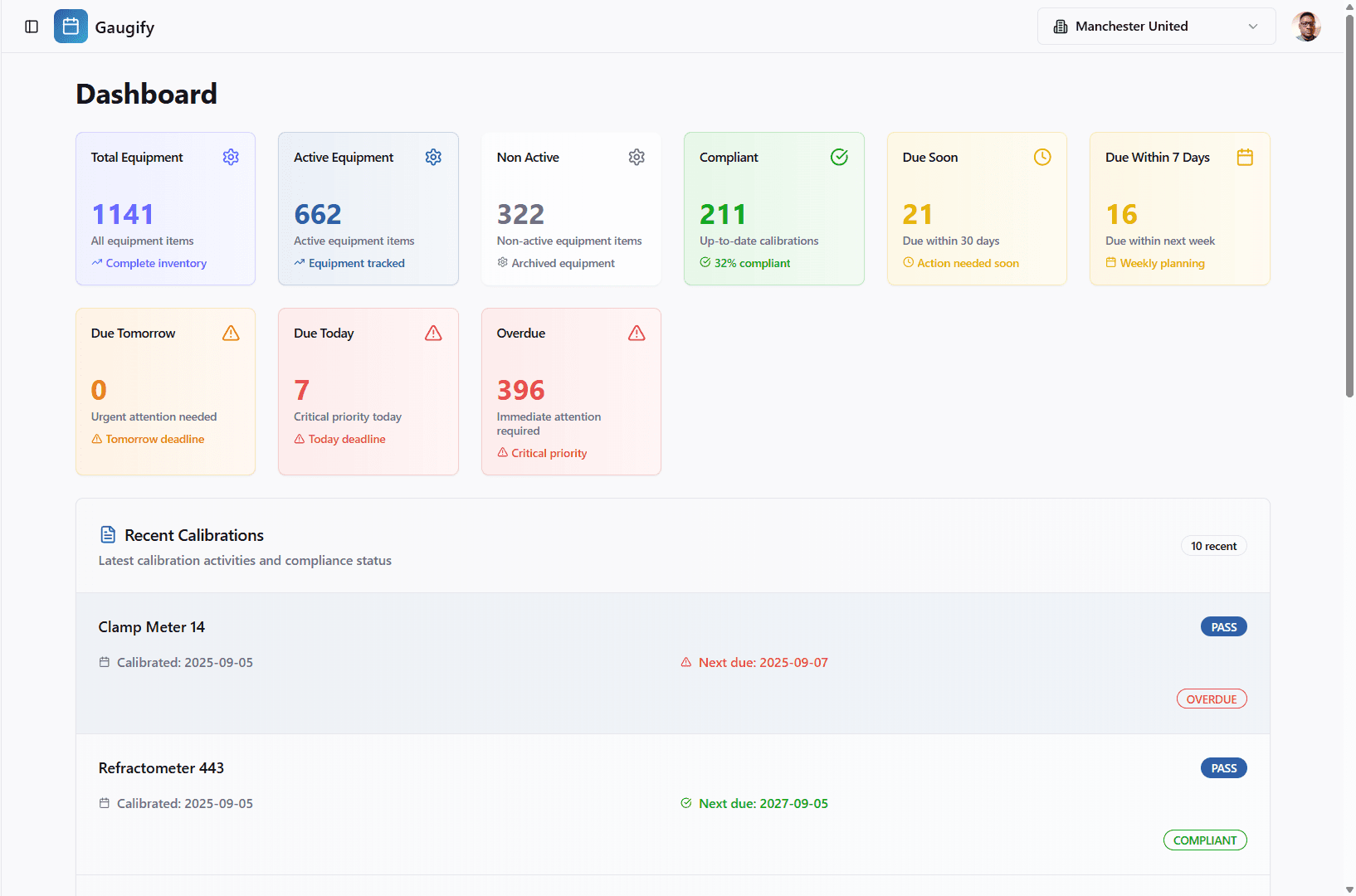
Gaugify automatically calculates calibration due dates based on your specified intervals and sends email reminders 30, 14, and 7 days before calibration due dates. The system accounts for weekends and holidays, ensuring you never miss a critical calibration deadline.
For tensile testers requiring quarterly extensometer calibration and annual force calibration, Gaugify tracks each component separately with customized schedules. The dashboard provides clear visibility of upcoming calibrations across your entire instrument fleet.
Comprehensive Data Management
Store complete calibration records including:
As-found and as-left measurement data
Environmental conditions during calibration
Calibration certificates with full traceability chains
Measurement uncertainty calculations
Technician certifications and signatures
The system maintains complete audit trails showing who performed calibrations, when adjustments were made, and detailed change histories. This level of documentation easily satisfies ISO 17025 requirements and customer audit expectations.
Advanced Analytics and Trending
Gaugify automatically generates calibration trend charts showing instrument drift over time. This data helps optimize calibration intervals and identify instruments requiring preventive maintenance. For example, if your 100 kN tensile tester consistently shows 0.3% high readings, the trending data supports extending calibration intervals or planning load cell replacement.
Mobile Access and Field Calibration
Calibration technicians can access Gaugify from tablets or smartphones, enabling real-time data entry during on-site calibrations. Upload photos of calibration setups, record environmental conditions, and update instrument status immediately rather than transcribing handwritten forms later.
Ready to modernize your calibration management? Start your free trial and experience how Gaugify simplifies tensile tester calibration tracking while ensuring complete regulatory compliance.
Integration with Quality Management Systems
Gaugify seamlessly integrates with existing quality management systems through API connections and data exports. Generate calibration reports in your company format, export data for statistical analysis, or automatically update instrument status in your LIMS system.
The platform supports multiple user roles with customized permissions. Lab managers get executive dashboards showing fleet calibration status, while technicians access detailed work instructions and data entry forms. Quality auditors receive read-only access to complete calibration histories and certificates.
Implementing a Complete Tensile Tester Calibration Program
Beyond individual calibration procedures, successful programs require systematic approaches addressing all aspects of measurement assurance:
Calibration Procedures and Work Instructions
Develop standardized procedures covering each tensile tester model in your facility. Include specific acceptance criteria, environmental requirements, and safety precautions. Reference applicable standards like ISO 7500-1 and manufacturer specifications.
Work instructions should specify required reference standards, measurement uncertainty targets, and escalation procedures for out-of-tolerance conditions. Include photographs showing proper setup and alignment techniques.
Technician Training and Certification
Calibration technicians require extensive training on both general metrology principles and specific tensile testing requirements. Key competencies include:
Understanding of force and displacement traceability chains
Proper use of deadweight force standards and laser interferometry
Statistical analysis of calibration data and uncertainty evaluation
Recognition of common failure modes and troubleshooting techniques
Document training records and maintain technician certifications within your calibration management system. Gaugify tracks individual technician qualifications and prevents unauthorized personnel from performing calibrations.
Measurement Uncertainty Analysis
Calculate and document measurement uncertainty for each calibration point following ISO/IEC Guide 98-3 (GUM). Typical uncertainty components include:
Reference standard uncertainty (typically 0.05% to 0.1%)
Resolution uncertainty based on display least count
Repeatability from multiple measurements
Environmental effects (temperature, vibration)
Interpolation errors between calibration points
Combined uncertainties typically range from 0.15% to 0.5% depending on the calibration quality and instrument design. This uncertainty must be considered when establishing test method specifications and acceptance criteria.
Future Trends in Tensile Tester Calibration
Calibration technology continues evolving with advances in measurement science and digitalization:
Automated Calibration Systems
Emerging automated calibration systems reduce human intervention while improving consistency and documentation. These systems automatically position force standards, collect data, and generate calibration certificates with minimal operator involvement.
Continuous Monitoring
Advanced tensile testers increasingly incorporate self-monitoring capabilities using built-in check standards and statistical process control. These systems automatically detect drift and alert operators before calibration intervals expire.
Digital Calibration Certificates
Blockchain-based digital certificates provide tamper-proof calibration records with enhanced security and traceability. These certificates include machine-readable data enabling automated import into calibration management systems.
Staying current with these trends requires flexible calibration management software that adapts to changing requirements while maintaining compliance with established standards. Gaugify's compliance-focused design ensures your calibration program remains current with evolving industry practices.
Take Control of Your Tensile Tester Calibration Program
Proper tensile tester calibration forms the foundation of reliable materials testing, supporting everything from incoming material inspection to research and development programs. The complex requirements for force, displacement, and extensometer calibration demand systematic management approaches that traditional spreadsheet-based systems simply cannot provide.
Gaugify's comprehensive calibration management platform addresses these challenges with automated scheduling, complete documentation, advanced analytics, and seamless integration capabilities. Whether you're managing a single tensile tester or a fleet of materials testing equipment, Gaugify ensures nothing falls through the cracks while simplifying compliance with ISO 17025, ISO 9001, and customer audit requirements.
Don't let calibration management complexity compromise your testing program effectiveness. Start your free trial today and discover how modern calibration management transforms your materials testing operations. Experience the difference that professional-grade software makes in maintaining measurement confidence and regulatory compliance.
For questions about implementing tensile tester calibration in Gaugify or to discuss your specific requirements, schedule a personalized demonstration with our calibration management experts.
How to Calibrate a Tensile Testing Machine
Tensile testing machines are the backbone of materials testing laboratories, performing critical strength and elongation measurements on everything from steel bar stock to polymer films. Proper tensile tester calibration ensures these sophisticated instruments deliver accurate force and displacement readings that meet stringent quality standards. Whether you're running ASTM D638 plastic specimens or ISO 6892 metallic materials tests, calibration accuracy directly impacts your test results and regulatory compliance.
This comprehensive guide walks through the complete tensile tester calibration process, from understanding the instrument's measurement principles to implementing a robust calibration management system that keeps your testing program on track.
What is a Tensile Testing Machine and What Does it Measure?
A tensile testing machine, also known as a universal testing machine (UTM) or materials testing system, applies controlled force to test specimens while measuring their mechanical properties. These instruments typically feature a load frame with upper and lower crossheads, precision load cells, extensometers, and sophisticated control software.
The primary measurements include:
Applied Force: Measured by calibrated load cells, typically ranging from 1 kN to 2000 kN depending on the machine capacity
Displacement: Crosshead movement measured by linear encoders or LVDTs with resolutions down to 0.001 mm
Strain: Measured by clip-on or contact extensometers with gauge lengths from 10 mm to 200 mm
Test Speed: Controlled crosshead velocity from 0.001 mm/min to 1000 mm/min
Modern tensile testers like those from Instron, MTS, or Zwick automatically calculate derived properties including ultimate tensile strength, yield strength, modulus of elasticity, and elongation at break. These calculated values are only as accurate as the underlying force and displacement measurements, making calibration absolutely critical.
Why Tensile Tester Calibration is Critical
Tensile testing results directly influence material acceptance decisions, product design specifications, and regulatory compliance. Consider a scenario where you're testing aerospace-grade aluminum with a required ultimate tensile strength of 310 ± 10 MPa. If your load cell reads 2% high due to calibration drift, you might accept material that actually tests at 304 MPa – below the minimum specification.
Key reasons why calibration is essential:
Regulatory Compliance: ISO 17025 accreditation requires documented calibration with traceability to national standards
Product Liability: Inaccurate test results can lead to product failures and costly recalls
Customer Confidence: Major OEMs audit supplier testing capabilities and require calibration records
Cost Avoidance: Proper calibration prevents expensive material rejections due to measurement uncertainty
The measurement uncertainty for tensile testing typically ranges from ±0.5% to ±2% of reading, depending on the calibration quality and instrument condition. This uncertainty must be factored into acceptance criteria to avoid false accepts or rejects.
Step-by-Step Tensile Tester Calibration Procedure
Professional tensile tester calibration requires specialized equipment and trained technicians. Here's the detailed procedure most calibration laboratories follow:
Pre-Calibration Setup
Environmental conditions must meet stringent requirements before beginning calibration:
Temperature: 23 ± 2°C (controlled within ±1°C during calibration)
Humidity: 50 ± 10% RH
Vibration isolation to prevent measurement interference
Power supply stability within ±1%
Allow the tensile tester to warm up for at least 60 minutes before calibration to ensure thermal stability of the electronics and load cells.
Force Calibration
Force calibration uses deadweight force standards or calibrated proving rings traceable to NIST or equivalent national standards:
Install Force Standard: Mount the proving ring or force transducer in the load train, ensuring proper alignment
Zero Calibration: With no applied force, verify the zero reading is within ±0.1% of full scale
Multi-Point Calibration: Apply forces at minimum 5 points across the measurement range:
20% of full scale (e.g., 20 kN for 100 kN capacity)
40% of full scale (40 kN)
60% of full scale (60 kN)
80% of full scale (80 kN)
100% of full scale (100 kN)
Acceptance Criteria: Force indication error must be within ±0.5% of reading for Class 1 accuracy per ISO 7500-1
Hysteresis Check: Apply and remove loads while checking for consistent readings within ±0.3%
Record all as-found readings before any adjustments. If the instrument fails initial calibration, document the out-of-tolerance readings and perform necessary repairs or adjustments.
Displacement Calibration
Displacement calibration uses precision gauge blocks or laser interferometry:
Install Displacement Standard: Mount calibrated gauge blocks or laser interferometer target
Crosshead Positioning: Move crosshead through specified displacements from 1 mm to maximum stroke
Bidirectional Testing: Check both upward and downward movements for backlash
Acceptance Criteria: Displacement error within ±0.5% of reading or ±2.5 μm, whichever is greater
Speed Calibration
Verify crosshead speed accuracy using calibrated timing methods:
Test speeds from 0.1 mm/min to maximum rated speed
Acceptance criteria: ±1% of programmed speed
Check speed stability over 60-second intervals
Managing this complex calibration process becomes much easier with dedicated calibration management software that tracks procedures, stores certificates, and schedules recurring calibrations automatically.
Relevant Calibration Standards for Tensile Testing Machines
Several international standards govern tensile tester calibration procedures and requirements:
Primary Calibration Standards
ISO 7500-1: Metallic materials — Verification of static uniaxial testing machines — Part 1: Tension/compression testing machines
ASTM E4: Standard Practices for Force Verification of Testing Machines
ISO 9513: Metallic materials — Calibration of extensometer systems used in uniaxial testing
ASTM E83: Standard Practice for Verification and Classification of Extensometer Systems
Application-Specific Standards
ISO 6892-1: Metallic materials — Tensile testing (defines machine requirements)
ASTM D638: Standard Test Method for Tensile Properties of Plastics
ASTM D5766: Standard Test Method for Open-Hole Tensile Strength of Polymer Matrix Composite Laminates
These standards specify accuracy classes, calibration intervals, and uncertainty requirements. For example, ISO 7500-1 defines Class 0.5, Class 1, and Class 2 machines with force indication errors of ±0.5%, ±1%, and ±2% respectively.
Manufacturers also provide specific calibration procedures in their service manuals. Instron's 5900 Series specifications require annual force calibration with uncertainties not exceeding 0.15% of reading, while MTS Criterion systems specify similar requirements with additional temperature compensation checks.
Recommended Calibration Intervals for Tensile Testing Machines
Calibration frequency depends on several factors including usage intensity, measurement criticality, and historical stability data. Industry best practices recommend:
Standard Intervals
Force System: Annual calibration for most applications
Displacement System: Annual or biannual depending on accuracy requirements
Extensometers: Semi-annual due to mechanical wear and handling
Temperature Sensors: Annual verification
Factors Affecting Calibration Intervals
Usage Volume: High-volume labs (>1000 tests/month) may require 6-month intervals
Application Criticality: Aerospace and medical device testing often requires quarterly calibration
Environmental Conditions: Harsh environments may accelerate drift
Historical Data: Instruments with proven stability may extend to 18-month intervals
For example, a testing lab performing ASTM D638 plastic testing for consumer products might calibrate annually, while an aerospace lab testing critical flight hardware per ASTM D5766 requires quarterly calibration with intermediate checks.
Risk-based calibration approaches use statistical analysis of historical calibration data to optimize intervals. If your tensile tester consistently passes calibration with minimal drift, you might justify extending the interval while maintaining measurement confidence.
Common Calibration Mistakes and How to Avoid Them
Even experienced technicians can make costly errors during tensile tester calibration. Here are the most frequent mistakes and prevention strategies:
Environmental Control Issues
Mistake: Performing calibration without proper temperature stabilization or during HVAC cycling.
Solution: Monitor environmental conditions continuously and postpone calibration if temperature varies more than ±1°C during the procedure. Install dedicated temperature monitoring with data logging.
Improper Load Train Alignment
Mistake: Installing force standards with angular misalignment, causing side loads and measurement errors.
Solution: Use precision alignment fixtures and verify centerline alignment with dial indicators. Check for binding or friction in the load train.
Inadequate Warm-Up Time
Mistake: Starting calibration immediately after powering up the instrument.
Solution: Follow manufacturer specifications for warm-up time (typically 30-60 minutes). Monitor load cell output stability before beginning.
Insufficient Documentation
Mistake: Poor record keeping of as-found conditions, environmental data, and calibration adjustments.
Solution: Use standardized calibration forms and maintain complete traceability records. Digital calibration certificates should include all measurement uncertainty calculations.
Ignoring Intermediate Checks
Mistake: Relying solely on annual calibrations without monitoring instrument performance between calibrations.
Solution: Implement routine check standards and control charts to detect drift early. Use certified reference materials or check standards monthly.
How Gaugify Streamlines Tensile Tester Calibration Management
Modern calibration management requires more than spreadsheets and paper certificates. Gaugify's cloud-based platform provides comprehensive tools specifically designed for managing complex instruments like tensile testing machines.
Automated Scheduling and Reminders
Gaugify automatically calculates calibration due dates based on your specified intervals and sends email reminders 30, 14, and 7 days before calibration due dates. The system accounts for weekends and holidays, ensuring you never miss a critical calibration deadline.
For tensile testers requiring quarterly extensometer calibration and annual force calibration, Gaugify tracks each component separately with customized schedules. The dashboard provides clear visibility of upcoming calibrations across your entire instrument fleet.
Comprehensive Data Management
Store complete calibration records including:
As-found and as-left measurement data
Environmental conditions during calibration
Calibration certificates with full traceability chains
Measurement uncertainty calculations
Technician certifications and signatures
The system maintains complete audit trails showing who performed calibrations, when adjustments were made, and detailed change histories. This level of documentation easily satisfies ISO 17025 requirements and customer audit expectations.
Advanced Analytics and Trending
Gaugify automatically generates calibration trend charts showing instrument drift over time. This data helps optimize calibration intervals and identify instruments requiring preventive maintenance. For example, if your 100 kN tensile tester consistently shows 0.3% high readings, the trending data supports extending calibration intervals or planning load cell replacement.
Mobile Access and Field Calibration
Calibration technicians can access Gaugify from tablets or smartphones, enabling real-time data entry during on-site calibrations. Upload photos of calibration setups, record environmental conditions, and update instrument status immediately rather than transcribing handwritten forms later.
Ready to modernize your calibration management? Start your free trial and experience how Gaugify simplifies tensile tester calibration tracking while ensuring complete regulatory compliance.
Integration with Quality Management Systems
Gaugify seamlessly integrates with existing quality management systems through API connections and data exports. Generate calibration reports in your company format, export data for statistical analysis, or automatically update instrument status in your LIMS system.
The platform supports multiple user roles with customized permissions. Lab managers get executive dashboards showing fleet calibration status, while technicians access detailed work instructions and data entry forms. Quality auditors receive read-only access to complete calibration histories and certificates.
Implementing a Complete Tensile Tester Calibration Program
Beyond individual calibration procedures, successful programs require systematic approaches addressing all aspects of measurement assurance:
Calibration Procedures and Work Instructions
Develop standardized procedures covering each tensile tester model in your facility. Include specific acceptance criteria, environmental requirements, and safety precautions. Reference applicable standards like ISO 7500-1 and manufacturer specifications.
Work instructions should specify required reference standards, measurement uncertainty targets, and escalation procedures for out-of-tolerance conditions. Include photographs showing proper setup and alignment techniques.
Technician Training and Certification
Calibration technicians require extensive training on both general metrology principles and specific tensile testing requirements. Key competencies include:
Understanding of force and displacement traceability chains
Proper use of deadweight force standards and laser interferometry
Statistical analysis of calibration data and uncertainty evaluation
Recognition of common failure modes and troubleshooting techniques
Document training records and maintain technician certifications within your calibration management system. Gaugify tracks individual technician qualifications and prevents unauthorized personnel from performing calibrations.
Measurement Uncertainty Analysis
Calculate and document measurement uncertainty for each calibration point following ISO/IEC Guide 98-3 (GUM). Typical uncertainty components include:
Reference standard uncertainty (typically 0.05% to 0.1%)
Resolution uncertainty based on display least count
Repeatability from multiple measurements
Environmental effects (temperature, vibration)
Interpolation errors between calibration points
Combined uncertainties typically range from 0.15% to 0.5% depending on the calibration quality and instrument design. This uncertainty must be considered when establishing test method specifications and acceptance criteria.
Future Trends in Tensile Tester Calibration
Calibration technology continues evolving with advances in measurement science and digitalization:
Automated Calibration Systems
Emerging automated calibration systems reduce human intervention while improving consistency and documentation. These systems automatically position force standards, collect data, and generate calibration certificates with minimal operator involvement.
Continuous Monitoring
Advanced tensile testers increasingly incorporate self-monitoring capabilities using built-in check standards and statistical process control. These systems automatically detect drift and alert operators before calibration intervals expire.
Digital Calibration Certificates
Blockchain-based digital certificates provide tamper-proof calibration records with enhanced security and traceability. These certificates include machine-readable data enabling automated import into calibration management systems.
Staying current with these trends requires flexible calibration management software that adapts to changing requirements while maintaining compliance with established standards. Gaugify's compliance-focused design ensures your calibration program remains current with evolving industry practices.
Take Control of Your Tensile Tester Calibration Program
Proper tensile tester calibration forms the foundation of reliable materials testing, supporting everything from incoming material inspection to research and development programs. The complex requirements for force, displacement, and extensometer calibration demand systematic management approaches that traditional spreadsheet-based systems simply cannot provide.
Gaugify's comprehensive calibration management platform addresses these challenges with automated scheduling, complete documentation, advanced analytics, and seamless integration capabilities. Whether you're managing a single tensile tester or a fleet of materials testing equipment, Gaugify ensures nothing falls through the cracks while simplifying compliance with ISO 17025, ISO 9001, and customer audit requirements.
Don't let calibration management complexity compromise your testing program effectiveness. Start your free trial today and discover how modern calibration management transforms your materials testing operations. Experience the difference that professional-grade software makes in maintaining measurement confidence and regulatory compliance.
For questions about implementing tensile tester calibration in Gaugify or to discuss your specific requirements, schedule a personalized demonstration with our calibration management experts.