
How to Calibrate a Compression Testing Machine
How to Calibrate a Compression Testing Machine
David Bentley
Quality Assurance Engineer
12 min read
How to Calibrate a Compression Testing Machine
Compression testing machines are critical instruments in material testing laboratories, quality control departments, and manufacturing facilities. Proper compression tester calibration ensures accurate force measurements that determine whether concrete cylinders, foam samples, cardboard packaging, and countless other materials meet their specified strength requirements. Without regular calibration, these machines can produce inaccurate results that lead to costly material failures, rejected products, or unsafe structures.
Whether you're working with a 250 kN hydraulic compression tester for concrete testing or a 5 kN electromechanical unit for packaging materials, understanding the calibration process is essential for maintaining measurement accuracy and regulatory compliance. This comprehensive guide covers everything quality managers and lab technicians need to know about compression tester calibration, from step-by-step procedures to common pitfalls and tracking requirements.
Understanding Compression Testing Machines and Their Measurements
Compression testing machines, also known as compression testers or universal testing machines in compression mode, apply controlled compressive forces to test specimens while measuring the applied load and often the resulting deformation. These instruments typically consist of:
Load frame: The mechanical structure that houses the loading mechanism
Loading system: Hydraulic, pneumatic, or electromechanical actuators that apply force
Load cell: Transducer that converts applied force into electrical signals
Platens: Flat surfaces that contact the test specimen
Control system: Electronics and software that control testing parameters
Display/readout: Digital or analog indicators showing force values
Common applications include testing concrete cylinders at 28 days (typical acceptance criteria of 4,000 PSI for standard concrete), evaluating corrugated box compression strength (often 32 ECT for shipping containers), determining foam density and strength characteristics, and assessing ceramic tile breaking strength per ASTM C648 standards.
These machines typically measure forces ranging from a few Newtons for delicate materials up to several meganewtons for structural concrete testing. Accuracy requirements vary by application, but most quality standards demand measurement uncertainties of ±0.5% to ±1% of the applied force.
Why Compression Tester Calibration Is Critical
Compression testing directly impacts product safety, structural integrity, and regulatory compliance across numerous industries. Inaccurate force measurements from an uncalibrated compression tester can have severe consequences:
Concrete Testing Implications: An uncalibrated 2,000 kN compression tester reading 5% high could approve concrete cylinders that actually fall below the required 4,000 PSI strength specification. This could result in structural failures, costly remediation, and potential liability issues for construction projects.
Packaging Industry Risks: Box compression testing ensures packages survive shipping and stacking loads. A compression tester reading 10% low might reject acceptable packaging materials, leading to over-engineered designs and increased material costs. Conversely, readings that are too high could approve weak packaging that fails during transport.
Material Certification Requirements: Many material certificates and test reports require traceability to national standards through calibrated equipment. ISO 17025 accredited laboratories must demonstrate measurement traceability, and uncalibrated compression testers can invalidate test results and laboratory accreditation.
Regulatory Compliance: Industries like aerospace, automotive, and construction often mandate specific testing protocols with defined accuracy requirements. DOT concrete testing, ASTM packaging standards, and FDA material testing regulations all require properly calibrated equipment.
Regular calibration also identifies equipment drift, mechanical wear, and environmental effects that gradually degrade measurement accuracy over time. Load cells can shift due to temperature cycling, mechanical systems develop backlash, and electronic components drift with age.
Step-by-Step Compression Tester Calibration Procedure
Professional compression tester calibration requires traceable reference standards, controlled environmental conditions, and systematic procedures. Here's the detailed process used by accredited calibration laboratories:
Pre-Calibration Preparation
Begin by documenting the compression tester's identification information, model number, serial number, and current calibration status. Record environmental conditions - temperature should be stable within ±2°C, and relative humidity should be between 45-75% for most calibrations. Allow the equipment to stabilize for at least 30 minutes after any significant temperature changes.
Inspect the compression tester for obvious damage, worn platens, loose connections, or contamination. Clean the load surfaces and ensure proper alignment between upper and lower platens. Verify that the display functions properly and that all controls respond appropriately.
Reference Standard Selection
Calibration requires traceable force standards with uncertainties at least 3-4 times better than the compression tester's required accuracy. Common reference standards include:
Proving rings: Mechanical force standards accurate to ±0.05% or better
Load cells: Electronic force transducers with NIST-traceable calibrations
Deadweight machines: Primary standards using calibrated masses and gravity
Force transfer standards: Portable load cells for field calibrations
For a 1,000 kN concrete compression tester requiring ±1% accuracy, the reference standard should have an uncertainty of ±0.25% or better, traceable to national standards within the past 12 months.
Calibration Point Selection
Select calibration points that span the compression tester's normal operating range. Typical point selection includes:
10% of maximum capacity (100 kN for a 1,000 kN machine)
25% of maximum capacity (250 kN)
50% of maximum capacity (500 kN)
75% of maximum capacity (750 kN)
100% of maximum capacity (1,000 kN)
Additional points may be required at specific operating loads. For concrete testing, include points near typical working loads like 400 kN and 600 kN that correspond to common cylinder strengths.
Force Application and Measurement
Apply each calibration force using smooth, steady loading without shock or vibration. Allow the system to stabilize for 10-15 seconds before recording readings. Take multiple readings at each point to assess repeatability - typically three readings with the compression tester returning to near-zero force between applications.
Record both the reference standard reading (true applied force) and the compression tester indication. Note any hysteresis by taking readings during both increasing and decreasing force cycles.
For a 500 kN calibration point, typical recordings might show:
Reference standard: 500.2 kN
Compression tester reading: 501.8 kN
Error: +1.6 kN (+0.32%)
Acceptance Criteria Evaluation
Compare measured errors against the compression tester's accuracy specification. Most industrial compression testers specify ±1% accuracy, while laboratory instruments may require ±0.5% or better.
Calculate the measurement uncertainty budget considering the reference standard uncertainty, environmental effects, resolution limitations, and repeatability observations. The total measurement uncertainty should not exceed the acceptance criteria.
If errors exceed acceptance criteria, investigate potential causes like worn load cells, mechanical binding, electrical interference, or temperature effects before making adjustments.
Relevant Calibration Standards and Requirements
Several national and international standards govern compression tester calibration procedures and requirements:
ASTM E4 - Standard Practices for Force Verification of Testing Machines: This standard defines calibration procedures, accuracy classes, and verification intervals for materials testing machines. Class A machines require ±1% accuracy, while Class AA requires ±0.5%. The standard specifies minimum calibration points, acceptable reference standards, and documentation requirements.
ISO 7500-1 - Metallic Materials - Verification of Static Uniaxial Testing Machines: The international equivalent to ASTM E4, covering force verification for tension/compression testing machines. This standard is commonly referenced in ISO 17025 accredited laboratories and international material specifications.
EN 12390-4 - Testing Hardened Concrete - Compressive Strength of Test Specimens: Specifically addresses calibration requirements for concrete compression testing machines, including daily verification procedures using reference specimens.
ASTM D642 - Standard Test Method for Determining Compressive Resistance of Shipping Containers: Defines calibration requirements for box compression testing, typically requiring ±1% accuracy over the range of 2% to 100% of maximum capacity.
Manufacturer Specifications: Equipment manufacturers often provide more stringent calibration requirements than industry standards. For example, Instron compression testers may specify ±0.5% accuracy with annual calibration intervals, while MTS servo-hydraulic systems might require semi-annual calibration for critical applications.
ISO 17025 accredited laboratories must maintain calibration procedures that meet or exceed these standards while demonstrating measurement traceability to national metrology institutes like NIST.
Recommended Calibration Intervals and Influencing Factors
Compression tester calibration frequency depends on several factors including usage intensity, accuracy requirements, environmental conditions, and regulatory mandates. Here are typical recommendations:
Annual Calibration: Most industrial compression testers used for routine quality control should receive full calibration annually. This interval balances calibration costs with measurement reliability for applications like concrete testing, packaging verification, and general material characterization.
Semi-Annual Calibration: High-accuracy laboratory instruments, machines used for critical safety testing, or equipment in harsh environmental conditions may require calibration every six months. Research laboratories developing new materials often use this interval to maintain measurement confidence.
Quarterly Calibration: Production environments with high utilization, such as concrete plants testing hundreds of cylinders weekly, may need quarterly calibration to account for accelerated wear and contamination exposure.
Factors Affecting Calibration Frequency:
Usage intensity: Machines operating multiple shifts daily experience more wear than occasional-use instruments
Load ranges: Regular testing near maximum capacity accelerates load cell fatigue
Environmental conditions: Temperature cycling, humidity, and contamination affect measurement stability
Accuracy requirements: Critical applications may demand more frequent verification
Historical performance: Machines with good calibration history may justify extended intervals
Regulatory requirements: Some industries mandate specific calibration frequencies regardless of performance
Daily Verification Checks: Many standards recommend daily verification using reference specimens or check standards. For concrete testing, this might involve crushing a reference cylinder with known strength. Packaging labs might use aluminum reference specimens with certified compression values.
Want to automate your calibration scheduling and never miss another due date? Start your free Gaugify trial to see how cloud-based calibration management simplifies interval tracking for compression testers and all your other measurement equipment.
Common Calibration Mistakes and How to Avoid Them
Even experienced technicians can make errors during compression tester calibration that compromise measurement accuracy and regulatory compliance. Here are the most frequent mistakes and prevention strategies:
Inadequate Reference Standard Uncertainty
Using reference standards without sufficient accuracy margins is a common error. A compression tester requiring ±1% accuracy needs reference standards with uncertainties of ±0.25% or better to provide adequate discrimination. Some facilities attempt calibration using standards with ±0.5% uncertainty, which doesn't provide sufficient confidence in the measurement.
Solution: Always use reference standards with uncertainties at least 4:1 better than the compression tester specification. Verify that reference standards have current, traceable calibrations from accredited laboratories.
Insufficient Environmental Control
Temperature variations during calibration can significantly affect results. Load cells typically have temperature coefficients of 0.002%/°C or higher. A 5°C temperature change during calibration could introduce 0.01% error, which becomes significant for high-accuracy instruments.
Solution: Maintain stable environmental conditions throughout calibration. Allow equipment to stabilize for at least 30 minutes, and monitor temperature continuously during the procedure.
Improper Loading Techniques
Shock loading, excessive loading rates, or vibration during force application can cause erroneous readings and potentially damage sensitive load cells. Some technicians apply forces too rapidly, not allowing proper stabilization between measurements.
Solution: Apply calibration forces smoothly and gradually. Allow 10-15 seconds for stabilization at each point. Use proper lifting techniques and vibration isolation when handling heavy reference standards.
Inadequate Documentation
Incomplete calibration records create compliance problems and make it difficult to identify trends or recurring issues. Missing environmental data, incomplete uncertainty analyses, or unclear acceptance criteria documentation are frequent problems during audits.
Solution: Use standardized calibration forms that capture all required data. Document environmental conditions, reference standard information, measurement uncertainty calculations, and clear pass/fail determinations.
Ignoring Hysteresis and Repeatability
Some calibrations only check accuracy at discrete points without evaluating hysteresis (difference between increasing and decreasing load readings) or repeatability. These characteristics are critical for understanding measurement uncertainty and equipment condition.
Solution: Include both loading and unloading cycles in calibration procedures. Take multiple readings at each point to assess repeatability. Investigate any significant hysteresis or poor repeatability before accepting calibration results.
Calibrating Beyond Intended Use Range
Calibrating compression testers across their full range when they're only used at specific load levels wastes time and resources. Conversely, failing to calibrate at actual working loads can miss accuracy problems in critical operating regions.
Solution: Focus calibration points around actual operating loads while including enough range coverage to meet applicable standards. For concrete testing machines primarily used for 4,000 PSI cylinders, ensure calibration points bracket the typical 350-400 kN working range.
Tracking Compression Tester Calibration with Modern Software
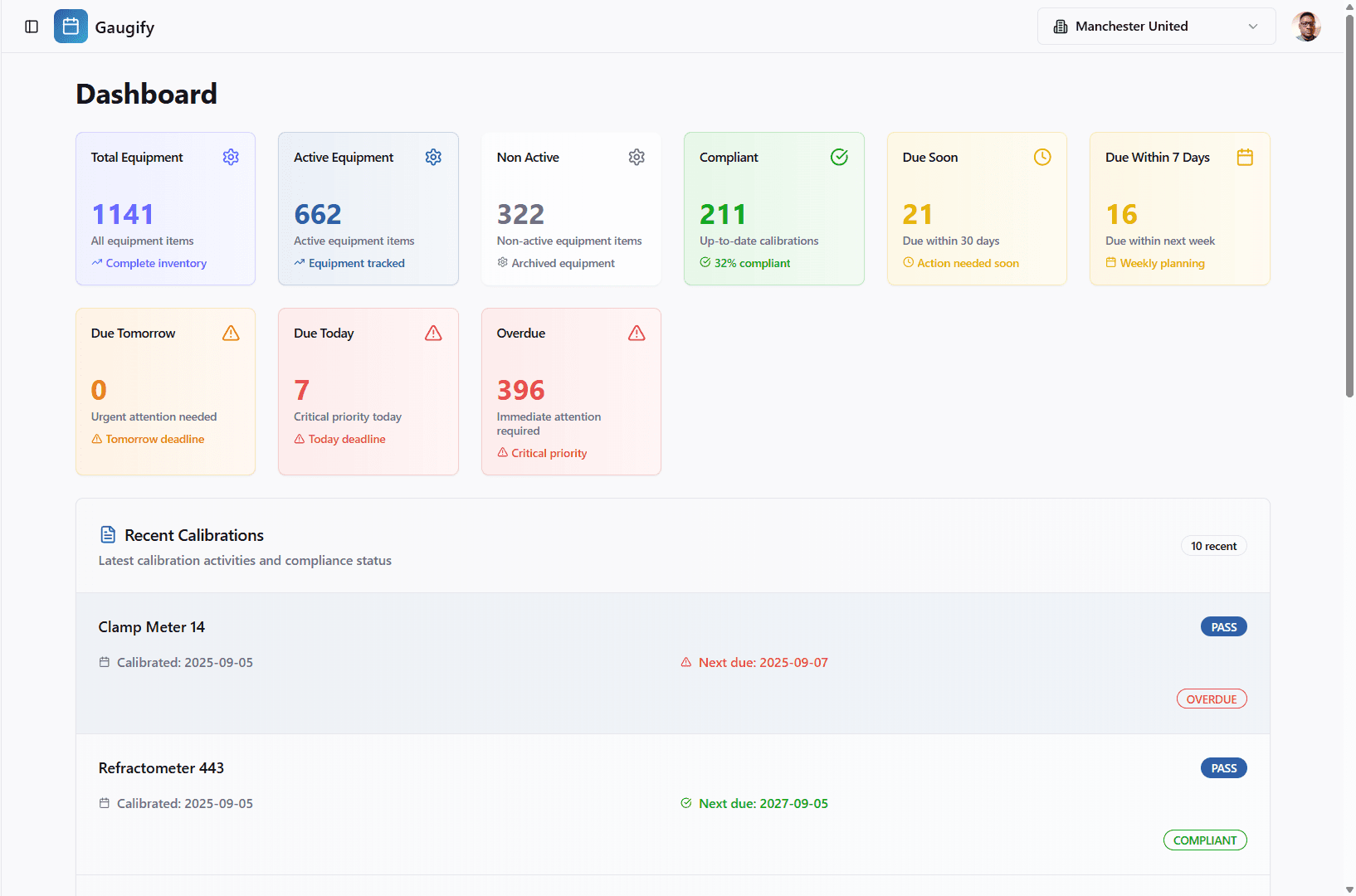
Managing compression tester calibration schedules, records, and compliance requirements manually becomes increasingly complex as equipment inventories grow. Modern calibration management software like Gaugify provides comprehensive solutions for tracking compression testing equipment alongside all other measurement instruments.
Automated Scheduling and Reminders
Gaugify automatically tracks calibration due dates for each compression tester based on configurable intervals. Whether your concrete testing machine requires annual calibration or your packaging lab instruments need semi-annual service, the system sends email reminders at 90, 30, and 7 days before due dates. This prevents unexpected calibration lapses that could shut down production or invalidate test results.
The system accommodates complex scheduling requirements, such as different intervals for different load ranges or seasonal adjustments for equipment used primarily during construction season. Custom fields allow tracking manufacturer recommendations, regulatory requirements, and internal quality policies for each instrument.
Comprehensive Calibration Records
Gaugify's calibration tracking features capture complete as-found and as-left data for each compression tester calibration. Technicians can record calibration points, measured errors, environmental conditions, and acceptance criteria directly in the system using mobile devices or desktop computers.
The software automatically calculates key metrics like measurement uncertainty, error trends, and calibration intervals based on historical performance. For compression testers showing consistent accuracy over multiple calibration cycles, the system can recommend extended intervals while maintaining compliance confidence.
Digital certificate storage eliminates lost paperwork and provides instant access to calibration documentation during audits or customer inquiries. QR code labels link each compression tester directly to its complete calibration history and current status.
Regulatory Compliance Support
For laboratories maintaining ISO 17025 accreditation, Gaugify provides audit trails, measurement traceability documentation, and automated compliance reporting. The system tracks reference standard hierarchies, ensuring that compression tester calibrations maintain proper traceability to national standards.
Compliance management features include automated reports showing calibration status across all equipment, overdue notifications for management review, and integration with quality management systems. Custom dashboards provide real-time visibility into calibration compliance across multiple locations or departments.
Integration with Testing Workflows
Beyond basic calibration tracking, Gaugify integrates with broader quality management processes. Link compression test results directly to the calibration status of testing equipment, ensuring that invalid measurements from out-of-calibration instruments are flagged automatically.
For multi-location organizations, centralized calibration management provides consistency across concrete plants, packaging facilities, or research laboratories. Standardized procedures, shared reference standards, and consolidated reporting simplify management while maintaining local operational flexibility.
Optimizing Your Compression Testing Calibration Program
Effective compression tester calibration goes beyond mere compliance - it becomes a strategic quality tool that ensures measurement reliability, optimizes costs, and supports continuous improvement. By implementing systematic calibration procedures, leveraging modern tracking software, and focusing on your specific application requirements, you can maintain measurement confidence while minimizing downtime and costs.
Regular calibration of compression testing equipment protects your organization from the significant risks of inaccurate measurements, whether you're ensuring concrete strength for critical infrastructure, validating packaging performance for global shipping, or developing new materials in research applications. The investment in proper calibration procedures and tracking systems pays dividends through improved product quality, regulatory compliance, and operational efficiency.
Remember that calibration is not a one-time activity but an ongoing process that requires careful planning, execution, and documentation. Modern cloud-based calibration management systems make this process more efficient and reliable than ever before, providing the tools needed to maintain measurement excellence in today's demanding quality environment.
Ready to streamline your compression tester calibration management and ensure you never miss another calibration due date? Try Gaugify free for 30 days and discover how modern calibration software can transform your measurement quality program. Join thousands of quality professionals who trust Gaugify to manage their calibration compliance and measurement reliability.
How to Calibrate a Compression Testing Machine
Compression testing machines are critical instruments in material testing laboratories, quality control departments, and manufacturing facilities. Proper compression tester calibration ensures accurate force measurements that determine whether concrete cylinders, foam samples, cardboard packaging, and countless other materials meet their specified strength requirements. Without regular calibration, these machines can produce inaccurate results that lead to costly material failures, rejected products, or unsafe structures.
Whether you're working with a 250 kN hydraulic compression tester for concrete testing or a 5 kN electromechanical unit for packaging materials, understanding the calibration process is essential for maintaining measurement accuracy and regulatory compliance. This comprehensive guide covers everything quality managers and lab technicians need to know about compression tester calibration, from step-by-step procedures to common pitfalls and tracking requirements.
Understanding Compression Testing Machines and Their Measurements
Compression testing machines, also known as compression testers or universal testing machines in compression mode, apply controlled compressive forces to test specimens while measuring the applied load and often the resulting deformation. These instruments typically consist of:
Load frame: The mechanical structure that houses the loading mechanism
Loading system: Hydraulic, pneumatic, or electromechanical actuators that apply force
Load cell: Transducer that converts applied force into electrical signals
Platens: Flat surfaces that contact the test specimen
Control system: Electronics and software that control testing parameters
Display/readout: Digital or analog indicators showing force values
Common applications include testing concrete cylinders at 28 days (typical acceptance criteria of 4,000 PSI for standard concrete), evaluating corrugated box compression strength (often 32 ECT for shipping containers), determining foam density and strength characteristics, and assessing ceramic tile breaking strength per ASTM C648 standards.
These machines typically measure forces ranging from a few Newtons for delicate materials up to several meganewtons for structural concrete testing. Accuracy requirements vary by application, but most quality standards demand measurement uncertainties of ±0.5% to ±1% of the applied force.
Why Compression Tester Calibration Is Critical
Compression testing directly impacts product safety, structural integrity, and regulatory compliance across numerous industries. Inaccurate force measurements from an uncalibrated compression tester can have severe consequences:
Concrete Testing Implications: An uncalibrated 2,000 kN compression tester reading 5% high could approve concrete cylinders that actually fall below the required 4,000 PSI strength specification. This could result in structural failures, costly remediation, and potential liability issues for construction projects.
Packaging Industry Risks: Box compression testing ensures packages survive shipping and stacking loads. A compression tester reading 10% low might reject acceptable packaging materials, leading to over-engineered designs and increased material costs. Conversely, readings that are too high could approve weak packaging that fails during transport.
Material Certification Requirements: Many material certificates and test reports require traceability to national standards through calibrated equipment. ISO 17025 accredited laboratories must demonstrate measurement traceability, and uncalibrated compression testers can invalidate test results and laboratory accreditation.
Regulatory Compliance: Industries like aerospace, automotive, and construction often mandate specific testing protocols with defined accuracy requirements. DOT concrete testing, ASTM packaging standards, and FDA material testing regulations all require properly calibrated equipment.
Regular calibration also identifies equipment drift, mechanical wear, and environmental effects that gradually degrade measurement accuracy over time. Load cells can shift due to temperature cycling, mechanical systems develop backlash, and electronic components drift with age.
Step-by-Step Compression Tester Calibration Procedure
Professional compression tester calibration requires traceable reference standards, controlled environmental conditions, and systematic procedures. Here's the detailed process used by accredited calibration laboratories:
Pre-Calibration Preparation
Begin by documenting the compression tester's identification information, model number, serial number, and current calibration status. Record environmental conditions - temperature should be stable within ±2°C, and relative humidity should be between 45-75% for most calibrations. Allow the equipment to stabilize for at least 30 minutes after any significant temperature changes.
Inspect the compression tester for obvious damage, worn platens, loose connections, or contamination. Clean the load surfaces and ensure proper alignment between upper and lower platens. Verify that the display functions properly and that all controls respond appropriately.
Reference Standard Selection
Calibration requires traceable force standards with uncertainties at least 3-4 times better than the compression tester's required accuracy. Common reference standards include:
Proving rings: Mechanical force standards accurate to ±0.05% or better
Load cells: Electronic force transducers with NIST-traceable calibrations
Deadweight machines: Primary standards using calibrated masses and gravity
Force transfer standards: Portable load cells for field calibrations
For a 1,000 kN concrete compression tester requiring ±1% accuracy, the reference standard should have an uncertainty of ±0.25% or better, traceable to national standards within the past 12 months.
Calibration Point Selection
Select calibration points that span the compression tester's normal operating range. Typical point selection includes:
10% of maximum capacity (100 kN for a 1,000 kN machine)
25% of maximum capacity (250 kN)
50% of maximum capacity (500 kN)
75% of maximum capacity (750 kN)
100% of maximum capacity (1,000 kN)
Additional points may be required at specific operating loads. For concrete testing, include points near typical working loads like 400 kN and 600 kN that correspond to common cylinder strengths.
Force Application and Measurement
Apply each calibration force using smooth, steady loading without shock or vibration. Allow the system to stabilize for 10-15 seconds before recording readings. Take multiple readings at each point to assess repeatability - typically three readings with the compression tester returning to near-zero force between applications.
Record both the reference standard reading (true applied force) and the compression tester indication. Note any hysteresis by taking readings during both increasing and decreasing force cycles.
For a 500 kN calibration point, typical recordings might show:
Reference standard: 500.2 kN
Compression tester reading: 501.8 kN
Error: +1.6 kN (+0.32%)
Acceptance Criteria Evaluation
Compare measured errors against the compression tester's accuracy specification. Most industrial compression testers specify ±1% accuracy, while laboratory instruments may require ±0.5% or better.
Calculate the measurement uncertainty budget considering the reference standard uncertainty, environmental effects, resolution limitations, and repeatability observations. The total measurement uncertainty should not exceed the acceptance criteria.
If errors exceed acceptance criteria, investigate potential causes like worn load cells, mechanical binding, electrical interference, or temperature effects before making adjustments.
Relevant Calibration Standards and Requirements
Several national and international standards govern compression tester calibration procedures and requirements:
ASTM E4 - Standard Practices for Force Verification of Testing Machines: This standard defines calibration procedures, accuracy classes, and verification intervals for materials testing machines. Class A machines require ±1% accuracy, while Class AA requires ±0.5%. The standard specifies minimum calibration points, acceptable reference standards, and documentation requirements.
ISO 7500-1 - Metallic Materials - Verification of Static Uniaxial Testing Machines: The international equivalent to ASTM E4, covering force verification for tension/compression testing machines. This standard is commonly referenced in ISO 17025 accredited laboratories and international material specifications.
EN 12390-4 - Testing Hardened Concrete - Compressive Strength of Test Specimens: Specifically addresses calibration requirements for concrete compression testing machines, including daily verification procedures using reference specimens.
ASTM D642 - Standard Test Method for Determining Compressive Resistance of Shipping Containers: Defines calibration requirements for box compression testing, typically requiring ±1% accuracy over the range of 2% to 100% of maximum capacity.
Manufacturer Specifications: Equipment manufacturers often provide more stringent calibration requirements than industry standards. For example, Instron compression testers may specify ±0.5% accuracy with annual calibration intervals, while MTS servo-hydraulic systems might require semi-annual calibration for critical applications.
ISO 17025 accredited laboratories must maintain calibration procedures that meet or exceed these standards while demonstrating measurement traceability to national metrology institutes like NIST.
Recommended Calibration Intervals and Influencing Factors
Compression tester calibration frequency depends on several factors including usage intensity, accuracy requirements, environmental conditions, and regulatory mandates. Here are typical recommendations:
Annual Calibration: Most industrial compression testers used for routine quality control should receive full calibration annually. This interval balances calibration costs with measurement reliability for applications like concrete testing, packaging verification, and general material characterization.
Semi-Annual Calibration: High-accuracy laboratory instruments, machines used for critical safety testing, or equipment in harsh environmental conditions may require calibration every six months. Research laboratories developing new materials often use this interval to maintain measurement confidence.
Quarterly Calibration: Production environments with high utilization, such as concrete plants testing hundreds of cylinders weekly, may need quarterly calibration to account for accelerated wear and contamination exposure.
Factors Affecting Calibration Frequency:
Usage intensity: Machines operating multiple shifts daily experience more wear than occasional-use instruments
Load ranges: Regular testing near maximum capacity accelerates load cell fatigue
Environmental conditions: Temperature cycling, humidity, and contamination affect measurement stability
Accuracy requirements: Critical applications may demand more frequent verification
Historical performance: Machines with good calibration history may justify extended intervals
Regulatory requirements: Some industries mandate specific calibration frequencies regardless of performance
Daily Verification Checks: Many standards recommend daily verification using reference specimens or check standards. For concrete testing, this might involve crushing a reference cylinder with known strength. Packaging labs might use aluminum reference specimens with certified compression values.
Want to automate your calibration scheduling and never miss another due date? Start your free Gaugify trial to see how cloud-based calibration management simplifies interval tracking for compression testers and all your other measurement equipment.
Common Calibration Mistakes and How to Avoid Them
Even experienced technicians can make errors during compression tester calibration that compromise measurement accuracy and regulatory compliance. Here are the most frequent mistakes and prevention strategies:
Inadequate Reference Standard Uncertainty
Using reference standards without sufficient accuracy margins is a common error. A compression tester requiring ±1% accuracy needs reference standards with uncertainties of ±0.25% or better to provide adequate discrimination. Some facilities attempt calibration using standards with ±0.5% uncertainty, which doesn't provide sufficient confidence in the measurement.
Solution: Always use reference standards with uncertainties at least 4:1 better than the compression tester specification. Verify that reference standards have current, traceable calibrations from accredited laboratories.
Insufficient Environmental Control
Temperature variations during calibration can significantly affect results. Load cells typically have temperature coefficients of 0.002%/°C or higher. A 5°C temperature change during calibration could introduce 0.01% error, which becomes significant for high-accuracy instruments.
Solution: Maintain stable environmental conditions throughout calibration. Allow equipment to stabilize for at least 30 minutes, and monitor temperature continuously during the procedure.
Improper Loading Techniques
Shock loading, excessive loading rates, or vibration during force application can cause erroneous readings and potentially damage sensitive load cells. Some technicians apply forces too rapidly, not allowing proper stabilization between measurements.
Solution: Apply calibration forces smoothly and gradually. Allow 10-15 seconds for stabilization at each point. Use proper lifting techniques and vibration isolation when handling heavy reference standards.
Inadequate Documentation
Incomplete calibration records create compliance problems and make it difficult to identify trends or recurring issues. Missing environmental data, incomplete uncertainty analyses, or unclear acceptance criteria documentation are frequent problems during audits.
Solution: Use standardized calibration forms that capture all required data. Document environmental conditions, reference standard information, measurement uncertainty calculations, and clear pass/fail determinations.
Ignoring Hysteresis and Repeatability
Some calibrations only check accuracy at discrete points without evaluating hysteresis (difference between increasing and decreasing load readings) or repeatability. These characteristics are critical for understanding measurement uncertainty and equipment condition.
Solution: Include both loading and unloading cycles in calibration procedures. Take multiple readings at each point to assess repeatability. Investigate any significant hysteresis or poor repeatability before accepting calibration results.
Calibrating Beyond Intended Use Range
Calibrating compression testers across their full range when they're only used at specific load levels wastes time and resources. Conversely, failing to calibrate at actual working loads can miss accuracy problems in critical operating regions.
Solution: Focus calibration points around actual operating loads while including enough range coverage to meet applicable standards. For concrete testing machines primarily used for 4,000 PSI cylinders, ensure calibration points bracket the typical 350-400 kN working range.
Tracking Compression Tester Calibration with Modern Software
Managing compression tester calibration schedules, records, and compliance requirements manually becomes increasingly complex as equipment inventories grow. Modern calibration management software like Gaugify provides comprehensive solutions for tracking compression testing equipment alongside all other measurement instruments.
Automated Scheduling and Reminders
Gaugify automatically tracks calibration due dates for each compression tester based on configurable intervals. Whether your concrete testing machine requires annual calibration or your packaging lab instruments need semi-annual service, the system sends email reminders at 90, 30, and 7 days before due dates. This prevents unexpected calibration lapses that could shut down production or invalidate test results.
The system accommodates complex scheduling requirements, such as different intervals for different load ranges or seasonal adjustments for equipment used primarily during construction season. Custom fields allow tracking manufacturer recommendations, regulatory requirements, and internal quality policies for each instrument.
Comprehensive Calibration Records
Gaugify's calibration tracking features capture complete as-found and as-left data for each compression tester calibration. Technicians can record calibration points, measured errors, environmental conditions, and acceptance criteria directly in the system using mobile devices or desktop computers.
The software automatically calculates key metrics like measurement uncertainty, error trends, and calibration intervals based on historical performance. For compression testers showing consistent accuracy over multiple calibration cycles, the system can recommend extended intervals while maintaining compliance confidence.
Digital certificate storage eliminates lost paperwork and provides instant access to calibration documentation during audits or customer inquiries. QR code labels link each compression tester directly to its complete calibration history and current status.
Regulatory Compliance Support
For laboratories maintaining ISO 17025 accreditation, Gaugify provides audit trails, measurement traceability documentation, and automated compliance reporting. The system tracks reference standard hierarchies, ensuring that compression tester calibrations maintain proper traceability to national standards.
Compliance management features include automated reports showing calibration status across all equipment, overdue notifications for management review, and integration with quality management systems. Custom dashboards provide real-time visibility into calibration compliance across multiple locations or departments.
Integration with Testing Workflows
Beyond basic calibration tracking, Gaugify integrates with broader quality management processes. Link compression test results directly to the calibration status of testing equipment, ensuring that invalid measurements from out-of-calibration instruments are flagged automatically.
For multi-location organizations, centralized calibration management provides consistency across concrete plants, packaging facilities, or research laboratories. Standardized procedures, shared reference standards, and consolidated reporting simplify management while maintaining local operational flexibility.
Optimizing Your Compression Testing Calibration Program
Effective compression tester calibration goes beyond mere compliance - it becomes a strategic quality tool that ensures measurement reliability, optimizes costs, and supports continuous improvement. By implementing systematic calibration procedures, leveraging modern tracking software, and focusing on your specific application requirements, you can maintain measurement confidence while minimizing downtime and costs.
Regular calibration of compression testing equipment protects your organization from the significant risks of inaccurate measurements, whether you're ensuring concrete strength for critical infrastructure, validating packaging performance for global shipping, or developing new materials in research applications. The investment in proper calibration procedures and tracking systems pays dividends through improved product quality, regulatory compliance, and operational efficiency.
Remember that calibration is not a one-time activity but an ongoing process that requires careful planning, execution, and documentation. Modern cloud-based calibration management systems make this process more efficient and reliable than ever before, providing the tools needed to maintain measurement excellence in today's demanding quality environment.
Ready to streamline your compression tester calibration management and ensure you never miss another calibration due date? Try Gaugify free for 30 days and discover how modern calibration software can transform your measurement quality program. Join thousands of quality professionals who trust Gaugify to manage their calibration compliance and measurement reliability.