
How to Calibrate an Oscilloscope
How to Calibrate an Oscilloscope
David Bentley
Quality Assurance Engineer
12 min read
How to Calibrate an Oscilloscope
Oscilloscope calibration is a critical quality assurance process that ensures these sophisticated test instruments maintain their accuracy for voltage, timing, and frequency measurements. Whether you're working with a basic 100 MHz benchtop scope or a high-end 50 GHz real-time oscilloscope, proper calibration procedures are essential for maintaining measurement integrity in your lab or production environment.
As measurement requirements become increasingly stringent across industries—from automotive electronics testing to telecommunications equipment validation—understanding the complete oscilloscope calibration process has never been more important. This comprehensive guide will walk you through everything you need to know about calibrating oscilloscopes effectively and maintaining compliance with industry standards.
Understanding Oscilloscopes and Their Critical Measurements
An oscilloscope is a fundamental electronic test instrument that displays voltage signals as waveforms over time. Modern digital storage oscilloscopes (DSOs) and mixed-signal oscilloscopes (MSOs) serve as the backbone of electronic testing in industries ranging from aerospace to consumer electronics manufacturing.
Oscilloscopes measure several critical parameters that directly impact your product quality:
Voltage amplitude: Typically ranging from millivolts to hundreds of volts, with accuracy requirements often ±2-3% of reading
Time base accuracy: Critical for timing measurements, usually specified as ±0.01% or better
Frequency response: Bandwidth specifications from DC to the instrument's maximum frequency rating
Rise time: Essential for digital signal analysis and high-speed circuit testing
Trigger accuracy: Affects measurement repeatability and waveform capture consistency
For example, when testing automotive ECU signals operating at 500 MHz, a calibrated oscilloscope with verified 1 GHz bandwidth ensures you're capturing all relevant signal components without introducing measurement artifacts that could lead to incorrect design decisions.
Why Oscilloscope Calibration Is Mission-Critical
Unlike simpler instruments such as basic multimeters, oscilloscopes contain complex analog and digital circuitries that can drift over time due to component aging, temperature variations, and mechanical stress. The multi-channel architecture and high-frequency capabilities make oscilloscope calibration particularly challenging and essential.
Consider these real-world scenarios where uncalibrated oscilloscopes create serious problems:
Medical Device Testing: A cardiac monitor manufacturer discovered their oscilloscope had drifted +150mV on the vertical scale during routine audit preparation. This error would have resulted in incorrect heart rhythm analysis algorithms, potentially affecting patient safety.
5G Infrastructure Development: A telecommunications company's 20 GHz oscilloscope showed 2.3% frequency response error at 15 GHz, causing engineers to incorrectly modify antenna designs. The calibration revealed attenuator drift in the input stage.
Automotive Compliance Testing: During ISO 26262 functional safety validation, an automotive supplier found their oscilloscope's time base had drifted by 0.05%, causing incorrect CAN bus timing measurements that could have led to communication failures.
Proper oscilloscope calibration ensures measurement traceability to national standards, maintains compliance with quality management systems, and prevents costly product recalls or regulatory violations.
Complete Oscilloscope Calibration Procedure
Professional oscilloscope calibration requires precision reference standards and controlled environmental conditions. Here's the detailed step-by-step process used by accredited calibration laboratories:
Required Reference Standards and Equipment
Before beginning oscilloscope calibration, ensure you have appropriate reference standards with accuracy ratios of at least 4:1 compared to the oscilloscope's specifications:
Precision voltage calibrator: Fluke 5520A or similar, with accuracy better than ±0.005% for DC voltage
Function/arbitrary waveform generator: Keysight 33622A or equivalent, capable of frequencies up to the oscilloscope's bandwidth
Time interval analyzer: For time base verification with sub-picosecond resolution
50-ohm precision attenuators: Calibrated step attenuators for amplitude linearity checks
Fast rise time pulse generator: Rise times typically 10x faster than oscilloscope specifications
Environmental Requirements
Maintain stable calibration conditions throughout the procedure:
Temperature: 23°C ±2°C (some high-accuracy work requires ±1°C)
Relative humidity: 45-65%
Minimum 2-hour temperature stabilization for the oscilloscope
Vibration isolation to prevent mechanical interference
Step-by-Step Calibration Process
Step 1: Initial Setup and Documentation
Record the oscilloscope's make, model, serial number, and current calibration status. Document environmental conditions and reference standard certifications. Perform visual inspection for physical damage that could affect measurements.
Step 2: As-Found Data Collection
Before making any adjustments, collect as-found measurements to document the instrument's condition. This data is crucial for calibration trending and helps identify systematic drift patterns.
Step 3: DC Voltage Accuracy Verification
Apply precise DC voltages across the oscilloscope's full range using your voltage calibrator. Test at minimum five points per decade: 10%, 30%, 50%, 75%, and 100% of each voltage range. For a typical ±10V range, test points include ±1V, ±3V, ±5V, ±7.5V, and ±10V.
Acceptance criteria typically allow ±2-3% of reading plus a fixed offset (e.g., ±3mV). Record both positive and negative polarity measurements for each channel.
Step 4: AC Voltage and Frequency Response
Using calibrated sine wave signals, verify AC voltage accuracy at multiple frequencies spanning the oscilloscope's bandwidth. Critical test frequencies include:
1 kHz (reference frequency)
100 kHz
10% of rated bandwidth
50% of rated bandwidth
Full rated bandwidth (-3dB point)
Step 5: Time Base Calibration
Apply precision time interval signals to verify horizontal time base accuracy. Test each time/division setting from fastest to slowest. Use square wave or pulse signals with known periods. Acceptance criteria are typically ±0.01% of the time base setting.
Step 6: Trigger Level and Stability
Verify trigger accuracy by applying signals of known amplitude and confirming trigger activation at specified levels. Test both positive and negative slope triggering across the full trigger range.
Step 7: Rise Time and Bandwidth Verification
Apply fast rise time pulses (typically 10x faster than oscilloscope rise time specifications) to verify bandwidth and rise time measurements. This step is critical for high-frequency applications.
Ready to streamline your oscilloscope calibration tracking? Start your free trial of Gaugify and see how modern calibration management software can automate scheduling, maintain detailed as-found/as-left records, and ensure you never miss a calibration due date.
Governing Standards for Oscilloscope Calibration
Several key standards govern oscilloscope calibration procedures and requirements:
IEEE 1057-2007: "IEEE Standard for Digitizing Waveform Recorders" provides comprehensive test methods for digital oscilloscopes, including specifications for effective bits, signal-to-noise ratio, and spurious-free dynamic range measurements.
IEC 61010-2-030: Safety requirements for oscilloscopes and other electronic measuring instruments, including CAT I-IV measurement category specifications that affect calibration procedures for different voltage levels.
NIST Technical Note 1542: "Guidelines for Oscilloscope Calibration" offers detailed procedures developed by the National Institute of Standards and Technology, including uncertainty budgets and traceability requirements.
Manufacturer Specifications: Equipment manufacturers like Keysight, Tektronix, and Rohde & Schwarz provide detailed calibration procedures specific to each oscilloscope model. These procedures often include internal calibration routines and adjustment specifications.
For laboratories seeking ISO 17025 accreditation, Gaugify's ISO 17025 compliance features help maintain the detailed documentation and measurement uncertainty tracking required for accredited oscilloscope calibrations.
Optimal Oscilloscope Calibration Intervals
Determining the right calibration interval for oscilloscopes requires balancing measurement accuracy requirements against calibration costs and instrument availability. Most organizations start with manufacturer recommendations and adjust based on historical performance data.
Standard Calibration Intervals:
Benchtop oscilloscopes (≤1 GHz): 12-month intervals for general-purpose applications
High-performance oscilloscopes (>1 GHz): 6-12 month intervals depending on accuracy requirements
Production test oscilloscopes: 6-month intervals due to high usage and critical measurements
Reference/standards lab instruments: 6-month intervals with quarterly verification checks
Factors That Affect Calibration Intervals:
Environmental conditions significantly impact calibration stability. Oscilloscopes operating in temperature-controlled metrology labs typically maintain calibration longer than instruments used in production environments with wider temperature swings and mechanical vibration.
Usage intensity also matters. An oscilloscope used occasionally for troubleshooting may maintain calibration for 18-24 months, while instruments running automated test sequences 24/7 may require 6-month intervals due to component stress and aging.
Measurement criticality drives interval decisions. Oscilloscopes used for FDA-regulated medical device testing or aerospace applications often use shorter intervals (6 months) regardless of historical stability, while instruments used for non-critical development work might extend to 18-24 months.
Common Oscilloscope Calibration Mistakes and Prevention
Even experienced technicians make errors that can compromise oscilloscope calibration quality. Here are the most frequent mistakes and proven prevention strategies:
Inadequate Warm-Up Time
The most common error is insufficient warm-up time before calibration. Modern oscilloscopes contain precision crystal oscillators and analog components that require thermal stabilization. Rushing this process leads to measurement errors that appear as calibration drift.
Prevention: Always follow manufacturer warm-up specifications, typically 30 minutes minimum for basic instruments and up to 2 hours for high-performance models. Document actual warm-up time in calibration records.
Improper Cable and Connection Handling
Using uncalibrated or damaged test cables introduces measurement uncertainties that can exceed the oscilloscope's inherent accuracy. Coaxial cables with poor impedance matching create reflections that affect high-frequency measurements.
Prevention: Use calibrated 50-ohm cables with known characteristics. Inspect connections for corrosion or damage. Include cable calibration data in measurement uncertainty budgets.
Ignoring Probe Compensation
Improperly compensated probes cause measurement errors that calibration cannot correct. This is particularly critical for 10:1 and 100:1 probes used in high-voltage measurements.
Prevention: Verify probe compensation before calibration using the oscilloscope's built-in calibration signal. Document probe serial numbers and compensation settings in calibration records.
Environmental Condition Neglect
Failing to control temperature, humidity, and vibration during calibration introduces measurement uncertainties that can cause good instruments to fail calibration unnecessarily.
Prevention: Monitor and document environmental conditions throughout the calibration process. Use temperature-controlled calibration areas whenever possible.
Streamlining Oscilloscope Calibration Management with Gaugify
Managing oscilloscope calibrations across multiple instruments and locations presents unique challenges that modern calibration management software can solve effectively. Gaugify's cloud-based platform addresses the specific needs of organizations maintaining oscilloscope measurement traceability.
Automated Calibration Scheduling
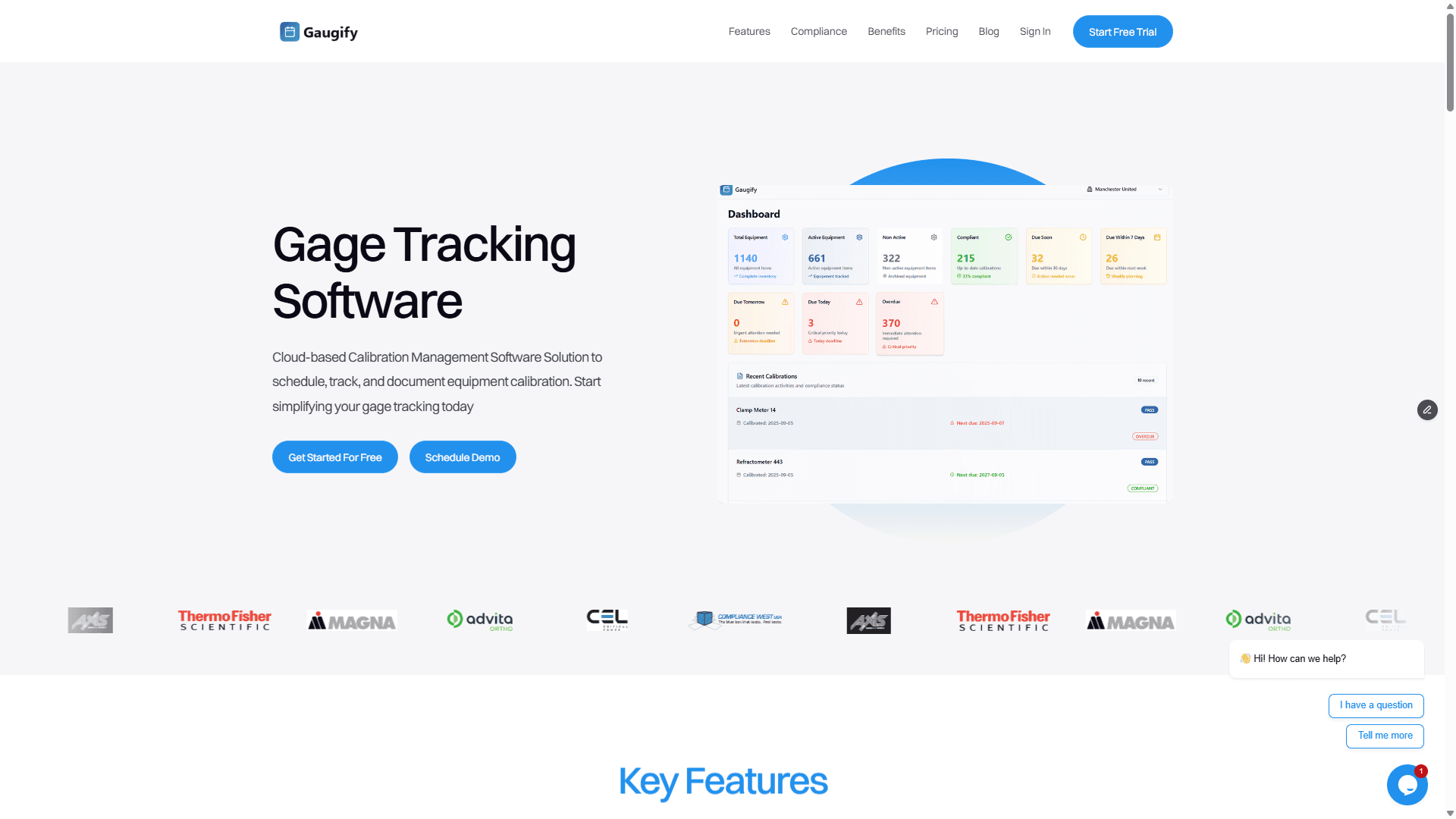
Gaugify automatically tracks calibration due dates for each oscilloscope in your inventory, sending email reminders at configurable intervals (30, 60, 90 days before expiration). The system accounts for different calibration intervals based on instrument model, usage, and criticality level.
For example, you can configure production test oscilloscopes for 6-month intervals while setting development instruments to 12 months. The system tracks each instrument independently and provides dashboard visibility across your entire fleet.
Comprehensive As-Found/As-Left Data Management
The platform captures detailed calibration data including:
As-found measurements for each test point
Environmental conditions during calibration
Reference standard information and certifications
Adjustment details and as-left values
Measurement uncertainties and acceptance criteria
This data enables statistical analysis of calibration trends, helping optimize calibration intervals and identify instruments requiring more frequent attention.
Digital Calibration Certificates
Gaugify generates professional calibration certificates that meet industry standards and audit requirements. Certificates include all measurement data, uncertainties, and traceability information in formats suitable for ISO 9001, AS9100, and ISO 13485 compliance.
The system maintains permanent digital records accessible from anywhere, eliminating lost paperwork and simplifying audit preparation. Gaugify's compliance features ensure your oscilloscope calibration documentation meets the most stringent regulatory requirements.
Integration with Quality Management Systems
Modern quality management requires seamless integration between calibration data and other quality processes. Gaugify provides API access and export capabilities that integrate with existing ERP and quality management systems.
The platform also supports multi-location organizations with centralized visibility and local management capabilities, perfect for companies with oscilloscopes across multiple facilities or contract manufacturers.
Conclusion: Ensuring Measurement Excellence Through Proper Oscilloscope Calibration
Effective oscilloscope calibration combines technical expertise, proper procedures, and systematic management to ensure measurement integrity across your organization. From understanding the critical parameters that affect measurement accuracy to implementing robust calibration intervals and avoiding common pitfalls, every aspect contributes to reliable test results.
The complexity of modern oscilloscopes—with their multi-channel architectures, high-frequency capabilities, and sophisticated triggering systems—demands professional calibration approaches backed by appropriate reference standards and environmental controls. Whether you're maintaining compliance with FDA regulations, aerospace standards, or ISO quality management requirements, proper oscilloscope calibration provides the measurement foundation your products depend on.
As measurement requirements continue to evolve with advancing technology, organizations need calibration management systems that can scale with their needs while maintaining detailed traceability and compliance documentation. The investment in proper oscilloscope calibration management pays dividends through improved product quality, reduced compliance risks, and enhanced customer confidence in your measurement capabilities.
Ready to transform your oscilloscope calibration management? Start your free trial of Gaugify today and discover how modern calibration management software can streamline your processes, ensure compliance, and provide the visibility you need to maintain measurement excellence. With automated scheduling, comprehensive data management, and digital certificate generation, Gaugify makes oscilloscope calibration management effortless and audit-ready.
How to Calibrate an Oscilloscope
Oscilloscope calibration is a critical quality assurance process that ensures these sophisticated test instruments maintain their accuracy for voltage, timing, and frequency measurements. Whether you're working with a basic 100 MHz benchtop scope or a high-end 50 GHz real-time oscilloscope, proper calibration procedures are essential for maintaining measurement integrity in your lab or production environment.
As measurement requirements become increasingly stringent across industries—from automotive electronics testing to telecommunications equipment validation—understanding the complete oscilloscope calibration process has never been more important. This comprehensive guide will walk you through everything you need to know about calibrating oscilloscopes effectively and maintaining compliance with industry standards.
Understanding Oscilloscopes and Their Critical Measurements
An oscilloscope is a fundamental electronic test instrument that displays voltage signals as waveforms over time. Modern digital storage oscilloscopes (DSOs) and mixed-signal oscilloscopes (MSOs) serve as the backbone of electronic testing in industries ranging from aerospace to consumer electronics manufacturing.
Oscilloscopes measure several critical parameters that directly impact your product quality:
Voltage amplitude: Typically ranging from millivolts to hundreds of volts, with accuracy requirements often ±2-3% of reading
Time base accuracy: Critical for timing measurements, usually specified as ±0.01% or better
Frequency response: Bandwidth specifications from DC to the instrument's maximum frequency rating
Rise time: Essential for digital signal analysis and high-speed circuit testing
Trigger accuracy: Affects measurement repeatability and waveform capture consistency
For example, when testing automotive ECU signals operating at 500 MHz, a calibrated oscilloscope with verified 1 GHz bandwidth ensures you're capturing all relevant signal components without introducing measurement artifacts that could lead to incorrect design decisions.
Why Oscilloscope Calibration Is Mission-Critical
Unlike simpler instruments such as basic multimeters, oscilloscopes contain complex analog and digital circuitries that can drift over time due to component aging, temperature variations, and mechanical stress. The multi-channel architecture and high-frequency capabilities make oscilloscope calibration particularly challenging and essential.
Consider these real-world scenarios where uncalibrated oscilloscopes create serious problems:
Medical Device Testing: A cardiac monitor manufacturer discovered their oscilloscope had drifted +150mV on the vertical scale during routine audit preparation. This error would have resulted in incorrect heart rhythm analysis algorithms, potentially affecting patient safety.
5G Infrastructure Development: A telecommunications company's 20 GHz oscilloscope showed 2.3% frequency response error at 15 GHz, causing engineers to incorrectly modify antenna designs. The calibration revealed attenuator drift in the input stage.
Automotive Compliance Testing: During ISO 26262 functional safety validation, an automotive supplier found their oscilloscope's time base had drifted by 0.05%, causing incorrect CAN bus timing measurements that could have led to communication failures.
Proper oscilloscope calibration ensures measurement traceability to national standards, maintains compliance with quality management systems, and prevents costly product recalls or regulatory violations.
Complete Oscilloscope Calibration Procedure
Professional oscilloscope calibration requires precision reference standards and controlled environmental conditions. Here's the detailed step-by-step process used by accredited calibration laboratories:
Required Reference Standards and Equipment
Before beginning oscilloscope calibration, ensure you have appropriate reference standards with accuracy ratios of at least 4:1 compared to the oscilloscope's specifications:
Precision voltage calibrator: Fluke 5520A or similar, with accuracy better than ±0.005% for DC voltage
Function/arbitrary waveform generator: Keysight 33622A or equivalent, capable of frequencies up to the oscilloscope's bandwidth
Time interval analyzer: For time base verification with sub-picosecond resolution
50-ohm precision attenuators: Calibrated step attenuators for amplitude linearity checks
Fast rise time pulse generator: Rise times typically 10x faster than oscilloscope specifications
Environmental Requirements
Maintain stable calibration conditions throughout the procedure:
Temperature: 23°C ±2°C (some high-accuracy work requires ±1°C)
Relative humidity: 45-65%
Minimum 2-hour temperature stabilization for the oscilloscope
Vibration isolation to prevent mechanical interference
Step-by-Step Calibration Process
Step 1: Initial Setup and Documentation
Record the oscilloscope's make, model, serial number, and current calibration status. Document environmental conditions and reference standard certifications. Perform visual inspection for physical damage that could affect measurements.
Step 2: As-Found Data Collection
Before making any adjustments, collect as-found measurements to document the instrument's condition. This data is crucial for calibration trending and helps identify systematic drift patterns.
Step 3: DC Voltage Accuracy Verification
Apply precise DC voltages across the oscilloscope's full range using your voltage calibrator. Test at minimum five points per decade: 10%, 30%, 50%, 75%, and 100% of each voltage range. For a typical ±10V range, test points include ±1V, ±3V, ±5V, ±7.5V, and ±10V.
Acceptance criteria typically allow ±2-3% of reading plus a fixed offset (e.g., ±3mV). Record both positive and negative polarity measurements for each channel.
Step 4: AC Voltage and Frequency Response
Using calibrated sine wave signals, verify AC voltage accuracy at multiple frequencies spanning the oscilloscope's bandwidth. Critical test frequencies include:
1 kHz (reference frequency)
100 kHz
10% of rated bandwidth
50% of rated bandwidth
Full rated bandwidth (-3dB point)
Step 5: Time Base Calibration
Apply precision time interval signals to verify horizontal time base accuracy. Test each time/division setting from fastest to slowest. Use square wave or pulse signals with known periods. Acceptance criteria are typically ±0.01% of the time base setting.
Step 6: Trigger Level and Stability
Verify trigger accuracy by applying signals of known amplitude and confirming trigger activation at specified levels. Test both positive and negative slope triggering across the full trigger range.
Step 7: Rise Time and Bandwidth Verification
Apply fast rise time pulses (typically 10x faster than oscilloscope rise time specifications) to verify bandwidth and rise time measurements. This step is critical for high-frequency applications.
Ready to streamline your oscilloscope calibration tracking? Start your free trial of Gaugify and see how modern calibration management software can automate scheduling, maintain detailed as-found/as-left records, and ensure you never miss a calibration due date.
Governing Standards for Oscilloscope Calibration
Several key standards govern oscilloscope calibration procedures and requirements:
IEEE 1057-2007: "IEEE Standard for Digitizing Waveform Recorders" provides comprehensive test methods for digital oscilloscopes, including specifications for effective bits, signal-to-noise ratio, and spurious-free dynamic range measurements.
IEC 61010-2-030: Safety requirements for oscilloscopes and other electronic measuring instruments, including CAT I-IV measurement category specifications that affect calibration procedures for different voltage levels.
NIST Technical Note 1542: "Guidelines for Oscilloscope Calibration" offers detailed procedures developed by the National Institute of Standards and Technology, including uncertainty budgets and traceability requirements.
Manufacturer Specifications: Equipment manufacturers like Keysight, Tektronix, and Rohde & Schwarz provide detailed calibration procedures specific to each oscilloscope model. These procedures often include internal calibration routines and adjustment specifications.
For laboratories seeking ISO 17025 accreditation, Gaugify's ISO 17025 compliance features help maintain the detailed documentation and measurement uncertainty tracking required for accredited oscilloscope calibrations.
Optimal Oscilloscope Calibration Intervals
Determining the right calibration interval for oscilloscopes requires balancing measurement accuracy requirements against calibration costs and instrument availability. Most organizations start with manufacturer recommendations and adjust based on historical performance data.
Standard Calibration Intervals:
Benchtop oscilloscopes (≤1 GHz): 12-month intervals for general-purpose applications
High-performance oscilloscopes (>1 GHz): 6-12 month intervals depending on accuracy requirements
Production test oscilloscopes: 6-month intervals due to high usage and critical measurements
Reference/standards lab instruments: 6-month intervals with quarterly verification checks
Factors That Affect Calibration Intervals:
Environmental conditions significantly impact calibration stability. Oscilloscopes operating in temperature-controlled metrology labs typically maintain calibration longer than instruments used in production environments with wider temperature swings and mechanical vibration.
Usage intensity also matters. An oscilloscope used occasionally for troubleshooting may maintain calibration for 18-24 months, while instruments running automated test sequences 24/7 may require 6-month intervals due to component stress and aging.
Measurement criticality drives interval decisions. Oscilloscopes used for FDA-regulated medical device testing or aerospace applications often use shorter intervals (6 months) regardless of historical stability, while instruments used for non-critical development work might extend to 18-24 months.
Common Oscilloscope Calibration Mistakes and Prevention
Even experienced technicians make errors that can compromise oscilloscope calibration quality. Here are the most frequent mistakes and proven prevention strategies:
Inadequate Warm-Up Time
The most common error is insufficient warm-up time before calibration. Modern oscilloscopes contain precision crystal oscillators and analog components that require thermal stabilization. Rushing this process leads to measurement errors that appear as calibration drift.
Prevention: Always follow manufacturer warm-up specifications, typically 30 minutes minimum for basic instruments and up to 2 hours for high-performance models. Document actual warm-up time in calibration records.
Improper Cable and Connection Handling
Using uncalibrated or damaged test cables introduces measurement uncertainties that can exceed the oscilloscope's inherent accuracy. Coaxial cables with poor impedance matching create reflections that affect high-frequency measurements.
Prevention: Use calibrated 50-ohm cables with known characteristics. Inspect connections for corrosion or damage. Include cable calibration data in measurement uncertainty budgets.
Ignoring Probe Compensation
Improperly compensated probes cause measurement errors that calibration cannot correct. This is particularly critical for 10:1 and 100:1 probes used in high-voltage measurements.
Prevention: Verify probe compensation before calibration using the oscilloscope's built-in calibration signal. Document probe serial numbers and compensation settings in calibration records.
Environmental Condition Neglect
Failing to control temperature, humidity, and vibration during calibration introduces measurement uncertainties that can cause good instruments to fail calibration unnecessarily.
Prevention: Monitor and document environmental conditions throughout the calibration process. Use temperature-controlled calibration areas whenever possible.
Streamlining Oscilloscope Calibration Management with Gaugify
Managing oscilloscope calibrations across multiple instruments and locations presents unique challenges that modern calibration management software can solve effectively. Gaugify's cloud-based platform addresses the specific needs of organizations maintaining oscilloscope measurement traceability.
Automated Calibration Scheduling
Gaugify automatically tracks calibration due dates for each oscilloscope in your inventory, sending email reminders at configurable intervals (30, 60, 90 days before expiration). The system accounts for different calibration intervals based on instrument model, usage, and criticality level.
For example, you can configure production test oscilloscopes for 6-month intervals while setting development instruments to 12 months. The system tracks each instrument independently and provides dashboard visibility across your entire fleet.
Comprehensive As-Found/As-Left Data Management
The platform captures detailed calibration data including:
As-found measurements for each test point
Environmental conditions during calibration
Reference standard information and certifications
Adjustment details and as-left values
Measurement uncertainties and acceptance criteria
This data enables statistical analysis of calibration trends, helping optimize calibration intervals and identify instruments requiring more frequent attention.
Digital Calibration Certificates
Gaugify generates professional calibration certificates that meet industry standards and audit requirements. Certificates include all measurement data, uncertainties, and traceability information in formats suitable for ISO 9001, AS9100, and ISO 13485 compliance.
The system maintains permanent digital records accessible from anywhere, eliminating lost paperwork and simplifying audit preparation. Gaugify's compliance features ensure your oscilloscope calibration documentation meets the most stringent regulatory requirements.
Integration with Quality Management Systems
Modern quality management requires seamless integration between calibration data and other quality processes. Gaugify provides API access and export capabilities that integrate with existing ERP and quality management systems.
The platform also supports multi-location organizations with centralized visibility and local management capabilities, perfect for companies with oscilloscopes across multiple facilities or contract manufacturers.
Conclusion: Ensuring Measurement Excellence Through Proper Oscilloscope Calibration
Effective oscilloscope calibration combines technical expertise, proper procedures, and systematic management to ensure measurement integrity across your organization. From understanding the critical parameters that affect measurement accuracy to implementing robust calibration intervals and avoiding common pitfalls, every aspect contributes to reliable test results.
The complexity of modern oscilloscopes—with their multi-channel architectures, high-frequency capabilities, and sophisticated triggering systems—demands professional calibration approaches backed by appropriate reference standards and environmental controls. Whether you're maintaining compliance with FDA regulations, aerospace standards, or ISO quality management requirements, proper oscilloscope calibration provides the measurement foundation your products depend on.
As measurement requirements continue to evolve with advancing technology, organizations need calibration management systems that can scale with their needs while maintaining detailed traceability and compliance documentation. The investment in proper oscilloscope calibration management pays dividends through improved product quality, reduced compliance risks, and enhanced customer confidence in your measurement capabilities.
Ready to transform your oscilloscope calibration management? Start your free trial of Gaugify today and discover how modern calibration management software can streamline your processes, ensure compliance, and provide the visibility you need to maintain measurement excellence. With automated scheduling, comprehensive data management, and digital certificate generation, Gaugify makes oscilloscope calibration management effortless and audit-ready.