
How to Calibrate Weighing Scales for Manufacturing
How to Calibrate Weighing Scales for Manufacturing
David Bentley
Quality Assurance Engineer
12 min read
How to Calibrate Weighing Scales for Manufacturing
Weighing scale calibration manufacturing processes depend on precise, accurate measurements that directly impact product quality, regulatory compliance, and operational efficiency. Whether you're measuring raw materials for pharmaceutical batching, portioning ingredients in food production, or weighing components in aerospace manufacturing, your weighing scales must deliver consistent, traceable results. This comprehensive guide covers everything you need to know about calibrating weighing scales in manufacturing environments, from analytical balances with 0.1mg readability to industrial platform scales handling multi-ton loads.
Understanding Manufacturing Weighing Scales and Their Critical Role
Manufacturing weighing scales encompass a broad range of instruments designed to measure mass across various applications and load capacities. These instruments typically include:
Analytical balances: High-precision instruments with readabilities from 0.01mg to 0.1mg, commonly used in pharmaceutical and chemical manufacturing for active ingredient weighing
Precision balances: Mid-range instruments with 1mg to 10mg readability, ideal for formulation work and quality control testing
Industrial bench scales: Robust scales with capacities from 5kg to 500kg, used for packaging, portioning, and component weighing
Platform scales: Heavy-duty scales with capacities exceeding 1000kg, essential for bulk material handling and finished goods weighing
Crane scales: Suspended weighing systems for materials that cannot be placed on traditional platforms
These instruments measure mass by comparing the gravitational force acting on an object to known reference standards. Modern electronic scales convert this mechanical force into digital readings using load cells, strain gauges, or electromagnetic force restoration technology.
Key Performance Characteristics
Manufacturing weighing scales are evaluated based on several critical parameters:
Accuracy: The closeness of the measured value to the true value, typically expressed as a percentage of full scale or as absolute units
Repeatability: The ability to produce consistent results under identical conditions, usually specified as standard deviation
Linearity: How well the scale responds proportionally across its entire measurement range
Hysteresis: The difference in readings when approaching the same weight from different directions
Temperature stability: The scale's ability to maintain accuracy across operating temperature ranges
Why Weighing Scale Calibration Manufacturing Standards Are Non-Negotiable
In manufacturing environments, weighing scale accuracy directly impacts multiple critical areas that can make or break operational success. Unlike general-purpose scales, manufacturing weighing instruments must meet stringent accuracy requirements that support both quality objectives and regulatory compliance.
Product Quality and Consistency
Consider a pharmaceutical manufacturer producing tablets where the active pharmaceutical ingredient (API) represents only 2% of the total tablet weight. If an analytical balance drifts by just 0.5mg on a 10mg API measurement, the resulting 5% error could render entire batches ineffective or potentially dangerous. Similarly, in food manufacturing, a 1% error on a 50kg batch of chocolate could result in flavor inconsistencies that customers immediately notice.
Manufacturing processes often involve sequential weighing operations where errors compound. For example, in paint manufacturing, base pigments, binders, and additives are typically weighed separately then combined. A scale that consistently reads 0.2% high could result in final products that fail color matching specifications or exhibit poor performance characteristics.
Regulatory Compliance Requirements
Manufacturing industries face increasingly strict regulatory oversight of weighing operations. FDA-regulated facilities must demonstrate weighing accuracy through documented calibration programs that ensure scales meet stated specifications. The consequences of non-compliance extend far beyond failed inspections—they can include product recalls, facility shutdowns, and significant financial penalties.
ISO 9001 quality management systems require organizations to demonstrate that measuring equipment is calibrated and controlled. For many manufacturers, this means implementing comprehensive calibration programs that document scale performance over time and trigger corrective actions when instruments drift outside acceptable limits.
Cost Control and Waste Reduction
Inaccurate weighing scales directly impact material costs and waste generation. A packaging line scale that consistently under-weights products by 0.5% might seem negligible, but across millions of units, this represents significant material giveaway. Conversely, scales that over-weight can result in customer complaints and potential regulatory action for net content violations.
Step-by-Step Weighing Scale Calibration Manufacturing Procedure
Proper weighing scale calibration requires systematic execution of documented procedures using traceable reference standards. The following comprehensive procedure applies to most electronic weighing scales used in manufacturing, with specific modifications noted for different scale types.
Pre-Calibration Preparation
Before beginning calibration activities, establish proper environmental conditions and gather necessary equipment:
Environmental Requirements:
Temperature stability: ±2°C variation maximum during calibration
Humidity control: 45-75% RH for most applications
Vibration isolation: Eliminate sources of mechanical disturbance
Air currents: Close doors, turn off fans, minimize HVAC impact
Electromagnetic interference: Distance from motors, welders, radio transmitters
Required Equipment:
Certified reference weights with uncertainty ratios of 3:1 or better
Weight handling tools (tweezers for small weights, lifting devices for large weights)
Calibration data sheets or electronic recording system
Cleaning materials appropriate for the scale type
Anti-static measures if required
Initial Scale Inspection and Preparation
Begin calibration by thoroughly examining the scale for physical damage, cleanliness, and proper setup:
Physical inspection: Check for damaged load cells, cracked platforms, loose connections, or signs of overload damage
Cleaning: Remove all foreign material from the weighing platform and surrounding areas
Leveling verification: Confirm the scale is properly leveled using built-in bubble levels or external leveling tools
Warm-up period: Allow electronic scales to stabilize for minimum 30 minutes (analytical balances may require 2+ hours)
Zero verification: Confirm the scale displays zero with no load applied
For analytical balances, additional preparation steps include installing draft shields, minimizing static electricity through ionization if available, and allowing reference weights to equilibrate to ambient temperature for at least 4 hours.
Calibration Test Sequence
Execute the following test sequence using certified reference weights that span the scale's operating range:
1. Zero Test: Record the scale indication with no applied load. Most scales should indicate zero within ±0.5 divisions.
2. Repeatability Test: Place and remove a test load equal to approximately 50% of scale capacity ten consecutive times. Calculate the standard deviation of readings. For Class II scales, repeatability should not exceed 1 scale division.
3. Linearity Test: Apply test loads at approximately 10%, 25%, 50%, 75%, and 100% of scale capacity. Record both the applied weight value and scale indication. Calculate errors at each point:
Error = Scale Reading - Reference Weight Value
4. Hysteresis Test: Load the scale to maximum capacity, then reduce load in decrements to test points used in linearity testing. Compare readings obtained during loading versus unloading phases.
5. Corner Loading Test (Platform Scales): Apply a test load equal to 1/3 scale capacity to each corner and center of the weighing platform. Record readings and calculate maximum deviation from the average.
Data Recording and Analysis
Document all calibration results using standardized forms or digital calibration management systems. Calculate measurement uncertainty for each test point and compare results to acceptance criteria established in your calibration procedures.
Typical acceptance criteria for manufacturing weighing scales:
Analytical balances: ±0.1mg or ±2 divisions, whichever is greater
Precision balances: ±1mg or ±2 divisions
Industrial scales: ±0.1% of applied load or ±2 divisions
Platform scales: ±0.05% of capacity or as specified by manufacturer
If any results fall outside acceptance criteria, investigate potential causes including environmental conditions, reference weight accuracy, or scale mechanical issues. Perform adjustments if authorized by procedures, then repeat affected test points.
Ready to streamline your calibration process? Start your free trial of Gaugify and see how digital calibration management eliminates paperwork while ensuring complete traceability for all your weighing instruments.
Governing Standards for Weighing Scale Calibration Manufacturing Applications
Multiple national and international standards provide guidance for weighing scale calibration in manufacturing environments. Understanding which standards apply to your specific operations ensures compliance and provides framework for developing robust calibration procedures.
Primary International Standards
OIML R 76-1: Non-automatic weighing instruments serves as the fundamental international standard for commercial weighing scales. This standard establishes accuracy classes, performance requirements, and testing procedures that form the basis for most national regulations.
ISO/IEC 17025: General requirements for the competence of testing and calibration laboratories applies when calibration services are performed by accredited laboratories. This standard ensures calibration certificates include proper uncertainty statements and traceability documentation.
ASTM E617: Standard Specification for Laboratory Weights and Precision Mass Standards defines accuracy classes and tolerances for reference weights used in scale calibration. This standard helps select appropriate reference weights that provide adequate uncertainty ratios.
Industry-Specific Standards
Different manufacturing sectors often have additional requirements that supplement general weighing standards:
Pharmaceutical Manufacturing:
USP Chapter <41> Balances specifies minimum requirements for pharmaceutical weighing
FDA 21 CFR Part 211 requires calibration and maintenance of weighing equipment
EU GMP Guidelines provide specific guidance for analytical balance validation
Food and Beverage:
FDA 21 CFR Part 110 requires accurate weighing for food manufacturing
NIST Handbook 133 provides testing procedures for package net content compliance
SQF and BRC standards require documented calibration programs
Chemical Manufacturing:
OSHA Process Safety Management standards require calibrated weighing for batch operations
EPA regulations may specify weighing accuracy for emissions calculations
ISO 14001 environmental management systems often require accurate waste weighing
Manufacturer Specifications
Scale manufacturers provide detailed specifications that often exceed minimum regulatory requirements. Leading manufacturers like Mettler Toledo, Sartorius, and Ohaus publish comprehensive service manuals that include:
Recommended calibration intervals based on usage and environment
Detailed test procedures specific to each scale model
Acceptance criteria that reflect actual instrument capabilities
Environmental requirements for optimal performance
Troubleshooting guidance for common calibration issues
Calibration Frequency Recommendations for Manufacturing Weighing Scales
Determining optimal calibration intervals requires balancing risk management, regulatory compliance, and operational efficiency. Manufacturing environments present unique challenges that often necessitate more frequent calibration than laboratory settings.
Standard Interval Recommendations
Based on industry best practices and manufacturer recommendations, typical calibration intervals include:
Analytical balances: Every 6-12 months, depending on usage intensity and criticality
Precision balances: Every 6-12 months for critical applications, annually for general use
Industrial bench scales: Every 6-12 months based on usage and environment
Platform scales: Annually, or semi-annually for heavy-use applications
Crane scales: Every 6 months due to harsh operating conditions
Factors That Affect Calibration Frequency
Several factors may require more frequent calibration than standard intervals:
Usage Intensity: Scales used continuously in three-shift operations experience more wear and may drift faster than instruments used occasionally. High-volume packaging lines or continuous batching operations may require quarterly calibration to maintain accuracy.
Environmental Conditions: Manufacturing environments with temperature fluctuations, vibration, dust, or corrosive atmospheres accelerate instrument degradation. A scale located near heat-treating furnaces might require monthly attention, while one in a climate-controlled clean room could extend to annual calibration.
Load Characteristics: Scales frequently loaded to maximum capacity or subjected to shock loading may require more frequent calibration. Impact loading from dropped materials can shift calibration immediately.
Criticality of Application: Scales used for critical safety parameters or regulatory compliance often justify more frequent calibration. Pharmaceutical active ingredient weighing might warrant monthly verification, while scrap material weighing could extend to annual intervals.
Risk-Based Calibration Strategies
Modern calibration management incorporates risk assessment to optimize intervals while maintaining adequate control. This approach considers:
Historical calibration data showing drift patterns
Consequences of out-of-tolerance conditions
Cost-benefit analysis of different intervals
Availability of backup instrumentation
Interim verification capabilities
Manufacturing facilities often implement multiple verification levels, including daily operator checks, weekly supervisor verifications, and formal calibrations at extended intervals. This layered approach provides early detection of problems while optimizing calibration resources.
Common Weighing Scale Calibration Mistakes and Prevention Strategies
Even experienced technicians can make errors that compromise weighing scale calibration accuracy and reliability. Understanding these common pitfalls helps implement preventive measures that ensure consistent, reliable results.
Environmental Control Failures
The most frequent calibration errors stem from inadequate environmental control during the calibration process. Temperature fluctuations during calibration can cause reference weights to expand or contract, leading to apparent scale errors that don't reflect actual performance.
Prevention strategies:
Allow minimum 2-hour stabilization for analytical balances, 30 minutes for other scales
Monitor temperature throughout calibration using separate temperature indicators
Schedule calibrations during stable environmental periods (avoid mornings when HVAC systems cycle)
Use draft shields consistently and ensure they don't interfere with weighing pan movement
Air currents represent another major source of error, particularly for high-resolution analytical balances. Even minor air movement can cause reading instability that makes accurate calibration impossible.
Reference Weight Handling Errors
Improper handling of calibration weights introduces measurement uncertainty and potential contamination that affects results. Fingerprints, dust, or corrosion on weight surfaces can change their mass values significantly relative to analytical balance resolution.
Best practices include:
Always use tweezers or tongs for weights under 1g
Wear powder-free gloves when handling larger weights
Allow weights to equilibrate to ambient temperature before use
Clean weights according to manufacturer specifications
Store weights in appropriate cases with desiccant if required
Verify weight certification status and recalibration dates before use
Inadequate Documentation Practices
Incomplete or inaccurate calibration documentation creates compliance risks and hampers troubleshooting efforts when scales exhibit performance problems. Common documentation errors include missing environmental data, illegible handwriting, and failure to record all required test points.
Digital calibration management systems like Gaugify eliminate many documentation errors by providing structured data entry, automatic calculations, and complete audit trails that satisfy regulatory requirements.
Insufficient Understanding of Scale Specifications
Applying inappropriate acceptance criteria or test procedures can result in rejecting acceptable instruments or accepting defective ones. Each scale type has specific performance characteristics that must be evaluated properly.
For example, analytical balances typically specify repeatability as standard deviation rather than maximum deviation, while industrial scales might use different criteria. Understanding these distinctions ensures calibration results are interpreted correctly.
Timing and Sequencing Errors
Rushing through calibration procedures or performing steps out of sequence can invalidate results. Analytical balances require adequate settling time between measurements, while some scales need specific loading sequences to evaluate hysteresis properly.
Develop standardized procedures that specify minimum timing requirements and always follow manufacturer recommendations for test sequences.
Streamlining Weighing Scale Calibration Manufacturing Management with Gaugify
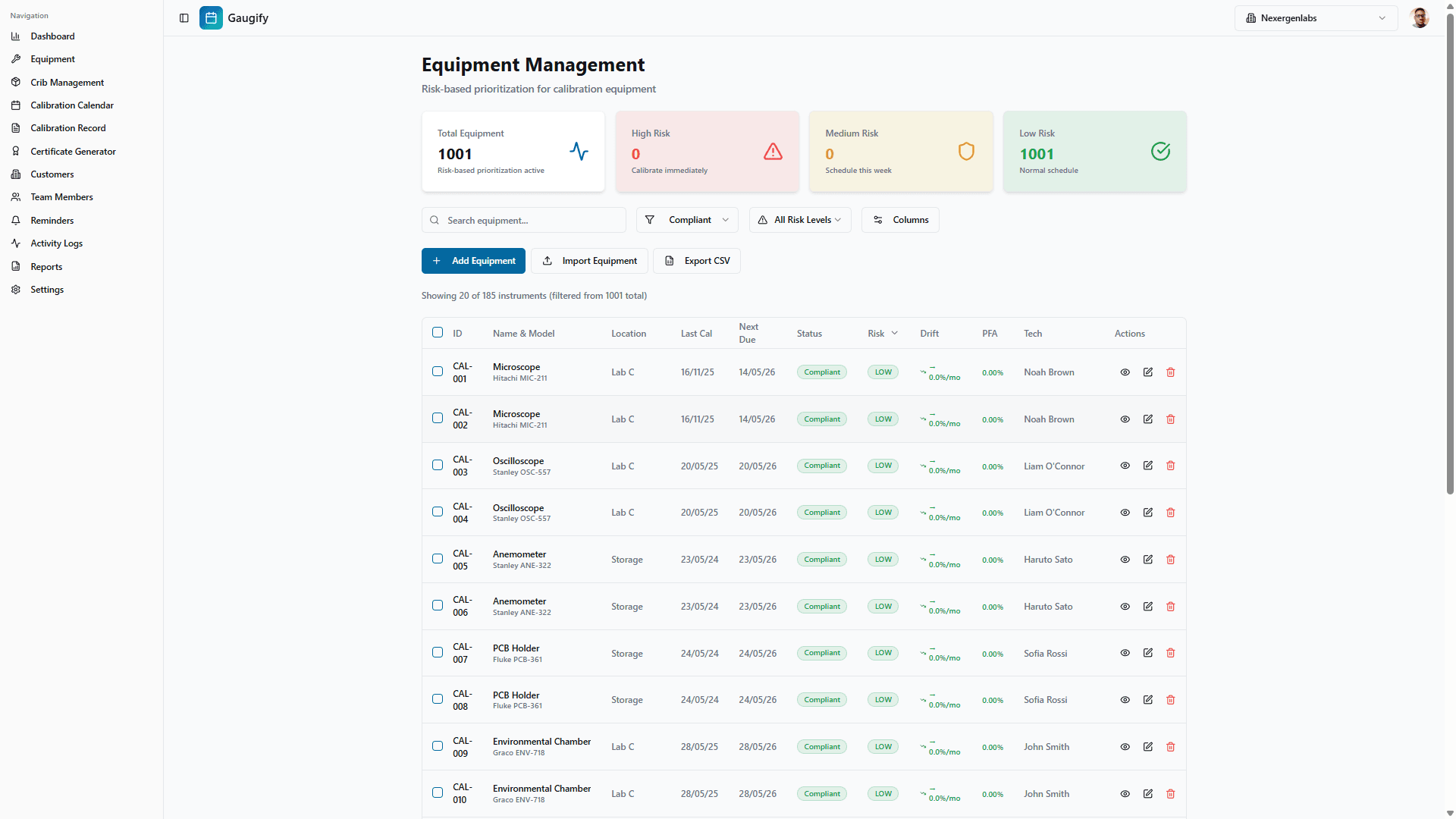
Managing weighing scale calibrations across manufacturing facilities involves coordinating multiple instruments, tracking calibration schedules, maintaining documentation, and ensuring regulatory compliance. Traditional paper-based systems create bottlenecks and increase the risk of missed calibrations or incomplete records.
Automated Scheduling and Notifications
Gaugify's intelligent scheduling system tracks calibration due dates for all weighing instruments and automatically generates work orders based on your established intervals. The system accounts for weekends, holidays, and planned shutdowns to ensure calibrations are scheduled when instruments are available.
Email notifications alert responsible personnel when calibrations are approaching due dates, with escalating reminders to prevent overdue conditions. For critical weighing applications, the system can generate more frequent notifications and flag instruments that require immediate attention.
Comprehensive Data Management
Digital calibration records in Gaugify capture all required data points including as-found readings, environmental conditions, reference standards used, and as-left results. The system automatically calculates errors, uncertainty values, and pass/fail determinations based on your acceptance criteria.
Historical trending capabilities help identify scales that consistently drift in specific directions, enabling proactive maintenance before calibrations fail. This predictive approach reduces unexpected downtime and helps optimize calibration intervals based on actual performance data.
Regulatory Compliance Support
Gaugify's ISO 17025 compliant calibration software ensures all weighing scale calibration records meet regulatory requirements including complete traceability chains, proper uncertainty statements, and required approval signatures.
The system generates professional calibration certificates automatically, eliminating manual certificate preparation while ensuring consistent formatting and complete technical content. During regulatory inspections, authorized personnel can quickly access calibration histories and demonstrate compliance with applicable standards.
Integration with Manufacturing Operations
Modern manufacturing operations require seamless integration between calibration management and other critical systems. Gaugify provides APIs and integration capabilities that connect calibration status with manufacturing execution systems, quality management platforms, and enterprise resource planning systems.
This integration enables automatic flagging of products manufactured using out-of-calibration weighing scales, supporting robust quality systems and facilitating rapid response to calibration issues.
Mobile Accessibility for Field Calibrations
Many manufacturing weighing scales are located in production areas where laptop computers are impractical or prohibited. Gaugify's mobile-responsive interface enables technicians to perform calibrations using tablets or smartphones, entering data directly into the system from the scale location.
Offline data entry capabilities ensure calibrations can proceed even when network connectivity is temporarily unavailable, with automatic synchronization when connections are restored.
Transform Your Weighing Scale Calibration Manufacturing Program
Effective weighing scale calibration in manufacturing requires systematic execution of documented procedures, proper environmental control, and comprehensive record-keeping. The complexity of managing multiple instruments across diverse applications makes digital calibration management systems essential for maintaining compliance and operational efficiency.
Whether you're managing analytical balances in pharmaceutical manufacturing, platform scales in chemical processing, or precision balances in food production, consistent calibration practices ensure product quality and regulatory compliance. The investment in proper calibration procedures and management systems pays dividends through reduced quality incidents, improved audit readiness, and enhanced operational reliability.
Ready to modernize your weighing scale calibration program? Schedule a personalized demo to see how Gaugify can streamline your calibration management while ensuring complete regulatory compliance. Our cloud-based platform provides the tools you need to manage calibrations efficiently, reduce paperwork, and maintain the detailed records that regulatory agencies require.
Don't let manual calibration management hold back your manufacturing operations. Contact us today to learn how Gaugify can transform your approach to weighing scale calibration and support your quality objectives.
How to Calibrate Weighing Scales for Manufacturing
Weighing scale calibration manufacturing processes depend on precise, accurate measurements that directly impact product quality, regulatory compliance, and operational efficiency. Whether you're measuring raw materials for pharmaceutical batching, portioning ingredients in food production, or weighing components in aerospace manufacturing, your weighing scales must deliver consistent, traceable results. This comprehensive guide covers everything you need to know about calibrating weighing scales in manufacturing environments, from analytical balances with 0.1mg readability to industrial platform scales handling multi-ton loads.
Understanding Manufacturing Weighing Scales and Their Critical Role
Manufacturing weighing scales encompass a broad range of instruments designed to measure mass across various applications and load capacities. These instruments typically include:
Analytical balances: High-precision instruments with readabilities from 0.01mg to 0.1mg, commonly used in pharmaceutical and chemical manufacturing for active ingredient weighing
Precision balances: Mid-range instruments with 1mg to 10mg readability, ideal for formulation work and quality control testing
Industrial bench scales: Robust scales with capacities from 5kg to 500kg, used for packaging, portioning, and component weighing
Platform scales: Heavy-duty scales with capacities exceeding 1000kg, essential for bulk material handling and finished goods weighing
Crane scales: Suspended weighing systems for materials that cannot be placed on traditional platforms
These instruments measure mass by comparing the gravitational force acting on an object to known reference standards. Modern electronic scales convert this mechanical force into digital readings using load cells, strain gauges, or electromagnetic force restoration technology.
Key Performance Characteristics
Manufacturing weighing scales are evaluated based on several critical parameters:
Accuracy: The closeness of the measured value to the true value, typically expressed as a percentage of full scale or as absolute units
Repeatability: The ability to produce consistent results under identical conditions, usually specified as standard deviation
Linearity: How well the scale responds proportionally across its entire measurement range
Hysteresis: The difference in readings when approaching the same weight from different directions
Temperature stability: The scale's ability to maintain accuracy across operating temperature ranges
Why Weighing Scale Calibration Manufacturing Standards Are Non-Negotiable
In manufacturing environments, weighing scale accuracy directly impacts multiple critical areas that can make or break operational success. Unlike general-purpose scales, manufacturing weighing instruments must meet stringent accuracy requirements that support both quality objectives and regulatory compliance.
Product Quality and Consistency
Consider a pharmaceutical manufacturer producing tablets where the active pharmaceutical ingredient (API) represents only 2% of the total tablet weight. If an analytical balance drifts by just 0.5mg on a 10mg API measurement, the resulting 5% error could render entire batches ineffective or potentially dangerous. Similarly, in food manufacturing, a 1% error on a 50kg batch of chocolate could result in flavor inconsistencies that customers immediately notice.
Manufacturing processes often involve sequential weighing operations where errors compound. For example, in paint manufacturing, base pigments, binders, and additives are typically weighed separately then combined. A scale that consistently reads 0.2% high could result in final products that fail color matching specifications or exhibit poor performance characteristics.
Regulatory Compliance Requirements
Manufacturing industries face increasingly strict regulatory oversight of weighing operations. FDA-regulated facilities must demonstrate weighing accuracy through documented calibration programs that ensure scales meet stated specifications. The consequences of non-compliance extend far beyond failed inspections—they can include product recalls, facility shutdowns, and significant financial penalties.
ISO 9001 quality management systems require organizations to demonstrate that measuring equipment is calibrated and controlled. For many manufacturers, this means implementing comprehensive calibration programs that document scale performance over time and trigger corrective actions when instruments drift outside acceptable limits.
Cost Control and Waste Reduction
Inaccurate weighing scales directly impact material costs and waste generation. A packaging line scale that consistently under-weights products by 0.5% might seem negligible, but across millions of units, this represents significant material giveaway. Conversely, scales that over-weight can result in customer complaints and potential regulatory action for net content violations.
Step-by-Step Weighing Scale Calibration Manufacturing Procedure
Proper weighing scale calibration requires systematic execution of documented procedures using traceable reference standards. The following comprehensive procedure applies to most electronic weighing scales used in manufacturing, with specific modifications noted for different scale types.
Pre-Calibration Preparation
Before beginning calibration activities, establish proper environmental conditions and gather necessary equipment:
Environmental Requirements:
Temperature stability: ±2°C variation maximum during calibration
Humidity control: 45-75% RH for most applications
Vibration isolation: Eliminate sources of mechanical disturbance
Air currents: Close doors, turn off fans, minimize HVAC impact
Electromagnetic interference: Distance from motors, welders, radio transmitters
Required Equipment:
Certified reference weights with uncertainty ratios of 3:1 or better
Weight handling tools (tweezers for small weights, lifting devices for large weights)
Calibration data sheets or electronic recording system
Cleaning materials appropriate for the scale type
Anti-static measures if required
Initial Scale Inspection and Preparation
Begin calibration by thoroughly examining the scale for physical damage, cleanliness, and proper setup:
Physical inspection: Check for damaged load cells, cracked platforms, loose connections, or signs of overload damage
Cleaning: Remove all foreign material from the weighing platform and surrounding areas
Leveling verification: Confirm the scale is properly leveled using built-in bubble levels or external leveling tools
Warm-up period: Allow electronic scales to stabilize for minimum 30 minutes (analytical balances may require 2+ hours)
Zero verification: Confirm the scale displays zero with no load applied
For analytical balances, additional preparation steps include installing draft shields, minimizing static electricity through ionization if available, and allowing reference weights to equilibrate to ambient temperature for at least 4 hours.
Calibration Test Sequence
Execute the following test sequence using certified reference weights that span the scale's operating range:
1. Zero Test: Record the scale indication with no applied load. Most scales should indicate zero within ±0.5 divisions.
2. Repeatability Test: Place and remove a test load equal to approximately 50% of scale capacity ten consecutive times. Calculate the standard deviation of readings. For Class II scales, repeatability should not exceed 1 scale division.
3. Linearity Test: Apply test loads at approximately 10%, 25%, 50%, 75%, and 100% of scale capacity. Record both the applied weight value and scale indication. Calculate errors at each point:
Error = Scale Reading - Reference Weight Value
4. Hysteresis Test: Load the scale to maximum capacity, then reduce load in decrements to test points used in linearity testing. Compare readings obtained during loading versus unloading phases.
5. Corner Loading Test (Platform Scales): Apply a test load equal to 1/3 scale capacity to each corner and center of the weighing platform. Record readings and calculate maximum deviation from the average.
Data Recording and Analysis
Document all calibration results using standardized forms or digital calibration management systems. Calculate measurement uncertainty for each test point and compare results to acceptance criteria established in your calibration procedures.
Typical acceptance criteria for manufacturing weighing scales:
Analytical balances: ±0.1mg or ±2 divisions, whichever is greater
Precision balances: ±1mg or ±2 divisions
Industrial scales: ±0.1% of applied load or ±2 divisions
Platform scales: ±0.05% of capacity or as specified by manufacturer
If any results fall outside acceptance criteria, investigate potential causes including environmental conditions, reference weight accuracy, or scale mechanical issues. Perform adjustments if authorized by procedures, then repeat affected test points.
Ready to streamline your calibration process? Start your free trial of Gaugify and see how digital calibration management eliminates paperwork while ensuring complete traceability for all your weighing instruments.
Governing Standards for Weighing Scale Calibration Manufacturing Applications
Multiple national and international standards provide guidance for weighing scale calibration in manufacturing environments. Understanding which standards apply to your specific operations ensures compliance and provides framework for developing robust calibration procedures.
Primary International Standards
OIML R 76-1: Non-automatic weighing instruments serves as the fundamental international standard for commercial weighing scales. This standard establishes accuracy classes, performance requirements, and testing procedures that form the basis for most national regulations.
ISO/IEC 17025: General requirements for the competence of testing and calibration laboratories applies when calibration services are performed by accredited laboratories. This standard ensures calibration certificates include proper uncertainty statements and traceability documentation.
ASTM E617: Standard Specification for Laboratory Weights and Precision Mass Standards defines accuracy classes and tolerances for reference weights used in scale calibration. This standard helps select appropriate reference weights that provide adequate uncertainty ratios.
Industry-Specific Standards
Different manufacturing sectors often have additional requirements that supplement general weighing standards:
Pharmaceutical Manufacturing:
USP Chapter <41> Balances specifies minimum requirements for pharmaceutical weighing
FDA 21 CFR Part 211 requires calibration and maintenance of weighing equipment
EU GMP Guidelines provide specific guidance for analytical balance validation
Food and Beverage:
FDA 21 CFR Part 110 requires accurate weighing for food manufacturing
NIST Handbook 133 provides testing procedures for package net content compliance
SQF and BRC standards require documented calibration programs
Chemical Manufacturing:
OSHA Process Safety Management standards require calibrated weighing for batch operations
EPA regulations may specify weighing accuracy for emissions calculations
ISO 14001 environmental management systems often require accurate waste weighing
Manufacturer Specifications
Scale manufacturers provide detailed specifications that often exceed minimum regulatory requirements. Leading manufacturers like Mettler Toledo, Sartorius, and Ohaus publish comprehensive service manuals that include:
Recommended calibration intervals based on usage and environment
Detailed test procedures specific to each scale model
Acceptance criteria that reflect actual instrument capabilities
Environmental requirements for optimal performance
Troubleshooting guidance for common calibration issues
Calibration Frequency Recommendations for Manufacturing Weighing Scales
Determining optimal calibration intervals requires balancing risk management, regulatory compliance, and operational efficiency. Manufacturing environments present unique challenges that often necessitate more frequent calibration than laboratory settings.
Standard Interval Recommendations
Based on industry best practices and manufacturer recommendations, typical calibration intervals include:
Analytical balances: Every 6-12 months, depending on usage intensity and criticality
Precision balances: Every 6-12 months for critical applications, annually for general use
Industrial bench scales: Every 6-12 months based on usage and environment
Platform scales: Annually, or semi-annually for heavy-use applications
Crane scales: Every 6 months due to harsh operating conditions
Factors That Affect Calibration Frequency
Several factors may require more frequent calibration than standard intervals:
Usage Intensity: Scales used continuously in three-shift operations experience more wear and may drift faster than instruments used occasionally. High-volume packaging lines or continuous batching operations may require quarterly calibration to maintain accuracy.
Environmental Conditions: Manufacturing environments with temperature fluctuations, vibration, dust, or corrosive atmospheres accelerate instrument degradation. A scale located near heat-treating furnaces might require monthly attention, while one in a climate-controlled clean room could extend to annual calibration.
Load Characteristics: Scales frequently loaded to maximum capacity or subjected to shock loading may require more frequent calibration. Impact loading from dropped materials can shift calibration immediately.
Criticality of Application: Scales used for critical safety parameters or regulatory compliance often justify more frequent calibration. Pharmaceutical active ingredient weighing might warrant monthly verification, while scrap material weighing could extend to annual intervals.
Risk-Based Calibration Strategies
Modern calibration management incorporates risk assessment to optimize intervals while maintaining adequate control. This approach considers:
Historical calibration data showing drift patterns
Consequences of out-of-tolerance conditions
Cost-benefit analysis of different intervals
Availability of backup instrumentation
Interim verification capabilities
Manufacturing facilities often implement multiple verification levels, including daily operator checks, weekly supervisor verifications, and formal calibrations at extended intervals. This layered approach provides early detection of problems while optimizing calibration resources.
Common Weighing Scale Calibration Mistakes and Prevention Strategies
Even experienced technicians can make errors that compromise weighing scale calibration accuracy and reliability. Understanding these common pitfalls helps implement preventive measures that ensure consistent, reliable results.
Environmental Control Failures
The most frequent calibration errors stem from inadequate environmental control during the calibration process. Temperature fluctuations during calibration can cause reference weights to expand or contract, leading to apparent scale errors that don't reflect actual performance.
Prevention strategies:
Allow minimum 2-hour stabilization for analytical balances, 30 minutes for other scales
Monitor temperature throughout calibration using separate temperature indicators
Schedule calibrations during stable environmental periods (avoid mornings when HVAC systems cycle)
Use draft shields consistently and ensure they don't interfere with weighing pan movement
Air currents represent another major source of error, particularly for high-resolution analytical balances. Even minor air movement can cause reading instability that makes accurate calibration impossible.
Reference Weight Handling Errors
Improper handling of calibration weights introduces measurement uncertainty and potential contamination that affects results. Fingerprints, dust, or corrosion on weight surfaces can change their mass values significantly relative to analytical balance resolution.
Best practices include:
Always use tweezers or tongs for weights under 1g
Wear powder-free gloves when handling larger weights
Allow weights to equilibrate to ambient temperature before use
Clean weights according to manufacturer specifications
Store weights in appropriate cases with desiccant if required
Verify weight certification status and recalibration dates before use
Inadequate Documentation Practices
Incomplete or inaccurate calibration documentation creates compliance risks and hampers troubleshooting efforts when scales exhibit performance problems. Common documentation errors include missing environmental data, illegible handwriting, and failure to record all required test points.
Digital calibration management systems like Gaugify eliminate many documentation errors by providing structured data entry, automatic calculations, and complete audit trails that satisfy regulatory requirements.
Insufficient Understanding of Scale Specifications
Applying inappropriate acceptance criteria or test procedures can result in rejecting acceptable instruments or accepting defective ones. Each scale type has specific performance characteristics that must be evaluated properly.
For example, analytical balances typically specify repeatability as standard deviation rather than maximum deviation, while industrial scales might use different criteria. Understanding these distinctions ensures calibration results are interpreted correctly.
Timing and Sequencing Errors
Rushing through calibration procedures or performing steps out of sequence can invalidate results. Analytical balances require adequate settling time between measurements, while some scales need specific loading sequences to evaluate hysteresis properly.
Develop standardized procedures that specify minimum timing requirements and always follow manufacturer recommendations for test sequences.
Streamlining Weighing Scale Calibration Manufacturing Management with Gaugify
Managing weighing scale calibrations across manufacturing facilities involves coordinating multiple instruments, tracking calibration schedules, maintaining documentation, and ensuring regulatory compliance. Traditional paper-based systems create bottlenecks and increase the risk of missed calibrations or incomplete records.
Automated Scheduling and Notifications
Gaugify's intelligent scheduling system tracks calibration due dates for all weighing instruments and automatically generates work orders based on your established intervals. The system accounts for weekends, holidays, and planned shutdowns to ensure calibrations are scheduled when instruments are available.
Email notifications alert responsible personnel when calibrations are approaching due dates, with escalating reminders to prevent overdue conditions. For critical weighing applications, the system can generate more frequent notifications and flag instruments that require immediate attention.
Comprehensive Data Management
Digital calibration records in Gaugify capture all required data points including as-found readings, environmental conditions, reference standards used, and as-left results. The system automatically calculates errors, uncertainty values, and pass/fail determinations based on your acceptance criteria.
Historical trending capabilities help identify scales that consistently drift in specific directions, enabling proactive maintenance before calibrations fail. This predictive approach reduces unexpected downtime and helps optimize calibration intervals based on actual performance data.
Regulatory Compliance Support
Gaugify's ISO 17025 compliant calibration software ensures all weighing scale calibration records meet regulatory requirements including complete traceability chains, proper uncertainty statements, and required approval signatures.
The system generates professional calibration certificates automatically, eliminating manual certificate preparation while ensuring consistent formatting and complete technical content. During regulatory inspections, authorized personnel can quickly access calibration histories and demonstrate compliance with applicable standards.
Integration with Manufacturing Operations
Modern manufacturing operations require seamless integration between calibration management and other critical systems. Gaugify provides APIs and integration capabilities that connect calibration status with manufacturing execution systems, quality management platforms, and enterprise resource planning systems.
This integration enables automatic flagging of products manufactured using out-of-calibration weighing scales, supporting robust quality systems and facilitating rapid response to calibration issues.
Mobile Accessibility for Field Calibrations
Many manufacturing weighing scales are located in production areas where laptop computers are impractical or prohibited. Gaugify's mobile-responsive interface enables technicians to perform calibrations using tablets or smartphones, entering data directly into the system from the scale location.
Offline data entry capabilities ensure calibrations can proceed even when network connectivity is temporarily unavailable, with automatic synchronization when connections are restored.
Transform Your Weighing Scale Calibration Manufacturing Program
Effective weighing scale calibration in manufacturing requires systematic execution of documented procedures, proper environmental control, and comprehensive record-keeping. The complexity of managing multiple instruments across diverse applications makes digital calibration management systems essential for maintaining compliance and operational efficiency.
Whether you're managing analytical balances in pharmaceutical manufacturing, platform scales in chemical processing, or precision balances in food production, consistent calibration practices ensure product quality and regulatory compliance. The investment in proper calibration procedures and management systems pays dividends through reduced quality incidents, improved audit readiness, and enhanced operational reliability.
Ready to modernize your weighing scale calibration program? Schedule a personalized demo to see how Gaugify can streamline your calibration management while ensuring complete regulatory compliance. Our cloud-based platform provides the tools you need to manage calibrations efficiently, reduce paperwork, and maintain the detailed records that regulatory agencies require.
Don't let manual calibration management hold back your manufacturing operations. Contact us today to learn how Gaugify can transform your approach to weighing scale calibration and support your quality objectives.